Dating Indian history all over again – Nanditha Krishna

Logo of the Asiatic Society of Bengal depicting Sir William Jones (1905).

Today, science gives us advantages that William Jones lacked. But sadly, some accounts of Indian history are still stuck in outdated methods of dating – Dr. Nanditha Krishna

In 1650, Irish theologian James Ussher claimed that the world was created on Sunday, October 23, 4004 BCE. Ussher based his calculation on a correlation of the Christian holy writ and West Asian and Mediterranean histories.

Tragically, his unscientific dating became a basis for dating Indian history—and, for some, continues even today.

In 1783, William Jones was appointed judge at Fort William in Bengal. He studied Sanskrit, the Vedas and ancient Hindu laws. He was captivated by Indian culture and founded the Asiatic Society in Calcutta. He proposed a relationship between European and Indo-Aryan languages, now known as the Indo-European languages. He suggested that Sanskrit, Greek and Latin had a common root and postulated a proto-Indo-European language uniting Sanskrit, Iranian, Greek, Latin, Germanic and Celtic.

Jones, a follower of Ussher, believed that “the foundation of the Indian empire (sic) was about 3,800 years” before 1790 CE, that is, between Ussher’s date of 4004 BCE and the Great Flood that Jones believed took place in 2350 BCE. He dated the Rig Veda unscientifically to 1500-1000 BCE and proposed an Aryan invasion of India, an idea that lacked any evidence.

For a long time, the West supposed India jumped from the Stone Age to the Buddha, whose date became very important for ancient Indian history. Eastern Buddhist tradition in China, Japan, Vietnam and Korea dated Siddhartha between his birth in 1026 BCE and his death in 949 BCE.

In 1821, John Davy chose the Sinhalese date of Buddha’s Nirvana as 543 BCE, when the Sinhalese system of reckoning time begins. This gave time between Jones’s date for the Vedas (1500 BCE) and the Buddha; hence it was “chosen”. Mahavira was never properly dated and was regarded merely as Buddha’s contemporary.

Alexander’s foray into Punjab in 326 BCE turned up yet another date. Jones decided that Sandrocottus, mentioned by Megasthenes as Seleucus Nicator’s Greek ambassador to Pataliputra, was Chandragupta Maurya. Why not Chandragupta I or II of the Gupta dynasty? They too ruled from Pataliputra. But that did not suit the British dating of the Vedic period, the Buddha and later Ashoka.

Jones decided that Megasthenes had visited Chandragupta Maurya’s empire, founded in 322 BCE. But we know of Chandragupta’s life only from Vishakhadatta’s Mudrarakshasa, where there are no Greeks or Megasthenes, and which was written over a thousand years later.

It is only with Ashoka’s inscriptions that scientific methodology entered Indian archaeology. James Prinsep worked at the Calcutta mint in 1819 and stayed for a while in Benares. He interpreted the three stages of Indian numismatics as punch-marked, die-struck and cast coins. But his greatest contribution was deciphering the Brahmi script.

Edicts from all over India were sent to him. The edicts mentioned a King Devanampiyadasi who filled Indian rocks and pillars with messages of dharma. Prinsep initially assumed him to be Sri Lankan.

The identification of Devanampiyadasi and Ashoka as the same person was established by the Maski and Gujarra inscriptions, which used both the names Devanampiyadasi and Ashokaraja. In his inscriptions, Ashoka also mentions Antiochus, Ptolemy, Antigonus, Magas and Alexanderas as receivers of his message of dharma. But they lived beyond India. The names on this list, though intriguing, were ignored in the dating process.

In the early 20th century, the ruins of Harappa and Mohenjo Daro were discovered by Indian archaeologists Daya Ram Sahni and Rakhal Das Banerji. Overnight, Indian civilisation went back in time from the 6th century to 3300-1300 BCE, and to 2600-1900 BCE in the ‘mature Harappan’ phase. It was spread over an area larger than the contemporary Egyptian and Mesopotamian civilisations.

It extended from Balochistan in the west to western Uttar Pradesh in the east, from Afghanistan in the north to Maharashtra in the south. Later, agriculture was found to have emerged in 7000 BCE in Balochistan. The dating was based on archaeology, and not 4004 BCE.

It was declared as pre-Vedic and Dravidian, but when was Vedic and what was Dravidian? It remains an enigma.

In the 19th century, the river Sarasvati, described in the Rig Veda as a ‘mighty’ one flowing from the hills to the sea, was identified with the Ghaggar-Hakra river system that now ends in the Thar desert. ISRO observed from satellite pictures that most Indus civilisation sites from Haryana and Rajasthan to Gujarat lay along its course. When the monsoons diminished, the river dried up some 4,000 years ago and the Harappan civilisation declined.

Now archaeology was used to delineate Indian history. New discoveries cropped up all over India: Arikamedu and Poompuhar in the south, Dwarka under the sea off the coast of Gujarat and so on. Mahabharata was identified with painted greyware sites dating to 1200 BCE. So the Vedas had to be much older.

Yet, students are still taught dates that are calculated from 4004 BCE. Their textbooks say that the Aryans came to India in 1500 BCE, the date of the Vedas, that the writing of the Mahabharata dates back to 500 BCE, that Chandragupta Maurya met Alexander and so on.

No effort has been made to study the dating system of Indian kings as mentioned in their inscriptions or their chronology lists. This too needs archaeological corroboration. The Buddha died in Kushinagara. His remains could be scientifically tested to find out the exact date of his death.

Today, science gives us advantages that William Jones lacked. But sadly, some accounts of history are still stuck in outdated methods of dating. – The New Indian Express, 29 September 2024

› Dr. Nanditha Krishna is an author, historian, and environmentalist based in Chennai

Ashoka's Maski inscription with 'Buddha' word in Brahmi script, 3rd century BCE.

Max Mueller distorted the Vedas to pave way for India’s Christian conversion – Priya Arora

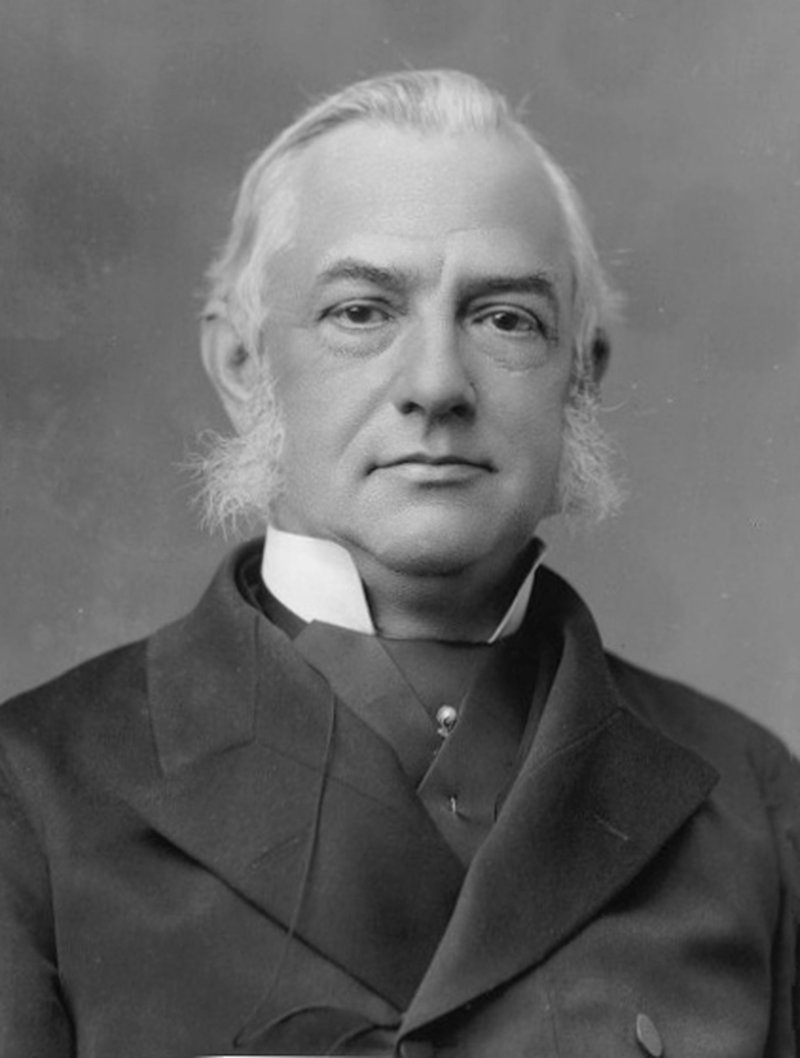
Friedrich Max Müller (1823 – 1900)

The disdain for Vedic philosophy with which German philologist Friedrich Max Müller embarked on his translation of the Vedas is apparent: “The ancient religion of India is doomed, and if Christianity does not step in, whose fault will it be?” – Priya Arora

In 1847, the British East India Company hired a philologist, Max Mueller, to translate the Vedas specifically to make the Hindu intelligentsia dismiss them as barbaric, backward and fanciful. The hope was that the changed attitude of some influential groups will soon spread throughout Indian society, liberating it from its perceived paganism.

Mueller was not a missionary but seemed to have a religious zeal. We realise this intent in his letters. He wrote to his wife: “I feel convinced, though I shall not live to see it, that this edition of mine and the translation of the Veda will hereafter tell to a great extent on the fate of India, and on the growth of millions of souls in that country. It is the root of their religion, and to show them what that root is, I feel sure, the only way of uprooting all that has sprung from it during the last 3,000 years.” (Oxford, December 9, 1867)

Along the same lines, Mueller wrote to the theologian, Chevalier Bunsen: “India is much riper for Christianity than Rome or Greece were at the time of St. Paul. The rotten tree has for some time had artificial supports. … For the good of this struggle, I should like to lay down my life, or at least to lend my hand to bring about this struggle. … I do not at all like to go to India as a missionary; that makes one dependent on the parsons. … I should like to live for ten years quite quietly and learn the language, try to make friends, and see whether I was fit to take part in a work, by means of which the old mischief of Indian priestcraft could be overthrown and the way opened for the entrance of simple Christian teaching.” (August 25, 1856)

The disdain for Vedic philosophy with which Mueller embarked on his translation of the Vedas is apparent: “The ancient religion of India is doomed, and if Christianity does not step in, whose fault will it be?” (Written to the Secretary of State for India, the Duke of Argyll, December 16, 1868)

“The worship of Shiva or Vishnu and the other popular deities, is of the same, nay, in many cases of a more degraded and savage character than the worship, of Jupiter, Apollo and Minerva; it belongs to a stratum of thought which is long buried beneath our feet, it may live on like the lion and the tiger but the mere air of free thought and civilised life will extinguish it.” (Westminster Lectures on Missions, December 1873)

Excerpts from Mueller’s letters express his opinion that the culture of the Aryans brought by earlier European conquest sorely needed replacement. In a communication to the Duke of Argyll, he wrote: “India has been conquered once, but India must be conquered again, and that second conquest should be a conquest by education. Much has been done for education of late, but if the funds were tripled and quadrupled, that would hardly be enough… A new national literature may spring up, impregnated with Western ideas, yet retaining its native spirit and character. … A new national literature will bring with it a new national life, and new moral vigour. As to religion, that will take care of itself. The missionaries have done far more than they themselves seem to be aware of.”

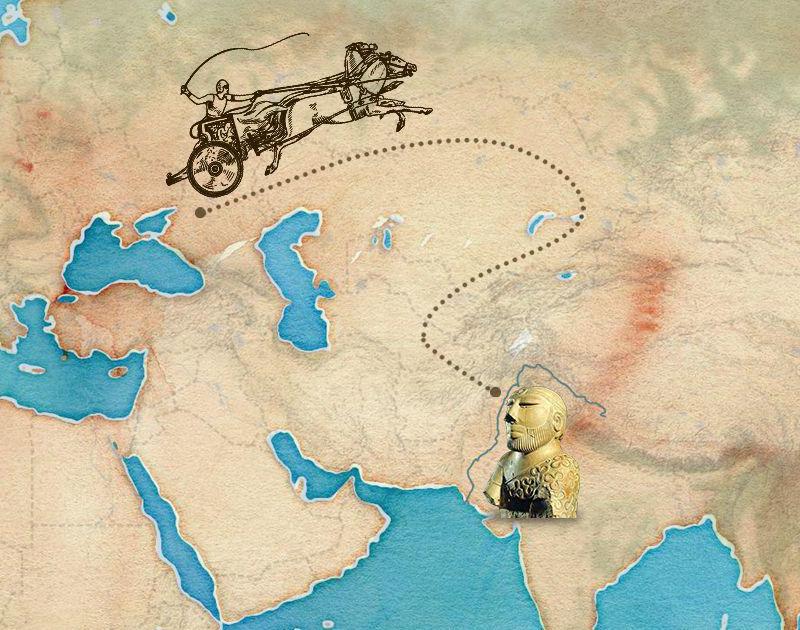
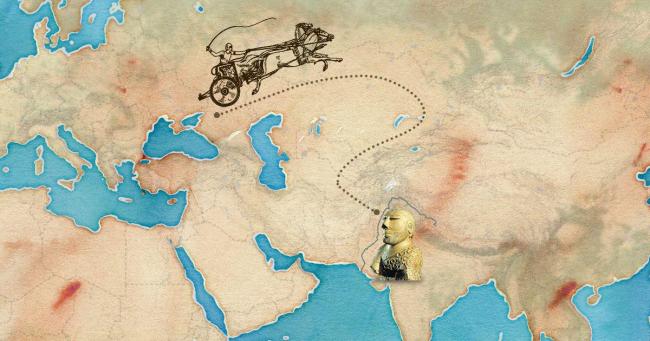
With this mindset, Mueller propounded the famous Aryan Invasion Theory (AIT) in the mid-19th century, based on two main factors: racial eminence and comparative linguistics. Alleging the Vedic people’s European origin, he claimed that a band of tall, fair-skinned nomadic pastoralists from the Russian steppes, called the Aryans, crossed the Himalayas on horse-driven chariots in 1500 BC. Being a superior race, they subjugated the unsophisticated dark-skinned aboriginals, whom they pushed south of the Vindhyas to become the Dravidians.

The colonising Aryan invaders then settled in the north and civilised the land, completely eradicating the local culture. They imposed Sanskrit and the Vedic lifestyle on the natives and were responsible for all ancient Sanskrit literature.

According to Mueller, the conquering Aryan race began composing the Vedas soon after their arrival, starting with the Rig Veda, which he dated at 1200 BC. They also formed the Vedic caste system, declaring themselves the upper-caste Brahmins and the natives the lower-caste Shudras.

This hypothesis implied that Brahmins and Shudras were of different racial ancestry, and since genetic study was unknown at the time, the supposition was accepted as fact. Then, in the 1920s, Mohenjo-Daro and Harappa, dating back to 3000 BC, were excavated.

Although the discovery of these highly advanced urban civilisations demonstrated that the indigenous people were far from unsophisticated aboriginals as previously believed, surprisingly, it did little to cast doubt on the Aryan Invasion Theory.

Instead, the narrative was neatly amended to fit the new information suggesting that the Indus Valley inhabitants, although evolved, were the peaceful dark-skinned pre-Vedic natives. They fled south when the Aryans, who had a technological edge in the form of horse-driven chariots unknown to the locals, attacked and defeated them. As a result, the prevailing culture was entirely replaced by an imported Vedic one indicating the invaders’ superiority.

The concept of Aryan supremacy fuelled white nationalism in Europe. Hitler notably adopted the false narrative of a master race, along with a distortion of the word Arya and the holiest of Vedic symbols, the swastika. Finally, in the latter part of the 20th century, when archaeological evidence proved conclusively that no invasion had occurred, the theory was modified to a peaceful migration and then further amended to a “trickling in”.

Despite the many iterations of how the Vedic culture came to India, whether by violent invasion, peaceful migration or people trickling in, the core assertion has remained that in 1500 BC, foreigners replaced the pre-Vedic local culture and language of North India with their own. The claim that the Vedic culture was imported rather than indigenous is still touted, though it is refuted by literature, archaeology and science.

Motivating factors for AIT at inception

The thought that the language of a subjugated people was the source of most European languages, including English, was abhorrent to imperialists. In his 1650 work, The Annals of the Old Testament, Archbishop James Ussher propounded that the first day of creation was October 23, 4004 BC. Most Christian scholars firmly held this belief during the colonisation of India, and the Vedic civilisation did not fit into this.

According to the biblical timeline, a highly evolved people could not have lived thousands of years before the Earth was supposed to have come into existence. Furthermore, the ecclesiastic chronology insisted that God destroyed the whole world by a flood around 2348 BC, so the Vedic civilisation posed a considerable problem.

To tie in with biblical events, Mueller fixed the anomaly by ascribing 1500 BC for the Aryan invasion when Sanskrit and the Vedic culture ostensibly came to India. The Aryan Invasion Theory was politically convenient.

It served to divide and rule, effectively controlling the natives by justifying British colonisation with an ancient precedent. The concept of invading Aryans was fed to the Indian population through the westernisation of education, beginning with Thomas Babington Macaulay’s Indian Education Act of 1835.

While the theory had apparent advantages for the ruling power, many Indians also embraced it, as it put them on the same racial footing as their rulers. The idea that foreigners displaced native Indians had far-reaching effects.

It effectively divided the nation, with north and south Indians believing they were racially, linguistically and culturally distinct from each other. The ancient varna system’s meritocracy was also replaced with birth-based caste and Brahmin eminence based on their perceived superior Caucasian ancestry. – News18, 27 September 2024

› Excerpts from Priya Arora’s book, Rama: A Man of Dharma. 

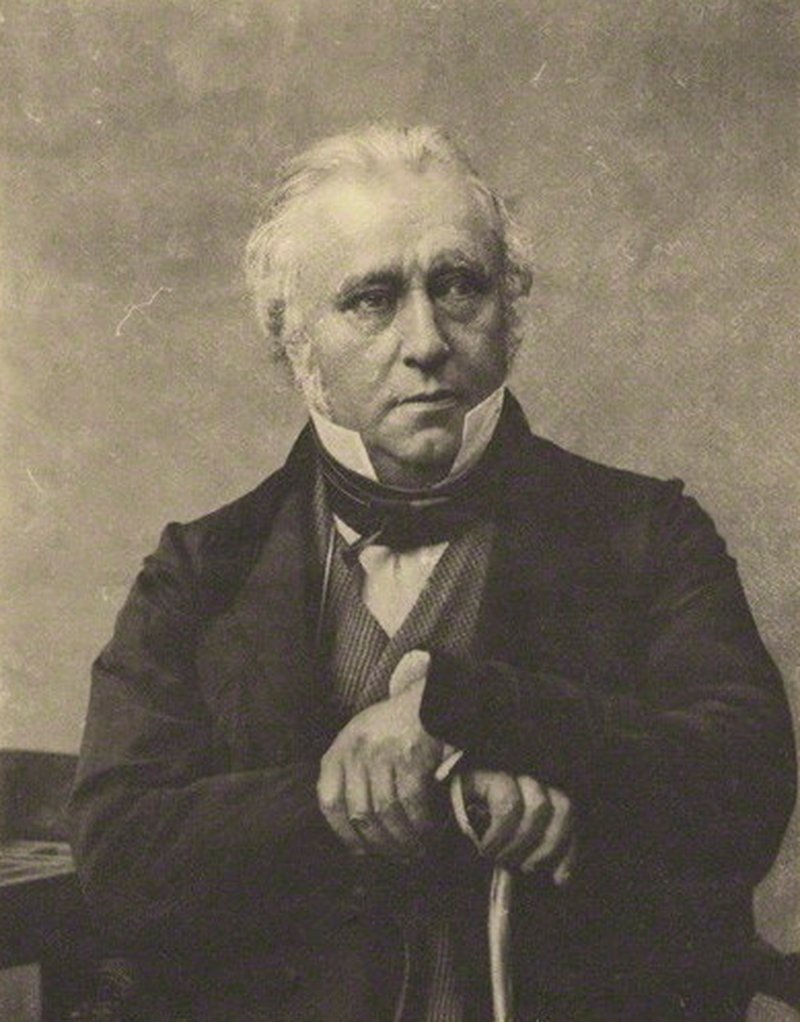
Thomas Babington Macaulay (1800 – 1859)

Democracy in ancient India – Rakesh Goyal

Ancient Indian Bazar

The Greek writer Diodorus Siculus mentions that at the time of Alexander’s invasion (326 BCE), he mostly came across cities which practiced a democratic form of government, though some were ruled by kings. – Rakesh Goyal

The Vedic Origin

Evidence of a democratic system of government in India is originally found in the Vedas. There is distinctive evidence from Rig Veda, which mentions a thriving republican form of government in India. We may quote a few beautiful slokas from Rig Veda which were to be sung in unison at the beginning of the republican assembly: 

 “We pray for a spirit of unity; may we discuss and resolve all issues amicably, may we reflect on all matters (of state) without rancor, may we distribute all resources (of the state) to all stakeholders equitably, may we accept our share with humility.”  – Rig Veda 10:191:2

However, in the absence of any corroborating material evidence because of a pre-historic nature of this source, most Western historians tend to dismiss this foundation and instead inclined to concentrate on the Buddhist period of Indian history, which they believe has more reliable sources of corroboration. Moreover, the Buddhist period was contemporary to the Greek city states and their republics, which make it easier for them to accept. A Vedic origin indicates a time period which preceded the Greek city states by a very wide margin, telling on the Western pride in Greek civilization as the fountainhead of all modern learning.

Buddhist Records

As per Buddhist texts in Pali, politics was vigorous during the Buddhist period, 600 BCE – 200 CE. During this period, India witnessed widespread urbanization, which was almost synonymous with a republican form of government. The Buddhist scriptures in Pali provide a vivid depiction of the city state of Vaishali during 5th century BCE.

As per these sources, various warrior kings often sought to exploit this amorphous structure of the society, sometimes with a measure of success. As per Buddhist literature in Pali and Brahminical literature in Sanskrit, republican system of government was almost universal.

These ancient classics offer a complex scenario to describe the different groups that managed their own affairs. Some of these groups were probably warrior formations; others were groups with avowed economic aims; some were religious fraternities. These organizations, of whatever type, were usually designated as a gana or a sangha; while less important political structures were known by such terms as shreni (guilds).

The terms gana and sangha initially meant multitude, but gradually with the passage of time, these words come to mean a self-governing multitude by 6th century BCE. In this system, all decisions were taken by the sangha members themselves, and the governing style was stabilized by convention for such groups. The strongest of these groups functioned as sovereign governments, who were generally known as “republics.”

Various sources indicate an almost universal presence of sovereign republics in India during that time. Commenting on the authenticity of these sources, the Western historians find the Greek sources as the more credible, as the texts of those writers are more familiar to the modern Western historian.

The Greek references

While describing Alexander’s campaigns in great detail, the Anabasis of contemporary Greek Historian Arrian refers to “eyewitness accounts of Alexander’s companions and describes him coming across free and independent Indian communities at every turn.” The historian further mentions that many Indian republican states controlled much larger territories and enjoyed a broader mandate at that time, as compared to the contemporary Greek city states. Some other Greek writers writing about the exploits of Alexander refer to a people who practiced a democratic form of government but were not monarchial, though their sway encompassed a large area. They maintained a large army comprising of 60,000 infantry, 500 chariots and 6,000 cavalry. This indicates that Indian republics of late 4th century BCE were much larger than the Greek city states of that time. It seems that republicanism was at that time the standard practice in the northwestern part of India. Alexander’s historians refer to a handful of kings, but they are lavish in their praise of a large number of republics; some of them are named, while some are not.

The Greek writer Diodorus Siculus mentions that at the time of Alexander’s invasion, he mostly came across cities which practiced a democratic form of government, though some were ruled by kings. This statement assumes importance as it apparently refers to a first-person account of India by the noted Greek traveler Megasthenes. It is important to note that Greek king Seleucus Nicator deputed Megasthenes as his ambassador to the court of Indian emperor Chandragupta Maurya at around 300 BCE, i.e. hardly 20 years after the invasion of Alexander. In the course of his duties, he travelled through northern India to the Mauryan capital Patliputra, where he stayed for some time. Thus, if this statement is drawn from Megasthenes, this indicates that entire northwestern India was dominated by republics at that time, signifying almost half of Indian subcontinent.

The Testimony of the Grammarian Panini

The Indian sources scrupulously support these observations. The most important indigenous sources describing north India during that time are three: The Buddhist scriptures in Pali, which describe the state of Gangetic plains during the 6th and 5th centuries BCE; Panini’s Sanskrit classic Ashtadhyayi, which discusses entire north India, focusing on the northwest during the 5th century; and Kautilya’s Arthashastra, which got shape during the 4th century BCE, i.e., almost contemporary to Megasthenes. These three indigenous sources enable us to independently identify various ganas and sanghas, some minor, while some large and powerful.

Dwelling at length on these republican polities, Panini informs us that “the states and regions (janapadas) in north India were established in his time by the conquest of a particular area by a specified invader group, which continued to hold sway on the polity of that area.” Some of these communities (in Panini’s terms janapadins) were ruled by a king, who was of one of their own kinsmen and who was dependent on their support. However, in case of many other communities, the janapadins were organized as republics. In both these kind of states, the governance was dominated by Kshatriyas, or say, the warrior caste.

The Nature of Republics

Interestingly, the term raja is used in both the instances, which obviously denotes a king in case of the monarchy, but in a republican state, it could be someone deputed to assume sovereignty.

In republican states, it might mean that political power was confined to the heads of a handful of “royal families” (rajakulas) among the ruling elite. The leaders of these family groups were sanctified as kings. On the other hand, there is evidence to suggest that in some polities, the empowered group was wider. Kautilya’s Arthashastra provides such an indication. According to this treatise, there were two kinds of janapadas, one predominantly martial, i.e. those constituted by soldiers, and the other constituted by craftsmen’s guilds, or by traders guilds and agriculturalists. The first were predominantly political entities where military might was the sole criteria to define those worthy of power; on the other hand, the second group appears to be such communities where wealth earned from trade and commerce provided the impetus to the political process.

The Republican Process

The gathering of the members of a sovereign gana or sangha worked together with each other as present day members of a legislature. Both the Brahminical and Buddhist literature provide details about the working of these ancient legislatures. Panini (5th century BCE) mentions explicit terminology as regards the process of decision-making in these polities. Panini provides various terms for voting, decision making through voting, and the requirement for a quorum. Another group of terms hints that the assemblies were divided on the basis of political parties. Panini also mentions that sometimes a smaller group of selected people within a sangha were given special functions, e.g. acting as the chief functionary or probably as a select committee for some specific purpose.

Panini also indicates that these republics functioned on an egalitarian basis during the 5th century BCE, and he mentions that “there was no consideration of high and low.” Kautilya’s Arthashastra specifies that ganas were an important factor in the polity of his time.

The Decline of Republics

It is remarkable to note that for several centuries, the avarice of monarchs, even of the greatest, impacted the sovereign republics only to a limited extent, with not much effect on the internal management of guilds, or religious sanghas, or the social life in the villages. As a matter of fact, the conquerors were hardly interested in restructuring the society, or to carve out kingdoms as we visualize them today. The kings were often satisfied with the acquiescence of their neighborhood states, whether they were republics or other kings. The defeated adversaries were often let off to look after their own realm, but were asked to pay a tribute or to provide troops in support of the conquerors’ war efforts.

It is therefore interesting to note that the existence of an aggressive warlord in the neighborhood did not pose much of a problem for the republican politics. We have to look elsewhere to search for the reasons for the gradual breakdown of sanghas. Apparently, a major stimulus came from within, as the republicans themselves gradually forsake the republican ethics by the 3rd and 4th centuries CE. In some instances, some well established republics gradually transformed and subjected themselves to hereditary chieftains. In due course, these republics transformed as monarchies.

The Disintegration

If we try to explore further into the underlying causes of the disintegration of these republics, we come across instances where members of ganas themselves sought this transformation due to various reasons. Quite frequently, the impetus to transform grew out of the ongoing frustration caused by inter-gana equations among the equal and often competing polities. It can be visualized that ganas claiming certain territory as their own were obstructed by other corporate groups. In the event of any territorial disputes, which were many, there was no arbitrating force which could sort out the tangle and reconcile the differences.

In a vast country like India and the number of equal and often competing republics many, there was apparently an inchoate wish in these circumstances to seek to identify some centralized coordinating authority, which could arbitrate in case of any inter-state conflict, even by preparing to relinquish a part of their sovereignty. Such an authority could take up the challenge of safeguarding their legitimate interests and protecting the weaker ones, by arrogating to itself imperialistic pretensions.

This was perhaps the political environment of the sub-continent, which supported the emergence of the first pan-India empire in India, in the shape and form of the redoubtable Mauryan Empire (322 BCE – 185 BCE). The stage had in any case been set by Alexander’s invasion (327-326 BCE) into the north-western flank of the country. Although Alexander decided to turn back instead of facing the mighty Magadha Empire ruled at that time by the powerful Nanda Dynasty, the writing on the wall was evident for the indigenous republicans.

The Republics Transformed

Thus, we see the republics withering away gradually. The political discourse was henceforth dominated by powerful empires. Though the ganas and sanghas continued to exist in theory, but now their sovereignty was compromised, giving way to a new social order, based on hierarchy at the cost of the former egalitarian structure of the country.

However, this spirit of republicanism continued to thrive at the grassroots at village level, which were left undisturbed to their own devices in the new political order. Likewise, the economic guilds organised on a republican pattern continued to function and to thrive even during the powerful Mauryan Empire. –  Pragyata, 3 January 2017

› Rakesh Goyal is a former state civil servant who has extensive experience of writing on subjects such as Spirituality, Hinduism, Lifestyle, Handicrafts, Travel, Yoga, Ayurveda and Vedic Astrology.

Mahajanapadas ca. 500 BCE

Aryan invasion theory and Dravidian distortions – Santishree D. Pandit

Aryan Invasion Theory (AIT)

We were civilised when Europe and the West were still picking stones. We were an outward-looking civilisation, we civilised them and not the reverse. Science and other evidence are disproving all these divisive conjectures constructed for the colonial-church-conversion project. Why are we still parroting the same? – Dr. Santishree Dhulipudi Pandit

Regardless of the domains, a theory is never considered the final word; it remains subject to criticism and debunking as they are just conjectures. The Aryan Invasion Theory is one such conjecture in history that stands out as one of the most flawed and divisive interpretations of Bharatiya civilisation and its rich history. For such reasons, the theory is increasingly treated with scepticism and disdain due to its lack of academic rigour and the ideological agenda it entailed. Moreover, other critical factors that caused the theory to lose credibility include the availability of archaeological evidence that has debunked the theory; and an increasing public interest in discovering the truth about India’s past, which has long been written by outsiders with vested interests. Unfortunately, the theory still lingers in small yet vocal circles of Left-leaning academics and intellectuals who view it as a potent tool for dividing the people based on the concept of race, caste and religion which is based on faulty assumed and prejudiced conjectures.

This theory has given rise to the faulty construct of a divide between Aryans and Dravidians by Bishop Robert Caldwell, whose purpose to convert was primary in his colonial-church agenda. What is surprising is, this false conjecture was constructed on Aryan invasions that never took place. This is the mainstay of the “distorians” of the Dravidian parties. Rationalism and atheism are anti all religions, but the hypocrisy of these parties is that many of them are faithful in Abrahamic faiths and attack only Hinduism. Hence, should one conclude that the Dravidian parties are the followers of Caldwell’s colonial-church-conversion construct and are creating Hinduphobia? Recent archaeological excavations at Rakhigarhi, Dwarka and many other places have proved by carbon dating that we are 8,000-10,000 years old. The geological theories prove the lost lands at the end of the Ice Age due to massive flooding especially in the Indian peninsula. So we were civilised when Europe and the West were still picking stones. We were an outward-looking civilisation, we civilised them and not the reverse. Science and evidence are disproving all these divisive conjectures constructed for the colonial-church-conversion project. Why are we still parroting the same?

A fallacious theory

The Aryan Invasion Theory (also referred to as the Indo-Aryan Migration Theory), often championed by Leftist historians, constitutes a part of a broader theoretical framework aimed at diminishing the historical significance of the ancient Bharatiya civilisation by attributing its establishment to an external race depicted as invaders. This theoretical perspective seeks to leverage linguistic connections among various contemporary and ancient languages, interpretations derived from philology, and findings from archaeological and anthropological research. This colonial endeavour reduced the millennia-old developments in the subcontinent to imagined notions of race that colonial powers believed in and employed during their imperial conquests. Also worth mentioning here is the pernicious Aryan-Dravidian divide that AIT encouraged and that was propagated by figures like Caldwell with his A Comparative Grammar of the Dravidian or South-Indian Family of Languages and Bishop Campbell, in the mid-19th century. This divisive narrative aimed to segregate Indian society along racial and caste lines, thus sowing seeds of divisions.

Erroneous to the core

The Aryan Invasion Theory has indeed been criticised endlessly for its flawed assumptions and ideologically driven agenda that transposed colonial ideas and racial divides onto the Indian subcontinent. Basically, the theory has been used to legitimise British colonialism in India by proposing a fallacious disposition that suggests Aryans colonised India. This narrative could arguably be seen as an effort to justify or normalise the British presence and actions in India by drawing parallels with an alleged ancient Aryan colonisation. Moreover, the theory seems to deflect colonial blame and shame from British shoulders. By suggesting that Aryans were historical colonisers, the theory sought to argue that Britain was not doing anything different from what India had seen in the past. In other words, the theory served as an attempt to diffuse the criticism of British colonialism by asserting that even Indians were guilty of colonisation and, therefore, Indians under British rule should accept British suzerainty without complaint.

In addition to the evident harm caused by such a pernicious theory, it is crucial to highlight the implicit strategies employed by the British to normalise it as the ultimate and unquestionable truth. As part of their so-called educational reforms aimed at undermining and demotivating the young populace of India, the British actively promoted the theory in schools and colleges. The relentless dissemination of the theory, without presenting credible evidence, critical viewpoints or alternative perspectives, led individuals of that time to accept it at face value. While the British, guided by their colonial interests, bear responsibility for these actions, perhaps more significant blame has to be assigned to Left intellectuals and historians who played an essential role in perpetuating this divisive narrative post-Independence.

Leftist embrace of AIT

A distorted mentality has influenced the propagation and spread of the AIT, mainly after Leftist ideologies gained prominence in India in the early 20th century and solidified under the Nehruvian government post-Independence. During this period, the AIT and the Aryan-Dravidian schism were embraced with enthusiasm by the Left, providing them with a tool to foster division, turning communities against one another and ushering in self-inflicted hate towards their own ancestors and history. As a result, a complex Indian consciousness emerged in the mid-20th century when numerous Indians began to harbour disdain for their history and origins. Essentially, these Leftist historians, wielding authoritative control over narratives, inherited and continued the interpretative legacy left by the British. Their influence further exacerbated existing divides by propagating views to keep the country divided. The authoritarian control over historical narratives allowed these scholars to shape and disseminate perspectives that reinforced divisive notions, contributing to the fragmentation of the Indian identity.

What remains most encouraging in discussions on the AIT and the Aryan-Dravidian divide is the transformed academic environment that today’s India provides, where such fallacious theories and misrepresentations are countered and debunked through facts, evidence, and logic. Recent archaeological excavations at Rakhigarhi, Dwarka and Keeladi have systematically dismantled myths surrounding these erroneous theories. In the spirit of Prime Minister Narendra Modi’s speech at the Ram Mandir Pran Pratishta (2024), where he united Indians under the roof of development and progress and urged citizens to “lay the foundation for the next thousand years of Bharat,” this foundation must be built on high intellectual traditions free of ideology, sycophancy, and falsehoods. Uprooting and debunking theories like AIT is a crucial part of this effort, and the youth must take the lead in challenging colonial-led assumptions and narratives that have beleaguered India for so long. A genuine history of the Bharatiya civilisation, rooted in truth and evidence, is the precursor for realising the vision of Viksit Bharat, which is a saga of continuity with change, realm with region, diversity and unity, tradition with modernity, balance with chaos, spiritual with the material, a holistic vision for all from the unique to the universal and the cosmos. – The Sunday Guardian, 10 March 2024

› Dr. Santishree Dhulipudi Pandit is the Vice-Chancellor of JNU.

Bishop Robert Caaldwell's statue on Marina Beach Chennai.

Soulmates: Gandhi and Kallenbach – Shimon Lev

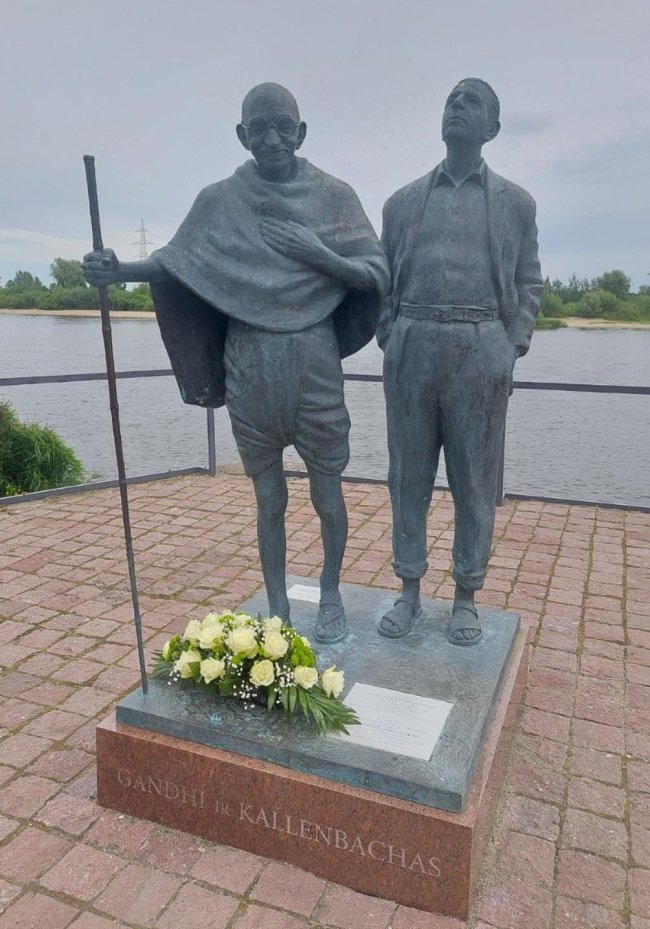
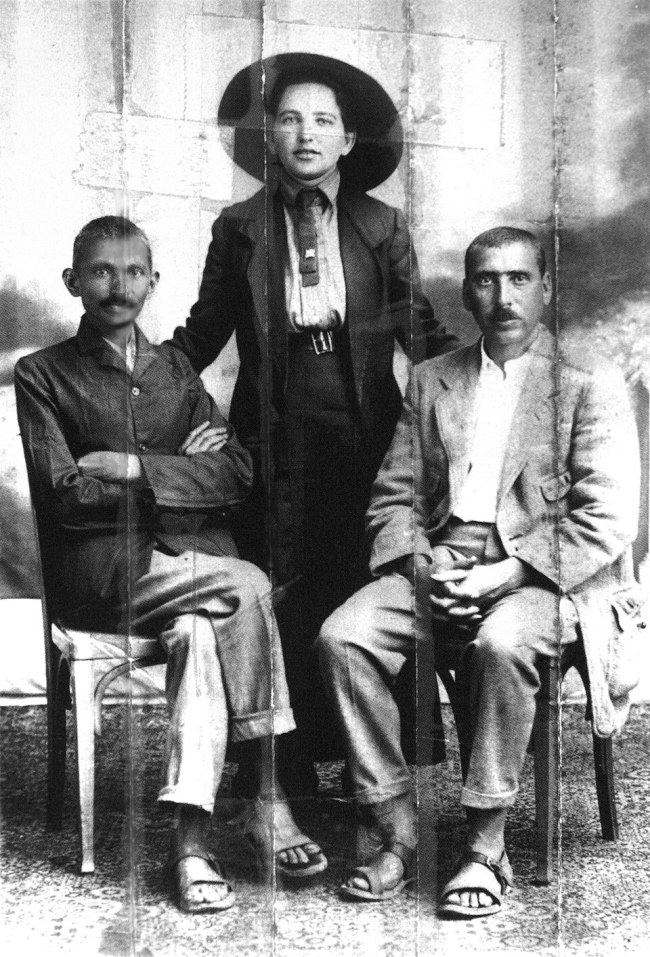
Gandhi & Kallenbach statue at Vilnius, Lithuania.

This excerpt from an article by Dr. Shimon Lev of Hadassah Academic College, Jerusalem, is based on the public lecture he delivered  on the occasion of the unveiling of the monument to Gandhi and Kallenbach in Vilnius, Lithuania, on 1 October 2015. – Admin

The story of Gandhi and Kallenbach, in my opinion, is a deeply intimate and personal story. But it also has historical and academic importance. This story is fascinating for yet another reason, as it proves and emphasizes the possibility of cross-cultural influences which can cause much greater outcomes, as was manifested in Gandhi’s impact on the world’s history.

The cross-culture aspects of this story involve Lithuania, South Africa, India and Israel. It involves a young and successful architect named Hermann Kallenbach, as well as an ambitious young Indian lawyer named Mohandas Karamchand Gandhi, who at that time was perhaps unaware he was to become the future Mahatma. Both Gandhi and Kallenbach were searching for their identities while living as unwelcome immigrants in South Africa.

But this story also involves Leo Tolstoy, the prophet of non-violence, who was among the main critics of Western civilization. It involves Hindus, Christians, Jews, Muslims, alongside with staunch Tolstoians and Theosophists as well as white racism. It also involves two ancient Asian nations on the process of a national revival, struggling for freedom in the age of the collapse of imperialism. But it also contains the most catastrophic event of the 20th century—World War II and the Holocaust. Gandhi on one hand, Hitler on the other—probably the two most famous figures of their time, but what a difference! And in-between there was Kallenbach, who was on the one hand a believer in non-violence, as a disciple of Gandhi, but on the other hand, shared the fears of the fate of his Jewish brothers in Europe, and particularly tried at the very last moment in 1939 to rescue his brother Simon Kallenbach’s family, as well as his other relatives, from the Nazi-occupied Klaipėda (Memel) in Western Lithuania.

Rarely can a historian come across such a story. But even if he does, he faces the risk of “destroying” it with the instrumentation of dry, boring academic facts and references. It is a true challenge to manage this risk, while at the same time giving due credit to the importance of this relationship in a broader historical perspective.

› Dr. Shimon Lev is an Israeli multidisciplinary artist, writer, photographer, curator and researcher in the fields of Indian Studies. He is the author of “Soulmates: The Story of Mahatma Gandhi and Hermann Kallenbach”  and teaches at the Hadassah Academic College, Jerusalem.

A reasonable date for Adi Shankara – Venu Gopal Narayanan

Adi Shankara

We see that there is nothing in Shankara’s works which contradict his dating to the 6th century BCE, nor historical evidence to either support or disprove a belief that Bimbisara, the Buddha, and Mahavira were his contemporaries. – Venu Gopal Narayanan

Historians have spent a century trying to determine when Adi Shankaracharya lived. Thus far, a total lack of archaeological evidence has frustrated their efforts. Instead, many have employed linguistic tools to assume that he lived sometime in the 8th to 9th centuries of the common era (CE).

While these arguments may appear convincing to the lay reader, they are all no more than inconclusive guesstimates; the simple truth is that we do not yet know when this remarkable mind bound our sacred land together using the logic of Advaita.

On the other hand, the Kanchi Kamakoti Peetham at Kanchipuram, in Tamil Nadu, maintains a list of head seers which says that it was founded by Shankara in 509 BCE. That is about 1500 years earlier than modern guesstimates.  The lineage list of the Govardhana Matha in Puri, Odisha, starts in 484 BCE. Similarly, the Dwaraka Matha in Saurashtra, Gujarat, maintains that it was established in 475 BCE.

The natural response for a Left Liberal thinker would be to declare a date of 6th century BCE as preposterous, and instantly dismiss it out of hand as some hoary tradition with no scientific basis. But the dharmic approach would be to test this thesis: what would be the impact on our history as we know it, if Shankara had indeed lived in the time of King Bimbisara of Magadha, Gautama the Buddha, and Mahavira the Tirthankara?

The most important test is whether such a date clashes with the dates of those texts referred to by Shankara in his works. Let us take the main ones:

One, the Brahma Sutra of Rishi Badarayana, which encapsulates the essence of the Upanishads—the concept of Brahman, and Vedanta—into dense aphorisms. Its opening line is, athato brahma jignyasa (then, therefore, the enquiry into Brahman). The basis of Shankara’s Advaita is his commentary on this work, called the Brahma Sutra Bhashya.

In the absence of any evidence, historians have dated this text with “great accuracy” to either the 5th or 2nd centuries BCE, or the 5th century CE.

Two, the Purva Mimamsa Sutra of Rishi Jaimini, who was an older contemporary of Rishi Badarayana. It aphoristically condenses the essence of the Brahmanas, Vedic texts detailing rituals and the concept of Dharma. Its opening line is, athato dharma jignyasa (then, therefore, the enquiry into Dharma). According to some legends, Shankara bested Mandana Mishra, the greatest proponent of Mimamsa, in a debate once, to establish the validity of Advaita with the ritualists.

Dating this text with any degree of assurance is an absolute non-starter because of nil epigraphical evidence till the medieval period. All we know is that it was composed in the same time period as the Brahma Sutra, since one cross-references the other.

Three, the Bhagavad Gita, and by extension, the two Epics. Shankara interpreted this celestial song using the logic of Advaita to demonstrate that it is the epitome of Vedic thought.

Once again, certain schools of historiography have gone to great pains to try and peg the Gita to a time after the Buddha, all without evidence of course. Assumptions chase conjectures through hoops of linguistics and philology to emerge as fact on the stages of academia.

There is a central reason why so much futile effort is expended: the date of the Vedas has to be held to 1500 BCE. Only then can horse-riding Aryans move from the steppes of Central Asia to the subcontinent. Only then can a yawning gap be created between the Vedic age and the supposedly earlier, supposedly different-in-every-way, Harappan/ Sindhu-Saraswati era.

Only then can Videgha Madhava of the Satapatha Brahmana carry Agni eastwards from the Saraswati River, around 1000 BCE, clear the forests along the Gandak, and settle his steppe folk in the Gangetic Plains. Now, in a tearing rush, the civilization can take root, compose the Upanishads, give birth to kingdoms, dynasties, legends, and initiate a lengthy intellectual journey which leads some millennia later to Shankara and Advaita.

However, if Shankara can be dated to the 6th century BCE, this elaborately fabricated historiography goes for a toss. Instead, and to the horror of our Marxist brethren, the date of Agni’s eastward journey gets pushed back by a thousand years at least, to well before the date they set for the Rig Veda, and bang in the middle of the Harappan era.

What Aryan invasion or migration theory then? This is what happens when our history is written for us by others, and what will persist if we allow that nefarious process to continue blithely forth without rigorous, scholarly contestation.

But mindsets are rapidly changing. The old assumptions are being hotly questioned, on merit. New data and new research show that Sanskrit is older than the Indus Valley Civilization, and, that Pali had evolved as a separate language by 4000 years ago. The discovery of the Sinauli chariot is both a new chapter of our ancient history waiting to be written, and the rewriting of conventional historiography; and one which points towards a far older date for Vidhega Madhava’s eastward passage.

Thus, we see that there is nothing in Shankara’s works which contradict his dating to the 6th century BCE, nor historical evidence to either support or disprove a belief that Bimbisara, the Buddha, and Mahavira were his contemporaries. But if this is so, then it turns some preconceived notions on their heads.

Rather than someone who contested the metaphysical intricacies of Buddhism only when it was deep into terminal decline in the subcontinent, which is how Shankara is popularly portrayed in modern scholarship, it means that he could have been there at the start, when the proliferation of heterodox sects began.

A date of 6th century BCE actually makes a lot more sense than one of 8th to 9th CE, because the motivations become a lot clearer, for bringing Brahman and Dharma—in essence, knowledge and action—together under one philosophical roof, for reinforcing the supremacy of the Vedas, and, for logically establishing with clear deductions, the umbilical Vedantic linkages between the Vedas, the Upanishads, and the Bhagavad Gita. It is all the philosophical protection Sanathana Dharma has ever needed to fend off the vagaries of history, and to preserve our way of life in our sacred land.

We may probably never know for sure which era Shankara lived in, but it feels good to imagine that a Malayalee sannyasi from Kaladi may have met and conversed with some great Biharis, in Sanskrit, in Uttar Pradesh, at a time of tremendous intellectual churn. – Swarajya, 25 February 2024

› Venu Gopal Narayanan is an independent upstream petroleum consultant who focuses on energy, geopolitics, current affairs and electoral arithmetic. 

Adi Shankara's Digvijaya Route

James Prinsep: The Englishman who mapped the Adi Vishwanath Temple in Kashi – Yudhajit Shankar Das

James Prinsep

James Prinsep first served in Calcutta and then in Benaras for ten years. Prinsep’s stay in Varanasi—from 1820 to 1830—is what is of interest and importance against the backdrop of what is unfolding today. – Yudhajit Shankar Das

At a walking distance from Kolkata’s Eden Gardens is the Prinsep Ghat on the banks of the River Hooghly. One gets a close view of the Vidyasagar Setu and can take a boat ride on the Hooghly from Prinsep Ghat.

The ghat is named after James Prinsep, a British numismatist and archaeologist, who made significant contributions to India’s historiography. He came to India when he was 28 and was the youngest fellow of the British Asiatic Society.

It was Prinsep who deciphered the Brahmi and Kharosthi scripts and helped the world know about Emperor Ashoka’s reign. It was he who established that King Devanampriya Piyadasi, who is mentioned in several inscriptions from Sri Lanka to Afghanistan, was none other than Emperor Ashoka.

The ghat in Kolkata was named after Prinsep as a way to recognise his contributions after he passed away in London in 1840 at the young age of 41.

Benares Illustrated by James Prinsep

James Prinsep and his ‘Benares Illustrated’

James Prinsep first served in Calcutta (now Kolkata) and then in Benaras (now Varanasi) for ten years. Prinsep’s stay in Varanasi (from 1820 to 1830) is what is of interest and importance against the backdrop of what is unfolding now.

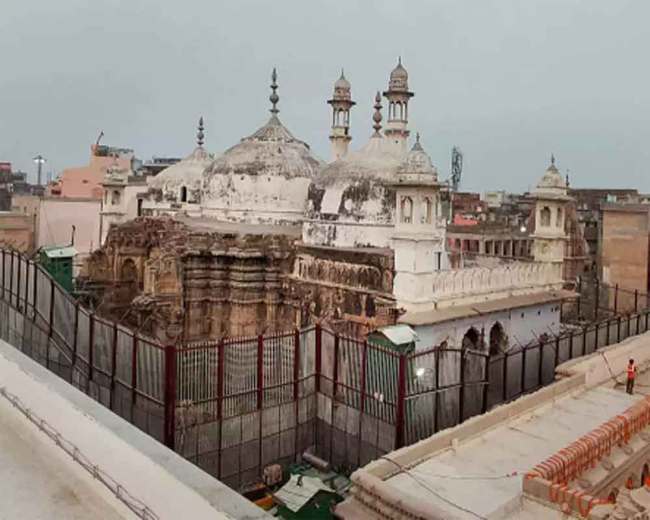
Prinsep built Varanasi’s underground sewage system, which is still operational, restored the Alamgir Mosque, built by Mughal Emperor Aurangzeb in 1669, and drew the city’s maps. He also brought out a book, Benares Illustrated, A Series of Drawings, in 1831.

That book and the map will be used as part of evidence by the Hindu side in the legal battle for the Gyanvapi complex, IndiaToday has been told.

In Benares Illustrated, James Prinsep used lithography to engrave every scene on paper and present information with evidence. Chapters and illustrations include Munikurnika Ghat, Bruhma Ghat, Procession of the Tazeeas and Hindoo Nach Girls.

Most importantly, James Prinsep, in Benares Illustrated, discussed the architecture of the old Vishweshwar Temple, and how the original place of worship was converted to the present Gyanvapi Mosque. Vishweshwar or Lord of the Universe is another name for Lord Shiva.

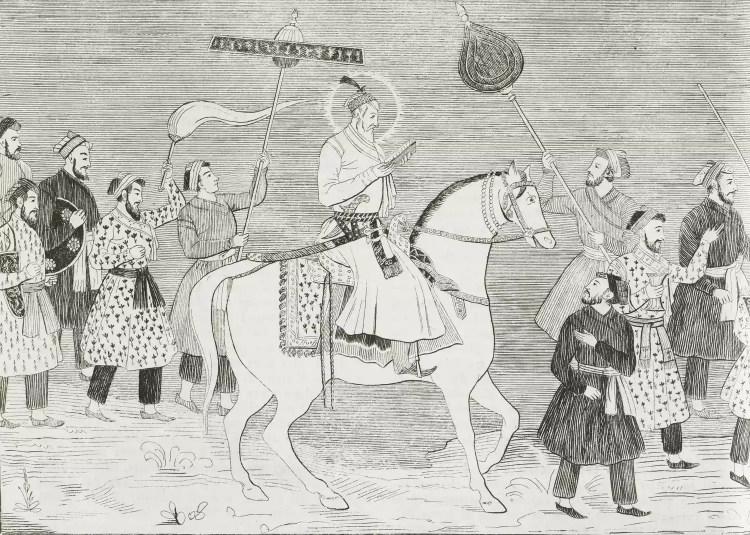
Engraving (1848) of Emperor Aurangzeb with his retenue.

Prinsep on Auranzeb’s bigotry

In Benares Illustrated, Prinsep details how Aurangzeb’s men used the material from the destroyed Kashi Vishweshwar Temple to build the Gyanvapi Mosque.

“The bigotry of Aurungzeb did not allow many vestiges of this more ancient style to remain. In 1660, for some trifling resistance to the imposition of a capitation tax, he took occasion to demolish the principal Shiwalas, and constructed Musjids or mosques with the same materials and upon the same foundations, leaving portions of the ancient walls exposed here and there, as evidence of the indignity to which the Hindoo religion had been subjected,” Princep writes.

The Kashi Vishweshwar Temple is of immense significance in Hinduism as it is one of the 12 Jyotirlingas or temples where Lord Shiva is said to have appeared as a column of light. Lord Shiva is said to have created a water-producing spot there hence the name Gyanvapi (well of knowledge).

The Adi Vishveshwara Temple was destroyed by Qutb ud-Din Aibak, the general of Muhammad Ghori, in 1194 but was rebuilt. It was Aurangzeb who razed the Kashi Vishweshwar Temple again in 1669 and built the Gyanvapi Mosque using the same foundations and materials.

It is very similar to the use of materials from the destroyed 12th-century temple that was used to build the Babri Masjid in Ayodhya. The Babri Masjid was constructed in 1528 by Babur’s commander, Mir Baqi.

Babur was the first Mughal ruler in India, while Aurangzeb was the last of that family to hold sway.

Distroyed Viswanath Temple replaced by Gyanvapi Mosque (James Princep 1834).
Plan of the ancient Kashi Vishwanath Temple. Fine dotted line in the plan image indicates the Gyanvapi Mosque build over the temple's foundation (James Prinsep 1832).

Prinsep’s 200-year-old map of Gyanvapi Temple

Prinsep then went on to reveal the old plan of the Vishweshwar Temple by drawing a map and marking on it how the Aurangzeb-built mosque stood on it.

But how could Prinsep, who came to Varanasi in the 19th century, come up with the map of the old Kashi Vishweshwar Temple, which was destroyed by Aurangzeb in the 17th Century, after a gap of about 160 years?

Prinsep explains in Benares Illustrated how he exactly managed to draw the map of the old Vishweshwar temple.

“Antiquarians will be well pleased that the Moosulmans, in their zeal for the triumph of their own religion, discovered a method of converting the original structure into a capacious Musjid, without destroying above one-half of its walls; so that not only the ground plan but the entire architectural elevation, may still be traced out,” he writes.

In the chapter “Plan of the old Vishveshwur Temple” of Benares Illustrated, Prinsep shares the map that shows that the old Kashi Visheshwar Temple had eight mandaps and the central section which Prinsep calls ‘Mahadeo’.

“The darkly shaded part shews the figure and foundations of the principal dewul: the fainter, those of the outer dewulees. The whole must have formed, when complete, a picturesque groupe of nine spires around a central pyramid. The heights diminishing from the centre towards the corners in the proportions of sixteen, eight, and six, as seen by the ground plan,” he writes.

The book and the map will be part of the evidence put forward in the Gyanvapi case, advocate Vishnu Jain, who represents the Hindu side in courts of law, confirmed to IndiaToday.

Shiva linga found in a well in Gyanvapi Mosque. According Muslims it is a wazukhana fountain (though there is no water connection and the top nozzle is added recently).

Prinsep on the ‘Lingam’ at Gyanvapi Masjid

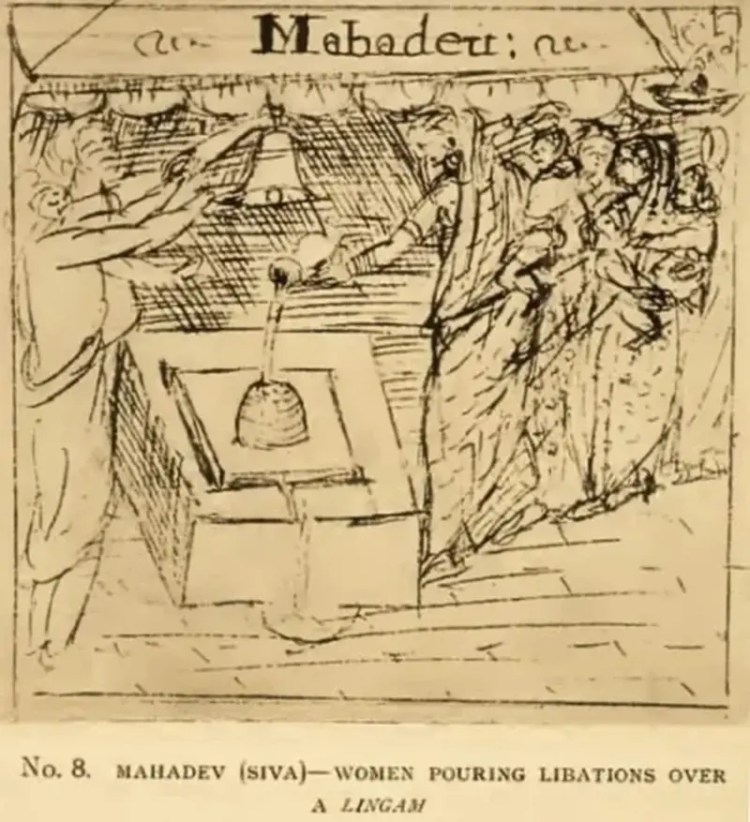
“The principal lingam of Mahadeo stood in an ornamented reservoir in the centre, having a drain below to carry off the Ganges water continually poured over it by day and night,” writes James Prinsep in his Benares Illustrated.

“Prinsep has shown the place of Vishweshwar or Mahadev in the centre of the temple and indicates that the principal lingam was located in a water reservoir and that could be the so-called fountain in the wazukhana, which could have been originally the ornamented reservoir having the lingam,” B.R. Mani, Director General of National Museum, tells IndiaToday.

Mani, who led the Allahabad High Court-ordered excavation at the then-disputed Ram Janmabhoomi-Babri Masjid site in 2003, says that more research is needed to ascertain if it is, in fact, the ‘Lingam’ that James Prinsep mentions.

The wazukhana, or the ablution area, of the Gyanvapi Mosque was sealed in 2022 following a Supreme Court order. According to the Hindu side, the fountain-like structure in the wazukhana is a Shivling or lingam.

This is what Prinsep seems to have suggested in his 1831 book.

“If you draw a graph of human genius, James Prinsep would head the list along with Leonardo da Vinci,” said O.P. Kejariwal, then Director of Nehru Memorial Library, in 2001.

The Gyanvapi site is seeing fast-paced action. A Varanasi court has allowed Hindus to perform puja in one of the cellars, Vyas ji ka Tehkhana, which was ordered sealed by former Uttar Pradesh Chief Minister Mulayam Singh in 1993.

Amid the legal battle surrounding the Gyanvapi site, James Prinsep and his Benares Illustrated, A Series of Drawings of 1831 are interesting to revisit. Both will likely play a key role in the events that follow.

As all the focus is on the Gyanvapi site, about 680 km from Varanasi, stands Prinsep Ghat in Kolkata, in the balmy breeze blowing from the Hooghly River. – IndiaToday, 7 February 2024

› Yudhajit Shankar Das is a deputy editor at IndiaToday.

Women doing abhishek to lingam in the Adi Vishwanath Temple (Peter Mindy 1632).

Why a nation and its people must know their true history – Makkhan Lal

India History Cartoon

No country can become a great nation, a world guru and a world leader on borrowed ideas, borrowed cultures and borrowed systems. The greatness and leadership is built upon the solid foundation and the pride of their own past. – Dr. Makkhan Lal

History, history writing and history teaching have, indeed, become newsworthy not only in India but also in most other parts of the world. The reasons may be varied—construction of a national history curriculum in India, England and Wales, the design of national history standards in the US, the content of history textbooks in Japan, China, Korea, Pakistan, Israel, and Germany, the approach to invasion of Latin American countries by the Europeans, the development of new curricula in the successor states of the former USSR, or even the rewriting of history textbooks in Russia after the collapse of the former USSR. Issues of identities, heritage, and citizenship, all rooted in the past, have become the hot stuff of politics.

Similarly, an issue can be raised about the conquest of peaceful people belonging to Inca, Aztec and Maya civilisations by the gun-trotting Europeans. Whether the victory should be viewed as the discovery of a new world and new economic resources for Europe, as is generally viewed by European and North American historians, or it should be seen as the destruction of the independently developed three native civilisations by technologically more advanced nations that have an unending lust for looting others’ treasures and making other people subservient.

A South American historian may well say: “It may be a subject of celebrations for Europeans but for us it is a subject of mourning because just in a few years the Europeans destroyed our civilisation developed over several thousands of years!”

Why study history

Questions have often been raised that when there are so many problems and differences of opinions among historians why should we study history at all.

History is all about the past. In almost every country, city, town and village throughout the world, a large number of existing buildings were built in the past to meet the needs and aspirations of people, now dead. This is most obvious in existing temples, churches, mosques, fireplaces, houses, public buildings, and so on. The systems of governments, political ideas, religious beliefs, art, architecture, cultural practices, educational systems, customs and behaviours are all products of the past, recent or remote.

The past is all-pervasive which, indeed, means that we cannot escape from it. The past signifies what actually happened—events that have taken place, societies that have risen and fallen, ideas and institutions, eating habits, dressing habits, etc. History is precisely the study of this human past. The past is our heritage; we are part of it and the past is part of us in all aspects: Be it culture, behaviour, religious faith and practices, be it rituals, be it the tradition of political, social and economic systems. It is reflected in our day-to-day living.

History is also about roots. It provides societies and individuals with a dimension of longitudinal meaning over time which outlives the human life span. It connects us with our past. History also allows us to peep into the future by providing precedents for contemporary actions and forewarning against the repetition of past mistakes. From its sense of continuity, history offers the apparent form and purpose to the past, the present and the future. In the words of E.H. Carr: “The past is intelligible to us only in the light of the present, and we can fully understand the present only in the light of the past.” He further says that history is needed “to enable man to understand the society of the past and to increase his mastery over the society of the present.” There is a need for history. It has a deeper social value and meaning.

The study of history is not a luxury. It is a necessity. This necessity has been best summed up by Arthur Marwick. He writes: “Individuals, communities, societies could scarcely exist if all knowledge of the past is wiped out. As memory is to the individual, so history is to the community or the society. Without memory, individuals find great difficulty in relating to others, in finding their bearings, in taking intelligent decisions—they lose their sense of identity. A society without history would be in a similar condition. … A society without knowledge of its past would be like an individual without memory. … It is only through a sense of history that communities establish their identity, orientate themselves, understand their relationship to the past and to other communities and societies. Without history (knowledge of the past), we, and our communities, would be utterly adrift on an endless and featureless sea of time.”

We all move ahead through the past of our own cultures, own civilisations, and values and it is this accumulation of ideas and experience, transmitted through education and sheer daily living that gives our thoughts meaning and the patterns and purpose of our actions. It is not that we live in the past but we are defined by it, and so the success of even the most forward-looking developments must inevitably rest on their relation to the ideas and practices of the society they are meant to serve. Science may forget its own history, but a society cannot.

History is neither a simple chronicle of the past nor a list of rulers and kings and the narratives of their rules. The past is not simply a collection of distinct ages or a hotchpotch of facts. History is an extremely complex discipline. Another point that needs to be emphasised is that a historian’s job is not that of a cook who prepares dishes as per the liking of his customers and adds spices accordingly. It is not the job of a historian to write politically correct history. His obligation is to write factually correct history.

It will be helpful if all historians remember what Sir Jadunath Sarkar wrote about the job of a historian: “I would not care whether the truth is pleasant or unpleasant, and in consonance with, or opposed to, current views. I would not mind in the least whether the truth is, or is not, a blow to the glory of my country. If necessary, I shall bear in patience the ridicule and slander of friends and society for the sake of preaching the truth. But still, I shall seek truth, understand truth, and accept the truth. This should be the firm resolve of a historian.”

This brief discussion on the nature of history as an academic discipline should make it abundantly clear that history is neither a static discipline nor can the writings on and of history be put into a set mould. Each generation views and writes about the past in the light of its own experience. Therefore, all interpretations and explanations are and must be as temporary and provisional as the descriptions. But in all these endeavours the sanctity of truth and facts should not be forgotten. Unanimity or one’s efforts to make others surrender is a recognisable characteristic of dictatorships, and not that of a free state. Open and continuing discussions and debates are the essence and strength of history and, for that matter, a great strength of an open society of an intellectually vibrant nation.

And now a word of caution! There is a tendency among historians to act as judges and give moral sermons. Historians must write and rewrite history. They are not supposed to be moral judges. Benedetto Crose has rightly said: “Those, who on the plea of narrating history, bustle about as judges, condemning here and giving absolution there, because they think that this is the office of history … are generally recognised as devoid of historical sense.”

Problems in history writing

Historians recognise that they are all culturally and socially influenced in their endeavour to write history but make all efforts to deny that their work is culturally, or socially, determined or constructed. As has been discussed briefly in the Introduction, EH Carr in chapter two of his book What is History provides a useful summary on this aspect of history writing. He quotes Donne Devotion that society and individuals are inseparable. “No man is an island, entire of itself, every man is a piece of the continent, a part of the main.” Like any other individual, a historian too is a social phenomenon, both the product and the conscious and unconscious spokesperson of the society to which he belongs. It is in this capacity that he approaches the facts of the historical past.

Therefore, we must not forget that we cannot fully understand or appreciate the work of a historian unless we have first grasped the standpoint from which he himself approaches it, and that standpoint is itself rooted in social and historical background. It is, therefore, essential that before we study history, we must study the historian and study his historical and social environment. When some historians claim that they are writing scientific history, or that only their version of history is correct, one must conclude immediately that the historians are not only being untruthful but are also hiding their political agenda under the garb of a “scientific” history. There exists nothing like scientific history. On similar lines, Benedetto Croce also spoke with his characteristic bluntness:

“The historian must have a point of view, … an intimate personal conviction regarding the conception of the facts which he has undertaken to relate. … It suffices to read any book of history to discover at once the point of view of the author if he is a historian worthy of the name and knows his own business. … Absolutely historical historians do not and cannot exist. Can it be said that Thucydidus and Polybius, Livy and Tacitus, Machiavelli and Guicciardini, Giannone and Voltaire were without morals and political views; and in our own time, Guizot or Thiers, Macaulay or Balbo, Renke or Mommson? … If the historian is to escape from this inevitable necessity of taking sides, he must become a political and scientific eunuch; and history is not the business of eunuchs. … Historians who profess to wish to interrogate the facts without adding anything of their own, are not to be believed.”

Karl Marx buried among the crosses of Highgate Cemetery, London.

The problem with Marxist historiography and its relationship with history is much more curious. For Marx and his followers, i.e. Marxist historians, the problem of history is not just understanding “what happened”, “how it happened” and “why it happened”. For them, the problem is “how to change the world” by the use of history. At the core of this view lie two fundamental beliefs. Firstly, the Marxists believe in five universal stages of history.

These five stages are:

  1. Primitive Communism
  2. Slavery
  3. Feudalism
  4. Capitalism
  5. Communism

Secondly, they believe that the society we inhabit is a bad bourgeois society and, fortunately, this society is in a state of crisis. The good society which lies just around the corner can be easily attained if only “we” work systematically to destroy the language, the value, the culture, the ideology of this “bourgeois” society. This necessitates a massive, radical left-wing political programme, and everything the historians write, every criticism they make, is determined by that overriding objective. In this, the post-modernists are exceptions. They are fully convinced of the utterly evil nature of the “bourgeois” society but have lost all hope of change and have fallen back into destructive nihilism. They assert that the only way to achieve Marxism is to destroy society if it cannot be changed.

Marxist historians have failed to understand and appreciate the fact that the society we live in has evolved through a complex historical process, very different from the Marxist formula of the rise of feudalism over slavery and bourgeoisie overthrowing the feudal aristocracy. It is highly complex with respect to the distribution of power, authority, and influence. Just as it was not formed by the simple overthrow of aristocracy by the bourgeoisie, so, in its contemporary form, it does not consist simply of a bourgeois ruling class and a proletariat. The idea that we are now in the final period of the late-capitalist crisis is simply absurd. Marxists have been looking forward to the final capitalistic collapse for over a century—in 1848, 1866, 1918, 1946, 1963 and 1968, to mention just a few dates, but as fate would have it, they are themselves doomed forever.

Statements like “The pursuit of history is, whether practitioners choose to acknowledge it or not, a political occupation,” indeed, is not only exceptional but also far-fetched. At the same time, we have to acknowledge that the experience of colonisation around the world has shown that domination by a more powerful culture—which defines its reality in quite different ways—either totally destroys, or at least drives, the less powerful ones into a subservient role. What was considered culturally “valid” can be rendered “invalid”, and the politically weaker ones are somehow required to modify their reality to fit within the constraints of the new codes.

We, as historians, must learn to recognise: “The past is perceived in different ways by different cultures. Methods of interpreting, recording, managing and protecting the past also differ between cultures. … The way people define their existence, their world view and their creation stories, and how they value, interpret, manage and transmit their past will continue to be handed on from generation to generation.”

Conclusions

Let us remember that no country can become a great nation, a world guru and a world leader on borrowed ideas, borrowed cultures and borrowed systems. The greatness and leaderships are built upon the solid foundations and the pride of the past; deeper the foundations, taller are the superstructures. Even globalisation is built upon this foundation. Many countries are part of globalisation on a much larger scale than India without abandoning their history, culture and heritage. It is on this basis they are able to assert their authority and influence the world order. – Firstpost, 6 January 2022

› Prof. Dr. Makkhan Lal is a historian and the founder director of the Delhi Institute of Heritage Research and Management.

Why ‘eminent historians’ still swear by the debunked Aryan theory – Makkhan Lal

Image depicting the imaginary Aryan invasion of India from the Caspian Sea.

“It is difficult to say that all the earliest Aryans belonged to one race, but their culture was more or less the same type. Originally the Aryans seem to have lived somewhere in the steppes stretching from Southern Russia to Central Asia. On their way to India the Aryans first appeared in Central Asia and Iran. A little earlier than 1500 BC the Aryans appeared in India.” – R.S. Sharma

“By 1500 BC when the Aryans began to arrive in India, the Harappan culture had collapsed. We do not know where they came from; perhaps they came from north-eastern Iran or the region near the Caspian Sea or Central Asia.” – Romila Thapar

The two quotations from India’s two “eminent historians” sum up their approach to the Aryan Invasion Theory. Just look at expressions “difficult to say”, “seems to have”, “somewhere in steppes”, “we do not know where they come from”, “perhaps they came from north-eastern Iran or the region near Caspian Sea or Central Asia”. Despite so many probabilities, they are certain that Aryans came from outside. When and from where? No idea!

Despite all evidence to the contrary, why does the Aryan invasion/migration theory (AIT) continue to remain the lifeline of Indian Marxist historians? Let us now look at the AIT in historical perspectives.

Linguistic Evidence

Florentine merchant, Filippo Sassetti, who lived in Goa from AD 1583 to 1588, was struck by similarities between Sanskrit and European languages, especially Latin and Greek. Later, the relationship between Sanskrit and European languages was further elaborated by William Jones and many other scholars in the service of the East India Company. The efforts made towards understanding these linguistic similarities between Sanskrit on the one hand and Greek, Latin and some other modern European languages on the other gave rise to a new discipline called ‘comparative linguistics’. Its birth had questionably motivated considerations and in the last 200 years the discipline (if at all it is a discipline) of ‘Comparative Linguistics’ has shown a far greater variety of gymnastic exercises than the sport of gymnastics itself.

Since the earliest books (i.e. the Vedas) of the Aryans and so also all human beings are written in Sanskrit, it came to be recognised as the language of the Aryans. In the beginning, all European languages, along with Sanskrit, came to be clubbed as Aryan languages, and Sanskrit got identified as not only the oldest of all but also the mother of all European languages. Lord Monboddo was convinced that “Greek was derived from Sanskrit”. Frederick Schlegel, a highly respected German linguist wrote, “The Indian language is older and others [European languages] younger and derived from it.” Thus, Sanskrit came to be recognised as the mother of “all the less ancient Indo-European languages, as well as the modern European tongues and dialects”.

But these opinions did not last very long. Local pride, racial complexes and Evangelical considerations overshadowed everything as a part of a shift from ‘Indo-mania’ to ‘Indo-phobia’.

Though William Jones could not accept the earlier view that Sanskrit is the ‘mother’ of all Aryan languages. He advocated that Sanskrit is just a ‘sister’, i.e. a co-descendant of an earlier ancestor language. Following the lead provided by Jones, F. Bopp wrote: “I do not believe that Greek, Latin and other European languages are to be considered as derived from Sanskrit. I feel rather inclined to consider them together as subsequent variations of one original tongue, which however, the Sanskrit has preserved more perfect than its kindred dialects.”

So, a search for the original homeland of a language, namely ‘Proto-Indo-European’, led different scholars to different places. This search for the imagined original language homeland also meant the search for the ‘Original Homeland of Aryans’. This also gave rise to forging labels such as the ‘Indo-Aryan’, ‘Indo-European’, ‘Aryan languages’, ‘Indo-Aryan languages’, and the ‘Indo-European languages’. Sometime around the 1820s, the word ‘Aryan’ began to be dropped and it simply became ‘Indo-European’. Some German scholars even started using the term ‘Indo-German’ on the presumption that the Sanskrit and German languages, between them, covered the entire Indo-European speaking area—the farthest language to the east being Indic and German to the west.

Sanskrit, even today, may be “the greatest language of the world” or even if it “is of a wonderful structure, more perfect than Greek, more copious than Latin and more exquisitely refined” but so what? How could a language spoken by ‘niggers’ have been once the mother of languages today spoken by Europeans, i.e. white people? This position could not be accepted even by William Jones and Max Mueller, who have been so wholesome in their praise for Sanskrit.

Sanskrit was first demoted from mother to the position of a mere sister of all the ancient and modern European languages, but later on, with further building-up of the language tree, it came to be demoted to the position of grand-daughter, when it got linked to the so-called Indo-Iranian family. Thus, the position is: Proto-Indo-European language gave birth to the Indo-Iranian, which in turn produced Sanskrit. It’s already almost 200 years and the search for the grand-mother of Sanskrit (i.e. the Proto-Indo-European) is still on. We still do not know what she (the Proto-Indo-European Language) may have looked like, of what colour she may have been, or what may have been her physical and metaphysical structure. She still remains formless even in dreams. Quite often, these practitioners of philology were so illogical, so incoherent, so absurd, so adamant and arrogant, but, indeed, their impact has been so devastating that it has aptly been termed as ‘linguistic tyranny’.

Central Place Argument and Aryan Invasion

Once Sanskrit was demoted from the honoured status of being mother to all Indo-European languages and made a mere sister or niece of the European languages, a search started for the ‘original tongue’ i.e. the ‘Proto-Indo-European’. This cleared the deck also for legitimising the Aryan invasion of India; a theory which suggested that Sanskrit was brought here from the place where this imaginary language called ‘Proto-Indo-European’ was spoken. In 1842, A.W. von Schlegel claimed: “It is completely unlikely that the migrations which had peopled such a large part of the globe would have begun at its southern extremity (i.e. India) and would have continually directed themselves from there towards the northwest. On the contrary everything compels us to believe that the colonies set out in diverging directions from a central region.”

And for Schlegel this central region consisted of the areas around the Caspian Sea.

With the increasing hold of the British on India, the colonial and the Evangelical interests soon became a force in shaping Indian history for the rest of the academic world. Following the lead provided by A.W. von Schlegel, Max Mueller reiterated his position on the issue of the Aryan invasion and said in 1887: “If an answer must be given as to the place where our Aryan ancestors dwelt before their separation … I should still say, as I said forty years ago, ‘somewhere in Central Asia’ and no more.”

However, Srinivas Ayengar wrote in 1914: “The Aryans [in their entire literature] do not refer to any foreign country as their original home, do not refer to themselves as coming from beyond India, do not name any place in India after the names of places in their original land as conquerors and colonisers do, but speak of themselves exactly as sons of the soil would do. If they had been foreign invaders, it would have been humanly impossible for all memory of such invasion to have been utterly obliterated from memory in such a short time as represents the differences between the Vedic and Avestan dialects.”

It must be reiterated that it does not refer to a single name of flora and fauna found in Central Asia, Russia and Europe. If Rig Vedic people came from Central Asia how come they have no memory of it. Historically, linguistically and as per the oral traditions it is simply impossible.

The fallacy of this central-place theory as the origin of an imaginary language and then spreading all around can be explained with a contemporary example—English. Consider a situation wherein after a couple of thousand years, people forget that England was the place where the English language developed and spread from, and start looking for the place of its origin. The Central Place Theory will exclude England in the very first instance, as it is located on the outskirts of the world of the English language. The United States of America would be the natural choice from where it spread to Europe and Asia in the east, and Australia, New Zealand, Hawaii, etc, in the west and Canada in the north.

Lexicographic Evidence

Lexicography (the vocabulary of spoken/written words) is another area which was pressed in the service. Besides collecting a large number of the common words in various languages to prove their affinity, a number of words were chosen to prove the location of the language. For example, it has been argued that since there is no common word for the ocean in the Indo-European language, we can safely conclude that the Indo-European people were not aware of the ocean.

Varadpande rightly presses the points: “If we carry this reasoning further we shall have to suppose that ‘Indo-Europeans’ were living in a region where there was no air and no water, since there are no common words for air and water in all the ‘Indo-European’ Languages.”

The whole situation is that first a conjecture is turned into a hypothesis; to be later treated as a fact to be used in support of a new theory. For instance, language like Proto-Indo-European, Proto-Indo-Iranian and Proto-Dravidian are no more than hypothetical constructions, which may or may not have really existed; and yet these modern creations are often imposed on populations that lived thousands of years ago, to prove migrations theories.

Shaffer writes: “The Indo-Aryan invasion(s) as an academic concept in 18th-19th century Europe reflected the cultural milieu of that period. Linguistic data was used to validate the concept, which in turn, was used to interpret archaeological and anthropological data. What was theory, became an unquestioned fact that was used to interpret and organise all subsequent data. It is time to end the ‘linguistic tyranny’ that has prescribed interpretative frameworks of pre-and proto-historic cultural development in South Asia.”

The question of Aryan invasion/Aryan migration vis-a-vis philology has always been questioned. In the beginning of the last century, Aurobindo, while commenting on the philology, wrote: “Comparative philology has hardly moved a step beyond its origins; all the rest has been a mass of conjectural and ingenious learning of which the brilliance is equalled only by the uncertainty and unsoundness. … The very idea of the science of language is chimera.”

It is important to point out that in the last 30 years renowned linguists like Ram Bilash Sharma, S.S. Misra, S.G. Talgeri, N.S. Rajaram and Koenraad Elst have proved, on the basis of linguistic evidence itself, that this whole theory of Aryan invasion/migration is a fallacy.

Aryans, Racialism and Rig Veda

Subjugation of India by the British filled the masters with a desire to prove their all-round superiority. Racialism was one angle of it. Writings of Grant, Mill, Marx, Macaulay and their accomplices denigrated Indian people, culture, civilisation, society, history and religion.

Trautmann has traced the emergence of racialism and the development of physical anthropology as a resolution of the inescapable philological reality with the colonial need for cultural superiority over the natives of India. One of the most striking types of evidence of such an attitude is best seen in the writings of ACL Carlleyle. In 1879 he wrote: “We, British Europeans are Aryans, and far more pure and genuine Aryans than the Hindus, and no talk of the Hindus can alter our race, or make us any less or any different from what we are. It is the Hindus who have altered and deteriorated, and not we. The Hindus have become the coffee dregs, while we have remained the cream of the Aryan race. The Hindus are like the monkey.”

Some scholars think that the linguistic affinities of Indians and Europeans were also responsible for the development of physical anthropology leading the whole debate towards racialism. Most of the European scholars could not accept the view that Indians (‘niggers’, that is how most of the time Indians have been referred to in those writings) could have been once related to them and could have, indeed, been their forefathers, a conclusion which comparative linguistics was suggesting.

Edwin Bryant expresses it in the following words: “Even during the earlier phase of the homeland quest, when India was still a popular candidate, many scholars were uncomfortable about moving the Indo-Europeans too far from their biblical origins somewhere in the Near East. There were those among the British, in particular, whose colonial sensibilities made them reluctant to acknowledge any potential cultural indebtedness to the forefathers of the rickshaw pullers of Calcutta, and who preferred to hang on to the biblical Adam far more than their European contemporaries.”

Max Mueller himself was sad to note the mood of the day: “They would not have it, they would not believe that there could be any community origin between the people of Athens and Rome, and the so-called niggers of India.”

The newly developing science of physical anthropology was pressed into service to project Aryans as tall, white-skinned, blue-eyed, with sharp and high nose, and dolichocephalic. The non-Aryans came to be identified as natives with dark skin, flat nose, short stature, and so on. The dasas mentioned in the Rigveda were made to represent non-Aryans, i.e., the indigenous local population of India. Thus, the frame of the invasion of Aryans and the subjugation of the non-Aryan local population got corroborated with the evidence from Physical Anthropology.

The racial theory had a devastating impact on European polity. Each nation/state started claiming to be the real descendent of the Aryan race and considered others as inferiors. Max Mueller tried to intervene by declaring again and again: “If I say Aryans, I mean neither blood nor bones, nor hair nor skull. … How many misunderstandings and how many controversies are due to what is deduced by arguing from language to blood-relationship or from blood-relationship to language. … An ethnologist who speaks of an Aryan race, Aryan eyes and hair, and Aryan blood is as great a sinner as a linguist who speaks of a dolichocephalic dictionary or brachycephalic grammar.”

Alas! It was too late. The djinn created by Max Mueller had now grown up and was no longer under Mueller’s command. In the twilight years of his life, Max Mueller realised the devastating impact of distortions that he had made in Indian history in order to please his employers and the newly acquired faith. He died a sad man, preaching at the end of his career things like India: What Can It Teach Us.

He described India as: “The country most richly endowed with all the wealth, power and beauty that nature can bestow, … a very paradise on earth, … [a place where] human mind has most fully developed some of its choicest gifts, has most deeply pondered on the greatest problems of life.”

Racialism and DNA Evidence

In this context it will be useful to recall the studies carried out by K.A.R. Kennedy and his colleagues. For almost five decades they carried out a detailed study of a large number of pre- and proto-historic skeletons found in excavations from a large number of archaeological sites from all over the Indian sub-continent.

On the basis of their research, Kennedy and his colleagues concluded: “As for the question of biological continuity within the Indus valley, two discontinuities appear to exist. The first occurs between 6,000 and 4,500 B.C. The second occurs at some point after 800 B.C. but before 200 B.C.”

Both discontinuities exclude any adjustment for Aryan Invasion.

Besides the studies of Kennedy and his colleagues on ancient skeletons, an important study has come out recently on modern humans. Keeping in mind the AIT, Kivishield and his colleagues carried out a detailed study on gene pools of Western Eurasians and people of the Indian subcontinent. They studied the ‘genetic inheritance aspect’ of genes through the Mitochondrial DNA Test. It may be mentioned here that the mitochondrial DNA test can reveal the whole history of genetic changes and mutations that may have taken place even in the remote past i.e. several thousand years ago.

Kivishield and his colleagues have reached the conclusion that the Mitochondrial DNA, typical of Western Eurasians, is present among Europeans up to 70 percent whereas among Indians it is only up to 5.2 percent. The DNA gene pool of Western Europeans is very different from that of Indians. It has been very clearly stated that if there was any Aryan invasion of India a few thousand years ago, it must be visible in the mitochondrial DNA tests in terms of a splash in percentage of Western Eurasian genes. But this is not so. Further, the percentage and types of Western Eurasian genes present among south Indians and north Indians are almost the same. This fact establishes that there is no difference between the south Indian and north Indian gene pools, and the same goes against the Aryan invasion theory.

Conclusions

Now over a period of 200 years, the meaning of ‘Aryans’ has been constructed and reconstructed as being nomadic, pastoralists, sedentary agriculturists, dolichocephalic, brachycephalic, blond and fair, and from brown-haired to dark-haired. The Aryan homeland has been located and relocated everywhere, virtually from the North Pole to the South Pole, and from the shores of the Atlantic to Chinese deserts—South India, North India, Central India, Tibet, Bactria, Iran, the Black Sea, the Caspian Sea, Lithuania, the Caucasus, the Urals, the Volga Mountains, South Russia, the Steppes of Central Asia, Western Asia, Palestine, Anatolia, Scandinavia, Finland, Sweden, the Baltic, western Europe, northern Europe, central Europe, and eastern Europe.

The Aryan homeland, however, still remains elusive. J.P. Mallory has put the whole thing very succinctly: “One does not ask, ‘Where is the Indo-European homeland?’ but rather ‘where they put it now?’”

Anthropologist Edmund Leach of Cambridge University has most aptly summed up the whole question of the Aryan Invasion Theory. In 1990 in his article, Aryan Invasions over Four Millennia, Leach wrote: “Why do serious scholars persist in believing in the Aryan invasion? Why is this sort of thing attractive? Who finds it attractive? Why has the development of Sanskrit come so dogmatically associated with the Aryan invasion? The details of this theory fit in with this racist framework. … The origin myth of British imperialism helped the elite administrators in the Indian Civil Service to see themselves as bringing ‘pure’ civilisation to a country in which civilisation of the most sophisticated kind was already nearly 6,000 years old. Here, I will only remark that the hold of this myth on the British middle-class imagination is so strong that even today, 44 years after the death of Hitler and 43 years after the creation of an independent India and independent Pakistan, the Aryan invasions of the second millennium BC are still treated as if they were an established fact of history. … The Aryan invasion never happened at all.” – Firstpost, 20 July 2022

›  Prof. Dr. Makkhan Lal is a well-known historian and the founder director of the Delhi Institute of Heritage Research and Management.

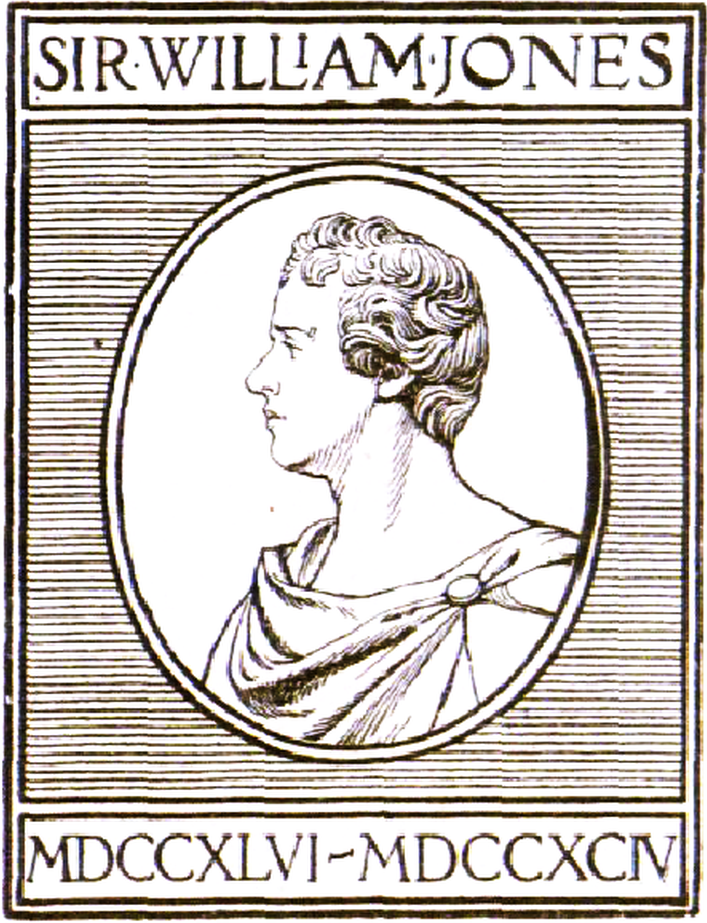
Rig Veda

Sita Ram Goel Vindicated: ‘Eminent historians’ no longer deny Islamic iconoclasm – R. Jagannathan

Sita Ram Goel

If the “eminent historians” now can acknowledge the reality of Islamic iconoclasm, surely they can promote Hindu-Muslim amity by getting Muslim groups to accept that damage was done in the past, and some remedy is called for in the present to let bygones become bygones. – R. Jagannathan

Our “eminent historians”, mostly from the Left, are showing signs that they are not beyond all education when hit repeatedly on their heads with facts and evidence. The late Sita Ram Goel, who was among the first to debunk the whitewashed versions of India’s Islamic history, stands vindicated.

Before the Babri was demolished, they repeatedly asserted that there was no temple below the mosque. Once the archaeological survey ordered by the Allahabad High Court established beyond doubt that there indeed was a temple below the Babri, their story-line changed from “no temple below the mosque”, to bland assertions that what was under the Babri was another mosque or even a Buddhist stupa. (Read some of what they said then here.)

When evidence kept surfacing of multiple temple demolitions under Islamic rule, the party line was that this was done not for religious reasons but political reasons. False equivalences were drawn between consistent and bigoted Islamic iconoclasm and the occasional damage done to temples or Buddhist and Jain places of worship. The latter were aberrations rather than the norm.

Now, with a survey seeking to establish the presence of Hindu carvings (and possibly a Shiv Linga) inside the Gyanvapi Mosque, these eminences are slowly abandoning the claim that no temples were destroyed.

In The Times of India today (24 May), there is a clear acceptance that Mughal rulers destroyed temples, though the argument has changed.

Irfan Habib, professor emeritus at the Aligarh Muslim University (AMU), is quoted thus: “Mughal emperor Aurangzeb destroyed temples in Varanasi and Mathura to raise mosques. However, the question today is whether what was done in 1670 should be repeated, despite the existence of the Indian Monuments Act. Should we do the same things as Mughal emperors did in the past?” (Read the details here.)

This is progress. Big progress. If we should not do what Aurangzeb did, it is an indirect admission that the Mughal emperor was a bigot. Facts are no longer denied, or conveniently misinterpreted as mere political acts of rulers in the past, though that is not entirely gone.

Shalin Jani of the Delhi University department of history is quoted as saying: “As far as Mughal India is concerned, we know about the politics of temple desecration during those times. We can’t resolve our contemporary problems by looking at the past.”

Well, maybe the Germans got it wrong when they refused to airbrush history or deny Hitler and the Nazi past. Without acknowledging the past, and making some amends, we cannot move forward.

The unwillingness to see religious bigotry behind temple desecration is not entirely gone, but the facts are no longer disputed.

Nadeem Rezavi, professor of mediaeval history at AMU, is clearer. “No one can justify what Aurangzeb did. However, we can’t behave like him and keep demolishing mosques to restore temples. What difference remains then between the Mughal ruler and rulers of today?”

Clearly, Audrey Truschke, who has tried to whitewash Aurangzeb’s reign in her book Aurangzeb: The Man and The Myth, clearly needs to hear what Habib and Rezavi now have to say. Aurangzeb was a bigot. Full stop. His temple desecrations were real, not just political fallout.

Clearly, the work done by Sita Ram Goel in volume two of his two-volume work on Hindu Temples: What Happened To Them  (Vol. 1 & Vol. 2), which examines both the Hindu and Muslim evidence, should now be required reading in all history departments, including AMU.

Later books by Meenakshi Jain (Rama & Ayodhya, The Battle For Rama, Flight of Deities & Rebirth of Temples, Vasudeva Krishna and Mathura, have also completely sealed the evidence in favour of the Hindu version of Islamic destruction of key temples. It is also time to revisit the older historical works of R.C. Majumdar and Sir Jadunath Sarkar and not just junk them as “communal historians”.

The only way forward from here is not to live in the past, but to acknowledge it, and negotiate a deal to hand over the Kashi and Mathura temples back to Hindus fully in return for Hindus allowing the rest of the temple desecrations to remain as acknowledged facts of history with no recompense due.

If the “eminent historians” now can acknowledge the reality of Islamic iconoclasm, surely they can promote Hindu-Muslim amity by getting Muslim groups to accept that damage was done in the past, and some remedy is called for in the present to let bygones become bygones. – Swarajya, 4 May 2022

› R. Jagannathan is a senior journalist and editor and the Editorial Director of Swarajya Magazine.

Gyanvapi Mosque back wall being the front wall of the ancient Vishwanath Temple.