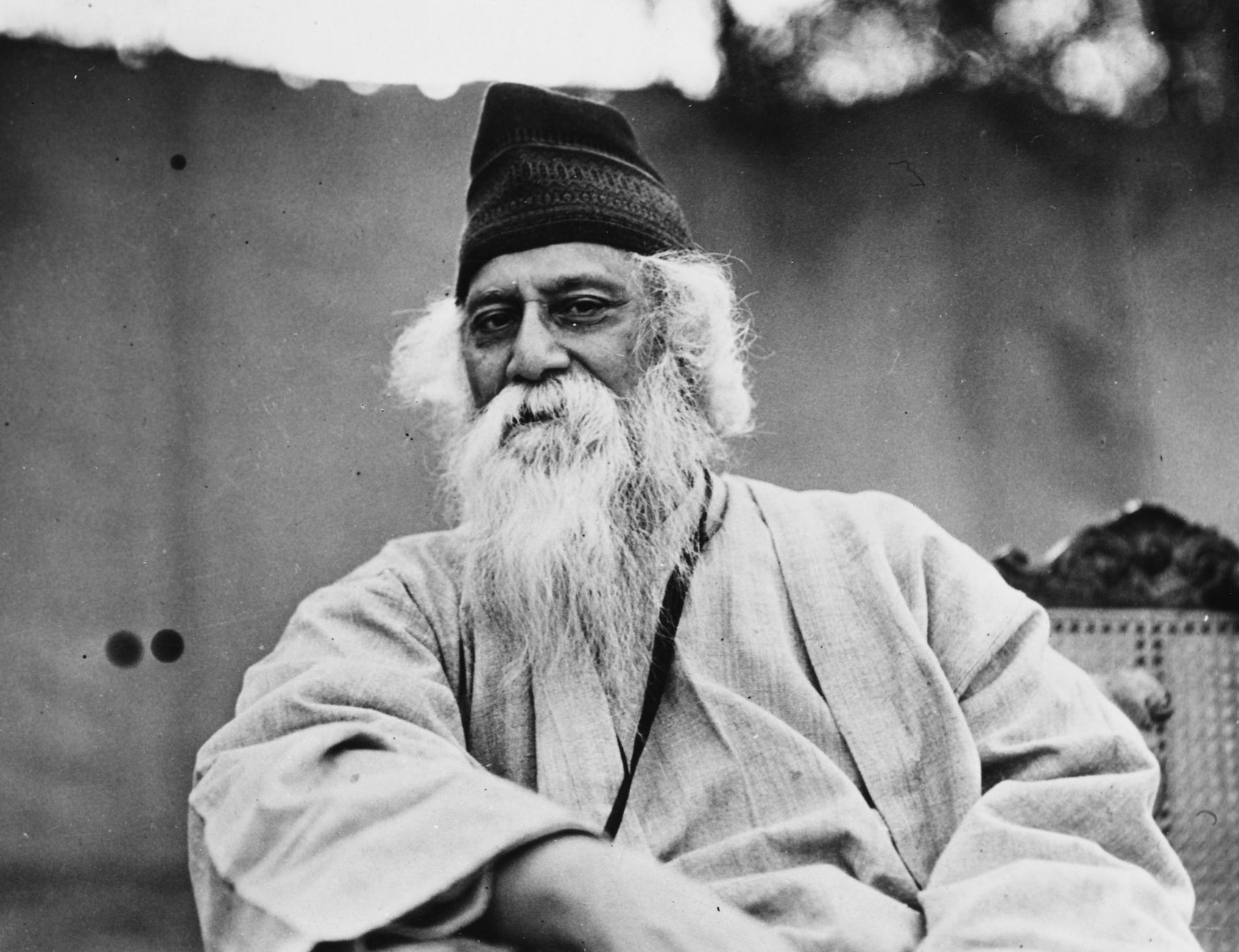
Jana Gana Mana was neither written for King George V nor sung in his honour. The misconception arose in the overlap between the Congress leadership’s eagerness to ingratiate themselves with the visiting monarch and the British propaganda apparatus, always poised to exploit an opportunity. – Samik Bhattacharya
Even today, many still fall for the British-spawned myth about Jana Gana Mana, a song that was always an ode to India’s soul. How did such a distortion come into being? It arose from the convergence of two forces: the Congress leadership’s eagerness to ingratiate themselves with the Emperor, and the calculated manoeuvring of the British propaganda apparatus. At the time, several Congress leaders wished that Rabindranath Tagore compose a song in honour of King George V, to be performed at the Congress session.
In the ceaseless churn of falsehood, even gods may fall from grace, so goes the old saying. But fewer know that, in a similar vortex of falsehood, Rabindranath Tagore himself was once cast as a “British loyalist.” The irony is that the old Congress ought to have known better, for it was their silent complicity that allowed the British press to malign Tagore so effectively. One hundred and fourteen years have passed, and yet that slander still drifts through our collective memory as a stubborn myth. Many continue to be ensnared by it; a Member of Parliament was its most recent victim. But the BJP, as a party, has never endorsed the notion that Tagore composed Jana Gana Mana Adhinayaka Jaya Hey in praise of King George V.
The year was 1911. From 26 to 28 December, the Indian National Congress held its session in Calcutta. It was there that Jana Gana Mana was first sung publicly. On the morning of 27 December, accompanied by Dinendranath Tagore’s musical arrangement and performed by a chorus of young boys and girls, the song resonated through the Congress pavilion.
It is true that King George V was visiting India at that time. But the song was neither written for him nor sung in his honour. How, then, did this misconception arise? It germinated in the overlap between the Congress leadership’s eagerness to ingratiate themselves with the monarch and the British propaganda apparatus, always poised to exploit an opportunity.
Many Congress leaders, wishing to please the Emperor, wanted Rabindranath to write a song honouring George V for the Congress session. This proposal reached Tagore through the barrister and Congress leader Ashutosh Chaudhuri. He was annoyed and indeed disappointed. He had no objection to writing a song for the Congress session, but to write one in praise of George V, he flatly refused.
And so, two songs were sung that day: in the morning, Tagore’s Jana Gana Mana Adhinayaka Jaya Hey; in the evening, Badshah Hamara, composed by Rambhaja Dutta Chowdhuri. A glance at their language makes it immediately clear which song lauded the Emperor and which did not.
Rambhaja Dutta Chowdhuri, a Congress leader from Punjab, happened to be Tagore’s nephew-in-law, married to Sarala Devi Chaudhurani. Since Tagore would not grant the request routed through Ashutosh Chaudhuri, another Congress leader within the extended family took up the task and composed a loyal hymn for the British “Badshah.”
If this is what truly occurred, how then did the contrary myth take root? It was, quite simply, a British stratagem. The morning after Jana Gana Mana was sung at the Congress session, three English newspapers—including The Statesman and The Englishman—published identical claims that Tagore had written the song in honour of King George V. All three were faithful mouthpieces of the colonial regime. Their synchronised reports forged a falsehood that, over time, solidified into “truth.” Thus, an empty fiction grew into a vast national myth, still alive in our discourse today. Even in independent India, several eminent figures repeated this error, unaware that they were only echoing a lie crafted by the British.
Tagore himself attempted more than once to correct the distortion. On 20 November 1937, in Bichitra, and again on 29 March 1939, in Purbasha, he wrote with a mixture of pain and indignation, compelled to dismantle the persistent falsehood. He confessed that he felt insulted by such wilful misinterpretation. “I did not write this song for any George the Fifth or George the Sixth,” he stated unequivocally. The song, he clarified, was dedicated to those eternal, illumined spirits who had guided India since the dawn of civilisation. Yet, despite his own testimony, the slander survived.
In the 1990s, I myself intervened to save a political colleague from repeating the same old error. I was then active in the youth wing of the party. At a national event, I heard someone invoke the fable linking Jana Gana Mana to George V’s visit to India. I corrected him on the spot. L.K. Advani was present on that very stage. Yet even today, some continue to perpetuate the mistake.
A carefully researched essay by MP Sukhendu Sekhar Roy also sets forth the true facts. The piece rests on firm documentary evidence. Another work, Jatiyo Sangeet-er Utso Sondhane, sheds further light on the matter. Anyone in doubt may consult these sources.
Let me restate the essence plainly. On the evening of 27 December 1911, Badshah Humara was sung at the Congress session in honour of King George V. But that morning, Jana Gana Mana, sung at the very same venue, had no connection whatsoever to the Emperor. Just as the “Aryan invasion theory” is an unverified myth, so too is the claim that Tagore composed his song for George V. Many remain afflicted by this myth. But as a party, we do not endorse it; it has never been our agenda.
And to those now raising a hue and cry over the personal opinion of one BJP MP, do they remember what their own party once did to Tagore after the Jallianwala Bagh massacre?
When news of the atrocity reached him, Tagore wished to travel to Punjab with Mohandas Gandhi. He sent a messenger, but Gandhi did not respond. Tagore then urged Chittaranjan Das to organise a protest meeting in Kolkata. Chittaranjan Das asked whether Tagore would preside. Tagore agreed. Later, he was asked whether he would deliver the principal address. He agreed again. Then Chittaranjan Das suggested that Tagore himself should organise the meeting. Irritated and disillusioned, Tagore ceased further communication with the Congress leaders. Instead, he renounced his knighthood, turning his protest into a thunderous moral gesture that echoed across the world. – News18, 5 December 2026
› Samik Bhattacharya is the BJP WB President and Rajya Sabha MP.


