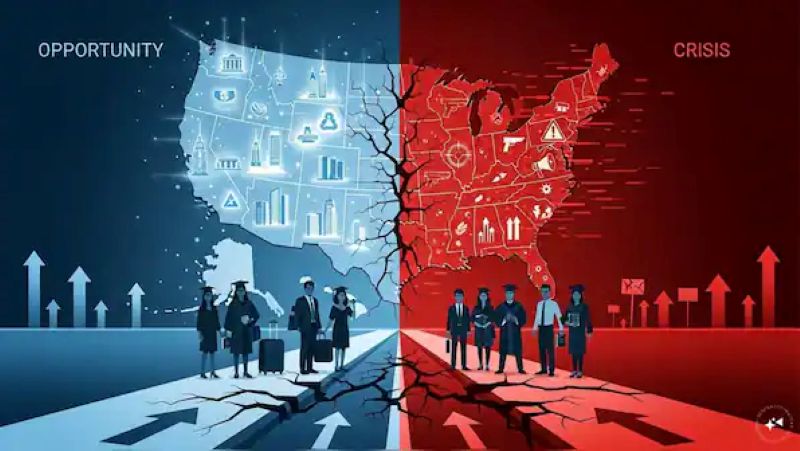
The reflexive American assumption that it sits above other societies in the hierarchy of civilisation—that it has earned the right to view the rest of the world as a collection of hellholes from which it extracts talent—is not a position sustained by evidence. It is a posture and an increasingly threadbare one. – Sanbeer Singh Ranhotra
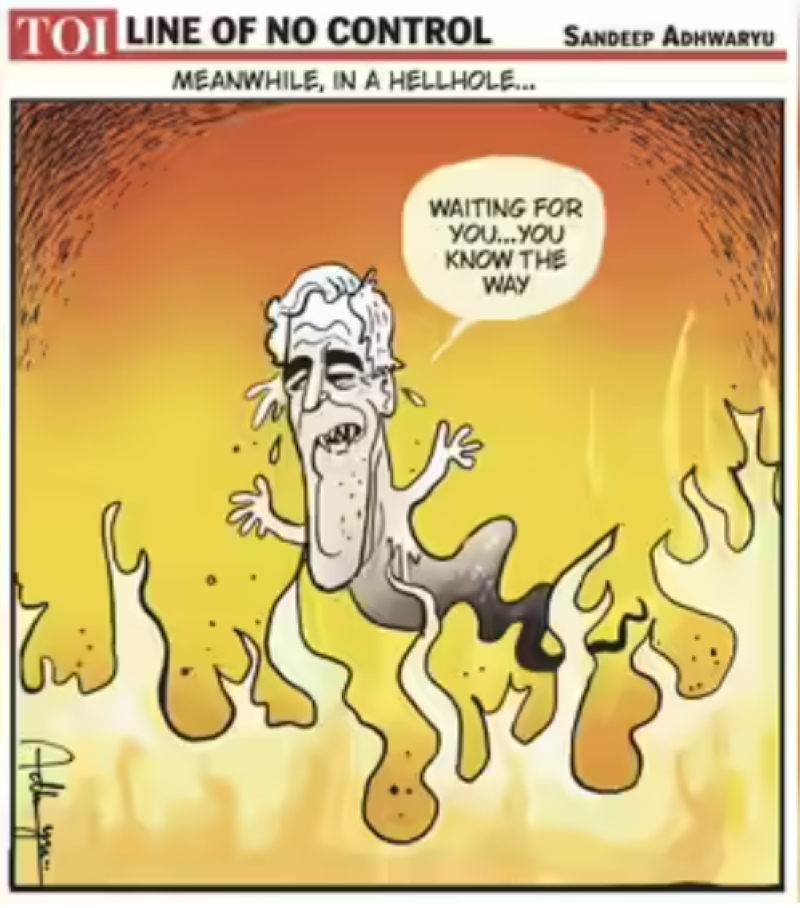
When conservative radio host Michael Savage described India and China as “hellholes” in a screed about birthright citizenship, it would have been unremarkable—the kind of fringe provocation that bounces around American conservative media most weeks. What made it different was that Donald Trump reposted it on Truth Social, without comment, for his nearly 100 million followers. India’s foreign ministry called it “uninformed, inappropriate and in poor taste”.
This is, in miniature, how the American myth corrodes. Not usually through a single outburst, but through what the powerful choose to endorse and what they choose to ignore. A country that has spent decades marketing itself as a beacon for the talented, the ambitious and the persecuted now has a president who approvingly circulates content describing two of the oldest civilisations on earth as “hellholes”—civilisations that predate the United States by several thousand years, that built universities when Europe was still in its Dark Ages, and that gave the world mathematics, philosophy, and systems of governance that America’s founders openly admired.
The Carnegie Endowment for International Peace, in a February 2026 survey of Indian Americans conducted with YouGov, found that 40 per cent—14 per cent frequently and 26 per cent occasionally—have thought about leaving the United States altogether. The most cited reason, mentioned by 58 per cent of those considering departure, was frustration with US politics. Around 54 per cent flagged rising costs of living, and 41 per cent cited safety concerns. These are not recent arrivals with shallow roots. Indian Americans number more than 5.4 million, form one of the most economically productive immigrant communities in the country’s history, and have built careers, companies and families in the US over decades. Their disillusionment, even if not all of them act on it, is worth taking seriously.
The broader pattern the survey documents is arguably more telling than the departure numbers. Nearly a third of respondents said they had stopped discussing politics on social media out of fear of discrimination. One in five reported avoiding leaving and re-entering the United States—a profound chilling effect, given that many Indian Americans on work visas depend on routine international travel. Nineteen per cent said they avoided wearing Indian dress in public. This is a community modifying its visible identity in a country that has built an entire self-image around celebrating visible diversity.
None of this emerged from nowhere. The “nation of immigrants” narrative that America exports—through its culture, its universities, and its diplomacy—has always had a fine-print clause that most immigrants discover only after arrival. The warmth was historically calibrated by origin. The Chinese Exclusion Act of 1882 explicitly barred Chinese labourers. The Immigration Act of 1924 used national origin quotas designed to limit arrivals from Southern Europe, Eastern Europe and Asia while keeping the door open for Northern Europeans. The Bracero Program brought Mexican agricultural workers in to pick American crops, then systematically deported them when the harvest was done. The pattern recurs: welcome the labour, manage the person, and expel the inconvenience.
What has changed in the current period is not the substance of this calculation but its openness. Previous administrations practised selective exclusion through bureaucratic friction—visa backlogs, H-1B uncertainty, and green card queues stretching decades for Indian nationals. The current administration is practising it more plainly. Mass deportation operations, executive orders on birthright citizenship challenged immediately in courts, and rhetoric that frames immigration primarily as a security threat and an economic displacement. The message being sent, whatever the legal outcome of any specific policy, is legible to anyone paying attention.
It is worth pausing on what the “hellhole” framing implies about America’s self-image, because the implicit comparison does not survive scrutiny. In 2024, the K-12 School Shooting Database logged 336 gun incidents on school property in the United States—roughly six or seven per week. Education Week, using the strictest definition of shootings that caused injuries or deaths during school hours, counted 39. Both figures are accurate; they measure different things. But even by the narrowest count, that is more than three incidents a month in which a child was shot at school. Firearms are the leading cause of death for American children and teenagers, ahead of car accidents and cancer—a distinction no other wealthy democracy holds. India and China have serious, well-documented problems. However, they are not countries where parents rehearse active-shooter drills with eight-year-olds before the school day begins.
The reflexive American assumption that it sits above other societies in the hierarchy of civilisation—that it has earned the right to view the rest of the world as a collection of hellholes from which it extracts talent—is not a position sustained by evidence. It is a posture and an increasingly threadbare one.
What the Carnegie survey also reveals, somewhat ironically, is the durability of American pull even under these conditions. When asked to advise a hypothetical professional considering whether to move to the US for work, 62 per cent of Indian American respondents still recommended applying for a US work visa. Dissatisfaction with American politics, in other words, has not yet translated into a wholesale rejection of American opportunity. The country’s universities, its capital markets, its infrastructure for innovation—these remain genuinely formidable. The unease is real, but it coexists with continued engagement.
That coexistence may not last indefinitely. The 40 per cent who have considered leaving skews younger and more educated. Of those contemplating departure, only a quarter named India as their likely destination—most are thinking about Canada, Australia or European countries with more stable immigration environments. This is the talent drain that American business leaders have begun to flag with some urgency to the administration, largely without visible effect. When a country tells its most productive immigrants, repeatedly and in public, that they were never fully welcome, some of them eventually believe it.
The American republic was not built on a graveyard, only metaphorically. Its founding involved the systematic displacement and erasure of Indigenous peoples and the forced labour of enslaved Africans, facts that its founding mythology has worked for two centuries to absorb, minimise or simply talk around. The immigrant narrative that replaced and overlaid that founding story was always conditional—a shifting standard applied differently depending on who was arriving and what the political economy of the moment required.
What is perhaps new now is that the conditionality is being stated so plainly, and at such volume, that it is becoming impossible to bracket as a fringe position. When a sitting president amplifies content describing India as a hellhole, the defence that he was merely reposting someone else’s words is technically true and functionally meaningless. The repost was the endorsement. And for 40 per cent of Indian Americans currently wondering whether the US still has a place for them, the distinction between authorship and amplification is not a comfort. – Firstpost, 25 April 2026
› Sanbeer Singh Ranhotra is a columnist for Firstpost, with an interest in world politics and South Asia.
 VOICE OF INDIA