Maritime trade is severely disturbed today, and it is increasingly a disaster for innocent bystanders bereft of oil and gas. And it is increasingly the Indian Ocean that matters: specifically the sea lanes from Hormuz to Malacca, which handle a significant portion of both oil/gas trade and goods trade globally.
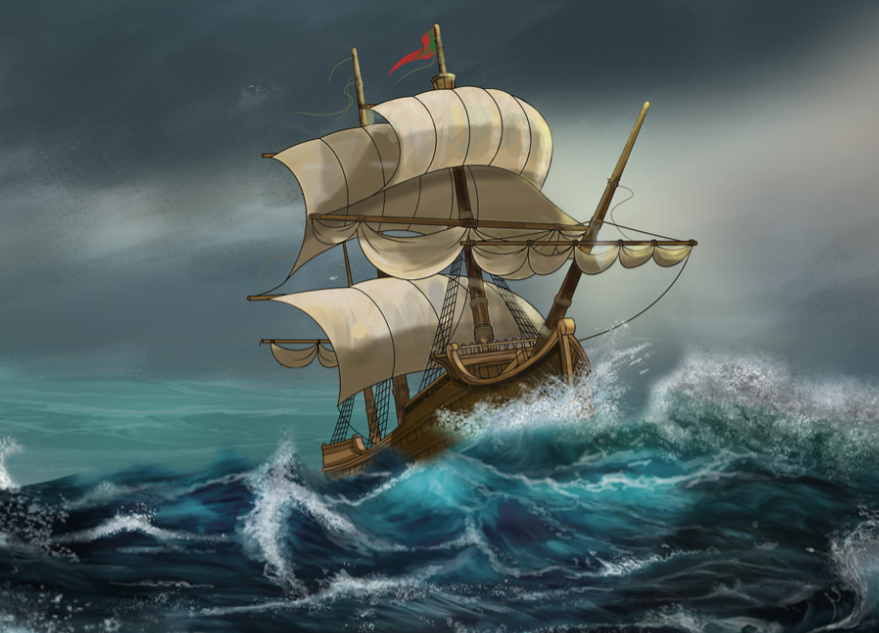
In 1025 CE, exactly 1,001 years ago, Emperor Rajendra Chola sent an armada (probably the largest fleet in history before the advent of steam) 4,000 kilometres clear across the Indian Ocean. It was on a mission strangely familiar to us in 2026: open up a critical strait that was being choked by a littoral state. The thalassocratic Srivijaya Empire of Sumatra was closing the strait and imposing tolls, as well as winking at a little piracy.
The strait in question then was Malacca. The Chola goal: to reopen Indian trade with Southeast Asia and China. Remarkably, the Cholas were not interested in territorial conquest, only in freedom of navigation.
It is ironic that today, it is again a question of free trade, that shibboleth that has been waved about for decades (although that was a euphemism for “managed trade that benefits the West”).
The difference between then and now? The salient fact is that Rajendra Chola was able to open Malacca with his wooden ships. With all his aircraft carriers and F-35s and missiles, President Trump is unable to open Hormuz. This must mean something, although reasonable people may differ on what that is. My claim is that it means India has the opportunity, in fact the need, to step into the breach.
Maritime trade is severely disturbed today, and it is increasingly a disaster for innocent bystanders bereft of oil and gas. And it is increasingly the Indian Ocean that matters: specifically the sea lanes from Hormuz to Malacca, which handle a significant portion of both oil/gas trade and goods trade globally.
Geopolitics and Geoeconomics
It is a reasonable conjecture that the locus of power has shifted over the centuries: in the 19th century, the Atlantic was supreme; in the 20th century, the Pacific; and in the 21st century, the most important ocean is the Indian Ocean. Asia has returned to the centre stage. In support of this assertion, see how the economic centre of gravity of the world has returned to the vicinity of India, after the European colonial interlude.
It is, therefore, appropriate to ask what it would take for India to regain its former keystone role in the Indian Ocean. Of course, geography offers it to the country on a platter. From both Alfred Thayer Mahan’s theory of naval power, and from Nicholas Spykman’s Rimland theory, India could, or should, be the dominant power in the region: it is almost literally India’s ocean.
Mahan’s ideas, updated for today, suggest that a strong navy should protect a large merchant marine fleet, manage trade, and control choke points. The preferred hardware may have changed from battleships to aircraft carriers and especially nuclear submarines these days, but the basic idea remains: speak softly but carry a big stick with a force-projection navy.
Spykman’s Rimland theory seems more appropriate in current circumstances than the Heartland theory popularised by Halford MacKinder. The Eurasian landmass may well be subject to control by a coastal hegemon or an alliance that controls the sea lanes and choke points. Despite pipelines and rail-borne containers, maritime trade still dominates.
Spice Route versus Silk Road
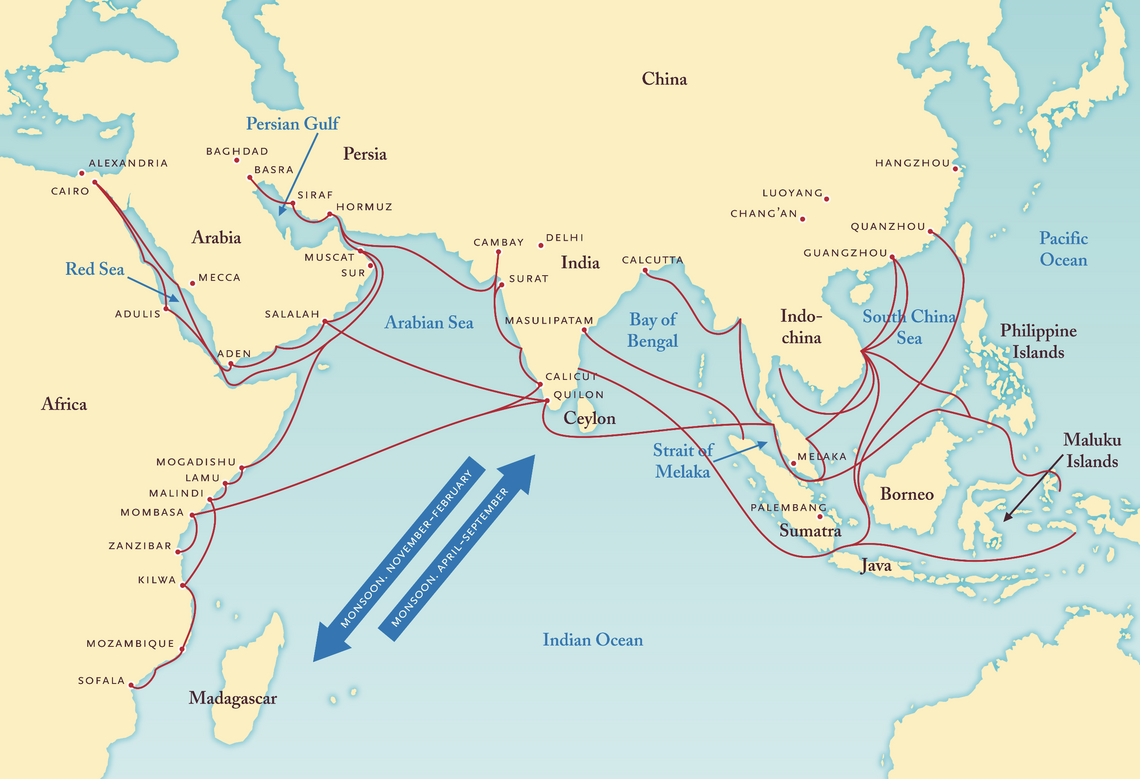
A stark reminder of this is the comparison between the fabled ‘Silk Road’ and the ancient ‘Spice Route’. Despite all the breathless propaganda about the Silk Road, it is abundantly clear that sea-borne trade was an order of magnitude greater, because a caravan of 500 camels, braving deserts, robbers and so on across Central Asia couldn’t possibly carry more than 100 tonnes of goods; whereas an ocean-going stitched teak ship, like a single uru from Beypore, Kerala, could easily carry 400 tonnes. And the monsoon winds provided predictable, seasonal propulsion.
India’s prowess was built on the monsoons. By mastering the seasonal winds, Indian mariners turned the ocean into a highway. This made India the supreme trading power. Merchants from Rome and Egypt traded with Chinese and Southeast Asian counterparts on the Malabar and Coromandel coasts, leaving behind troves of coins as evidence.
The Switch
The remarkable thing is that these merchants did not even need to meet each other physically, because India provided the “multi-protocol switch”: translating their diverse needs and offering the conveniences of an entrepot, while also producing coveted, high-value products such as black pepper. For example, a Greek buyer could buy something from a Chinese seller, and settle the transaction using Indian credit.
And how did India do it? By providing the “switching fabric”, such as the ports, the credit systems, and the security, that allowed these disparate worlds to exchange products and wealth without ever meeting.
This is much like what a network gateway such as TIBCO does for packets of different kinds of data (in passing, how appropriate that TIBCO was founded by an Indian-American, Vivek Ranadive!). Hardware switches, e.g. from Cisco Systems, have been around for a while, but TIBCO abstracted that functionality in software to connect those with different protocols.
India already has many of the ingredients of the switching fabric in the India Stack. Using protocols like UPI, e-KYC, Account Aggregation, Central Bank Digital Currency, and ONDC, especially along with distributed-ledger blockchain-based smart contracts, it should be possible to provide end-to-end transparent and reliable multi-party trade support which complements the SWIFT payment system. Complement, not necessarily replace.
The same pattern held with India’s age-old trade system. The ports were on the Malabar Coast, such as Muziris; on the Coromandel Coast, such as Arikkamedu; and on the Konkan Coast, such as Bharuchcha. The credit systems were run by temples which acted as both bankers and venture capitalists for the trading guilds. The security: well, that’s what Rajendra Chola demonstrated in 1025 CE.
Alas, medieval India lost its maritime focus. So did China. Both became insular, and were overwhelmed by invaders, including Turks and Europeans. In India’s case, the Turkish invaders were land-focused powers; although there were isolated maritime attempts (e.g. the Maratha Navy, Travancore defeating the Dutch in an amphibious battle at Colachel in 1741, etc.)
Now, however, there are new ports. The most interesting of them is the Port of Trivandrum (Vizhinjam). This deep-water container transhipment port is only 10 nautical miles away from the Hormuz-Malacca sea lanes, and now when Dubai is closed, it reportedly has a backlog of 100 container ships waiting to be berthed. Then there is the upcoming Vadhavan container port in Maharashtra, and the Galathea Bay container port in Great Nicobar, which overlooks the mouth of Malacca.
Pax Indica today
The modern idea of Pax Indica borrows from both perspectives: hard power and a switch. An Internet search brings up the fact that it was my friend Bapa Rao and I who first started talking about it in terms of India being the benevolent hegemon in the Indian Ocean, way back in the 1990s.
Later, Shashi Tharoor wrote in his 2011 book Pax Indica that it could be “a peace system based on cooperation, stability, and rule-based order in Asia and beyond, in which rising India helps shape the rules of the road rather than impose its will through hegemony.” That is, along roughly the same lines as the “multi-protocol switch” or entrepot concept.
Pax Indica is not an empire; it is an ecosystem. There are three aspects: military power, the full exploration of the multiprotocol switch, and the port-led development policy. Bapa Rao and I will consider these in a future article. Briefly, though, here is what these entail.
1. Project Power: Use a 3-carrier, 18-24-submarine navy to ensure no single power can close the ocean’s gates.
2. Enable Trade: Use the Digital India Stack to act as the “Multi-Protocol Switch” for a fragmented world, plus super-ports like Vizhinjam (Trivandrum).
3. Secure the Choke Points: Be ready, like the Cholas, to act decisively when a “Srivijaya-style” blockade threatens the common good.
Hard power needs to come through the acquisition of a blue-water navy: at least three aircraft carrier groups, one for the Arabian Sea (Hormuz), one for the Bay of Bengal (Malacca), and one in maintenance, refit and upgrades.
Even though drones and missiles have rendered them less dominant than in earlier times, carrier groups are still important for air superiority and power projection. But an ever more critical factor is “area denial” by nuclear attack submarines (SSBNs) that can launch second-strike nuclear missiles as part of the “triad”, of which India should have at least three to four. In addition, there should be at least a dozen silent AIP-equipped diesel-electrics for securing straits, and at least 6-12 SSNs (possibly leased) to enhance blue-water reach.
“The IOR must become an Indian lake,” said General Raj Shukla on ‘X’. I agree: Not as a territory of conquest, but as a sanctuary of trade, where India sits at the centre, as the protocol provider that makes world trade work again, as in millennia past. – Firstpost, 29 April 2026
› Rajeev Srinivasan writes on strategy and innovation. He has worked at Bell Labs and in Silicon Valley, and has taught innovation at several IIMs.
 VOICE OF INDIA