Trump’s endgame is surrender – Robert Kagan

Donald Trump

Trump no doubt hopes that he can slip away without Americans noticing the magnitude of this defeat. … The President may also hope that he can change the subject by launching another military operation, this time against the government in Cuba. And the news media have indeed begun writing more about Cuba than about the unfolding disaster in Iran. – Robert Kagan

The outlines of President Trump’s endgame in the Iran war are now emerging. In a phone call with Israeli Prime Minister Benjamin Netanyahu yesterday, Trump reportedly explained that the United States was negotiating a “letter of intent” with Iran that would “formally end the war and launch a 30-day period of negotiations” on Iran’s nuclear program and the reopening of the Strait of Hormuz. The purpose and effect of such an agreement should be clear: The United States is walking away from the crisis. Trump may launch another limited strike to look tough and satisfy the demands of the war’s supporters, but it would be a performative gesture. Endgame in this case is a euphemism for “surrender.”

Trump has blinked many times in the confrontation with Iran—ever since March 18, when Israel attacked the Pars gas field and Iran retaliated with a strike against Qatar’s most important natural-gas-production facility. Trump then called for a halt on U.S. and Israeli targeting of Iran’s energy infrastructure, and the war effectively ended.

Trump’s repeated threats to resume attacks since then have proved to be bluffs. The leaders in Tehran have been calculating for two months that Trump would not launch another attack, and for this reason they have made no concessions despite the damage they suffered from 37 days of relentless strikes. On the contrary, their terms for a settlement are those of a victor: They demand war reparations, no limits on uranium enrichment, recognized control of the strait, and an end to sanctions.

For Trump to respond to this defiance by now calling for another 30 days of cease-fire and talks is a tacit admission of defeat. If he does launch a performative attack in the next few days, the Iranians will understand it for what it is. No one believes that he is going to resume a full-scale war a month from now. Among other reasons, with 30 more days to heal, rearm, and fill its coffers with tolls, Iran will be a more formidable adversary.

In 30 days, moreover, the new Iranian strait regime may already be firmly in place. As the Institute for the Study of War reports, Iran has been using the cease-fire period to “normalize” its control over the strait by “compelling oil-importing countries” to establish transit agreements with Tehran and charging fees on vessels from nations without such deals. According to Iranian officials, the new strait regime will give Iran’s strategic partners, such as Russia and China, priority and allow nations friendly to Iran, such as India and Pakistan, to negotiate their own transit agreements. Vessels associated with nations that Iran regards as an adversary will be denied access to the strait entirely.

Several nations, including South Korea, Turkey, and Iraq, are reportedly already negotiating at least temporary transit agreements. Now that Trump has made clear he has no intention of fighting to reopen the strait, the stampede to get good terms with Tehran will begin. All nations heavily dependent on energy from the Persian Gulf will want to cut their deal quickly to get the oil and gas and other commodities flowing and rescue their battered economy. Those nations currently allied with the United States and friendly to Israel will feel pressure to distance themselves and make their peace with Iran. The international sanctions against Iran will collapse, and even more money will pour into the country’s accounts as its newly central role in the global economy becomes normalized. By the end of 30 days, most of the world will have a stake in the new arrangement and will oppose any resumption of hostilities, even in the unlikely event that Trump wanted to go back to war.

Trump no doubt hopes that he can slip away without Americans noticing the magnitude of this defeat. The financial markets may stabilize if it is clear that oil will eventually start flowing again through a reopened strait, even if under the new Iran-controlled system. A major strategic setback for the United States need not affect Wall Street. The president may also hope that he can change the subject by launching another military operation, this time against the government in Cuba. And the news media have indeed begun writing more about Cuba than about the unfolding disaster in Iran.

According to one U.S. official, Netanyahu’s “hair was on fire” after the call with Trump—for good reason. The Iran war may end up as the single most devastating blow to Israel’s security in its brief history. On the present trajectory, Iran will emerge from the conflict many times stronger and more influential than it was before the war. It will exercise leverage with dozens of the richest nations in the world, all of which will have an acute interest in keeping Iran happy. They will be unlikely to take Israel’s side in any conflict that it has with Tehran or with its proxies in Lebanon and Gaza, because Iran will have the means to punish them if they do. Israel will emerge more isolated than it has been at any time in its history—and not least from its only reliable protector, the United States. When Trump turns his back on Israel, as he must do to implement this policy, MAGA will gladly follow. The bipartisan anti-Israel consensus in the United States will grow and harden.

Will Israel go gentle into this good night? That is the wild card that may disrupt the financial markets’ dreams of a new stability in the Gulf. A stronger, richer, more influential Iran will mean new life for Hamas and Hezbollah. It will mean the end of the Abraham Accords, as the Gulf States will have to make their own peace with Tehran so that their economies can survive. Trump says that Netanyahu “will do whatever I want him to do.” But can Israel stand by while Iran replaces the United States as the arbiter of power in the region?

Most likely, the new normal in the Persian Gulf will be chronic instability and frequent disruptions in shipping. That’s what happens when the hegemon cedes hegemony. – The Atlantic, 21 May 2026

Robert Kagan is an author, a contributing writer for The Atlantic, and a senior fellow at the Brookings Institution.
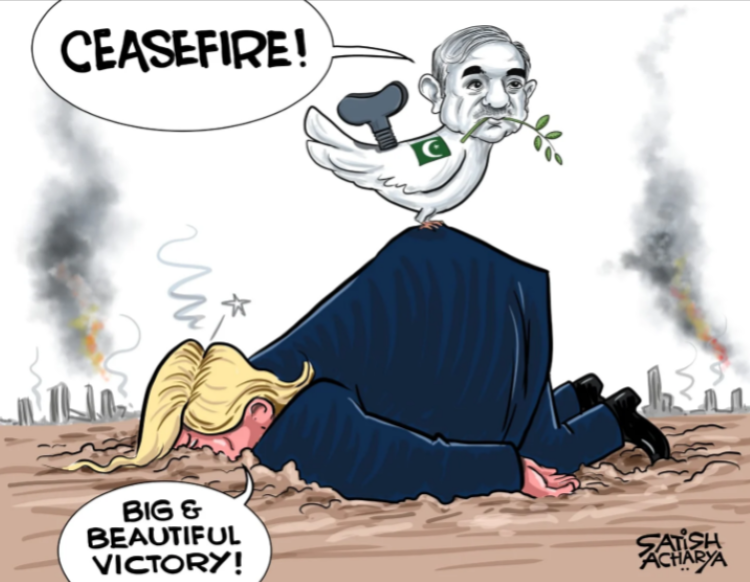
Trump Cartoon


The need for Pax Indica – Rajeev Srinivasan

Chola Ship

Maritime trade is severely disturbed today, and it is increasingly a disaster for innocent bystanders bereft of oil and gas. And it is increasingly the Indian Ocean that matters: specifically the sea lanes from Hormuz to Malacca, which handle a significant portion of both oil/gas trade and goods trade globally.

In 1025 CE, exactly 1,001 years ago, Emperor Rajendra Chola sent an armada (probably the largest fleet in history before the advent of steam) 4,000 kilometres clear across the Indian Ocean. It was on a mission strangely familiar to us in 2026: open up a critical strait that was being choked by a littoral state. The thalassocratic Srivijaya Empire of Sumatra was closing the strait and imposing tolls, as well as winking at a little piracy.

The strait in question then was Malacca. The Chola goal: to reopen Indian trade with Southeast Asia and China. Remarkably, the Cholas were not interested in territorial conquest, only in freedom of navigation.

It is ironic that today, it is again a question of free trade, that shibboleth that has been waved about for decades (although that was a euphemism for “managed trade that benefits the West”).

The difference between then and now? The salient fact is that Rajendra Chola was able to open Malacca with his wooden ships. With all his aircraft carriers and F-35s and missiles, President Trump is unable to open Hormuz. This must mean something, although reasonable people may differ on what that is. My claim is that it means India has the opportunity, in fact the need, to step into the breach.

Maritime trade is severely disturbed today, and it is increasingly a disaster for innocent bystanders bereft of oil and gas. And it is increasingly the Indian Ocean that matters: specifically the sea lanes from Hormuz to Malacca, which handle a significant portion of both oil/gas trade and goods trade globally.

Geopolitics and Geoeconomics

It is a reasonable conjecture that the locus of power has shifted over the centuries: in the 19th century, the Atlantic was supreme; in the 20th century, the Pacific; and in the 21st century, the most important ocean is the Indian Ocean. Asia has returned to the centre stage. In support of this assertion, see how the economic centre of gravity of the world has returned to the vicinity of India, after the European colonial interlude.

It is, therefore, appropriate to ask what it would take for India to regain its former keystone role in the Indian Ocean. Of course, geography offers it to the country on a platter. From both Alfred Thayer Mahan’s theory of naval power, and from Nicholas Spykman’s Rimland theory, India could, or should, be the dominant power in the region: it is almost literally India’s ocean.

Mahan’s ideas, updated for today, suggest that a strong navy should protect a large merchant marine fleet, manage trade, and control choke points. The preferred hardware may have changed from battleships to aircraft carriers and especially nuclear submarines these days, but the basic idea remains: speak softly but carry a big stick with a force-projection navy.

Spykman’s Rimland theory seems more appropriate in current circumstances than the Heartland theory popularised by Halford MacKinder. The Eurasian landmass may well be subject to control by a coastal hegemon or an alliance that controls the sea lanes and choke points. Despite pipelines and rail-borne containers, maritime trade still dominates.

Spice Route versus Silk Road

A stark reminder of this is the comparison between the fabled ‘Silk Road’ and the ancient ‘Spice Route’. Despite all the breathless propaganda about the Silk Road, it is abundantly clear that sea-borne trade was an order of magnitude greater, because a caravan of 500 camels, braving deserts, robbers and so on across Central Asia couldn’t possibly carry more than 100 tonnes of goods; whereas an ocean-going stitched teak ship, like a single uru from Beypore, Kerala, could easily carry 400 tonnes. And the monsoon winds provided predictable, seasonal propulsion.

India’s prowess was built on the monsoons. By mastering the seasonal winds, Indian mariners turned the ocean into a highway. This made India the supreme trading power. Merchants from Rome and Egypt traded with Chinese and Southeast Asian counterparts on the Malabar and Coromandel coasts, leaving behind troves of coins as evidence.

The Switch

The remarkable thing is that these merchants did not even need to meet each other physically, because India provided the “multi-protocol switch”: translating their diverse needs and offering the conveniences of an entrepot, while also producing coveted, high-value products such as black pepper. For example, a Greek buyer could buy something from a Chinese seller, and settle the transaction using Indian credit.

And how did India do it? By providing the “switching fabric”, such as the ports, the credit systems, and the security, that allowed these disparate worlds to exchange products and wealth without ever meeting.

This is much like what a network gateway such as TIBCO does for packets of different kinds of data (in passing, how appropriate that TIBCO was founded by an Indian-American, Vivek Ranadive!). Hardware switches, e.g. from Cisco Systems, have been around for a while, but TIBCO abstracted that functionality in software to connect those with different protocols.

India already has many of the ingredients of the switching fabric in the India Stack. Using protocols like UPI, e-KYC, Account Aggregation, Central Bank Digital Currency, and ONDC, especially along with distributed-ledger blockchain-based smart contracts, it should be possible to provide end-to-end transparent and reliable multi-party trade support which complements the SWIFT payment system. Complement, not necessarily replace.

The same pattern held with India’s age-old trade system. The ports were on the Malabar Coast, such as Muziris; on the Coromandel Coast, such as Arikkamedu; and on the Konkan Coast, such as Bharuchcha. The credit systems were run by temples which acted as both bankers and venture capitalists for the trading guilds. The security: well, that’s what Rajendra Chola demonstrated in 1025 CE.

Alas, medieval India lost its maritime focus. So did China. Both became insular, and were overwhelmed by invaders, including Turks and Europeans. In India’s case, the Turkish invaders were land-focused powers; although there were isolated maritime attempts (e.g. the Maratha Navy, Travancore defeating the Dutch in an amphibious battle at Colachel in 1741, etc.)

Now, however, there are new ports. The most interesting of them is the Port of Trivandrum (Vizhinjam). This deep-water container transhipment port is only 10 nautical miles away from the Hormuz-Malacca sea lanes, and now when Dubai is closed, it reportedly has a backlog of 100 container ships waiting to be berthed. Then there is the upcoming Vadhavan container port in Maharashtra, and the Galathea Bay container port in Great Nicobar, which overlooks the mouth of Malacca.

Pax Indica today

The modern idea of Pax Indica borrows from both perspectives: hard power and a switch. An Internet search brings up the fact that it was my friend Bapa Rao and I who first started talking about it in terms of India being the benevolent hegemon in the Indian Ocean, way back in the 1990s.

Later, Shashi Tharoor wrote in his 2011 book Pax Indica that it could be “a peace system based on cooperation, stability, and rule-based order in Asia and beyond, in which rising India helps shape the rules of the road rather than impose its will through hegemony.” That is, along roughly the same lines as the “multi-protocol switch” or entrepot concept.

Pax Indica is not an empire; it is an ecosystem. There are three aspects: military power, the full exploration of the multiprotocol switch, and the port-led development policy. Bapa Rao and I will consider these in a future article. Briefly, though, here is what these entail.

1. Project Power: Use a 3-carrier, 18-24-submarine navy to ensure no single power can close the ocean’s gates.

2. Enable Trade: Use the Digital India Stack to act as the “Multi-Protocol Switch” for a fragmented world, plus super-ports like Vizhinjam (Trivandrum).

3. Secure the Choke Points: Be ready, like the Cholas, to act decisively when a “Srivijaya-style” blockade threatens the common good.

Hard power needs to come through the acquisition of a blue-water navy: at least three aircraft carrier groups, one for the Arabian Sea (Hormuz), one for the Bay of Bengal (Malacca), and one in maintenance, refit and upgrades.

Even though drones and missiles have rendered them less dominant than in earlier times, carrier groups are still important for air superiority and power projection. But an ever more critical factor is “area denial” by nuclear attack submarines (SSBNs) that can launch second-strike nuclear missiles as part of the “triad”, of which India should have at least three to four. In addition, there should be at least a dozen silent AIP-equipped diesel-electrics for securing straits, and at least 6-12 SSNs (possibly leased) to enhance blue-water reach.

“The IOR must become an Indian lake,” said General Raj Shukla on ‘X’. I agree: Not as a territory of conquest, but as a sanctuary of trade, where India sits at the centre, as the protocol provider that makes world trade work again, as in millennia past. – Firstpost, 29 April 2026

Rajeev Srinivasan writes on strategy and innovation. He has worked at Bell Labs and in Silicon Valley, and has taught innovation at several IIMs.

10th Century Indian Ocean Trade

The Iran Paradox: The strange case of Leftists mourning for a despot – Makarand R. Paranjape

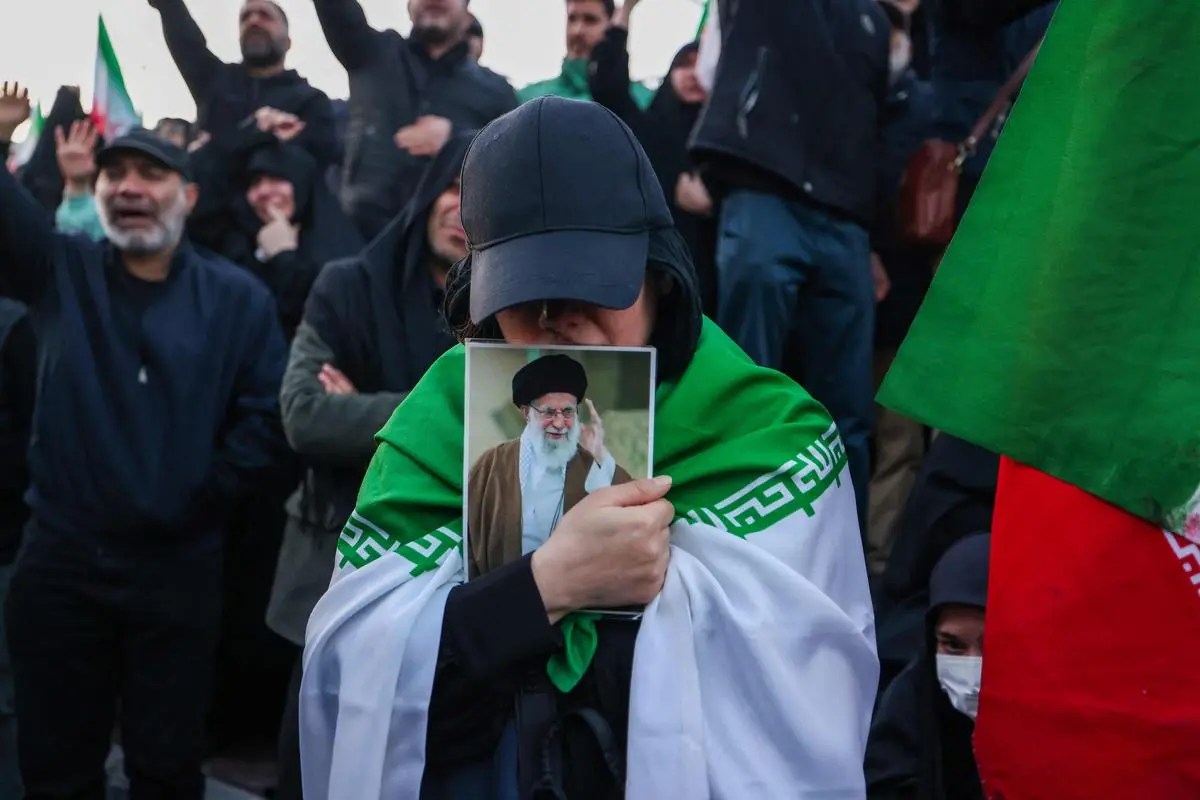
Mourning the death of Ayatollah Ali Khamenei in Tehran.

To eulogise and lament the demise of a barbarous despot and a brutal regime, which trampled on its own citizens and destroyed its own country economically, socially and politically, is sheer folly. – Makarand R. Paranjape

While Iranians all over the world, and to the extent possible within Iran, are celebrating the fall of a horrible despot and his regime of terror, Left-liberals in both the US and India are in mourning over the Ayatollah’s demise. How can one explain this strange and perplexing paradox?

Iranian women are rejoicing over the downfall of one of the most oppressive and misogynistic regimes in the world, yet US and Indian feminists—who, without the enforced hijab in Iran, would have faced certain imprisonment, even torture—are lamenting the fall of Iran’s patriarchal despots.

Iranian women have endured decades of policed veiling, gender segregation, and brutal crackdowns on protests, such as the 2022 uprising following Mahsa Amini’s death in custody for “improper hijab”. The regime’s misogyny was systemic, with laws permitting child marriage, quasi-prostitution disguised as temporary marriage (sigheh or nikah mut‘ah) and stoning for adultery (zina-e-mohsen).

Yet, when news broke of Khamenei’s death and the subsequent collapse of key regime figures, feminists both in the US and India decried the “militaristic patriarchy” of US and Israeli forces. The same feminists, who champion bodily autonomy, aligned with a theocracy that denied it.

Similarly, organised gay and LGBTQ groups, who could have faced execution in the Islamist Republic of Iran, are wailing the end of Iran’s theocratic dictatorship. Some on social media even pointed out how one of the greatest postmodernists, Michel Foucault, not only praised the regime in Iran but visited the country. I am not sure they knew he was homosexual—or did they simply choose to ignore it in so famous a foreign supporter?

The irony is stark: those who could be hanged from cranes in Tehran are now indirectly defended by activists enjoying protections in liberal democracies, all in the name of intersectional anti-oppression.

Communists were executed by Islamists not only in Iran, but in many other parts of the world. The Iranian regime’s early years saw the mass execution of Leftists, including members of the Tudeh Party, who were purged in the 1980s for ideological deviations from Khomeini’s Shia Islamism. Globally, Islamists have clashed with Communists, viewing Marxism as atheistic heresy. Yet today, Communist sympathisers in the West echo Iran’s anti-American slogans, seeing the regime as a victim of capitalist encirclement.

American Communists are taking the “Death to America” line right in New York City today, thanks to the patronage of their mayor, misusing the latitude of free speech given to them by the laws of the very country they excoriate. Speaking of the mayor, he promptly issued a statement condemning his own country and president.

I do not recall him shedding a tear for any of the prisoners of conscience tortured and killed in Iranian jails or castigating the horrifying attacks of Iran’s proxies in the region. Oh, I stand corrected; he did condemn Hamas much later, after facing repeated criticism. The day after the raid of 7 October 2023, he actually denounced Israel for its apartheid and occupation, not to mention its declaration of war against Hamas. Now this same mayor questions the legality of US and Israeli actions against Iran.

It is strange, to say the least, that the fallen regime has all kinds of supporters, East and West, many of whom are not even remotely connected to, let alone know much about, Iran. The Shia reaction in the subcontinent, by contrast, is understandable, even if, arguably, irrelevant to international geopolitics.

This global phenomenon of Left-liberal outrage over US-Israeli actions, which we may term the “Iran Paradox”, grows even stranger when we realise how many Muslim, especially Arab, states have actually condemned Iran’s retaliatory strikes, not the initial US-Israeli strikes. Even China and Russia, despite whatever verbal or political support they might extend in the totally marginalised and disunited United Nations, did not come to Iran’s aid in its time of dire need. The Ayatollah’s rule of terror, in other words, was left friendless in the end. Such, indeed, is the fate of dictators around the world.

Western liberalism, if we can even call it that, with its fading echoes elsewhere, reveals a profound disconnect with ground realities. Indeed, global political discourse shows that ideological alignments trump human rights or even historical realities.

At its core, the Iran Paradox stems from the frightened prejudice of sore losers, a Left which, some say not without reason, is both intellectually and morally bankrupt. It has nothing to fall back upon except its hatred for the US and Israel.

They are the ultimate villains—imperialist, colonialist and, worst of all, capitalist. Any regime opposing this axis, no matter how repressive, becomes, by default, a symbol of resistance.

Founded in 1979, the Islamic Republic of Iran, under Ayatollah Khomeini, positioned itself as an anti-imperialist bulwark, chanting “Death to America” and “Death to Israel”. They took their latter responsibility a bit too seriously, exporting death through proxies like Hezbollah in Lebanon and Hamas in Gaza.

Now, in closing, to India’s weak and splintered opposition—especially the increasingly irrelevant Congress and its differently enabled band of ideological fellow-travellers. Preaching moral lessons to Prime Minister Narendra Modi, who embraced Israeli Prime Minister Benjamin Netanyahu on the eve of the strike on Iran, is one thing.

But to eulogise and lament the demise of a barbarous dictator and a brutal regime, which trampled on its own citizens and destroyed its own country economically, socially and politically, is, as outspoken critics are wont to put it, sheer folly.

Yes, India did business with Iran, but that does not mean we should sing hosannas to its deceased leaders while ignoring their crimes against humanity. Let us not even comment on those virtue-signalling by issuing strong denunciations of the US and Israel. Actions speak louder than words. Besides, who is listening to them? Firstpost, 4 March 2026

Prof. Makarand R. Paranjape is an author and columnist.

Celebrating Khamenei's death in Iran.