The crisis of modern civilization is not a shortage of knowledge but a surfeit of information divorced from wisdom—societies that have multiplied their instruments of power without cultivating any corresponding growth in the spirit that must wield them. – Prof. Hindol Sengupta
Few civilizations have theorised education as searchingly as India’s, and few single verses compress that theorizing as tightly as the eleventh mantra of the Isha Upanishad: vidyām cavidyām ca yas tad vedobhayam saha, avidyayā mrtyum tirtva vidyayamrtam asnute—he who knows both vidaya and avidyā together, crosses over death through avidyā and attains immortality through vidyā. That closing phrase, vidyaya’mrtam asnute—by knowledge one attains immortality—has functioned for over two millennia not as a slogan but as a standing definition of what education is for. It is worth asking what that definition actually claims, and how India’s philosophers, ancient and modern, elaborated it into a coherent idea of education very different from the instrumental one now dominant across the world.
The Upanishadic claim
The Isha Upanishad’s verse is startling because it refuses to let vidya stand alone. Avidya here does not simply mean ignorance in the pejorative sense; in context it denotes the practical, ritual, and worldly knowledge—action in the phenomenal world—that must be mastered and then transcended, while vidya denotes knowledge of the Self, the unconditioned ground of being. The verse insists that both are necessary and must be held together: avidya carries one across death (mortality, finitude, the cycle of cause and effect), and vidya alone confers amrta—deathlessness, the immortal. Education, on this reading, is not the accumulation of facts but a passage: a movement from the world of doing to the ground of being, in which the worldly is not despised but used as a bridge to be crossed, not clung to.
This is the deep structure beneath the more famous Upanishadic formula sa vidyayā ya vimuktaye—that alone is knowledge which liberates. Learning that does not liberate, in this view, is merely information; it may be useful, even necessary, but it is not, in the full sense, vidyā.
This is a demanding claim, and Shankara’s Advaita Vedanta pressed it further: ignorance (avidyā, here in its more familiar negative sense of nescience) is not a lack of data about the world but a misapprehension of the nature of the Self—the superimposition of the finite ego upon the infinite Brahman. Education in the Advaitic sense is therefore jnana yoga, the discipline of discrimination (viveka) between the real and the apparent, disciplined by shravana (hearing), manana (reflection), and nididhyasana (sustained meditation). The teacher’s task is not to fill the student but to remove a covering—to let what is already there be recognized. It is an idea of education built on the conviction that the deepest truths are not acquired from outside but uncovered from within, guided rather than installed.
Radhakrishnan’s ideas
It is Sarvepalli Radhakrishnan, philosopher-president and one of India’s foremost interpreters of the Upanishads to the modern world, who translated this ancient claim into a working philosophy of education for a democratic and scientific age. For Radhakrishnan, the crisis of modern civilization was not a shortage of knowledge but a surfeit of information divorced from wisdom—societies that had multiplied their instruments of power without cultivating any corresponding growth in the spirit that must wield them. He held that the purpose of education could never be reduced to vocational training or the transmission of technique, though these have their place; its higher purpose was the awakening of the whole person—intellectual, moral, aesthetic, and spiritual—toward what he called, echoing the Upanishads, an integral vision of reality. Radhakrishnan’s own chairmanship of the University Education Commission (1948-49) put this conviction into institutional form: he argued that a university’s task was to produce not merely trained specialists but educated human beings capable of self-governance, ethical discrimination, and disinterested pursuit of truth—a vision he rooted explicitly in the Upanishadic distinction between the immediate, useful knowledge of avidyā and the higher self-knowledge of vidyā, insisting that a civilization neglects the second at its peril. Education, for him, was ultimately the cultivation of the capacity to see the universal in the particular—the same movement the Isha Upanishad describes as crossing from mortality to the deathless.
Vivekananda’s reflections
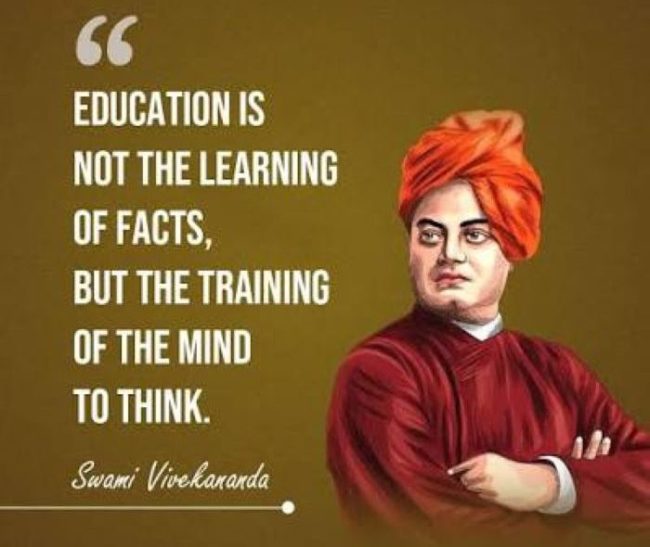
Swami Vivekananda gave this idea its most quotable modern form: education is not information stuffed into the brain, but the manifestation of the perfection already existing in every human being. This is a direct descendant of the Advaitic premise—if the Self is already whole, already divine, then the teacher’s role is not to add something foreign but to draw out what is innate, through discipline, concentration, and character-building. Vivekananda’s emphasis on shraddha (faith in oneself), on physical and moral strength alongside intellectual training, and on service to others as inseparable from self-realization, extended the Upanishadic idea into a program for national regeneration—education as the means by which a colonized and demoralized people could recover their own dignity and capacity.
The ‘integral freedom’ of Sri Aurobindo and Tagore
Sri Aurobindo’s idea of “integral education” pushed the same logic toward the evolutionary future: the aim was not the reproduction of existing knowledge but the development of faculties—physical, vital, mental, and spiritual—so that the individual could become an instrument of a higher consciousness struggling to emerge in human history. Learning, in his ashram at Pondicherry, was to proceed from the child’s own nature outward, never imposed from without—a pedagogical translation of the Upanishadic insistence that vidyā is uncovered, not installed.
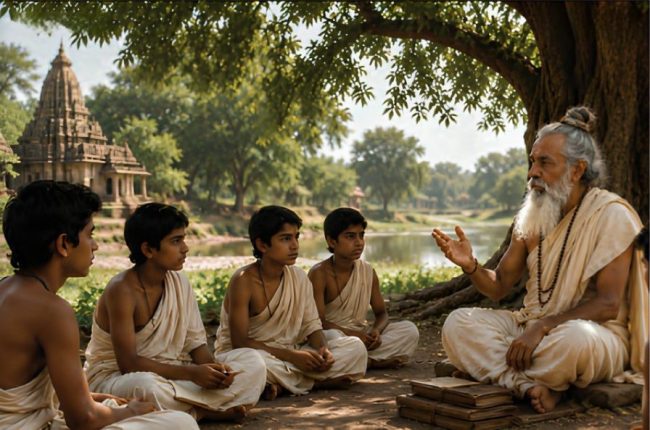
Rabindranath Tagore, working at almost the same historical moment at Santiniketan, gave the idea its most beloved poetic expression—his prayer for a world “where the mind is without fear and the head is held high,” where knowledge is free and the mind is led “into ever-widening thought and action.” Tagore’s objection to colonial schooling was precisely that it produced avidyā without vidyā: competent clerks without free minds. His forest-school pedagogy, conducted under open skies, close to nature and to the arts, aimed to restore the wholeness that examination-driven instruction fragmented.
Dharmapal and his discovery of the indigenous
If the philosophers above worked mainly at the level of theory, Dharampal’s historical research supplied the empirical ground beneath the claim that India possessed, until colonial disruption, an education of extraordinary depth and reach. In The Beautiful Tree (1983), assembling British colonial surveys from the early nineteenth century—including reports by William Adam in Bengal and Bihar and district-level data collected for Governor Munro in the Madras Presidency—Dharampal showed that indigenous schooling before colonial rule was far more widespread across caste lines than the colonial administrators themselves had expected, embedded in local community life and sustained without state compulsion. His broader point was not nostalgic antiquarianism but a challenge to the very idea, inherited from colonial and later nationalist historiography, that Indian civilization required an external, imported model of schooling to become literate or rational. What that older system dismantled by colonial policy had transmitted was precisely the union the Isha Upanishad demands: practical, livelihood-oriented avidyā—arithmetic, craft, agriculture, local administration—taught alongside the moral and metaphysical formation that a village school, often attached to a temple or under a local teacher, considered inseparable from literacy itself. Dharampal’s work restores to the philosophical argument a historical dimension: the vidyā–avidyā synthesis was not merely a metaphysical ideal confined to ashrams and Upanishadic seminars, but had once been, however imperfectly, a lived social reality across India, dismantled rather than absent.
What unites Shankara’s viveka, Radhakrishnan’s integral personality, Vivekananda’s manifested perfection, Aurobindo’s evolving consciousness, Tagore’s fearless mind, and Dharampal’s recovered village school is the Upanishadic insistence that education is measured not by what is added to a person but by what is freed within one—and, Dharampal would add, by how deeply it is rooted in a community’s own soil. Vidyā, rightly pursued, does not simply inform but transforms, carrying the learner, as the Isha Upanishad says, beyond mortality itself. In an age that increasingly measures education by employability metrics and standardised scores, this is a demanding and unfashionable claim. It is also, India’s philosophers would insist, the only claim education can make that justifies calling it education at all. – The Sunday Guardian, 26 July 2026
› Prof. Hindol Sengupta is an award-winning historian and author of 13 books. He is professor of international relations at O.P. Jindal Global University, NCR.