The Vedas do not describe an invasion or refer to a homeland outside India. The rivers, mountains and animals named in them are Indian. … The archaeological record shows no cultural break between the Indus-Saraswati cities and the Iron Age cultures that followed. So, the revision from Aryan invasion to migration doesn’t work either. – Nick Collins
I spent 40 years in the international shipping industry, in London, Tokyo, Singapore and Dubai. When I decided to write a book on the history of maritime trade, I had no academic position to defend and no orthodoxy to uphold. But I had a working knowledge of how trade actually functions and a professional habit of asking challenging questions and following evidence wherever it led.
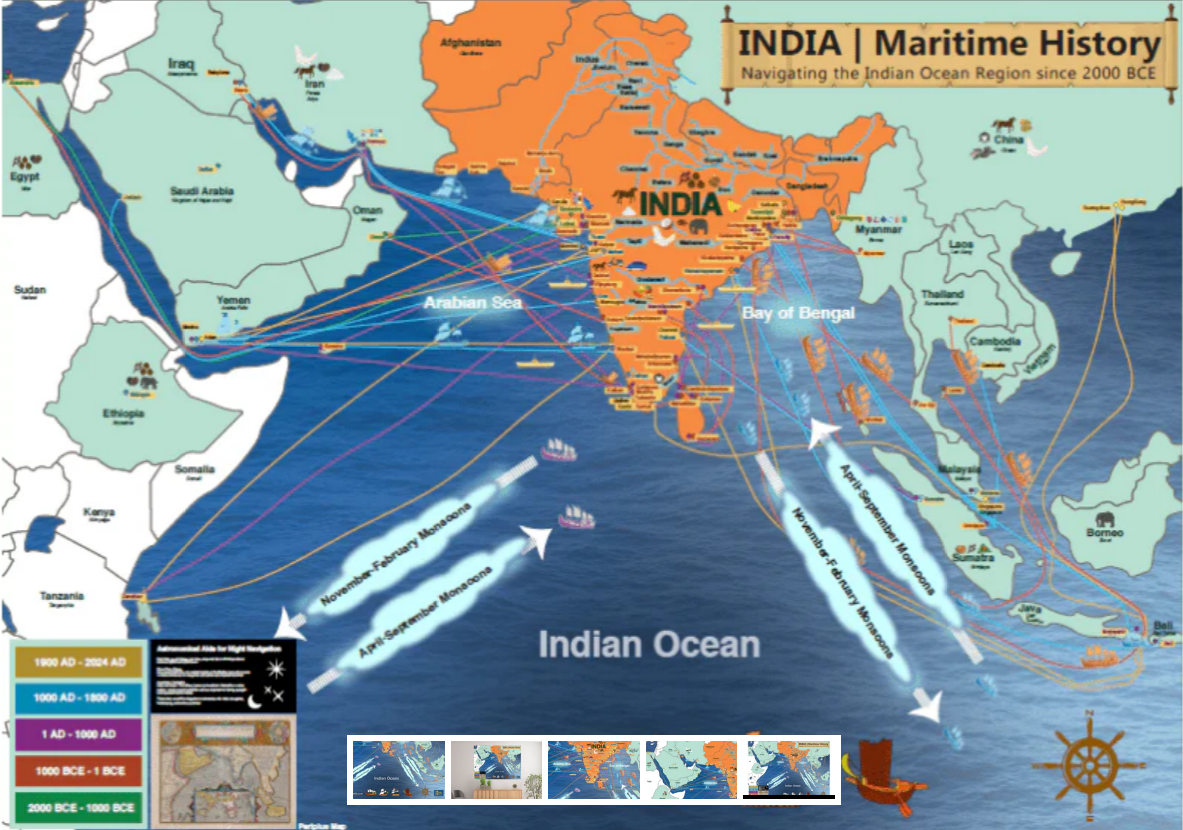
When I followed the sea lanes backwards into deep antiquity, I found that they converged on the Indian subcontinent. That was not the book I had intended to write. It was the book the evidence forced me to write. And the more I looked, the more I came to understand that the conventional account of the ancient world had been built on a set of assumptions that nobody had thought to question for a long time.
Where archaeologists chose to dig
In the second half of the 19th century, European archaeologists made remarkable discoveries in the deserts of Mesopotamia: cuneiform tablets, the Code of Hammurabi, the great ziggurats. These were genuine and important finds. They were also conveniently located. The hot, dry climate of Mesopotamia preserves clay and brick beautifully. The Biblical and classical sources European scholars had read pointed them to the region.
So, they dug there. What they found became the foundation of the standard account: Mesopotamia as the cradle of civilisation, the birthplace of writing, of urbanism, of law, of mathematics. The story moved from Mesopotamia to Egypt to Greece to Rome to Christendom to modern Europe in a tidy westward, arc. India appeared only as a colonial possession at the end of it.
What they did not do was dig with comparable intensity in north-west India. Harappa was identified in 1842 but not seriously explored until the 1920s. Mohenjo-daro was discovered only in 1922. By the time these excavations began, the dominant assumption was already set. Mesopotamia was the centre. Anything found in India had to be derivative.
What was actually there
But the Indus-Saraswati civilisation was not derivative. It was the largest and most economically productive society of the ancient world.
By the middle of the third millennium BC, it supported about 300 riverine cities, each with populations of over 50,000 people. Two-thirds of them stood on the banks of the Saraswati, the central of the seven rivers described in the Rig Veda. Canals supplied water to 2,500 dependent settlements. Vedic kings ruled territory stretching, in the words of their own texts, from sea to sea—roughly 1.5 million square miles, comprising what is today Afghanistan, Pakistan and most of north-west India. Egypt covered about 13,000 square miles. Sumer was smaller still.
Cities were laid out with mathematical precision. Streets ran north-south and east-west in a strict grid. Covered drains carried wastewater from brick-built houses with bathrooms. Bricks across every site followed a 4:2:1 proportion. Weights followed a binary system: 1, 2, 4, 8, 16, 32. Buildings were constructed in 5:4 ratios. A division on an ivory measuring rod found at Lothal measured 1.704 millimetres, the smallest Bronze Age unit of measurement ever recorded.
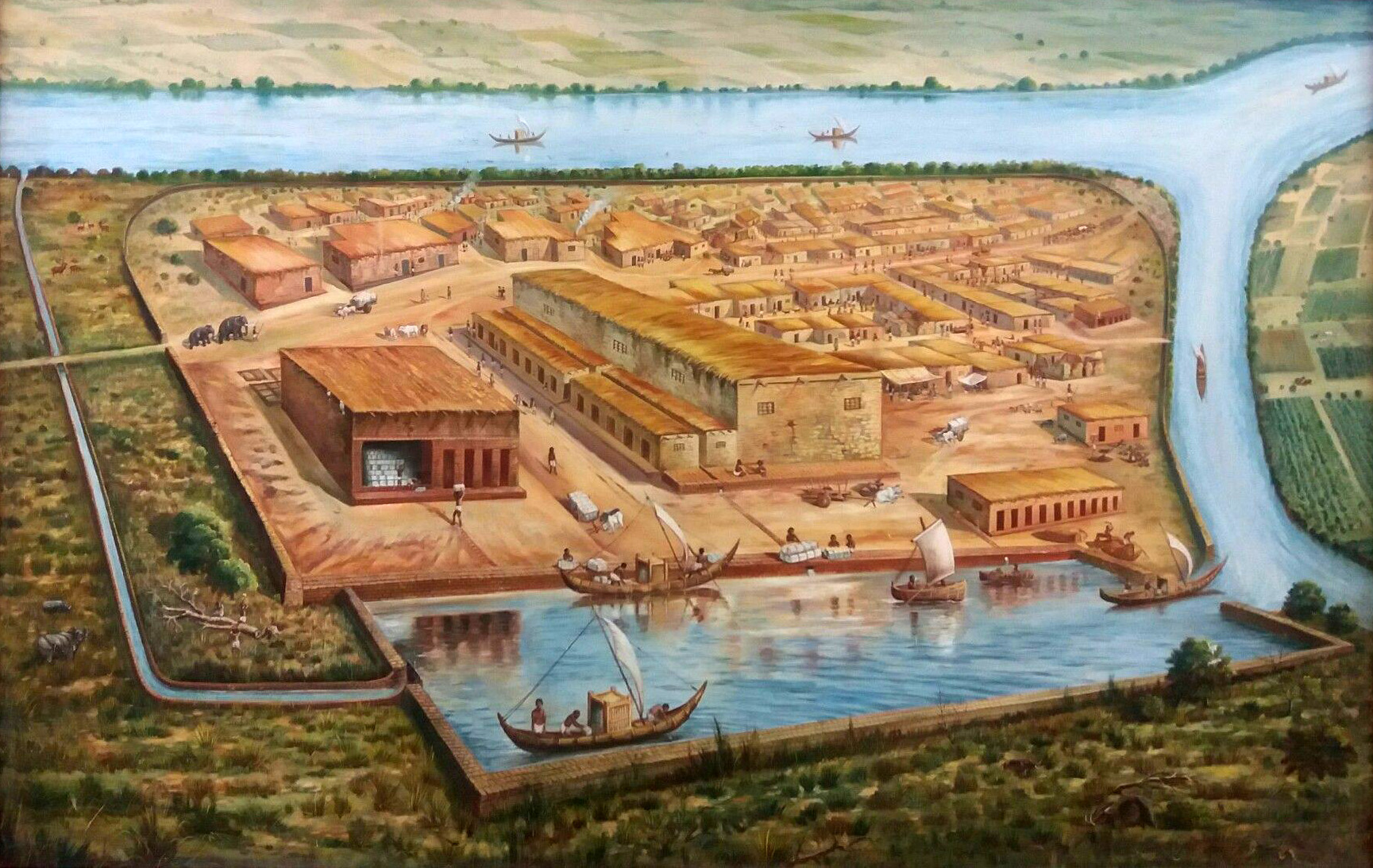
Lothal, its main port, had a dock 214 metres long, built with a million bricks, capable of handling thirty ships of sixty tons—the largest dock in the ancient world. Europe would not match it for 4,000 years. So divorced from maritime trade were the academics who first encountered it that they initially identified it as a communal bathing pool.
The Aryan invasion theory
Once the scale of these cities became impossible to ignore, the existing framework had a problem. So, the framework was adjusted.
The argument, developed by Max Müller and others in the late 19th century, was that pale-skinned Indo-European nomads, Aryans, from the Eurasian steppe, had invaded northern India around 1500 BC, bringing with them literature, mathematics, astronomy and philosophy. The Vedic civilisation was therefore not Indian in origin. It was European, transplanted. The theory preserved the assumption that complex civilisation must originate from European racial stock, and it conveniently justified the colonial presence.
There was no evidence for any of it. The Vedas do not describe an invasion or refer to a homeland outside India. The rivers, mountains and animals named in them are Indian. No earlier-language place names survive of the kind one would expect if an invasion had occurred. Compare the Americas, where indigenous names like Mississippi and Massachusetts remain attached to almost every river and region. Genetic studies carried out between 1999 and 2006, reviewed by Michel Danino across nine large samples, found no trace of any invasion. The archaeological record shows no cultural break between the Indus-Saraswati cities and the Iron Age cultures that followed. So, the revision from Aryan invasion to migration doesn’t work either.
The Aryan invasion theory was a hypothesis to fit a preferred conclusion. It persisted in school textbooks well into the 21st century. It is still found in many today.
The problem of studying history in boxes
Both errors share a single methodological cause. Academic history is divided into specialities. Sumerian scholars study Mesopotamia. Egyptologists study Egypt. Indologists study India. Each discipline trains its own students, runs its own journals and rewards its own internal references. The connections between the boxes are studied less often than the contents of the boxes themselves.
This may work for political history, which universities mainly study. It works poorly for the history of trade, where everything that mattered crossed the boundaries of these boxes. The carnelian beads, timber and food (the latter archaeologically invisible) in Sumerian cities arrived on ships from Meluhha, the Sumerian name for the Indus-Saraswati civilisation. If you study Sumer alone, or Egypt alone, or India alone, the connections cannot be understood.
Correcting the record
When the artificial boundaries between geographic specialities are removed, the picture is consistent across every type of evidence: archaeological, linguistic, genetic, literary, geographic. The Indian subcontinent was the most economically productive and powerful region of the ancient world, and just as with today’s America, its influence on the rest of the world in ideas, culture and language was substantial. It was where the first long-haul maritime trade networks originated. It was the source of the Indo-European language family, not its destination. It was the cradle of philosophical and mathematical traditions that travelled westward through the same trade routes that carried cotton textiles, spices and gems.
None of this is controversial when the evidence is laid out. It only seems controversial because it contradicts a story assembled in the late 19th century by archaeologists working in a different climate, scholars working in a different intellectual tradition and political administrators working with a different agenda.
Correcting the record requires no ideology. It requires telling the story the evidence already supports. The Aryan invasion theory should be removed from textbooks where it still survives.
In my experience, many Indians already suspect this is the case. The evidence is overwhelming. But erroneous ideas are difficult to dislodge when received wisdom is protected by institutional interest. It is time to let the evidence speak. – Firstpost, 22 June 2026
› Nick Collins is the author of a three-volume history of maritime trade published by Pen & Sword Books and Garuda Prakashan. The first volume, How Maritime Trade and the Indian Subcontinent Shaped the World, was shortlisted for the Mountbatten Maritime Literary Award. He spent nearly forty years in the international shipping industry.