Why Indian-Americans are under attack in America – Makarand R. Paranjape

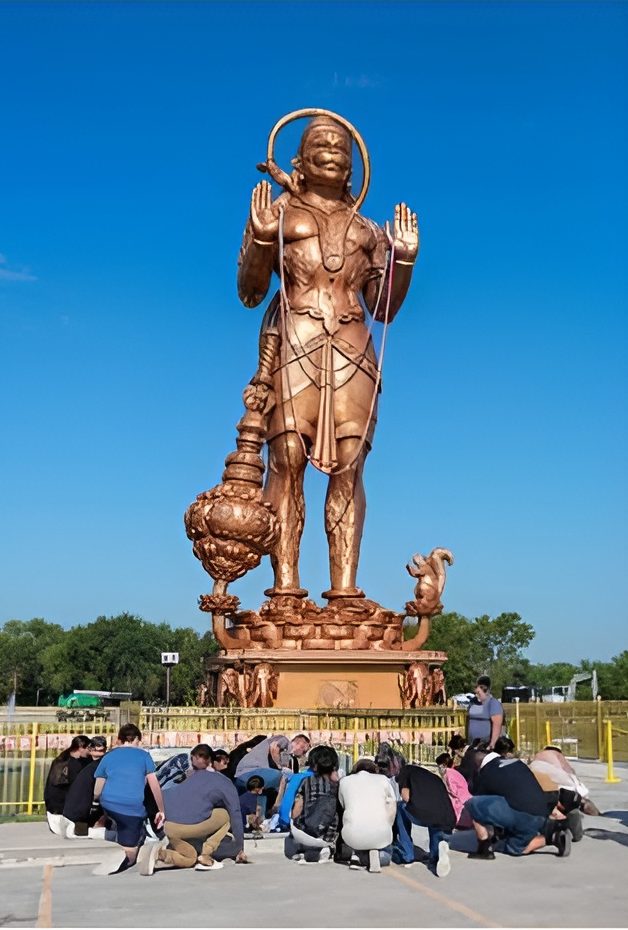
Hanuman statue in Sugarland, Texas.

Indian-Americans find themselves in an unenviable predicament. Their extraordinary educational, economic and professional achievements, instead of guaranteeing acceptance, have made them targets of suspicion, jealousy and, increasingly, outright hatred. – Makarand R. Paranjape

Indian-Americans may be facing their worst wave of hostility in the United States in half a century. The irony is that they are under attack not because they have failed to make it in the US, but because they have succeeded so spectacularly.

Caught between an increasingly identitarian, socialist Left and a resentful, revanchist Right, they find themselves in an unenviable predicament. Their extraordinary educational, economic and professional achievements, instead of guaranteeing acceptance, have made them targets of suspicion, jealousy and, increasingly, outright hatred.

Consider two recent incidents, seemingly unrelated but symptomatic of this disturbing development. Nineteen-year-old Alexandros Paporakis, a self-proclaimed neo-Nazi, attempted to open fire outside a temple. Luckily, his rifle jammed. He subsequently spoke of returning to finish his murderous mission. Fortunately, his co-workers alerted the police, who arrested him.

One wonders at their miraculous escape: what saved hundreds of Hindu worshippers from a possible massacre at the Sri Venkateswara Swami Temple in Aurora, near Chicago, on October 11? Among those worshipping that day were Democratic Congressman Raja Krishnamoorthi and his family. One shudders to imagine what might have happened had the rifle fired.

Some devotees might attribute their miraculous escape to Lord Venkateswara’s protection. Some would rule out divine intervention and point simply to a malfunctioning rifle. My question is different: Why should Hindu worshippers in America become targets of murderous racial hatred?

Vivek Ramaswamy, the brilliant, ambitious Indian-origin Republican gubernatorial candidate in Ohio, has landed himself in an entirely avoidable controversy. His campaign released an advertisement featuring the estranged mother of his Democratic opponent, Amy Acton, accusing her daughter of dishonesty. Given Acton’s traumatic childhood and allegations of sexual abuse, the advertisement struck many as gratuitously cruel.

Even Republican Governor Mike DeWine demanded its withdrawal. Could this prove a turning point? A mid-October poll already showed Ramaswamy trailing Acton by seven percentage points.

But apart from a tasteless and offensive ad, might there be another factor? Perhaps voters in this predominantly white Midwestern state may not be comfortable with a Hindu governor of Indian origin. Any excuse, including being vegetarian or walking about barefoot at home, might be enough to tilt voter sentiment against him. The advertisement could give wavering voters an excuse to reject Ramaswamy without interrogating their own prejudices.

Remember Bobby Jindal, the Indian-origin Republican who converted to Catholicism? He successfully governed conservative Louisiana for two terms, but his presidential ambitions came to nothing. Religious assimilation, evidently, is neither a necessary nor sufficient condition for political success.

Let me state my larger proposition bluntly. Indian-Americans may be facing their most uncomfortable political moment in half a century. Why? Because on the Left, large sections of the so-called Progressives have moved beyond traditional liberalism towards an amalgam of radical identity politics, anti-capitalism and accommodation of Islamist political movements. Hindu Americans, notwithstanding their minority status, can be portrayed as privileged white-adjacents, whose legitimate concerns about discrimination and religious freedom deserve little sympathy. Yet religious liberty cannot be selective. Hindus, Muslims, Christians, Jews, Sikhs and others must enjoy equal constitutional protection.

The Right presents a different problem.

Indian-Americans are among America’s most successful immigrant communities. According to Pew Research Center, Indian-headed households had a median annual income exceeding $151,000 in 2023. Their educational and professional achievements are equally impressive.

Instead of celebrating this contribution, parts of Maga increasingly regard Indian professionals as economic competitors, even interlopers stealing the jobs of US-born native Americans. Read that as fellow whites. Yes, let’s face it. Maga anti-Indianism has not only Christian fundamentalist but also racist undertones.

The Trump administration has imposed all kinds of barriers on new H-1Bs, including an extraordinary $100,000 fee on certain new H-1B petitions. Although federal courts have blocked it, Trump has come up with a new $103,265 fee proposed by the Department of Homeland Security (DHS) through a a Notice of Proposed Rulemaking $108,000 fee on new applications. This move is considered legally more resilient than the earlier, $100,000 fee. Vice President J.D. Vance has also attacked abuses of H-1B visas, using some unparliamentary epithets. But reforming immigration is one thing; vilifying immigrants quite another. America cannot maintain technological supremacy by discouraging the very scientists, engineers, physicians and entrepreneurs who help sustain it.

There is also a distinction that fashionable multiculturalism has been reluctant to acknowledge. Not all immigrant communities are identical in their educational backgrounds, cultural practices, religious beliefs or attitudes towards integration. To pretend otherwise is intellectual dishonesty.

Consider Britain’s appalling grooming-gang scandals. In notorious cases, including Rotherham and Rochdale, networks of predominantly Muslim Pakistani-origin men sexually exploited vulnerable underage girls. This was done in a systematic and prolonged manner while the police and judicial authorities, apparently, turned a blind eye.

But an underlying question remains to be addressed: why persist with the indiscriminate and blatantly inaccurate designation ‘Asian’ when nearly all of these rapists were Muslim, not to mention Pakistani? What do Hindus, Sikhs, Bangladeshis, Nepalis or other Asian communities have to do with these criminal networks? Why should they bear the shame?

Ayaan Hirsi Ali, the Somali-born former Dutch parliamentarian who suffered female genital mutilation herself, has spent decades challenging the horribly sexist, even misogynist, practices of Sharia law in Muslim-majority countries around the world. Her books Infidel, Heretic and Prey expose the dangers of refusing to examine cultural and theological assumptions.

Swedish research on rape convictions has also identified disturbing disparities associated with immigrant backgrounds. It is Muslim immigrants whose numbers are disproportionately high among perpetrators of sexual crimes. Such findings demand investigation, not ideological suppression. Although we mustn’t simplistically assume religious causation, religious and cultural differences should be investigated honestly rather than concealed beneath politically convenient labels.

The irony is that Indian-Americans, despite their conspicuous achievements, are themselves increasingly subjected to indiscriminate suspicion. Even though they are among the most law-abiding and non-violent of all immigrant communities. Racial prejudice compounds economic resentment. The evidently white-supremacist motivation behind the Aurora attack cannot be explained away as concern about jobs or immigration.

But another political calculation may be involved. Indian-Americans have traditionally leaned Democratic. Some MAGA strategists may therefore reason: why bother courting a community that won’t vote Republican anyway? Yet Indian-Americans are hardly politically homogeneous. Ramaswamy himself, and the prominence of Usha Vance, demonstrate their growing presence within Republican circles.

What, then, should Indian-Americans do?

My answer is simple: organise, participate, influence. For too long, this remarkably successful community has concentrated on education, professional advancement, entrepreneurship and family prosperity, leaving political activism to others.

That must change.

Indian-Americans need stronger civic associations, effective lobbying, greater political participation and a confident presence in public debates. Hindu Americans, particularly, must defend their religious freedoms through constitutional institutions rather than occasional expressions of outrage.

But integration also demands reciprocity.

Indian-Americans must not retreat into comfortable cultural ghettos. They must learn more about America’s history, traditions and institutions. Participate in neighbourhood organisations, school boards, voluntary associations and public life. Build friendships and alliances beyond ethnic boundaries. Above all, they mustn’t allow their identities to be defined by those who dislike them.

The United States remains one of humanity’s boldest experiments in accommodating differences within a common constitutional framework. Indian-Americans have benefited enormously from that promise and contributed handsomely to its fulfilment.

The question is not whether they can become sufficiently American to satisfy their detractors, but whether America can remain sufficiently faithful to its founding ideals to embrace them as they are. – Firstpost, 28 October 2026

› Makarand R. Paranjape, author and public intellectual, is currently Sri Aurobindo Chair, Vedere University & Director of Education, AHCP LLC.

Shooter Alexandros Paporakis and the Sri Venkateswara Swami Temple in Aurora, Illinois.

The Problem of Islamism – Sita Ram Goel

Islamism

What we mean by Islamism is a self-righteous psychology and a closed cultural attitude which make it impossible for Muslim converts to coexist peacefully and with dignity with other people. – Sita Ram Goel

The most malevolent of these residues is Islamism, the residue of the Muslim invasion of India spread over several centuries. Its basic tenets are ultimately derived from the teachings of Islam which has so far succeeded in sealing itself off from every shade of empiricism, rationalism, universalism, humanism and liberalism, the hallmarks of Hindu as well as modern Western culture. But in the context of India where Islam failed in its mission of lasting conquest and total conversion, these tenets have acquired a singularly sinister and subversive character.

Let it be clear that the reference here is not at all to our Muslim brethren who are our own flesh and blood, except for that microscopic minority which takes pride in the purity of its Arab, Persian or Turkish descent.[1] Instead of being the proponents of Islamism, the Muslims of India are its victims whom it is trying to use as vehicles of its poisonous virulence. The vast majority of Indian Muslims were converted to Islam by force or allurements. But the conversion did not help them socially or culturally as their status today in India’s Muslim society should amply prove. The Muslims of India, therefore, have to be freed from rather than accused of Islamism.

What we mean by Islamism is a self-righteous psychology and a closed cultural attitude which make it impossible for its converts to coexist peacefully and with dignity with other people. There are many Hindus who share several tenets of Islamism. On the other hand, there are many Muslims who are frightened by Islamism and who would gladly join the mainstream of Indian nationalism if they are freed from the whiphand which a minority of theologians, politicians and hooligans has come to wield in their community.

Those who want to know Islamism first-hand and in full measure are referred to Shaikh Sir Mohammed Iqbal’s two long poems which he wrote quite early in his career, and which earned for him the title of Allama among the adherents of this cult. These are the Shikwa and the Jawab-i-Shikwah which Mr. Khushwant Singh has recently published in an English translation.

The Shikwa ends by summing up that “naghma hindi hai tau kya, lai tau hijazi hai miri”, that is, “no matter if my idiom is Indian, my spirit is that of Hijaz”. Hijaz is that part of Arabia in which Mecca and Medina are situated.

The Jawab-i-Shikwah ends on a still more strident note. Allah announces to the Allama His supreme message for mankind in the following words: “kî wafã tûne muhammad se tau ham tere hain”, that is, “if you are faithful to Muhammad, I shall be faithful to you.”

Now, there are many Muslims in India who have never heard the name of Iqbal or listened to his muse. And there are many Hindus whose admiration for Iqbal is immeasurable. No, Islamism does not refer to any particular section of Indian society. It refers to that intellectual-or unintellectual-attitude which awards the monopoly of truth and virtue to a particular prophet, and consigns all knowledge to the pages of a particular book.

Taking our cue from Allama Iqbal and his lesser cohorts like Altaf Hussain Hali, we can safely summarise the credo of Islamism in the following five fundamentals:

1. That Indian society before the advent of Islam was living in utter spiritual, moral and cultural darkness (jahiliya) like pre-Islamic Arabia;

2. That Islam brought to India the only true religion, the only authentic moral values, the only humane culture, and the only progressive social order;

3. That this civilizing mission of Islam in India could not be completed, as in many other lands of Asia and Africa, due to the intervention of the wily British who cheated Islam of its empire in India, mostly by means of fraud;

4. That while the creation of Pakistan has been a triumph and consolidation of the power of Islam, west of the Ravi and east of the Hooghly, the conquest of India by Islam remains an unfinished task;

5. That Islam has a right to use all means, including force, to convert this Dãrul-harb of an India into a Dãrul-Islam, so that a Hakûmat-i-Ilãhiyah could liquidate all traces of jãhilîya and impose the law and culture of Islam.

There are many Hindus like the late Pandit Sunderlal who fully accept the first two fundamentals of Islamism. It is a different matter that their logic fails them at this stage and they do not proceed to the next three fundamentals which follow irrevocably. And there have been many Muslims like the late Rafi Ahmed Kidwai and Justice M.C. Chagla who rejects these fundamentals as repugnant.

Having thus outlined its version of past Indian history, and the apocalypse towards which future Indian history should be forced to travel, Islamism has evolved a strategy in which the Muslims of India are envisaged as a base and an arsenal. Some salient features of this strategy can be outlined as follows:

1. The Muslims of India, particularly the Muslim intelligentsia, should be sealed off from every shade of rationalism, universalism, humanism and liberalism, and an army of mullahs and maulvis trained in the tenets of Islam should be let loose to brainwash and keep them along the right track;

2. Every Muslim who does not accept Islamism or dares criticize it or stands for the mainstream of Indian nationalism, away from and above religious differences, should be denounced as a renegade and a legitimate victim for murderous Muslim mobs;

3. The Muslims should be encouraged to air as many grievances as can be invented, and try to pass off as a down-trodden minority, oppressed, exploited and treated as second class citizens by the “brute” Hindu majority;

4. These contrived grievances of the Muslims should be used to convert the Muslim community into a compact vote-bank which can function as a balancing factor in as many electoral constituencies as possible, and which can blackmail all non-Islamist political parties to accommodate Muslim candidates or include the maximum measure of concessions to the Muslim community in their election manifestos;

5. The Muslims should be made to agitate for India’s support to all international Islamic causes, right or wrong, legitimate or illegitimate, so that their attention is kept constantly diverted from demands of their own economic, social and cultural condition;

6. The Muslims should be progressively persuaded and prepared to stage street riots on the slightest pretext, be it a stray pig, or music before a mosque, or Urdu, or the minority character of the Aligarh Muslim University, or a purely personal fracas between toughs belonging to two communities, or the bombing of al-Aqsa mosque in Jerusalem by an Austrian adventurer, or the hanging of Z.A. Bhutto by President Zia of Pakistan, or the capture of the Kaaba by some disgruntled faction in Saudi Arabian politics, or some other similar event in the Islamic world at large;

7. The frequent riots should be used to frighten the Muslims who should then be coaxed to create, consolidate and extend exclusive Muslim enclaves which can be stocked with arms and ammunition, imported or otherwise.

The seven-fold strategy is aimed at the Muslims in India who are to be brainwashed, blackmailed, frightened and forced into the fold of Islamism. Another side of the same strategy has been worked out to neutralise, paralyse and blacken or pamper different sections of Hindu society so that the road is cleared for the forward march of Islamism.  Some salient features of this secondary strategy can be outlined as follows:

1. The concept of Secularism which is enshrined in the Constitution of India and which has become the most sacred slogan for all our political parties should be distorted, misinterpreted and misused to the maximum to block out the least little expression of Hindu culture in the state apparatus and public life of India;

2. The terms “communal” and “communalism” which have become terms of abuse in India’s political parlance, should be carefully cultivated and more and more mystified to malign all those organisations, institutions and parties which do not serve Islamism, directly and/or indirectly;

3. The accusation of being fascists and anti-secularists should be hurled at all those individuals and organisations who question the exclusive claims of Islam and its culture, who know and tell the truth about Islamic scripture and history, and who see through the Muslim game of grievances;

4. All praise and support should be extended to those Hindus who go out of their way to champion Islamic causes, national and international, and who see in Islam and its culture those higher values which Islamism claims for them;

5. All available platforms should be used to defeat and frustrate the emergence of a genuine and positive Indian nationalism by always harping on India’s multi-racial, multi-religious, multi-language, multi-national, and multi-cultural character.

Islamism did make some headway among the Muslims in Independent India mostly because the dominant section of Hindu intelligentsia partronised it for various reasons. The Congress politicians patronised it because they found out very soon that they were in a minority among the Hindus, and that they could survive in power only by combining a solid Muslim vote with whatever Hindu vote they could get. The Socialists went out of their way to patronise it partly because they harbour an anti-Hindu animus and partly in the hope of securing Muslim vote-a hope which has not as yet come anywhere near fulfilment. The Gandhians partronised it because they no more remembered that their great master, Mahatma Gandhi, was a Hindu with a profound faith in Sanãtana Dharma, and because they misunderstood his doctrine of non-violence towards all people, including the Muslims of India, as an endorsement of Islam. The Communists patronised it because they saw in it a powerful ally in their campaign against Hindu society which they viewed as their main enemy. The self-alienated Hindu intellectuals patronised it out of sheer animus towards Hindu society and culture which they were out to damn on any pretext. Extending patronage to Islamism thus became a pastime for all those who wanted to pass off as large-hearted liberals, progressives and secularists.

But in the absence of local resources and international patronage, the progress of Islamism in India was rather slow. Pakistan, which was its only patron abroad, could not provide much help beyond some hysteria in its mass media and propaganda in international political forums. The several wars which India was forced to fight with Pakistan to the disadvantage of the latter, also inhibited Islamism in India from acquiring the requisite degree of self-confidence.

The use of oil as a political weapon by Islamic countries and the influx of petro-dollars in plenty from several Arab countries, particularly Libya and Saudi Arabia, since the early 1970s, has given to Islamism in India a new glow of self-confidence in one sudden sweep. This influx of Arab money is a natural and inevitable phenomenon because, in the last analysis, Islamism is only another name for Arab imperialism which had, at one stage of its history, pillaged and populated with its own progeny many foreign lands and which even today keeps many non-Arab nations spiritually enslaved.

Islamism in India is now busy employing to the maximum advantage the Arab money which is pouring in through many channels and in increasing quantities. Some of these uses are very obvious to the eye. A few salient features of the new scenario can be listed as follows:

1. The rapid rise of a powerful press, mostly in Indian languages, and many publishing houses to propagate Islamism;

2. The generous funding of old and the founding of many new maktabs, madrasas and institutes for teaching Islam and training missionaries who are then employed at high salaries for purifying the faith of the Muslim flock and seeking new pastures for converts to Islam;

3. Buying of land and real estate all around in urban and rural areas by individual Muslims and Islamic institutions and organisations at whatever prices available;

4. Manufacturing and storing of arms in mosques, Muslim homes and localities and training of Muslim toughs;

5. Holding of frequent conferences, national and international, and taking out demonstrations in support of every Islamic cause;

6. Financing Muslim politics and inducing Muslim politicians to infiltrate and ingratiate themselves in every political party, and function from every public platform;

7. Bribing secularist Hindu intellectuals, scribes public workers and politicians, and buying them up for supporting Islamism, denigrating Hindu culture, and character-assassinating those who oppose Islamism;

8. Using the lure of money for winning converts to Islam from the weaker sections of Hindu society, particularly the Harijans.

The strategy is nothing new. The self-same strategy had been used by the Muslim League for the carving out of Pakistan. Only the aid and abetment which the British provided at one time have been replaced by the aid and abetment from Arab countries. And in the matter of a mere decade, Islamism in India has assumed the same menacing proportions as it had on the eve of Partition. The parallel should make us pause. – Extracted from Hindu Society Under Seige, 1996

Footnotes

1. See K.S. Lal, Indian Muslims: Who Are They, Voice of India, New Delhi, 1990.

Shariah