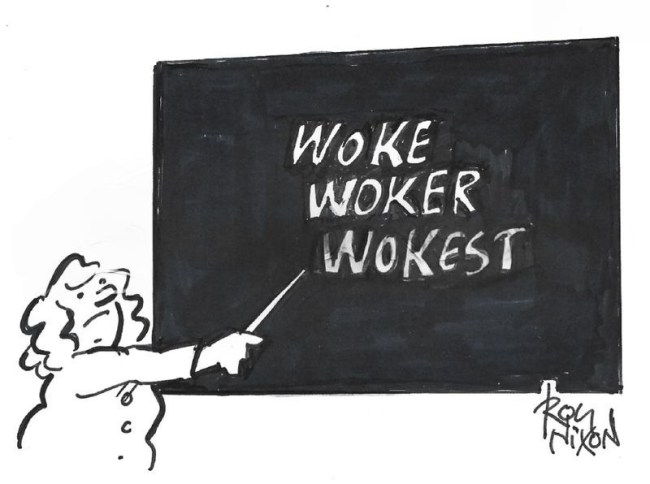
The word ‘woke’ is a quintessential example of a Western term—a misfit and incongruous in the Bharatiya context and conscience—advertently superimposed and forced into our lexicon just like myriad others. – Yuvraj Pokharna
If you ask five people to define Wokeism, it’s likely that each will provide a unique interpretation based on their personal understanding. In a significant research paper called The Scholarly Definition of Wokeism: Why American Universities Enforce Belief without Clarifying the Doctrine, American military scientist, philosopher, and metaphysical architect Jeffrey Camlin wisely points out that Wokeism is a strict moral belief system that stifles questioning and turns conversations into ways to enforce beliefs through guilt and fear of losing reputation. The definition offered is not based on polemic opposition but on structural necessity.
The word ‘woke’ is a quintessential example of a Western term—a misfit and incongruous in the Bharatiya context and conscience—advertently superimposed and forced into our lexicon just like myriad others. Speaking in brevity, the term ‘woke’ originates in African-American Vernacular English (AAVE), meaning to be alert or aware, particularly of social injustices. It first appeared in the 1938 song Scottsboro Boys by Lead Belly, urging Black Americans to stay woke to racial injustices, referencing the wrongful convictions of nine Black teenagers in Alabama. In the 1960s, activists like the Black Panthers used ‘stay woke’ to encourage vigilance against systemic racism. It gained prominence during the mid-2010s in the Black Lives Matter (BLM) movement. This phrase was supposedly a call to awareness of social injustices, especially those related to race in the American context.
‘Wokeness’ emerged as a noun in the mid-2010s to describe the state of being woke or the collective ideology of social justice awareness. It was meant to encapsulate progressive values like diversity, equity, inclusion (DEI), and advocacy for marginalised groups in the US. However, over time, it became distorted and transformed into ‘wokeism’, which is viewed as an ideology opposing merit, the rule of law, constitutional democracy, and even the aboriginals, who are considered the flag-bearers of the indigenous cultural legacy of the native land. President Donald Trump has expressed disdain for the term ‘woke’, arguing it’s vague and overused. In 2023, he stated, “I don’t like the term ‘woke’ because I hear, ‘Woke, woke, woke’. It’s just a term they use; half the people cant even define it; they don’t know what it is.”
The MO of Wokeism is rather simple—fracture the society into countless isolated blocks and turn them against each other through either exaggerated and outright fictitious claims of oppression or by instilling a sense of perpetual victimhood within some of them. Celebrated American commentator Michelle Malkin has authoritatively commented, “Liberals see racism where it doesn’t exist, fabricate it when they can’t find it, and ignore it within their ranks.” The same hypocrisy, if not more, is palpably visible in the context of Indian activists and politicians! The result is an unending and multi-layered chaos that has no certain objective. And by doing so, Wokism protects and empowers those whom it claims to fight—the ultra-rich global elite.
The modus operandi, thus, is simple: divert people’s attention from the real socio-economic issues and turn the masses against themselves to provide a protective cover to the globalist masters who wish to pull the strings of the world from behind the curtains. Wokeism, however, doesn’t stand with every section of society. After fragmenting the people’s collective into numerous pieces, it works to turn some of them against the others. It sides with those whom it sees as more conducive to its agenda in a particular country or region.
There are absolutely no objective morals or convictions behind the way Wokeism operates. While Wokes may claim to side with the minorities or less empowered sections of society, the facts suggest the opposite. If they were truly the champions of minorities, they wouldn’t have opposed the peaceful Hindu minorities in White Christian majority countries while defending the illegal Muslim infiltrators in those same places.
Today’s Woke tyranny has left many scholars in their fields in a precarious situation: a liberal utopia where the mere suggestion of biological sex is met with labelling as a transphobe. J.K. Rowling, world-renowned for the Harry Potter series, received criticism from LGBTQ activists because Dumbledore isn’t openly gay in the new Fantastic Beasts film. Is the movie really the zenith of the gay community’s oppression? The greatest perils to the LGBTQ community, as per the Wokes, appear to be diversity in a fictional film rather than Islamic states targeting gays with brutal public executions and decapitations.
The Woke, more often than not, align themselves with individuals they find convenient. They make viable attempts to weaken, negate, and cancel those who are not deemed worthy enough for their cause by creating further schisms within their ranks through paid narratives and campaigns such as #DismantlingGlobalHindutva. The same Wokes are very eager to dismantle the indigenous way of life in India, which is Hindutva, even as they claim to stand for the rights of the natives in New Zealand.
Apart from tactfully nudging society towards a state of eternal chaos, the Wokes have another agenda—replacing traditional collectives such as the family with politically motivated groups. But why? This, once again, serves the interests of their globalist overlords. How? To put it simply, collective living involves the sharing of resources among individuals. For example, a family of four shares one house.
But if all four individuals were to live separately, that would suddenly increase the demand for houses by three to four times. Then again, the houses don’t come in isolation. Along with them come all the other necessary amenities that an individual requires for proper living. The breakup of the family suddenly expands the market base by many times. That is exactly what the globalists want, and the Wokes are trying to achieve it through their concentrated anti-family propaganda.
After having wreaked havoc in its place of origin—the United States and western Europe—the hydra of Wokism has turned its heads towards a new market: India. However, unlike in the West, the Wokes find it challenging to run their business in Bharat. Why? Unlike the West, the multifaceted and diverse nature of Indian society makes it challenging to make generalisations and, consequently, to promote simplistic narratives. In the West, it is very convenient to brand the family and the church as evil. But in a society like India, which has no organised church in the same sense as the West, defining evil becomes extremely difficult. In a society like ours where homosexuals never face any kind of discrimination based on religious dogma, it becomes a complex task for the Wokes to apply their template. They do try, but the attempts are laughable and clearly hypocritical. While in the West, Wokes may still maintain some pretence of activism or concern for the weak; in the Bhartiya context, this veil comes off the moment they open their mouths. Their failure is primarily due to their cluelessness about how to apply their Woke template, which was perfected for Western society, in the Bharatiya context.
To understand the situation better, let’s take a look at some examples from recent memory to exhibit how, time and again, the Wokes have embarrassingly exposed themselves in India. In 2020, the Indian government implemented new agricultural reforms aimed at transforming Indian agriculture into a competitive industry. However, the movement gained momentum when over 3,00,000 farmers reportedly marched to New Delhi to protest against these reforms. While the farmers may have had legitimate concerns and their grievances needed to be heard, some of the most articulate left-leaning Wokes, such as Greta Thunberg, and even the oblivious artist Rihanna, weighed in on the Indian farm imbroglio, pledging support to the farmer protests.
Perhaps not surprisingly, the alleged climate activist, the flagbearer of the global Woke commune, who’s barely an adult with an IQ understandably equivalent to Delhi’s temperature, Greta Thunberg, was unaware that the reforms help combat the climate apocalypse that she claims to fight by minimising the worst annual carbon emissions across the globe through stubble burning, which also leads to significant health problems like asthma and cancer.
Rihanna, a fully monetised celebrity and a pure product of capitalism, denied the benefits of the same to millions of farmers in India, pushing them to espouse a system of agriculture that was not just mediaeval in method and practice but was first introduced in the mediaeval period itself. The hypocrisy is unreal and uncanny! However, despite strong arguments and enough support from some of the most celebrated economists from around the world, the Indian government later repealed the farm reform laws as a mark of respect for the dissent of the farmers and the people.
Another amusing instance of Woke hypocrisy is the case in 2021 when Aryan Khan, son of Shah Rukh Khan, was arrested by the Narcotics Control Bureau. Defenders of Woke culture contended that the arrest of the 24-year-old was due to his Muslim identity. So, as per the dimwit Wokes, the son of one of the most influential Indians in the last 150 years was being marginalised. Ironically, these same individuals remained silent over the brutal murder of a Dalit man named Nagaraju, who had married a Muslim woman.
One such example of abject absurdity stems from the Islamic Republic of Pakistan’s female activist and Nobel Peace Prize laureate Malala Yousafzai who herself is an iconic victim of Islamic violence and its forceful nature. In her book I Am Malala, she writes, “Wearing a burqa is like walking inside a big fabric shuttlecock with only a grille to see through, and on hot days it’s like an oven.” However, Malala, acknowledged globally for her intrepidness, reverses her stance by neglecting to acknowledge the real-life struggles faced by Indian Muslim women. She came all in for the Muslim girls in Karnataka, claiming they were denied entry into a government school because they were wearing a hijab, despite it being evident that Islamists were using the students as weapons to disrupt and fuel anarchy in India. Such celebrity activism reeks of hypocrisy, if not inanity. Ironically, she gratefully accepted the Nobel Prize from Norway, which has for many years banned burqas and hijabs in educational institutions.
The Woke community and rent-a-cause activists, who otherwise claim to stand for the rights of underprivileged classes, conveniently specialise in whitewashing realities and downplaying the brutal injustices faced by the Hindu community due to their unapologetic, unabated, and perpetual hate for Hinduism. To summarise, the Woke utopia wilfully ignores the murder of Nagaraju, a Dalit man, out of fear of being labelled as Islamophobic. However, it intimidates people into silence and dismisses anyone who deviates from the narrow Woke path. And this is what identity politics does to you.
Clearly, mediocre minds would rather celebrate the public inanity of the incurable nincompoops than ponder over the nuanced argument of an expert that would go over their heads anyway. The Woke utopia has begun to silence all voices except its own, justifying all evil committed by its members’ clique. It brings people together by segregating them into smaller and smaller groups, where only a handful of privileged, spoilt individuals with no credibility and numbers agree among themselves. The Woke utopia is engaging in a much larger international arena and seeping into the Indian diaspora through foreign media, celebrities, and OTT platforms. We must be careful. – Firstpost, 12 July 2026
› Yuvraj Pokharna is a Surat-based educator, columnist, and social activist who keeps a eye on contemporary issues including Social Media, Education, Politics, Hindutva, Bharat (India) and Government Policies. He is the author of the book Hindutva For Gen Z, from which the above article has been excerpted.


 VOICE OF INDIA