Both siblings of the Congress’ first family have been uttering openly mocking or borderline contemptuous anti-Hindu remarks for years now, revealing how Hinduphobia has become central to the party’s ideological core. As Congress’ reliance on Islamist, Christian, Marxist and neo-Ambedkarite fundamentalists has grown, and as its leadership surrounds itself with far-left radical voices, this hate for Hindus and their Dharma has crossed into dangerous territory. – Reverse the Gaze
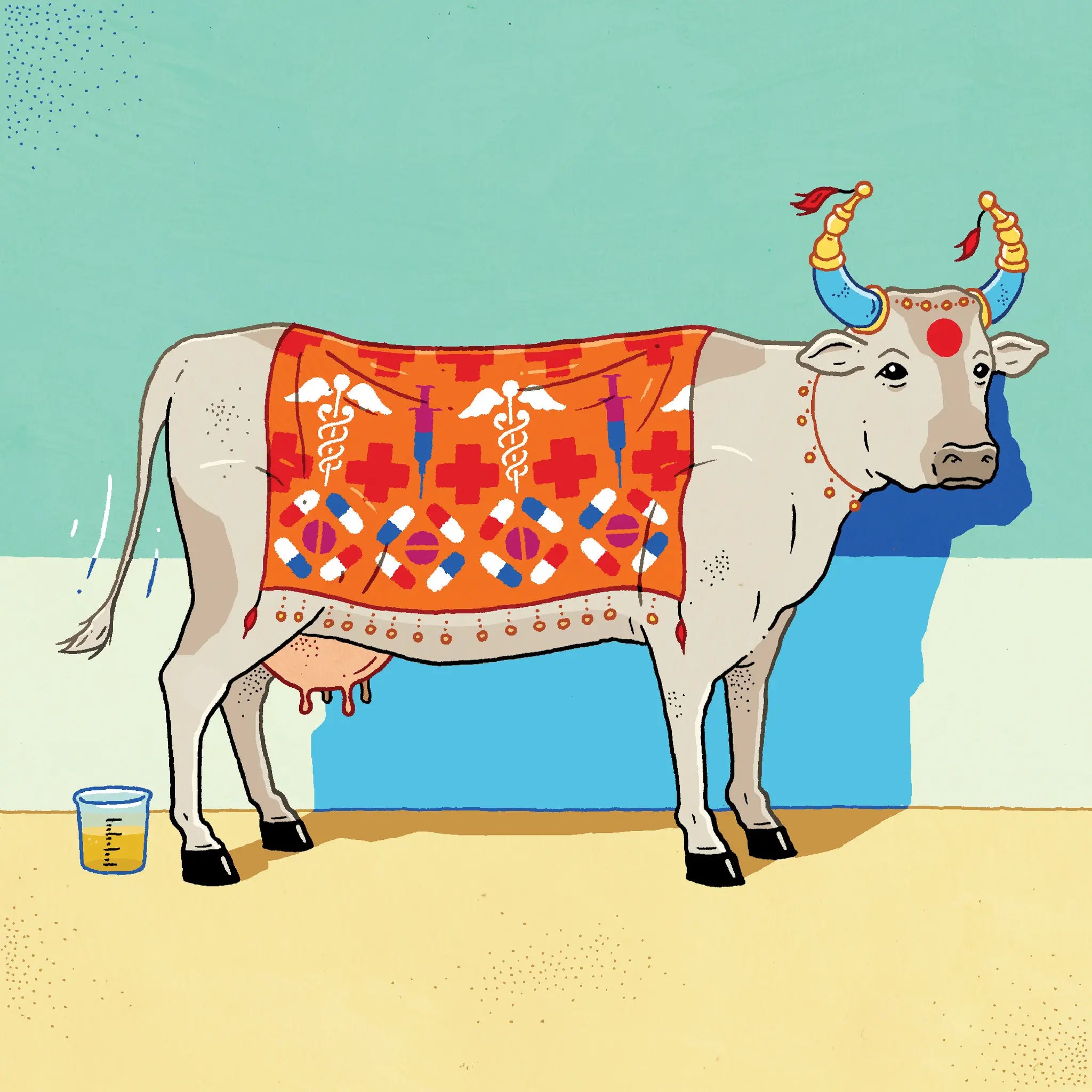
When Priyanka Gandhi Vadra described the accomplished IIT Madras Director, Prof. V. Kamakoti, as a “gaumutra expert” on the floor of Parliament, it was not merely a throwaway insult. It revealed something deeper—a persistent strain of contempt within India’s secular political elite toward Hindu religious and civilizational identity, along with an impulse to judge and mock Hindus for the wide and diverse range of beliefs and practices that together constitute the Hindu tradition.
Let us examine what exactly is being mocked.
In the Hindu worldview, all life is interconnected and imbued with divinity. The cow is sacred in Hindu Dharma because it combines spiritual symbolism with practical, life-giving value, and its reverence is also deepened by its association with Bhagwan Krishna. Hindu tradition likewise extends reverence to other forms of life—for instance, snakes are worshipped during Nag Panchami, the blackbuck is considered sacred by the Bishnoi community—reflecting a worldview that sees the sacred in creation itself. Gomutra (cow urine), within this framework, has been used in certain Ayurvedic preparations and ritual contexts. One may debate its efficacy, but to reduce it to a slur is to dismiss an entire knowledge tradition without inquiry.
Prof. Kamakoti is not a fringe figure. He is a highly respected computer scientist who has contributed significantly to India’s technological capabilities, including leading the development of SHAKTI, India’s first indigenous industrial-grade microprocessor. He has approached the subject of cow urine’s medicinal properties through a scientist’s lens, citing peer-reviewed research and treating it as a matter for study. Around the world, scientists maintain personal faith alongside professional rigor. ISRO scientists visiting Tirupati mandir before launches is one familiar example. Spirituality and science, in the Dharmic tradition, have rarely been seen as mutually exclusive domains.
The deeper question is this: why are Hindu beliefs uniquely singled out for mockery?
Many older religions and indigenous belief systems across the world have long shared the Hindu reverence for specific animals and their byproducts. The cow’s sacred status transcends India; ancient Zoroastrians revered the animal, and Parsi rituals today still utilize sprinkled cow urine (nirang) for purification. Similarly, traditional African pastoralist communities, like the Maasai and Dinka, view cattle as sacred symbols of life and wealth. Beyond the bovine, indigenous peoples globally center their spirituality around animals, such as Native American tribes who revere the American bison as a sacred relative and provider, or Arctic Inuit who view the polar bear as a powerful spiritual guide.
This reverence frequently extends into traditional medicine, where global systems differ widely from modern biomedical norms by utilizing ingredients that outsiders might find unsettling. Traditional Chinese practices incorporate human feces and animal penises, while Arabic and Unani remedies involve camel urine and goat testicles. Indeed, as per an authentic Hadith (Sahih al-Bukhari), Islam’s Prophet prescribed camel urine and milk to a group of sick travelers—and in traditional Arab and Bedouin societies, camel urine is still consumed fresh directly from the animal or sold commercially in bottles to local users and visiting pilgrims.
Beyond medicine, cultural subjectivity heavily shapes global views on what is normal versus taboo, as seen in American dung-throwing contests and the consumption of bison testicles or beaver urinary secretions for food flavoring. Similarly, the very thought of European ‘delicacies’ like Scottish haggis—sheep’s heart, liver, and lungs minced and cooked inside the animal’s stomach lining—would make many outsiders throw up. This visceral divide extends to livestock and pets; Westerners view horses and domestic dogs strictly as companions, yet those animals are esteemed as traditional delicacies in parts of South America, China, and Northeastern India
What is sacred or therapeutic in one culture may be rejected in another, yet in most global contexts, such differences are treated with a degree of anthropological curiosity or cultural respect. In India, however, Hindu practices are often subjected to a unique, visceral derision that minority or external traditions escape.
This asymmetry points to a profound mental colonization. It reflects an implicit acceptance of supremacist Abrahamic doctrines that dismiss Hindu Dharma as an “incoherent” or “false” religion, or reduce it to a foreign imposition by “Aryan invaders” with a name merely coined by Arabs or Persians. This mindset did not disappear with independence; it was deeply institutionalized in academia, media, and politics, producing a class of opinion-makers who comfortably critique Hindu practices in crude terms while remaining intensely cautious and respectful toward other religions and cultures.
Ironically, this disdain ignores the fact that the Hindu intellectual tradition has long accommodated debate, inquiry, and plurality. From the logical rigor of Nyaya to the linguistic precision of Panini, and from Aryabhata’s mathematics and astronomy to Kanada’s atomic theory, there has never been an inherent contradiction between spiritual exploration and empirical reasoning.
Contrast this with the modern ideological certainties of Indian Nehruvians and Marxists, who are indoctrinated to believe that only they possess a “scientific temper.” This claim to an exclusive monopoly on reason rings hollow when their own belief systems operate with the zeal of blind superstition. Their cult-like obsession and unquestioning deference to chosen figures—whether Marx, Stalin, Mao, or Nehru—completely mirror religious dogma. Indian Communists continue this blind worship despite the historical havoc wreaked by Marxism and Maoism, causing millions to perish globally. The utopian society Marxism promises—arriving after a bloody revolution and endless class conflict to create a world where borders, police and armies are obsolete and everyone lives in perfect harmony—utterly flies in the face of human history and the human condition. While Marxist dogmas collapse against reality, the Dharmic pursuit of purushartha (purpose of human life) remains profoundly viable because it recognizes human nature and the fluid dynamics of the gunas, motivating humanity to strive for genuine, balanced harmony rather than an impossible commune.
This internalized disdain is not confined to academic theory; it manifests directly as a coordinated theological assault within contemporary Indian politics. Both siblings of the Congress’ first family have been uttering openly mocking or borderline contemptuous anti-Hindu remarks for years now, revealing how Hinduphobia has become central to the party’s ideological core. As Congress’ reliance on Islamist, Christian, Marxist and neo-Ambedkarite fundamentalists has grown, and as its leadership surrounds itself with far-left radical voices, this hate for Hindus and their Dharma has crossed into dangerous territory.
Specific instances lay bare this theological and cultural hostility:
Rahul Gandhi’s denigration of Bhagwan Vishnu, and his tendency to set the Hindu deities Vishnu and Shiva in opposition, deserves serious analysis and should not be dismissed as immature commentary. It ties in with other remarks made by him during his Bharat Jodo Yatra, where he praised Bhagwan Shiva’s all-embracing detachment while contrasting it with “priestly systems” that “divide and oppress” (interestingly, ignoring the far more rigid and hereditary nature of priestly structures in Christian and Islamic traditions).
This strategy directly aligns with Left-academic, evangelical and Dravidian theories that seek to balkanize Hindu society by painting Bhagwan Shiva as an “indigenous, non-Vedic deity” who was maliciously ‘appropriated’ by Aryan invaders. By isolating Shiva from the broader Hindu landscape, this narrative seeks to decouple the deity from mainstream Hindu traditions. But when the opportunity arises, the same network and its Islamist allies do not hesitate to mock the Shivling, the sacred symbol used in the worship of Bhagwan Shiva.
Rahul Gandhi has also mocked the Hindu idea of punarjanam (rebirth) and claimed that “people have the burden of lakhs of lives on their shoulders.”
Furthermore, the drama enacted in parliament by the Samajwadi Party, Congress, and other opposition politicians recently to highlight the theft of donations at the Ram Mandir shows exactly how the Overton window has shifted in Indian secular politics into openly Hinduphobic territory. A criminal-turned-politician, Pappu Yadav, dressed up in saffron robes, holding a photo of Sri Ram, sat down with a large tin box, and MPs like Rahul Gandhi sauntered up to him wearing sandals and put some money in that box, which Yadav then pretended to steal and run away. This deliberate act of portraying Hindu sadhus and saffron robes in a bad light—when the actual theft at the Ram Mandir was done by counting staff and certain supervisors involved in handling donations, not sadhus—was not lost on anyone. The sant samaj has rightly condemned it, although not as loudly and unitedly as one would have hoped. Can one even imagine the global outrage if a BJP MP staged a similar skit, this time caricaturing child sex abuse by madrasa maulvis or church pastors—abuse scandals that have repeatedly surfaced in such religious institutions across the world?
Ultimately, the Sonia-led Congress’ opposition to Hindu Dharma is not just political, nor is it limited to historical submissions of affidavits in courts claiming that “Ram is imaginary.” It has now morphed into an aggressive theological and cultural opposition to almost everything Hindu, mirroring the exact, uncompromising contempt held by a fundamentalist maulvi or pastor. The “gaumutra” jibe, then, is not merely an isolated political insult. It represents a coordinated, malicious attempt by a mentally colonized elite to demonize the very civilizational soul of Bharat —a dangerous campaign that sacrifices cultural cohesion for electoral appeaseability and threatens to tear the nation’s social fabric apart. – Reverse the Gaze, 3 August 2026
› Reverse the Gaze is an anonymous author on Substack.