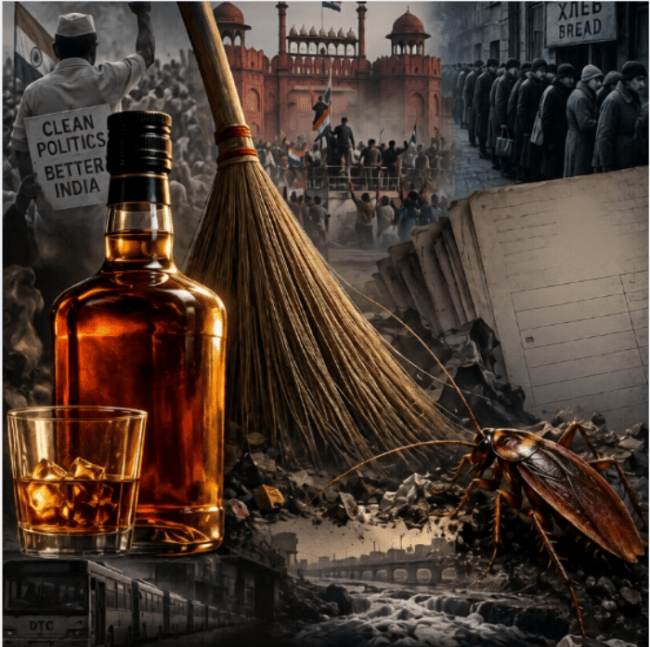
The symbols — bottle, broom and cockroach — change but our weakness remains the same: hope can misguide us into forgetting the lessons of the past. – Mayank Jain
How Intoxication Makes History and Suffering Disappear
Sita Ram Goel once told a disturbing parable. A man had strangled his wives yet women continued to marry him. Each new bride knew what had happened before but persuaded herself that her own story would be different. Circumstances had changed. Perhaps she understood him better. Perhaps what happened to the others would not happen to her. Wishful thinking had acquired the appearance of reason.
The horror of the parable lies not merely in the murderer but in the failure of memory and judgement. Human beings can know what happened yesterday and still persuade themselves that tomorrow will somehow be different. Politics repeatedly exploits this weakness. The old order is declared rotten and a new movement arrives promising purification through a new symbol — a rose, a fist, a broom and now a cockroach.
The last symbol is unintentionally revealing. In nature cockroaches can be useful decomposers. In human habitation they are pests capable of carrying pathogens such as Salmonella and E. coli, while their shed skin and droppings can trigger asthma and allergies. The broom promised to clean the system; the cockroach thrives in its filth — and can spread the disease.
Delhi’s broom once possessed enormous moral power. Anna Hazare’s fasting body became an accusation against an entire political class while Arvind Kejriwal supplied the organisation and strategy capable of converting indignation into political power. The outsider eventually entered the Secretariat.
The destination of this austere revolution contained a remarkable irony. Kejriwal had identified himself with the rejection of VIP culture and ostentatious government privilege. Years later his official residence at 6 Flagstaff Road became the centre of the controversy his opponents called the “Sheesh Mahal”. The CAG found that a project initially estimated at ₹7.91 crore and awarded for ₹8.62 crore ultimately cost ₹33.66 crore. Of that final expenditure, ₹18.88 crore went into additional items involving what the audit described as superior-specification, artistic, antique and ornamental work. The built-up area itself increased by 36 per cent. The numbers supplied their own political metaphor: the movement that entered power carrying a broom and preaching austerity had arrived at a ₹33.66-crore residence.
From the Fast to the Bottle
Perhaps no image captures the transformation more cruelly than liquor. India Against Corruption had been born amid fasting, sacrifice and Gandhian imagery. A decade later, during the COVID period, Delhi witnessed liquor retailers offering a bottle free with every bottle purchased — “buy one, get one free” — under the AAP government’s excise regime. The movement born around an old man’s fast against corruption had travelled from abstinence to an excise regime associated with aggressive liquor discounting. The financial consequences were serious too. The CAG subsequently estimated a ₹2,002.68-crore revenue loss arising from deficiencies in the formulation and implementation of the 2021–22 excise policy.
But the bottle interests me for a reason larger than Delhi. Alcohol has historically offered governments an extraordinary combination: revenue for the state and oblivion for the drinker. An intoxicated man can forget his misery for an evening. The unpaid bill disappears, humiliation recedes and tomorrow loses urgency. Morning arrives, circumstances remain unchanged and the bottle beckons again. Intoxication privatises anguish. Instead of asking why his circumstances remain miserable, a man acquires a temporary escape from them. The sorrow has not been cured. It has merely disappeared from consciousness.
Tsarist Russia constructed an enormous fiscal machine around vodka and, remarkably, the Communist state rediscovered the same instrument. Lenin maintained prohibition but after his death Stalin restored the Tsarist-era vodka monopoly, importantly for state finance. Mark Lawrence Schrad traces the continuity across supposedly antagonistic systems: the Tsar fell and Communism abolished the aristocracy but the political utility of intoxication survived the revolution (Mark Lawrence Schrad, Vodka Politics).
Gorbachev’s anti-alcohol campaign exposed the trap from the opposite direction. Once the state becomes dependent upon alcohol revenue, curing alcoholism carries a fiscal cost. Misery encourages intoxication, intoxication generates revenue and revenue makes the state materially dependent upon the source of intoxication. The worker believes he is escaping the system for an evening; the system is collecting money from his escape.
Apartheid South Africa offers another disturbing example. Under the notorious dop system, agricultural labourers in parts of the Cape were historically remunerated partly in wine, a practice studied explicitly in relation to alcohol abuse and social control. Alcohol could become part of a structure that impoverished a family while making its suffering temporarily easier to endure. Across radically different political systems, the mechanism survived: revenue for authority, oblivion for the citizen. Consolation is easier to distribute than competence.
When the Rebel Became the Establishment
Ramlila Maidan briefly made corruption a moral question in Indian homes. The Lokpal was being discussed by people who had never read a statute. Millions believed politics might finally be purified by people who did not resemble politicians. Kejriwal converted that moral energy into organisation and electoral power. But power brought new interests — offices, money, loyalists and the need to stay in power. By 2017 Anna Hazare was looking back with a devastating sentence: “I hope no Kejriwal comes out of my movement again.”
The lesson goes beyond Kejriwal. Movements that claim to be morally superior often discover that power changes their leaders too. The broom had promised to change politics. Instead, power changed those carrying the broom.
When the Broom Met the Ledger
Eventually every revolution meets arithmetic. DTC recorded a loss of ₹8,498.35 crore in 2022–23 (CAG, State Finances Audit Report of the Government of NCT of Delhi, 2022–23). A loss on that scale is not an accounting abstraction. Public finance eventually becomes human experience — in buses, roads, hospitals, water supply and the quality of institutions a citizen encounters every day.
The Delhi Jal Board illustrated the problem differently. Water can be made free to the consumer but water itself cannot become free. Somebody must source it, purify it, pump it, maintain pipes and sewers and treat what eventually enters the Yamuna. A government can remove a bill from a household; it cannot repeal engineering.
The Mohalla Clinic was similarly an attractive idea: take primary healthcare closer to people. Yet against a target of 1,000 clinics, only 523 were operational by March 2023. Auditors also found that in the period examined, 70 per cent of patients in sampled clinics spent less than one minute with the doctor. A healthcare promise ultimately has to survive contact with a patient. Politics can announce an entitlement in an afternoon. Institutions capable of delivering it take years to build.
The Intoxication of Populism
The bottle now becomes a wider metaphor. Populism can also intoxicate. The bottle offers immediate escape from suffering; the freebie offers immediate escape from economic cost. Both can obscure who eventually pays. A sewage-treatment plant cannot compete emotionally with a zero bill.
Welfare and populism are different. Welfare helps people become stronger; populism gives immediate benefits to win their support, often at tomorrow’s cost. The real question is whether public spending strengthens people and institutions or weakens institutions to keep people happy.
Venezuela is an extreme warning. Oil wealth allowed the government to fund subsidies and cheap imports while domestic agriculture and industry weakened. When oil revenues fell, the country could no longer afford what it had become dependent on importing. Shortages, inflation and mass emigration followed. Political disasters rarely look dangerous when they begin.
Communist societies generated their own jokes about this gulf between ideological promise and everyday reality. An old Eastern Bloc joke has a man standing for hours in a bread queue in the freezing cold. Finally he explodes: “I have had enough of this Communist regime. I am going to shoot the General Secretary!”
An old Soviet joke tells of a man who has been standing for hours in a bread queue. Finally, furious with the shortages, he shouts, “I’ve had enough. I’m going to shoot Brezhnev!” and storms off.
An hour later he returns and quietly takes his place in the bread queue again.
“What happened?” his friend asks.
The man sighs: “The queue to shoot Brezhnev was even longer.”
The joke captured the absurdity of a system in which shortages had become so common that even getting rid of the leader required standing in a queue.
This is why a competent government is less glamorous than revolutionary politics. Sewage treatment, water pressure, bus maintenance, hospital staffing and balanced accounts do not generate the emotional excitement of a movement. But civilisation depends upon precisely these boring achievements.
Punjab: The Second Laboratory
Punjab gave AAP something few political experiments receive: a second laboratory. It also inherited one of India’s most terrible social problems — narcotics. The Tribune estimated in 2025 that 7.5 lakh to 10 lakh people in Punjab were addicted to heroin, consuming an estimated 93.75 kg daily and spending an average ₹60–70 crore every day.
The government’s enforcement campaign has produced arrests and seizures but the magnitude of those figures itself reveals the scale of the disease. Behind them are households in which savings disappear, possessions are sold and parents watch addiction consume the future they imagined for their children.
The narcotic makes the same promise as the bottle: I cannot remove your sorrow, but I can make you forget it for a while.
Russia’s vodka, South Africa’s alcohol system, Delhi’s liquor politics and Punjab’s narcotics tragedy belong to very different histories but expose the same psychological vulnerability. Suffering disappears from consciousness without disappearing from life.
Goel’s United Front
Here another warning from Sita Ram Goel becomes particularly relevant. In Hindu Society Under Siege, he wrote:
“The United Front between Islamism and Communism has been in existence and active since the early forties. … Christianism … has not been an equal and direct partner. … This United Front functions under the protective umbrella of Macaulayism.”
Goel was not describing three identical ideologies. He was describing forces with different doctrines, constituencies and ambitions which, in his analysis, could nevertheless converge against Hindu society. Elsewhere in the same discussion, he identified different social fields in which he believed these ideologies operated: Christianism among tribal Hindus, Islamism among Dalits and Communism among the upper and middle classes. Goel’s argument was simple but powerful. Different forces do not need the same goals to unite against a common enemy. They may disagree about the India they ultimately want but can still work together against the civilisation or political order they all oppose.
Delhi offers a good example. Different political and ideological groups repeatedly came together around the same protests. Jamia, Shaheen Bagh and the anti-CAA protests began around a law but soon became part of a much wider political mobilisation. Sharjeel Imam’s words revealed how far some of the rhetoric had travelled. Speaking at Aligarh Muslim University in January 2020, he said: “If we have five lakh people with us, we can cut off the Northeast from India.” He spoke of blocking roads and railway tracks so that Assam would be separated from the rest of India, at least temporarily.
Then, during Donald Trump’s visit in February 2020, north-east Delhi erupted in riots. Fifty-three people were killed. Homes and businesses were destroyed within hours, leaving families to live with the loss long after the riots ended.
The farmers’ agitation became another huge protest movement. On Republic Day 2021, sections of protesters left the agreed routes, broke barricades, clashed with police and stormed the Red Fort. CCTV cameras, metal detectors and other property were damaged. What was presented as a protest over farm laws ended with one of India’s greatest national symbols being vandalised.
Goel’s warning therefore leaves us with questions more important than the slogan of any particular agitation: who converges around a movement, who supplies its intellectual legitimacy, who amplifies it and what political order emerges if the movement succeeds?
The Colour-Revolution Trap
Colour revolutions understood the power of symbols. They turned complex politics into a simple battle between a corrupt government and a virtuous public, represented by a colour, flower, fist or other symbol. Public anger provided the energy while organisation, funding, media, international support and political ambition helped turn that anger into a movement.
Georgia’s Rose Revolution of 2003 was initially celebrated around the world. The new government reduced petty corruption and strengthened parts of a dysfunctional state but the revolutionary halo offered no protection against concentrated power. In 2007 the government violently dispersed opposition protests and imposed a state of emergency. Then came the disastrous 2008 war with Russia and enduring territorial fracture involving Abkhazia and South Ossetia.
The lesson is larger than Georgia. Destroying legitimacy is easier than constructing legitimacy. A crowd can help bring down a government within weeks. Building institutions capable of restraining power, administering justice and holding a divided country together can require generations.
A rose identifies the enemy. A broom promises cleansing. Neither runs buses, treats sewage or administers courts. Revolution simplifies; government must deal with everything the slogan omitted.
From the Broom to the Cockroach
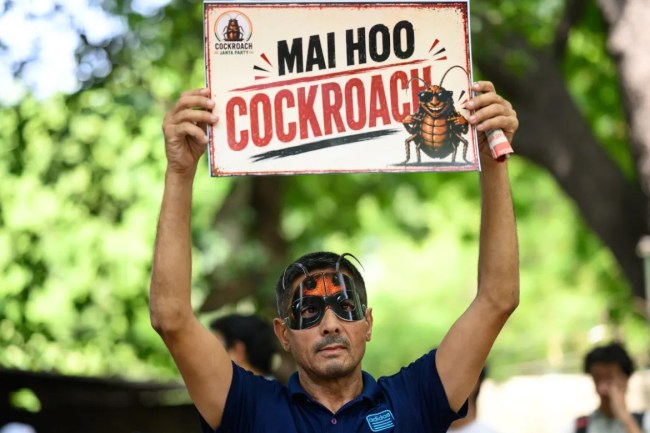
And now another symbol has appeared. The Cockroach Janta Party has brought together anger over examinations, jobs and institutions. The broom belonged to the television age; the cockroach belongs to social media, where an insult can become a meme, a meme can become an identity and an identity can quickly become a political movement.
Sonam Wangchuk initially gave the movement credibility. But by August 2026, he was distancing himself from its founders, calling them “not saints” and saying they appeared to have political ambitions. He wanted the student movement to remain independent of political parties..
Delhi has seen this pattern before. Moral credibility builds trust, trust brings crowds and crowds create political power. The broom also began with a promise to clean up politics. What happened afterwards is exactly why we should not forget that history when another movement arrives with a new symbol.
Delhi has already paid the price for one political experiment. A new name, younger faces and a new symbol do not necessarily mean a new kind of politics. The lesson of AAP is simple: the next movement promising to clean up politics should be examined carefully before it is trusted.
And then there is the symbol itself. The broom promised to clean the system. The cockroach survives in the very dirt the broom failed to remove. The question now is simple: will the cockroach clean up the system or thrive in its dirt?
When Intoxication Erases Memory
We return finally to Sita Ram Goel’s parable. Every woman knew what had happened to the women before her. Yet each believed that her own story would end differently. That was Goel’s warning: history may show us the danger but hope can misguide us into believing that this time will be different.
Political intoxication works similarly. Revolutionary certainty can intoxicate. Populism can intoxicate. The conviction that this time the faces are different can intoxicate. Every new movement offers essentially the same reassurance: they became corrupt, we shall remain pure; they wanted power, we want change; they betrayed the movement, we are the movement.
Real people pay the price for political experiments. Anna’s supporters gave the movement their trust. Families devastated by addiction lose much more than money. Fifty-three people lost their lives in the Delhi riots. The Red Fort was vandalised. And angry young people can easily become a ladder for someone else’s rise to power.
That is what connects the bottle, the broom and the cockroach. The symbols change but our weakness remains the same: hope can misguide us into forgetting the lessons of the past.
That is the warning in Sita Ram Goel’s parable. The husband had killed his wives before, yet each time he could present himself as innocent and convince another woman that the past did not tell the truth about him. She knew what had happened to the others but still believed that her own story would be different. Politics often works in the same way: the record is there but a new promise makes us believe that this time will be different.
The bottle makes us forget our suffering. Revolutionary politics makes us forget history. And when we forget history, the next promise looks new again.
› Mayank Jain is an author and filmmaker with more than 50 critically acclaimed films to his credit. His work spans governance, national security, public health and social reform and is known for tackling complex issues with intellectual rigour and cinematic clarity.