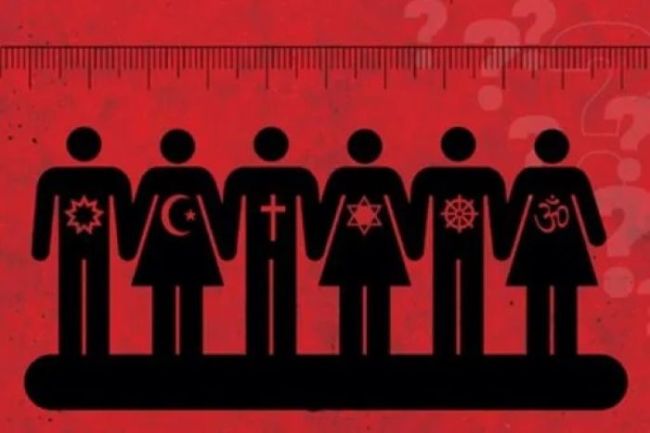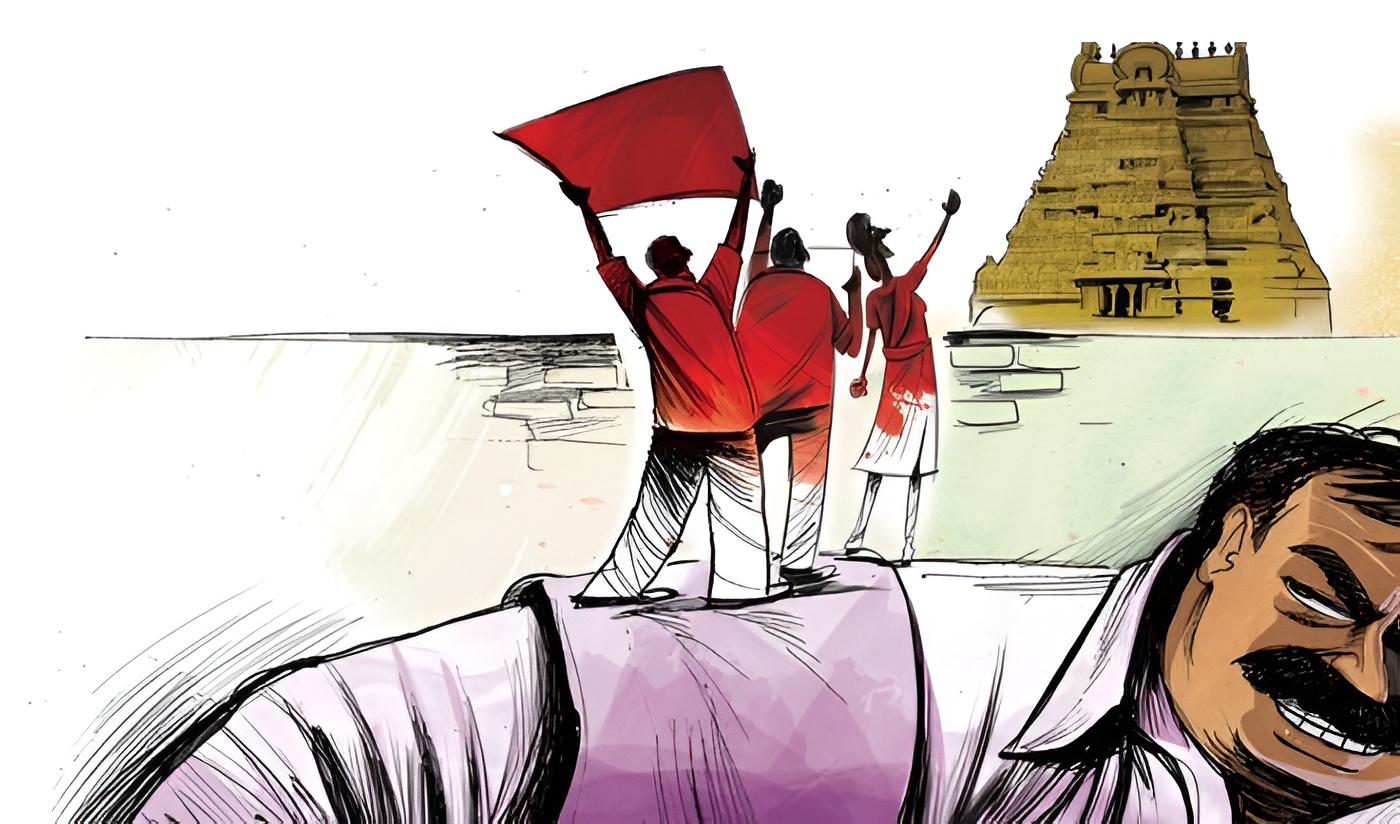
A glaring example of the anti-Hindu nature of Indian secularism is provided by the way Hindu temples have been taken over by the state governments. The extent of this practice is simply mind-boggling. What is even more disturbing is that some of the states, where the BJP is in power, have not discontinued the practice. – Prof. Arvind Sharma
Part One
How secularism has failed India
This question can no longer be dodged.
Secularism, in its broadest connotation, was held up as the guiding principle of the new country when it came into existence in 1947, and of the new republic in 1950 when it adopted a Constitution, which was secular in every respect except in name, which too was added to it in 1976, by the Constitution (Forty-Second Amendment) Act.
But what is secularism? The fundamental principle of secularism is the separation of Church (or religion), and State. The state stays away from religion, and religion stays away from the state. All the citizens become subject to secular law as equals, religion becomes a private matter, which is kept out of the public square, and religious peace is thereby secured.
Let us now examine how well this principle has worked in India. What does the record of the past 75 years reveal in this regard? This is a considerable slice of time, almost a third of the period of British rule over India.
Has the Indian state stayed out of religion?
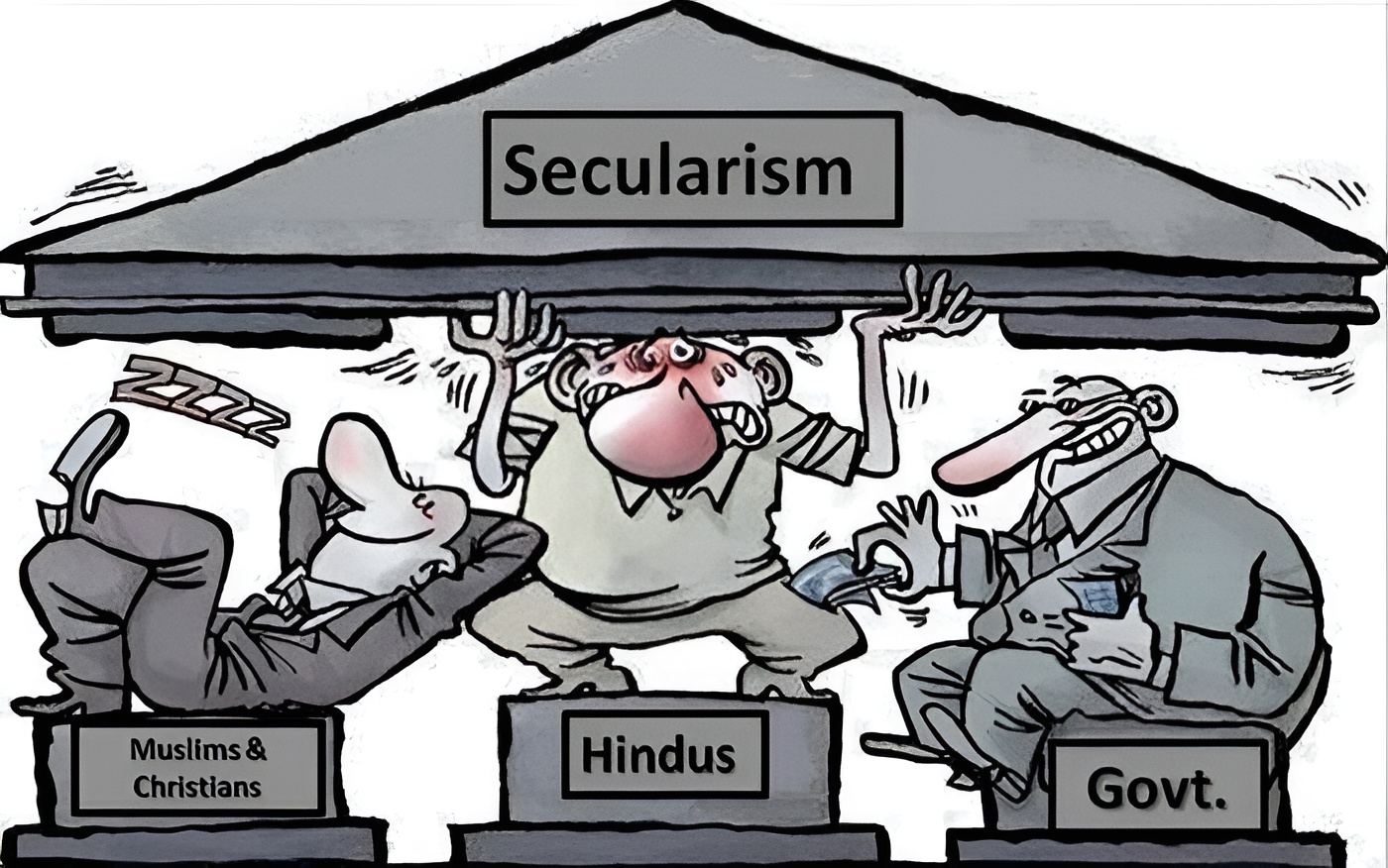
Let us take the case of just one state such as Tamil Nadu. Tamil Nadu has about 44,000 temples. Out of these, 38,000 are run by the Tamil Nadu government. If we spread our net wider, we discover that around 34,500 temples are under the control of the state of Karnataka. It has been further calculated that around 90,000 temples in the five southern states of Tamil Nadu, Kerala, Karnataka, Andhra Pradesh, and Telangana are run by the state governments.
One is compelled to ask if this degree of state control of temples is consistent with secularism. Is it a tenet of Indian secularism, that it is only the central government which will stay out of religion, and not the state governments? I know of no such principle. Both the central and the state governments represent the state in India.
Sometimes it is argued that the governments take temples over to fight corruption, but other secular democracies do not take over a religious institution if they suspect foul play; they take the institution to court, precisely because a secular government is supposed to stay out of running religious institutions. So far as corruption is concerned, the likelihood of the state governments themselves getting corrupted by running the temples cannot be discounted either. According to one source, the various state governments collected a total of around Rs 6,000 crore from the temples in the year 2020. According to another source, Rs 2,300 crore from the Tirupati temple were transferred to the treasury of the Andhra government in 2021. With such astronomical amounts of money floating around, the possibility of corruption cannot be overlooked. Just imagine that the annual hundi collection of Tirupati is Rs 1,310 crore, of Vaishno Devi Rs 520 crore, and of Siddhivinayak Temple Rs 98 crore. There are good reasons why a secular state needs to stay out of religion.
Can the Indian state still be considered secular? Consider this. In both Delhi and West Bengal, both Hindu and Muslim priests are receiving monthly stipends from the respective state governments. This also seems to be a serious violation of the secular principle.
A secular legal system is the next feature one needs to consider in this context. This is the necessary legal basis of the secular state. In keeping with this realisation, the Constitution directed the government to move towards evolving a Uniform Civil Code for all its citizens in keeping with Directive Principle No 44. In the absence of such a code, a Muslim can have four wives in India but other citizens are restricted to monogamy, to mention just one anomaly. The principle of equality also has implications for the running of religious institutions by the state. Only Hindu institutions, it seems, have been taken over by the state governments; Muslim and Christian institutions have been left untouched, although they are also subject to Article 25 of the Indian Constitution.
A remarkable example of the inequality in this respect has come to light recently. The St. Stephen’s College is a well-known Christian institution of higher education in Delhi. According to newspaper reports, it receives substantial funding from the Indian government; some reports put the extent of support as high as ninety per cent. However, fifty per cent of the student body is said to be Christian. According to reports, the college now wants to influence the procedures for admission for the other fifty percent. One wonders how all this can be reconciled with the idea of secularism.
Has Indian secularism succeeded in securing religious peace as promised? The record is extremely distressing in this regard. Over the years, Hindus have killed Muslims and Christians. The names of Akhlaq and Pehlu Khan come to mind, who were lynched by Hindu mobs, and of the Christian missionary Graham Staines, who was killed by Dara Singh. Muslims have also killed Hindus, as the film The Kashmir Files documented, and as happened recently in Udaipur and Amravati. Christians have also killed Hindus, as in the case of Swami Laksmananada, in Kandhamal in Odisha. It is remarkable that a secular state has succeeded in making members of both the majority and minority community equally insecure.
In other words, it could be argued that secularism has failed in India, but can we conclude from this that secularism has failed India?
It has been said that the trouble with Christianity is that it has never been tried. The same could be said of secularism in India. The parallel is tempting.
Just as, by and large, the impressive ecclesiastical structures of Christianity pay lip-service to the principles of Christianity, but hardly ever seem to abide by them, according to its critics. Similarly, the impressive political structures of Indian democracy, regularly pays lip-service to the principles of secularism, but seems to ignore its basic principles in the actual functioning of it.
The secular foundation of the Indian nation has been receiving one jolt after another in the form of The Kashmir Files, the hijab controversy, the Gyanvapi mosque episode, the Nupur Sharma controversy, and now its gory aftermath—for how long will it be able to withstand such shocks?
The government or governments should immediately get out of the business of running Hindu temples, as by not doing so they violate one of the basic tenets of secularism, even as they invoke it. Similarly, equality of all citizens before the law must be established, which is to say that a Uniform Civil Code in some form must be introduced as soon as possible, before the so-called secularism collapses under the weight of its own contradictions.- Firstpost, 24 July 2022
Part Two
The anti-Hindu nature of Indian secularism
In an earlier post, I tried to draw attention to what I perceived to be the failure of Indian secularism. In this post, I would like to identify its anti-Hindu character.
I admit that the claim, that Indian secularism is perceived as hostile to Hinduism, is a controversial claim, and therefore, I would like now to provide the evidence in support of this claim.
Soon after independence, the Hindu community rebuilt the Somnath Temple which had been destroyed by Mahmud of Ghazna in the 11th century, and also subsequently by other rulers. Jawaharlal Nehru, first prime minister of India, not only declined to participate in the celebration but also tried to prevent the then president of India from participating in it, whereas Pandit Nehru had no compunction in attending functions of a similar kind when organised by minority religions.
Although the Indian Constitution directs the government to endeavour to establish a uniform civil code for all Indians, the then government only consolidated Hindu personal law and left the minorities out of that exercise. This was, and is, perceived as discrimination against the Hindus. It leads to the anomaly that a Muslim in India can have four wives, but not the followers of other religions in India. It is not so much that the followers of other religions want to have four wives; the feeling of resentment springs from the discrimination involved.
Another aspect of the Constitution, which has caused considerable anguish in the Hindu community, is that the rights of the minorities to run their own institutions are clearly safeguarded in the Constitution but no such protection is afforded to the institutions run by the Hindu majority. A glaring example of how this works out in the field is provided by the Ramakrishna Mission. This quintessentially Hindu body petitioned the courts in 1980 to have itself declared a non-Hindu minority religion (following Ramkrishnaism), in order to benefit from the protection of Article 30 of the Indian Constitution, which allows Muslim and Christian institutions to safeguard their autonomy. The request was finally turned down by the Supreme Court of India in 1995, after the Calcutta High Court had accepted it. The fact that a Hindu institution had to claim to be a minority institution to safeguard its independence speaks volumes.
According to most scholars, the case of Shah Bano disillusioned many Indian intellectuals regarding the commitment of the Indian government to secularism. Shah Bano was the name of a Muslim divorcee, who petitioned Indian courts for maintenance under India’s secular laws and the request was granted by the Supreme Court. The government, however, under pressure from the Muslim lobby in India, introduced legislation in 1985 to modify it in accordance with Islamic law. The prolonged debate around the issue, and the volte-face of the government on the issue, seriously undermined popular confidence in the secular claims of the Indian government. One Muslim member of the cabinet, Arif Muhammad Khan, resigned over the issue. He now serves as the Governor of Kerala. According to him, the Shah Bano case was a point of departure on the issue of secularism.
The Indian government has rarely shown such legal sensitivity in cases involving Hindus.
Kashmir has been a bone of contention between India and Pakistan for a long period. It could be argued that Kashmir as a Muslim majority state within India, which is a largely Hindu country, is a strong factor in keeping India secular. However, a chain of events from 1989 to 1991 led to the expulsion of a large number of Hindus from the state, amidst violent circumstances in which many Hindus lost their lives and those that survived the convulsion had to be accommodated in camps in Jammu. The spectacle on TV of unarmed Hindus being driven out of the Kashmir Valley to threats of rape and murder (some of which were carried out) was not the best advertisement for Indian secularism. The plight of the exiled Hindus has been captured in a film, released recently under the title The Kashmir Files and creates the impression that there is no place for Hindus if they are in a minority anywhere in secular India.
A glaring example of the anti-Hindu nature of Indian secularism is provided by the way Hindu temples have been taken over by the state governments. The extent of this practice is simply mind-boggling. What is even more disturbing is that some of the states, where the BJP is in power, have not discontinued the practice.
It is difficult to imagine a more serious violation of the secular principle. It has led to such potentially incendiary developments, as money collected from Hindu temples being used to fund Haj trips for Muslims, and trips to the Holy Land for Christians. It is as if the looting of the Hindu temples, once associated with Muslim and British rule, continues unchecked in a secular India.
I hope enough evidence has now been provided to convince the sceptical reader that the charge regarding the anti-Hindu nature of Indian secularism should be taken seriously. – Firstpost, 21 August 2022
Part Three
India should have adopted pluralism rather than secularism
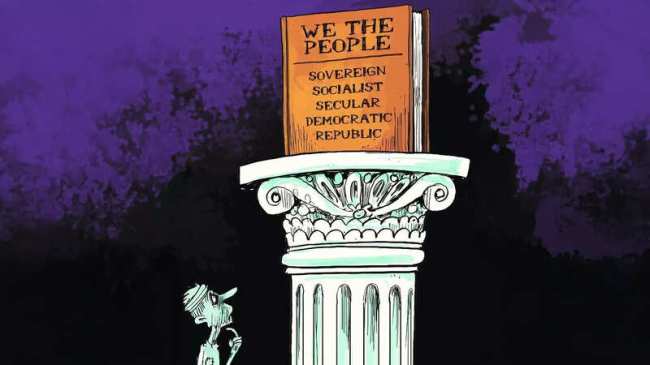
India famously claims to be a secular state. What is the basis for this claim? The claim rests on the grounds that the present Constitution of India declares it as such in the Preamble. Two objections could be raised against this claim. The first, that the original version of the Constitution did not contain this word in the Preamble and it was inserted into the Constitution during Emergency (1975-1977) imposed by Mrs Indira Gandhi. Emergency is generally regarded as a dark period for Indian democracy and therefore the insertion remains questionable. The second could be that although the Constitution claims to be secular, some of its provisions favour the minority religions over the religion of the majority, and therefore cannot be accepted as a genuinely secular document.
These are heavily contested points, so let me make it clear that, for the purpose of this column at the moment, we will accept the statement that at face value India is a secular state.
The point to note then is that the concept of secularism arose in the Western world, in a context in which religion dominated the public square. Religion in the Western world, as a term, connotes exclusive religious identity. In the broader context of the Abrahamic religious traditions, one cannot be a Jew, a Christian, and a Muslim at the same time, although all of them are monotheistic religions and believe in only one God. In the narrower context of the Christian world, one cannot be a Catholic or a Protestant at the same time, although both accept Jesus Christ as their Saviour. Such exclusive religious identification, in the Christian world, did not pose a problem so long as Roman Catholicism remained the dominant form of Christianity, but the situation changed with the Protestant revolution ushered in by Martin Luther (1483-1546). The Reformation, as it was called, ultimately led to enormous political conflict when different principalities in Europe started espousing the cause of different sects. The idea of the separation of the church or religion from the state, which is the key conceptual element of secularism, then arose as a way of dealing with the religious conflict generated by these developments.
This concept was then applied to India, where the dominant concept was one of dharma, which does not insist on an exclusive religious identity. One could challenge this point by insisting that the concept of religion, as a replacement for dharma, had been successfully introduced in India during the British period through the decadal censuses; that the introduction of the Western concept of secularism was therefore justified to deal with the problems of religious life in India. More than seventy years have passed since secularism was adopted as a possible solution to the problem, but it does not seem to have produced the desired outcome so far.
This raises the question: What went wrong? Could it be that the close connection between European secularism and Christianity was overlooked when the concept was applied to India? Was Indian reality perceived through a European lens and the European solution applied to an Indian problem unthinkingly, thereby creating or aggravating the very problem it was meant to solve in Europe, in India; that the treatment created the disease? Was the fact also overlooked that Europe faced a sectarian problem, not a religious one? That is to say, Europe faced the problem of conflict among different sects, all of whom professed Christianity, while India faced the problem of conflict among various religions. Could a solution meant to resolve an inter-sectarian problem, be applied to an inter-religious problem, such as the one faced by India?
Let us, however, adopt a historical approach to the issue for a moment. Then it becomes clear that just after World War II, when India became independent and the Constitution was framed, the key term invoked in matters of religion was secularism. Let us now fast-forward to our own times. Is the word secularism still the flavour of the season? To a certain extent it is, but there has also been a new development. In the interval, the West has witnessed what has been sometimes referred to as “marbling”. The word refers to the fact that the West, which was previously monochromatic, has changed. The West, which was overwhelmingly Christian until the end of World War II, has now sizeable minorities following religions other than Christianity within its borders, with the result that it finds itself as much in an inter-religious situation as an inter-sectarian one. The word now increasingly being used, as a response to this new situation, is pluralism.
What then is the difference between secularism and pluralism? Secularism wants to keep religion in general, and any religion in particular, out of the public square; pluralism wants to find a place for all of the religions, and ideologies, in the public square. Both want to avoid the public square being dominated by any religion (or sect or ideology); secularism wants to achieve this result by keeping religion out of it altogether, pluralism wants to prevent it from being dominated by any one religion by allowing all an equal place at the table.
Perhaps our Constitution would be more in sync with the dharmic traditions of India if it adopted pluralism rather than secularism as its guiding principle. Perhaps it is not too late to make the change. – Firstpost, 14 Novemeber 2021
› Prof. Dr. Arvind Sharma, formerly of the IAS, is the Birks Professor of Comparative Religion at McGill University in Montreal Canada, where he has taught for over thirty years. He has also taught in Australia and the United States and at Nalanda University in India. He has published extensively in the fields of Indian religions and world religions.