For the Hindu, evolution being the work of a blind watchmaker creates no problem. The creator-god is not the supreme power. He is not infallible. He is but a form of the Mother Goddess. – Aravindan Neelakandan
Unlike Christendom, Hindu intelligentsia did not have a problem with the idea of evolution. Evolution came to India within a few decades of 1859. In 1879, the Krishna Samhita of Kedarnath Datta Bhaktivinoda was published. He was the grand guru of Abhay Charanaravinda Bhaktivedanta Prabhupada Swami, the founder of ISKCON. Particularly interesting is the way Bhakitivinoda Swami treats the Dashavatara concept in his book:
Here the Samhita describes how each incarnation of God successively assumes a physical form to match the evolutionary development of the embodied soul (jivatma) from its most primitive invertebrate state to its highest vertebrate and intelligent state. Not only do these passages suggest the evolutionary theories of Darwin, they also reflect the view that the passage of time is synonymous with progress. – Shukavak N. Das, ‘Bhaktivinoda and Scriptural Literalis’ in the Hare Krishna Movement: The Postcharismatic Fate of a Religious Transplant, 2004.
Whether such a progressive evolution is consistent with Darwinian evolution is another question. But that the Hindu scholarship of that time could approach religion with what Vinoda Swami himself called Adunika Vada or modern approach is what is important.
Again, two important savants of Hindu dharma in modern context, Swami Vivekananda and Sri Aurobindo had no problem with evolution. In fact, Sri Aurobindo could sing it in his Savitri.
Hindu puranas speak of the humbling of both Brahma the creator-god and Indra the celestial sky-god. In Skanda Purana, we see Skanda-Muruga humbling the creator-god because he did not know the meaning of Aum through which alone, he creates. In Bhagavata again, we see that Brahma is humbled by Sri Krishna—who emanates the entire population of cowherds, when Brahma hides them. Again, Indra is also humbled when he becomes jealous and seeks to get revenge for the cowherds worshipping the Govardhan mountain.
Knocking down of Brahma, humbling of Indra—the conceited creator-god and the jealous sky-god is known to every child of Hinduism. As Swami Vivekananda says, it is manifestation not creation—and a Hindu child knows this truth. So, when science speaks of the random mutation and natural selection ushering in the infinite variety of life, the Hindu child can say with Darwin, “there is grandeur in this view of life.…”
Sri Aurobindo in his commentary on the Kena Upanishad explains:
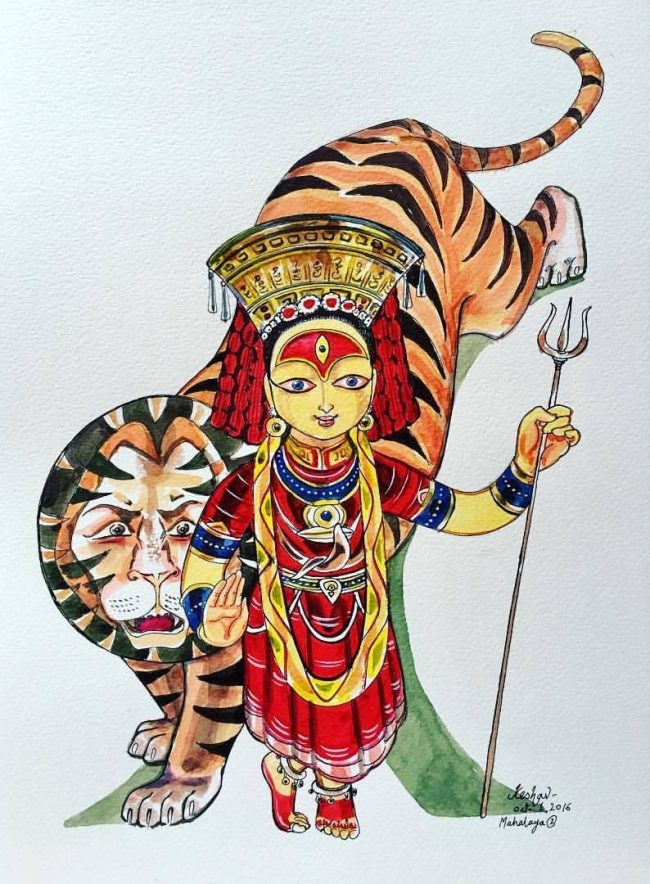
Uma is the supreme Nature from whom the whole cosmic action takes its birth; She is the pure summit and highest power of the One who here shines out in many forms. From this supreme Nature which is also the supreme consciousness the gods must learn their own truth; they must proceed by reflecting it in themselves instead of limiting themselves to their own lower movement.
The gods, devas, are hence just movements in the infinite consciousness that is She.
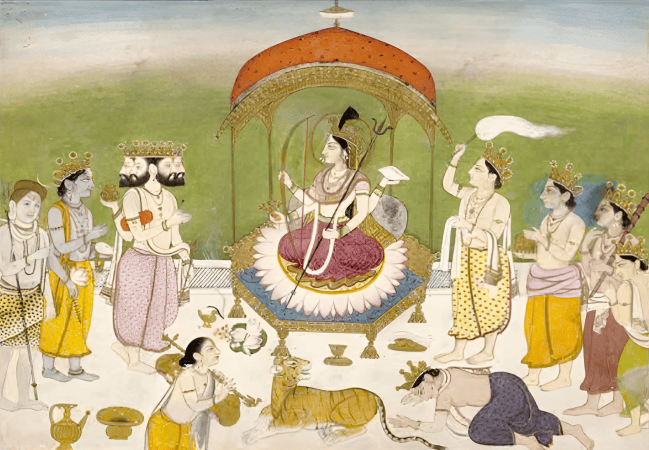
In fact, the names from 256 to 262 in the Sri Lalita Sahasranama speak of Her as doing the five functional archetypes of creation, sustenance, dissolution, veiling and liberation as the five gods themselves—Brahma, Vishnu, Rudra, Ishwara and Sadashiva (Names: 264 to 273).
So, for the Hindu, evolution being the work of a blind watchmaker creates no problem. The creator-god is not the supreme power. He is not infallible. He is but a form of Her.
In the nascent stages of Christianity, particularly during its Gnostic phase, the same insight into the Divine Feminine was present there too.
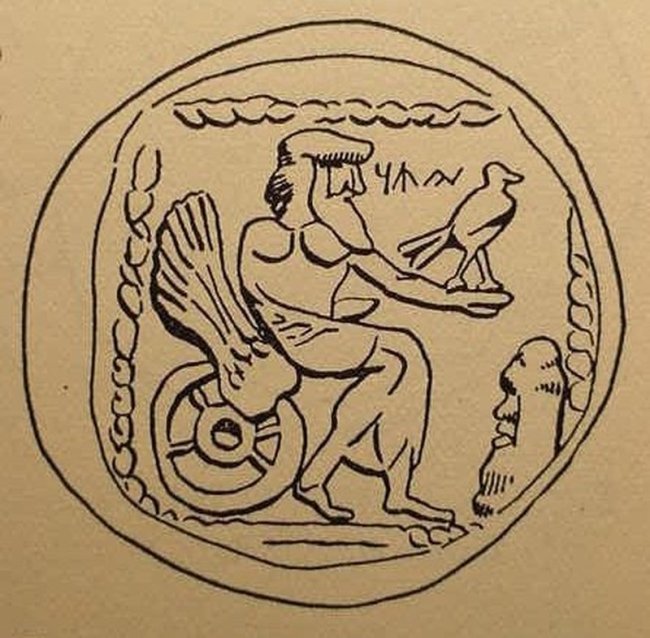
In Gnostic tradition, the creator of the material universe was not the ultimate god but a deity by name Yaltaboath who was actually a creation of the Wisdom Mother Goddess, Sophia. However, having forgotten Sophia, Yaltaboath, who thinks he had out of his own power created humanity in his image, declares that he is the jealous god and that there is no other god besides him. Through a heavenly voice, Sophia reminded him who he really was and called him Samuel—the blind god. Gnostic Christianity even tried to structure a mytho-theological universe with a break from the literalist textual traditions—the creator-god and a higher God whose wisdom was Sophia.
Unfortunately, Sophia went into exile as Christianity became more institutionalised. Had Christianity not been a separate religion but a mere sect of Judaism—incorporating the mythology of Sophia as its theological basis—one wonders how the Western common religious mind would have responded to the science of evolution.
The Goddess tradition in India is such that it makes us like a child look up to the Devi as the Mother Universe and then approach material science with the same awe and veneration. – Swarajya, 12 October 2021
› Aravindan Neelakandan is an author, psychology and economics major, and contributing editor at Swarajya.