The caste-based reservation system is neither rational nor moral. One has to say that Indians are either irrational or immoral or both, if they defend reservation. — Prof. Dr. S.N. Balagangadhara
The problem that has plagued India since Independence [is] caste-based reservations for education, employment and career promotions. In the last four decades of living in Europe, I have heard both sides of the debate. As an Indian living abroad, it appears to me that these debates actually raise one single question: Are Indians irrational or immoral, or both? This is the un-debated side of the reservation discourse in India. Let me explain. Is caste-based reservation a rational policy to follow? The answer to this question does not require a definition of ‘rationality.’ Instead, the issue is: does this policy eventuate in irrational consequences or effects?
Consider two individuals: one outside the reserved category, the other within. The former knows that to get an admission in a good university, he should belong to the top 0.5 per cent of the applicants. He knows too that he will not be part of the very few, who make the grade. Thus, what is the most rational thing for him to do? If putting in enormous effort and taking it easy both produce the same result, it is rational for him to expend less effort. Consider the latter. He knows that to get a seat in a good university, he only needs 35 per cent. Getting more marks will not increase his chances. No matter how little effort he puts in, he will get the desired seat. As a rational agent, therefore, he too takes it easy. Because knowledge and competence are mostly commensurate with the efforts put in to acquire them, expending little effort implies equivalent increase in ignorance and incompetence.
Since the caste-based reservation makes it rational for people both in and outside reservation to choose to be lazy, there is an incentive to remain ignorant, incompetent and inefficient. If this attitude is generalised—in colleges, courts and bureaucracy—it produces and reproduces such people. Result: the institutions they run cannot be more efficient than them. The inevitable consequence is the collapse of both the society and its institutions. That is how outsiders perceive India today: her courts, educational institutions, bureaucracy, police, governments, are in the process of breaking down.
Why does this rationality argument not figure in Indian discourse? There is a well-known answer: the reservation is the reparation for the injustice committed by one group of people against another over two millennia or more. In that case, moral considerations trump rationality. If we accept that it is irrational to follow policies that lead to the collapse of society because everyone is rationally encouraged to pursue irrational goals, the question becomes: is it moral to be rational?
In and of itself, there is nothing absurd about it. One can indeed speak of local rationalities, such as scientific, technological and ecological rationalities and raise ethical questions about them. So, let us ask: irrespective of its rationality, is the caste-based reservation system moral?
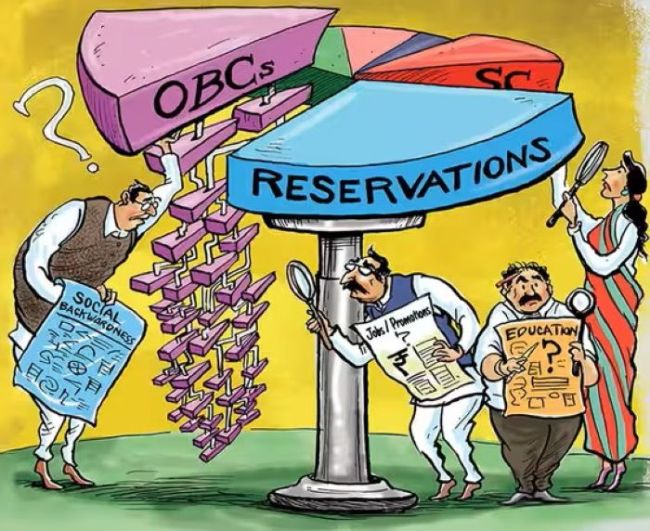
Today, it is common sense to say that there is oppression of one group of people across the whole of India by another group of people spread equally widely across India. However, there can be no empirical evidence for this claim because say ‘Dalit’ or OBC (Other Backward Castes) is neither one social group nor one particular caste. Both names refer to sets of groups. It is only correct to say then that multiple groups have oppressed multiple other groups in the last millennia in India. One could, of course, name the oppressed groups as the Dalits or OBCs. Sadly, this fact of oppression is true for all human civilisations. Therefore, if the reservation system is a moral critique of oppression, it would have to follow that all other societies except the Indian are immoral, because they do not have such a system. This suggestion is implausible. Is the reservation system a payment for the sins of our forefathers, who instituted an unjust social system? This could be true, but only if one argues that the children of oppressors have to pay for the sins of their forefathers.
This moral stance is unique to the Judaic tradition, where the sins of the fathers visit their sons. No other moral tradition has coherently argued this. I am aware that some Indians do talk in this fashion but that is incoherent within the framework of Indian culture.
Rightly or wrongly, ideas like karma and punarjanma require that only the agent pays for his misdeeds. If one has to pay for the misdeeds of another, what do karma and karmaphala mean? The entire set of Indian traditions would become totally incoherent. Therefore, you cannot assume this ethical stance unless you are a Jew yourself. But Jewish Israel has no reservation system. Neither are Indians Jewish. Hence, this moral justification does not work.
Can we not say that the reservation system is the reparation of past damages, whether inflicted on one group or on multiple groups? Maybe. In the case of the Native Americans, for example, the white settlers took away their lands and became wealthy as a result. The Nazis deprived the Jews of property, wealth, and life itself. African-Americans were displaced and transformed into slaves.
Perhaps, one could also address the British for the damages inflicted by colonialism. In all these cases, a specific group appropriates unjustly what belonged to another specific group. Again, there is no historical evidence to indicate that there was dispossession of the property of one particular group by another specific group all over India.
If none of these arguments work, why does this policy appeal? Is it because of the demands of justice in general and of social justice in particular? If this is the case, one should give the criteria of justice and of social justice that make sense of caste-based reservation. Nobody has done so. Surely, those who question the morality of rationality mean something other than all these flawed arguments.
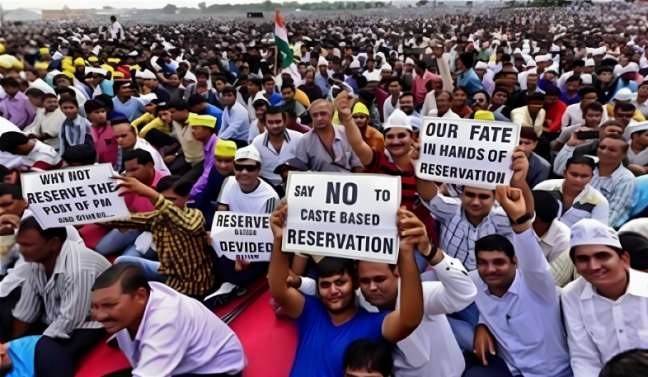
Here is one such. Just structures are preferable, since they always generate just consequences. However, it has been shown that just structures, in certain contexts, produce unjust consequences. Therefore, this claim is not a logical truth; we are compelled to show empirically that the reservation system is not generating unjust consequences. If that were to be the case, there would be no Patel, Gurjar or Jat protests, nor Mandal Commission. Thus, the reservation system is not an embodied critique of a local rationality—‘the’ caste system—nor is it about the morality of rationality.
Consequently, the caste-based reservation system is neither rational nor moral. One has to say that Indians are either irrational or immoral or both, if they defend reservation. The British were reluctant to give self-rule or independence to India because many were convinced that Indians were immoral and irrational. Looking from the outside today, one is compelled to ask: were the British telling the truth, after all? – The New Indian Express, 11 September 2015
› Prof. Dr S. N. Balagangadhara of Ghent University, Belgium, is the Director of the India Platform and Research Centre, Comparative Science of Cultures.