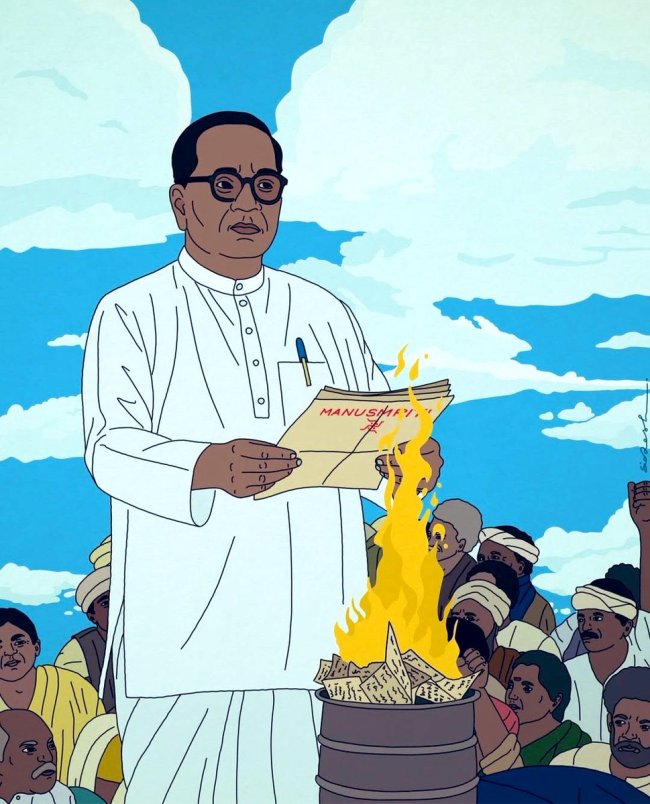
The Manusmriti deserves neither worship nor hysteria. It deserves to be read as what it is: an ancient text, shaped by the anxieties, assumptions, customs and social hierarchies of its time. – Prajesh Panikkar
In his Annihilation of Caste, Dr. B.R. Ambedkar says the Manusmriti prescribes pouring molten lead into the ears of a Shudra who hears the Veda. Ambedkar writes: “The Manusmriti prescribes such heavy sentences as cutting off the tongue, or pouring of molten lead in the ears, of the Shudra who recites or hears the Veda.”
Among the many charges levelled against the Manusmriti, this is one of the most frequently cited and most damning: that it prescribes pouring molten lead into the ears of a Shudra who hears the Veda. How brutal! How primitive! One might even think that stoning the offender to death would have been the more humane alternative. After all, stoning is not primitive; it is still prescribed and practised in some places for certain offences considered immoral.
But there is a problem with this charge: the Manusmriti does not mention it. Dr. Ambedkar was mistaken. Nowhere in the Manusmriti is such a punishment prescribed for such an offence. Interestingly, one of the more recent editions of Annihilation of Caste, edited and annotated by S. Anand, with an introduction by Arundhati Roy, acknowledges this discrepancy in a footnote, though without explicitly stating that Ambedkar himself was mistaken. The footnote says, “Such verses do not figure in the Manusmriti”, as if the Manusmriti has fallen short, rather than Ambedkar having gotten it wrong.
Ever since Ambedkar attacked the Manusmriti, the text has come to be seen across India as a symbol of all that is vicious in Hindu society. But this perception overlooks a basic fact: the Manusmriti is not a sacred text, nor does it govern the day-to-day life of a Hindu, not even that of a Brahmin. It is just one text among many in the vast corpus of Hindu Dharma literature, a tradition that spans the Apastamba and Gautama Dharmasutras to the Yajnavalkya and Vishnu Smritis. Occasionally these texts are cited to justify a particular practice or position in a religious context. But the corpus is so vast and varied that one can find scriptural support for almost anything, as well as for its opposite.
Not a binding text
Today, no Smriti, not the Manusmriti, not any other, dictates how a Hindu lives, Brahmin or otherwise. These texts do not govern the daily life of even the most conservative modern Hindu. To treat them as the Hindu equivalent of a universally binding religious code is not just wrong; it is a fundamental misreading of their place in the tradition.
But there is a readymade answer to this argument. Since the Manusmriti-charade has been going on for so long, anyone who follows the debate is familiar with the arguments, the comebacks, and the comebacks to those comebacks.
“We are not saying that the Manusmriti is a binding text,” the critic of the Manusmriti would say. “What we are saying is that the Manusmriti shaped India’s casteist social backwardness. Its ideas seeped into the culture, even if nobody cites the text today. It therefore stands as a symbol of the viciousness and societal ugliness of Hinduism.”
The reality is that there was never, in the entire history of Hinduism, a single Smriti followed by all its sects and communities, Brahmin or non-Brahmin. There was no single tradition, no single set of rituals, no single code of law. The Namboothiris, the Brahmins of Kerala, for instance, claim their code of conduct is shaped by the Shaankarasmriti, a text attributed to Shankaracharya, and many of its provisions directly contradict those prescribed in the Manusmriti. Even its followers readily admit that Shankaracharya did not write it; the attribution was likely made to lend the text greater authority.
Plurality of laws
Each region, village, and family had its own customs and its own code of law. In the Arthashastra, Kautilya refers to this as the “plurality of laws”. The many Smriti texts and Dharmasutras emerged in this context. Each of these codes of law contained provisions that differed from those found in the others, while also sharing, and sometimes directly borrowing, ideas and verses from one another. More importantly, these texts were not necessarily expressions of the personal ideas of their authors. The authors largely codified practices and norms that were generally accepted as law, while also extolling the virtues and traditions of their own clans. This explains why many Smriti texts contain similar ideas, and why some even contain identical or near-identical verses. Whether it is the Manusmriti, Yajnavalkya Smriti, Vishnu Smriti, or Shaankara Smriti, these texts reflected the ideas, customs, and social norms prevalent among the communities in which they emerged. At the same time, they often sought to establish the special status of those communities and their traditions, portraying their customs as more authoritative, their social position as more legitimate, and, at times, their place in the social order as having a particular sanction or proximity to the divine.
Among these, Manu’s code of law has a particular significance, as it is among the earliest surviving systematic codifications of law in India. It was a text that was written around 2nd century CE. One of the verses most often cited to portray the text as primitive is “na stri svatantryam arhati”, commonly understood to mean that a woman should remain under the care of her father, husband, or son and is not entitled to independence. This was one of the verses quoted by Rahul Gandhi in one of his recent PowerPoint presentations, in what appeared to be an attempt to connect with the Gen Z. (One is reminded of Eric Cartman’s famous line from the sitcom South Park; “How do I reach these keeeeds!”)
The idea expressed in this verse, however, was hardly unique to India. The notion that women should remain under the guardianship of men was widespread across the ancient world and reflected a broader social and legal norm of the period. Take The Institutes of Gaius for example. That text was an introductory legal textbook on Roman private law written around the same period as Manusmriti. In the Book 1, the text says, “Where the head of a family has children in his power he is allowed to appoint guardians for them by will. That is, for males while under puberty but for females however old they are, even when they are married. For it was the wish of the old lawyers that women, even those of full age, should be in guardianship as being scatter brained.”
Women in Manusmriti
The text goes beyond merely denying women independence. It places women in a subordinate legal and social position, explicitly justifying their continued guardianship on the grounds that they were considered incapable of exercising independent judgment.
We can judge such ancient observations and value systems by today’s standards, recoil in shock, and condemn them with full force. But that is moral presentism. There is a difference between condemning an ancient law according to our present moral standards and understanding what that law meant, how it functioned, and the historical context in which it emerged. The former becomes the fallacy of moral presentism when contemporary assumptions are substituted for historical inquiry.
No sane person in India would support the Manusmriti and seek to enact it as though it were the word of God. For a believing Hindu, the text has virtually no practical authority in everyday life. It does not dictate family life, social or political life, how a man or woman conducts themselves in public, or even religious practice. For the overwhelming majority of Hindus, the Manusmriti has little to no bearing on how they actually live their lives.
Even though it has no direct bearing on a Hindu’s life, it is possible that the Manusmriti may have influenced or shaped Hindu practices in some faint or indirect way, much as the Institutes of Gaius influenced the development of modern civil law systems. Such influence does not mean that the text’s ideas, positive or negative, were simply copied and carried forward unchanged. It means only that an old text can leave traces in the intellectual and cultural traditions that develop around it, even when the text itself is no longer followed as a code of conduct.
Why was Manusmriti written?
The Manusmriti was written, or perhaps more accurately codified, at an interesting point in Indian history. Buddhism was gaining increasing acceptance among several major royal houses, while Brahmanical traditions, which had until then enjoyed considerable influence and a role in courtly and political affairs, were facing a changing social and intellectual landscape. It is in this context that the Smriti tradition takes on an interesting significance. The Brahmins had to reaffirm their own importance, not merely to others but to themselves. They needed a framework that affirmed their place at the centre of the social and religious order, and that presented the proper functioning of society as dependent upon Brahminical authority and sanction. Scholars who have studied the text in detail, such as Wendy Doniger and Patrick Olivelle, as well as historians of ancient India, have advanced versions of this view. The Smritis, with their repeated emphasis on Brahminical status and their assertions of the superiority of Brahmins over other social groups, can be understood, at least in part, against this backdrop of a community seeking to reaffirm its position and authority.
Given all this, why is the Manusmriti, a text that is almost two millennia old, that plays no major role in how Hindus live their lives, and that is today of greater interest for its anthropological and historical value than its religious one, so often portrayed as a vicious scripture venerated by the entire Hindu community as though it were sacred and universally authoritative? This week too, the Congress burned the text in front of the RSS headquarters. Every year brings at least one such protest, a public burning of the Smriti. Yet hardly anyone seems to care anymore. No Hindu, not even the most conservative, bats an eye.
This has to be seen in contrast with the conspicuous silence from the same quarters when it comes to more severe forms of misogyny from other corners. For example, Kantapuram Aboobacker Musliyar, the current general secretary of the Samastha Kerala Jam’iyyathul Ulama, the same body that passed a resolution discouraging Muslim women’s education in the 1930s, said last week that women should “remain confined to the home and live quietly”. Kantapuram, an octogenarian Islamic scholar who holds the title of Indian Grand Mufti and commands considerable respect among Kerala Muslims, said the Holy Quran itself holds this view and that women’s public appearance would cause great destruction. The comment, which one would not need to think twice before condemning or rejecting, was handled with kid gloves by many political leaders. P.C. Vishnunath, a Congress MLA from Kerala and Minister for Cultural Affairs, whom one might have expected to be among the first to condemn such a misogynistic remark, instead said, “I do not want to get into the substance of Kantapuram’s remarks and comment on them.”
If a national leader of the Congress, say Rahul Gandhi himself, were pressed for a comment on Kantapuram’s observation, it would be hard to imagine him giving a very different answer. The reason is simple. Misogyny in many other quarters is harder to attack because it is woven into the very fabric of their ideology. Religious and social practices in those communities are still shaped by such ideas, making it difficult to condemn them without risking accusations of hurting religious sentiments.
Why is it an easier target?
The Manusmriti, and the other Smriti texts, present an easier target. Their misogyny or casteism can be attacked and vilified precisely because, for all practical purposes, these texts are obsolete and have little or no influence on the religious or everyday lives of Hindus. Burning the Manusmriti costs nothing: no priest will refuse to perform a wedding over it, no temple will alter its rituals, and no believer will feel that their faith has been violated. Nobody’s religious sentiments are going to be hurt, because for most Hindus, the text was never a living document to begin with. It is a safe act, a pseudo outrage, one that lets the burner claim the moral high ground of fighting caste and patriarchy without having to confront any actual, currently practiced belief or institution that might resist, defend itself, or generate real controversy.
Burning the Manusmriti had a symbolic value when Ambedkar did it decades ago. It no longer carries the same significance today. The symbolism was further eroded when some protesters turned the burning of the Manusmriti into an annual, and sometimes even a monthly, ritual. What was once a powerful symbolic act has now been repeated so often that it has lost much of its meaning. Today, burning the Manusmriti means little to anyone. Want to burn a Smriti text now? Go ahead. Who cares?
Today, the Manusmriti is attacked not because it plays a prescriptive role in Hindu life, but precisely because it does not. It has virtually no role in the lives of Hindus, and nobody is likely to object when it is attacked. Burning it is therefore a profitable exercise for a politician. You can fight a glorious battle without hurting anyone, like Don Quixote tilting at windmills, and walk away with accolades, applause, and, instantly, the credentials of a progressive.
And that is why, after a point, talking about the Manusmriti becomes boring. Yes, patriarchy. Yes, misogyny. We know. It is a code of law that is two millennia old and is not practised in any meaningful way by anyone today. Tell me, sir, what are your views on the misogyny that is still practised and remains embedded in the foundational ideas of other faiths? What about the lived reality of women in those communities? What about scholars who say that women should not appear in public, or that women should not lead governments? Does that not require any rectification or change?
The Manusmriti deserves neither worship nor hysteria. It deserves to be read as what it is: an ancient text, shaped by the anxieties, assumptions, customs and social hierarchies of its time. We can reject its misogyny and caste distinctions without pretending that it governs the lives of Hindus today. We can condemn what is objectionable in it without attributing to it an authority it does not possess. And if our concern is genuinely with the dignity and freedom of women, our scrutiny should not stop at texts that are politically convenient to attack. The real test of progress is not how loudly we condemn a book that nobody follows, but whether we are willing to question ideas that continue to influence the lives of people today. That is a far more difficult, but far more meaningful, battle. As long as that concern does not extend to those politicians who attack the Manusmriti, their criticism cannot be regarded as genuine. It is agenda-driven, insincere, and nothing more than political posturing dressed up as progressive morality. – News18, 2 September 2026
› Prajesh Panikkar is a commentator with a research degree in philosophy from the University of Sheffield, focusing on the intersections of culture, history, and politics.