Can Devdutt Pattanaik save Hinduism from Western distortions? – David Frawley

Devdutt Pattanaik

Make certain, Pattanaik is no detached observer, but has a vested interest in the very negative interpretations of Hinduism that he now seems to question. He has so far shown little interest in any defence of Hinduism whether by Indians or Westerners, much less promoting its deeper Yoga and Vedantic teachings. – Dr. David Frawley

Devdutt Pattanaik is a popular interpreter of Hindu sacred stories, what are now, not always respectfully, called “myths”. In an old article “From Macaulay to Frawley, from Doniger to Elst: Why do many Indians need White saviours”, he claims that “Indians do not really need Europeans and Americans to tell them what Hinduism, Sanskrit or Vedas were, are or should be.”

Attacking both Western critics and Western defenders of Hinduism

The title of the article appears appealing given the many Western distortions of Hinduism. Yet strangely, Pattanaik criticises both Western defenders of Hinduism as well as critics, lumping them both together as if they were two sides of the same bad coin, suggesting that neither understands the Hindu tradition.

Pattanaik would like us to think that he is honouring this tradition of great yogis that has suffered so much from colonial, missionary, Marxist and neo-modern misinterpretations. But in the majority of his own writings, he himself follows the current politically correct Western scholarship that denigrates Hinduism at a cultural level and downplays its deeper philosophical and yogic dimensions. His comments on Hindu gods and goddesses are often in terms of modern psychology and leftist politics, as if these deities were human beings with personal problems and social biases, not symbols of transcendent and cosmic powers.

Now Pattanaik is suddenly critical of the same controversial Western scholars like Wendy Doniger and Sheldon Pollock that he has previously defended. The mythological approach he uses is an approach they also use and is very different from India’s own dharmic school of thought. Is he questioning that mythological angle that he has so extensively promoted?

Looking deeper, Pattaniak’s article betrays a subterfuge. His critique of Western defenders of Hinduism appears more strident than his questioning of anti-Hindu views. Clearly Western scholars defending Hinduism are his main target, and by implication the defence of Hinduism itself.

India connections of Western interpretations of Hindu Dharma

Pattanaik makes a point that one has to be born a Hindu to be a real Hindu that is connected to “birth” and “geography”, no doubt to discredit any Western attempts to speak for Hinduism. This is historically easy to disprove given the numerous Hindu temples and kingdoms from Angkor Wat in Cambodia to Vietnam and Indonesia whose populace were not simply born Hindus in what is now India.

Yet the deeper question in all such discussions is the nature of the interpretations given, not the skin colour of the person advocating them. Most important is the methodology that such interpreters follow. Individual scholars are usually representatives of schools of thought that must be examined overall.

The denigrating approaches of such as Doniger and Pollack have prominent Indian supporters, notably Marxists like Romila Thapar and Irfan Habib, whom Pattanaik does not mention. Similarly, the view of Hindu Dharma by Western Hindus has its roots in teachers from India. The books of Sita Ram Goel and Ram Swarup have framed much of the defence of modern Hinduism. Yet this trend goes back to Sri Aurobindo, Swami Vivekananda, Lokmanya Tilak and India’s Independence movement that challenged Eurocentric ideas of religion, culture and history.

Mahatma Gandhi’s criticism of Christian missionaries is also relevant here. It ultimately is based upon Vedic texts that address the nature of the mind and the meaning of human life in a very different manner than dominant Western schools of thought.

Pattanaik has tried to place Hinduism’s Western defenders on the “right” of the political perspective, with its critics on the “left”, forgetting that right and left in politics are Western views, not Indian and neither is dharmic. He reflects the statements of anti-Hindu writers who routinely label Hinduism as right-wing and regressive.

Pattanaik further describes Western defenders of Hindu Dharma as “authoritarian” and “Abrahamic” in approach, as if they were presenting a distortion of Hindu Dharma. This is also nothing new. The same charge is made by Luytens’ Delhi against any Hindu groups in India that have sought to proudly promote Hindu Dharma. Such verbal theatrics only shows that he remains ambivalent about presenting Hindu teachings in a respectful manner. He does not otherwise criticise Abrahamic traditions.

Problems with ancient history

Pattanaik seems to have a particular problem with the historical view of the Harappan or Indus Valley civilisation as Vedic, as supported by Western Hindus. Yet, this is also the view of the Archaeological Survey of India and its former director general Prof. B.B. Lal. It is the view of the Geological Survey of India based upon Landsat Satellite photography and numerous ground water studies of the long dry Sarasvati River. It is the view of India’s great gurus today. To call it into question because it is also a view of white Hindus is neither accurate nor sincere. It suggests that Pattanaik does not like the idea of a history of India that gives prominence to Vedic and Hindu contributions.

Is sadhana necessary to truly understand Hindu Dharma?

Hindu teachings, as in the Bhagavad Gita and Upanishads, have at their core a yogic pursuit of higher consciousness, including experiences beyond the human intellect and its limiting dualities. They hold that the physical world is but an outer aspect of a multi-dimensional universe of consciousness, with our inner self having many bodies and many births and ultimately extending beyond all time and space.

Pattanaik does not seem comfortable with such yogic spirituality, which Doniger and company routinely ignore or dismiss, though he throws a few Sanskrit terms around in order to sound traditional. He is particularly unhappy with my claim that Yoga sadhana should be part of any authentic interpretation of Hindu texts. Yet that is not merely my personal view, it is found in all the great traditions of India that emphasise meditation over mere book learning. If sadhana is not part of one’s study of Hinduism, one can only claim to have the view of an outsider.

Is Pattanaik changing his views?

Pattanaik’s article is a cover-up for his own errors and prejudices. It is an effort to surreptitiously disown his own past with Doniger and company, perhaps out of fear of being judged politically incorrect by these Western critics that he has often kowtowed before in the past. Attacking Western defenders of Hinduism along the way affords him the appearance of being a neutral observer, and makes it more difficult for him to lump with what Doniger and company castigate as the Hindu right that they usually decry as fascist as well.

Make certain, Pattanaik is no detached observer, but has a vested interest in the very negative interpretations of Hinduism that he now seems to question. He has so far shown little interest in any defence of Hinduism whether by Indians or Westerners, much less promoting its deeper Yoga and Vedantic teachings. While there is nothing wrong with changing one’s views, it is better to be honest about it and admit one’s mistakes. – Swarajya, 1 January 2017
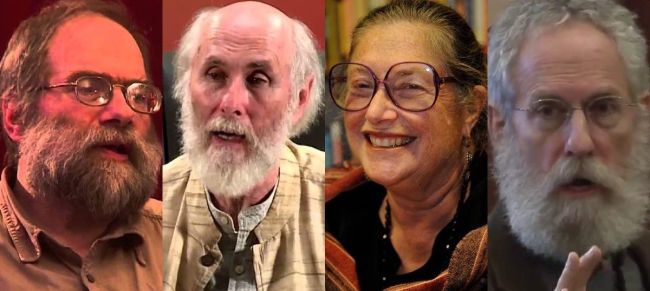
Koenraad Elst & David Frawley vs. Wendy Doniger & Sheldon Pollock.

Koenraad Elst: A maharathi without a rath – Shankar Sharan

Koenraad Elst

It is so strange even by common sense, not to say political-intellectual sense, that Hindutva quarters did not see the need to make Dr Elst’s stature influential or at least more visible. Elst is personally known to many tall Hindutva leaders, who are directly in power for decades. But it never occurred to anyone to set even a little ground beneath his feet, so that he could continue to work comfortably. – Prof Shankar Sharan

Koenraad Elst has coined two evocative terms to help understand Indian socio-political situation: “Negationism in India” and “Decolonizing the Hindu mind”. These are also the names of his two most important books published in 1992 and 2001 respectively. Going through just these two books one can understand his great contribution to current Indology. Yet his assistance to the Hindu side on the Ayodhya debate is as significant, though surprisingly little known even to Hindutva leaders.

In fact, the Ayodhya issue changed the course of Koenraad’s life. He was incidentally in India when the controversy erupted on the national scene. He observed the falsehood being spread by eminent Marxist historians and liberals in Indian media, and could not resist the urge to fight it out. The common adventurer in this European young academic decided to take it on, even without any support. Except that Sita Ram Goel decided to publish his first book: Ram Janmabhoomi vs. Babri Masjid, A Case Study in Hindu-Muslim Conflict (Voice of India, 1990).

It was also the first book on the dispute based on first-hand sources written by an unbiased Western scholar. Koenraad rebutted the false claims of the Marxist historians, then actively campaigning for the Muslim side, or put better, against the Hindu side. The book was released by none other than L.K. Advani and Girilal Jain, then the most important figures in politics and media respectively. Advani at the time was the Hindutva hero, after his recently concluded famous Rath Yatra that put the Ram mandir in Ayodhya on the national agenda.

However, as it became clear later painfully, Koenraad had inadvertently put his career and by implication his life on line to defend the Hindu position on Ayodhya and other related issues. Hindu leaders and organizations happily used his hard research, data, facts and arguments he marshaled. But hardly thanked him and, more importantly, never provided some succor to compensate the hardship he invited upon himself by just becoming the friends of Hindus.

The situation has not changed since. Although today Koenraad is an internationally recognized Indologist, well known to all organized anti-Hindu forces. He is even feared by many left-liberals. No Indian left-liberal or Islamic apologist is ready to face him in any standard debate on Ayodhya or on issues related with the theory and practice of secularism in India. For the same reason he has also been denied academic situations in the Western world, mostly controlled by left-liberals. The unstated reason everywhere is the same: he is a supporter of “Hindutva forces”, by itself deemed as a bad entity.

Yet, the very Hindutva forces never invested even in his well-being, let alone thanking and celebrating his scholarship. A first rate scholarship that put leftwing superciliousness in place. Hardly any Indian left-winger or secularist ever took up Koenraad’s works to find faults, though they all know its weight. Initially they tried even to deny his existence, saying that Koenraad Elst is a fictitious name created by cunning Hindutvawadis to give their “lies” a Western support! An uber-secularist Khushwant Singh also fell for this propaganda, until he by chance met Koenraad in real flesh. This kind of denial attempt by the left-liberal powerhouses in India was also a revelation of their puerile scholarship. By the same token, it was also a left-hand recognition of Koenraad’s prowess.

That is why it is so strange even by common sense, not to say political-intellectual sense, that Hindutva quarters did not see the need to make his stature influential or at least more visible. Koenraad is personally known to many tall Hindutva leaders, who are directly in power for decades. But it never occurred to anyone to set even a little ground beneath his feet, so that he could continue work comfortably. The work which benefited the Hindutva leaders themselves. His scholarly contribution on the Ayodhya controversy is just a case in point.

The VHP and BJP were campaigning for Hindu claim over the disputed Ramjanmabhumi-Babri Masjid site for years. Yet they did not collected hard evidences to be used in court for their claim. The campaign was largely emotional, based on traditional lore. It was important but where a court was hearing the matter and the issue was debated in media and academia, such an approach was hardly winnable. It was Koenraad, encouraged and helped by Sita Ram Goel, who took upon himself to present a systematic case for Hindus with authentic historical and logical evidences. This was his second book Ayodhya and After: Issues before Hindu Society (Voice of India 1991), a first introduction to all aspects of India’s religious conflicts.

Thus, Koenraad Elst was one of the rare individual scholars who put paid to the pretensions of eminent Marxist historians. Soon they started dragging feet because they depended on the mere emotionalism of the Hindu forces, and were sure to win the thinking classes by flaunting their high academic chairs. Koenraad, Sita Ram Goel and also some others such as Arun Shourie, Swapan Dasgupta, etc. challenged them on facts, arguments and historical method. Thence the Marxists changed their tune, fled the court contest and finally also the arbitration the Prime Minister Chandra Shekhar had constituted to resolve the issue on evidence.

It would be ungrateful if we do not recognize the role Koenraad also played, indirectly, in Hindus winning the Ayodhya court case. The archeological evidence, after the Allahabad High Court ordered the Archeological Survey of India to dig into the site, further corroborated the contentions of Koenraad and Sita Ram Goel presented in their books about temple destructions.

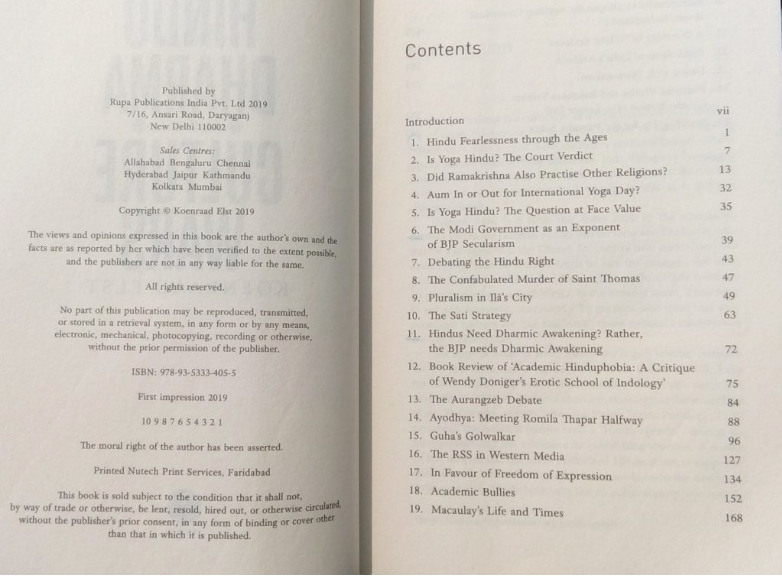
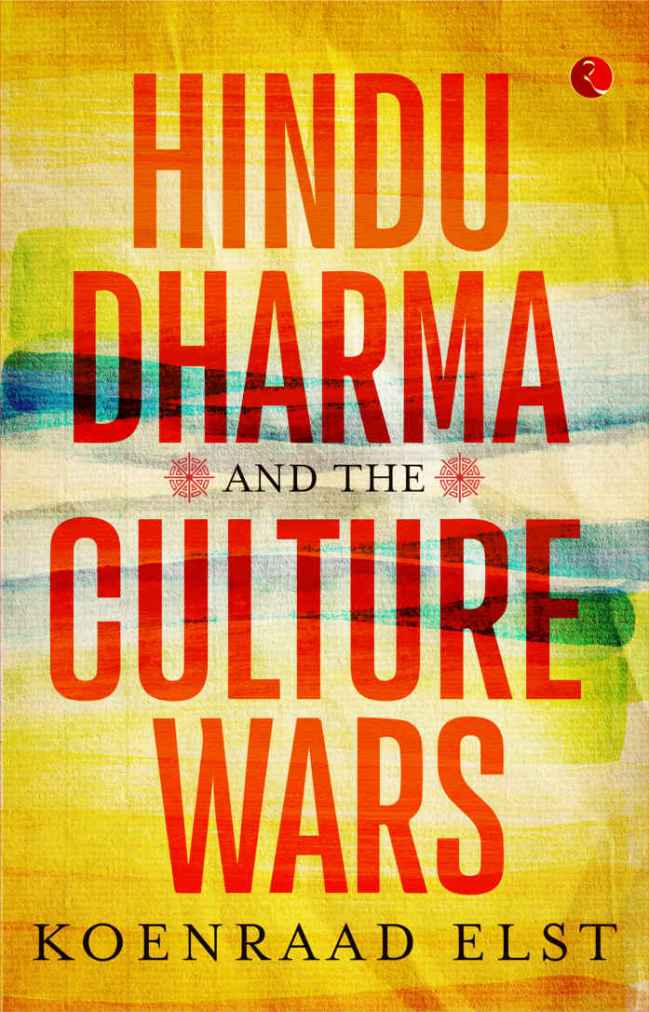
This long prelude is necessary to explain the importance of his new book, Hindu Dharma and the Cultural Wars (Rupa, 2019). It may be useful to evaluate the book, as it helps to understand the continuity of his concerns and consistency ever since he voluntarily took up the case of Hindus vis-à-vis their opponents in politics and academia.

The articles in this book are on diverse issues, all combined make the outline of a cultural war presently raging which Hindus are compelled to fight. Yet they are ever so reluctant to fight, as the articles about the BJP and their governments in this volume also indicate. Many Hindus, including their leaders, are not ready yet to even acknowledge that there is such a war going on. Even as they are feeling the heat of the war for a long time. This strange apathy is also addressed in some articles in the collection.

Book Contents

Some new insightful pieces in this collection of 25 articles are: Hindu Fearlessness through the Ages (pp. 1-6), A Diversity of ‘White saviours’ (178-194), Debating the Hindu Right (43-46), The Modi Government as an Exponent of BJP Secularism (39-42), Hindus Need Dharmic Awakening? Rather, the BJP needs Dharmic Awakening (72-74), Academic Bullies (152-167) , and The RSS in Western Media (127-133). For a new reader every article would be a novelty and provide food for thought. They all combined make the title meaningful, suggesting that the Hindus are in the midst of a cultural war. Even though many highly educated Hindus are blissfully unaware of it.

That makes this book rather more valuable. The author himself said it is a “very good book”. Should Hindu organizations study and propagate it seriously, a great need of the time may be fulfilled. The need of making uninformed Hindus aware of the dangers they are facing. The Modi government in power has not thwarted it. At best the dangers seem subsided or waiting at a distance, but they are very much alive and focused.

Take, for example, any issue discussed in the book. Yoga, Ramakrishna, Saint Thomas, Golwalkar, Aurangzeb, Macaulay, Hinduphobia, nationalism, or even Ayodhya. The daily discussions, observations and comments about it in our prestigious media are found invariably opposite to the hard realities, past or present. They tend to take, as a rule, an anti-Hindu and pro-Islamic or pro-church stance. Sometimes even knowingly so. What this shows, if not that many leading Hindu intellectuals are fighting from the enemy side? They even take pride in being “liberal” and more “fair” to others. Totally oblivious of the dire results of such a naïve Gandhian stance in the recent past, as in Bengal and Punjab during the years 1947-48 or in Kashmir since 1989 onwards for more than a decade. Not to speak of the great devastation the Hindu society earlier suffered during centuries of barbaric Islamic onslaught.

Being increasingly ignorant of the un-natural calamities that fell upon Hindus, past or present, is the hallmark of Indian academic discourse in independent India. By extension of our media too. As a result, they simply deny there is any cultural war going on. If at all, they say it is the “minorities” who are at the receiving end. Any single day a prestigious Indian English newspaper would reveal a score of evidence in its coverage, headlines, comments, op-ed articles, and even in selection of pictures or data or words. Not only they summarily speak a different tune, from the concerns expressed in this book of Koenraad, but also definitely ridicule it in more or less open manner.

Therefore, the problems the Hindu society is facing on cultural fronts are as acute as ever. In fact, the BJP securely in power has somewhat lulled many in the Hindu movement. All the while the enemies of Hindus are relentlessly playing the victim card, and getting rewards, even more easily. Any event of significance, be it the legislation for banning triple talaq, or the hearing on Ayodhya in the Supreme Court, or abrogation of Article 370, or meeting of the RSS chief with an Islamic leader, or even just BJP winning an election is used as a common indicator of the “hurt” non-Hindus are feeling regularly. This refrain is articulated and propagated more regularly and forcefully by Hindu liberals than a Muslim or Christian writer. In no case, such as mentioned above, a left-liberal Hindu would even care to give a voice to a single Hindu hurt, as if such a hurt is non-existent or irrelevant.

This makes the Koenraad book much more noteworthy. It brings to light some still hidden truths about the history of the Hindu society. It also challenges many wrong notions entrenched in its intellectual classes. At present is a golden opportunity because influential Hindu organizations in India could use such works to awaken sleeping sections of our country, reeducate the misinformed sections and correct the wrong notions wantonly propagated by misinformed or misguided intellectuals. Not only the Hindus but at least a section of Muslims also mouth falsehoods due to plain ignorance.

If candid rebuttals and correct information could be disseminated with equal seriousness and regularity, the tide of the cultural war can be turned successfully. That is the opportunity at hand. Are the so-called organized Hindutva forces up to it? It remains to be seen. Meanwhile individual Hindu warriors may rejoice that one of their inspirations—a maharathi—is still fighting the battle, despite being without a rath. This seems an apt imagery to depict Koenraad Elst, the Belgian scholar and orientalist. Through his scholarly contributions he has been fighting for Hindus with his two bare hands—without weapons customarily available to those on high academic chairs. Grateful Hindus must salute the rare warrior on completing his 60 years recently! – IndiaFacts, 21 December 2019

Dr Shankar Sharan is Professor of Political Science at the NCERT, New Delhi.

Hindu Dharma and the Culture Wars