The rediscovery of India that is Bharat – Francois Gautier

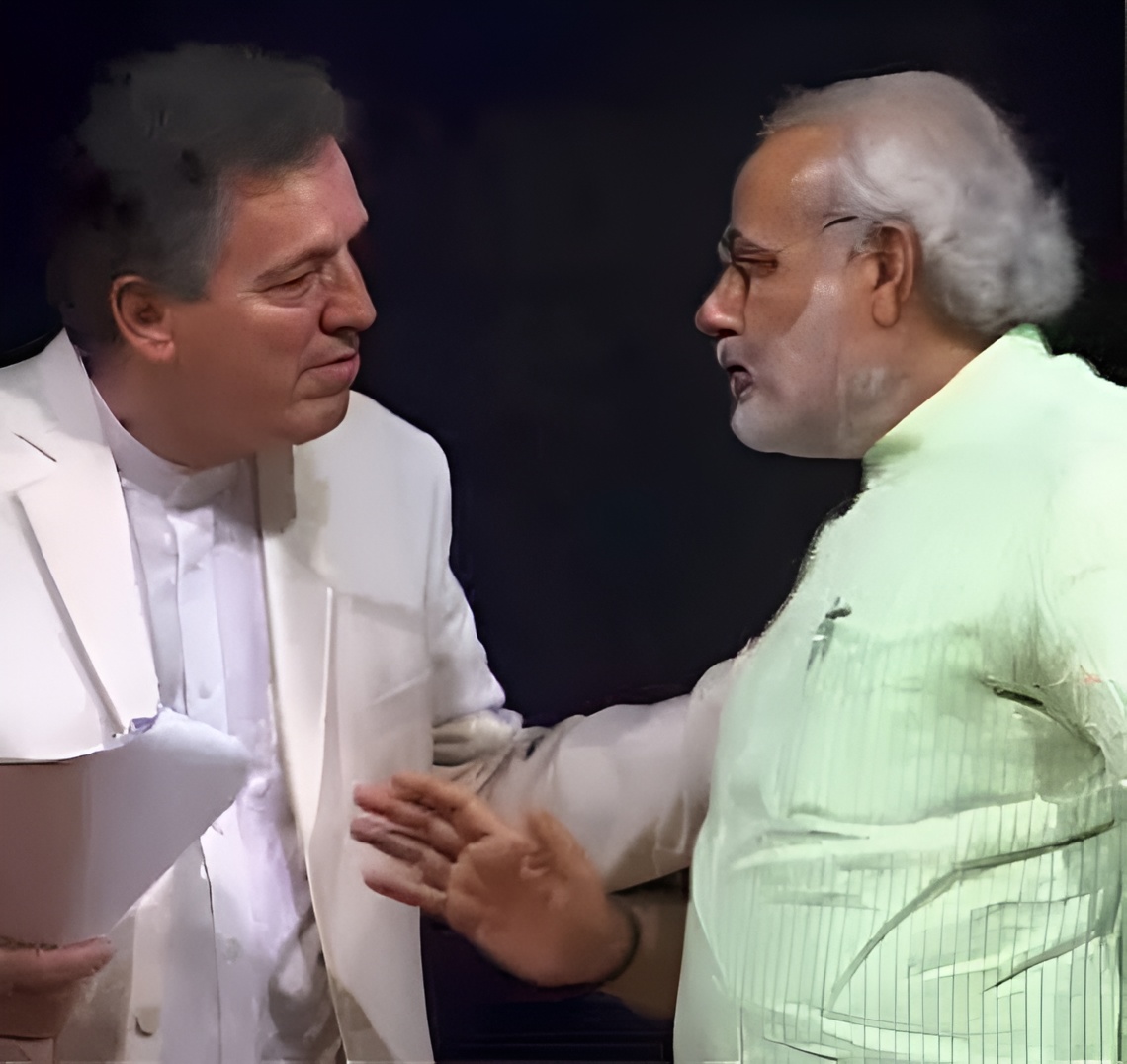
Francois Gautier & Narendra Modi

Contrary to Sonia Gandhi, I have nothing to give or prove to Bharat. It is Bharat which has given everything to me. Indeed, like Mother Teresa before her, Sonia Gandhi seemed to me to approach India through a Western Catholic prism: as if India is a country that needs to be guided, corrected, uplifted or even lectured. – Francois Gautier

Sonia Gandhi and I have something in common. We were both born in Europe, both raised in the Catholic tradition, both married Indians, and both eventually made India our home. But the comparison stops there.

I came to India as a young Frenchman, with my Western education, Christian background and European prejudices. I knew practically nothing about this extraordinary civilisation. Yet, from the moment I arrived in Delhi, having driven from Paris in a caravan of five cars at the tender age of 19, I felt I had come home.

Slowly, through years of living among Indians, travelling across the country, studying its ancient wisdom and meeting its spiritual masters, I discovered a civilisation far greater, deeper and more sophisticated than anything I had imagined. Knowledge came down the ages via the Hindus, this unique people who had been so much persecuted.

Therefore, contrary to Sonia Gandhi, I have nothing to give or prove to Bharat. It is Bharat which has given everything to me. Indeed, like Mother Teresa before her, Sonia Gandhi seemed to me to approach India through a Western Catholic prism: as if India is a country that needs to be guided, corrected, uplifted or even lectured.

I observed Sonia’s political career at close range during my decades as a journalist covering South Asia. What struck me was not simply her rapid ascent within the Congress, but the ease with which she appeared to accept the reverence, privileges and extraordinary deference surrounding her.

I remember being so shocked when she got re-elected as president of the party in November 2000: she came in cavalcade of cars from her Janpath residence-fortress to her party’s office on Akbar Road just a few hundred metres away, surrounded by dozens of security, and Congress workers touching her feet—so impervious, arrogant like a ‘white memsahib’.

Her mother-in-law Indira Gandhi being shot by her Sikh bodyguards and her husband Rajiv being killed by a Sri Lankan Tamil separatist must have traumatised her. But personal tragedy cannot confer a hereditary right to govern a nation of 1.4 billion people.

This is why I was even more shocked that when constitutionally she was only an MP, during the UPA’s 10 years in power (2004-14), she behaved as the sovereign of India, Manmohan Singh being the puppet prime minister. The unfortunate karma of the Congress is that it was created by an Englishman and it remains even today a colonised party, which instinctively accords greater prestige to Westerners.

In her just-released book, Belonging: A Journey of Love, Sonia says, “I cried as I watched the demolition of Babri Masjid”—where nobody was killed on site.

But did she cry when 59 innocent Hindus, including 37 women and children, were burnt like animals in the Sabarmati Express in February 2002? No, certainly not!

My greatest concern today is that Rahul Gandhi appears to have inherited much of his mother’s political outlook. He speaks frequently of democracy, equality and constitutional values. These are noble principles. But I remain unconvinced because I think he has the same Westernised, Catholic-centric view of India and of Hindus in particular.

He will never understand—nor will his sister Priyanka—that India is not simply a geographical territory, an electoral arithmetic or a collection of communities competing for political concessions. India is Bharat. It is a civilisation whose spiritual and philosophical achievements stretch back thousands of years. It gave humanity the Upanishads, Bhagavad Gita, yoga, profound systems of metaphysics and an extraordinary tradition of religious pluralism.

One cannot hope to govern India successfully without understanding this inheritance.

Hindus have traditionally accepted many paths to the divine, they have often hesitated to defend their own traditions forcefully. I believe that Sonia Gandhi and the Congress establishment shamelessly exploited—and still do—this generosity.

For centuries, European powers dominated much of the world politically, economically and intellectually. They colonised Asia and Africa, and persuaded generations of educated people that Western civilisation represented the summit of human progress. That era is ending. The hour of Asia has come.

Bharat has an exceptional role to play in this transformation, not merely as an economic or military power, but as a spiritual and civilisational force. I continue, therefore, to place my faith in Narendra Modi.

I do not believe his government is beyond criticism. Indeed, I have criticised the BJP when I felt it failed to defend Hindu interests. But Modi has accomplished something historically significant: he has helped restore to millions of Indians a sense of pride in their own civilisation. He has challenged the assumption that India must imitate the West to become modern. I believe he remains the strongest political instrument of that rediscovery. – The New Indian Express, 16 November 2026

› Francois Gautier is a French journalist, author and former South Asia correspondent for Le Figaro.
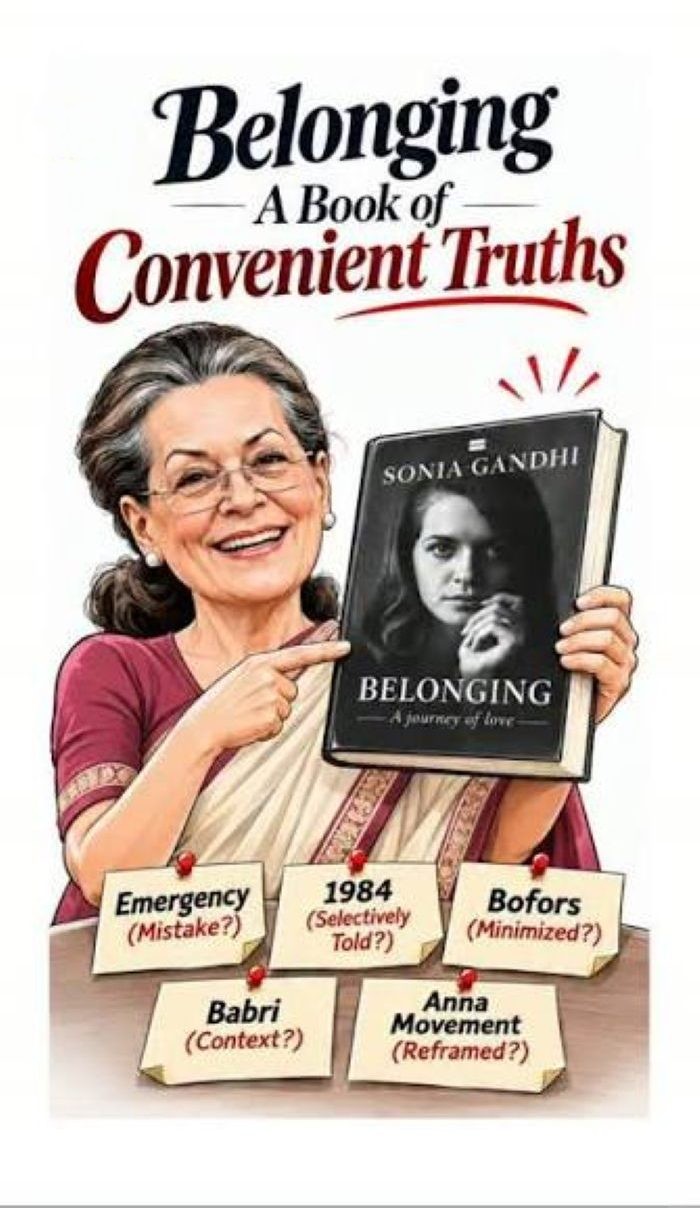
Belonging: A Journey of Love - Sonia Gandhi - HarperCollins - 2026 - Pages 544 - Rs 844.

Let’s honour the India that is Bharat and the Hinduism that is Sanatana Dharma – David Frawley

Bharat Mata

India that is Bharat, which occurs in the beginning of India’s Constitution, highlights the need for a civilisational revival that was an integral part of India’s independence movement, not just creating another modern nation-state. – Dr. David Frawley

India cannot be understood without an equation with its traditional name of Bharat. India is a much older civilisation than Europe and has maintained its continuity uniquely over the millennia. The term Bharat brings that ancient history to mind and its cultural identity as Bharatiya Samskriti, a vast dharmic civilisation with its own unique voice and global influence.

India that is Bharat, which occurs in the beginning of India’s Constitution, highlights the need for a civilisational revival that was an integral part of India’s independence movement, not just creating another modern nation-state.

Similarly, Hinduism cannot be understood without its equation with Sanatana Dharma, meaning the universal, eternal and perpetual Dharma. Sanatana Dharma shows the need to understand the dharmic traditions of Bharat in their own right and according to their own terminology: a profound spiritual, religious, philosophical, scientific, artistic and cultural tradition, with numerous great rishis, yogis and gurus, deity forms and temples, all reflecting a pursuit of higher consciousness and Self-realisation. We should equate Hinduism, Hindu Dharma and Sanatana Dharma, not simply by name but by meaning and implications.

It is great to see India’s politicians today using the term Bharat, or India/Bharat for their identification at diplomatic programs. It is an essential part of decolonization and calls for a reexamination of the global identity of India and what it represents as a civilisation. Similarly, it is important to identify Hinduism as Sanatana Dharma.

Sanatana Dharma refers to the term dharma in a generic way, embracing dharma in all its names, actions, vision and wisdom. Hindu Dharma is known for its many sects and sampradayas, whether Shaivite, Vaishnava, Shakta, Ganapata and Saura such as Adi Shankara recognised long ago, and as Vedic, Itihasa/Purana and Tantra with many modern movements as well. These diverse Hindu teachings are all expressions of a unitary Sanatana Dharma.

Vedic sciences like Yoga, Ayurveda, Vedanta, Jyotish and Vastu that are spreading worldwide reflect the Sanatana Dharma vision of universal consciousness at the foundation of Hinduism. Hindu art and culture with its music, dance, festivals and customs express the vibrant Sanatana way of life, embodied in its magnificent temples, their mystical designs and ornate sculptures.

Bharat and Sanatana Dharma

We must also note that Bharat cannot be understood without its inherent connection with Sanatana Dharma, as Bharat always viewed itself as a dharmic civilisation. Yet this does not mean that by using the terms Bharat and Sanatana Dharma, one will be creating a limited religious state. It will be acknowledging India’s dharmic civilisation and its experiential search for universal truth and consciousness, as in Yoga and Vedanta.

Let us, therefore, remember Bharat as the inner reality behind what is called India, and Sanatana Dharma as the essence of what people refer to as Hinduism. Sanatana Dharma highlights Hindu Dharma as embracing all humanity and all living beings, rooted in the Earth and nature, not any dogma. It has the vision of the world as one family, and the universe, both animate and inanimate as part of one’s own Self, with the Divine not apart from us.

I am not saying we should give up the terms Hinduism or Hindu Dharma but recognise Sanatana Dharma as its foundation. Even the word India we cannot give up, given its global usage, but can equate it with its Bharatiya essence for greater clarity and understanding.

Sanatana Dharma and national elections

Sadly, we still see an equation of Hinduism/Sanatana Dharma in a negative light at a political level with new assertions of the same old prejudices. This is most glaring in anti-Hindu anti-Sanatana Dharma state governments like the Communists in Kerala and DMK in Tamil Nadu who are trying to discredit and eradicate it for their own personal advantage. Meanwhile, India’s Congress party today, their ally, remains silent in the face of these virulent attacks, though it still claims to be Hindu when convenient, but lacks any conviction to express or defend Sanatana Dharma from such denigration.

We must remember that Sanatana Dharma is the ancient basis of Kerala and Tamil cultures, honouring Vedic knowledge and sustaining numerous monumental Hindu temples. Sanatana Dharma was the original basis of India’s Independence movement inspired by the Bhagavad Gita, and there can be no real Congress party apart from it.

Such political parties that oppose this dharmic heritage should be rejected in [any] national election. If they have no place for Bharat or Sanatana Dharma in what they respect or represent, what country, culture or civilisation can they claim to uphold or be part of?

Let us honour the India that is Bharat and the Hinduism that is Sanatana Dharma and we will understand the greatness of both. – News18, 9 Decemeber 2023

› Dr. David Frawley is the director of the American Institute of Vedic Studies and the author of more than 30 books on Yoga and Vedic traditions. 

Map of India