Gen-Z, revolution is the ballot, not the barricade – Yuvraj Pokharna

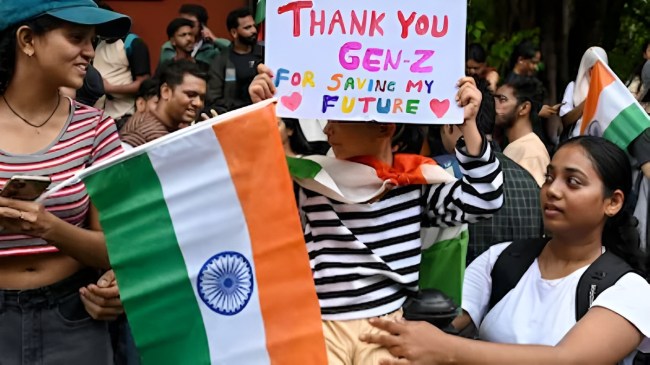
Gen-Z stident protest at New Delhi 2026.

Bharat at 2047 is not built on barricades. It is built in classrooms, laboratories, boardrooms, farms, and yes, in voting booths. The ‘Suvarn Kaal’ does not wait for those busy performing revolution for an audience that does not have Bharat’s interests at heart. – Yuvraj Pokharna

Let me speak directly to my Gen-Z, the Yuva of Bharat. That is the generation I write for, argue for, and refuse to give up on. You are being played! Not by the government. Not by the system, but by a well-oiled, well-funded, ideologically rehearsed ecosystem—one with a singular agenda—to manufacture a generation of permanent protesters out of a generation that was born to build.

India is growing at a pace that is forcing even the IMF to revise its numbers upward. This very quarter, the Fund was compelled to upgrade India’s growth projection from 6.5 per cent to 7 per cent. From sui to space, from UPI to ISRO, the Bharat growth story is not a government press release. It is documented, data-backed, and a globally acknowledged reality. The Indian Yuva is at the centre of that story as engineers, entrepreneurs, coders, creators, and contributors to a civilisation reclaiming its rightful place. And yet, someone wants you on the street instead.

Let us be clear about something. India has earned its revolutions. The rebellion against British colonial plunder was not anarchy; it was civilisational self-defence. The JP Andolan against Indira Gandhi’s Emergency was not disorder, it was democracy fighting back against a despotic ruler who had strangled the Constitution with her own hands. Those were different times, drastic times: times when the protest was the only constitutional tool left standing. Those times are not these times. When a democratically elected government is functioning within its full constitutional mandate, when the judiciary is not just intact but actively engaged, when elections are held on schedule, when the EVM remains the most powerful instrument of change available to every single citizen, anarchy dressed in the language of constitutionalism is not resistance. It is sabotage.

Look at the pattern. Because there is always a pattern. JNU erupts and two faces emerge for national primetime: Kanhaiya Kumar and Umar Khalid. The anti-CAA protests ignite and Sharjil Imam arrives, complete with his maps and his proposals for cutting the Northeast off from Bharat. Jamia burns and the ecosystem gifts us its heroes. And now, from the current round of mobilisation, we are being asked to accept Neha Bora—after the July rounds of protests that gave us cockroaches or so they would like to call themselves—AISA president, Rahul Gandhi’s new poster girl, and Marxist agitator as the new youth icon of India.

Rai ka pahad banana. A trimmed fingernail elevated into a certificate of martyrdom.

Here is what Bora actually said on record, in a video address to the Socialist Students’ Front conference in Bangladesh: “We know that the Gen-Z movement that we are seeing everywhere in this country first started in Bangladesh. Congratulations to you for showing us the way.” Bangladesh. A country where a student-led uprising led to over 500 deaths, forced a prime minister to flee, and plunged a neighbouring nation into chaos. That is the model being held up for your inspiration, Gen Z of Bharat.

And standing alongside her at a press conference at the Press Club of India today, senior advocate Prashant Bhushan said this – also on record: “There will definitely be a regime change. We all want a regime change.”

Not at the ballot box. Not through elections. Through the street. When Bangladeshi anarchists and Pakistani handles applaud these protests, what exactly are they celebrating? India’s democratic health? Or India’s destabilisation? The foreign connection is not a conspiracy theory. It is a documented, observable, consistent feature of every manufactured uprising this ecosystem has produced.

The government’s decision to denotify Jantar Mantar as a protest venue and redirect demonstrations to Ramlila Maidan is being spun as petrification. Let us apply basic logic here. Ramlila Maidan is the same ground where JP Narayan stood and shook a despotic government to its foundations. If the government were afraid of protest, it would not have designated one of the most historically significant protest grounds in the nation’s memory as the space for dissent.

It has not banned protest. It has maintained constitutional order. And if at any point it overstepped that mandate, the judiciary, neither absent nor captured, would have intervened. It has not needed to. Because the government has not overstepped.

My Gen-Z, let me say this with the love and the sharpness that this moment demands.

You are not the problem. You are the target.

This ecosystem needs your energy, your numbers, your social media fluency, and your genuine frustration with real issues—issues that matter and resonate with the youths—to fuel a political project that has nothing to do with your future and everything to do with its own survival.

Neha Bora did not build anything for you. Neither does she intend to. And that Yogendra Yadav, born as Salim Yadav—who declared “Sansad se nahi, sadak se faisla hoga”—is not fighting for your future. Prashant Bhushan, who wants regime change through the street and has previously spoken of revolution and bloodshed, is not your ally. They are using you. Do not be the fuel for someone else’s fire. If the government has failed you on any count—and no government is above that accountability—your weapon is the ballot. That is the most powerful instrument of peaceful, civilisational revolution ever designed. JP used the street because the ballot box had been suspended. You have not been robbed of yours. Use it.

Bharat at 2047 is not built on barricades. It is built in classrooms, laboratories, boardrooms, farms, and yes, in voting booths. The ‘Suvarn Kaal’ does not wait for those busy performing revolution for an audience that does not have Bharat’s interests at heart. You are not here to live in ‘delulu’. You are not here to merely find the ‘solulu’. You are here to become it. – News18, 20 October 2026

› Yuvraj Pokharna is a Surat-based educator, columnist, and social activist. He is the author of the book Hindutva For Gen Z.
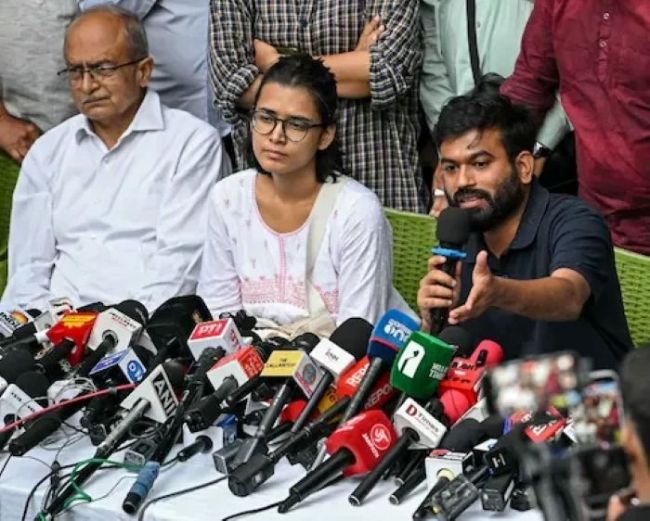
Prashant Bhushan, Neha Bora and Abhijeet Dipke

Modi’s rulership on probation, should prepare for a million mutinies now – R. Jagannathan

Narendra Modi

The problem with the Modi government is that well-meaning decisions driven from the top may not seem as good on the ground. Among the younger crowd, which is not used to listening to authority, they may even be seen as an imposition rather than a solution to a problem. … The important thing is to change the government’s DNA from rulership to consultation. – R. Jagannathan

By letting Dharmendra Pradhan go, albeit reluctantly, the Modi government may have bought itself some time to recoup political capital and rework its political calculations.

But the time it has bought may be weeks, not months. For once triggered, the chances are that every major citizen grievance will now be aired in public. Some could also lead to Jantar Mantar.

Already there is an E20 Janta Party in the making, comprising vehicle owners miffed about what E20, petrol blended with 20 per cent ethanol, may be doing to their vehicles. Soon you could have farmers and other groups vying to get into the action.

The Prime Minister, realising that the Jantar Mantar protests were driven by Gen Z, those in the 15–29 age group, and their Instagram posts, has himself gone on Instagram.

While there is no harm in this, he should not assume that his presence on the platform will change perceptions about this government. Reason: the Prime Minister is himself showing his age, and putting it on repeated view for a younger generation may not work with Gen Z.

So what exactly should the government be doing?

One, and most important, it must choose engagement with the youth over action driven from the top. The Gen Z grouse is not about any specific issue but about those in power not listening to what they are thinking, what they want out of life, and which things must be prioritised.

Of course, future careers are a big issue in our country, but it will not end with that. This cohort wants to be listened to. Having tasted blood at its first coming-out party, Gen Z is not going to go back to its studies.

The problem with the Modi government is that well-meaning decisions driven from the top may not seem as good on the ground. Among the younger crowd, which is not used to listening to authority, they may even be seen as an imposition rather than a solution to a problem.

The government has to develop the habit of listening to the youth and other social groups and then coming to decisions, rather than assuming that its own good intent is enough to justify a decision, as is the case with E20.

At the very least, it must offer alternatives to E20, even if 100 per cent petrol is priced higher. While ordinary vehicle owners are not going to create a chakka jam at Jantar Mantar, fleet operators and taxi owners might well do so.

So this is one trouble the government should see coming right now, and it should choose to engage with those raising concerns about E20. It is of course true that offering two fuel options may take time to implement, but being heard is the important thing here.

Two, this is also a kind of taxpayer revolt. While the vast majority of citizens do not pay any income tax, they do pay indirectly through the goods and services tax.

They also pay ‘private taxes’ in the form of bribes to various officials at the state or municipal levels, whether for traffic violations, birth and death certificates, or hospital and other subsidised services.

Our definition of the tax-paying middle class needs to change from one framed by income groups to a broader definition that looks at the middle-class mindset: anyone seeking to write competitive exams and pursue higher education, or consuming packaged foods, for example, should be considered middle class.

The emerging consuming classes are the larger middle class, even if their income levels do not always indicate their membership of this group.

Three, as Santosh Desai argues in his Times of India column of 27 July 2026, for Gen Z the only government they have known is the Modi government, not least because it has been seen everywhere and is also seen to be winning many elections.

So it will demand maximum accountability from the Modi government, even if most of their problems are not created by the Central government.

The Modi government would do well to start the process of devolving power to state governments, and to ask the latter to further devolve power to local bodies, for this is where citizens most interact with the state. The state governments will start feeling the heat soon enough.

The message is not merely to the Modi government but to all state governments and municipal authorities, none of whom is actually delivering good quality citizen services. They will all be vulnerable, but as the party which dominates Indian politics both at the Centre and in many states, the BJP will face searing heat.

Four, the CJP protests did not have any overt caste undertones, but many of the students protesting the NEET mess-up, and the larger problem of a lack of career opportunities, were also worried about the creeping nature of educational and job reservations.

But anyone who tries to interfere with reservations as they currently exist will inevitably face a political backlash, which could well set off a caste war.

This is precisely what will sink the BJP’s boat, for it is dependent on a Hindu vote consolidation that subsumes caste. If we end up with caste-based conflict, 2029 will be an uphill battle for the BJP, especially since minority consolidation against it is a reality.

Five, all political parties now need to heed the call for better governance and citizen services. Till now, thanks to the government’s ability to offer freebies using the Jan Dhan–Aadhaar–Mobile facility, politicians have been busy emptying the exchequer to win elections.

While no one can discount the probability of a well-aimed freebie bringing in the incremental vote, future elections will be about freebie-plus, not just freebies. If NEET can cause a political convulsion, why not garbage and traffic jams and poor health services?

Six, the judiciary and the news media should not consider themselves free from large-scale scrutiny. At the Jantar Mantar protests, many journalists were given abusive treatment, sometimes even with physical jostling.

The judiciary has not yet been a direct target, but the students on the prowl at Jantar Mantar did not have much reverence for it either. In fact the term ‘cockroach’ itself came courtesy of a casual remark made by the Chief Justice of India.

So, to repeat, what should the Modi government, or any government at any level, do?

One, it should consider initiating huge reforms by consulting Gen Z representatives, among others, apart from experts. This does not mean only the CJP, but many more youth leaders and organisations who understand the pulse of this cohort. Other political parties and citizen groups should also be kept in the loop.

Two, there should be committees and consultations for reforms in agriculture, education, health, skilling, bureaucracy, judiciary and, most important, political reforms. The last is the biggest cause of corruption.

The judiciary should know that while the executive will be held accountable for its lapses, the judiciary itself is one of the worst-performing arms of the state. So too is the bureaucracy. These reforms will not happen in a day, but if Modi is smart he will use the opportunity to drive change in the judiciary and bureaucracy too.

Three, the Modi cabinet could do with a huge amount of spring cleaning. It clearly needs fresh blood, young blood, and this must be visible. Some performing ministers, such as Ashwini Vaishnaw, are clearly overburdened, and some others seem compromised.

Nitin Gadkari is one of the performers, but he was seen to be insensitive to the concerns of vehicle owners on E20. He does not need to resign, but he could, along with petroleum minister Hardeep Singh Puri, consider setting up a panel with the aggrieved parties to take a relook at the whole E20 plan, including the possibility of gradually separating E20 from 100 per cent petrol priced higher. Consultation is key to forward movement.

Already, even after Pradhan’s exit, the Modi government has missed two opportunities.

First, it announced the formation of a committee headed by Nandan Nilekani for fixing the exam system and its infirmities. But it could have done this in consultation with some Gen Z representatives.

Second, it named Pralhad Joshi as the new Education Minister. But he does not represent change. A younger face in the ministry, even at the Minister of State level, would have been better.

The CJP movement is ultimately not about NEET or Dharmendra Pradhan. It is about demanding a higher quality of governance and performance from all arms of the state.

The Modi government is on probation, but so is the system itself. How Narendra Modi navigates these challenges over the next few years will determine whether he gets to influence the 2029 elections or is pushed aside by a rising tide of dissent. India is again at the threshold of a million mutinies.

But this is not just a threat. If Modi navigates it successfully, his legacy will not only survive but thrive. The important thing is to change the government’s DNA from rulership to consultation. – TheJaggi, 26 July 2026

› R. Jagannathan is senior journalist and former editorial director at Swarajya magazine. 

India's GenZ