Humanity and the forgotten dream of world unity – Gautam Chikermane

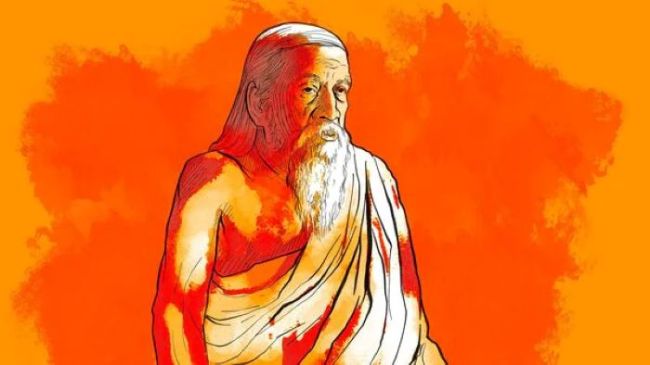
Sri Aurobindo

Just as an individual does not lose individuality when united with the divine but fulfils it, nations too flower to their fullest and freest expressions when united—this is the spiritual goal for a planet currently being crushed by rapidly fragmenting geopolitics. – Gautam Chikermane

On India’s Independence Day and Sri Aurobindo’s birth anniversary on August 15, 2026, there are two phenomenon the world seems to have forgotten: the idea of man as a transitional and evolving being as defined by Sri Aurobindo, and the geography (India) that gave birth to that spiritual inheritance five millenniums ago. Lurking in the dark shadows of progress, the rich age of the mind continues its onward march but the crude era of physical dominance continues; the latter through military may even be hijacking the fruits of development ripened after centuries of West-dominated conflicts.

In Sri Aurobindo’s universe, a nation is not merely a contract of individuals coming together, it is equally and more accurately, a society expressing itself through what he redefined as “collective being”. Such a society has a collective mind, a collective soul, a collective swabhava (essential nature) and a collective swadharma (law of action flowing from swabhava). We can term it ‘spiritual geopolitics’ that has become the psychic undergirding of the surface drama being enacted by principal actors in the form of collective beings expressing themselves as various nations.

When we reframe nations as beings rather than borders, we find in them not the drive of perfected statecraft, impeccably articulated by Ved Vyasa, Sun Tsu or Clausewitz, but the differently-evolving parts of the state: the physical, the vital, the mental and the psychic, each demanding and finding its individual place in the collective consciousness, each incomplete without the other. In 2026, it is the vital parts of the collective beings that are dominating this devolutionary pause in the larger evolutionary discourse.

Replacing progress with regress, we are being gaslit by emotive and vital streams of consciousness through actions of states and powered by nonstate actors such as US Big Tech, both of which are being aggressively embraced by humans stripped of geographical limitations. The slow, deliberate and decisive geological time-treads of evolution towards what Sri Aurobindo defines as the ‘supramental’ seem to have paused under the weight of the physical and the emotional. The grease of war is seeing humanity slip a few steps. It is fumbling, its spiritual aspiration lost to material fall, its ideas of security drowned by the forces of warring technologies.

The question he would ask, therefore, is not who is fighting the righteous war but from which stage of consciousness are the collective beings acting from: the illumined mind, the awakened soul or the desire-seeking vital. Amid the bombings of soldiers and civilians alike, the answer is clearly skewing towards an ego-driven ambition that, in a bid to create history, has chosen to forget history.

Beyond the strait, if Sri Aurobindo were writing today, he would observe the US-Iran war as much an occult phenomenon expressing the repeated rise of asuric forces to counter humanity’s spiritual evolution as a surface conquest and control of chokepoints or energy economics through an ethics-challenged power play. The US-Iran war is an axiomatic paradigm, part of the bigger tensions around the US-Russia-China rivalry that is showcasing itself through the Eastward shift of power and potentially the emergence of a new world order where the US-led West stands strategically softened, still in the play but seeking the dominance that has vanished.

To Sri Aurobindo, the US would be a vital-mental civilisation of tremendous dynamism, built on individual liberty and pragmatic energy, but with a persistent confusion between its national interest and a universal ideal. Its danger is not tyranny of the old imperial kind but a subtler one. It is the tendency to mistake its own particular form of life—technological and military dominance, market democracy, soft power, or once-robust institutions—for the only legitimate form of human progress, and to press this uniformity on other collective beings in the name of unity.

He would see Russia as a wounded and defensive vital ego, a civilisation with a real and distinct soul-nature shaped by centuries of hostility that continue till today. Apart from security, the collective being that is also the world’s largest geography has not yet found the peaceful, self-assured expression of its swabhava. Triggered by great power dominance and pitched against the US and the EU, its swadharma is constantly in a reactive mode. Its current assertiveness, the annexation of territory, the appeal to civilisational destiny, would strike him as the vital being’s attempt to recover dignity through force because it has not yet discovered a freer, more inward form of national stability.

As far as China goes, Sri Aurobindo would view it as an old and formidable civilisation-state whose genius lies in collective ordering, cultural continuity, and disciplined mental organisation capable of remarkable internal coherence. Its risk, in his terms, would be the opposite of America’s: not chaotic individualism exported as universal form, but a centralised harmony imposed from above, in which uniformity masquerades as unity. That is, a well-organised mind and a disciplined citizenry now experiencing wealth and economic success that has not yet let the deeper soul of its people, or of the nations within its orbit, breathe freely.

All three, he would argue, are playing a very old game: alliances, deterrence, balance of power, sanctions, spheres of influence. In other words, power. This is essentially the same mechanism as the historical struggle between empire-by-conquest and confederation-by-mutual-interest that he analysed in his essays in The Ideal of Human Unity, an unstable equilibrium, not a true unification, because it is built on calculation of force and self-interest rather than on the discovery of a common soul-life.

The solution Sri Aurobindo would point to, as he did in his August 15, 1947, article for All India Radio, would be in last three of the five dreams he had for India and its role in global affairs: “A world-union forming the outer basis of a fairer, brighter and nobler life for all mankind.” The momentum of this future existed then, as it does now, if India can develop a statesmanship not limited by current facts and surface events. It must build the physical resilience to endure headwinds, the emotional strength that sustains vitality, and the mental argumentations backed by material power to lead the world to peace, prosperity and progress.

The challenges before us today are not very different from those eight decades ago, when the vacuum of peace was filled with global institutions, all of which have failed to sustain, constantly in need of repair, with temporary changes to quieten voices rather than fix the problems. The institutions, particularly the United Nations, that can sustain humanity’s tomorrow cannot stand on the debris of yesterday; they need to be reimagined, not reformed—a new body to replace the UN, as the UN once replaced the League of Nations in 1946, which replaced the Concert of Europe in 1914.

Three characteristics would define the future. First, for institutions to be born and to sustain, the 195 collective beings would need to function as federations of equality rather than be vulnerable to the fragilities of self-interest; if anything, the latter must be embedded into the former.

Second, each collective being would need to attend to its own inner swadharma rather than importing from others; the powerful would need to prevent themselves from being intoxicated by their outer powers and resist the temptation to impose their models on others. The US and the EU would need to temper their universalising impulses and embrace the wider diversity of planet earth; Russia to secure identity through inner strength rather than territorial assertions; China to let its internal harmony become more inclusive outside borders; India to build its physical and vital strength to reach the higher recesses of the spiritual and become a medium of Sri Aurobindo’s dream.

And third, to understand that administrative or economic unification is merely the scaffolding that can handhold collective beings towards peace; it is a necessary component of getting there—but it is not sufficient. Real unity requires a change of consciousness, a transmutation into something more than the national ego or an idea beyond consumption dominance, geopolitical grabbing or coercion under the threat of a nuclear bomb. As he wrote in Savitri:

I have found the atoms from which he built the worlds:
The first tremendous cosmic energy
Missioned shall leap to slay my enemy kin,
Expunge a nation or abolish a race,
Death’s silence leave where there was laughter and joy.

The bomb may have created some external unity, forced by the weight of destruction in Hiroshima and Nagasaki. Surely such a unity cannot sustain; below the word, collective beings continue to simmer at the asymmetry. Tehran seeking a nuclear deterrence and Washington D.C. preventing it, or Islamabad and Pyongyang sabre rattling around their nuclear bombs are parts of that strategic simmering of disunity.

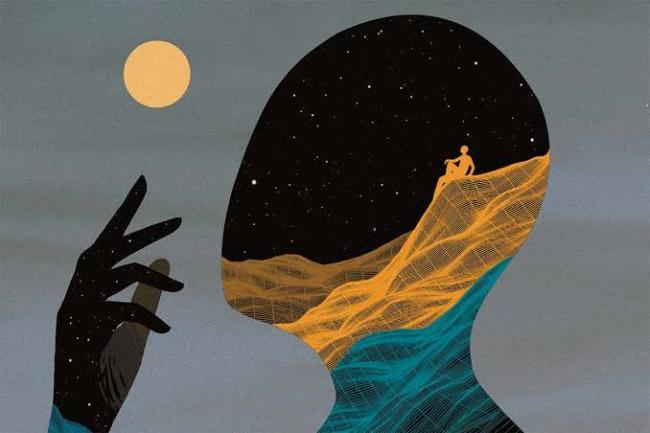
In all this, it is difficult to see the individual and the collective, the spiritual and the material as a unified divine expression. But in one line Sri Aurobindo merges them seamlessly. “I may now see myself as a creature contained in the universe,” he wrote in Essays in Philosophy and Yoga, “but when I come to self-knowledge, I see too the universe to be a thing contained in myself.” Just as an individual does not lose individuality when united with the divine but fulfils it, nations too flower to their fullest and freest expressions when united—this is the spiritual goal for a planet currently being crushed by rapidly fragmenting geopolitics. Guided by Sri Aurobindo, global unity is what India aspires for, moves towards and will lead the world into. – Firstpost, 14 August 2026

Author and journalist, Gautam Chikermane explores the unholy trinity of money, power and faith. He is the New Media Director at Reliance Industries Ltd and a Director on the Board of CARE India. 

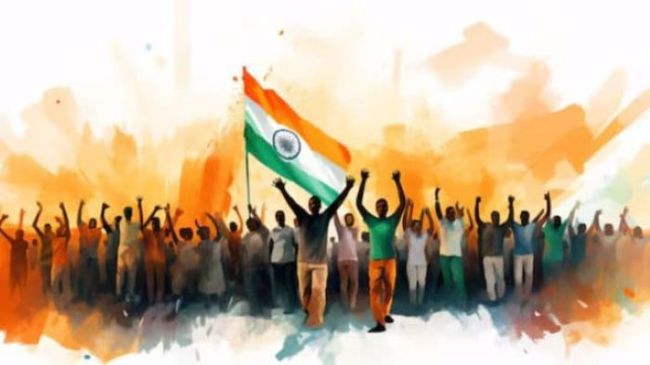
Indians with their flag.

When rationalists don’t get Hindu philosophy – David Frawley

Shiva covers himself when Vishnu visits.

There is a great mystery of consciousness behind the visible world that is our real duty as human beings to discover and to realise. This mystery cannot be limited to biological patterns or to intellectual theories. We should not be content with mere outer views of life. – Dr. David Frawley

From Freudian academics to the modern media, the main examinations of Hindu deities, particularly of Lord Shiva and his family, usually give their primary attention to sexual implications. But in the process of focusing on this side—often to the exclusion of the rest of the teachings—the deeper meaning of these spiritual traditions easily gets lost.

We can forget yoga’s profound insights into the mind, consciousness and higher human evolution, as well as the subtle meditation practices taught to reveal these.

Tantric Yoga philosophy describes seven chakras from the base of the spine to the top of the head. The purpose of yoga is to raise our awareness from the root chakra below—where we are spiritually asleep in ego consciousness and physical reality—to the thousand-petal lotus at the top of the head where we can experience cosmic consciousness and self-realisation, the state of the Supreme Shiva.

The chakras indicate vibratory levels with the five lower chakras relating to the earth, water, fire, air and ether elements and the two higher chakras to mind and consciousness. The ascent through the chakras involves moving from denser to subtler vibrations, and developing a greater unity consciousness along the way.

We should not stop short at the first and second chakras, which rule over lower energies, but consider all seven chakras and their implications in examining yogic deities and practices, extending to higher realms far beyond physical reality.

We should not only consider the role of physical union but also the role of union with the divine, and with the unitary awareness behind the universe as a whole.

The symbolism of Hindu deities

It is true that Hindu deities provide a wealth of fascinating symbolisms that stretch the boundaries of our imaginations and are not easy to understand for the rational intellect. They are capable of diverse interpretations as they reflect the whole of life and all of nature in its mind-transcending magic and bewildering paradoxes.

But the primary implications of these yogic powers are relative to cosmological principles and higher states of awareness, which constitute the bulk of their traditional interpretations that are quite detailed and extensive. Modern scientists have noted these cosmic connections, with the entire universe as Lord Shiva’s dance of light.

Hindu deities, particularly Shiva and his wife Parvati, reflect the practice of yoga and the energies of all the chakras in their stories and teachings, starting with Shiva as Yogeshwara, the lord of yoga, ruling over asana, prana, mantra and meditation. Parvati is the ideal yogini and manifests the yoga shakti, the inner power of yoga that takes us from darkness to light, from death to immortality.

There is a great mystery of consciousness behind the visible world that is our real duty as human beings to discover and to realise. This mystery cannot be limited to biological patterns or to intellectual theories. We should not be content with mere outer views of life.

Recognising the primacy of ananda

It is time to move beyond such circumscribed views to recognising the deeper aspects of science, art and philosophy behind the yoga tradition and its extraordinary images and cosmic depictions. This affords us a greater appreciation of the yogis of India and their intricate teachings, not merely about the body and mind, but relative to the universal consciousness in which is infinite and everlasting bliss!

Bliss or ananda is the origin and goal of all as the ancient Upanishads so eloquently state. If we are sensitive to beauty, love or grace anywhere, it is only because of this divine ananda. May we all discover that ananda within and around us! It is much more than any media sensation and takes us far beyond the biases of the mind to a boundless vision and new creative insight at every moment. This is what higher yoga practices can lead us to. – Daily-O, 23 September 2015

› Dr David Frawley (Pandit Vamadeva Sastri) is an American Hindu teacher and author who has written more than thirty books on topics such as the Vedas, Hinduism, Yoga, Ayurveda and Vedic astrology, published both in India by Voice of India and in the United States. 

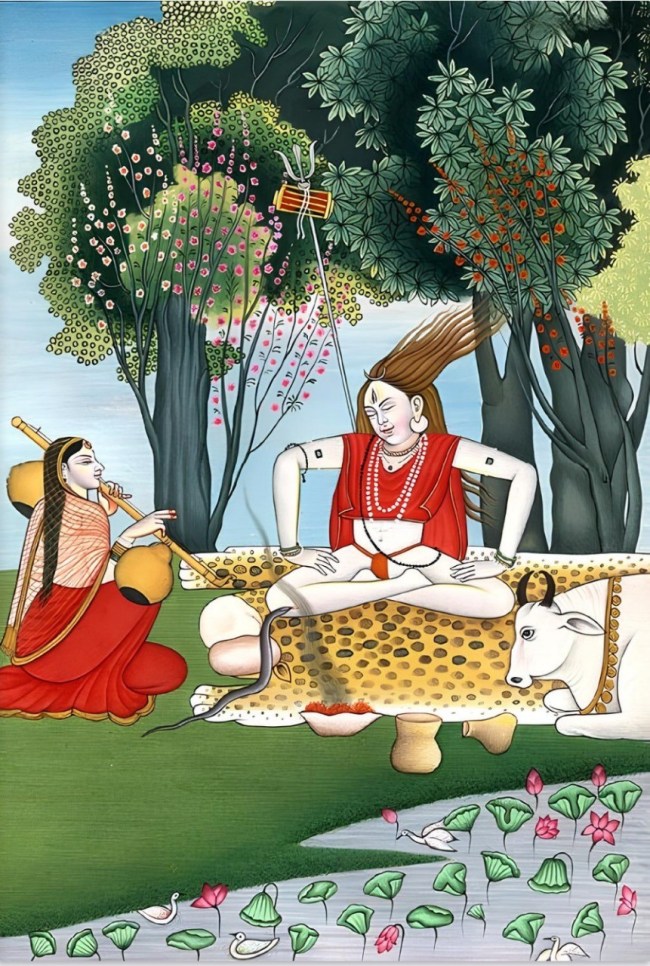
Shiva in bliss.