Let’s honour the India that is Bharat and the Hinduism that is Sanatana Dharma – David Frawley

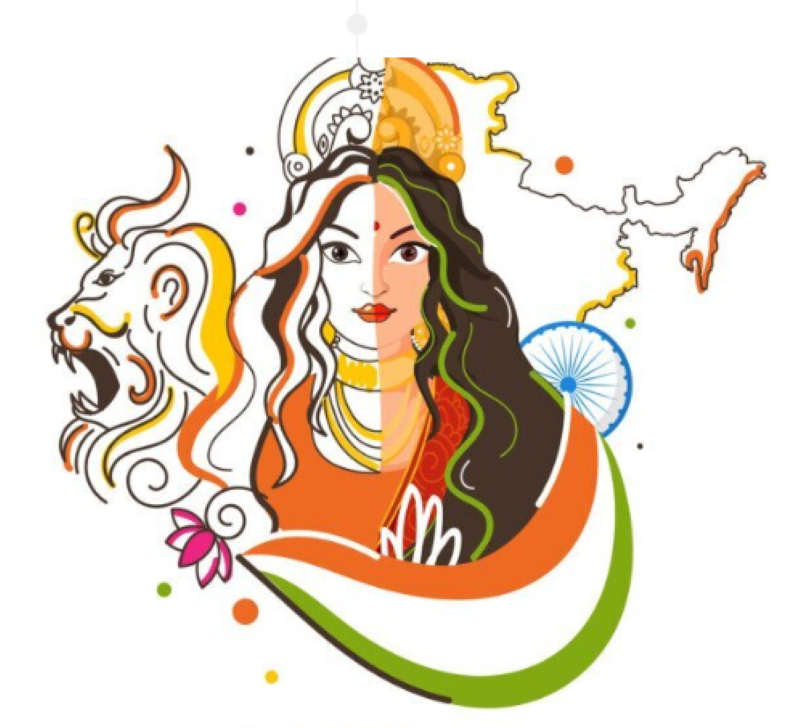
Bharat Mata

India that is Bharat, which occurs in the beginning of India’s Constitution, highlights the need for a civilisational revival that was an integral part of India’s independence movement, not just creating another modern nation-state. – Dr. David Frawley

India cannot be understood without an equation with its traditional name of BharatIndia is a much older civilisation than Europe and has maintained its continuity uniquely over the millennia. The term Bharat brings that ancient history to mind and its cultural identity as Bharatiya Samskriti, a vast dharmic civilisation with its own unique voice and global influence.

India that is Bharat, which occurs in the beginning of India’s Constitution, highlights the need for a civilisational revival that was an integral part of India’s independence movement, not just creating another modern nation-state.

Similarly, Hinduism cannot be understood without its equation with Sanatana Dharma, meaning the universal, eternal and perpetual Dharma. Sanatana Dharma shows the need to understand the dharmic traditions of Bharat in their own right and according to their own terminology: a profound spiritual, religious, philosophical, scientific, artistic and cultural tradition, with numerous great rishis, yogis and gurus, deity forms and temples, all reflecting a pursuit of higher consciousness and Self-realisation. We should equate Hinduism, Hindu Dharma and Sanatana Dharma, not simply by name but by meaning and implications.

It is great to see India’s politicians today using the term Bharat, or India/Bharat for their identification at diplomatic programs. It is an essential part of decolonization and calls for a reexamination of the global identity of India and what it represents as a civilisation. Similarly, it is important to identify Hinduism as Sanatana Dharma.

Sanatana Dharma refers to the term dharma in a generic way, embracing dharma in all its names, actions, vision and wisdom. Hindu Dharma is known for its many sects and sampradayas, whether Shaivite, Vaishnava, Shakta, Ganapata and Saura such as Adi Shankara recognised long ago, and as Vedic, Itihasa/Purana and Tantra with many modern movements as well. These diverse Hindu teachings are all expressions of a unitary Sanatana Dharma.

Vedic sciences like Yoga, Ayurveda, Vedanta, Jyotish and Vastu that are spreading worldwide reflect the Sanatana Dharma vision of universal consciousness at the foundation of Hinduism. Hindu art and culture with its music, dance, festivals and customs express the vibrant Sanatana way of life, embodied in its magnificent temples, their mystical designs and ornate sculptures.

Bharat and Sanatana Dharma

We must also note that Bharat cannot be understood without its inherent connection with Sanatana Dharma, as Bharat always viewed itself as a dharmic civilisation. Yet this does not mean that by using the terms Bharat and Sanatana Dharma, one will be creating a limited religious state. It will be acknowledging India’s dharmic civilisation and its experiential search for universal truth and consciousness, as in Yoga and Vedanta.

Let us, therefore, remember Bharat as the inner reality behind what is called India, and Sanatana Dharma as the essence of what people refer to as Hinduism. Sanatana Dharma highlights Hindu Dharma as embracing all humanity and all living beings, rooted in the Earth and nature, not any dogma. It has the vision of the world as one family, and the universe, both animate and inanimate as part of one’s own Self, with the Divine not apart from us.

I am not saying we should give up the terms Hinduism or Hindu Dharma but recognise Sanatana Dharma as its foundation. Even the word India we cannot give up, given its global usage, but can equate it with its Bharatiya essence for greater clarity and understanding.

Sanatana Dharma and national elections

Sadly, we still see an equation of Hinduism/Sanatana Dharma in a negative light at a political level with new assertions of the same old prejudices. This is most glaring in anti-Hindu anti-Sanatana Dharma state governments like the Communists in Kerala and DMK in Tamil Nadu who are trying to discredit and eradicate it for their own personal advantage. Meanwhile, India’s Congress party today, their ally, remains silent in the face of these virulent attacks, though it still claims to be Hindu when convenient, but lacks any conviction to express or defend Sanatana Dharma from such denigration.

We must remember that Sanatana Dharma is the ancient basis of Kerala and Tamil cultures, honouring Vedic knowledge and sustaining numerous monumental Hindu temples. Sanatana Dharma was the original basis of India’s Independence movement inspired by the Bhagavad Gita, and there can be no real Congress party apart from it.

Such political parties that oppose this dharmic heritage should be rejected in [any] national election. If they have no place for Bharat or Sanatana Dharma in what they respect or represent, what country, culture or civilisation can they claim to uphold or be part of?

Let us honour the India that is Bharat and the Hinduism that is Sanatana Dharma and we will understand the greatness of both. – News18, 9 Decemeber 2023

› Dr. David Frawley is the director of the American Institute of Vedic Studies and the author of more than 30 books on Yoga and Vedic traditions. 

Map of India

Max Müller to Doniger to Orsini: The West sends Trojan horses to India – Abhijit Majumder

Trojan Horse

The West repeatedly sends academic Trojan horses who would erase and distort Indian history, attack self-esteem, construct divisive narratives, and collude with India’s own sell-out intelligentsia to project credibility. – Abhijit Majumder

India is the imperialist’s unfinished project. Few lands that have been touched by Christian or Islamic imperialists have managed to remain largely unconverted and geopolitically intact. In a little over 100 years since 1900, the centuries-old fluid indigenous faiths in the entire African continent, for instance, dwindled from 76 per cent of the population to just 8 per cent, having been replaced by the two hardcoded religions.

Bharat, or what remains of it after Pakistan and Bangladesh were created, still has not given in. Sanatan Dharma is still the way of life for more than 75 per cent of Indians, and in spite of the best efforts of invaders and colonialists, its nationalism and civilisational self is rising again, its economy rapidly growing, its military gaining muscle.

The mere presence of Bharat—with its staggering size, diversity, and potential—has unnerved the West enough across ages to repeatedly send academic Trojan horses who would erase and distort history, attack self-esteem, construct divisive narratives, and collude with India’s own sell-out intelligentsia to project credibility.

The controversy around Francesca Orsini, Hindi scholar from London-based SOAS, is a continuation of that. A white woman specialising in an Indian language may fascinate us, but a look into her political activism in academic guise begins to reveal a different story.

She accuses the very language she teaches, Hindi, of political usurpation of other languages. She has a problem with Indian nationalism. In 2020, she introduced a resolution in the Seattle City Council against India’s Citizenship Amendment Act (CAA) and the National Register of Citizens (NRC).

While India is not obligated to host those arriving to spread intellectual poison, Orsini was deported recently after landing in Delhi for gross violation of visa conditions during her previous visits. Orsini is a rather mediocre entrant in the galaxy of Western radicals who have got into the study of Indology, history, Sanskrit and other languages only to undermine Bharat.

German philologist Friedrich Max Müller, hired by the British colonialists in 1847, came with a mission to bury the Vedas, which he described in a letter to his wife as “the root of their religion, and to show them what that root is, I feel sure, the only way of uprooting all that has sprung from it during the last 3,000 years”. He also wrote: “The ancient religion of India is doomed, and if Christianity does not step in, whose fault will it be?”

Then there was James Mill, a Scottish historian and economist whose work, The History of British India (1817), divided Indian history into Hindu, Muslim, and British periods. In his book, Mill extensively describes Hindus as “uncivilised”, “barbaric”, “savage”, and “rude”. This gentleman wrote with astonishing confidence on India without once stepping on this land and no knowledge whatsoever of Indian languages.

The more recent gift horses from the West to India like Wendy Doniger, Sheldon Pollock, and Audrey Truschke employ a more sophisticated packaging but are no less venomous. Doniger uses psychoanalytic quackery to introduce a homosexual angle to the relationship between Ramkrishna Paramhansa and his disciple Swami Vivekananda; Pollock blames the Sanskrit language for the Holocaust; and Truschke swoons over the genocidal Mughal Aurangzeb.

India’s intellectual tradition is among the most welcoming mindscapes in the world. Bharat has continuously assimilated knowledge and made “outsiders” its own. Even in the modern era, it has been enriched by foreigners from Sister Nivedita to David Frawley, Michael Danino to Koenraad Elst, Francois Gautier to Maria Wirth. These scholars have taken a dharmic approach. They did not approach Indic knowledge with the mission to debase it.

But ultimately, Indians will have to take a major part of the blame for not taking up their own knowledge universe seriously, neglecting languages like Sanskrit, writing their own history, and leaving a vast vacuum for the likes of Orsini to fill.

Unless Bharat begins to take its own story seriously, vultures will come to feast. – News18, 25 October 2025

Abhijit Majumder is a senior journalist and editor-in-chief at Earshot Media, New Delhi. He is the author of the book, ‘India’s New Right’. 

George Orwell Quote


Why Hindu Americans can’t do what Jewish and Muslim Americans can – Surajit Dasgupt

Hindu Americans

The grievance that Hindu Americans do not lobby for India as Jews do for Israel is both premature and misplaced. Diaspora power is earned over generations, not asserted overnight. As Indian Americans mature politically, their challenge will be to balance pride in their roots with the pluralism that defines their adopted homeland. – Surajit Dasgupt

When Shashi Tharoor raised a seemingly provocative question about the global Hindu community’s inability to lobby for India the way Jews in the US advocate for Israel or Muslims campaign for Palestine, he tapped into a long-standing unease within sections of India’s diaspora. His remarks, made at a public event, drew swift responses from several non-resident Indians (NRIs) and persons of Indian origin (PIOs) in America. They countered that India’s decision-makers seldom consult them before taking major policy decisions—such as buying oil from Russia or voting at the United Nations—and that they are often treated merely as emotional extensions of the homeland rather than as stakeholders in policy outcomes.

At one level, the NRI lament is outlandish. No sovereign country consults its overseas citizens before making foreign or economic policy choices. Yet, Tharoor’s pin prick touched a raw nerve because it revealed a deeper question about influence: Why have Hindu Americans, despite their wealth and education, not attained the political leverage that Jewish-Americans enjoy, or the ideological coherence that binds American Muslims on issues like Palestine?

This comparison is not new, but it is newly urgent. Indian-Americans have risen rapidly in visibility over the past two decades, producing senior officials, business leaders and even members of Congress. Still, their collective political voice remains fragmented. To understand why, it helps to explore how other diasporas—particularly Jewish-Americans—built power over generations. That contrast begins with history.

Jewish experience, American integration

Jewish migration to America began in waves through the 19th century, driven by persecution in Europe and the promise of religious freedom. It was not easy, as American Christians were no less swayed by the notion that Jews were the ‘killers’ of Jesus Christ. One thing that the older Americans perhaps did not throw at the Jews is envy. European Christians—as much as Asian Muslims—were jealous of Jews, seeing the Israelites become the first among the followers of the three Abrahamic faiths to become rich, thanks to the business of interest on money considered evil in Christianity and Islam but not in Judaism. There were enough rich men in the capitalist US to resent Jewish riches.

Yet, the early Jewish settlers faced hostility, discrimination and exclusion. If Europe saw Jews portrayed as villains, American cinema portrayed Jews (and Blacks) as villains too.

Examples from classic English literature

  • The Canterbury Tales (c 1400): In “The Prioress’s Tale,” Jewish characters are depicted in a classic antisemitic blood libel, accused of murdering a devout Christian child.
  • The Jew of Malta (1590s): Christopher Marlowe’s play features Barabas, a greedy, treacherous, and murderous character, who helped define the “villain Jew” stereotype on the English stage.
  • The Merchant of Venice (c 1600): William Shakespeare’s Shylock is the most famous example of this archetype. Though given a humanising monologue, he is characterised as a vengeful moneylender who demands a “pound of flesh” and is ultimately forced to convert to Christianity—a “happy ending” for the Christian characters.
  • Oliver Twist (1838): Charles Dickens’s Fagin is a villainous “crafty old Jew” who runs a school for child pickpockets. Dickens initially referred to Fagin as “the Jew” over 250 times, reinforcing the association of criminality with his Jewish identity. After a Jewish reader criticised the portrayal, Dickens removed many of the references in later editions and created a positive Jewish character, Riah, in a later novel.
  • Trilby (1894): George du Maurier’s novel features Svengali, a manipulative Jewish rogue and hypnotist who dominates a young woman. The character was so influential that his name entered the English language as a term for a sinister manipulator.

When film emerged in the 20th century, many of these same stereotypes were transferred to the screen.

  • Antisemitic caricatures: The early 20th century saw the phenomenon of “Jewface,” vaudeville acts that featured exaggerated Jewish stereotypes with props like putty noses and fake beards. Early cinema adapted many of these tropes.
    Nazi propaganda: In the 1930s and 1940s, Nazi Germany weaponised these historical caricatures in its propaganda films to portray Jewish people as satanic, greedy, and inferior.
  • A 1943 production of The Merchant of Venice in Vienna, for example, depicted Shylock as a demonic figure to support Nazi ideology.
  • Controversial adaptations: The 1948 film adaptation of Oliver Twist was denounced by Jewish groups in America for its antisemitic depiction of Fagin, leading to the film’s postponement in the US.
  • The “Jewish American Princess” stereotype: Post-war Jewish male writers, and later cinema, popularised the “JAP” stereotype, portraying young, materialistic, and spoiled Jewish women.

That was until several rights movements in the 1960s forced the American racists to climb down their high horses.

Over time, the Jews in America organised themselves into tight-knit communities centred on synagogues, charities and cultural institutions. From the outset, Jewish immigrants recognised the necessity of solidarity to survive in a majority-Christian society. That solidarity evolved into political coordination.

By the early 20th century, Jewish newspapers, cultural organisations and philanthropic networks had formed a vast informal infrastructure for communal representation. After the horrors of the Holocaust, Jewish activism entered a new phase: moral urgency fused with political strategy. Groups such as the American Jewish Committee, the Anti-Defamation League (ADL), and later the American Israel Public Affairs Committee (AIPAC) refined lobbying into an art. They cultivated bipartisan connections, funded research centres and established think-tanks that shaped American opinion about Israel and anti-Semitism.

It took decades of sustained effort. Jewish leaders worked patiently to normalise pro-Israel positions within Washington’s mainstream. When critics today call US Middle East policy “tilted” towards Israel, they overlook how that tilt emerged from generations of community-building, strategic philanthropy and civic participation. The result is not merely influence over foreign policy but a broad societal sympathy for Jewish concerns—a by-product of cultural immersion through education, arts and civil rights movements.

Muslim identity, shared faith

The Muslim-American story is very different but equally instructive. Muslims in the US are far more ethnically diverse—comprising Arabs, South Asians, Africans and converts—yet they have gradually coalesced around faith-based advocacy. Their political influence is still evolving, but organisations such as the Council on American-Islamic Relations (CAIR) and the Islamic Society of North America (ISNA) have given them a public voice.

The Palestinian issue provides a coherent moral and political framework to all Muslims in the US, transcending their respective nationalities, with their advocacy prioritising a global Muslim identity. This communal psychology contributes to their emotional unity. Not the case with the Hindu-American community! Predominantly Indian in origin, Hindus in the US represent a single country but lack an equivalent unifying ideology. Moreover, if individually, Indians constitute no more than 1% of the American population—too small for lobbying—and Pakistanis, Bangladeshis, or Arabs are fewer than Indians, the Islamic collective makes up for the absence of a large number of migrants from one given country.

As a saving grace, Indian-Americans are hardly casteist and their separate denominations—like Vaishnava, Shaiva, Shakta, Smartha, etc—do not manifest in the US to the point where Hindu unity would become a tough ask. However, India’s internal political polarisation often spills into the diaspora, dividing Indian-Americans between secular liberals and those aligned with the ruling Bharatiya Janata Party (BJP).

Indian-American paradox

Indian-Americans are among the most prosperous ethnic groups in the United States, with high median incomes and remarkable educational attainment. Silicon Valley, academia and medicine are full of Indian success stories. Yet political power does not automatically follow economic success. Unlike Jewish or Muslim groups, Indian-Americans have not built long-term institutions for coordinated lobbying. The existing organisations—such as the US-India Political Action Committee (USINPAC) or the Hindu American Foundation (HAF)—operate in silos and often struggle for mainstream acceptance.

There is also a generational factor. The first wave of Indian immigrants in the 1960s and 70s arrived under professional visas, focused on assimilation and career advancement. Political activism was rare. Their children, more culturally confident and socially integrated, are beginning to enter politics—figures such as Pramila Jayapal, Ro Khanna, and Vivek Ramaswamy illustrate this new visibility—but ideological divisions persist. Jayapal’s left-leaning stance on India’s human rights record often clashes with the nationalist sentiment of conservative Hindus. Consider how desperate Ramaswamy was during the Trump campaign to prove Hinduism isn’t too un-Christian, after all!

Most awkwardly, Hindus under the overseas wings of the Sangh Parivar need to work in coordination with Pakistani and Indian Muslims—including with CAIR and ISNA activists—in the US so that the South Asian identity looks significant and prominent enough to pressure the American policy makers.

Even symbolic recognition has come slowly. When one American state declared October 2022 as the “Hindu Heritage Month”, it was celebrated as a milestone. But as the activists who pushed for it admitted, Hispanics took nearly three decades to achieve comparable recognition. Diaspora influence takes time—and unity.

Politics of access, perception of influence

The optics of Prime Minister Narendra Modi’s warm rapport with Donald Trump during the latter’s first presidency created an illusion of extraordinary Indian-American influence. The “Howdy Modi” rally in Houston in 2019, where the two leaders walked hand in hand before a cheering crowd, suggested that the community had arrived as a political force. Yet that perception was misleading. It reflected personal chemistry, not institutional power.

When Trump returned to office for a second term, expectations of deeper India-US alignment quickly met geopolitical reality. Washington’s interests in China, trade and global security do not shift with diaspora enthusiasm. The limits of Indian-American leverage became clear, underscoring how different it is from the entrenched Jewish lobby or even the organised Muslim advocacy on Palestine and civil rights.

Long road to influence

Diaspora influence, as history shows, matures over generations. The Jewish experience offers the clearest example. From the early 20th century to the post-Holocaust era, Jewish-Americans worked through education, philanthropy and coalition-building. They forged alliances with African-Americans during the civil rights movement, ensuring moral reciprocity when they later defended Israel’s legitimacy. Their activism was institutional, not episodic.

For Indian-Americans, such institutional continuity is still forming. The community’s philanthropic energies are vast but scattered. Major donors fund temples, educational foundations and disaster relief, yet few invest strategically in think-tanks or policy advocacy. Nor is there consensus on which issues to champion. Should lobbying focus on India’s image, on global Hindu identity, or on broader multicultural representation? Each objective attracts different constituencies, often at cross purposes.

Cultural perception, historical memory

Then, influence does not depend on money or access alone; your narrative is an edifice built upon the foundation of the memories of your community as a collective. For Jewish-Americans, the memory of persecution provided a moral foundation for activism. Anti-Semitism in Western literature and film gradually gave way to empathy and representation, transforming public attitudes. Today, Jewish characters in American media are complex, human and often central to moral storytelling. This cultural normalisation underpins political legitimacy.

Indian-Americans, by contrast, are still defining their narrative. The Western imagination often reduces India to stereotypes of spirituality or poverty. Despite recent Bollywood popularity and the global reach of Indian cuisine, the Hindu identity remains poorly understood. Worse, political controversies—over caste, majoritarianism or Kashmir—have made the term “Hindutva” contentious abroad, complicating outreach efforts.

Future of diaspora advocacy

If Indian-Americans are to build real influence, they must learn from the patience and organisation of their Jewish counterparts. Effective lobbying requires consensus, credible institutions and a shared sense of purpose beyond partisan divides. It also demands bridging the gap between India’s domestic politics and the pluralist expectations of American democracy.

For now, the community’s most powerful asset remains its credibility: hardworking professionals with high civic participation and low crime rates. Translating that respectability into political leverage will take time—and strategic discipline.

The grievance that Hindus do not lobby for India as Jews do for Israel is, therefore, both premature and misplaced. Diaspora power is earned over generations, not asserted overnight. As Indian-Americans mature politically, their challenge will be to balance pride in their roots with the pluralism that defines their adopted homeland.

Tharoor’s question, then, was less an accusation than an invitation—to imagine what an organised, confident and inclusive Indian-American voice could achieve if it learned from history. – News18, 15 October 2025

Surajit Dasgupta is a senior journalist and writer.

Hinduphobia


Hindutva and other peoples’ nationalism – Koenraad Elst

Hindu & India Flags

Along with falling from cultural Hindu nationalism to empty secular-territorial nationalism, the BJP has also fallen from solidarity with other oppressed and colonised nations to a short-sighted ethnocentrism. – Dr. Koenraad Elst

The BJP’s subordination of any and every ideological or religious conflict to questions of “national unity and integrity”, this most mindless form of territorial nationalism, is also a worrying retreat from the historical Hindu conception of Indian nationhood and its implications for the evaluation of foreign problems of national unity. Along with Mahatma Gandhi and other Freedom Fighters, the BJS used to be convinced that India was a self-conscious civilisational unit since several thousands of years, strengthened in its realisation of unity by the Sanskrit language, the Brahmin caste, the pilgrimage cycles which brought pilgrims from every part of India all around the country (“country” rather than the “Subcontinent” or “South Asia”, terms which intrinsically question this unity), and other socio-cultural factors of national integration. The notions that India was an artificial creation of the British and a “nation in the making”, were floated by the British themselves and by Jawaharlal Nehru, respectively, and both are obvious cases of unfounded self-flattery. Gandhi’s and the BJS’s viewpoint that India is an ancient nation conscious of its own unity is historically more accurate.

In foreign policy, one can expect two opposite attitudes to follow from these two conceptions of India, the Gandhian one which derives India’s political unity from a pre-existent cultural unity, and the Nehruvian one which denies this cultural unity and sees political unity as a baseless coincidence, an artificial creation of external historical forces. In its own self-interest, an artificially created state devoid of underlying legitimacy tends to support any and every other state, regardless of whether that state is the political embodiment of a popular will or a cultural coherence. The reason is that any successful separatism at the expense of a fellow artificial state is a threat to the state’s own legitimacy. That is, for instance, why the founding member states of the Organisation of African Unity decided from the outset that the ethnically absurd colonial borders were not to be altered. It is also why countries like Great Britain and France, whose own legitimacy within their present borders is questioned by their Irish, Corsican and other minorities, were reluctant to give diplomatic recognition to Lithuania when it broke away from the Soviet Union.

By contrast, those who believe that states are merely political instruments in the service of existing ethnic or cultural units, accept that state structures and borders are not sacrosanct in themselves and that they may consequently be altered. That is why Aleksandr Solzhenitsyn proposed to allow the non-Slavic republics to leave the Soviet Union, and why as a sterling Russian patriot he pleaded in favour of Chechen independence from the Russian Federation: it is no use trying to keep Turks and Slavs, or Chechens and Russians, under one roof against their will. If Russia is meant to be the political expression of the collective will of the Russian people, it is only harmful to include other nations by force, as the Chechens and Turkic peoples once were.

To be sure, even partisans of this concept of “meaningful” (as opposed to arbitrary) states will concede that there may be limitations to this project of adjusting state structures and state borders to existing ethnic and cultural realities, especially where coherent communities have been ripped apart and relocated, as has happened in Russia. Also, cultural and ethnic identities are not static givens (e.g. the “Muslim” character of India’s principal minority), so we should not oversimplify the question to an idyllic picture of a permanent division of the world in states allotted to God-given national entities. But at least the general principle can be accepted: states should as much as possible be the embodiment of coherent cultural units. That, at any rate, is the Hindu-nationalist understanding of the Indian state: as the political embodiment of Hindu civilisation.

Now, what is the position of the BJS/BJP regarding the right of a state to self-preservation as against the aspirations of ethnic-cultural communities or nations? The BJS originally had no problem supporting separatism in certain specific cases, esp. the liberation of East Turkestan (Sinkiang/Xinjiang), Inner Mongolia and Tibet from Chinese rule. At the time, the BJS still adhered to the Gandhian position: India should be one independent state because it is one culturally, and so should Tibet for the same reason. Meanwhile, however, this plank in its platform has been quietly withdrawn.

As A.B. Vajpayee told the Chinese when he was Janata Party Foreign Minister, and as Brijesh Mishra, head of the BJP’s Foreign Policy Cell, reconfirmed to me (February 1996): India, including the BJP, considers Tibet and other ethnic territories in the People’s Republic as inalienable parts of China.[1] The BJP has decisively shifted towards the Nehruvian position: every state, by virtue of its very existence, must be defended against separatist tendencies, no matter how well-founded the latter may be in cultural, ethnic or historical respects. That is, for example, why the BJP is not supporting Kurdish sovereignty against Iraqi and Turkish imperialism.[2] Along with falling from cultural Hindu nationalism to empty secular-territorial nationalism, the BJP has also fallen from solidarity with other oppressed and colonised nations to a short-sighted ethnocentrism.

When you ask why the BJP has abandoned its support for the Tibetan freedom movement, the standard reply is that this would justify other separatisms, including those in Kashmir and Punjab. Exactly the same position is taken by non-BJP politicians and diplomats. But from a Hindu and from an Indian nationalist viewpoint, this position does injustice to India’s claim on Kashmir and Punjab, which should not be put on a par with all other anti-separatism positions in the world. Firstly, while Tibet was never a part of China, and while Chechnya was only recently (19th century) forcibly annexed to Russia, Kashmir and Punjab have been part of the heartland of Hindu culture since at least 5,000 years. Secondly, in contrast with the annexations of Chechnya and Tibet, the accession of Punjab (including the nominally independent princedoms in it) and the whole of the former princedom of Jammu & Kashmir to the Republic of India were entirely legal, following procedures duly agreed upon by the parties concerned.

Therefore, Indian nationalists are harming their own case by equating Kashmiri separatism with independentism in Tibet, which did not accede to China of its own free will and following due procedure, and which was not historically a part of China. To equate Kashmir with Tibet or Chechnya is to deny the profound historical and cultural Indianness of Kashmir, and to undermine India’s case against Kashmiri separatism. Here again, we see the harmful effect of the BJP’s intellectual sloppiness.

To be fair, we should mention that the party considers its own compromising position on Tibet as very clever and statesmanlike: now that it is preparing itself for Government, it is now already removing any obstacles in the way of its acceptance by China and the USA (who would both be irritated with the “destabilising” impact of a Government in Delhi which is serious about challenging Beijing’s annexation of Tibet). In reality, a clever statesman would reason the other way around: possibly there is no realistic scope for support to Tibetan independence, but then that can be conceded at the negotiation table, in exchange for real Chinese concessions, quid pro quo.[3] If you swallow your own hard positions beforehand, you will have nothing left to bargain with when you want to extract concessions on the other party’s hard positions, i.e., China’s territorial claims on Ladakh, Sikkim and Arunachal Pradesh, and its support to Burmese claims on the Andaman and Nicobar islands. International diplomacy should teach the BJP what it refuses to learn from its Indian experiences, viz. that being eager to please your enemies doesn’t pay. – Pragyata, 13 May 2020 (excerpt taken from BJP vis-a-vis Hindu Resurgence by  Koenraad Elst and published by Aditya Prakashan, New Delhi).

› Belgian scholar Dr Koenraad Elst is an author, linguist, and historian who visits India often to study and lecture. 

References

  1. If earlier BJP manifestos still mentioned Sino-Indian cooperation “with due safeguards for Tibet”, meaningless enough, the 1996 manifesto does not even mention Tibet. Nor does it unambiguously reclaim the China-occupied Indian territories; it vaguely settles for “resolv[ing] the border question in a fair and equitable manner”.(p.32)
  2. In October 1996, a handful of BJP men bravely demonstrated before the American Embassy against the American retaliation to the Iraqi troops’ entry in the Kurdish zone from which it was barred by the UNO. There was every reason to demonstrate: while punishing Iraq, the Americans allow Turkish aggression against Iraqi Kurdistan, the so-called “protected” zone, and fail to support Kurdish independence in deference to Turkey’s objections. But that was not the target of the BJP protest, which merely opposed any and every threat against the “unity and integrity” of Iraq, a totally artificial state with artificial and unjustifiable borders (as Saddam Hussain himself argued during the Gulf War, pointing to the artificial British-imposed border between the Mesopotamian population centre and the Kuwaiti oil fields).
  3. This is not to suggest that demanding freedom for Tibet should only be done to have a bargaining chip, merely to illustrate the principle that concessions, even if unavoidable under the circumstances, should still be made known as such, i.e. in exchange for concessions from the other party, and not made beforehand in exchange for nothing. But Beijing politics may develop in such a way that Tibetan sovereignty becomes a realistic proposition again.

Tibetan Independence

Hinduism & Buddhism: More similar than dissimilar – Ravi S. Kapoor

Mahabodhi Temple

In many parts of Asia—including India, Nepal, and Tibet—there is considerable similarity between Buddhist and Hindu practices, with communities often participating in each other’s festivals and visiting shared sacred sites. – Ravi Shanker Kapoor

With the Supreme Court agreeing to examine a plea for repealing the Bodh Gaya Temple Act, 1949, tensions between Buddhists and Hindus may rise shortly. As it is, there is a long-standing belief that Buddhism and Hinduism are fundamentally different from and antithetical to each other. This perception has led to the construction of oppositional binaries: egalitarian Buddhism versus iniquitous Hinduism, noble Buddhists versus wicked and scheming Brahmins, atheistic versus theistic, spiritual versus ritualistic. However, a closer examination of the philosophies, histories, and lived practices of the two traditions reveals that such binaries are misleading.

At the heart of both Hinduism and Buddhism lie the concepts of dharma and karma. These are not just abstract metaphysical principles but fundamental frameworks through which both traditions interpret human action and its consequences. In Hindu thought, dharma represents righteous duty, aligned with cosmic order. Karma refers to the principle of causation, where one’s actions directly influence future circumstances—either in this life or the next. Buddhism, especially in its early and classical forms, embraces these principles in similar ways.

While it is true that the Buddha rejected the authority of the Vedas and certain ritual practices associated with orthodox Brahmanical practices, he did not reject the ethical foundations of religious life. His teachings were a reformist response to what he saw as unnecessary ritualism and social stratification, not a wholesale rejection of spirituality. The roots of his thought remain embedded in the soil of the Indian subcontinent, and many of his core ideas are echoed in various strands of Hindu philosophy, especially in the Upanishads, Samkhya, and Vedanta schools.

From a theological perspective, there is a remarkable similarity between the philosophies of several Buddhist teachers and the great Hindu exponent of Vedanta, Adi Shankar. According to Encyclopedia Britannica, “His works reveal that he not only was versed in the orthodox Brahmanical traditions but also was well acquainted with Mahayana Buddhism. He is often criticized as a ‘Buddhist in disguise’ by his opponents because of the similarity between his doctrine and Buddhism. Despite this criticism, it should be noted that he made full use of his knowledge of Buddhism to attack Buddhist doctrines severely or to transmute them into his own Vedantic non-dualism.”

Another misconception often propagated is that Buddhism was inherently against Brahminical authority, that it was a movement against Brahmins. Historical evidence contradicts this simplistic narrative. A large number of early and influential Buddhist monks, scholars, and teachers were themselves Brahmins. Asanga and Vasubandhu, the fourth-century Gandhara-based Brahmin brothers, went on to found the Buddhist school of Yogacara (Practice of Yogā). It became a prominent school in China.

Kumarjiva (344-13), a brilliant translator of the Mahayana Buddhist texts like Lotus Sutra, was the son of a Brahmin. The great Buddhist philosopher of the Madhyamaka school, Nagarjuna, and the poet who embraced Buddhism after being its critic, Asvaghosha, also had Brahmin backgrounds.

Idols play a major role in Hinduism and Buddhism, though the followers of both faiths have different attitudes towards idols. In many parts of Asia—including India, Nepal, and Tibet—there is considerable similarity between Buddhist and Hindu practices, with communities often participating in each other’s festivals and visiting shared sacred sites.

The similarity in iconography is also quite evident. Also, images of the Buddha are often found in Hindu homes.

Another dimension where Hinduism and Buddhism have a common history is in the suffering and destruction inflicted by Muslim invasions, particularly during the medieval period. Between the 12th and 16th centuries, numerous Buddhist monasteries and Hindu temples were destroyed, their libraries burned, and monks and priests killed. The great Buddhist universities of Nalanda, Vikramashila, and Odantapuri, which were global centers of learning, were brutally attacked by Turkic and Afghan invaders. Hindu religious centers, too, faced similar devastation.

This shared trauma is a chapter in Indian history that remains insufficiently acknowledged in public discourse. Both traditions were marginalized, not only in terms of physical infrastructure but also in terms of cultural continuity. While Hinduism, with its vast rural roots and decentralised structure, managed to survive and revive over time, Buddhism, with its monastic dependency, suffered a more prolonged decline in India—though it flourished in other parts of Asia.

This is not to suggest that there was never any conflict between the two great traditions, but mostly it was peaceful coexistence. In India, as elsewhere. In The Golden Road: How Ancient India Transformed the World, William Dalrymple writes, “This free mixing of Hinduism and Buddhism is a striking feature of South-east Asian religion for this time onwards [sixth century]. … The Buddha and the Hindu gods accommodated each other and often appear folded in with local religious practices including ancestor worship, fertility ceremonies, and Naga and Yakshi worship as well as other spirit cults.”

To pit Hinduism and Buddhism against each other is to do a disservice to both. – News18, 1 September 2025

› Ravi Shanker Kapoor is an author and freelance journalist.

Muhammad Bakhtiyar Khalji

The RSS Century – Makarand R. Paranjape

Mohan Bhagwat and Narendra Modi with Hedgewar memorial at RSS headquarters in Nagpur.

The RSS set its sights on nation-building through cultural and political mobilisation. Its ideology emphasises a unified Hindu identity as the bedrock of Indian nationhood, a stance that has both inspired millions and provoked fierce opposition. – Prof. Makarand R. Paranjape

In the brouhaha over the ‘impossible’ retirement of Prime Minister Narendra Modi and the somewhat more probable demission of Rashtriya Swayamsevak Sangh (RSS) head Mohan Bhagwat, might we be forgetting an even more important milestone?

True that both Modi and Bhagwat will turn 75 in a few weeks, September 17 and September 11, respectively. Seventy-five, we needn’t remind ourselves, is the age at which leaders of the Sangh Parivar are expected to retreat gracefully both from public office and active duty, giving way to younger, even if not more capable, talent.

The prospects of Modi hanging up his boots, so to speak, seem not just unlikely, but remote. Despite his much-vaunted ‘almost sannyasi’ image as India’s most powerful renouncer. From all reports, not only does the Bharatiya Janata Party (BJP) need him, but he, too, has sent several signals to the effect that his work is far from done.

What about Bhagwat? Less implausible than Modi, but who can tell? RSS sarsanghchalaks lead by example. They are not politicians, though, almost as an occupational hazard, so embroiled in politics. Instead, a sarsanghchalak is supposed to embody the highest values, not only of the Sangh but of Sanatana Dharma itself.

My own contact with Mohan Bhagwat has convinced me that both his company and his conversation are spiritually elevating. At a crucial moment in my career, he suggested, quite simply and softly, that sticking to one’s own highest intention and integrity were far more valuable, in the long run, than ”playing the game”. A true intellectual, he remarked in passing, should never seek position or preferment: “Vat rahat nahi,” he said in Marathi. Which means, you lose respect.

Yes, we, in India, tend to revere individuals more than organisations. The personality cult comes naturally to us. But built into the Sangh’s DNA is the idea that the organisation is more important than the individual, society more important than the organisation, and the nation the most important of all.

As one pracharak or full-time worker, shifted out of what most would consider a very high-profile post to one of relative ano­nymity told me, “We are good to go wherever we are sent at very short notice.” He smiled when he said this and did not look at all unhappy or disappointed: “Apna jhola tham liya aur bus chal diye.” Get hold of one’s rucksack and just move on.

Such an attitude of egoless idealism and absence of attachment may not be universal among the cadres, but in the core group of those who actually make the Sangh what it is, it is less rare than common.

No wonder, rather than focusing on any individual, however great, the more significant jubilee that I am alluding to, of course, is the 100th anniversary of RSS.

Let us not forget that RSS has produced not only prime ministers like Narendra Modi and Atal Bihari Vajpayee but dozens of cabinet ministers, chief ministers, and governors. At least two vice presidents, Bhairon Singh Shekhawat and M. Venkaiah Naidu, and one president of India, Ram Nath Kovind, have come from its ranks. Not to mention luminaries in every branch of society.

With an estimated membership running into millions and over 75,000 active branches (shakhas) that are supposed to congregate daily, RSS is the world’s largest and most important voluntary socio-cultural organisation.

One would have to be blind or utterly prejudiced to disregard its unique and prodigious achievements. The RSS journey over the last 100 years has been nothing short of phenomenal. Its contributions to nation-building have, in my estimation, no parallel anywhere in the world.

On Vijayadashami 2025, the tenth victory day marking the culmination of In­dia’s autumn Navaratri festival, RSS completes 100 years of its existence. Celebrated all over the subcontinent and elsewhere as the triumph of good over evil, it coincides this year, quite ironically for critics, with the birthday of Mahatma Gandhi on October 2.

Unlike our political leaders, RSS shuns self-praise, avoids blowing its own trumpet. Of its six sarsanghchalaks, only its found­er, Dr. Keshav Baliram Hedgewar or Doctorji and, his anointed successor, Madhav Sadashiv Golwalkar or Guruji, have a specially consecrated joint memorial in Nagpur. No one else. There is no active personality cult around these two either.

I would not be surprised if, at least from the RSS side, its centenary celebrations might end up being relatively quiet. Closer to the date, however, the world, especially the Indian media, is bound to take notice.

Let us just say that I am starting a bit early.

Does the RSS centennial signify a spectacular and momentous accomplishment?

The answer is an unambiguous yes. Because, in the minds of many, RSS has done more in the service of Hindu society and the Indian nation than any other organisation or association.

Founded in Nagpur in 1925 by Hedgewar, RSS emerged at a time when India was grappling with colonial subjugation and internal divi­sions. Hedgewar, an ardent nationalist and physician trained at the Calcutta Medical College and Hospital, envi­sioned an organisation that would unify Hindus and foster a sense of cultural and national pride. RSS was not merely a response to British colonialism but also to the fragmentation of Hindu society, weakened by centuries of invasions, social stagnation, and religious disunity.

In addition to the threat of Muslim separatism, which was casting its long and sinister shadow over the motherland.

Hedgewar adopted a grassroots approach, establishing shakhas, daily gatherings where volunteers engaged in physical exercises, ideological discussions, and community service. This disciplined, decentralised model allowed RSS to penetrate deep into Indian society, from urban centres to remote villages. From its modest beginnings, RSS, as I have already shown, has become a mighty and, I dare to invoke a Gandhian phrase, a “beautiful tree”.

The RSS journey is marked by its unapologetic, at times aggressive, commitment to Hindu nationalism, or Hindutva, a term popularised by Vinayak Damodar Savarkar. Unlike other reform movements like the Arya Samaj or the Ramakrishna Mission, which focused primarily on religious or social reform, RSS set its sights on nation-build­ing through cultural and political mobilisation. Its ideology emphasises a unified Hindu identity as the bedrock of Indian nationhood, a stance that has both inspired millions and provoked fierce opposition.

Why is RSS is so feared, to the extent of being deliberately slandered and demonised? Because it alone, of all of India’s great Hindu reform movements, has dared to dedicate itself to nation formation. Also because its enemies want Hindus to remain divided and India to remain weak?

When Hindu society was at a parlous and precarious juncture, as during the bloody Partition of India in 1947, RSS played a critical role in saving the lives of hundreds of thousands of men, women, and children. RSS, since Independence, has also selflessly served the nation, whether during flood, famine, or, worse—the dreaded Emergency of 1975-77, often at great cost to itself and immense sacrifice of its members.

What is more, all this service has been rendered silently, with hardly any publicity or fanfare. Even if its fully dedicated cadre of workers, numbering not over an estimated 3,500, are called pracharaks or publicists—a better English rendering, were it not for the negative connotations, would actually be “super spreaders”.

This goal has embroiled it in the rough and tumble of politics. RSS not only inspired, seeded, and nurtured the Bharatiya Jana Sangh in 1951, but its successor, the Bharatiya Janata Party in 1980. The latter has been India’s ruling party at the Centre for over 11 years and is in power in 14 out of India’s 28 states.

Besides BJP and the Jana Sangh, RSS has also spawned over 100 important organisations from student to trade unions, schools, colleges, and ashrams, to cultural, social, and religious organisations.

It was RSS that founded the Akhil Bharatiya Vidyarthi Parishad (ABVP) in 1949 and the Vishva Hindu Parishad (VHP) in 1964. As also the Bajrang Dal in 1984.

The Bharatiya Mazdoor Sangh, the Bharatiya Kisan Dal, and Seva Bharati have been inspired and founded by RSS too. Its work is not confined, unlike a popular misconception, solely to men. Major women’s organisations such as the Rash­tra Sevika Samiti, Durga Vahini, and Matru Shakti have also been birthed by the Sangh. As dozens devoted to tribal and minority welfare have also been. These and a variety of other institutions have endeavoured to strengthen Hindu society and the Indian nation.

RSS is feared, reviled, and hated precisely because it has not shied away from seeking and wielding power, through its progenies and affiliates, in the interests of Hindus and India. This is the one simple reason why several groups, forces, and bodies from the extreme left to the farther right, not to mention India’s former ruling party Congress, all sought to ban, suppress, malign, denigrate, and delegitimise RSS.

But while its antagonists have failed and weakened over the decades, RSS has succeeded dramatically, even incredibly. That is why the last 100 years can justly be termed the RSS century.

And millions more may join its summons to national service in consonance with its beautifully moving and inspiring anthem. Inspired by Doctorji and composed by Narhari Narayan Bhide, let me invoke its opening line: Namaste Sada Vatsale Matrubhume (To Thee, ever-affectionate Motherland, my obeisance). – Open Magazine, 1 August 2025

Prof. Makarand R. Paranjape is an author, columnist, former teacher at JNU and former director of the Indian Institute of Advanced Study.

RSS flag march in Tamil Nadu.

Is the Ganga really self-cleaning? – Pranay Lal

Shiva with Ganga Devi in the raging river at Rishikesh.

The Ganga is no longer the self-cleansing river it once was. Its silicate-rich water, and less so, its myriad bot-like bacteriophages, are fading as the human stain deepens. – Dr. Pranay Lal

In 1896, a British bacteriologist named Ernest Hankin stood on the banks of the Ganga, watching as locals filled clay pots with water. He hoped that the dreaded cholera outbreak would not occur under his watch. In his attempt to avert it, Hankin discovered something extraordinary: water drawn from the river seemed to kill the pathogen within hours. In wells where the Ganga’s water was not introduced, however, the bacteria flourished.

Intrigued, Hankin conducted experiments, filtering and heating the water to determine what made it so inhospitable to cholera. He hypothesised that an unseen biological agent was at work. The notion that the Ganga could retain its self-purifying properties defied conventional wisdom. Even as evidence mounted, the idea was dismissed as anecdotal—a quirk of the river’s mythology rather than a function of science.

Hankin’s discovery would take another three decades to be recognised as the action of bacteriophages: viruses that prey exclusively on bacteria. It wasn’t until the 21st century that modern research tools finally confirmed what Hankin had suspected.

Several recent studies have mapped the prevalence of bacteriophages in the Ganga, in water samples collected from Hardwar to Varanasi. These studies have found unusually high concentrations of phages targeting common pathogens of waterborne diseases. Some scientists have even isolated bacteriophages that neutralise deadly, antibiotic-resistant bacteria.

When phage therapy was first discovered, researchers were elated that the Ganga was an untapped reservoir.

But bacteriophages exist only because its prey, the bacteria, is found in abundance. They would not exist without them. Simply put, the presence of bacteria-killing viruses is a symptom of bacterial pollution. It is not the sign of some potent power of the river.

Further, the presence of bacteriophages is only a small part of the Ganga story. The secret of the river’s anti-bacterial water lies in its unique geochemical properties.

All about silicates

On the slopes of the Himalayas and in the waters of the Ganga and its tributaries, an invisible process unfolds. It was first articulated by Nobel laureate Harold Urey, who proposed a deceptively simple equation: CO2 reacts with calcium-bearing silicate rocks, forming limestone and releasing silicates. This reaction, playing out over geological time, acts as a planetary thermostat, drawing carbon dioxide from the air and locking it away in ocean sediments. This entrapment, called deep carbon burial, prevents the carbon from returning to the atmosphere, helping regulate atmospheric CO2 and global warming.

Nowhere is this process more pronounced than in the Himalayas, where young, rapidly eroding rock faces provide an ideal surface for chemical weathering. Rain, made slightly acidic by atmospheric CO2, scrubs the mountain’s flanks, washing sediments down the Ganga and ultimately to the deep basins of the Bay of Bengal. There, carbon mineralises and settles into long-term storage, part of a vast, slow-moving cycle that has regulated global temperatures for millions of years.

In theory, this should be a stabilising force. The amount of organic carbon buried in the Bengal basin alone accounts for up to 20 per cent of terrestrial organic carbon reaching oceanic sediments. But this process is not immune to disruption. Some climate scientists have turned their attention to what happens when pollution, deforestation, unchecked urbanisation, and large and small dams interfere with the carbon reaction explained by Urey.

The Ganga’s seemingly staid landscape is actually quite complex. The rocks and sediments that get carried down from the high Himalayas define its chemistry. In the highlands, calcium, magnesium, and bicarbonate dominate, pointing to carbonate weathering. But as the river descends, sodium, potassium, and excess bicarbonate take over—evidence of silicate weathering and inputs from alkaline soils and groundwater.

The clays and sediments of each river are unique, and they entomb a variety of silicate-rich minerals. These minerals deter bacterial growth, killing them or reducing their reproduction. The river, along its course, deposits different silicate concentrations: the higher the concentration, the lower the bacterial counts.

No longer a purifying force

A 2024 paper has found that the Ganga’s dissolved silicon (DSi) and silicon isotopes build up in the river but their potency reduces downstream, in the plains.

At higher elevations, only some silicates bind with iron oxides and carbonates. When the river meets the Yamuna and the Gomti, more silicon gets added, from other rocks and river sands. At the place where the Gomti meets the Ganga, the silicate concentration reaches its maximum limit.

As sewage gets dumped into the river, farm and industrial pollution builds up and much of the silicates get bound. By the time that the silicates reach the mid-Ganga, they’re completely sequestered. Most get bound to organic molecules like bacteria or sewage. This would not have been the case in the pre-industrial era. As cities and industries have grown, Ganga’s silicate potential has diminished. Instead of trapping CO2, it now combines with human waste.

The Ganga is no longer the self-cleansing force it once was. Its silicate-rich water, and less so, its myriad bot-like bacteriophages, are fading as the human stain deepens. Restoring the river isn’t just a matter of environmental conservation or a public health imperative. It is critical that this ceaseless engine of carbon capture isn’t lost to modern neglect. – The Print, 25 October 2025

Dr. Pranay Lal is a biochemist and natural history writer. He is the author of ‘Indica: A Deep Natural History of the Indian Subcontinent’ and ‘Invisible Empire: The Natural History of Viruses’. 

Sri Devi dies on the Ganga bank in Kolkata.

Time for India to stop wearing the ‘secular’ and ‘socialist’ labels – Abhijit Majumder

Preamble to the Indian Constitution

It is time for Bharat to do away with “secular” and “socialist” labels—one a colonial, Western construct weaponised against India’s civilisation; the other, an infatuation with the rise of the Soviet Union and its oppressive communist economy, which ultimately failed. – Abhijit Majumder

The words of RSS sarkaryavah or general secretary Dattatreya Hosabale have often been the bellwether to profound and unexpected change. His statement [qualifying] decriminalisation of homosexuality under Section 377 of the Indian Penal Code, for instance, paved the way for the Indian Right bringing down its wall of resistance towards the reform.

So, when “Datta-ji” calls for a debate on the words “secular” and “socialist”, which were inserted into the Preamble of the Constitution not by Parliament but through the backdoor during Emergency, his words carry both weight and edge.

“Later, these words were not removed. Should they remain or not, a debate must happen. These two words were not in Dr. Ambedkar’s Constitution. During the Emergency, the country had no functioning Parliament, no rights, no judiciary and yet these two words were added,” Hosabale said.

Has the Narendra Modi dispensation made up its mind to remove “secular” and “socialist” from India’s Constitution?

It seems so.

Late last year, Tamil Nadu governor R.N. Ravi too had brought it up.

Secularism was a European concept that evolved after a conflict between the Church and the King, he said. He argued Bharat is a dharma-centric nation, and therefore, “secularism” was not part of the Constitution but added during the Emergency by “one insecure prime minister”.

The founding parents of the Indian Constitution had extensively debated the subject before deciding not to include the two terms.

On November 15, 1948, K.T. Shah proposed an amendment to the draft of the Indian Constitution to include “Secular, Federal, Socialist Union of States”. However, B.R. Ambedkar, the chairman of the Drafting Committee, junked the proposal.

He said, “What should be the policy of the state, how society should be organised in its social and economic side, are matters which must be decided by the people themselves according to time and circumstances.”

Ambedkar was staunchly against codifying an ideology like socialism in the Constitution and restricting future generations from choosing their own path.

“It cannot be laid down in the Constitution itself because that is destroying democracy altogether,” he said.

Ambedkar argued that the Constitution blueprint already had socialist principles laid down through the Directive Principles of State Policy. He pointed to Article 31 of the draft, which already prescribed a strong dose of socialism by preventing the concentration of wealth and providing equal pay for equal work.

And both Jawaharlal Nehru and Ambedkar argued that the term “secular” did not need to be explicitly mentioned in the Preamble. Ambedkar said the Constitution had already made it clear that India would not recognise any religion.

Articles 16 and 19, for instance, prohibit discrimination against any person based on religion.

Nehru said the notion of Western secularism did not fit Bharat’s ideas of religious tolerance and respect for all cultures, ironically echoed by Ravi and the RSS-BJP ecosystem so many decades later.

But Congress member of the Constituent Assembly Lokanath Misra was perhaps one of the most outspoken and unabashed voices against “secularism”. He called “secular State” a “slippery phrase, a device to bypass the ancient culture of the land”. He argued that religion could not be divorced from life.

“If religion is beyond the ken of our State, let us clearly say so and delete all reference to rights relating to religion. If we find it necessary, let us be brave enough and say what it should be,” he said.

Here is a particularly impassioned—many may say politically incorrect—excerpt of his speech at the Constituent Assembly debates.

“We have no quarrel with Christ or Mohammad or what they saw and said. We have all respect for them. To my mind, Vedic culture excludes nothing. Every philosophy and culture has its place but now, the cry of religion is a dangerous cry. It denominates, it divides and encamps people in warring ways.

In the present context what can this word ‘propagation’ in Article 19 mean? It can only mean paving the way for the complete annihilation of Hindu culture, the Hindu way of life and manners. Islam has declared its hostility to Hindu thought. Christianity has worked out the policy of peaceful penetration by the backdoor on the outskirts of our social life.

This is because Hinduism did not accept barricades for its protection. Hinduism is just an integrated vision and a philosophy of life and cosmos, expressed in organised society to live that philosophy in peace and amity.

But Hindu generosity has been misused and politics has overrun Hindu culture. Today religion in India serves no higher purpose than collecting ignorance, poverty and ambition under a banner that flies for fanaticism. The aim is political, for in the modern world all is power-politics and the inner man is lost in the dust.

Let everybody live as he thinks best but let him not try to swell his number to demand the spoils of political warfare. Let us not raise the question of communal minorities anymore. It is a device to swallow the majority in the long run. This is intolerable and unjust.”

It is time for Bharat to do away with “secular” and “socialist” labels—one a colonial, Western construct weaponised against India’s civilisation; the other, an infatuation with the rise of the Soviet Union and its oppressive communist economy, which ultimately failed.

The new India must carefully choose what it wears, what it wants to be. – News18, 27 June 2025

Abhijit Majumder is an author, editor, journalist and media entrepreneur in New Delhi.

Constituent Assembly Members (1950)

Audrey Truschke: A demagogue with a megaphone – Sankrant Sanu

Audrey Truschke

Hinduism, as a non-Abrahamic tradition, remains open season in many Western academic spaces. This double standard isn’t just unjust—it’s intellectually dishonest. – Sankrant Sanu

On the streets of New York, Audrey Truschke—then assistant professor of South Asian history at Rutgers University—stood with a megaphone and declared to a crowd: “Prime Minister Narendra Modi and his political party, the BJP, openly adhere to Hindutva.”

She then launched into her historical comparison: “Hindutva came about roughly 100 years ago. … It was inspired in its early days by Nazism. Did I say Nazis? Yeah, I said Nazis.” She emphasised: “I want to be clear that I am talking about real, actual, historical Nazis.”

Then came the most inflammatory claim: “Early Hindutva espousers openly admired Hitler. … They praised Hitler’s treatment of the Jewish people in Germany as a good model for dealing with India’s Muslim minority.”

With this inflammatory rhetoric, she branded India’s ruling BJP and its adherence to Hindutva as Nazi-like—by extension tarring the hundreds of millions of Indians who democratically elected this government, as fascists. It wasn’t scholarship; it was street theatre designed to demonise an entire community. For Hindus across America, this wasn’t just academic discourse—it was public vilification. To rub salt into the wound, the department of history at Rutgers gleefully posted Truschke’s diatribe on their Facebook feed with the endorsement: “That’s what we call public history.”

Now, with her latest book India: 5,000 Years of History on the Subcontinent hitting shelves this month, Truschke’s troubling methodology is reaching an even wider audience. The timing couldn’t be more urgent for examining what happens when academic platforms become weapons of ideological warfare.

The Hitler Analogy: History stripped of context

Truschke’s accusation draws from a controversial passage in We or Our Nationhood Defined, published in March 1939 and attributed to M.S. Golwalkar of the RSS. The reality is more complex than her megaphone moment suggests.

The book wasn’t authored by Golwalkar but paraphrased and translated by him. The historical context matters crucially: in 1939, the full extent of Nazi atrocities against Jews was not yet known. The Holocaust — the systematic extermination of six million Jews—wouldn’t begin until 1941. For many colonised peoples worldwide, including some Indians, Hitler was viewed primarily as an enemy of Britain—their colonial oppressor.

The passage reflects the ideological uncertainty of that era, when colonised peoples worldwide were grappling with competing definitions of nationalism and looking to various models of national reorganisation. More importantly, the RSS has explicitly disavowed this misattributed quote, and decades of subsequent Hindutva writings have evolved far beyond these early formulations. But such nuance doesn’t fit Truschke’s narrative.

Most perversely, her Hitler comparison erases a remarkable historical truth: Hindus have never persecuted Jews. For over two millennia, India has been a haven for Jewish communities—in Kerala, Maharashtra, and Bengal. While Jews faced pogroms in Europe, ghettos in the Middle East, and extermination in Nazi camps, they found safety and dignity in Hindu-majority India.

To draw parallels between Hindutva and Hitler isn’t just inflammatory—it’s a moral inversion of history that anachronistically applies knowledge of the Holocaust to judge a misattributed quote from an earlier period—and then use that nearly 100-year-old aside to define a contemporary political movement. This is not academic history; it is political pamphleteering.

A pattern of distortion

This isn’t an isolated incident. Truschke’s 2017 book Aurangzeb: The Life and Legacy of India’s Most Controversial King whitewashes a well-documented record of temple destruction, discriminatory taxation, and forced conversions. Despite abundant evidence from Aurangzeb’s own firmans (imperial decrees) documenting systematic iconoclasm and forced conversion of Hindus, she claims he “simply left temples alone” and was a protector of Hindus, dismissing documented destructions as merely following “an Indian stance dating back, at least, to the Chalukyas and Pallavas”.

This false equivalency ignores a crucial theological distinction. When Aurangzeb’s contemporary sources praise him for hitting against the “infidels” and spreading Islam through “holy war,” these aren’t political calculations—they’re expressions of religious doctrine. In Islamic theology, idol worship is the gravest sin, making temple destruction an act of piety. Hinduism contains no such mandate. Political motivations aren’t identical to doctrinal imperatives.

Truschke dismisses scholars like Jadunath Sarkar as unreliable while downplaying Persian sources that contradict her narrative. Her approach isn’t history—it’s revisionism designed to obscure inconvenient truths.

Her recently published India: 5,000 Years of History on the Subcontinent promises more of the same: selective citations, interpretive sleights, and wholesale demagoguery. We can expect the 600-page tome to follows the familiar pattern—Hinduism cast as irredeemably oppressive, Islam framed as emancipatory. There’s little interest in balance, complexity, or competing narratives. It is only in the politicised ghetto of “South Asian Studies”, where practicing Hindus have little voice, that an academic would get away with this level of propaganda.

Silencing students, stifling dialogue 

At a recent Georgia Tech event, a Hindu student described confronting Truschke at Princeton about her portrayals. Instead of engaging his respectful questions, she dismissed his concerns as “Hindutva propaganda” and shut him down. The room fell silent—a moment of intimidation, not academic exchange.

Hindu students at Rutgers report similar experiences: hesitating to speak in her classes, fearing they’ll be branded bigots for defending their faith. Many now avoid her courses entirely. In 2021, students petitioned against her teaching Hinduism, citing her claim that the Bhagavad Gita “rationalises mass slaughter” and her suggestion linking Hindus to the January 6 Capitol riot.

Rutgers defended her academic freedom and promised dialogue with the Hindu community. That dialogue never materialised.

The double standard problem

American universities rightfully crack down on antisemitism, Islamophobia, and anti-Black racism. Yet when Hindu students raise similar concerns, institutions often look away, or worse, actively endorse such writing.

Truschke positions herself as the victim of “Hindu nationalist trolls” while sidestepping legitimate concerns from students who feel unsafe in her academic spaces. When she tweeted that Lord Rama was a “misogynistic pig”—later claiming scholarly translation—even Robert Goldman, the scholar she cited, publicly rejected her framing. One wonders how the academy would react if a professor used the same language about a different revered figure, say Prophet Mohammad.

The damage spreads beyond academia. Hindu students report being mocked as “cow piss drinkers”, stereotyped as “Brahmin oppressors”, or casually equated with fascists. When they respond, they’re accused of extremism—silenced not by force, but by fear.

Drawing the line

This isn’t about suppressing legitimate criticism of Hindutva politics. It’s about distinguishing between scholarly critique and rhetorical abuse.

Truschke’s defenders, including Romila Thapar and Sheldon Pollock, argue that attacking Hindutva isn’t Hinduphobia.  In practice, targeting Hindutva often disguises targeting Hindus.

When Truschke abuses Rama, she is attacking an iconic figure in the Hindu tradition, revered across the length and breadth of India. There can be no better evidence of what her target is.

Would such treatment be tolerated toward any other faith community?

The answer is obvious. Hinduism, as a non-Abrahamic tradition, remains open season in many Western academic spaces. This double standard isn’t just unjust—it’s intellectually dishonest.

The path forward

Universities must confront this hypocrisy. If “safe spaces” truly exist for all, Hindu students deserve the same dignity afforded every other community. That means distinguishing between legitimate academic inquiry and inflammatory demagoguery—whether delivered through peer-reviewed journals, street megaphones, or 600-page histories now being peddled as the history of India.

Academic freedom must be balanced with academic responsibility. Scholars have the right to challenge religious and political traditions, but they also have an obligation to maintain scholarly standards, engage in good faith, and create inclusive learning environments.

With Truschke’s latest work now in circulation, the stakes have never been higher. Her interpretive framework isn’t confined to specialised academic journals—it’s shaping how a new generation learns about Indian civilisation.

Until universities address this imbalance, the promise of inclusive academia remains hollow. Hindu Americans will continue raising their voices—not to suppress debate, but to demand what every community deserves: fairness, intellectual honesty, and basic respect.

The megaphone may be loud, but truth has a voice of its own. – News18, 16 June 2025

Sankrant Sanu is an author, entrepenour, and researcher based in Seattle nad Gurgoan.

Which is the oldest Dravidian language? – Anirudh Kanisetti

Kota people from the Nilgiris

The speakers of Proto-Dravidian, according to archaeological and linguistic streams of evidence, lived in the Krishna-Godavari valley in present-day north Karnataka and Andhra Pradesh. – Anirudh Kanisetti

Veteran actor Kamal Haasan courted controversy by declaring that “Kannada was born out of Tamil.” The question of which Indian language is oldest—and, by extension, most native to the soil—has been a political hot topic since the mid-20th century. Some say Sanskrit, others say Tamil. But beneath the nationalist furore, paleobotanists, historical linguists, and archaeologists have made stunning discoveries about the linguistic heritage of all Indians.

From the lost Gangetic ‘Language X’, to the possible origins of Southeast Asian languages, to the homeland of Proto-Dravidian speakers, it turns out prehistoric Indian languages were as diverse as today’s.

Where do Dravidian languages come from?

The term “Dravidian” today is often associated with India’s southern states, linked to ideas of ethnicity, culture and politics. Here I use it only in the linguistic sense. In The Dravidian Languages (2003), linguist Bhadriraju Krishnamurti writes that Dravidian languages are spoken from the tip of the peninsula deep into Central India; one isolated Dravidian language, Brahui, is spoken as far west as Balochistan in present-day Pakistan.

Anthropologist and historian Thomas Trautmann, in Dravidian Kinship (1981), also found a Dravidian substrate in many place-names in Maharashtra, and pointed out that Dravidian cultural practices—such as first-cousin and maternal uncle-niece marriages—are practiced by a few castes in Sindh and even Gujarat. Speakers of Dravidian languages, and their descendants, are extremely widespread.

Given this vast geographic range, it’s natural to ask: who were the ‘original’ Dravidian speakers? How did they spread and why? By looking at the earliest shared features of all Dravidian languages, we can assemble a hypothetical Proto-Dravidian language from which all modern Dravidian languages descend. We can figure out what plants and animals they saw, what their climate was like, and what their politics and settlements were like. Then we can look at the ecology of the subcontinent, archaeological digs, and we can see what matches.

Distinguished linguist Franklin C. Southworth, in his paper Proto-Dravidian Agriculture” (2005), made the most rigorous attempt yet to reconstruct this lost world. Proto-Dravidian speakers had a word for “king”. They used a similar word for “hut” and “village”, suggesting small populations of related families. They knew of various agricultural and hunting tools, and a wide variety of wild animals.

Around the 3rd millennium BCE—when the Harappan civilisation was thriving on the Indus Valley—the speakers of Proto-Dravidian were also aware of many crops, such as sorghum and various types of millet and gram. They also had terms for cattle pens and domesticated sheep and goats. Finally, as archaeobotanist Dorian Q. Fuller writes in “Non-Human Genetics, Agricultural Origins and Historical Linguistics in South Asia” (2007), Proto-Dravidian speakers seem to have lived in a dry, deciduous forest environment.

One region seems a good match for all these criteria. It is a region where the ranges of the modern Dravidian language families—Northern, Central, South-Central and South—overlap, and possibly where they radiated from. This is supported by extensive archaeological findings of a “Southern Neolithic” period, with evidence of small mud homes, remains of domesticated and wild animals, and crops.

There is a 73 per cent match between Southworth’s Proto-Dravidian vocabulary of plants and those found in Southern Neolithic sites. Surprisingly, these sites are rather distant from the hotbeds of South Indian linguistic nationalism today. They are neither in south Karnataka nor in Tamil Nadu. Rather, the speakers of Proto-Dravidian, according to archaeological and linguistic streams of evidence, lived in the Krishna-Godavari valley in present-day north Karnataka and Andhra Pradesh.

The archaeology of languages

To be clear, this is not to say that all Dravidian speakers originated from the Krishna-Godavari valley. (If we are being cheeky, no human being truly ‘originated’ anywhere except Eastern Africa.) The fact is, even the Proto-Dravidian language has some words borrowed from other language families, namely Austro-Asiatic—spoken mostly in Southeast Asia today, with the Munda families of Odisha and Chhattisgarh being the Indian representatives. This may suggest that the speakers of even earlier stages of Dravidian migrated to the Krishna-Godavari valley from elsewhere, picking up influences from other languages on the way. Some genetic and linguistic theories link early Dravidian speakers to the Iranian Plateau and the Harappan civilisation, but that’s a matter for another day.

Interestingly, the Proto-Dravidian language is not a perfect match for Southern Neolithic excavations: the peoples of the Southern Neolithic practised urn burials, but there’s no vocabulary for it in Proto-Dravidian. It also doesn’t match other archaeological candidates, such as the Harappan civilisation. If their cities are anything to go by, Harappans must have had a vocabulary for engineering and geometry, but it’s practically nonexistent in Proto-Dravidian. Proto-Dravidian also doesn’t have a word for ‘rhinoceros’, which are often depicted on Harappan seals. This doesn’t mean that no Dravidian speakers lived in Harappan cities—such a vast civilisation must have been multilingual. It just means there may have been another, now-extinct early branch of Dravidian languages, which could have evolved separately from Proto-Dravidian.

Proto-Dravidian has words for some crops—especially wheat—which may be of Harappan origin, suggesting, at the very least, agricultural exchanges. The true “homeland” of the Dravidians, then, is still unclear. All we can say for certain is that around 3000 BCE, Proto-Dravidian speakers deep in the South Indian peninsula harnessed agriculture and, as their population exploded around 1100 BCE, they spread out in waves across the Indian Subcontinent.

“Broadly, the default Proto-Dravidian agricultural practice was dry farming of millets, pulses and tubers. Irrigated rice farming (alongside cash crops like cotton and sugarcane) became more important in the late 1st millennium BCE,” Dr Sureshkumar Muthukumaran, a historian, curator and lecturer at the National University of Singapore, told me. Over the centuries, Dravidian speakers traded words, animals and crops not only with North India but also with Southeast Asia. A particularly influential branch headed south, giving rise to the South Dravidian languages. Some groups, relatively isolated on the Nilgiri hills, developed languages such as Irula and Toda. Others, settling into the expansive coasts and plains, spoke the ancestors of Kannada, Tamil and Malayalam.

The language that became Tamil, according to Krishnamurti (Dravidian Languages), branched off around 600 BCE, roughly when the first cities were growing on the Gangetic Plains far to the North. Three centuries later, it had developed into Old Tamil, the first Dravidian language to have a written culture, composed in thriving new trading towns with rice-farms. Old Tamil itself was composed of many dialects, which evolved into Middle Tamil and eventually modern Tamil centuries later. Between 800–1200 CE, some Middle Tamil dialects branched off into Malayalam.

We can say with confidence that the ancestor of Kannada is not Tamil: it is a lost South Dravidian language related both to the languages of the Nilgiris and to Old Tamil. Unfortunately, the earliest written examples of Kannada date to c. 450 CE, so we don’t have a clear picture of how the language evolved in the centuries prior. Thereafter, though, many dialects of Kannada evolved, through Old Kannada into Middle and thence modern Kannada. In North Karnataka, Kannada dialects had a fertile exchange with Indo-Aryan languages such as Marathi, which in turn had a Dravidian substrate.

The mosaic of Indian languages

It is becoming increasingly clear that this complex mosaic of linguistic borrowings, evolutions, migrations, and shifts is the story of all Indians, indeed of all humanity. Rig Vedic Sanskrit provides another early example. Prof Michael Witzel, a linguist and scholar of the Vedas, writes in “Substrate Languages in Old Indo-Aryan” (1999) that already by 1500 BCE, the earliest Indo-Aryan languages had absorbed a chunk of vocabulary from now-lost Austro-Asiatic languages in Punjab—a hypothetical Harappan language called “Meluhhan” in Sindh, and a language called “Language X”, probably spoken by the earliest Neolithic farmers in the Gangetic plains. A few centuries later, c. 800 BCE, Dravidian words suddenly appear in the Vedas, possibly hinting at now-lost North Dravidian languages.

As noted above, Tamil literature and writing appeared around 300 BCE. The earliest Tamil literature is called the Sangam poetry, after assemblies of poets who compiled it. Linguists, however, generally agree that the word “Sangam” itself is borrowed from Indo-Aryan languages, while Old Tamil poets were clearly aware of Vedic mythology. Meanwhile, around the same time in North India, Prakrit literatures blossomed, overpowering the dominance of Sanskrit in religion and ritual. Krishnamurti (The Dravidian Languages) argues that Prakrits probably developed from the integration of the speakers of now-lost regional Dravidian languages into the North Indian mainstream. And, in the medieval period, starting around 600 CE, all the major Southern Dravidian languages, including both Kannada and Tamil, borrowed extensive political, grammatical, and religious terms from a revitalised Classical Sanskrit.

So, what is indigenous and what is foreign? Which language is “oldest” when all have branched off from already-diverse origins, and borrowed from or lent to each other across centuries? India’s modern linguistic diversity didn’t appear out of nowhere: all the evidence is telling us that we are the inheritors of a complex, multidimensional mixing of genes, words, technologies, and ideas across timescales of truly mind-boggling proportions. Banal statements that language A is older than language B might set social media aflame and rally nationalists to a cause. But, as is increasingly clear, patriotic oversimplifications always trample on the histories and dignities they claim to protect. – The Print, 5 June 2025

Anirudh Kanisetti is an author and public historian. 

Dravidian Language Map