At a time when Western powers are either apologising for or seeking to whitewash their colonial past, Rahul Gandhi’s volunteering Bharat for membership of the colonial club is a spectacular self-goal. – Utpal Kumar
At an event at the University of Chicago last week, Congress leader Rahul Gandhi invented a hitherto unknown dimension of Bharat’s past: its colonial history. “The only country that has ever colonised China is India,” he declared.
And how did India, that is Bharat, accomplish this remarkable feat? “Because we gave them Buddhism,” he said.
By this logic, the land of ancient Israel colonised much of the world by giving it Judaism and Christianity—as well as some of the core theological foundations of Islam!
The Oxford Dictionary defines ‘colonise’ as an attempt “to take control of an area or a country that is not your own, especially using force, and send people from your own country to live there”. Noted academic Edward Said takes the argument further in Culture and Imperialism, as he writes:
“Neither imperialism nor colonialism is a simple act of accumulation and acquisition. Both are supported and perhaps even impelled by impressive ideological formations that include notions that certain territories and people require and beseech domination.”
Which aspect of the spread of Buddhism to China fits either of these descriptions? Where were the Indian armies of occupation and colonial administrators? Where was the economic exploitation or political subjugation?
But, then, why single out Rahul Gandhi for using the ‘C’ word, his supporters might ask. Didn’t R.C. Majumdar, a doyen among Indian historians, use a similar expression? They would remind us of his 1927 work, Ancient Indian Colonies in the Far East. If such an eminent historian could invoke “ancient Indian colonies”, why cannot a politician?
The argument, however persuasive it might seem, overlooks the historical context. Majumdar was writing when Bharat itself was a colony. Being a colonial power was hardly a stigma then; it was widely regarded as a measure of national power and prestige.
By invoking Bharat’s supposed colonial past, Majumdar sought to remind the British that they were dealing not with an inherently backward nation but with a great civilisation passing through a difficult phase in its long historical existence. He was also seeking to restore the self-confidence of a colonised people.
What explains Rahul Gandhi’s fascination with the colonial tag a century later?
Going through the entire Chicago interaction, one gets the impression that the Congress leader meant well—and may have spoken the colonial stuff in jest. He thought he was portraying Bharat in a favourable light. Alas, intentions do not always determine consequences. His statement could well open another front in the narrative war against Bharat.
After all, we have already been portrayed as descendants of Central Asian invaders who, much like the white European settlers in America and Australia, dispossessed the original inhabitants and pushed them southwards. We have been labelled casteist, classist and misogynistic. And now we are colonialists too!
At a time when Western powers are either apologising for or seeking to whitewash their colonial past, volunteering Bharat for membership of the colonial club is a spectacular self-goal.
The statement is even more problematic from a historical standpoint. Bharat’s engagement with much of the outside world has traditionally been civilisational, cultural and economic rather than colonial.
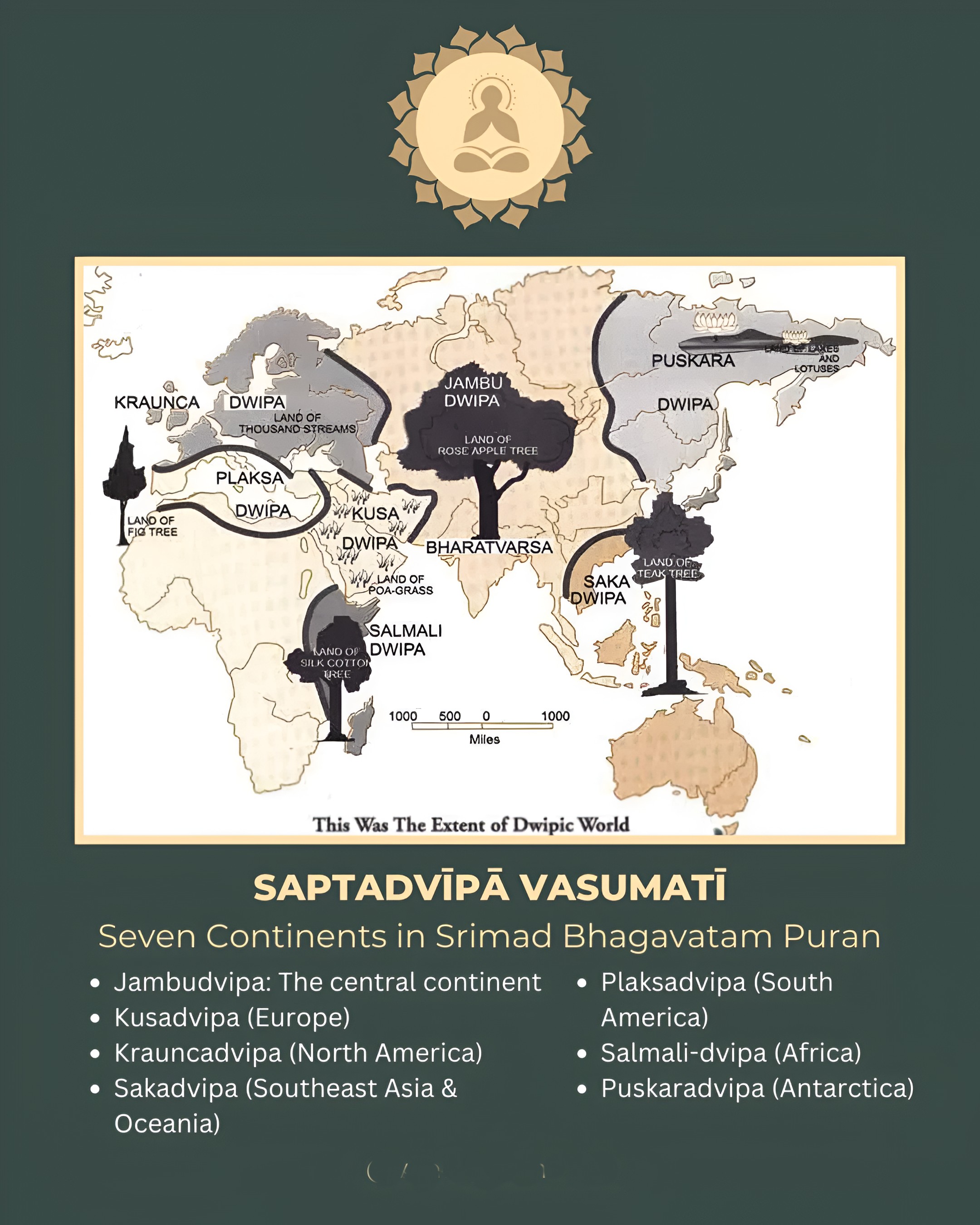
One is reminded of the expansive geographical consciousness of ancient Bharat each time a Hindu takes a sankalpa during a puja. The ritual invokes Jambu-dvipa, identified in certain geographical interpretations with a large part of Eurasia, followed by Dakshina Parv (the southern part of Jambu-dvipa), Bharata Khand (Greater Bharat), Bharata Varsha (the Indian subcontinent) and, eventually, the locality where the ritual is performed.
The Brahma Purana describes these geographical regions in considerable detail:
“The dvipas are Jambu, Plaksha, Shalmala, Kusha, Krouncha, Shaka, and Pushkara as the seventh. … Jambu-dvipa is located right in the middle of these and in the centre is Meru, the golden mountain… The earth is like a lotus and the mountain is established like its pericarp. … Bharata is said to be the first varsha, and Kimpurusha is the one that comes next. Harivarsha is to the south of Meru. Ramyaka is to the north and Hiranmaya is next to it. O supreme Brahmanas! Uttarkuru is like Bharata. Each of these extends for 9,000 yojanas. Ilavrita is in the centre and the golden mountain of Meru rises up there. O immensely fortunate ones! In four directions from Meru, Ilavrita extends for 9,000 yojanas.”
Jambu-dvipa is described as circular and surrounded by the sea on all sides. According to the Markandeya Purana, the earth in Jambu-dvipa “rises up in the middle and slopes downwards to the north and the south”. The elevated land is known as Ilavrita, at the centre of which stands Mount Meru.
The Vayu Purana describes in detail the mountains, rivers and valleys of Jambu-dvipa. Prof. S.M. Ali writes in The Geography of the Puranas that the “geographical section of this (Vayu) Purana is more complete and detailed than that found in any other Puranas”.
According to him, the description of the northern regions of Jambu-dvipa “covers a very vast area, from the Urals and the Caspian to the Yenisel and from the Turkestan, Tien Shan ranges to the Arctic. It describes the topography of the whole land very accurately and in some cases picturesquely”.
In such geographical interpretations of the Puranas, the vast expanse beyond the Himalayas and the Hindu Kush, stretching from the Pamirs towards the Arctic, has been identified with Uttara Kuru, while the extreme northern region has been associated with Somagiri.
There are numerous references to these regions in Valmiki’s Ramayana and Ved Vyasa’s Mahabharata. In the Ramayana, for instance, Sugriva, whilst dispatching the vanaras northwards in search of Sita, describes the routes and countries lying in that direction.
Among other places, he directs them to search for Sita in the lands and towns of the Dardas, Kambojas, Yavanas and Shakas. He also describes Uttara Kuru and Somagiri, the latter situated in the extreme north. The region, he says, is without national boundaries and remains illuminated even in the absence of the sun.
Not only are regions beyond the geographical confines of Bharat described in considerable detail, but their inhabitants are also represented as part of a larger Indic civilisational ecosystem.
The Mahabharata, for instance, regards the Shakas, Daradas, Pahlavas, Kiratas and Paradas as Kshatriyas of good birth. Several of these groups find representation on either side of the epic Kurukshetra war.
The Puranas refer to the Pahlavas, Kambojas, Shakas, Yavanas and Paradas as the pancha-ganah, or the five hordes. In a military alliance with the Haihaya or Talajangha Kshatriyas of the Yadava lineage, these groups defeated and dethroned King Bahu of Kosala.
Sagara, the son of King Bahu, subsequently defeated the Haihayas and their allies. According to the Puranic account, Sagara divested these groups of their Kshatriya status, following which the Brahmin priests abandoned them. In due course, they came to be described variously as Vrishalas, Vratyas, Shudras or degraded Kshatriyas.
The Sagara saga, thus, situates these Central Asian communities within the larger Indic civilisational imagination.
Bharat’s ties with Central and Western Asia were deep, enduring and reciprocal, with people, goods and ideas moving in both directions over centuries. These regions shared significant socio-cultural and religious affinities.
Such affinities help explain why, when several Central Asian groups entered the Indian subcontinent following the decline of the Mauryas, their military incursions did not necessarily translate into an irreconcilable clash of civilisations. Many of them were already familiar with Indic cultural and religious traditions.
Let’s look at the Kushanas (Yueh-chis), whose empire straddled Central Asia and the Indian subcontinent. In Lord Shiva: In India and Abroad, noted academic B.B. Kumar writes:
“The figure of Shiva was found on the coins of Gondopheres, Maves and others. It appears on the coins of the Kushana rulers. … It needs mention that the Kushana kings were the devotees of Shiva before their arrival in this country. Shiva was worshipped in India and Central Asia along with Vishnu and Sun God, as revealed in famous Nicolo seal, noticed by Cunningham and deciphered by Ghirshman; it was originally in Tocharian language and script, the figure of the devotee on the seal is that of a Haephthalite chief. The seal reveals the composite cult of Shiva, Vishnu and Surya (Mihira, Vedic Mitra, Sun God). This confirms the fact that the religious behaviour operated in the continuum frame, rather than in the dichotomy frame.”
The religious history of the Mongols provides another illustration of this continuum. Among Buddhist Mongols, Mahakala, a deity with associations with Shiva in the wider Indic religious tradition, occupies an important position. Trident symbolism has also been associated with Mongol military standards. According to Berthold Laufer, Mongolian mythology attributes Kublai Khan’s conversion to Buddhism to an inspirational dream featuring Lord Shiva. To this, B.B. Kumar adds:
“The other deities worshipped by them (Mongols) were: Yama (the god of the dead), Goddess Devi (Lha-mo; the spouse of Shiva), Kartikeya (Cam-Sran; a war god), Vaisravana or Kubera, Brahma, 33 devas, digpalas, 21 Taras, Hevajra, Buddha-kapala, Yamantaka, Hayagriva (a horse-necked god; seems to be connected with Vishnu, rather than Shiva; the protector of horses), etc.”
Intriguing religious parallels can also be discerned among the historically persecuted Yazidis. The Shaivite tradition, in which Shiva occupies the highest position and the peacock-riding Kartikeya (Skanda) is his son, bears a symbolic resemblance to the Yazidi tradition, in which the Peacock Angel occupies a pre-eminent position among divine beings. Interestingly, the Indian peacock is native to the subcontinent, although such parallels cannot, by themselves, conclusively establish a common religious origin.
Eminent British historian Arnold Toynbee traced the Indic linguistic and cultural presence in Central Asia deep into antiquity, saying that “the region belonged to Sanskrit people from 1700 BC to 400 AD”.
What, then, does the Bharat-Central Asia saga tell us?
It demonstrates the depth and reciprocity of relations between the two regions, the coexistence and mutual enrichment of Hindu and Buddhist traditions, and the inadequacy of the rigid dichotomy between them emphasised by certain strands of colonial-Marxist historiography. Indeed, contrary to popular perceptions, B.B. Kumar argues in India and Central Asia: A Shared Past that Hinduism “precedes Buddhism in Central Asia”.
What we see here is a cultural and civilisational continuum, not an empire founded upon political-economic subjugation.
If one wishes to examine colonialism in the Asian context, perhaps greater attention should be paid to China’s own territorial expansion, particularly in regions such as Tibet, Xinjiang and Inner Mongolia.
A substantial proportion of present-day China comprises territories historically distinct from the Han heartland in their cultural, ethnic, religious and political identities. Their incorporation into successive Chinese empires and, eventually, the modern Chinese state involved complex processes of military conquest, political consolidation and demographic transformation. Even as recently as the 1930s, British diplomat Sir Eric Teichman, travelling across Inner Mongolia towards Xinjiang, observed how “the traveller finds himself in a new country; China and Mongolia are left behind”.
This was less than a century ago. When one moves further back in history, these distinctions become even more pronounced. While Indic cultural influence across much of Central and Western Asia was extensive, the Han court’s sustained diplomatic engagement with Central Asia developed relatively later.
As Rahul Sankrityayan recounts in Madhya Asia Ka Itihas (History of Central Asia), when Emperor Wu of the Han dynasty (141–87 BC) dispatched his envoy, Zhang Qian, to Central Asia to gather first-hand information about the region and establish relations with the Yuezhi, the envoy encountered goods of Chinese origin in Bactria that had apparently reached there through Indian trade networks.
The episode illustrates the extensive reach of Indian commercial networks at a time when the Han court was still acquainting itself with the political and geographical realities of Central Asia.
An even greater distortion is the popular conception of the Silk Road as a single, well-defined commercial artery connecting China with Europe. Prof. Valerie Hansen of Yale University, in The Silk Road: A New History, explains how the term ‘Silk Road’ itself is a relatively recent invention. She writes:
“From its inception, the Silk Road was shown as relatively straight and well-travelled, but it never was. Over a hundred years of archaeological investigation have revealed no clearly marked, paved route across Eurasia—nothing remotely like the Appian way of Rome—but instead a patchwork of drifting trails and unmarked footpaths.”
William Dalrymple is thus not without justification when he writes in The Golden Road that “goods from China reached Rome merely as an exotic supplement to its thriving commerce with India, and passed through Indian ports”.
Eminent Indologist Lokesh Chandra completes the picture by suggesting that the so-called Silk Road might more appropriately be described as the ‘Sutra Road’, given the monks, scholars and pilgrims who traversed these routes carrying Sanskrit manuscripts and disseminating Hindu-Buddhist knowledge and philosophy. Indian monks and scholars played a prominent role in this vast network of intellectual exchange.
The most compelling repudiation of Rahul Gandhi’s proposition, however, comes from the story of Kumarajiva, the celebrated Buddhist scholar of the fourth and early fifth centuries AD.
Born to a Kashmiri father, Kumarayana, and a Kuchean mother, Jiva, Kumarajiva studied Buddhism in Kashmir. To pursue Brahmanical learning, including the study of the Vedas, he is said to have travelled to Kashgar, in present-day Xinjiang. That a Buddhist scholar travelled to a predominantly Buddhist region to study the Vedas should itself unsettle those invested in the narrative of an unremitting Hindu-Buddhist conflict.
Kumarajiva’s story is also relevant because it reveals the fundamentally non-colonial character of the transmission of Buddhist knowledge to China. He was actively sought by Chinese rulers, even through the use of military force. He was not imposed upon the Chinese by an expansionist Indian state. Instead, the supposed coloniser had to be forcibly brought to the supposedly colonised country!
When Kumarajiva eventually reached China, he developed a sophisticated method of translation that helped shape the vocabulary and intellectual idiom of Chinese Buddhism.
He would explain the Sanskrit text to Chinese monks, who would discuss its meaning and render it into literary Chinese. He would then compare the translation with the original, ensuring fidelity to its philosophical essence without sacrificing Chinese literary aesthetics.
Kumarajiva, thus, avoided mechanical translations, accommodating Chinese intellectual and linguistic sensibilities. In this worldview, China was not expected to become another Bharat; it was encouraged to remain China while enriching itself with knowledge from Bharat.
This was civilisational dialogue, not colonial monologue. Colonialism establishes hierarchies; civilisational exchange creates possibilities, synthesises and accommodation.
Rahul Gandhi says Bharat colonised China. History, however, shows it was China that colonised its neighbours. – Firstpost, 22 November 2926
› Utpal Kumar is Opinion Editor at Firstpost and News18 and is the author of the book Eminent Distorians: Twists and Truths in Bharat’s History.