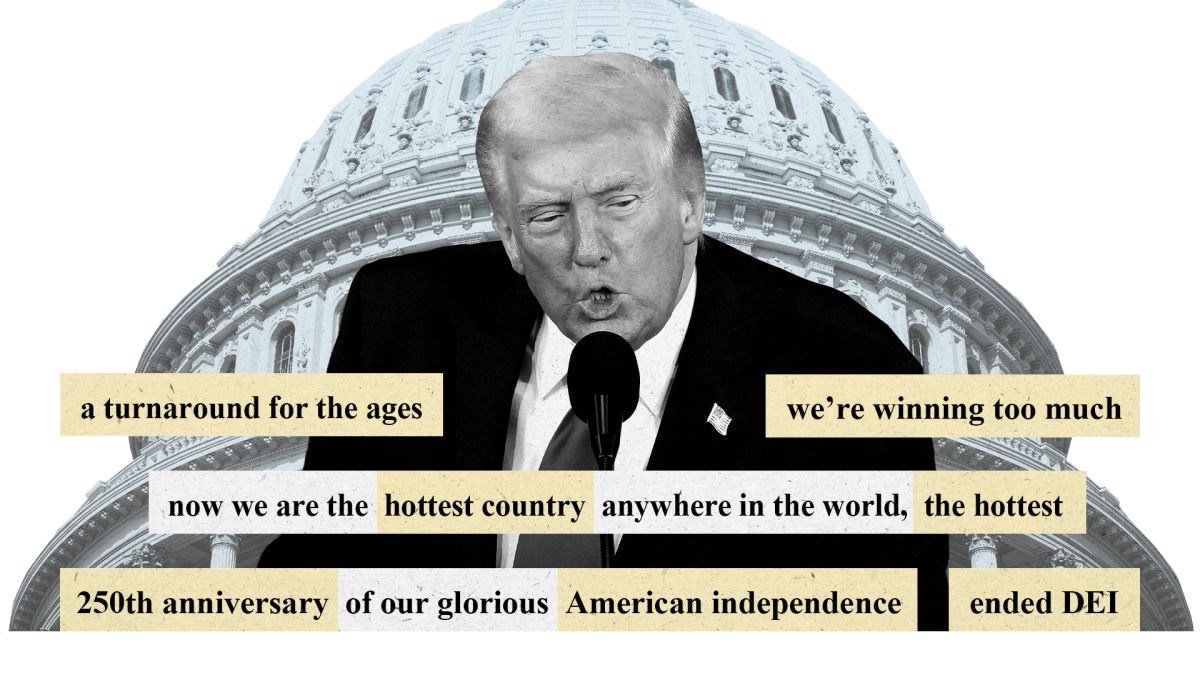
Trump’s politics keeps supporters oriented toward a tantalizing payoff that feels within reach. It’s almost spiritual, like the promise of the Kingdom of Heaven to the faithful. – Newsweek Editors
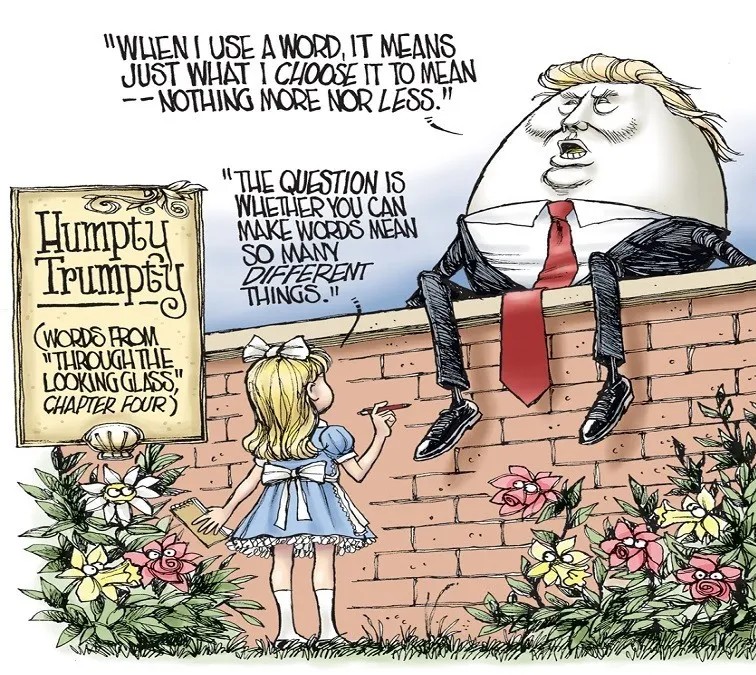
If you’ve read Lewis Carroll’s Through the Looking-Glass, you may well recall the White Queen’s rule about jam which she explains with comic absurdity.
“The rule is,” says the queen, “jam tomorrow and jam yesterday—but never jam today.”
President Donald Trump—the White King, perhaps—has turned the “jam tomorrow” rule into a political method.
His movement’s perennial slogan “Make America Great Again” encapsulates both jam yesterday and jam tomorrow. America was great and will be again. But perhaps not today.
The clearest current example of this Trumpian jam tomorrow method is with Iran. American victory has been imminent for months. A deal has been ready to be signed for weeks. And yet: nothing.
On Wednesday, as U.S.-Iran talks dragged on amid fresh Gulf violence, Trump told reporters an Iran peace deal “could happen … over the weekend.”
We shall see if there’s any jam this weekend. But Iran’s foreign minister said the same talks had made “no tangible progress.”
The promise is always close enough to taste and distant enough to deflect today’s skepticism.
The Iran Deal Is Always Almost Here
Trump’s Iran diplomacy has followed a recurring pattern for some time.
The breakthrough is imminent, the awkward details are secondary, and the calendar keeps moving deeper into the year.
After a recent call with Middle Eastern leaders, Trump declared on Truth Social that a peace deal with Iran had been “largely negotiated” and the details would be “announced shortly.” That was, at the time of writing, almost two weeks ago.
Vice President J.D. Vance gave the softer version of the same message a few days later, saying: “We’re not there yet, but we’re very close.”
The problem here is the distance between “very close” and “done”.
U.S. and Iranian forces have exchanged fresh missile and drone strikes during what is supposed to be a ceasefire as Trump talked up negotiations.
Kuwait’s military said this week an Iranian strike on Kuwait International Airport killed one person and injured 63. CENTCOM struck an oil tanker heading to Iran with a Hellfire missile to disable it, enforcing its blockade of the Strait of Hormuz.
Meanwhile, in Washington, the House voted 215-208 for a war powers resolution aimed at curbing Trump’s authority in the Iran conflict. The rebuke is largely symbolic: Similar measures have repeatedly failed in the Senate, and Trump could veto it.
The strongest defense of Trump’s approach is that war and diplomacy often require public optimism before private agreement, and the two sides may genuinely be close to a deal behind closed doors. The final yards are often the hardest to run.
A draft outline included a 60-day ceasefire extension, reopening the Strait of Hormuz, limited sanctions relief and further nuclear talks, according to Axios, citing an anonymous U.S. official.
The White House has said that Iran agreed to a ceasefire and reopening Hormuz while broader talks continued.
Even so, the habit is to announce the triumph before it exists. And Iranian officials have repeatedly disputed U.S. versions of how negotiations are progressing.
The Promise Is the Produce
Trump’s political genius has long been to sell proximity to fulfillment as if it were fulfillment itself.
Every politician overpromises, of course. What sets his version apart is the scale and the specificity—the hard deadlines like “day one” and “this weekend,” and the habit of presenting the announcement itself as the achievement.
After winning in 2016, Trump promised to rebuild infrastructure, put millions to work and “double our growth.” PolitiFact later rated his promise to grow the economy 4 percent a year as broken.
The pattern has survived defeat, comeback and incumbency.
In 2024, Trump said: “Starting on day one, we will end inflation.” He promised prices would “come down fast,” putting an emphasis during his campaign on groceries, such as eggs and meat.
The reality tells another story. After the election, Trump admitted to Time that bringing prices down was “very hard.”
Amid the Iran war and Trump’s tariffs, the Bureau of Labor Statistics reported that consumer prices rose 3.8 percent over the 12 months ending in April 2026—the highest for nearly three years.
Now, tomorrow’s economic jam is put in different terms.
Trump waved away the sharp spike in gas prices as “peanuts” in a justification for Iran that captured the essence of jam tomorrow and jam yesterday, but never today.
“Look, as soon as this war is over, gas is going to—you know, I had gas leaned down to $1.85 in Iowa. … But I was down to, in many cases, less than two dollars a gallon,” Trump said to reporters on May 19.
That’s jam yesterday right there.
“And then I said to myself, this is great, we just hit a new high in the stock market, everything’s going good, I’m sorry, but we have to go down and take a little journey down to Iran,” he said.
“We have to do something with Iran. We cannot let them have a nuclear weapon. You want to see the world exploded? You want to see a problem?”
Sorry, no jam today.
“And this is peanuts, and I appreciate everyone putting up with it for a little while. It won’t be much longer,” Trump said.
Don’t worry: there’ll be jam tomorrow.
Why Tomorrow Works Better Than Today
Tomorrow is useful to Trump because it lets him claim motion on important issues before any results, good or bad, actually arrive.
The trick is to keep the present modest and the future enormous, so attention stays fixed on what is coming.
Trump’s 2025 Stargate announcement promised “over 100,000 American jobs almost immediately” from an AI infrastructure venture. Stargate was framed as up to $500 billion over four years, with an initial expected investment of $100 billion.
Large investment announcements can be real and still function politically as jam tomorrow. OpenAI’s statement said Stargate intended to create hundreds of thousands of jobs.
The immediate political value came from the announcement itself, while the measurable employment gains were pushed into later quarters, later construction schedules, and company decisions down the line.
It’s not clear if all those jobs have arrived yet with the investment. Data centers are certainly springing up across the U.S., though the intensity of their resource consumption is provoking local backlash.
The evidence so far points to real Stargate-related hiring, but not to Trump’s promised “100,000 American jobs almost immediately.”
Oracle says its Abilene site in Texas is expected to generate more than 9,000 construction jobs and 1,000 ongoing project-supported roles, while local reporting has described thousands of workers already arriving there.
OpenAI’s later 100,000-jobs estimate explicitly bundled permanent roles with short-term construction and indirect manufacturing/service jobs, so the public record supports a narrower conclusion.
Stargate has produced visible construction employment, not a verified 100,000-job hiring wave.
Some promises simply proved false—4 percent growth, inflation ending on day one, immediate peace in Ukraine when he returned to the White House. Others stay deferred, like Iran.
Stargate is a third kind: probably real, but with its payoff pushed into a future that keeps receding.
What unites them is the posture—each is announced as imminent, and imminence is the product. This helps explain why the tactic keeps working. Trump’s 2016 victory speech was built around verbs of arrival: rebuild, renew, reclaim, begin.
His 2024 affordability pitch used the same cadence with groceries, energy and inflation. His Iran messaging now says peace is close while missiles are still flying.
The politics keeps supporters oriented toward a tantalizing payoff that feels within reach. It’s almost spiritual, like the promise of the Kingdom of Heaven to the faithful.
Where’s the Jam?
The risk for Trump is that repeated imminence eventually becomes measurable delay, and there is evidence to show the trick is fading in its effectiveness.
There is growing skepticism both among the political class and the public about how the Iran war is unfolding. A recent Quinnipiac poll of voters found a majority opposed the war and thought it made the world less safe rather than more secure.
Moreover, on the economy, Trump’s approval is sinking fast among voters, turning what was once his greatest asset into a political liability. Trump’s overall job approval rating has dropped to new lows across a range of pollsters.
Trump can still get an Iran deal, lower some prices, point to AI investment, or claim job gains from projects now in motion. Maybe he’ll solve Ukraine after all, too. The fairest test is delivery, not theatrical proximity to the sweet taste of success.
Carroll’s White Queen made deprivation sound like a grammatical rule. Trump’s version turns delay into momentum.
If the Iran weekend passes once again without a deal, it will join groceries, growth, jobs, AI, and Ukraine in the same bright pantry of postponed satisfaction.
In Trump’s politics, tomorrow is always stocked. But today is where Americans are looking for the jar. And more of them are asking: where’s the jam you promised yesterday? – Newsweek, 5 June 2026
› Newsweek Editors byline denotes a collectively authored piece, often produced by the senior editorial team at Newsweek.
 VOICE OF INDIA