The real challenge before Indian historiography today is not the existence of competing narratives, but the treatment of one ideological school as the sole custodian of intellectual legitimacy while dismissing all dissent as ignorance. – Utpal Kumar ‘
Sometimes the crisis of Indian historiography can be captured through a single viral clip.
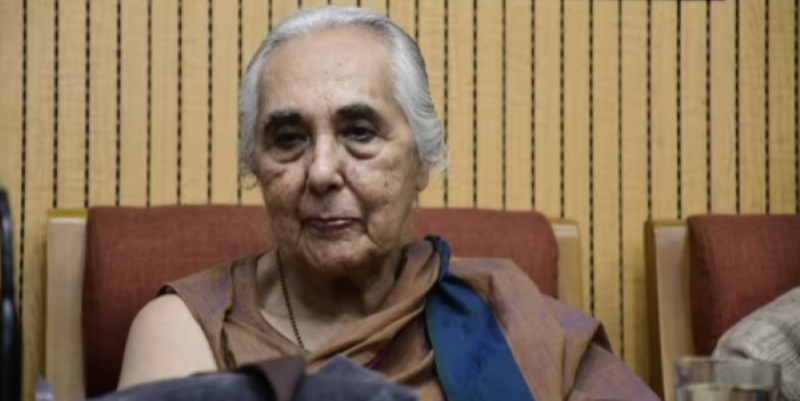
In the video, eminent historian Romila Thapar confidently claims that Patanjali described the relationship between Brahmins and Sramanas as being like that between a snake and a mongoose. It is a striking image, perfectly suited to the Marxist interpretation of ancient Bharat as a perpetual battlefield of social conflict. There is, however, one problem: the passage does not exist in Patanjali’s Mahabhashya. As author Nityananda Mishra explains in the viral clip, Patanjali refers to Sramanas and Brahmins together only once, and even there the snake-mongoose analogy is absent. Interestingly, the same claim had appeared in Thapar’s earlier works, including Interpreting Early India (1992) and Cultural Pasts (2000).
This incident is important not merely because it reveals the truth about a disputed quotation. It is important because it raises uncomfortable questions about the authority exercised by certain schools of Indian historiography and the reluctance within parts of academia to subject “eminent” historians to the same scrutiny they routinely apply to others.
For decades, a relatively small ideological circle dominated the country’s historical discourse. Their influence rested not merely on scholarship, but also on institutional power. They wrote textbooks, controlled college and university departments, influenced media narratives, and determined who truly qualified to be a “serious” historian. Those who questioned them were dismissed as communal, revivalist, unscientific, or simply “unqualified”. The irony, of course, is that many of these guardians of “scientific history” were themselves shielded from the most elementary standards of scrutiny.
That immunity is now gone.
Romila Thapar’s recent memoir, Just Being, reflects this anxiety. She laments the growing influence of what she calls “non-historians” in shaping public understandings of the past and argues that official support is increasingly going towards narratives different from those produced by “professionally trained historians”.
“Until a decade or two ago,” Thapar writes, “historical scholarship was not interfered with by unqualified people. That situation has now changed. The perception of history that is being popularised and has official backing is distinct from that which is being researched by scholars. The two are moving in opposite directions. The danger is that the latter may be nullified by the official support given to the former.”
The complaint reveals a deeper unease. After all, the first time since Independence, Marxist historiography in the country no longer enjoys uncontested intellectual authority. It is this erosion of monopoly, more than disagreement itself, that seems to have generated such anxiety, if not anger.
If one looks back, the country’s “eminent” historians evaded intellectual accountability for most of the post-Independence era. In fact, the only time they were put in the dock—quite literally—was when they went to the Allahabad High Court as “expert witnesses” in the Ram Janmabhoomi case. The Ayodhya case was unusual because it compelled our “professionally trained” historians to leave classrooms and seminar halls to enter a courtroom, where claims had to withstand cross-examination rather than ideological consensus. As author Arvind Singh writes in India’s Rogue Historians, the Ram Janmabhoomi dispute was “perhaps the only instance where Marxist historiography was weighed on jurisprudence”.
The results were devastating. One after another, “expert witnesses” collapsed under cross-examination. Behind the intimidating academic reputations lay conjecture, second-hand assumptions, ideological certainties, and in some cases startling unfamiliarity with the very primary evidence on which they claimed expertise.
One striking example was Prof Suresh Chandra Mishra, who appeared before the court as an expert witness and epigraphist. Prof Mishra initially claimed that inscriptions found at the disputed structure were written in Arabic. Later, he revised the statement and said they were in Persian. Eventually, under cross-examination, he admitted that he knew neither Persian nor Arabic. The contradiction was devastating because epigraphic expertise necessarily depends upon linguistic competence.
The matter became even more awkward when Prof. Mishra claimed he had compared the inscriptions with passages from the Baburnama, which he said he carried inside the disputed premises. When he was cornered by the other side, which argued that one was not allowed to carry anything inside, he changed his statement again, saying he had relied on memory to compare the inscriptions after coming out of the site. Justice Sudhir Agarwal dryly noted this “wonderful memory”, particularly given Mishra’s admission that he knew “neither Persian nor Arabic”.
Then came archaeologist Suraj Bhan, another prominent figure of the academic establishment. His credentials appeared impressive in public debates, but under oath the limitations became apparent. Despite holding degrees involving Sanskrit, he admitted he could neither read nor speak the language. Justice Agarwal observed that Bhan “has not read the text of the inscriptions as published in different books from time to time and had no occasion to compare them”, and that parts of his testimony rested on “pure conjecture and surmise”.
Similarly, Prof. Suvira Jaiswal reportedly acknowledged that, despite appearing as an “expert witness” in the Ayodhya case, she had not read key primary sources such as the Baburnama. Another star expert witness, Prof. Shirin Musavi, reportedly stated that she had never personally visited Ayodhya to examine the disputed structure; she believed such examination was unnecessary for a historian.
These were the historians who were supported and patronised, often openly, by the country’s leading historians led by Romila Thapar, R.S. Sharma, D.N. Jha and Irfan Habib, among others. It is interesting that while these second-rank historians took the lead in supporting the Babri Masjid cause, the top historians avoided doing so. They knew the pitfalls of their historiography. They knew it would not withstand cross-questioning. They were also not used to being questioned in public.
The case exposes a contradiction at the heart of elite academic discourse in the country. Historians who insist upon methodological rigour and denounce dissenters as “non-historians” were themselves, in a case as significant as Ayodhya, found relying on assumptions, ideological predispositions, or incomplete engagement with primary evidence.
The larger issue, however, is not that historians can make mistakes. Genuine scholarship always leaves room for error, revision and correction. The real problem is the culture of intellectual insulation that protected certain historians from sustained scrutiny for decades. Within academic and media ecosystems, their assertions were often treated as settled truth. Critical examination was discouraged because it threatened the ideological consensus that dominated post-Independence intellectual life.
The real challenge before Indian historiography today is not the existence of competing narratives. A confident civilisation can accommodate disagreements. The danger lies instead in treating one ideological school as the sole custodian of intellectual legitimacy while dismissing all dissent as ignorance.
Ironically, as Romila Thapar’s memoir itself suggests, the decline of intellectual monopolies often produces resentment. Much of the current anxiety and anger directed at “non-historians” appears rooted less in questions of qualification than in the loss of cultural and institutional control.
History does not—and cannot—belong permanently to any ideological priesthood. – Firstpost, 25 May 2026
› Utpal Kumar is the author of the book, ‘Eminent Distorians: Twists and Truths in Bharat’s History’.