Vande Mataram: How an anti-British song became ‘anti-Muslim’ – Ibn Khaldun Bharati

Bankim Chandra Chatterjee

In the Islamic political praxis, Muslims are nationalist if they are in majority and the rule is theirs. But if they can’t rule the country, they can’t be nationalist either. – Ibn Khaldun Bharati

The Muslim opposition to Vande Mataram is well known. However, the reason behind it is not well understood. Actually, it’s beyond comprehension. Their objection to the national song is formulated in such abstruse theological terms that even an educated Muslim can’t grasp its esoteric nuance. In reality, it’s not so much an opposition to the song as to the idea behind it—the idea of India as a nation. It’s the idea that Hindus and Muslims become an organic whole to form an inseparable political community. The major Muslim ideologues insisted on their separateness, and separate they remain.

To say that saying Vande Mataram (Salutations, Oh Mother) evokes the imagery of idol worship is the kind of convoluted reasoning that defies common sense. Furthermore, to emphasise that the hostility to idol worship is the foundational creed of Islam, and that it’s incumbent on every Muslim to wear this abhorrence on sleeve, isn’t really conducive to diversity, pluralism, peaceful coexistence, and composite nationhood—the ideals in which the Muslims have greater stake than anyone else.

Recently, Maulana Mahmood Madani, the head of the largest organisation of ulema in India, Jamiat Ulema-i-Hind, made a controversial speech, in which he stressed the imperative of jihad in India. He also said, “Murda qaumen mushkilaat mein mubtala nahin hotin. Wo to surrender kar deti hain. Wo kahenge ke Vande Mataram padho to padhna shuru kar denge.” (Dead communities don’t face any difficulty since they surrender readily. When asked to chant Vande Mataram, they willingly do that).

The ferocity with which these Muslims proclaim their revulsion for Vande Mataram, and the grim determination with which they threaten to go to war if its public singing were to be revived, makes one wonder if there is actually something so repugnant in the song that a Muslim can’t countenance it if he were to remain true to his faith.

Is there a problem?

Let’s see if there is anything in Vande Mataram that makes Muslims recoil in horror. Arif Mohammed Khan, the scholarly Governor of Bihar, translated into Urdu the two stanzas that have the status of the national song, and sent the same to one of the most prominent Islamic seminaries, the Nadwa, at Lucknow, for their opinion on it; specifically asking if there was anything in it that was contrary to Islam.

It was presented as an original composition, and not a translation. He had rendered the key words, Vande Mataram, as “Taslimaat, Maa, Taslimaat”. The ulema at Nadwa opined that there was nothing in the song that contravened Islam. One, however, suspects that if they knew it to be the translation of Vande Mataram, they might have had a different opinion. Such is politics and such is the power of narrative!

The reality behind the narrative

The root of the Sanskrit word ‘vande’ is ‘vand’. According to Sanskritist Monier Monier-Williams, depending on the context, ‘vand’ means “to praise, celebrate, laud, extol, to show honour, do homage, salute respectfully; or, venerate, worship, adore”. The primary meaning is not worship; certainly, not the ritual worship. Even if it were, hasn’t Urdu poetry been more extravagant in such expressions. For example, Iqbal, the poet of Islamic revivalism, in one of his earlier poems, said, “Khaak-e watan ka mujhko har zarra devta hai” (Every particle of the country is a god unto me)”. Iqbal’s fans—quite a few of them being fundamentalist fanatics—never saw anything amiss in this.

Can there be a nation without a motherland?

As for mataram, i.e., mother—Mother India—Urdu has a beautiful term, madar-e-watan, the motherland. No Muslim ever found this concept contrary to Islam. In fact, the most literal and yet most exquisite rendition of Vande Mataram has been A.R. Rahman’s song Maa Tujhe Salaam.

There are numerous verses in the Quran (7:12, 23:12, 30:20, etc.) which say that we are made of earth, and it is the source of life and the place of origin. It’s implied that, in a deeper sense, the earth is the mother, and one’s own place is the motherland.

In a display of genius that is peculiar to them, the Muslim leaders espied the idol of a deity in the conception of motherland, and flinched from its adoration. Even in Pakistan—which broke away from us, on difference over the Indian nationhood, and the sacredness of the motherland—Asim Munir, the generalissimo, can be seen referring to his country as motherland.

Nowhere else in the world do Muslims have had any problem with the concepts of nationalism and the sacredness of the respective countries. The literal translation of the word ‘Pakistan’ is holy land, which in Hindi translates as punya bhumi. The Indian Muslims, however, can’t accord this status to their own country.

In the Islamic political praxis, Muslims are nationalist if they are in majority, and the rule is theirs. But if they can’t rule the country, they can’t be nationalist either. In a debate that raged between poet Muhammad Iqbal and Jawaharlal Nehru, the former candidly said, “In majority countries Islam accommodates nationalism; for there Islam and nationalism are practically identical; in minority countries it is justified in seeking self-determination as a cultural unit”. (Modern Review, Calcutta, 1934-35)

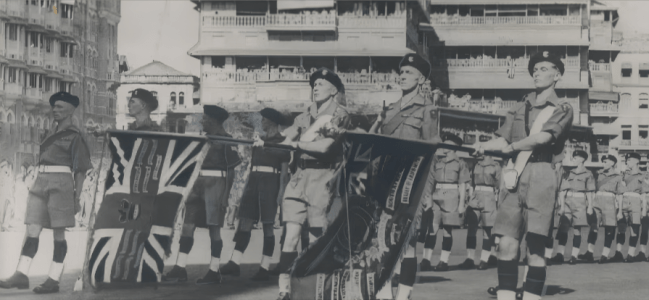
There’s a deeper reality. Without recognising the country as the motherland, there can’t be a nation. But can the people who came as invaders, conquered the country, and ruled it for centuries, ever accord the status of mother to the vanquished territory? Could the British ever regard India as mother?

The Muslim ideology has been in the hands of the elite descended from the old ruling class. The Muslim masses follow it uncritically because it’s couched in religious idiom, and religion is not to be questioned.

Is Anandmath anti-Muslim?

Regarding Vande Mataram being a part of the novel Anandmath; well, it’s true that the poem, though independently written, has been interpolated in the book. It’s also true that the theme of the book is the Sannyasi Rebellion of 1770s, which was an uprising against the oppressive Muslim rule, and therefore, some passages have clear anti–Muslim overtones. But isn’t it equally true that those Muslim rulers were oppressors, and their religious hostility toward the Hindu peasants was an added factor in oppression? So, why shouldn’t the rebellion against them be seen as a class war of the oppressed against the oppressors, and the fulmination against them should be seen in perspective, and not misconstrued as invective against ordinary Muslims who belonged to the same class as them? Haven’t we seen this kind of class analysis about the Moplah “Rebellion”?

But, it’s not possible despite the fact that a large number of Marxist historians have been Muslim. That’s because, these historians, when it suits them, treat Muslims as a monolith, ignoring their socioeconomic diversities. Thus, a justified diatribe against the Nawabi system is seen as a tirade against ordinary Muslims. What if Indian Christians were to see in the criticism of the British rule the condemnation of ordinary Christians?

By the way, no Indian ever rejected the popular patriotic song Saare Jahan Se Achha just because it’s from the pen of Iqbal, the separatist ideologue.

The genesis

Vande Mataram, set to tune by Rabindranath Tagore, had been sung in the Congress sessions since 1896. No Muslim leader ever found it antithetical to their religion. Even during the Swadeshi Movement, which was a response to the Partition of Bengal (1905), when this song became the anthem of resistance to the British, one doesn’t hear of any objection to its purported polytheistic imagery. This was despite the fact the division of Bengal was on religious lines, and it supposedly favoured the Muslim majority of East Bengal. Even Maulana Abul Kalam Azad, the great Islamic scholar and thinker, who claims to have joined the underground revolutionary movement of the Bengali youth, doesn’t record any religious objections to it.

Even during the Khilafat Movement (1919-24), when the Congress was working on pan-Islamist agenda, Vande Mataram continued to be sung in its gatherings, in the presence of the leading Khilafatist maulanas, who, then, dominated its proceedings.

How an anti-British song became ‘anti-Muslim’

From 1896 to 1937, Vande Mataram was the staple for the Congress. And then, elections were held under the Government of India Act, 1935; and Congress ministries were formed in provinces. After centuries, the natives of India, the Hindus, were in power. The Muslim ruling class could endure British rule, but seeing their former subjects becoming rulers was beyond their endurance. For centuries, they had been conditioned to look down upon the Hindus, and now the same Hindus were ministers. They freaked out, and began hallucinating about the Hindu oppression. As they upped the ante for a desperate fight, their glance fell upon the “Durga” and “Lakshmi” in Vande Mataram, and the Islam-in-danger bogey became ever more palpable.

This situation has been best summarised by a nationalist Muslim, Rafi Ahmed Kidwai. In a statement that was published in The Pioneer on 19 October 1937, that merits in-extenso reproduction, he said, “Mr. Jinnah characterises Vande Mataram as an anti-Islamic song. Mr Jinnah had been a devoted and enthusiastic member of the Congress and of its chief executive, the All-India Congress Committee, for a number of years. Every year, the session of the Congress opened with the singing of this song, and every year he was seen on the platform listening to the song with the attention of a devotee. Did he ever protest? Mr Jinnah left the Congress, not because he thought the Vande Mataram was an anti-Islamic song, but because he had found the idea of swaraj unacceptable.”

Nehru is both Churchill and Chamberlain

The Muslim League, having suffered a rout in the 1937 elections, and further failing to force its way into the government in the United Provinces—not on the basis of the seats won, but as an entitlement for having once been the rulers—suddenly realised that Vande Mataram was idolatrous, and raised a war cry against it.

In the book Vande Mataram: The Biography of a Song, historian Sabyasachi Bhattacharya details the debates in the Congress, and the correspondence between Nehru, Bose, and Rabindranath Tagore. Nehru’s first reaction was: “The present outcry against Bande Mataram is to a large extent a manufactured one by the communalists.” However, soon, in order to appease the communalists, he said that having read the English translation of Anandmath, he was of the opinion that it was “likely to irritate the Muslims”. And so, he set out “to meet real grievances where they exist(ed).” That is how the Congress Working Committee, on 26 October 1937 (just days after Kidwai’s remonstrance), decided to truncate the song, and adopt only the first two stanzas as they were “unobjectionable”.

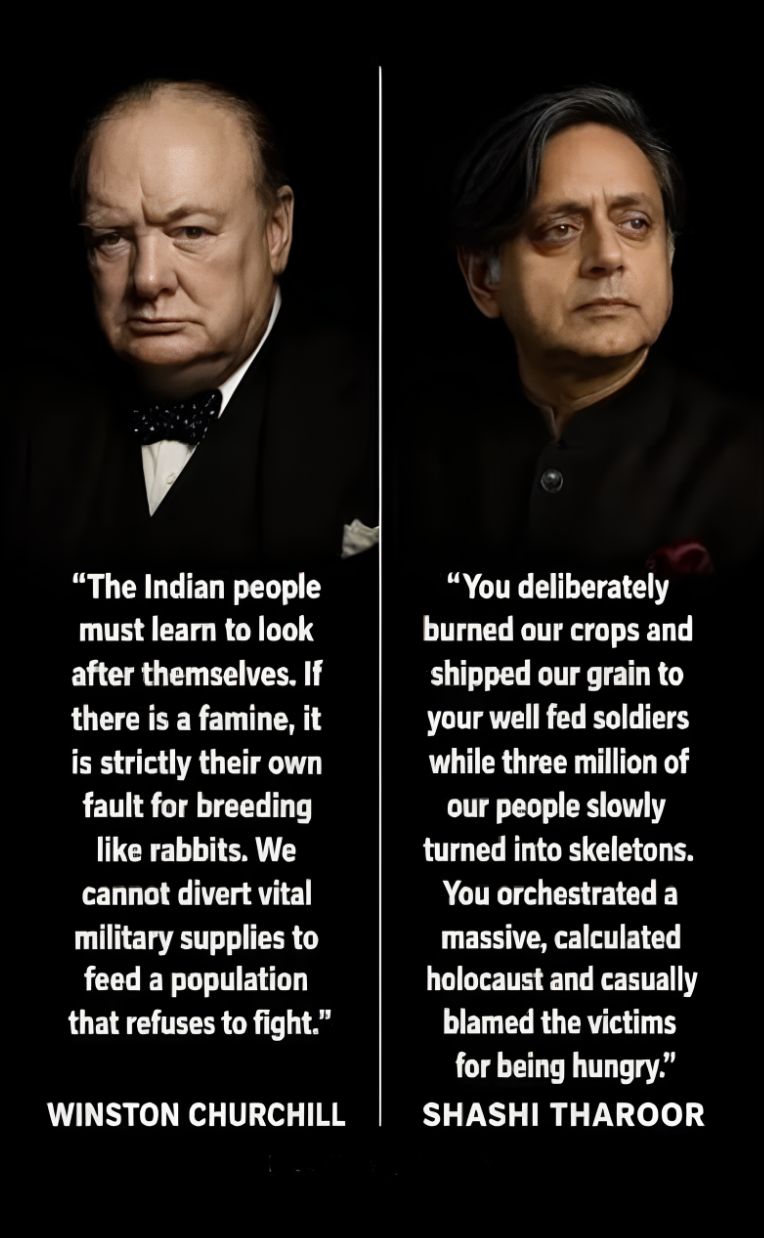
Such bending backward before the communalists recalls to mind what Atal Bihari Vajpayee once told Nehru about the streak of appeasement in him: “In you, there are both Churchill and Chamberlain”.

Sabyasachi Bhattacharya narrates how this concession couldn’t satisfy the Muslim League, as they insisted on the deletion of Vande Mataram in toto. Jinnah wrote, “Pandit Jawaharlal Nehru cannot be unaware that Muslims all over have refused to accept the Vande Mataram or any expurgated edition of the anti-Muslim song as a binding National Anthem”.

Prime Minister Narendra Modi is right in his analysis that the mutilation of Vande Mataram whetted the appetite of the Muslim League, and became the prelude to the partition of India. It is in the logic of appeasement that instead of resolving an issue, it exacerbates it.

Even now, the Muslim leadership remains as staunchly against Vande Mataram as it was during Jinnah’s time. So, what is gained by cutting out the better part of the song; and, what’s been gained by acquiescing to the partition?

The way forward

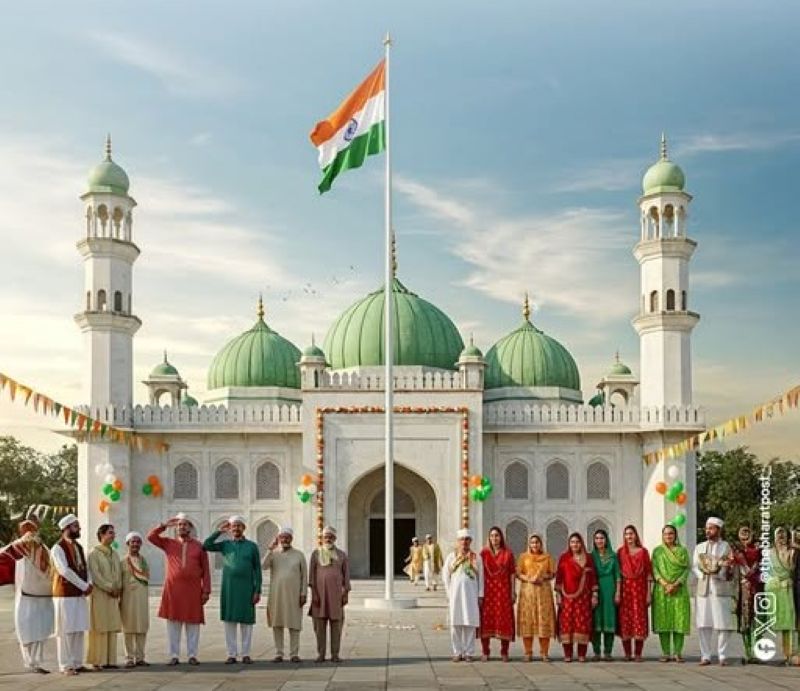
Since 2014, because of the conducive atmosphere provided, the Muslims have been showing an unprecedented fondness for the Constitution, and the sacred symbols of the nation. The Independence and Republic Days are celebrated with gaiety in Muslim institutions, including madrasas; and the national anthem is sung with gusto. Many a time, one can see the national flag waving from the high minaret of a mosque. If a better atmosphere is conduced, the Muslims will sing Vande Mataram with as much fervour as anyone else. – The Print, 12 December 2025

Ibn Khaldun Bharati is a student of Islam, and looks at Islamic history from an Indian perspective. 

Chhattisgarh Waqf Board orders all mosques and madrasas to hoist the Indian flag on Independence Day.

The RSS Century – Makarand R. Paranjape

Mohan Bhagwat and Narendra Modi with Hedgewar memorial at RSS headquarters in Nagpur.

The RSS set its sights on nation-building through cultural and political mobilisation. Its ideology emphasises a unified Hindu identity as the bedrock of Indian nationhood, a stance that has both inspired millions and provoked fierce opposition. – Prof. Makarand R. Paranjape

In the brouhaha over the ‘impossible’ retirement of Prime Minister Narendra Modi and the somewhat more probable demission of Rashtriya Swayamsevak Sangh (RSS) head Mohan Bhagwat, might we be forgetting an even more important milestone?

True that both Modi and Bhagwat will turn 75 in a few weeks, September 17 and September 11, respectively. Seventy-five, we needn’t remind ourselves, is the age at which leaders of the Sangh Parivar are expected to retreat gracefully both from public office and active duty, giving way to younger, even if not more capable, talent.

The prospects of Modi hanging up his boots, so to speak, seem not just unlikely, but remote. Despite his much-vaunted ‘almost sannyasi’ image as India’s most powerful renouncer. From all reports, not only does the Bharatiya Janata Party (BJP) need him, but he, too, has sent several signals to the effect that his work is far from done.

What about Bhagwat? Less implausible than Modi, but who can tell? RSS sarsanghchalaks lead by example. They are not politicians, though, almost as an occupational hazard, so embroiled in politics. Instead, a sarsanghchalak is supposed to embody the highest values, not only of the Sangh but of Sanatana Dharma itself.

My own contact with Mohan Bhagwat has convinced me that both his company and his conversation are spiritually elevating. At a crucial moment in my career, he suggested, quite simply and softly, that sticking to one’s own highest intention and integrity were far more valuable, in the long run, than ”playing the game”. A true intellectual, he remarked in passing, should never seek position or preferment: “Vat rahat nahi,” he said in Marathi. Which means, you lose respect.

Yes, we, in India, tend to revere individuals more than organisations. The personality cult comes naturally to us. But built into the Sangh’s DNA is the idea that the organisation is more important than the individual, society more important than the organisation, and the nation the most important of all.

As one pracharak or full-time worker, shifted out of what most would consider a very high-profile post to one of relative ano­nymity told me, “We are good to go wherever we are sent at very short notice.” He smiled when he said this and did not look at all unhappy or disappointed: “Apna jhola tham liya aur bus chal diye.” Get hold of one’s rucksack and just move on.

Such an attitude of egoless idealism and absence of attachment may not be universal among the cadres, but in the core group of those who actually make the Sangh what it is, it is less rare than common.

No wonder, rather than focusing on any individual, however great, the more significant jubilee that I am alluding to, of course, is the 100th anniversary of RSS.

Let us not forget that RSS has produced not only prime ministers like Narendra Modi and Atal Bihari Vajpayee but dozens of cabinet ministers, chief ministers, and governors. At least two vice presidents, Bhairon Singh Shekhawat and M. Venkaiah Naidu, and one president of India, Ram Nath Kovind, have come from its ranks. Not to mention luminaries in every branch of society.

With an estimated membership running into millions and over 75,000 active branches (shakhas) that are supposed to congregate daily, RSS is the world’s largest and most important voluntary socio-cultural organisation.

One would have to be blind or utterly prejudiced to disregard its unique and prodigious achievements. The RSS journey over the last 100 years has been nothing short of phenomenal. Its contributions to nation-building have, in my estimation, no parallel anywhere in the world.

On Vijayadashami 2025, the tenth victory day marking the culmination of In­dia’s autumn Navaratri festival, RSS completes 100 years of its existence. Celebrated all over the subcontinent and elsewhere as the triumph of good over evil, it coincides this year, quite ironically for critics, with the birthday of Mahatma Gandhi on October 2.

Unlike our political leaders, RSS shuns self-praise, avoids blowing its own trumpet. Of its six sarsanghchalaks, only its found­er, Dr. Keshav Baliram Hedgewar or Doctorji and, his anointed successor, Madhav Sadashiv Golwalkar or Guruji, have a specially consecrated joint memorial in Nagpur. No one else. There is no active personality cult around these two either.

I would not be surprised if, at least from the RSS side, its centenary celebrations might end up being relatively quiet. Closer to the date, however, the world, especially the Indian media, is bound to take notice.

Let us just say that I am starting a bit early.

Does the RSS centennial signify a spectacular and momentous accomplishment?

The answer is an unambiguous yes. Because, in the minds of many, RSS has done more in the service of Hindu society and the Indian nation than any other organisation or association.

Founded in Nagpur in 1925 by Hedgewar, RSS emerged at a time when India was grappling with colonial subjugation and internal divi­sions. Hedgewar, an ardent nationalist and physician trained at the Calcutta Medical College and Hospital, envi­sioned an organisation that would unify Hindus and foster a sense of cultural and national pride. RSS was not merely a response to British colonialism but also to the fragmentation of Hindu society, weakened by centuries of invasions, social stagnation, and religious disunity.

In addition to the threat of Muslim separatism, which was casting its long and sinister shadow over the motherland.

Hedgewar adopted a grassroots approach, establishing shakhas, daily gatherings where volunteers engaged in physical exercises, ideological discussions, and community service. This disciplined, decentralised model allowed RSS to penetrate deep into Indian society, from urban centres to remote villages. From its modest beginnings, RSS, as I have already shown, has become a mighty and, I dare to invoke a Gandhian phrase, a “beautiful tree”.

The RSS journey is marked by its unapologetic, at times aggressive, commitment to Hindu nationalism, or Hindutva, a term popularised by Vinayak Damodar Savarkar. Unlike other reform movements like the Arya Samaj or the Ramakrishna Mission, which focused primarily on religious or social reform, RSS set its sights on nation-build­ing through cultural and political mobilisation. Its ideology emphasises a unified Hindu identity as the bedrock of Indian nationhood, a stance that has both inspired millions and provoked fierce opposition.

Why is RSS is so feared, to the extent of being deliberately slandered and demonised? Because it alone, of all of India’s great Hindu reform movements, has dared to dedicate itself to nation formation. Also because its enemies want Hindus to remain divided and India to remain weak?

When Hindu society was at a parlous and precarious juncture, as during the bloody Partition of India in 1947, RSS played a critical role in saving the lives of hundreds of thousands of men, women, and children. RSS, since Independence, has also selflessly served the nation, whether during flood, famine, or, worse—the dreaded Emergency of 1975-77, often at great cost to itself and immense sacrifice of its members.

What is more, all this service has been rendered silently, with hardly any publicity or fanfare. Even if its fully dedicated cadre of workers, numbering not over an estimated 3,500, are called pracharaks or publicists—a better English rendering, were it not for the negative connotations, would actually be “super spreaders”.

This goal has embroiled it in the rough and tumble of politics. RSS not only inspired, seeded, and nurtured the Bharatiya Jana Sangh in 1951, but its successor, the Bharatiya Janata Party in 1980. The latter has been India’s ruling party at the Centre for over 11 years and is in power in 14 out of India’s 28 states.

Besides BJP and the Jana Sangh, RSS has also spawned over 100 important organisations from student to trade unions, schools, colleges, and ashrams, to cultural, social, and religious organisations.

It was RSS that founded the Akhil Bharatiya Vidyarthi Parishad (ABVP) in 1949 and the Vishva Hindu Parishad (VHP) in 1964. As also the Bajrang Dal in 1984.

The Bharatiya Mazdoor Sangh, the Bharatiya Kisan Dal, and Seva Bharati have been inspired and founded by RSS too. Its work is not confined, unlike a popular misconception, solely to men. Major women’s organisations such as the Rash­tra Sevika Samiti, Durga Vahini, and Matru Shakti have also been birthed by the Sangh. As dozens devoted to tribal and minority welfare have also been. These and a variety of other institutions have endeavoured to strengthen Hindu society and the Indian nation.

RSS is feared, reviled, and hated precisely because it has not shied away from seeking and wielding power, through its progenies and affiliates, in the interests of Hindus and India. This is the one simple reason why several groups, forces, and bodies from the extreme left to the farther right, not to mention India’s former ruling party Congress, all sought to ban, suppress, malign, denigrate, and delegitimise RSS.

But while its antagonists have failed and weakened over the decades, RSS has succeeded dramatically, even incredibly. That is why the last 100 years can justly be termed the RSS century.

And millions more may join its summons to national service in consonance with its beautifully moving and inspiring anthem. Inspired by Doctorji and composed by Narhari Narayan Bhide, let me invoke its opening line: Namaste Sada Vatsale Matrubhume (To Thee, ever-affectionate Motherland, my obeisance). – Open Magazine, 1 August 2025

Prof. Makarand R. Paranjape is an author, columnist, former teacher at JNU and former director of the Indian Institute of Advanced Study.

RSS flag march in Tamil Nadu.