Trump’s endgame is surrender – Robert Kagan

Donald Trump

Trump no doubt hopes that he can slip away without Americans noticing the magnitude of this defeat. … The President may also hope that he can change the subject by launching another military operation, this time against the government in Cuba. And the news media have indeed begun writing more about Cuba than about the unfolding disaster in Iran. – Robert Kagan

The outlines of President Trump’s endgame in the Iran war are now emerging. In a phone call with Israeli Prime Minister Benjamin Netanyahu yesterday, Trump reportedly explained that the United States was negotiating a “letter of intent” with Iran that would “formally end the war and launch a 30-day period of negotiations” on Iran’s nuclear program and the reopening of the Strait of Hormuz. The purpose and effect of such an agreement should be clear: The United States is walking away from the crisis. Trump may launch another limited strike to look tough and satisfy the demands of the war’s supporters, but it would be a performative gesture. Endgame in this case is a euphemism for “surrender.”

Trump has blinked many times in the confrontation with Iran—ever since March 18, when Israel attacked the Pars gas field and Iran retaliated with a strike against Qatar’s most important natural-gas-production facility. Trump then called for a halt on U.S. and Israeli targeting of Iran’s energy infrastructure, and the war effectively ended.

Trump’s repeated threats to resume attacks since then have proved to be bluffs. The leaders in Tehran have been calculating for two months that Trump would not launch another attack, and for this reason they have made no concessions despite the damage they suffered from 37 days of relentless strikes. On the contrary, their terms for a settlement are those of a victor: They demand war reparations, no limits on uranium enrichment, recognized control of the strait, and an end to sanctions.

For Trump to respond to this defiance by now calling for another 30 days of cease-fire and talks is a tacit admission of defeat. If he does launch a performative attack in the next few days, the Iranians will understand it for what it is. No one believes that he is going to resume a full-scale war a month from now. Among other reasons, with 30 more days to heal, rearm, and fill its coffers with tolls, Iran will be a more formidable adversary.

In 30 days, moreover, the new Iranian strait regime may already be firmly in place. As the Institute for the Study of War reports, Iran has been using the cease-fire period to “normalize” its control over the strait by “compelling oil-importing countries” to establish transit agreements with Tehran and charging fees on vessels from nations without such deals. According to Iranian officials, the new strait regime will give Iran’s strategic partners, such as Russia and China, priority and allow nations friendly to Iran, such as India and Pakistan, to negotiate their own transit agreements. Vessels associated with nations that Iran regards as an adversary will be denied access to the strait entirely.

Several nations, including South Korea, Turkey, and Iraq, are reportedly already negotiating at least temporary transit agreements. Now that Trump has made clear he has no intention of fighting to reopen the strait, the stampede to get good terms with Tehran will begin. All nations heavily dependent on energy from the Persian Gulf will want to cut their deal quickly to get the oil and gas and other commodities flowing and rescue their battered economy. Those nations currently allied with the United States and friendly to Israel will feel pressure to distance themselves and make their peace with Iran. The international sanctions against Iran will collapse, and even more money will pour into the country’s accounts as its newly central role in the global economy becomes normalized. By the end of 30 days, most of the world will have a stake in the new arrangement and will oppose any resumption of hostilities, even in the unlikely event that Trump wanted to go back to war.

Trump no doubt hopes that he can slip away without Americans noticing the magnitude of this defeat. The financial markets may stabilize if it is clear that oil will eventually start flowing again through a reopened strait, even if under the new Iran-controlled system. A major strategic setback for the United States need not affect Wall Street. The president may also hope that he can change the subject by launching another military operation, this time against the government in Cuba. And the news media have indeed begun writing more about Cuba than about the unfolding disaster in Iran.

According to one U.S. official, Netanyahu’s “hair was on fire” after the call with Trump—for good reason. The Iran war may end up as the single most devastating blow to Israel’s security in its brief history. On the present trajectory, Iran will emerge from the conflict many times stronger and more influential than it was before the war. It will exercise leverage with dozens of the richest nations in the world, all of which will have an acute interest in keeping Iran happy. They will be unlikely to take Israel’s side in any conflict that it has with Tehran or with its proxies in Lebanon and Gaza, because Iran will have the means to punish them if they do. Israel will emerge more isolated than it has been at any time in its history—and not least from its only reliable protector, the United States. When Trump turns his back on Israel, as he must do to implement this policy, MAGA will gladly follow. The bipartisan anti-Israel consensus in the United States will grow and harden.

Will Israel go gentle into this good night? That is the wild card that may disrupt the financial markets’ dreams of a new stability in the Gulf. A stronger, richer, more influential Iran will mean new life for Hamas and Hezbollah. It will mean the end of the Abraham Accords, as the Gulf States will have to make their own peace with Tehran so that their economies can survive. Trump says that Netanyahu “will do whatever I want him to do.” But can Israel stand by while Iran replaces the United States as the arbiter of power in the region?

Most likely, the new normal in the Persian Gulf will be chronic instability and frequent disruptions in shipping. That’s what happens when the hegemon cedes hegemony. – The Atlantic, 21 May 2026

Robert Kagan is an author, a contributing writer for The Atlantic, and a senior fellow at the Brookings Institution.
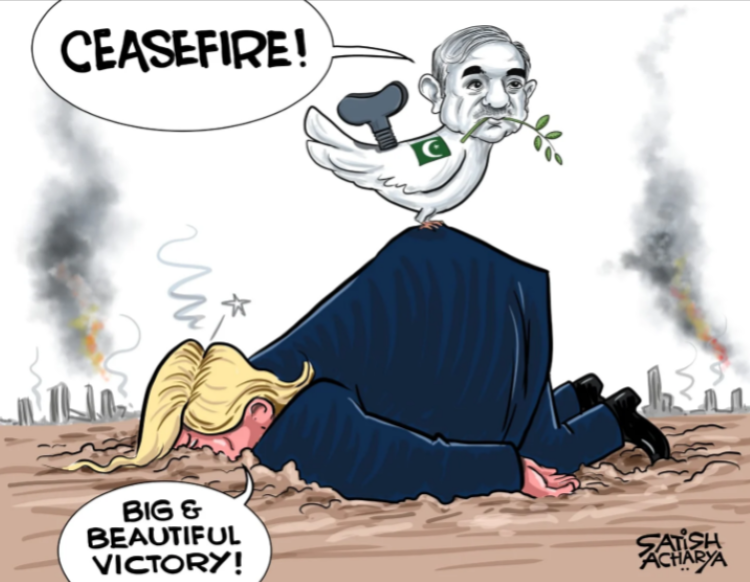
Trump Cartoon


The Iran Paradox: The strange case of Leftists mourning for a despot – Makarand R. Paranjape

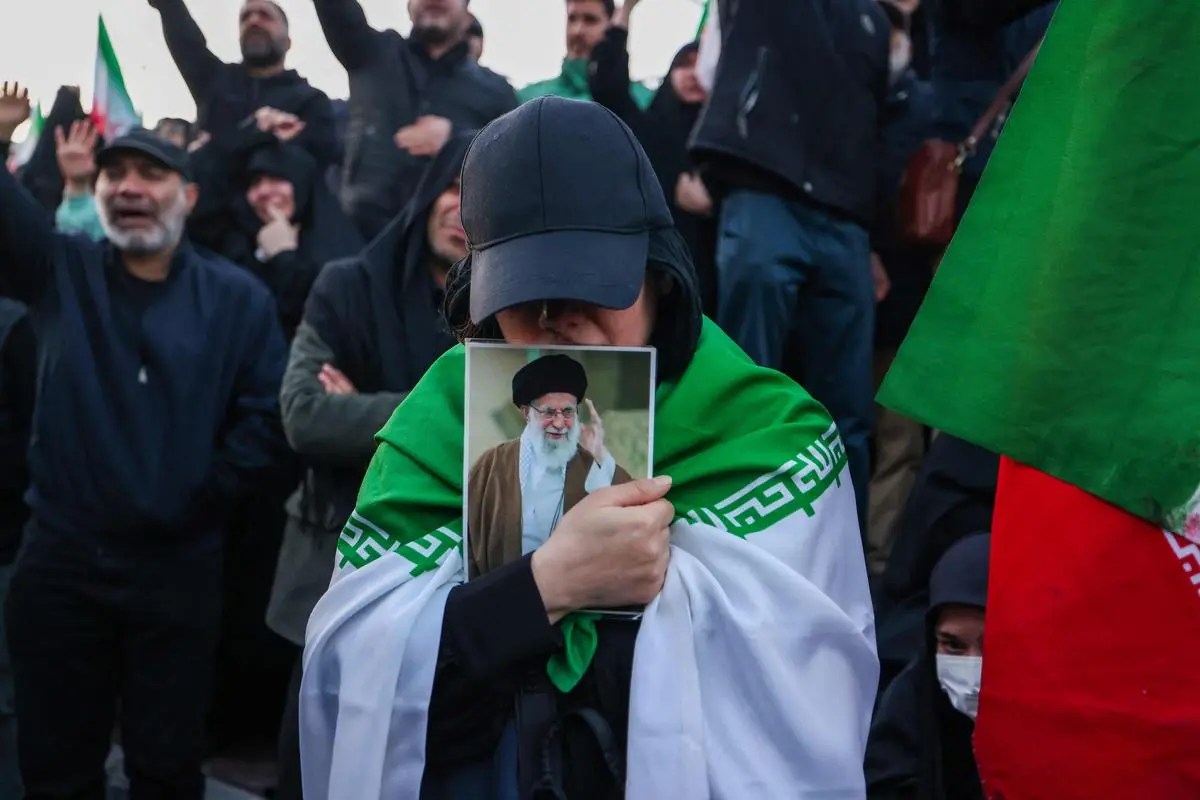
Mourning the death of Ayatollah Ali Khamenei in Tehran.

To eulogise and lament the demise of a barbarous despot and a brutal regime, which trampled on its own citizens and destroyed its own country economically, socially and politically, is sheer folly. – Makarand R. Paranjape

While Iranians all over the world, and to the extent possible within Iran, are celebrating the fall of a horrible despot and his regime of terror, Left-liberals in both the US and India are in mourning over the Ayatollah’s demise. How can one explain this strange and perplexing paradox?

Iranian women are rejoicing over the downfall of one of the most oppressive and misogynistic regimes in the world, yet US and Indian feminists—who, without the enforced hijab in Iran, would have faced certain imprisonment, even torture—are lamenting the fall of Iran’s patriarchal despots.

Iranian women have endured decades of policed veiling, gender segregation, and brutal crackdowns on protests, such as the 2022 uprising following Mahsa Amini’s death in custody for “improper hijab”. The regime’s misogyny was systemic, with laws permitting child marriage, quasi-prostitution disguised as temporary marriage (sigheh or nikah mut‘ah) and stoning for adultery (zina-e-mohsen).

Yet, when news broke of Khamenei’s death and the subsequent collapse of key regime figures, feminists both in the US and India decried the “militaristic patriarchy” of US and Israeli forces. The same feminists, who champion bodily autonomy, aligned with a theocracy that denied it.

Similarly, organised gay and LGBTQ groups, who could have faced execution in the Islamist Republic of Iran, are wailing the end of Iran’s theocratic dictatorship. Some on social media even pointed out how one of the greatest postmodernists, Michel Foucault, not only praised the regime in Iran but visited the country. I am not sure they knew he was homosexual—or did they simply choose to ignore it in so famous a foreign supporter?

The irony is stark: those who could be hanged from cranes in Tehran are now indirectly defended by activists enjoying protections in liberal democracies, all in the name of intersectional anti-oppression.

Communists were executed by Islamists not only in Iran, but in many other parts of the world. The Iranian regime’s early years saw the mass execution of Leftists, including members of the Tudeh Party, who were purged in the 1980s for ideological deviations from Khomeini’s Shia Islamism. Globally, Islamists have clashed with Communists, viewing Marxism as atheistic heresy. Yet today, Communist sympathisers in the West echo Iran’s anti-American slogans, seeing the regime as a victim of capitalist encirclement.

American Communists are taking the “Death to America” line right in New York City today, thanks to the patronage of their mayor, misusing the latitude of free speech given to them by the laws of the very country they excoriate. Speaking of the mayor, he promptly issued a statement condemning his own country and president.

I do not recall him shedding a tear for any of the prisoners of conscience tortured and killed in Iranian jails or castigating the horrifying attacks of Iran’s proxies in the region. Oh, I stand corrected; he did condemn Hamas much later, after facing repeated criticism. The day after the raid of 7 October 2023, he actually denounced Israel for its apartheid and occupation, not to mention its declaration of war against Hamas. Now this same mayor questions the legality of US and Israeli actions against Iran.

It is strange, to say the least, that the fallen regime has all kinds of supporters, East and West, many of whom are not even remotely connected to, let alone know much about, Iran. The Shia reaction in the subcontinent, by contrast, is understandable, even if, arguably, irrelevant to international geopolitics.

This global phenomenon of Left-liberal outrage over US-Israeli actions, which we may term the “Iran Paradox”, grows even stranger when we realise how many Muslim, especially Arab, states have actually condemned Iran’s retaliatory strikes, not the initial US-Israeli strikes. Even China and Russia, despite whatever verbal or political support they might extend in the totally marginalised and disunited United Nations, did not come to Iran’s aid in its time of dire need. The Ayatollah’s rule of terror, in other words, was left friendless in the end. Such, indeed, is the fate of dictators around the world.

Western liberalism, if we can even call it that, with its fading echoes elsewhere, reveals a profound disconnect with ground realities. Indeed, global political discourse shows that ideological alignments trump human rights or even historical realities.

At its core, the Iran Paradox stems from the frightened prejudice of sore losers, a Left which, some say not without reason, is both intellectually and morally bankrupt. It has nothing to fall back upon except its hatred for the US and Israel.

They are the ultimate villains—imperialist, colonialist and, worst of all, capitalist. Any regime opposing this axis, no matter how repressive, becomes, by default, a symbol of resistance.

Founded in 1979, the Islamic Republic of Iran, under Ayatollah Khomeini, positioned itself as an anti-imperialist bulwark, chanting “Death to America” and “Death to Israel”. They took their latter responsibility a bit too seriously, exporting death through proxies like Hezbollah in Lebanon and Hamas in Gaza.

Now, in closing, to India’s weak and splintered opposition—especially the increasingly irrelevant Congress and its differently enabled band of ideological fellow-travellers. Preaching moral lessons to Prime Minister Narendra Modi, who embraced Israeli Prime Minister Benjamin Netanyahu on the eve of the strike on Iran, is one thing.

But to eulogise and lament the demise of a barbarous dictator and a brutal regime, which trampled on its own citizens and destroyed its own country economically, socially and politically, is, as outspoken critics are wont to put it, sheer folly.

Yes, India did business with Iran, but that does not mean we should sing hosannas to its deceased leaders while ignoring their crimes against humanity. Let us not even comment on those virtue-signalling by issuing strong denunciations of the US and Israel. Actions speak louder than words. Besides, who is listening to them? Firstpost, 4 March 2026

Prof. Makarand R. Paranjape is an author and columnist.

Celebrating Khamenei's death in Iran.


Tracing the roots of hostility among Jews, Christians and Muslims – Arvind Sharma

Abrahamic Religions

The Arabs trace their origin to Ishmael, and the Jews trace their origin to Isaac. The struggle between them, therefore, dates back to the question: Who was the rightful heir to Abraham? – Prof. Arvind Sharma

The current tensions in the Middle East compel one to probe the roots of the hostility of the Christians and the Muslims towards the Jews, especially the hostility between the Jews and the Muslims. To trace the roots, one needs to go back to around 1800 BCE. That is the age in which Abraham, who is venerated by all three traditions, lived.

The Arabs trace their origin to Ishmael, and the Jews trace their origin to Isaac. The struggle between them, therefore, dates back to the question: Who was the rightful heir to Abraham? This issue has been the source of a lasting sibling rivalry.

It is not all conflict, however. According to the standard narrative, both the brothers buried Abraham together when he passed away.

The Jews, descendants of Isaac, finally found their kingdom in the promised land. They prospered, especially around 1000 BCE, giving us the legendary figures of David and Solomon. Thereafter, however, the Jewish kingdom fell prey to the various empires which arose in the Middle East, such as the Assyrian, the Babylonian, the Persian, and the Roman.

We fast forward now to the beginning of the Christian era when the Romans were ruling over the Jews. The prolonged period of political servitude had instilled in the Jews the hope that a great saviour, a messiah, would arise in due course to restore their sovereignty. It was in such an atmosphere of messianic expectation that Jesus was born. His charismatic personality and the miracles he performed raised the expectation in some quarters that he might be the messiah. But others wondered whether that could be the case, because of the aura of non-violence around him. Those who continued to believe that he was the messiah, even after his crucifixion, became the founders of Christianity. In other words, the key issue between the Jews and the Christians is whether Jesus was the messiah. The Christians accept him as such, and the Jews reject him as such.*

Just as the difference between the Jews and the Muslims goes back to the legacy of Abraham; the difference between the Jews and the Christians goes back to the legacy of Jesus Christ.

The difference between the Jews and the Christians is aggravated by the fact that, in the Christian scriptures, the Jews are depicted as responsible for the crucifixion of Jesus, although the crucifixion was formally carried out by the Romans. In Christian theology, Jesus is sometimes identified with God and, therefore, the Christians held the Jews responsible not just for the killing of Jesus Christ, but for killing God, or what is known as deicide.

Some historians argue that this was the result of the spread of Christianity in the Roman Empire. The Romans could not be held responsible for killing Jesus, because they were proving receptive to the message of Christianity, and therefore the blame for the death of Jesus Christ had to be shifted to the Jews. Christian theology not only aggravates but also complicates the relationship between the Jews and the Christians. Because Jews and Christians worship the same God, the Christians felt that God’s word to the Jews had also to be redeemed in some form. That is why Jews survived as a sect in the Roman Empire even though Christianity eliminated all other rival sects within the empire once it became the official religion.

Thus the hostility of both the Muslims and the Christians towards the Jews has deep historical roots. In recent times, however, the hostility between the Christians and the Jews has diminished because of the Holocaust, in which almost six million Jews were eliminated during the Nazi regime. Many Christians now feel guilty about this, and therefore tend to favour Israel.

The hostility between the Jews and the Muslims also went through a period when it was not as acute as it is now. During the sixteenth century, when the Jews were expelled from Christian Spain, they found shelter in the Muslim Ottoman Empire. Therefore, although the hostility between the Jews and the Muslims and the Jews and the Christians has deep historical roots, one should not fall prey to historical determinism and imagine it must always be so. It is possible that a modus vivendi may yet emerge. – News18, 23 November 2023

* Jews also reject the prophethood of Muhammad. – Editor

Prof. Arvind Sharma is the Birks Professor of Comparative Religion at McGill University in Montreal Canada, where he has taught for over thirty years. He has also taught in Australia and the United States and at Nalanda University in India. He has published extensively in the fields of Indian religions and world religions.

Abraham with Sarah and Hagar and their respective childrem Isaac and Ishmael.