Chanakya: Why Devdutt Pattanaik’s pseudo-history falls apart – Prosenjit Nath

Chanakya & Chandragupta Maurya

Chanakya was real, brilliant, and indispensable to India’s civilisational memory, no matter how inconvenient that fact may be for the modern political fantasist Devdutt Pattanaik. – Dr. Prosenjit Nath

I read Devdutt Pattanaik’s article “A fantasy called Chanakya” in The New Indian Express (9 Nov. 2025). Had Chanakya himself been alive, Pattanaik’s fantasies would have survived about as long as the kusa grass Chanakya famously uprooted when he vowed to destroy the Nandas. Beneath the polished prose and familiar rhetoric lies an old ideological trick: confuse the reader with multiple names, shout “interpolation” often enough, wrap it all in modern caste politics, and hope a historical figure vanishes.

But history does not work that way. The moment one actually looks at primary sources, Pattanaik’s thesis collapses flat.

Let us begin precisely where he does not want readers to look: the Arthaśāstra itself. The text explicitly identifies its author in unmistakable terms: “विष्णुगुप्तेन आर्यकौटिल्येन च सम्पादितम्”—compiled by Viśnugupta, the noble Kautilya. And again: “समाप्तं कौटिलीयम् अर्थशास्त्रम्”—here ends the Arthaśāstra of Kautilya.

Pattanaik’s sleight of hand rests on manufacturing two doubts. First that since the author is called “Kautilya”, Chanakya must be fictional. Second, that if the Arthaśāstra can be pushed centuries later, Chanakya cannot belong to the Mauryan age or guide Chandragupta Maurya. Both doubts evaporate the moment chronology is taken seriously.

Ashoka’s edicts from the 3rd century BCE describe an empire run through mahamatras, welfare officials, judicial ethics, administrative surveillance, animal-protection days, and moral governance—all core elements laid out systematically in the Arthaśāstra. The Mauryan state cannot be built on a Kautilyan framework if that framework supposedly did not exist until 500 CE. The empire itself is the evidence. Kautilya must predate Ashoka, exactly as tradition maintains—at least the late 4th century BCE.

Then comes the Spitzer Manuscript, the oldest known Sanskrit manuscript (1st–2nd century CE), which contains unmistakable references to the Arthaśāstra. Its discovery location is devastating for Pattanaik’s narrative: a Buddhist monastery in Kizil, Xinjiang—thousands of kilometres from any imagined “Brahmin power structure”. Why would Buddhist monks preserve and study a supposedly late “Brahminical propaganda text”? They would not, unless the text was already ancient, authoritative, and indispensable. This single fact shatters the claim that Kautilya was invented centuries later.

But the knockout punch arrives with the Kāmandakīya Nītiśāra (4th century CE), authored by the Buddhist scholar Kāmandaki. He explicitly and admiringly states that Viśnugupta/Kautilya—the author of the Arthaśāstra—was the very strategist who overthrew the Nandas and established Chandragupta Maurya. This is not a Hindu text, nor a Brahminical self-glorification exercise. A Buddhist intellectual, with no incentive to mythologise a Brahmin minister, identifies Kautilya and Chanakya as the same revolutionary statesman. That is the missing bridge Pattanaik refuses to acknowledge.

The convergence does not stop there. Buddhist sources such as the Mahāvaṃsa and Divyāvadāna describe Chandragupta’s Brahmin mentor. Jain texts like the Nisītha-Cūrṇi and Hemacandra’s Pariśiṣṭaparvan narrate the same overthrow of the Nandas by Chanakya for Chandragupta. Gupta-era dramas like Mudrārākṣasa assume the identity of Kautilya and Chanakya is already common knowledge. Kashmiri traditions such as the Tantrākhyāyikā immortalise Chanakya as the archetype of political genius. Across Buddhist, Jain, Hindu, and regional traditions—often rivals, sometimes hostile—the same man performs the same acts under different names. That is not myth-making; it is historical convergence, the strongest form of evidence when dealing with antiquity.

Pattanaik makes much of multiple names, as if this were suspicious. It is not. In the ancient world, it was normal. Confucius was also Kong Qiu, Kongzi, and Zhongni. In India, Viśnugupta is the personal name, Kautilya the gotra or scholastic name, and Chanakya the patronymic. One man. Many names. Total consistency. Claiming otherwise is like arguing that Zhongni disproves Confucius.

The remaining tactics are equally flimsy. References to “China” and Roman dināra are used to push the Arthaśāstra centuries forward. Yet scholars like K.P. Jayaswal showed long ago that “Cina” refers to the Sina/Shina Himalayan region near Gilgit, not Han China—hence terms like kauseya and cinapatta, which are not Chinese words. Later interpolations do exist, just as they do in Homer, Euclid, or the Pentateuch. No serious scholar claims interpolations prove the author never existed. Pattanaik deploys this argument selectively because he needs the text to be late to sever it from Chanakya.

Finally, the caste obsession collapses entirely. The earliest sources identifying Chanakya as a Brahmin are Buddhist and Jain traditions—historically critical of Brahmin authority. If “Brahmins invented Chanakya”, why do rival traditions independently preserve the same identity centuries earlier? Because they were transmitting historical memory, not manufacturing propaganda.

To be clear: Chanakya, Kautilya, and Viśnugupta are not three different people. They are three traditional names for one historical genius—the architect of the Mauryan Empire. When multiple competing traditions over two millennia remember the same man overthrowing the same dynasty for the same emperor, coincidence becomes absurd. History, in this case, is unanimous.

Devdutt Pattanaik’s article is not courageous scholarship. It is ideological provocation dressed up as history—a soggy biscuit of pseudo-academia that dissolves the moment primary sources are allowed to speak. And they speak loudly: Chanakya was real, brilliant, and indispensable to India’s civilisational memory, no matter how inconvenient that fact may be for modern political fantasies. – News18, 1 January 2026

Prosenjit Nath is a technocrat, political analyst, and author. He writes on national, geopolitical, and social issues.

A Fantasy Called Chanakya by Devdutt Pattanaik

Vande Mataram: How an anti-British song became ‘anti-Muslim’ – Ibn Khaldun Bharati

Bankim Chandra Chatterjee

In the Islamic political praxis, Muslims are nationalist if they are in majority and the rule is theirs. But if they can’t rule the country, they can’t be nationalist either. – Ibn Khaldun Bharati

The Muslim opposition to Vande Mataram is well known. However, the reason behind it is not well understood. Actually, it’s beyond comprehension. Their objection to the national song is formulated in such abstruse theological terms that even an educated Muslim can’t grasp its esoteric nuance. In reality, it’s not so much an opposition to the song as to the idea behind it—the idea of India as a nation. It’s the idea that Hindus and Muslims become an organic whole to form an inseparable political community. The major Muslim ideologues insisted on their separateness, and separate they remain.

To say that saying Vande Mataram (Salutations, Oh Mother) evokes the imagery of idol worship is the kind of convoluted reasoning that defies common sense. Furthermore, to emphasise that the hostility to idol worship is the foundational creed of Islam, and that it’s incumbent on every Muslim to wear this abhorrence on sleeve, isn’t really conducive to diversity, pluralism, peaceful coexistence, and composite nationhood—the ideals in which the Muslims have greater stake than anyone else.

Recently, Maulana Mahmood Madani, the head of the largest organisation of ulema in India, Jamiat Ulema-i-Hind, made a controversial speech, in which he stressed the imperative of jihad in India. He also said, “Murda qaumen mushkilaat mein mubtala nahin hotin. Wo to surrender kar deti hain. Wo kahenge ke Vande Mataram padho to padhna shuru kar denge.” (Dead communities don’t face any difficulty since they surrender readily. When asked to chant Vande Mataram, they willingly do that).

The ferocity with which these Muslims proclaim their revulsion for Vande Mataram, and the grim determination with which they threaten to go to war if its public singing were to be revived, makes one wonder if there is actually something so repugnant in the song that a Muslim can’t countenance it if he were to remain true to his faith.

Is there a problem?

Let’s see if there is anything in Vande Mataram that makes Muslims recoil in horror. Arif Mohammed Khan, the scholarly Governor of Bihar, translated into Urdu the two stanzas that have the status of the national song, and sent the same to one of the most prominent Islamic seminaries, the Nadwa, at Lucknow, for their opinion on it; specifically asking if there was anything in it that was contrary to Islam.

It was presented as an original composition, and not a translation. He had rendered the key words, Vande Mataram, as “Taslimaat, Maa, Taslimaat”. The ulema at Nadwa opined that there was nothing in the song that contravened Islam. One, however, suspects that if they knew it to be the translation of Vande Mataram, they might have had a different opinion. Such is politics and such is the power of narrative!

The reality behind the narrative

The root of the Sanskrit word ‘vande’ is ‘vand’. According to Sanskritist Monier Monier-Williams, depending on the context, ‘vand’ means “to praise, celebrate, laud, extol, to show honour, do homage, salute respectfully; or, venerate, worship, adore”. The primary meaning is not worship; certainly, not the ritual worship. Even if it were, hasn’t Urdu poetry been more extravagant in such expressions. For example, Iqbal, the poet of Islamic revivalism, in one of his earlier poems, said, “Khaak-e watan ka mujhko har zarra devta hai” (Every particle of the country is a god unto me)”. Iqbal’s fans—quite a few of them being fundamentalist fanatics—never saw anything amiss in this.

Can there be a nation without a motherland?

As for mataram, i.e., mother—Mother India—Urdu has a beautiful term, madar-e-watan, the motherland. No Muslim ever found this concept contrary to Islam. In fact, the most literal and yet most exquisite rendition of Vande Mataram has been A.R. Rahman’s song Maa Tujhe Salaam.

There are numerous verses in the Quran (7:12, 23:12, 30:20, etc.) which say that we are made of earth, and it is the source of life and the place of origin. It’s implied that, in a deeper sense, the earth is the mother, and one’s own place is the motherland.

In a display of genius that is peculiar to them, the Muslim leaders espied the idol of a deity in the conception of motherland, and flinched from its adoration. Even in Pakistan—which broke away from us, on difference over the Indian nationhood, and the sacredness of the motherland—Asim Munir, the generalissimo, can be seen referring to his country as motherland.

Nowhere else in the world do Muslims have had any problem with the concepts of nationalism and the sacredness of the respective countries. The literal translation of the word ‘Pakistan’ is holy land, which in Hindi translates as punya bhumi. The Indian Muslims, however, can’t accord this status to their own country.

In the Islamic political praxis, Muslims are nationalist if they are in majority, and the rule is theirs. But if they can’t rule the country, they can’t be nationalist either. In a debate that raged between poet Muhammad Iqbal and Jawaharlal Nehru, the former candidly said, “In majority countries Islam accommodates nationalism; for there Islam and nationalism are practically identical; in minority countries it is justified in seeking self-determination as a cultural unit”. (Modern Review, Calcutta, 1934-35)

There’s a deeper reality. Without recognising the country as the motherland, there can’t be a nation. But can the people who came as invaders, conquered the country, and ruled it for centuries, ever accord the status of mother to the vanquished territory? Could the British ever regard India as mother?

The Muslim ideology has been in the hands of the elite descended from the old ruling class. The Muslim masses follow it uncritically because it’s couched in religious idiom, and religion is not to be questioned.

Is Anandmath anti-Muslim?

Regarding Vande Mataram being a part of the novel Anandmath; well, it’s true that the poem, though independently written, has been interpolated in the book. It’s also true that the theme of the book is the Sannyasi Rebellion of 1770s, which was an uprising against the oppressive Muslim rule, and therefore, some passages have clear anti–Muslim overtones. But isn’t it equally true that those Muslim rulers were oppressors, and their religious hostility toward the Hindu peasants was an added factor in oppression? So, why shouldn’t the rebellion against them be seen as a class war of the oppressed against the oppressors, and the fulmination against them should be seen in perspective, and not misconstrued as invective against ordinary Muslims who belonged to the same class as them? Haven’t we seen this kind of class analysis about the Moplah “Rebellion”?

But, it’s not possible despite the fact that a large number of Marxist historians have been Muslim. That’s because, these historians, when it suits them, treat Muslims as a monolith, ignoring their socioeconomic diversities. Thus, a justified diatribe against the Nawabi system is seen as a tirade against ordinary Muslims. What if Indian Christians were to see in the criticism of the British rule the condemnation of ordinary Christians?

By the way, no Indian ever rejected the popular patriotic song Saare Jahan Se Achha just because it’s from the pen of Iqbal, the separatist ideologue.

The genesis

Vande Mataram, set to tune by Rabindranath Tagore, had been sung in the Congress sessions since 1896. No Muslim leader ever found it antithetical to their religion. Even during the Swadeshi Movement, which was a response to the Partition of Bengal (1905), when this song became the anthem of resistance to the British, one doesn’t hear of any objection to its purported polytheistic imagery. This was despite the fact the division of Bengal was on religious lines, and it supposedly favoured the Muslim majority of East Bengal. Even Maulana Abul Kalam Azad, the great Islamic scholar and thinker, who claims to have joined the underground revolutionary movement of the Bengali youth, doesn’t record any religious objections to it.

Even during the Khilafat Movement (1919-24), when the Congress was working on pan-Islamist agenda, Vande Mataram continued to be sung in its gatherings, in the presence of the leading Khilafatist maulanas, who, then, dominated its proceedings.

How an anti-British song became ‘anti-Muslim’

From 1896 to 1937, Vande Mataram was the staple for the Congress. And then, elections were held under the Government of India Act, 1935; and Congress ministries were formed in provinces. After centuries, the natives of India, the Hindus, were in power. The Muslim ruling class could endure British rule, but seeing their former subjects becoming rulers was beyond their endurance. For centuries, they had been conditioned to look down upon the Hindus, and now the same Hindus were ministers. They freaked out, and began hallucinating about the Hindu oppression. As they upped the ante for a desperate fight, their glance fell upon the “Durga” and “Lakshmi” in Vande Mataram, and the Islam-in-danger bogey became ever more palpable.

This situation has been best summarised by a nationalist Muslim, Rafi Ahmed Kidwai. In a statement that was published in The Pioneer on 19 October 1937, that merits in-extenso reproduction, he said, “Mr. Jinnah characterises Vande Mataram as an anti-Islamic song. Mr Jinnah had been a devoted and enthusiastic member of the Congress and of its chief executive, the All-India Congress Committee, for a number of years. Every year, the session of the Congress opened with the singing of this song, and every year he was seen on the platform listening to the song with the attention of a devotee. Did he ever protest? Mr Jinnah left the Congress, not because he thought the Vande Mataram was an anti-Islamic song, but because he had found the idea of swaraj unacceptable.”

Nehru is both Churchill and Chamberlain

The Muslim League, having suffered a rout in the 1937 elections, and further failing to force its way into the government in the United Provinces—not on the basis of the seats won, but as an entitlement for having once been the rulers—suddenly realised that Vande Mataram was idolatrous, and raised a war cry against it.

In the book Vande Mataram: The Biography of a Song, historian Sabyasachi Bhattacharya details the debates in the Congress, and the correspondence between Nehru, Bose, and Rabindranath Tagore. Nehru’s first reaction was: “The present outcry against Bande Mataram is to a large extent a manufactured one by the communalists.” However, soon, in order to appease the communalists, he said that having read the English translation of Anandmath, he was of the opinion that it was “likely to irritate the Muslims”. And so, he set out “to meet real grievances where they exist(ed).” That is how the Congress Working Committee, on 26 October 1937 (just days after Kidwai’s remonstrance), decided to truncate the song, and adopt only the first two stanzas as they were “unobjectionable”.

Such bending backward before the communalists recalls to mind what Atal Bihari Vajpayee once told Nehru about the streak of appeasement in him: “In you, there are both Churchill and Chamberlain”.

Sabyasachi Bhattacharya narrates how this concession couldn’t satisfy the Muslim League, as they insisted on the deletion of Vande Mataram in toto. Jinnah wrote, “Pandit Jawaharlal Nehru cannot be unaware that Muslims all over have refused to accept the Vande Mataram or any expurgated edition of the anti-Muslim song as a binding National Anthem”.

Prime Minister Narendra Modi is right in his analysis that the mutilation of Vande Mataram whetted the appetite of the Muslim League, and became the prelude to the partition of India. It is in the logic of appeasement that instead of resolving an issue, it exacerbates it.

Even now, the Muslim leadership remains as staunchly against Vande Mataram as it was during Jinnah’s time. So, what is gained by cutting out the better part of the song; and, what’s been gained by acquiescing to the partition?

The way forward

Since 2014, because of the conducive atmosphere provided, the Muslims have been showing an unprecedented fondness for the Constitution, and the sacred symbols of the nation. The Independence and Republic Days are celebrated with gaiety in Muslim institutions, including madrasas; and the national anthem is sung with gusto. Many a time, one can see the national flag waving from the high minaret of a mosque. If a better atmosphere is conduced, the Muslims will sing Vande Mataram with as much fervour as anyone else. – The Print, 12 December 2025

Ibn Khaldun Bharati is a student of Islam, and looks at Islamic history from an Indian perspective. 

Chhattisgarh Waqf Board orders all mosques and madrasas to hoist the Indian flag on Independence Day.

Colonised Minds: Modi didn’t speak the whole truth at Ayodhya – Balbir Punj

PM Modi raising the flag over the Ram Temple at Ayodhya (Nov.25, 2025).

What Modi said at Ayodhya about the Macaulay mindset is true, but unfortunately not the whole truth. India’s influential political, intellectual, and social elite has long been influenced not only by Macaulay but also by the ideological legacy of Karl Marx. Since independence, this powerful network has worked tirelessly—both jointly and separately—to carry forward the unfinished agenda of these two, who never met but shared a hatred for India’s timeless civilisation. – Balbir Punj

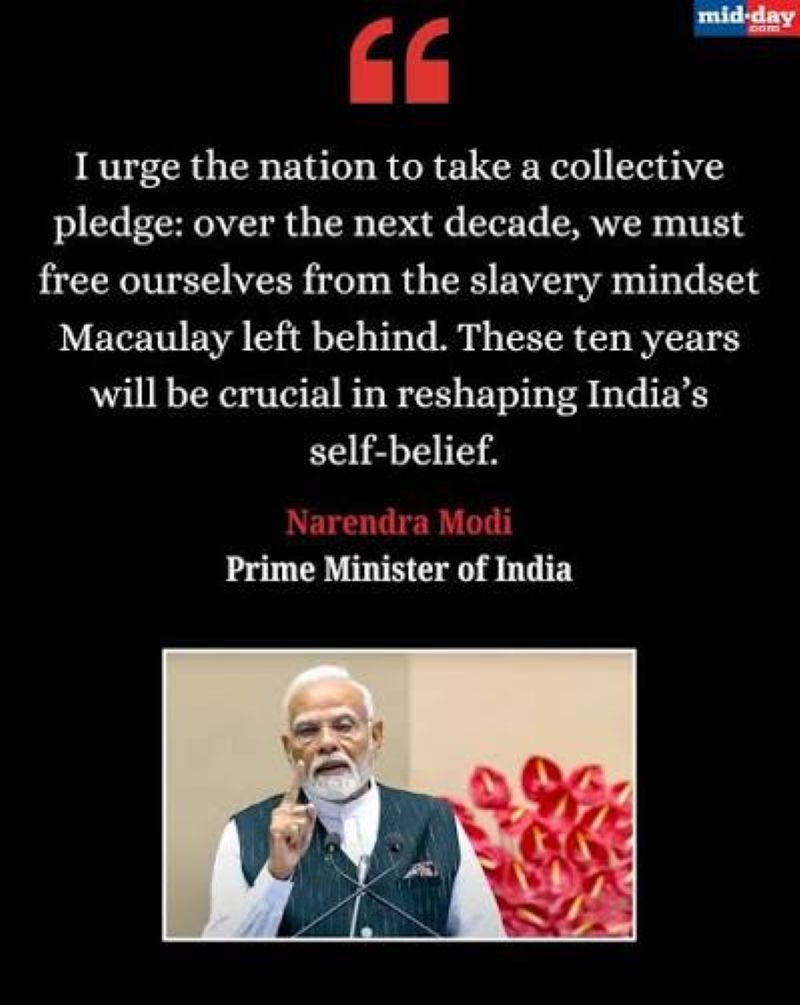
Recently, Prime Minister Narendra Modi vowed to liberate India completely from the Macaulayite mindset. In his words:

“Alongside pride in our heritage, one more task is equally vital-and that is the complete eradication of the mindset of servitude. Nearly 190 years ago, in 1835, a Briton named Macaulay sowed the seeds of uprooting India from her civilisational roots. It was Macaulay who laid the foundation of India’s mental colonisation. Ten years from now, in 2035, that unfortunate episode will complete two hundred years. Only a few days ago, at another event, I urged the nation to adopt the coming decade as a mission-a resolve that in these ten years, we shall free India entirely from this mindset of slavery.”

PM Modi hit the nail on the head, and what better place than Ayodhya to do so. The seven-decade delay in building the Shri Ram Janmabhoomi Temple symbolises the lingering scars of colonised mindsets. The temple could have been constructed soon after independence and marked the conclusion of India’s struggle to reclaim its self-respect and identity.

However, opposition driven by Macaulay-Marxist influences turned it into a Hindu-Muslim issue. Their colonial mindset created misleading narratives, resulting in endless litigation, damage to Hindu-Muslim relations, and the loss of many innocent lives and properties. I have explored this topic in detail in my book Tryst with Ayodhya: Decolonisation of India.

What Modi said about the Macaulay mindset is true, but unfortunately not the whole truth. India’s influential political, intellectual, and social elite has long been influenced not only by Macaulay but also by the ideological legacy of Karl Marx. Since independence, this powerful network has worked tirelessly—both jointly and separately—to carry forward the unfinished agenda of these two, who never met but shared a hatred for India’s timeless civilisation.

Thomas Babington Macaulay was a staunch capitalist and imperialist. In contrast, Karl Marx was the pioneer of Leftist ideology, focusing on class struggle while sharply criticising capitalism. Despite their ideological differences, both shared a common goal: to diminish India’s presence in the minds and hearts of its people. As a result, when the British, in collusion with the Muslim League, moved the subcontinent towards an inevitable partition, the contemporary Left intelligentsia not only justified it but also mused about breaking India into more than fifteen smaller pieces.

Macaulay’s 1835 education policy aimed at shaping a class of Indians who would be “Indian in blood and colour, but English in taste, in opinions, in morals and in intellect”-a group that would support British rule. His policies encouraged Indians to look down on their own civilisational roots and to detach mentally from their cultural foundations. So strong was his disdain that he famously claimed the entire “native literature of India” and learning was not “worth” even a “single shelf of a good European library”.

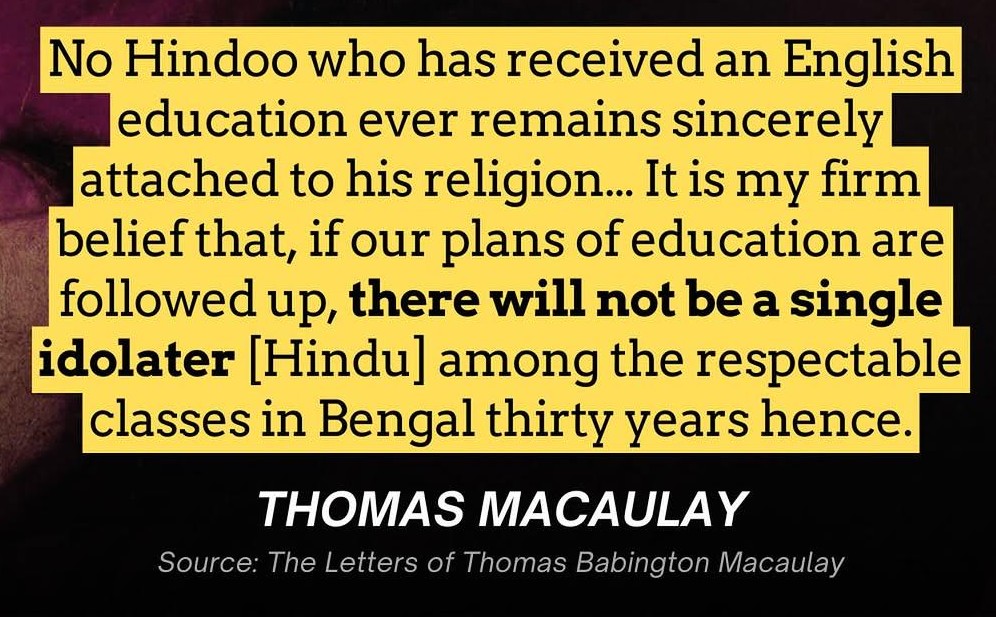
Macaulay’s project was not merely colonial; it was deeply evangelical. Writing to his father on  October  12, 1836, he declared:

“… Our English schools are flourishing wonderfully… The effect of this education on the Hindoos is prodigious. No Hindoo who has received an English education ever continues to be sincerely attached to his religion. Some continue to profess it as a matter of policy, and some embrace Christianity… It is my firm belief that, if our plans of education are followed up, there will not be a single idolater among the respectable classes in Bengal thirty years hence. …”

Macaulay’s thoughts aligned with the 1813 Charter Act of the East India Company, which encouraged European missionaries’ evangelical efforts in India. From this colonial origin, divisive ideas like the Aryan Invasion Theory, the Dravidian Movement, and the claim that “India is not a nation” arose, still influencing Indian politics and academia.

British rule in India, ironically, fulfilled Marx’s worldview, at least in one way. His satisfaction is evident in his column—“The Future Results of British Rule in India” published on 8 August 1853 in the New York Daily Tribune, where he wrote:

“The British were the first conquerors superior, and therefore inaccessible to Hindoo civilisation. They destroyed it by breaking up the native communities, by uprooting the native industry, and by levelling all that was great and elevated in the native society.”

Mark these words, “… they destroyed it by breaking up the native communities, by uprooting the native industry…” This sentence by Marx, over 170 years old, summarises how India was culturally and economically destroyed by colonial powers. Marx celebrated this destruction of Indian culture and industry as necessary for revolution, as culture and economics are intertwined—destroying one kills the other.

He further added in “The Future Results of British Rule in India”:

“England has to fulfil a double mission in India: one destructive, the other regenerating—the annihilation of old Asiatic society and laying the material foundations of Western society in Asia.”

Marx’s contempt for Indian traditions was further exposed in another New York Daily Tribune article “The British Rule in India,” dated 25 June 1853:

“… We must not forget that these little communities were contaminated by distinctions of caste and by slavery, that they subjugated man to external circumstances instead of elevating man the sovereign of circumstances, that they transformed a self-developing social state into never-changing natural destiny, and thus brought about a brutalising worship of nature, exhibiting its degradation in the fact that man, the sovereign of nature, fell down on his knees in adoration of Hanuman, the monkey, and Sabala, the cow. …”

Marx authored this caricature without visiting India, yet many of his ideological successors spread this disdain in independent India. Sanatan philosophy views man as part of the cosmic order, not its master. India’s Vedic culture, with deep roots, supported a thriving economy from the first to the seventeenth century, acknowledged by global research.

The liberation from the colonial Macaulay-Marx mindset—an emancipation that should have started immediately after independence—only gained momentum after 2014, with some exceptions. The Guardian’s May 18, 2014 editorial highlighted this shift:

”Narendra Modi’s victory in the elections marks the end of a long era in which the structures of power did not differ greatly from those through which Britain ruled the subcontinent. India under the Congress party was in many ways a continuation of the British Raj by other means. The last of midnight’s children are now a dwindling handful of almost 70-year-olds, but it is not the passing of the independence generation that makes the difference.”

Post-independence, there was a unanimous demand in Ayodhya from civil society, the political leadership of United Provinces (as Uttar Pradesh was called then), and the top echelons of state bureaucracy for handing over the Shri Ram Janmabhoomi site to Hindus, but the colonialists led by the then Prime Minister Nehru wouldn’t let that happen.

In this context, the Shri Ram Janmabhoomi Temple in Ayodhya stands as a living symbol of Sanatan resurgence and a national resolve to break free from colonial consciousness.

When, amid Vedic rituals on  November 25, the PM raised the standard of Sanatan in Ayodhya, it was a definitive statement about India’s civilisational renaissance and its quest to dismantle the colonial mindset. No wonder the Macaulay-Marxist pack is in a funk.

Balbir Punj is an eminent columnist and the author of “Tryst with Ayodhya: Decolonisation of India” and “Narrative ka Mayajaal”.

K.K. Muhammed: Muslims should hand over the Gyanvapi and Mathura sites to Hindus – BT & India Today

K. K. Muhammed

Former Archaeological Survey of India (ASI) regional director K.K. Muhammed has accused the Centre of neglecting conservation, delaying critical excavations and failing to protect India’s cultural legacy. – Business Today

Former Archaeological Survey of India (ASI) regional director K.K. Muhammed has described the last eleven years under the BJP government as a “dark age” for the country’s premier heritage body. He accused the Centre of neglecting conservation, delaying critical excavations and failing to protect India’s cultural legacy.

Speaking to India Today [see video below], the veteran archaeologist said the expectations he and others had from the government on cultural preservation “did not materialise”.

“We all expected a lot from the BJP government when it came to power. So, we thought there would be a kind of … the protection would be more from the side of these people, and they would be taking a lot of interest in culture, but it was not like that,” he said. “We call it the dark age of the period of the BJP for the last 11 years. It is the dark age of the Archaeological Survey of India.”

Pressed on why he believes this has happened, Muhammed pointed to stalled conservation work, including at the Bateshwar temple complex in Chambal, where he had previously overseen a major restoration effort.

“For example, my own Bateshwar Temples, where I had worked. Along with the Chambal decoits there we have been able to reconstruct near about 90 temples. But during the BJP’s 11 years, only 10 temples were reconstructed, and that too after trying a lot. I had to do a lot of exercise for that, otherwise even that would not have happened.”

He also criticised the government for halting significant excavations across several sites, including Delhi’s Purana Qila. “Purana Qila excavation should have continued. Dr Vasant Kumar Swarnkar was excavating it. He has not got the permission for that. That should have been done,” Muhammed said. “And similarly, excavations in various other parts also. It should have been taken up by the government, but they are not.”

According to him, the ruling party’s claim of being the “real owners of culture” has contributed to an atmosphere where oversight and criticism are weakened. “Because they claim that they are the real owners of the culture, but that is not so,” he said. He, however, acknowledged that at various places the work was happening, which was not the case during the Congress period. – Business Today, 1 December 2025

The monotheistic interpretation of Hinduism originates in colonial Hindumesia – Yogendra Singh Thakur

Hindu Gods

The over-arching need to find common ground with Abrahamic faiths … has at the very heart of it the belief that Hinduism is somehow inferior to the supremacist, monopolist and violent monotheistic religions. – Yogendra Singh Thakur

Some time ago, the former Lok Sabha Speaker and Union Minister Shivraj Patil claimed that Hinduism has a concept of “jihad” similar to the one in Islam. Patil, highlighting that there is a lot of discussion on jihad in Islam, said that “the concept comes to the fore when despite having the right intentions and doing the right thing, nobody understands or reciprocates, then it is said one can use force.”

“It is not just in Quran, but in Mahabharata also, the part in Gita, Shri Krishna also talks of jihad to Arjun and this thing is not just in Quran or Gita but also in Christianity,” he said adding further fuel to the fire.

Faced with the natural and correct backlash on the statement, Patil attempted to dress the wound with a clarification. But the dressing was evidently soaked in salt as the clarification only worsened the situation. Patil went on to say that just as Islam and Christianity, Hinduism too does not endorse many gods but only one. Such a god has “no colour, no shape and no form,” he said. Basically, the former Union Minister was pushing the monotheistic belief—the existence of one sole formless god—which is the very foundation of Abrahamic faiths. This is the same belief which has been at odds with polytheistic Hinduism for centuries, leading to the many wars initiated and instigated by Muslims and Christians, the ethnic genocides that these two religions have carried out worldwide and in India, and even caused the Partition of the country.

Some days ago, another political leader from the state of Karnataka, made an ill-intentioned remark on Hinduism, calling the word Hindu, “dirty”. The leader went on to remark that we should rise above the boundaries of religion and that “it is not appropriate to glorify anything related to Hinduism.” One wonders why it is always that Hindus and Hinduism are targeted whenever there is a call to rise above religion and religious identity, and that these calls are usually followed or accompanied by abusing only Hinduism and Hindus.

This idea about rising above religion or a notion that religion, when it comes to Hinduism, is something to be insecure about is not limited to the remarks of ignorant and mischievous political leaders alone. The Supreme Court has very famously stated that Hinduism is not a religion but a way of life. What this statement evidently implies is that Hinduism is a cultural belief system with rituals, festivals, and beliefs about life and death, and it does not contain any larger social regulation system, any system of doctrines or practices related to spirituality or worship, that it does not have anything to do with the sacred, holy, absolute, divine, and of special reverence, or that Hindus do not have ant political aspirations as a community. Hence in a scenario when such a system is built or such aspirations are formed, it becomes, by definition, “un-Hindu”: Hindus are merely amoebic, shape-shifting human beings in this conception of the Supreme Court of India.

This is what senior Congress leader Salman Khurshid asserted, when he claimed that Hindutva, which advocates for certain political interests of Hindu society, is similar to Boko Haram and ISIS terrorist outfits. But despite such cruel, false, and provocative comparisons drawn on the basis of “Hinduism is a way of life” notion, many do like to continue advocating it, including our current Prime Minister himself.

It is this notion alone which is at the heart of an advocacy that Hindus are not a people following one religion but a people identifying with a certain culture, irrespective of religious affiliations—the kind of advocacy which the Rashtriya Swayamsevak Sangh (RSS) chief, Dr Mohan Bhagwat, does quite often. Dr Bhagwat often expresses that they “have been telling since 1925 (when the RSS was founded) that everyone living in India is a Hindu. Those who consider India as their ‘matrubhoomi’ (mother land) and want to live with a culture of unity in diversity and make efforts in this direction, irrespective of whatever religion, culture, language and food habit and ideology they follow, are Hindus.” He adds that everyone living inside the boundaries of his imagined 40,000-year-old Akhand Bharat are Hindus.

The over-arching need to find common ground with Abrahamic faiths—by saying that the concept of jihad and a single formless god is in the core of Hinduism or that all people living in India and amidst Indian culture are Hindu—has this understanding at the very heart of it—that Hinduism is somehow inferior to the supremacist, monopolist, violent, and culturally, civilizationally, spiritually, and experientially different faiths. The unreasonable urge to “rise above religion,” or to not appreciate the aspects of Hinduism, is also driven by the same notion of relative inferiority. People possessed with such a notion do not seek to maintain the differences between a Pagan polytheistic faith like Hinduism and Abrahamic monotheistic faiths like Islam and Christianity; or even between the socio-cultural beliefs of Hinduism and the beliefs of Utilitarian globalists.

And why does this particular notion exist in the modern Hindu with such prominence? The answer to this can be traced back to the social reform movements in early modern British India.

The British Raj in the late eighteenth and early nineteenth century was undergoing a change in attitude towards India. One of the reasons for this change in attitude was the French Revolution, which seemed to inspire revolution around the world, particularly posing a threat to the colonial nations under the British, the long standing enemies of the French. In order to prepare themselves ahead of any French attempts or “inspiration” to destabilise the British Empire, the English from the College of Fort William pressed for a unified Hinduism. Henry Thomas Colebrooke (1765-1837) and Lord Wellesley were central to these efforts [1].

Lord Wellesley was brother of the future Duke of Wellington (who later defeated Napoleon at Waterloo in 1815) and spoke many a time against the French Revolution. As David Kopf notes [2], “a root cause of Wellesley’s actions was, by his own admission, his fear and hatred of France and the very real danger of French expansion into India” [3].

And thus from the College of Fort William commenced reformist interpretations of Hinduism, to turn it into a bulwark against possible “social activism, revolutionary tendencies and challenges to the status quo.”

Colebrooke wrote, under a substantial influence of Jesuit missionaries, that Hinduism was originally—and in its true form—a monotheistic religion with only a formless god at its center. It was thought that the diversity of Hinduism posed a threat to the stability of the British Empire in India in the post French Revolution era.

Hindu reformers such as Ram Mohan Roy followed Colebrooke and aggressively propagated the idea that Hinduism at its core is a monotheistic faith with no room for image worship or idolatry. Roy, walking in the footsteps of Colebrooke’s orientalism, divided the Hindu past into a “monotheistic true era” and the “polytheistic false era”. The latter era, according to him, was destroying “the texture of society” [4].

Later, Ram Mohan Roy founded the Brahmo Samaj with the objective of institutionalising these reformist ideas and interpretations of and about Hinduism. In his attempt, Roy incorporated a large portion of Christian theology into Hinduism [5]. The motives of it, as popularly described by scholars, was to oppose Christian Jesuit activities. But as evidenced from his earlier writings, there was definitely a drive of the orientalist belief behind it which saw Hinduism as originally a monotheistic faith.

The implication of this monist/monotheistic view of Hinduism naturally resulted in attempts to essentially dissolve Hinduism as a separate theology and project it as just another branch of global universal theism. Ram Mohan Roy considered “different religions as national embodiment of universal theism and the Brahmo Samaj as a universalist church” [6].

The social reform movement was carried out against what the reformers deemed to be the backward aspects of Hindu culture, practices, and mores. The goal of the movement was a restructuring of Hindu institutions and beliefs. At the core of these reform movements was dislike or even hatred of polytheism, which is essentially the crux and whole of Hinduism. As a remedy for the ills in Hinduism, Ram Mohan Roy advocated a monotheistic Hinduism in which reason guides the adherent to “the Absolute Originator who is the first principle of all religions” [7]. Roy was essentially incorporating the core beliefs of an Abrahamic faith into a polytheistic religion, labelling it a guiding truth.

What was started by Ram Mohan Roy was taken to even greater lengths and to a much bigger audience by Dayananda Saraswati and his Arya Samaj (founded in 1875). Dayananda studied Vedic literature and aggressively propagated the monotheistic interpretation of Hinduism. Multiple gods, to Dayanand, were a Puranic corruption by the priestly class to control and mislead the masses. And all post-Vedic Hindu literature, including the epics Ramayana and Mahabharata, were deemed inauthentic. “Go back to Vedas,” Dayanand proclaimed.

But amidst all this ground-breaking activism lay a highly prejudiced—and possibly Christian-centric—view of the Hindu past. Vedas speak proudly of many gods/deities with hymns dedicated to all of them. It is hard to imagine how this apparent fact could be interpreted into believing that the Vedas propagate monotheism, unless the interpreter has already concluded otherwise. Sure, the Vedas propound grand, cosmic speculation about the origins and nature of the cosmos, with the universe originating “through the evolution of an impersonal force manifested as male and female principles”. So, we find in the Vedas a “tension between visions of the highest reality as an impersonal force, or as a creator god, or as a group of gods with different jobs to do in the universe” [8].

Later the Ramakrishna Mission furthered similar monistic views of Hinduism, terming Hinduism as a religion of all, irrespective of faith or god. The notion of one religion for all, an umbrella theological belief system that could create a universal brotherhood of faiths, was taken to its extreme by the Theosophical Society founded by the Russian spiritualist Madame H.P. Blavatsky and the American Col. H.S. Olcott in 1875. In just nine years the Society had around a hundred branches along with its global centre in Adyar. The Theosophical Society used unconventional and indirect ways to further its ideas of theological universalism and monism. It managed to influence many important personalities who would later go on to change India’s politics via the Indian National Congress. The Society opened many schools and colleges including the Central Hindu College at Banaras.

The British establishment, no doubt, supported, encouraged and institutionalized these reforms, albeit for its own good. With the advent of the eighteenth century, British attitude towards India—which was purely an evangelic utilitarian one—was to somehow do away with the stagnation in Indian society by the work of law and “education” in Christian principles. The zealous goal of these efforts, as Udayon Mishra notes [9], was the creation of a “Europeanised India” with substantial incorporation of Christian ideas and beliefs into Hinduism. Hindu reformer organizations like the Brahmo Samaj, the Arya Samaj, the Theosophical Society, and others played that role exactly, knowingly or unknowingly, playing into the hands of British evangelicals.

This reformist approach of incorporating Christian core beliefs into Hinduism turned out to be a big help to the Christian missionaries and theologians. “By characterising Hinduism as a monistic religion, Christian theologians and apologists were able to criticise the mystical monism of Hinduism, thereby highlighting the moral superiority of Christianity,” Richard King notes. Christian theologians furthered the view that the enormous diversity of Hinduism—in gods, sects, and beliefs—was a sign of inferiority of the Indian stock, thereby making it a responsibility of the British to “educate, civilise, and save” Hindus and India.

“Educating” the Hindus on their so-called monotheistic core was also seen as a step that could help Britishers to club diverse Hindus into a group of single-minded people, easier to govern and less likely to start insurgencies. On the looming prospects of French expansion, an atmosphere of suspicion and anxiety about the stability of British rule led to the furthering of reformed interpretations of Hinduism.

And thus, the anxiety caused by the French Revolution and the British evangelical utilitarian zeal to Christianise India, guided the reformist view of Hinduism. This over-arching need to find common ground with Abrahamic faiths was born out of decades of colonial Hindumesia. – IndiaFacts, 15 December 2022

Footnotes

  1. Dhar, Niranjan, Vedanta and the Bengal Renaissance, Calcutta, Minerva Associates, 1977.
  2. As quoted by King, Richard A. H, Orientalism and Religion: Post-Colonial Theory, India and “The Mystic East”, 1999, pp. 130.
  3. David Kopf, British Orientalism and the Bengal Renaissance: The Dynamics of Indian Modernisation, 1773–1835, Berkeley and Los Angeles, University of California Press, 1969, pp. 46-47.
  4. Ibid., pp. 199-200.
  5. Charles H. Heimsath, Indian Nationalism and Hindu Social Reform, Oxford University Press, 1964.
  6. Dr. Sanjeev Kumar, Socio-religious reform movements in British colonial India, International Journal of History 2020; 2(2): 38-45.
  7. Heitzman and Worden, eds., “India: A Country Study,” 1995.
  8. Bijoy Prasad Das, Rammohan Roy: Progressive Role as a Social Reforms and Movements for Social Justice, International Journal of Humanities and Social Science Invention, Volume 10, Issue 6, pp. 57-59.
  9. Udayon Misra, “Nineteenth Century British Views of India: Crystallisation of Attitudes”, Economic and Political Weekly, vol. 19, no. 4, 1984, pp. 14–21.

Yogendra Singh Thakur is a freelance columnist from Betul, Madhya Pradesh. He is pursuing his studies, majoring in History, Political Science, and Sociology.

Vedic Gods

Islam is a religion of violence – Ayaan Hirsi Ali

Madrasa with Student

The view that the ideology of radical Islam is rooted in Islamic scripture understands fully the cause of terrorism; it takes religious arguments seriously, and does not view them as a mere smokescreen for underlying “real” motivations, such as socio-economic grievances. This school of thought understands that the problem of radicalization begins long before a suicide bomber straps on his vest or a militant picks up his machine gun; it begins in mosques and schools where imams preach hate, intolerance, and adherence to Medina Islam. – Ayaan Hirsi Ali

In the 14 years since the attacks of 9/11 brought Islamic terrorism to the forefront of American and Western awareness and then-President George W. Bush launched the “Global War on Terror,” the violent strain of Islam appears to have metastasized. With tracts of Syria and Iraq in the hands of the self-styled Islamic State, Libya and Somalia engulfed in anarchy, Yemen being torn apart by civil war, the Taliban resurging in Afghanistan, and Boko Haram terrorizing Nigeria, policymakers are farther away from eliminating the threat of violent Islamism than they were when they began the effort. In fact, Western countries are increasingly witnessing domestic attacks such as the murder of British military drummer Lee Rigby and the Boston Marathon bombings in 2013, the shootings at Parliament Hill in Canada in 2014, the attacks at satirical newspaper Charlie Hebdo and at a Jewish supermarket in Paris this past January, and most recently the terrorist attack in Chattanooga, Tennessee, on a military recruiting center and Naval compound.

But does this violent extremism stem from Islam’s sacred texts? Or is it the product of circumstance, which has twisted and contorted Islam’s foundations?

To answer this, it’s worth first drawing the important distinction between Islam as a set of ideas and Muslims as adherents. The socio-economic, political, and cultural circumstances of Muslims are varied across the globe, but I believe that we can distinguish three different groups of Muslims in the world today based on how they envision and practice their faith.

The first group is the most problematic—the fundamentalists who envision a regime based on Sharia, Islamic religious law. They argue for an Islam largely or completely unchanged from its original seventh-century version and take it as a requirement of their faith that they impose it on everyone else. I call them “Medina Muslims,” in that they see the forcible imposition of Sharia as their religious duty, following the example of the Prophet Mohammed when he was based in Medina. They exploit their fellow Muslims’ respect for Sharia law as a divine code that takes precedence over civil laws. It is only after they have laid this foundation that they are able to persuade their recruits to engage in jihad.

The second group—and the clear majority throughout the Muslim world—consists of Muslims who are loyal to the core creed and worship devoutly but are not inclined to practice violence or even intolerance towards non-Muslims. I call this group “Mecca Muslims.” The fundamental problem is that the majority of otherwise peaceful and law-abiding Muslims are unwilling to acknowledge, much less to repudiate, the theological warrant for intolerance and violence embedded in their own religious texts.

More recently, and corresponding with the rise of Islamic terrorism, a third group is emerging within Islam—Muslim reformers or, as I call them, “Modifying Muslims”—who promote the separation of religion from politics and other reforms. Although some are apostates, the majority of dissidents are believers, among them clerics who have come to realize that their religion must change if its followers are not to be condemned to an interminable cycle of political violence.

The future of Islam and the world’s relationship with Muslims will be decided by which of the two minority groups—the Medina Muslims and the reformers—wins the support of the Meccan majority. That is why focusing on “violent extremism” is to focus on a symptom of a much more profound ideological epidemic that has its root causes in Islamic doctrine.

To understand whether violence is inherent in the doctrine of Islam, it is important to look at the example of the founding father of Islam, Mohammed, and the passages in the Quran and Islamic jurisprudence used to justify the violence we currently see in so many parts of the Muslim world. In Mecca, Mohammed preached to his fellow tribesmen to abandon their gods and accept his. He preached about charity and the conditions of widows and orphans. (This method of proselytizing or persuasion, called dawa in Arabic, remains an important component of Islam to this day.) However, during his time in Mecca, Mohammed and his small band of believers had little success in converting others to this new religion. So, a decade after Mohammed first began preaching, he fled to Medina. Over time he cobbled together a militia and began to wage wars.

Anyone seeking support for armed jihad in the name of Allah will find ample support in the passages in the Quran and Hadith that relate to Mohammed’s Medina period. For example, Q4:95 states, “Allah hath granted a grade higher to those who strive and fight with their goods and persons than to those who sit (at home).” Q8:60 advises Muslims “to strike terror into (the hearts of) the enemies, of Allah and your enemies, and others besides, whom ye may not know, but whom Allah doth know.” Finally, Q9:29 instructs Muslims: “Fight those who believe not in Allah nor the Last Day, nor hold that forbidden which hath been forbidden by Allah and His Messenger, nor acknowledge the religion of Truth, (even if they are) of the People of the Book, until they pay the Jizya with willing submission, and feel themselves subdued.”

Mainstream Islamic jurisprudence continues to maintain that the so-called “sword verses” (9:5 and 9:29) have “abrogated, canceled, and replaced” those verses in the Quran that call for “tolerance, compassion, and peace.”

As for the example of Mohammed, Sahih Muslim, one of the six major authoritative Hadith collections, claims the Prophet Mohammed undertook no fewer than 19 military expeditions, personally fighting in eight of them. In the aftermath of the 627CE Battle of the Trench, “Mohammed felt free to deal harshly with the Banu Qurayza, executing their men and selling their women and children into slavery,” according to Yale Professor of Religious Studies Gerhard Bowering in his book Islamic Political Thought. As the Princeton scholar Michael Cook observed in his book Ancient Religions, Modern Politics, “the historical salience of warfare against unbelievers … was thus written into the foundational texts” of Islam.

There lies the duality within Islam. It’s possible to claim, following Mohammed’s example in Mecca, that Islam is a religion of peace. But it’s also possible to claim, as the Islamic State does, that a revelation was sent to Mohammed commanding Muslims to wage jihad until every human being on the planet accepts Islam or a state of subservience, on the basis of his legacy in Medina.

The key question is not whether Islam is a religion of peace, but rather, whether Muslims follow the Mohammed of Medina, regardless of whether they are Sunni or Shiite.

Today, the West is still struggling to understand the religious justification for the Medina ideology, which is growing, and the links between nonviolence and violence within it. Two main viewpoints have emerged in the debate on the causes of violent extremism in Islam. The difference between them is reflected in the different terminology used by proponents of the rival views.

Popular academics such as John Esposito at Georgetown and author Karen Armstrong believe that religion—Islam, in this case—is the “circumstantial” bit and that the real causes of Islamist violence are poverty, political marginalization, cultural isolation, and other forms of alienation, including real or perceived discrimination against Muslims. These apologists for Islam use words such as “radicalism,” “violent extremism,” and “terrorism” to describe the various attacks around the world committed in the name of Islam. If Islam is mentioned at all, it is to say that Islam is being perverted, or hijacked. They are quick to assert that Islam is no different from any other religion, that there are terrible aspects to other religions, and that Islam is in no way unique. That view is more or less the “official” view of policymakers, not only of the U.S. government, but also of most Western countries (though policy changes are beginning to appear on this front in some countries such as the U.K., Canada, and Australia).

But the apologists’ position has been a complete policy failure because it denies the religious justifications the Quran and the Hadith provide for violence, gender inequality, and discrimination against other religions.

Proponents of the alternative view, such as the late academic Patricia Crone and author Paul Berman, rely on different terms such as “political Islam,” Islamism, Salafism, Wahhabism, and Jihadism. All of these terms are designed to convey the religious basis of the phenomenon. The argument is that an ideological movement to impose Sharia law, by force if necessary, is gaining ground across the Middle East, North Africa, Southeast Asia, and even in Europe. In a speech this past July, British Prime Minister David Cameron said: “Simply denying any connection between the religion of Islam and the extremists doesn’t work, because these extremists are self-identifying as Muslims. The fact is from Woolwich to Tunisia, from Ottawa to Bali, these murderers all spout the same twisted narrative, one that claims to be based on a particular faith. Now, it is an exercise in futility to deny that.” I agree.

The view that the ideology of radical Islam is rooted in Islamic scripture understands fully the cause of terrorism; it takes religious arguments seriously, and does not view them as a mere smokescreen for underlying “real” motivations, such as socio-economic grievances. This school of thought understands that the problem of radicalization begins long before a suicide bomber straps on his vest or a militant picks up his machine gun; it begins in mosques and schools where imams preach hate, intolerance, and adherence to Medina Islam.

Western governments have tried to engage with “Moderate Muslims”: imams and community leaders who denounce terrorist attacks and claim to represent the true, peaceful Islam. But this has not amounted to meaningful ideological engagement. These so-called moderate representatives of Islam insist that violence has nothing to do with Islam and as a result the intolerant and violent aspects of the Quran and the Hadith are never acknowledged or rejected. There is never any discussion about change within Islam to bring the morally outdated parts of the religion in line with modernity or genuine tolerance for those who believe differently.

Despotic governments, civil war, anarchy, economic despair—all of these factors doubtless contribute to the spread of the Islamist movement. But it is only after the West and, more importantly, Muslims themselves recognize and defeat the religious ideology on which this movement rests that its spread will be arrested. And if we are to defeat the ideology we cannot focus only on violent extremism. We need to confront the non-violent preaching of Sharia and martyrdom that precedes all acts of jihad.

We will not win against the Medina ideology by stopping the suicide bomber just before he detonates himself, wherever he may be; another will soon take his (or her) place. We will not win by stamping out the Islamic State or al Qaeda or Boko Haram or al-Shabab; a new radical group will just pop up somewhere else. We will win only if we engage with the ideology of Islamist extremism, and counter the message of death, intolerance, and the pursuit of the afterlife with our own far preferable message of life, liberty, and the pursuit of happiness. – USIP, 9 November 2015

Ayaan Hirsi Ali is a Somali-born Dutch and American writer, activist, conservative thinker and former politician. She is a critic of Islam, and an advocate for the rights and self-determination of Muslim women.

S.R. Goel Quote

From Dharma to Dogma: The genesis of caste – Acharya Prashant

Indians

India’s tragedy is that somewhere in history, caste and dharma were kneaded together like salt in dough. What began as a division of labour merged with notions of virtue and sin. Acting within one’s caste became dharma; going outside it became sin. – Acharya Prashant

Every few years, incidents remind us that caste persists in different avatars. Our Constitution guarantees equality, yet divisions control how we live, marry, vote, and worship. Knowingly or unknowingly, we judge people by birth. Caste survives despite legal systems, educational programs, and metropolitan anonymity.

We wrongly believe social reform alone can fix what is mostly psychological. Caste is not a census number; it is a paradigm of evaluation. People constitute systems; as long as people don’t inwardly change, systemic change won’t help much.

Caste and the Constitution

The Constitution guarantees liberty, equality, and fraternity. Yet caste persists because exclusivity, superiority, and material benefits are irresistible. Caste has become ingrained in habit, rooted in livelihood, kinship, and identity. Our constitutional principles are like rangoli patterns on the ground; they cannot change the soil underneath.

That soil pervades everyday life. Many trades favour one community over another. Marriage remains mostly endogamous, with nine of ten unions within caste. Lineage maps out towns and villages. And when voting time comes, we rarely cast our vote; we vote our caste.

When Caste Masquerades as Dharma

The persistence of caste cannot be explained by sociology alone. Laws may impact behaviour and reforms may change customs, but neither explains nor eradicates how caste has been sanctified in dharma’s name.

For humans, consciousness is paramount. An insult to self-worth hurts far more than bodily injury. More than our flesh, we protect our ‘feeling’ of being right: our dharma. Dharma is the inner compass for right seeing and living, man’s most sacred possession, guiding all people.

India’s tragedy is that somewhere in history, caste and dharma were kneaded together like salt in dough. What began as a division of labour merged with notions of virtue and sin. Acting within one’s caste became dharma; going outside it became sin.

If caste were only a social structure, reformers would have erased it. If merely legal, the Constitution would suffice. But caste is sustained in religious belief. It persists because it hides behind Dharma’s name.

As long as this false dharma based on birth endures, caste will endure. What is worshipped will not be questioned, and what is not questioned will not change.

The History of Caste: The Distortion of Dharma

To understand why caste became inseparable from Indian life, let’s start from the beginning. The Purusha Sukta in the Rigveda speaks of an all-encompassing Being from whom everything comes. The hymn is metaphorical: the Brahmin came from His mouth, the Kshatriya from His arms, the Vaishya from His thighs, the Shudra from His feet. The symbolism points at how every form of work emerges from the same living whole, without any mention of hierarchy.

The Rigveda differentiates between Arya and Dasa, indicating early social stratification. There is still a dispute about whether varna was originally fluid or hierarchical. The goal is not to prove a perfect history, but to understand that any tradition has both liberating and limiting parts. It is our ethics that decide the thread we will follow next.

The Upanishads are the best argument against caste because they don’t just reject birth-based differences; they also reject body identification. The Vajrasuchika Upanishad, for example, directly emphasises that caste is unreal. The Bhagavad Gita said that varna comes from guna (individual physical tendencies) and karma (individual choices), not birth.

Such scriptures were being composed and had sublime philosophy emphasizing egalitarianism. However, there was a critical lapse: the scriptures were limited to a few meditative thinkers who mostly remained aloof and out of touch with mainstream society. The authors of the scriptures presented their insights in books, but did not get into grounded social activism to turn the spiritual insights into social reality. So, concurrently with the heights of meditative revelations, the social order continued to have strong currents of discrimination. By about 400 BC, the Dharmasutras emerged to become practical social guides. ‘Dharma’ began to mean social order. Spiritual symbolism became social distortion, and these new ‘scriptures’ started to show inequality based on caste. Over time, these grew into Dharmashastras, remembered as law codes such as the Manusmriti. Here lay the tipping point. The Purusha Sukta was reread with harmful additions: claims of Brahmin superiority, prohibitions on hearing the Vedas, and punishments for non-compliance. The spiritual metaphor became a manual of social control.

Later, the Puranas reinforced these distortions. With the Puranas’ dualistic approach came theism, and the social order was declared divinely ordained. Now, rebelling against caste meant rebelling against God, who made the caste system. Story after story contained subtle caste validation. Divine avatars were consistently born into upper castes, while those who challenged varna faced curses or calamity. The logic was circular but effective: if the gods themselves observed caste, it must be cosmic law. In dualistic theology, God becomes the author of worldly hierarchy. What Advaitic philosophy had rejected, mythology now sanctified.

Advaita Vedanta maintained a steadfast intellectual stance: since all distinctions are illusory, how can caste be authentic? But as caste became the dominant social system, even Advaita found itself compromised between transcendental truth (paramarthik) and practical social order (vyavaharik). The peak of truth was accepted as the highest, but was made distant from the ground of lived reality.

Caste’s story, however, is not one of unbroken supremacy. The Buddha did not accept the authority of the Brahmins. Bhakti poets Saints Kabir, Ravidas, and Chokhamela ridiculed caste. Basava’s Veerashaivism and Guru Nanak’s teachings went against the idea of a hierarchy. However, even as Bhakti emphasized that all individuals are equal in the eyes of God, it did not quite revolt against the unequal social hierarchy. A strange co-existence of unequal social order with equality before God was not just accepted, but institutionalized in Bhakti mythology, social order and rituals.

The reform movements show that resistance to caste often does arise within the religious system. But the idea of equality is often reabsorbed by the strong current of social inertia. What started as a misinterpretation of scripture became a social law, then a habit, and finally institutionalized heredity. The lesson is serious: to fight caste, you need both spiritual clarity and institutional change.

The Economics of Discrimination

Endogamy, or marrying within one’s own group, is at the heart of caste. It keeps bloodlines and a sense of belonging, while creating psychological walls. When marriage becomes restricted, so does social intimacy—families stop sharing meals, homes, and lives with those outside their group. Communities that marry within closed circles risk losing genetic diversity and cultural exchange. The biological costs are real, but the cultural impoverishment runs deeper: when people cannot marry across lines, they struggle to see each other as equals.

Yet caste continues not just as a belief but also as a source of profit. The priest’s ritual authority gave him power over knowledge, while the landlord’s caste position made his hold on land and labour even stronger. Endogamy preserved not just bloodlines but property. By ensuring daughters married within the caste, families kept wealth and land concentrated, turning social boundaries into economic moats that protected privilege across generations.

The Path Forward: Returning from Smriti to Shruti

The solution cannot principally come from courts; it must arise from understanding dharma itself. Sanatan Dharma was never meant to be a set of strict rules and inherited beliefs. It was the dharma of Shruti, the direct revelation of Truth. The emphasis was on clarity of consciousness, not on divine commandments. Social order was to be a spontaneous and fluid outcome of individual realization. Over time, however, we began living by Smriti, frozen law, and social convention.

As long as Smriti remained faithful to Shruti, it guided society; when it diverged, it enslaved society. Much of what we call “Hindu practice” belongs to this later distortion, drawn more from the Manusmriti and Puranas than the Upanishads. We talk about Vedic heritage, yet we live by hierarchies that came after the Vedic period.

This appeal to return to Shruti has a crucial objection: what if the texts themselves are complicit? What if hierarchy is inherent rather than incidental?

We need to consider this criticism. If the Upanishads were enough, why did Vedantic philosophy persist alongside millennia of discrimination? Sublime texts alone do not ensure accurate interpretation. The conclusion is stark: for each truthful scripture, we also need an equally truthful interpreter. The interpretation, practically, is as important as the scripture itself. And this interpretation must be made socially widespread, though that task will face resistance from those whose power depends on distortion. So, we need culture and powerful institutions to ensure and defend scriptural wisdom’s rigorous interpretation and dissemination.

And a note of caution to the sage-philosopher: your job doesn’t stop at meditation, revelation and publication. You need to get into the society and ensure that the light seen by you becomes the living light of the common man. The philosopher, the meditator, the thinker can’t afford to hide in his cave, he will have to be, firstly a rebellious social activist, and secondly, a meticulous institution-builder. This will mean getting into the din of public life and sacrificing the serenity he so lovingly cherishes, but that’s the sacrifice life and history demand of him. If he refuses, the consequences of his self-absorption will be socially devastating.

Democratization of Interpretation

We must ask who has the authority to interpret Shruti. In the past, only Brahmins, especially priests, had that right. But we cannot have the same gatekeepers who let the truth get distorted in charge of bringing it back.

It is important to make interpretation more democratic. Shruti should be accessible not as a privilege but as a birthright of consciousness. This means having translations of the Upanishads in the vernacular language, open discourse, and the recognition that spiritual realisation, not lineage, is what qualifies someone to understand the Upanishads.

When religion diverges from philosophy, it transforms into a blind and violent force, serving as a tool of fear rather than liberation. The Upanishadic view starts where hierarchy stops. It sees the sacred not in birth but in realisation.

In Vedanta’s light, every division dissolves. The way forward is cleansing religion, valuing truth over tradition, realisation over recollection. No interpretation of any scripture is valid if it violates the principles inherent in the Mahavakyas “Aham Brahmasmi” and “Tat Tvam Asi”.

The Path in Practice

It begins with modern, scientific education of the ego-self in school and college curricula. Students must be exposed to the process of biological and social conditioning, the matter of false identities, and the question “Who am I?”.

Cultural change valuing the Upanishads over the Manusmriti must be promoted, as well as rigorous interpretation of Smriti texts true to the spirit of Vedanta. Religious institutions must open doors regardless of birth, and spiritual leaders should publicly reject caste-based privilege.

Legal and economic measures too remain vital: affirmative action, anti-discrimination enforcement, and equalisation of opportunity. The soil is renewed not by one hand alone but by many: the teacher, the reformer, the legislator, and the rebel. – The Pioneer, 8 November 2025

Acharya Prashant is a spiritual teacher, philosoper, poet and author of wisdom literature.

There are Brahmin, Kshatriya, Patel, Jain, Bania, Parsi, Saiyad, Pathan and Christian sanitation workers in Gujarat.

Let’s honour the India that is Bharat and the Hinduism that is Sanatana Dharma – David Frawley

Bharat Mata

India that is Bharat, which occurs in the beginning of India’s Constitution, highlights the need for a civilisational revival that was an integral part of India’s independence movement, not just creating another modern nation-state. – Dr. David Frawley

India cannot be understood without an equation with its traditional name of BharatIndia is a much older civilisation than Europe and has maintained its continuity uniquely over the millennia. The term Bharat brings that ancient history to mind and its cultural identity as Bharatiya Samskriti, a vast dharmic civilisation with its own unique voice and global influence.

India that is Bharat, which occurs in the beginning of India’s Constitution, highlights the need for a civilisational revival that was an integral part of India’s independence movement, not just creating another modern nation-state.

Similarly, Hinduism cannot be understood without its equation with Sanatana Dharma, meaning the universal, eternal and perpetual Dharma. Sanatana Dharma shows the need to understand the dharmic traditions of Bharat in their own right and according to their own terminology: a profound spiritual, religious, philosophical, scientific, artistic and cultural tradition, with numerous great rishis, yogis and gurus, deity forms and temples, all reflecting a pursuit of higher consciousness and Self-realisation. We should equate Hinduism, Hindu Dharma and Sanatana Dharma, not simply by name but by meaning and implications.

It is great to see India’s politicians today using the term Bharat, or India/Bharat for their identification at diplomatic programs. It is an essential part of decolonization and calls for a reexamination of the global identity of India and what it represents as a civilisation. Similarly, it is important to identify Hinduism as Sanatana Dharma.

Sanatana Dharma refers to the term dharma in a generic way, embracing dharma in all its names, actions, vision and wisdom. Hindu Dharma is known for its many sects and sampradayas, whether Shaivite, Vaishnava, Shakta, Ganapata and Saura such as Adi Shankara recognised long ago, and as Vedic, Itihasa/Purana and Tantra with many modern movements as well. These diverse Hindu teachings are all expressions of a unitary Sanatana Dharma.

Vedic sciences like Yoga, Ayurveda, Vedanta, Jyotish and Vastu that are spreading worldwide reflect the Sanatana Dharma vision of universal consciousness at the foundation of Hinduism. Hindu art and culture with its music, dance, festivals and customs express the vibrant Sanatana way of life, embodied in its magnificent temples, their mystical designs and ornate sculptures.

Bharat and Sanatana Dharma

We must also note that Bharat cannot be understood without its inherent connection with Sanatana Dharma, as Bharat always viewed itself as a dharmic civilisation. Yet this does not mean that by using the terms Bharat and Sanatana Dharma, one will be creating a limited religious state. It will be acknowledging India’s dharmic civilisation and its experiential search for universal truth and consciousness, as in Yoga and Vedanta.

Let us, therefore, remember Bharat as the inner reality behind what is called India, and Sanatana Dharma as the essence of what people refer to as Hinduism. Sanatana Dharma highlights Hindu Dharma as embracing all humanity and all living beings, rooted in the Earth and nature, not any dogma. It has the vision of the world as one family, and the universe, both animate and inanimate as part of one’s own Self, with the Divine not apart from us.

I am not saying we should give up the terms Hinduism or Hindu Dharma but recognise Sanatana Dharma as its foundation. Even the word India we cannot give up, given its global usage, but can equate it with its Bharatiya essence for greater clarity and understanding.

Sanatana Dharma and national elections

Sadly, we still see an equation of Hinduism/Sanatana Dharma in a negative light at a political level with new assertions of the same old prejudices. This is most glaring in anti-Hindu anti-Sanatana Dharma state governments like the Communists in Kerala and DMK in Tamil Nadu who are trying to discredit and eradicate it for their own personal advantage. Meanwhile, India’s Congress party today, their ally, remains silent in the face of these virulent attacks, though it still claims to be Hindu when convenient, but lacks any conviction to express or defend Sanatana Dharma from such denigration.

We must remember that Sanatana Dharma is the ancient basis of Kerala and Tamil cultures, honouring Vedic knowledge and sustaining numerous monumental Hindu temples. Sanatana Dharma was the original basis of India’s Independence movement inspired by the Bhagavad Gita, and there can be no real Congress party apart from it.

Such political parties that oppose this dharmic heritage should be rejected in [any] national election. If they have no place for Bharat or Sanatana Dharma in what they respect or represent, what country, culture or civilisation can they claim to uphold or be part of?

Let us honour the India that is Bharat and the Hinduism that is Sanatana Dharma and we will understand the greatness of both. – News18, 9 Decemeber 2023

› Dr. David Frawley is the director of the American Institute of Vedic Studies and the author of more than 30 books on Yoga and Vedic traditions. 

Map of India

Max Müller to Doniger to Orsini: The West sends Trojan horses to India – Abhijit Majumder

Trojan Horse

The West repeatedly sends academic Trojan horses who would erase and distort Indian history, attack self-esteem, construct divisive narratives, and collude with India’s own sell-out intelligentsia to project credibility. – Abhijit Majumder

India is the imperialist’s unfinished project. Few lands that have been touched by Christian or Islamic imperialists have managed to remain largely unconverted and geopolitically intact. In a little over 100 years since 1900, the centuries-old fluid indigenous faiths in the entire African continent, for instance, dwindled from 76 per cent of the population to just 8 per cent, having been replaced by the two hardcoded religions.

Bharat, or what remains of it after Pakistan and Bangladesh were created, still has not given in. Sanatan Dharma is still the way of life for more than 75 per cent of Indians, and in spite of the best efforts of invaders and colonialists, its nationalism and civilisational self is rising again, its economy rapidly growing, its military gaining muscle.

The mere presence of Bharat—with its staggering size, diversity, and potential—has unnerved the West enough across ages to repeatedly send academic Trojan horses who would erase and distort history, attack self-esteem, construct divisive narratives, and collude with India’s own sell-out intelligentsia to project credibility.

The controversy around Francesca Orsini, Hindi scholar from London-based SOAS, is a continuation of that. A white woman specialising in an Indian language may fascinate us, but a look into her political activism in academic guise begins to reveal a different story.

She accuses the very language she teaches, Hindi, of political usurpation of other languages. She has a problem with Indian nationalism. In 2020, she introduced a resolution in the Seattle City Council against India’s Citizenship Amendment Act (CAA) and the National Register of Citizens (NRC).

While India is not obligated to host those arriving to spread intellectual poison, Orsini was deported recently after landing in Delhi for gross violation of visa conditions during her previous visits. Orsini is a rather mediocre entrant in the galaxy of Western radicals who have got into the study of Indology, history, Sanskrit and other languages only to undermine Bharat.

German philologist Friedrich Max Müller, hired by the British colonialists in 1847, came with a mission to bury the Vedas, which he described in a letter to his wife as “the root of their religion, and to show them what that root is, I feel sure, the only way of uprooting all that has sprung from it during the last 3,000 years”. He also wrote: “The ancient religion of India is doomed, and if Christianity does not step in, whose fault will it be?”

Then there was James Mill, a Scottish historian and economist whose work, The History of British India (1817), divided Indian history into Hindu, Muslim, and British periods. In his book, Mill extensively describes Hindus as “uncivilised”, “barbaric”, “savage”, and “rude”. This gentleman wrote with astonishing confidence on India without once stepping on this land and no knowledge whatsoever of Indian languages.

The more recent gift horses from the West to India like Wendy Doniger, Sheldon Pollock, and Audrey Truschke employ a more sophisticated packaging but are no less venomous. Doniger uses psychoanalytic quackery to introduce a homosexual angle to the relationship between Ramkrishna Paramhansa and his disciple Swami Vivekananda; Pollock blames the Sanskrit language for the Holocaust; and Truschke swoons over the genocidal Mughal Aurangzeb.

India’s intellectual tradition is among the most welcoming mindscapes in the world. Bharat has continuously assimilated knowledge and made “outsiders” its own. Even in the modern era, it has been enriched by foreigners from Sister Nivedita to David Frawley, Michael Danino to Koenraad Elst, Francois Gautier to Maria Wirth. These scholars have taken a dharmic approach. They did not approach Indic knowledge with the mission to debase it.

But ultimately, Indians will have to take a major part of the blame for not taking up their own knowledge universe seriously, neglecting languages like Sanskrit, writing their own history, and leaving a vast vacuum for the likes of Orsini to fill.

Unless Bharat begins to take its own story seriously, vultures will come to feast. – News18, 25 October 2025

Abhijit Majumder is a senior journalist and editor-in-chief at Earshot Media, New Delhi. He is the author of the book, ‘India’s New Right’. 

George Orwell Quote


Why Hindu Americans can’t do what Jewish and Muslim Americans can – Surajit Dasgupt

Hindu Americans

The grievance that Hindu Americans do not lobby for India as Jews do for Israel is both premature and misplaced. Diaspora power is earned over generations, not asserted overnight. As Indian Americans mature politically, their challenge will be to balance pride in their roots with the pluralism that defines their adopted homeland. – Surajit Dasgupt

When Shashi Tharoor raised a seemingly provocative question about the global Hindu community’s inability to lobby for India the way Jews in the US advocate for Israel or Muslims campaign for Palestine, he tapped into a long-standing unease within sections of India’s diaspora. His remarks, made at a public event, drew swift responses from several non-resident Indians (NRIs) and persons of Indian origin (PIOs) in America. They countered that India’s decision-makers seldom consult them before taking major policy decisions—such as buying oil from Russia or voting at the United Nations—and that they are often treated merely as emotional extensions of the homeland rather than as stakeholders in policy outcomes.

At one level, the NRI lament is outlandish. No sovereign country consults its overseas citizens before making foreign or economic policy choices. Yet, Tharoor’s pin prick touched a raw nerve because it revealed a deeper question about influence: Why have Hindu Americans, despite their wealth and education, not attained the political leverage that Jewish-Americans enjoy, or the ideological coherence that binds American Muslims on issues like Palestine?

This comparison is not new, but it is newly urgent. Indian-Americans have risen rapidly in visibility over the past two decades, producing senior officials, business leaders and even members of Congress. Still, their collective political voice remains fragmented. To understand why, it helps to explore how other diasporas—particularly Jewish-Americans—built power over generations. That contrast begins with history.

Jewish experience, American integration

Jewish migration to America began in waves through the 19th century, driven by persecution in Europe and the promise of religious freedom. It was not easy, as American Christians were no less swayed by the notion that Jews were the ‘killers’ of Jesus Christ. One thing that the older Americans perhaps did not throw at the Jews is envy. European Christians—as much as Asian Muslims—were jealous of Jews, seeing the Israelites become the first among the followers of the three Abrahamic faiths to become rich, thanks to the business of interest on money considered evil in Christianity and Islam but not in Judaism. There were enough rich men in the capitalist US to resent Jewish riches.

Yet, the early Jewish settlers faced hostility, discrimination and exclusion. If Europe saw Jews portrayed as villains, American cinema portrayed Jews (and Blacks) as villains too.

Examples from classic English literature

  • The Canterbury Tales (c 1400): In “The Prioress’s Tale,” Jewish characters are depicted in a classic antisemitic blood libel, accused of murdering a devout Christian child.
  • The Jew of Malta (1590s): Christopher Marlowe’s play features Barabas, a greedy, treacherous, and murderous character, who helped define the “villain Jew” stereotype on the English stage.
  • The Merchant of Venice (c 1600): William Shakespeare’s Shylock is the most famous example of this archetype. Though given a humanising monologue, he is characterised as a vengeful moneylender who demands a “pound of flesh” and is ultimately forced to convert to Christianity—a “happy ending” for the Christian characters.
  • Oliver Twist (1838): Charles Dickens’s Fagin is a villainous “crafty old Jew” who runs a school for child pickpockets. Dickens initially referred to Fagin as “the Jew” over 250 times, reinforcing the association of criminality with his Jewish identity. After a Jewish reader criticised the portrayal, Dickens removed many of the references in later editions and created a positive Jewish character, Riah, in a later novel.
  • Trilby (1894): George du Maurier’s novel features Svengali, a manipulative Jewish rogue and hypnotist who dominates a young woman. The character was so influential that his name entered the English language as a term for a sinister manipulator.

When film emerged in the 20th century, many of these same stereotypes were transferred to the screen.

  • Antisemitic caricatures: The early 20th century saw the phenomenon of “Jewface,” vaudeville acts that featured exaggerated Jewish stereotypes with props like putty noses and fake beards. Early cinema adapted many of these tropes.
    Nazi propaganda: In the 1930s and 1940s, Nazi Germany weaponised these historical caricatures in its propaganda films to portray Jewish people as satanic, greedy, and inferior.
  • A 1943 production of The Merchant of Venice in Vienna, for example, depicted Shylock as a demonic figure to support Nazi ideology.
  • Controversial adaptations: The 1948 film adaptation of Oliver Twist was denounced by Jewish groups in America for its antisemitic depiction of Fagin, leading to the film’s postponement in the US.
  • The “Jewish American Princess” stereotype: Post-war Jewish male writers, and later cinema, popularised the “JAP” stereotype, portraying young, materialistic, and spoiled Jewish women.

That was until several rights movements in the 1960s forced the American racists to climb down their high horses.

Over time, the Jews in America organised themselves into tight-knit communities centred on synagogues, charities and cultural institutions. From the outset, Jewish immigrants recognised the necessity of solidarity to survive in a majority-Christian society. That solidarity evolved into political coordination.

By the early 20th century, Jewish newspapers, cultural organisations and philanthropic networks had formed a vast informal infrastructure for communal representation. After the horrors of the Holocaust, Jewish activism entered a new phase: moral urgency fused with political strategy. Groups such as the American Jewish Committee, the Anti-Defamation League (ADL), and later the American Israel Public Affairs Committee (AIPAC) refined lobbying into an art. They cultivated bipartisan connections, funded research centres and established think-tanks that shaped American opinion about Israel and anti-Semitism.

It took decades of sustained effort. Jewish leaders worked patiently to normalise pro-Israel positions within Washington’s mainstream. When critics today call US Middle East policy “tilted” towards Israel, they overlook how that tilt emerged from generations of community-building, strategic philanthropy and civic participation. The result is not merely influence over foreign policy but a broad societal sympathy for Jewish concerns—a by-product of cultural immersion through education, arts and civil rights movements.

Muslim identity, shared faith

The Muslim-American story is very different but equally instructive. Muslims in the US are far more ethnically diverse—comprising Arabs, South Asians, Africans and converts—yet they have gradually coalesced around faith-based advocacy. Their political influence is still evolving, but organisations such as the Council on American-Islamic Relations (CAIR) and the Islamic Society of North America (ISNA) have given them a public voice.

The Palestinian issue provides a coherent moral and political framework to all Muslims in the US, transcending their respective nationalities, with their advocacy prioritising a global Muslim identity. This communal psychology contributes to their emotional unity. Not the case with the Hindu-American community! Predominantly Indian in origin, Hindus in the US represent a single country but lack an equivalent unifying ideology. Moreover, if individually, Indians constitute no more than 1% of the American population—too small for lobbying—and Pakistanis, Bangladeshis, or Arabs are fewer than Indians, the Islamic collective makes up for the absence of a large number of migrants from one given country.

As a saving grace, Indian-Americans are hardly casteist and their separate denominations—like Vaishnava, Shaiva, Shakta, Smartha, etc—do not manifest in the US to the point where Hindu unity would become a tough ask. However, India’s internal political polarisation often spills into the diaspora, dividing Indian-Americans between secular liberals and those aligned with the ruling Bharatiya Janata Party (BJP).

Indian-American paradox

Indian-Americans are among the most prosperous ethnic groups in the United States, with high median incomes and remarkable educational attainment. Silicon Valley, academia and medicine are full of Indian success stories. Yet political power does not automatically follow economic success. Unlike Jewish or Muslim groups, Indian-Americans have not built long-term institutions for coordinated lobbying. The existing organisations—such as the US-India Political Action Committee (USINPAC) or the Hindu American Foundation (HAF)—operate in silos and often struggle for mainstream acceptance.

There is also a generational factor. The first wave of Indian immigrants in the 1960s and 70s arrived under professional visas, focused on assimilation and career advancement. Political activism was rare. Their children, more culturally confident and socially integrated, are beginning to enter politics—figures such as Pramila Jayapal, Ro Khanna, and Vivek Ramaswamy illustrate this new visibility—but ideological divisions persist. Jayapal’s left-leaning stance on India’s human rights record often clashes with the nationalist sentiment of conservative Hindus. Consider how desperate Ramaswamy was during the Trump campaign to prove Hinduism isn’t too un-Christian, after all!

Most awkwardly, Hindus under the overseas wings of the Sangh Parivar need to work in coordination with Pakistani and Indian Muslims—including with CAIR and ISNA activists—in the US so that the South Asian identity looks significant and prominent enough to pressure the American policy makers.

Even symbolic recognition has come slowly. When one American state declared October 2022 as the “Hindu Heritage Month”, it was celebrated as a milestone. But as the activists who pushed for it admitted, Hispanics took nearly three decades to achieve comparable recognition. Diaspora influence takes time—and unity.

Politics of access, perception of influence

The optics of Prime Minister Narendra Modi’s warm rapport with Donald Trump during the latter’s first presidency created an illusion of extraordinary Indian-American influence. The “Howdy Modi” rally in Houston in 2019, where the two leaders walked hand in hand before a cheering crowd, suggested that the community had arrived as a political force. Yet that perception was misleading. It reflected personal chemistry, not institutional power.

When Trump returned to office for a second term, expectations of deeper India-US alignment quickly met geopolitical reality. Washington’s interests in China, trade and global security do not shift with diaspora enthusiasm. The limits of Indian-American leverage became clear, underscoring how different it is from the entrenched Jewish lobby or even the organised Muslim advocacy on Palestine and civil rights.

Long road to influence

Diaspora influence, as history shows, matures over generations. The Jewish experience offers the clearest example. From the early 20th century to the post-Holocaust era, Jewish-Americans worked through education, philanthropy and coalition-building. They forged alliances with African-Americans during the civil rights movement, ensuring moral reciprocity when they later defended Israel’s legitimacy. Their activism was institutional, not episodic.

For Indian-Americans, such institutional continuity is still forming. The community’s philanthropic energies are vast but scattered. Major donors fund temples, educational foundations and disaster relief, yet few invest strategically in think-tanks or policy advocacy. Nor is there consensus on which issues to champion. Should lobbying focus on India’s image, on global Hindu identity, or on broader multicultural representation? Each objective attracts different constituencies, often at cross purposes.

Cultural perception, historical memory

Then, influence does not depend on money or access alone; your narrative is an edifice built upon the foundation of the memories of your community as a collective. For Jewish-Americans, the memory of persecution provided a moral foundation for activism. Anti-Semitism in Western literature and film gradually gave way to empathy and representation, transforming public attitudes. Today, Jewish characters in American media are complex, human and often central to moral storytelling. This cultural normalisation underpins political legitimacy.

Indian-Americans, by contrast, are still defining their narrative. The Western imagination often reduces India to stereotypes of spirituality or poverty. Despite recent Bollywood popularity and the global reach of Indian cuisine, the Hindu identity remains poorly understood. Worse, political controversies—over caste, majoritarianism or Kashmir—have made the term “Hindutva” contentious abroad, complicating outreach efforts.

Future of diaspora advocacy

If Indian-Americans are to build real influence, they must learn from the patience and organisation of their Jewish counterparts. Effective lobbying requires consensus, credible institutions and a shared sense of purpose beyond partisan divides. It also demands bridging the gap between India’s domestic politics and the pluralist expectations of American democracy.

For now, the community’s most powerful asset remains its credibility: hardworking professionals with high civic participation and low crime rates. Translating that respectability into political leverage will take time—and strategic discipline.

The grievance that Hindus do not lobby for India as Jews do for Israel is, therefore, both premature and misplaced. Diaspora power is earned over generations, not asserted overnight. As Indian-Americans mature politically, their challenge will be to balance pride in their roots with the pluralism that defines their adopted homeland.

Tharoor’s question, then, was less an accusation than an invitation—to imagine what an organised, confident and inclusive Indian-American voice could achieve if it learned from history. – News18, 15 October 2025

Surajit Dasgupta is a senior journalist and writer.

Hinduphobia