India’s global power status will be decided in the next decade – Minhaz Merchant

India

India’s transition to a Great Power needs more governance and less bureaucracy, more reforms and less regulation, more assertive engagement with the rest of the world and less passive neutrality. – Minhaz Merchant

India’s geopolitical absence during the Middle East crisis has emboldened critics of India’s global rise. The critics are both indigenous and foreign. The US-led West does not welcome the prospect of India becoming another economic, technological and military powerhouse like China in the next decisive decade.

Christopher Landau, America’s deputy secretary of state, said it explicitly during a recent think tank conference in Delhi: “India should understand that we’re not going to make the same mistakes with India that we made with China 20 years ago in terms of saying, ‘Oh, you know, we’re going to let you develop all these markets,’ and then the next thing we know, you’re beating us in a lot of commercial things.”

The indigenous criticism of India’s evolving place in the world is harsher as it always is during an election season. Where does the truth lie? Has India’s global advance stalled? Or, is it simply navigating a difficult course in a disorderly world?

Strategic autonomy is India’s guiding geopolitical principle. But stretched too far, it can morph into passive neutrality. That is not how a nation makes the transition from a Middle Power to a Great Power.

Take China’s rise as an example. Till 1980 it was a peripheral power with a GDP of $0.19 trillion and widespread poverty. Its reformist leader Deng Xiaoping began an economic liberalisation process that catapulted China to a Great Power in one generation. By 2010, China’s GDP had grown more than thirty-fold in 30 years from $0.19 trillion to $6.10 trillion.

Much of China’s ascent owed to two factors: Communism and intellectual property theft. Obsessed by the Cold War, the US propped up China as a counter to the Soviet Union. It allowed free access to Chinese scientists and academics to US universities and research laboratories. China reverse-engineered US military and civil technology before Washington realised that it had unwittingly created a superpower rival.

America’s attitude to India is deeply prejudiced by its toxic Chinese experience. In 2005 the US experimented with deploying a still “fragile-five” India as a regional counterweight to China. An India-US civil nuclear deal followed, along with closer economic ties. China remained America’s target.

That policy has been largely abandoned for two reasons. One, China is now too powerful to be countered by a third country. Two, India itself threatens to become too powerful for America’s comfort in the next decisive decade.

The International Monetary Fund (IMF) in its latest World Economic Outlook (April 2026) report places India’s GDP, measured by Purchasing Power Parity (PPP), as the world’s third largest at $18.90 trillion. The US is the world’s second largest economy ($32.38 trillion) below first-placed China ($44.30 trillion).

The combined GDP (PPP) of India and China in 2026 is therefore $63.20 trillion, double US GDP. The two Asian giants are growing at an annual rate of 4.5 per cent (China) and 6.5 per cent (India) compared to annual US growth rate of 2 per cent. The economic gap between the world’s three largest economies is widening with India’s GDP (PPP) now nearly half China’s and two-thirds America’s.

Trump factor

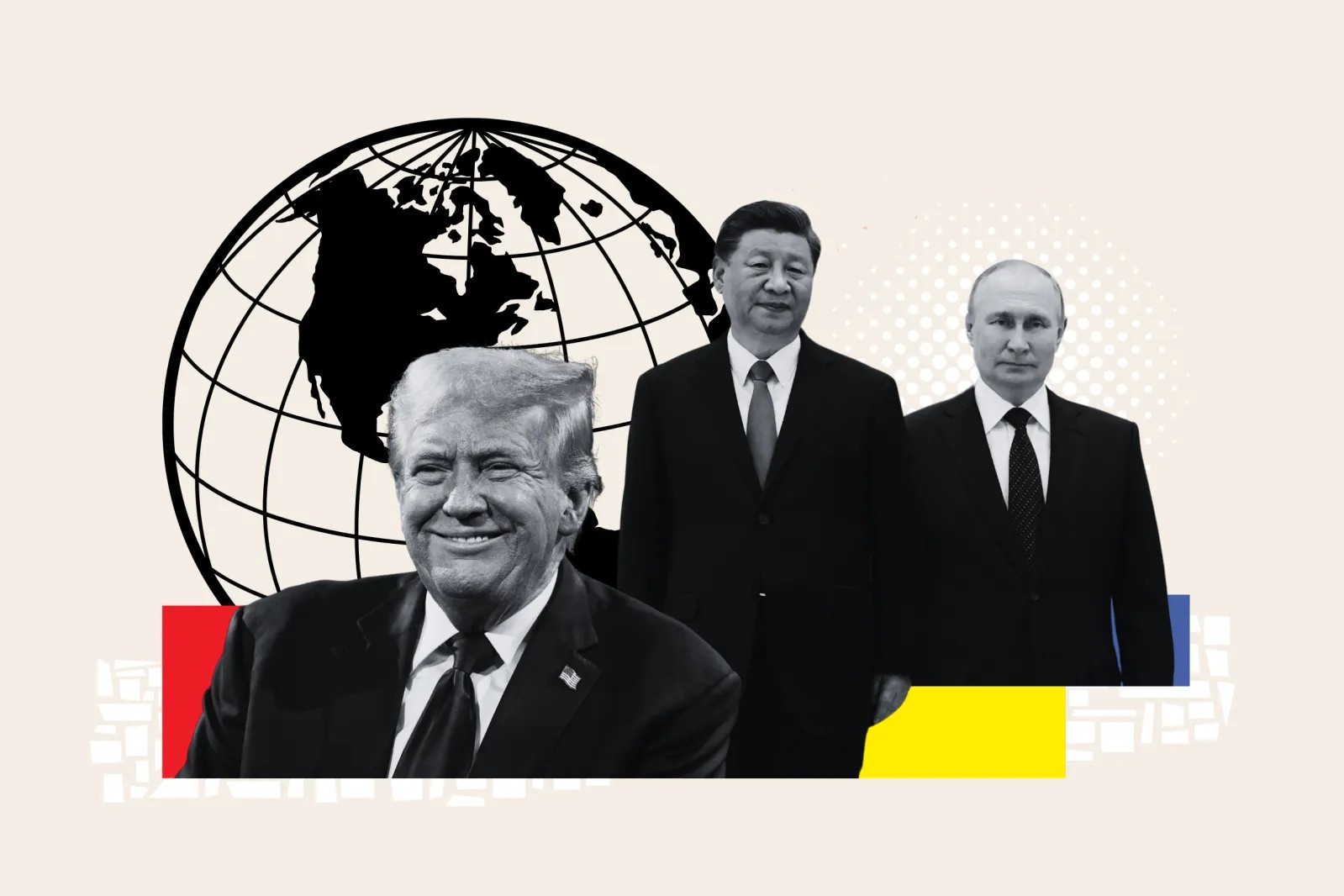
Under President Donald Trump, the US regards India’s ascent with concern. Moreover, Washington believes a thaw between India and China could create a powerful axis against the US-led West. That axis is currently fragmented. One half is centred around China, Russia, North Korea and Iran—all irredeemably hostile to the West.

The other half comprises powers of the Global South led by India, Brazil and others. If these two halves come together on a common platform, the US-led West could for the first time in two centuries face a credible threat to its global hegemony.

The only international platform that can grow into a unified non-Western axis is BRICS. India is currently the group’s annual rotating head. Foreign ministers from BRICS nations are scheduled to meet in Delhi in May. India will host the BRICS heads of government summit in Delhi in October. Chinese President Xi Jinping and Russian President Vladimir Putin are scheduled to attend.

BRICS has now expanded to 11 member-nations. They include the UAE, Saudi Arabia, Indonesia, Iran and Egypt, all key players in the unfolding world order.

As a Great Power in transition, India must ignore the advice Deng gave China in 1980: “Hide your strength, bide your time.” For India, the time to hide its strength has long gone. It has historically punched below its geopolitical weight. That era is over.

India must now move from a policy of strategic autonomy to strategic assertiveness. Autonomy is the passive language of non-alignment. It is mistaken by other powers as India’s unwillingness to take sides, take risks, and impose its strategic thinking on others.

For an economy which, as IMF data points out, contributes 17 per cent to annual global growth, second only to China (26.60 per cent) and far more than the US (9.90 per cent), passive neutrality is not the quickest path to Great Power status.

China transitioned from a Middle Power in 2000 to a Great Power in 2020 by being geopolitically assertive. As a noisy, fractious democracy, India’s path is not as smooth as Communist China’s. But in the long run, the advantages of democracy and freedom will always score over communism and dictatorship.

The seeds of China’s demographic downfall were sown in the 1970s when it enforced forcible birth control and a one-child policy. India tried to do the same during the 1975-77 Emergency with forcible sterilisation. Communism allowed China to enforce the policy. India’s democracy did not: forced sterilisation ended with the revocation of the Emergency and the 1977 general election.

The outcome: China’s population is in free fall. Workforce productivity, despite AI automation, is slowing. The UN projects China’s population will halve to 733 million in 2100. India’s population in contrast will plateau at 1.5 billion through to the end of the 21st century, giving it the tools to become the world’s largest economy (PPP) by 2055.

But the transition to a Great Power needs more governance and less bureaucracy, more reforms and less regulation, more assertive engagement with the rest of the world and less passive neutrality.

The tools are in place. Washington and Beijing may feign disinterest but they are watching carefully. Neither welcomes India’s ascent and will do what they can to stall it till, like China, India becomes too big to stall. – Firstpost, 21 April 2026

› Minhaz Merchant is an editor, author and publisher.

PM Modi with BRICS foreign ministers (2026).

The Sati Strategy – Koenraad Elst

Sati

The missionary assault on Hinduism dramatized the practice of Sati, which had been “an ‘exceptional act’ performed by a minuscule number of Hindu widows over the centuries”, of which the occurrence had been “exaggerated in the nineteenth century by Evangelicals and Baptist missionaries eager to christianize and anglicize India”. – Dr. Koenraad Elst

The missionaries are responsible for associating Hinduism with Sati much more prominently than would be fair. The missionary assault on Hinduism dramatized the practice of Sati, which had been “an ‘exceptional act’ performed by a minuscule number of Hindu widows over the centuries, of which the occurrence had been “exaggerated in the nineteenth century by Evangelicals and Baptist missionaries eager to christianize and anglicize India”. – Dr. Koenraad  Elst

Meenakshi Jain’s book ‘Sati’

After making history with her book on the Ayodhya controversy, Rama and Ayodhya (2013), Prof. Meenakshi Jain adds to her reputation with the present hefty volume Sati: Evangelicals, Baptist Missionaries, and the Changing Colonial Discourse (Aryan Books International, Delhi 2016). In it, as a meticulous professional historian, she quotes all the relevant sources, with descriptions of Sati from the ancient through the medieval to the modern period. She adds the full text of the relevant British and Republican laws and of Lord William Bentinck’s Minute on Sati (1829), that led to the prohibition on Sati. This book makes the whole array of primary sources readily accessible, so from now on, it will be an indispensable reference for all debates on Sati.

But in the design of the book, all this material is instrumental in studying the uses made of Sati in the colonial period. In particular, the missionary campaign to rally support for the project of mass conversion of the Indian heathens to the saving light of Christianity made good use of Sati. This practice had a strong in-your-face shock value and could perfectly illustrate the barbarity of Hinduism.

Indignation

In the preface, Prof. Jain surveys the existing literature and expresses her assent to some recent theories. Thus, Rahul Sapra found that Gayatri Spivak’s observations, e.g. that the 19th-century British tried to remake Indian society in their own image and used Sati as the most vivid proof of the need for this radical remaking, don’t take into account the changing political equation during the centuries of gradual European penetration. In the 17th century, European traders and travellers mostly joined the natives in glorifying the women committing Sati, whereas by the 19th century, they posed as chivalrous saviours of the victimized native women from the cruel native men. This was because they were no longer travellers in an exotic country and at the mercy of the native people, but had become masters of the land and gotten imbued with a sense of superiority.

Indians in large numbers, and especially the many indefatigable but amateurish “history rewriters”, tend to be defective in their sense of history, starting with their seeming ignorance about the otherwise very common phenomenon of change. When I hear these history rewriters fulminate against the West with its supposed evil designs of somehow dominating India again, it seems that in their minds, time has frozen in the Victorian age. Similarly here, there is not one monolithic Western view of Sati but, apart even from individual differences of opinion, there are distinct stages, partly because of the changing power equation and partly because internal changes in the Western outlook have influenced the Western perception of things Indian. So it takes a genuine historian to map out precisely what has changed and what not, and which factors have effected those particular changes.

Then again, It is of course interesting to realize the continuity between the present-day interference in Indian culture by Leftist scholars like Wendy Doniger and Sheldon Pollock and that of the British colonialists: “We know best what is wrong with your traditions and we come to save you from yourselves.”

In this respect, the changes in the Western attitude to Sati run parallel to that regarding caste. Until the early 20th century, caste was seen as a specifically Indian form of a universal phenomenon, viz. social inequality. Nobody was particularly scandalized when in 1622, the Pope gave permission to practise caste discrimination between converts inside the Church. Around the time of the French Revolution, the idea of equality started catching on, but only gradually became the accepted norm. At that point, it became problematic that people’s status was said to be determined by birth. In this case, determination by the inborn circumstance of being a woman, unequal in rights compared to men, and never more radically unequal than in committing Sati. After World War II the norm (henceforth called Human Rights) of absolute equality and increasingly of absolute individual self-determination made the tradition of caste and of Sati too horrible to tolerate. Therefore, the indignation about Sati is far greater today than when Marco Polo visited India. Today, Sati is already a memory, but the commotion around the exceptional Sati of 1987 gave an idea of the indignation it would provoke today.

Evangelization

In this case, an extra factor came into play to effect a change in British attitudes to Sati. In Parliamentary debates about the East India Company Charter in 1793, there was no mention yet of Sati though it had been described many times, including by Company eyewitnesses. But by 1829, Sati was forbidden in all Company domains. This turn-around was the result of a campaign by the missionary lobby.

Ever since the missionaries set out to convert the Pagans of India, they made it their business to contrast the benignity of Christianity with the demeaning atrocities of heathenism. This was an old tradition starting with the Biblical vilification of child sacrifice to the god Moloch by the Canaanites. The practice was also attested by the Romans when they besieged the Canaanite (Phoenician) colony of Carthage. The Bible writers and their missionary acolytes present child sacrifice as a necessary component of polytheism, from which monotheism came to save humanity. And indeed, we read here how Rev. William Carey tried to muster evidence of child sacrifice too—but settled for Sati as convincing enough.

In reality, the abolition of human sacrifice was a universal evolution equally affecting Pagan cultures such as the Romans. In the case of Brahmanism, it is speculated that the Vastu Purusha concept (a human frame deemed to underlie a house) is a memory of a pre-Vedic human sacrifice. Even if true, fact is that in really existing Brahmanism, human sacrifice has not been part of it for thousands of years; if it had, we would be reminded of it every day. In this respect, Brahmanism was definitely ahead of the rest of humanity.

Not to idealize matters, we have to admit that, like the Biblical writers, who used the vilification of the child-sacrificing Canaanites as a justification to seize their land (and even to kill them all), Pagans who had left the practice behind equally used the reference to it to score political points. The Romans had practised human sacrifice within living memory and then abolished it, so they were acutely aware of it and tried to exorcise it from their own historical identity by rooting it out in conquered lands as well. (This is the same psychology as among modern Westerners who remember their grandfathers’ abolition of slavery and therefore feel spurred to support or engineer the “abolition of caste” in India.) Using that mentality, Roman war leaders would emphasize this phenomenon of child sacrifice among the Carthaginians to portray them as barbarians in urgent need of Rome’s civilizing intervention. Later Caesar would also demonize as human-sacrificers the Druids of Gaul, another “barbarian” country the Romans “liberated” from its own traditions after conquering it. Likewise, the Chinese Zhou dynasty justified its coup d’état (11th century BCE) against the Shang dynasty by demonizing the Shang as practising human sacrifice.

This way, Sati came in very handy to justify an offensive in India. Mind you, in a military sense India had partly been conquered already, and British self-confidence at the time was such that the complete subjugation of the subcontinent seemed assured. The offensive in this case was not military, its target was the christianization of the East India Company, to be followed by the conversion of its subject population. Around 1800, the Company was still purely commercial and even banned missionaries: their religious zeal might create riots, and these would be bad for business. So, the Christian lobby had to convince the British parliamentarians that the christianization of India was good and necessary, and therefore worthy of the Company’s active or passive support, namely to free the natives from barbarism. To that end, there was no better eye-catcher than Sati.         

Here I will skip a large part of Prof. Jain’s research, namely into the details of the specific intrigues and events that ultimately led to the success of the missionary effort. While these chapters are important for understanding the Christian presence in India, and while I recommend you read them, I have decided for myself to limit my attention for colonial history as it is presently eating up too much energy, especially of the Hindus. The study of colonial history is instructive and someone should do it, but for the many, it is far more useful to study Dharma itself, to immerse yourself in Hindu civilization as it took shape, rather than in the oppression of and then the resistance by the Hindus. India is free now and could reinvigorate Dharmic civilization, which is a much worthier goal than to re-live the comparatively few centuries of oppression.

Let us only note that the missionaries are responsible for associating Hinduism with Sati much more prominently than would be fair. The missionary assault on Hinduism dramatized the practice of Sati, which had been “an ‘exceptional act’ performed by a minuscule number of Hindu widows over the centuries”, of which the occurrence had been “exaggerated in the nineteenth century by Evangelicals and Baptist missionaries eager to christianize and anglicize India”. 

Krishna’s wives 

Many Hindus believe that Sati is an external contribution, probably triggered by the Muslim conquests. In reality, Sati is as old as scriptural Hinduism. Already the Rg Veda (10:18:7-8, quoted and discussed on p. 4–5) describes a funeral where the widow is lying down beside her husband on the pyre, but is led away from it, back to the world of the living. So it already provides a description of a Sati about to take place, as well as of the Brahmanical rejection of Sati.

Likewise, the Mahabharata, the best guide to living Hinduism, features several cases of Sati. Most prominent is the self-immolation by Pandu’s most beloved wife Madri. Less well-known perhaps is that Krishna’s father Vasudeva is followed on the pyre by four wives, and that Krishna’s death triggers the self-immolation—in his absence—of five of his many wives. But unlike Mohammed, Krishna need not be emulated by his followers. By contrast, Rama’s influence on the women in his life is not such that they commit Sati—on the contrary, his wife Sita comes unscathed out of the flames of her “trial by fire”—and he counts as the perfect man, the model whose behaviour should serve us as exemplary.  

The oldest foreign (viz. Greek) testimony on Indian Sati reports on the death of an Indian general in the Persian army. His two wives fought over the honour of climbing his funeral pyre. Both had a case: one was the eldest, the other was not pregnant—whereas the eldest was, and should not deprive the deceased man of his progeny. So the authorities had to intervene, and they ruled in favour of the younger wife. It should be repeated, for the sake of clarity, that “favour” here really means the honour of committing self-immolation, as emphatically desired by the young widow.

Indeed, a woman wanting to commit Sati needed some will-power, for Hindu society did not take this as a matter of course. A per the many testimonies, she usually had to overcome the dissuasion from her family and from worldly or priestly authorities. (But rather than leading her away in chains for her own good, as modern psychiatrists would do, they give her the decisive last word.) That is why the first British report on the practice spoke of “self-immolation of widows”. Contrary to allegations of “murderous patriarchy” by modern feminists—who hold the same ignorant prejudices about Hindu culture as the average foreign tourist—women themselves chose this spectacular fate.

Contrary to a common assumption, the practice was not confined to the Rajputs or to the martial castes in general, where passion and bravery were prized. Prominent Hindu rulers like Shivaji Bhonsle and Ranjit Singh were followed on their pyres by a big handful of wives and concubines. Among the lower castes, like among the Muslims, life usually resumed and a widow soon remarried, not to let any womb go to waste. But nevertheless, a British survey in Bengal found that no less than 51% of Sati women belonged to Shudra families. Among the other upper castes, and among the majority of women even in the martial castes, widows would be confined to a life of service and asceticism. But no matter how rare the actual practice of Sati, it remained a glamorous affair, honoured among the Hindu masses with commerorative stones (sati kal) and temples (sati sthal).

Hindu Sati?

Sati was not confined the Hindu civilization. It existed elsewhere, both in Indo-European and in other cultures. Rulers in ancient China or Egypt are sometimes found buried with a number of wives, concubines and servants. In pre-Christian Europe, the practice was related—directly, not inversely—to the status of women in society: not at all in Greece, where women were very subordinate, but quite frequently among the more autonomous Celtic women. Among the Germanic people, a famous case is that of Brunhilde and her maidservants following Siegfried into death. Yet Indian secularists preferentially depict Sati as one of the unique “evils of Hindu society”.

The only shortcoming is this wonderful book is not a mistake but a hiatus, less than a page long. One important point I would have liked to see discussed more thoroughly, is the question raised by Alaka Hejib and Katherine Young in their paper: “Sati, Widowhood and Yoga”. They see a ”hidden religious dimension: yoga; though neither the widow nor the Sati was conscious of the yogic dimension of her life”. Indeed, “the psychology of yoga was instilled, albeit inadvertently, in the traditional Hindu woman”. Well well, yoga as the most consciousness-oriented discipline in the world is imparted unconsciously: “instilled, albeit inadvertently”. Prof. Jain reports this hypothesis but does not comment on it. So I will.

Naive readers may not have noticed it yet, but here we are dealing with as instance of a widespread phenomenon: the crass manipulation of the term “Hindu”. Every missionary and every secularist does it all the time: calling a thing “Hindu” when it is considered bad, but something—really anything—else as soon as it is deemed good. Many Hindus even lap it up: it is “instilled, albeit inadvertently”.

Thus, whenever Westerners show an interest in yoga, the secularists and their Western allies hurry to assure us: “Yoga has nothing to do with Hinduism.” (It is like with Islam, but inversely, for whenever Muslims make negative-sounding headlines, we are immediately reassured that these crimes “have nothing to do with Islam”.) There may be books on “Jain mathematics”, but never about “Hindu mathematics”, for a good thing cannot be Hindu. If the topic cannot be avoided, you call it, say, “Keralite mathematics” or fashionably opine that it “must have been borrowed from Buddhism”. So, yoga cannot be Hindu when its merits are at issue. However, when it is presented as something funny, with asceticism and other nasty things, then it can be Hindu, and even used as middle term to equate something else—something nasty, of course, like Sati—with Hinduism. So: Sati is Hindu!

In this case, the poor hapless secularists are even right. Sometimes even a deplorable motive, like their single-minded hatred for Hinduism, makes men speak the truth: Sati is Hindu. Sati is not Brahmanical: the Rg Veda enjoins continuing life rather than committing Sati, and the Shastras either don’t mention it or prefer widowhood, for which they lay down demanding rules. Many of the testimonies cited here mention Brahmanical priests trying to dissuade the woman from Sati. Not Brahmanical, then, but nonetheless Hindu, a far broader concept. A Hindu means an “Indian Pagan”, as per the Muslim invaders who first introduced the term in India. And indeed, Sati has existed in many countries but certainly in India, and it is not of Christian or Islamic origin, so it may be called Pagan. And so can the rejection of Sati. See?

This, then, makes for half a page that I would have done differently. The rest of this book, 500-something pages, is designed to stand the test of time. It will survive the flames that tend to engulf its topic: the brave Sati.

› Prof. Meenakshi Jain is a political scientist and historian. She is an associate professor of history at Gargi College, affiliated to the University of Delhi. 

› Dr. Koenraad Elst is an Orientalist from Belgian who frequently visits India to lecture. He is a Voice of India author.

Sati stones at Mahasati in Chittor Fort at Chittorgarh.

The legal doctrine that ate India’s religious traditions – Yashowardhan Tiwari & Krithika Jamkhandi

Supreme Court of India

For seventy years, India’s courts have claimed the power to decide what counts as truly sacred. The theology behind that claim isn’t Hindu—it’s Protestant. – Yashowardhan Tiwari & Krithika Jamkhandi

In 1954, a dispute over a monastery in the coastal town of Udupi reached the Supreme Court of India. The state of Madras wanted its commissioner to take over the administration of Shirur Math, a centuries-old Hindu institution.

The math’s leadership resisted, arguing that the Constitution guaranteed religious denominations the right to manage their own affairs in matters of religion. The state countered with what must have seemed like a reasonable proposition: surely, not everything a religious institution does is actually religious. Some of it—the hiring, the money, the logistics—is secular, and secular activities are fair game for regulation.

Seven justices considered this argument. What they produced, in a judgment now cited in virtually every religion case in India, was something nobody had quite bargained for: a new constitutional test that would empower judges to determine which religious practices deserve protection and which do not. They called it the test of “essential religious practices.”

It was, by almost any measure, a catastrophe of interpretation. And its consequences are still unfolding.

The architecture of religious freedom in the Indian Constitution is, on paper, relatively straightforward. Article 25 guarantees individuals the right to freely profess, practise, and propagate religion—subject to public order, morality, and health.

Article 26 extends similar protections to religious denominations. Article 25(2)(a) carves out an exception: the state can regulate “economic, financial, political, or other secular” activities that may be associated with religious practice.

The framers of the Constitution understood something important about Indian life.

As B.R. Ambedkar told the Constituent Assembly in December 1948, religious conceptions in India “are so vast that they cover every aspect of life, from birth to death.” His proposed solution was to limit the definition of religion so that constitutional protection wouldn’t freeze all social reform.

The protection was meant for practices that were “essentially religious”—practices closer to the religious end of the spectrum, as opposed to the secular activities that might orbit around them.

This distinction—between practices that are essentially religious in character and those that are essentially secular despite being associated with religion—is what the constitutional text actually contemplates. It is a sorting exercise: is this practice more religious than secular, or vice versa?

But in the Shirur Mutt judgment, the Supreme Court performed a quiet sleight of hand. Instead of asking whether a practice was essentially religious in nature, it began asking whether a practice was essential to the religion. The difference sounds subtle but it s not.

The first question asks about the character of an activity. The second asks about its importance within a theological hierarchy—a hierarchy that judges, not practitioners, would now define.

The court did acknowledge the difficulty. “Where is the line to be drawn between what are matters of religion and what are not?” it asked, with admirable candour.

Then it drew the line anyway, declaring that what constitutes the essential part of a religion must be ascertained with reference to the doctrines of that religion itself.

The essentiality test was born, and with it, the implicit claim that courts could read scripture well enough to rank religious practices by importance.

Two days later, the same judge—Justice B.K. Mukherjea—authored the Ratilal Gandhi decision, citing Shirur Mutt as precedent. The doctrine was entrenched before anyone had time to object.

What followed over the next seven decades was an extraordinary expansion of judicial authority into sacred space.

Armed with the essential religious practices test, Indian courts began adjudicating questions that would make most theologians nervous:

• Is the practice of tandava dance essential to the Ananda Marga faith?

• Is the exclusion of women of menstruating age essential to worship at Sabarimala?

• Is cow slaughter incidental or central to Islamic observance during Eid?

The problem, as critics have pointed out with increasing force, is not just that judges lack theological training. It is that the test itself is structurally incoherent.

When the constitutionality of a religious practice is challenged, courts must first determine whether the practice is religious or secular in nature. If secular, the state can regulate it freely. If religious, the court must then determine whether it is essential to the religion.

If it is not essential, the state can regulate it anyway. Only if a practice clears both hurdles—genuinely religious and essential to the faith—does it receive constitutional protection. And even then, it can be struck down if it offends public order, morality, or health. In practice, this means the entire religious sphere lies open to state regulation.

The legal scholar Faizan Mustafa has argued that the doctrine effectively elevates the judiciary to the status of clergy. Writing at the turn of the millennium, the constitutional scholars Rajeev Dhawan and Fali Nariman offered a more vivid formulation: judges had assumed a theological authority greater than that of any high priest, maulvi, or dharmashastri. Few religious pontiffs, they noted, possess this kind of power.

The court’s preferred method of determining essentiality—examining scriptures and doctrines—compounds the problem. Indian religious life is staggeringly diverse, and much of it is rooted not in canonical texts but in oral traditions, local customs, and practices handed down across generations without anyone writing them down.

A doctrinal approach to essentiality privileges text-heavy, scriptural traditions and implicitly marginalises everything else. It is, in a sense, a test designed for religions that look like Christianity or Islam—faiths organised around a book—rather than for the sprawling, decentralised, often text-free practices that characterise much of Hindu, tribal, and folk religious life.

The scholarly case against the essential religious practices doctrine has grown formidable. Legal academics have attacked it from nearly every angle: it substitutes judicial judgment for religious conscience; it discriminates between practices without constitutional warrant; it rests on a misreading of the constitutional text.

One recent paper argued that the courts have been guilty of making ill-founded observations about the validity of religious practices, turning the constitutional question of “what is essentially religious” into the theological question of “what is essential in religion.”

The paper proposed that courts should instead focus solely on identifying what is secular—regulating only that—and leave the religious domain alone, subject to the narrow exceptions the Constitution already provides. The principle would be “limited state intervention but maximum protection.”

The constitutional lawyer Zaid Deva, writing in the Indian Constitutional Law Review, traced the doctrinal error to its source. The original mandate of Articles 25 and 26 was to protect essential and non-essential religious practices alike. What should have been a test to distinguish “essentially religious” activities from “essentially secular” ones became, through judicial alchemy, a test to rank practices within the religious sphere by their perceived theological importance.

Arpan Banerjee, writing in the HNLU Student Bar Journal, identified another dimension of the problem: the Constitution does not discriminate between religious practices based on their significance. It protects them all. The essential practices test introduces a hierarchy that the constitutional text explicitly declined to create.

And yet, for all its force, this body of criticism stops at a particular threshold. It questions the doctrine. It questions the court’s competence. It proposes alternative legal tests. What it does not question is the assumption beneath all of it: that within every religion, there exists a meaningful distinction between the sacred and the secular—and that this distinction can, in principle, be mapped.

This is where the story takes an unexpected turn. S.N. Balagangadhara, a philosopher of culture who spent four decades at the University of Ghent developing what he calls the “Comparative Science of Cultures,” has advanced a thesis that reframes the entire debate.

The secular-religious divide, he argues, is not a universal feature of human civilisation. It is a product of Christian history—specifically, of the centuries-long struggle between the Church and the Crown, the spiritual and the temporal, that defined European political life from late antiquity through the Reformation.

Within Christianity, the distinction between the sacred and the secular was always theologically loaded. Early Christianity imagined two realms—the spiritual, governed by the Church, and the temporal, governed by earthly rulers.

The relationship between these realms generated endless conflict: Who has authority over marriage? Over education? Over the moral formation of citizens?

The Protestant Reformation sharpened the divide further, insisting that nothing should stand between an individual and God, and pushed religion toward the private sphere.

The Enlightenment thinkers who followed secularised this Protestant story, recasting it in the language of universal political theory. What began as Christian theology became, through repetition and colonial export, the world’s default framework for thinking about the relationship between the state and the sacred.

Balagangadhara’s research traces how this framework universalised itself through two mechanisms. The first is straightforward conversion—the expansion of Christian communities across the globe. The second is subtler and, he argues, more consequential: the generation of secular variants of Christian theology that win adherents without anyone recognising the theology at work.

“De-Christianised Christianity,” he calls it—Christian doctrines that have spread far beyond the community of believers, dressed up in clothes that no longer look recognisably Christian.

The idea that the state must be separated from religion, on this account, is not a neutral discovery of political science. It is a theological doctrine of Protestant Christianity that has been secularised to the point of invisibility.

The implications for Indian constitutional law are profound. If the secular-religious divide is not a universal structural feature of all traditions but a specific product of the Christian intellectual inheritance, then the entire framework of Articles 25 and 26 rests on a borrowed assumption—an assumption that Indian traditions may not share.

The Constitution asks courts to distinguish between religious and secular practices within Hinduism, Sikhism, Jainism, and Buddhism. But these traditions may not contain the kind of internal sacred-secular boundary that the Constitution presupposes. The exercise is not merely difficult. It may be conceptually impossible.

This would explain why, after seven decades of trying, Indian courts have never produced a stable, coherent framework for making the distinction. It is not that the judges are insufficiently skilled. It is that they are searching for a boundary that does not exist—at least not in the form the Constitution imagines.

Balagangadhara’s thesis raises uncomfortable questions about the constitution-making process itself. Were the framers operating within what might fairly be called a colonial consciousness—accepting state neutrality toward religion as a universal political principle, when it was in fact a parochial one?

Did the experience of colonial modernity convince India’s founding generation that the secular-religious divide was a self-evident feature of all civilisations, rather than a specific inheritance of the Christian West?

These are not questions that courts can resolve. They belong to the domain of political philosophy, cultural anthropology, and honest historical reckoning.

But they cast the essential religious practices doctrine in a sharply different light. The doctrine is not merely a flawed legal test that can be repaired or replaced with a better one. It is the downstream consequence of a deeper conceptual error—the assumption that Indian religious life can be parsed through categories borrowed from a very different civilisational experience.

If this diagnosis is correct, the path forward is not simply a matter of the Supreme Court overruling one line of precedent. It demands a more fundamental conversation about the adequacy of the constitutional framework itself. Could a constitutional amendment reconceive the relationship between the state and India’s indigenous traditions? Would it survive judicial review under the basic structure doctrine? Would it fall foul of secularism—a principle that is itself, on Balagangadhara’s account, a secularised Christian theology?

The answers may not arrive soon, or cleanly. A nine-judge bench of the Supreme Court, constituted to reconsider the Sabarimala review, may offer an occasion to revisit the doctrine’s foundations—or it may simply sidestep them. The political incentives to leave it well enough alone are considerable.

But the intellectual case for the essential religious practices doctrine has collapsed. It rests on a misreading of the constitutional text, an impossible demand on judicial competence, a scriptural bias against India’s oral and customary traditions, and—most fundamentally—a borrowed theology that its practitioners do not recognise as theology at all.

The kindest thing the Supreme Court could do is grant the doctrine a quiet, dignified death, before it does any more damage to the traditions it was ostensibly designed to protect.

Here’s to hoping that the Sabarimala review bench engages with this pre-dated obituary of the essential religious practices doctrine, and that its judgment may serve as the official version  of it. – Swarajya, 11 April 2026

Yashowardhan Tiwari is a Program Manager in the Office of the Vice Chancellor at Rishihood University.

Krithika Jamkhandi is an Advocate practicing in Karnataka High Court.

Women protest the entrance of fertile women into Sabaraimala.

Red China pretends to be the world leader for Buddhism – Claude Arpi

Marxism vs Buddhism

Today, Beijing is using the same old propaganda to propagate another lie: that China is the leading Buddhist power in the world, conveniently forgetting that Tibetan Buddhism comes from Nalanda Mahavihara in Northern India. – Claude Arpi

Every year around the end of March, Beijing’s propaganda clamours that China “emancipated” Tibet and “liberated millions of serfs” after the Dalai Lama escaped to India in 1959 and his government was taken over by the Chinese Communist Party in Lhasa.

This year, China Tibet Online, an official website of the Communist Party of China, in the same vein, titled an article “Lamenting the Most Heinous Crimes Against Humanity”. It explained, “In days of old, the Land of Snows was a living hell; serfs shed blood and tears that soaked their very garments. Stripped of their skin and gouged of their eyes—they possessed no human rights; the cruel regime’s sins ran deep.”

It is not what outsiders—both Westerners and Indians—who visited the Land of Snows reported; on the contrary, the independent observers discovered that the Tibetan people were a happy lot, though there were undeniably differences between the aristocracy, the clergy and the common men.

But today China continues to say, “Democratic reform ushered in a new dawn; a million serfs rose to become the masters of their own destiny”, adding that the Dalai Lama “defected to serve as a foreign lackey—betraying his faith, sowing chaos in Tibet, and spurning the benevolence of the nation.”

The “foreign country” is presumably India, which has always honoured the Tibetan leader as a very special guest.

In fact, an impartial study of the history of modern Tibet shows quite the opposite picture; it is the ordinary men and women who revolted against the Chinese yoke, in particular in March 1959, when the entire population rose against the Chinese occupiers to protect the life of their revered leader and allow him to leave for India.

Today, Beijing is using the same old propaganda to propagate another lie: that China is the leading Buddhist power in the world, conveniently forgetting that Tibetan Buddhism comes from Nalanda Mahavihara in Northern India.

India has started countering this misinformation by, for example, organising the second Global Buddhist Summit at the Bharat Mandapam in New Delhi on January 24 and 25, 2026.

The two-day conference brought together more than 200 delegates, mostly Buddhist leaders, scholars, practitioners and policymakers, to discuss contemporary global challenges facing the planet.

Sinisation of Buddhism

Today Beijing would like the world to believe that Buddhism has for decades been a leading component of Chinese civilisation and that China should take the lead in the propagation of the teachings of the Great Monk, who more than 2,500 years ago wandered in the plains of North India, preaching compassion, mindfulness and interdependent arising.

Paradoxically, Beijing wants to teach Buddhism to Tibet!

In September 2025, a meeting was convened in Lhasa by Wang Junzheng, the secretary of the party committee of the Tibet  Autonomous Region (TAR), to address Communist officials dealing with “religion”.

Is it not surprising that a state supposedly following Karl Marx’s atheist precepts should deal with religion?

Wang insisted on the necessity “to earnestly study and implement General Secretary Xi Jinping’s important instructions on religious work and … systematically promote the Sinicisation of Tibetan Buddhism.”

The objective was to “lay a solid foundation for long-term peace and stability”. This means that to be stable, Tibet needs to be Buddhist, but with Chinese characteristics.

Wang mentioned Xi Jinping’s visit to Tibet in July 2025, during which the president gave “important instructions …to  emphasise Buddhism with the requirements to systematically promote the Sinicisation of China’s religion, strengthen the governance of religious affairs and the rule of law and guide Tibetan Buddhism to adapt to the socialist society.”

In other words, first Marx and then the Buddha.

On November 11, 2025, Wang Junzheng, again presiding over a symposium on religious legislation in Tibet, asked the participants to “solidly promote the construction of the Chinese national community, actively guide Tibetan Buddhism to adapt to the socialist society”.

Preaching Buddhism Outside China

On April 21, Massimo Introvigne wrote on Bitter Winter, a specialised website following development inside China: “Buddhist Friendship in Seoul to Advance Its Religious Policy Agenda”, explaining that a Communist Party of China-controlled delegation “promotes Beijing’s line while regional partners intensify pressure on the Unification Church, Shincheonji, and other groups labelled as cults.”

It cites the case of a delegation from the China Buddhist Association (CBA), led by vice president Zong Xing, who travelled to Seoul from March 30 to April 2 to attend the preparatory meeting for the 26th China-Korea-Japan Buddhist Friendship Exchange Conference.

Bitter Winter observed that Chinese media portrayed this visit as a continuation of the “golden bond” of trilateral Buddhist cooperation, an idea established in 1995 by senior monks from the three countries. Official reports described the gathering as a way to contribute to regional stability and world peace, using the familiar language that defines Chinese religious affairs propaganda.”

The China Buddhist Association (CBA) is not an independent religious group; in December 2022 the United States Commission on International Religious Freedom (USCIRF) noted that the CBA serves “as a tool of the Chinese Communist Party (CCP) to control Buddhism inside China and promote state narratives outside. USCIRF called the association a conduit and endorser of state propaganda”.

The Fate of Those Refusing to Follow the Party

On April 23, Amnesty International appealed to Chinese authorities, seeking information on the fate and whereabouts of a Tibetan religious leader and educator called Choktrul Dorje Ten Rinpoche from Chikdril County in the Golog Tibetan Autonomous Prefecture of Qinghai Province.

Rinpoche is a prominent religious and educational figure in the region; he founded a monastery and a vocational school supporting local Tibetan communities. He has been missing since December 2025. Thereafter, no information about his status, place of detention, or the charges could be obtained, though in January 2026, some individuals monitoring the case received informal indications suggesting that the Tibetan leader was ‘under investigation’.

According to Amnesty International, the prolonged incommunicado detention of religious figures “raises serious concerns under international human rights law. Such conditions, the group emphasised, place detainees at heightened risk of torture and other forms of ill-treatment.”

Take the case of another prominent Tibetan lama, Tulku Hungkar Dorje Rinpoche, who was arrested in Ho Chi Minh City, Vietnam, on March 25, 2025, through a joint operation by Vietnamese police and Chinese agents. Rinpoche died in custody four days later, and despite international concern over transnational human rights violations, nothing came out of the case.

The Lama, aged 56, was a respected Tibetan spiritual leader and head of the Lung Ngon monastery in Amdo (Qinghai province). He had to escape to Vietnam to escape persecution by Chinese authorities. He was arrested in a hotel in Ho Chi Minh City.

Such cases have been happening regularly.

China’s Political Influence

Politically China remains very influential. It managed to get the International Council for the Day of Vesak to endorse an appeal from the Buddhist Association of China to host the 21st UN Day of Vesak Celebrations in China in 2026. The 20th UN Day of Vesak was held in Ho Chi Minh City, Vietnam, from May 6 to 8, 2025, under the theme “Unity and Harmony for Human Dignity”, while the 19th UN Day of Vesak (2024) took place in Bangkok, Thailand, from May 19-20, 2024; the theme was “The Buddhist Way of Building Trust and Solidarity”.

This year it will be held in China. It is not being questioned.

A Positive Development in India

In this context, an extremely interesting development is the revival of Tibetan Buddhism in the Himalayan belt.

A conference on the contribution of Himalayan Buddhism to the spiritual and cultural heritage of India will be held in Leh, Ladakh, on May 3. According to the organisers: “Himalayan Buddhism is a distinct, esoteric form of Mahayana Buddhism practised across the Indian Himalayas as well as in Tibet, Bhutan and Nepal.” Himalayan Buddhism has indelibly shaped and contributed to the spiritual, cultural, and intellectual landscape of Asia by acting as a ‘living repository’ for ancient Indian traditions.”

A concept note added: “Centred on historic, high-altitude monasteries, this heritage features vibrant festivals, monastic education, and artistic traditions that promote peace, compassion, and harmony with nature.”

“A unique way of life that is practised daily” is what makes it different from Buddhism in China, which is mostly synonymous with repression and assimilation; the precepts of the Buddha are not practised in daily life.

The revival of the Buddha Dharma on the northern Indian borders also has a political message to China; where do you see stupas, prayer flags, and Om Mani Padme Hum stones in Tibet? No, only the red flag flies, even on the Potala Palace or in the Tsuglhakhang Central Cathedral in Lhasa. Isn’t it a sign? – Firstpost, 6 May 2026

Claude Arpi is Distinguished Fellow at the Centre of Excellence for Himalayan Studies, Shiv Nadar Institution of Eminence (Delhi), and writes on India, China, Tibet and Indo-French relations.

Jokhang Temple in Lhasa with China flag.

The Fallacy of Hope – Carlo Pizzati

Hope

Hope, in the end, is not liberation but one of its obstacles; the belief that tomorrow will redeem us, that history has a direction; that our suffering serves a purpose; that the arc of the universe bends towards anything at all. – Carlo Pizzati

Hopelessness exists only for those addicted to hope. If you avoid falling in the traps of hope, you will be safe from hopelessness. Then you will discover there can be serenity and even happiness. Without hope. Asian thought has preached this for centuries, yet, lately, some Asian thinkers seem to forget this important lesson. They seem to stumble more and more often on the allure of hope, which is also the typical feeling that can emerge when a year ends and a new one begins, and we feel compelled to hope for a better one.

However, even some European thinkers have long been aware of the dangers of a path strewn with the blossoms of hope. When asked why he had declared that as you age you become more cheerful, Italian poet and intellectual Pier Paolo Pasolini answered: “Because when you have less of a future, you have less hope, and this gives you great relief.”

Hope is not universal. It’s a strongly Western construct, rooted in a prevail­ing branch of Christian theology and on the Enlightenment’s faith in progress.

To embrace hope as a moral obliga­tion is to remain captive to frameworks that mistake their own psychological architecture for human nature.

The true heroic act is the non-hopeful, clear-eyed confrontation with the pres­ent, rather than the hopeful quest for an imagined future victory.

Hope, as the West understands it, de­scends from Christian eschatology. It’s the promise of salvation, the kingdom to come, the resurrection that redeems all suffering.

In Christianity, hope has become a value that is not merely permitted but commanded. It’s the theological virtue that bridges the chasm between a fallen present and a perfected future. Saint Paul wrote that “hope does not disappoint,” binding the faithful to what is not yet, tied to a tomorrow that justifies today’s pain.

This Christian temporality, or the con­stant deferral of fulfilment, permeates sec­ular Western thought with the persistence of a genetic code. Enlightenment philoso­phies of progress, Hegelian dialectics, Marxist visions of historical materialism, even liberal dreams of expanding rights and freedoms: these are all structured by hope, by the conviction that history moves towards something better, that our striv­ing will be rewarded in time.

Yet for much of the world’s philo­sophical traditions, hope is not a virtue but a trap, not a solution but the prob­lem itself. In Buddhism, hope—asa—is a form of tanha, the craving or thirst that generates suffering. The Second Noble Truth teaches that suffering arises from desire, from our insistence that reality should be other than it is.

Hope is simply desire projected into the future. It’s the refusal to accept the present moment in its fullness and its pain. The Buddhist path does not run through hope but through its dissolu­tion. Liberation, nirvana, comes not from hoping for a better future but from extin­guishing the very mechanism of craving that makes hope possible. The Dham­mapada states: “Those who are free from selfish attachments, who have mastered their senses and passions, enjoy peace.” This peace is fundamentally incompat­ible with hope, which always involves attachment to what is not yet, to what may never be.

Daoist philosophy offers a parallel in­sight, though in a different key. The Da­odejing teaches wu wei, effortless action, the art of responding to circumstances without imposing desires upon them. To hope is to assert the ego’s will against the flow of dao, to demand that reality conform to our expectations rather than dancing with what is.

Zhuangzi wrote of the sage who “roams freely” precisely because he has no fixed outcomes in mind, no hopes to defend or mourn. Freedom, in this view, is not found through hoping for change but through releasing the need for any particular change to occur.

In Vedantic philosophy, hope is part of the illusion of maya, the veil that keeps us from recognising the eternal present of brahman. So long as we hope, we are locked in the world of becoming, blind to the truth of being. Nisargadatta Maharaj taught: “Wisdom lies in never forgetting the Self as the ever-present Source of both the experiencer and his experience.” To hope is to forget this, to imagine that ful­filment lies somewhere other than here, sometime other than now.

When we hope, we project ourselves out of the present and into an imagined future. We do not inhabit what is; we dwell in what we wish will be. Consider the mechanics: I love you, but you want to return to your ex. I hope you’ll come back to me. This hope is not love; it is suffering disguised as love, desire masquerading as devotion

These are not nihilistic philosophies, despite how they may sound to Western ears trained to hear any critique of hope as some form of depressing and fatalistic de­spair. Rather, they describe a different re­lationship to action and to the world: one that does not require the fiction of hope to sustain ethical life. They propose that we can act, create, resist, and love without the crutch of believing things will improve, without the narcotic of imagining our­selves on the right side of history.

Hope operates through temporal displacement, and this is its fundamen­tal violence. When we hope, we project ourselves out of the present and into an imagined future. We do not inhabit what is; we dwell in what we wish will be. Consider the mechanics: I love you, but you want to return to your ex. I hope you’ll come back to me. This hope is not love; it is suffering disguised as love, desire masquerading as devotion. I lack what I desire, and in my imagination, I possess what I might gain.

Hope keeps me suspended in this lack, unable to accept the present real­ity, unable to live without the fantasy of fulfilment. People who hope are never where they are; they are always some­where else, in a future that doesn’t exist, nursing a possibility that may be noth­ing more than self-deception.

This is how hope always functions, in love and in politics, in personal life and in collective struggle. It trains us to wait rather than to act, to defer rather than to engage. In hoping, we exchange the challenging work of presence for the seductive comfort of fantasy.

Hope is sort of a spiritual credit card: we purchase emotional comfort now by mortgaging the present to an imagined future, ac­cumulating a debt that can never be repaid because the future never actually arrives. It is always coming, always just beyond reach, always justifying today’s inaction or today’s endurance of the unendurable.

Hope is a concept which has been misconstrued within Christian theol­ogy as well. In the Bible, Jesus Christ often speaks of faith and love, but he is never recorded as having pronounced the word ‘hope’.

One could argue that hope actually undermines the acceptance dictated by faith in the divine. Ital­ian poet Dante Alighieri understood something that modernity has forgot­ten, something that sits uncomfortably with our compulsory optimism. In Paradise in the Divine Comedy the blessed do not hope. They contemplate the present beauty of God without reference to past regret or future longing. They are be­atified not because they hope for some­thing beyond themselves but because they are fully rooted in the now.

We can act because the action itself is right, because it expresses our values in this moment, because it is the response that the present demands according to our set of values, not because we hope it will produce a particular future. This is the difference between hope-driven action and what might be called present action.

Beatitude does not come through hope but through its transcendence, through the capacity to notice, accept, and celebrate what is, even when what is includes pain. The blessed have moved beyond hoping because they have dis­covered something hope always ob­scures: the sufficiency of the present moment.

Similarly, in the Bhagavad Gita, Krishna doesn’t tell Arjuna to “hope for the best.” He tells him to act without attachment to outcomes, nishkama karma. Devotional traditions like Bhakti allow hope in di­vine grace, but the ideal is surrender, not at all the anx­ious expectations feeding Western neurosis. Hindu texts like the Vivekachuda­mani suggest that the pin­nacle of spiritual existence is to be “perfectly hopeless”, without expectation for a separate, eternal life in the material sense. It is not despair, but a state of complete detachment, vairagya, and self-sufficiency, where one is not bound by the anxiety of what the future may bring.

Even in circumstances of great suffer­ing, perhaps especially then, it remains possible to act without hope. When the present is agonising, when injustice seems insurmountable, we can still respond. But our response need not be grounded in the belief that things will improve, that history bends towards justice, that our efforts will be rewarded. This is the great lie that hope tells: that action requires the promise of success, that resistance needs the guarantee of victory, that we cannot stand for justice unless we believe justice will prevail.

We can act because the action itself is right, because it expresses our values in this moment, because it is the response that the present demands according to our set of values, not because we hope it will produce a particular future.

This is the difference between hope-driven action and what might be called present action: the former is always held hostage by outcomes, always vulnerable to despair when things don’t improve; the latter is free, autonomous, complete in itself. The lover who can remain pres­ent without hoping for reciprocation is blessed. The activist who can resist op­pression without hoping for victory is free. The artist who can create without hoping for recognition inhabits a dif­ferent quality of life. These are not ex­amples of resignation or passivity. They describe a more radical engagement with reality, one that does not require the crutch of hope to justify itself, one that finds its meaning in the act rather than in the outcome.

What would it mean to resist with­out hoping? To create without the prom­ise of success? To act justly without the consolation that justice will prevail? It would mean confronting the present in its full reality, without the analgesic of future redemption. It would mean rec­ognising that the anguish we feel when watching images from Gaza, witness­ing the failures of institutions, living through the collapse of old certainties is itself the truth we must inhabit, not a problem that hope will solve.

The anguish is the message. The hor­ror is the reality. And no amount of hop­ing will change this; hope only distances us from what is actually happening, allows us to look away by focusing on what might be.

This is harder than hoping. Although when our perception of reality is filled with anxieties this seems counterin­tuitive, in reality hope is easy, because it allows us to look away from what is by focusing on what might be. Presence is difficult; it requires us to bear what we see, to act without guarantee, to love without possession, to resist without the promise of victory. Hope offers comfort; presence offers only clarity. But only in this difficulty does freedom lie. Only by abandoning hope can we discover what Zhuangzi called “free and easy wander­ing,” what the Buddha called “the extinc­tion of craving,” what Dante glimpsed in his vision of Paradise: a life no longer en­slaved by the future, no longer torment­ed by the not-yet, no longer dependent on outcomes we cannot control.

Hope, in the end, is not liberation but one of its obstacles; the belief that tomorrow will redeem us, that history has a direction; that our suffering serves a purpose; that the arc of the universe bends towards anything at all. The truly radical gesture is to set hope aside. To act justly because justice is right, not because we believe it will triumph. To create beauty because beauty is its own justification, not because we hope it will change the world. To resist oppres­sion because resistance expresses our humanity, not because we trust it will succeed. To love because love is what we choose to do, not because we hope to be loved in return. – Open, 25 December 2025

Carlo Pizzati is an award-winning multilingual author and journalist who has lived in India since 2010, currently residing in the fishing village of Paramankeni with his wife, author Tishani Doshi. He currently works as a political analyst and editorialist for La Stampa and contributes to The Hindu and Open.

Buddha Quote

Jana Gana Mana: How a British lie became India’s most persistent myth – S. Bhattacharya

Rabindranath Tagore (1861–1941)

Jana Gana Mana was neither written for King George V nor sung in his honour. The misconception arose in the overlap between the Congress leadership’s eagerness to ingratiate themselves with the visiting monarch and the British propaganda apparatus, always poised to exploit an opportunity. – Samik Bhattacharya

Even today, many still fall for the British-spawned myth about Jana Gana Mana, a song that was always an ode to India’s soul. How did such a distortion come into being? It arose from the convergence of two forces: the Congress leadership’s eagerness to ingratiate themselves with the Emperor, and the calculated manoeuvring of the British propaganda apparatus. At the time, several Congress leaders wished that Rabindranath Tagore compose a song in honour of King George V, to be performed at the Congress session.

In the ceaseless churn of falsehood, even gods may fall from grace, so goes the old saying. But fewer know that, in a similar vortex of falsehood, Rabindranath Tagore himself was once cast as a “British loyalist.” The irony is that the old Congress ought to have known better, for it was their silent complicity that allowed the British press to malign Tagore so effectively. One hundred and fourteen years have passed, and yet that slander still drifts through our collective memory as a stubborn myth. Many continue to be ensnared by it; a Member of Parliament was its most recent victim. But the BJP, as a party, has never endorsed the notion that Tagore composed Jana Gana Mana Adhinayaka Jaya Hey in praise of King George V.

The year was 1911. From 26 to 28 December, the Indian National Congress held its session in Calcutta. It was there that Jana Gana Mana was first sung publicly. On the morning of 27 December, accompanied by Dinendranath Tagore’s musical arrangement and performed by a chorus of young boys and girls, the song resonated through the Congress pavilion.

It is true that King George V was visiting India at that time. But the song was neither written for him nor sung in his honour. How, then, did this misconception arise? It germinated in the overlap between the Congress leadership’s eagerness to ingratiate themselves with the monarch and the British propaganda apparatus, always poised to exploit an opportunity.

Many Congress leaders, wishing to please the Emperor, wanted Rabindranath to write a song honouring George V for the Congress session. This proposal reached Tagore through the barrister and Congress leader Ashutosh Chaudhuri. He was annoyed and indeed disappointed. He had no objection to writing a song for the Congress session, but to write one in praise of George V, he flatly refused.

And so, two songs were sung that day: in the morning, Tagore’s Jana Gana Mana Adhinayaka Jaya Hey; in the evening, Badshah Hamara, composed by Rambhaja Dutta Chowdhuri. A glance at their language makes it immediately clear which song lauded the Emperor and which did not.

Rambhaja Dutta Chowdhuri, a Congress leader from Punjab, happened to be Tagore’s nephew-in-law, married to Sarala Devi Chaudhurani. Since Tagore would not grant the request routed through Ashutosh Chaudhuri, another Congress leader within the extended family took up the task and composed a loyal hymn for the British “Badshah.”

If this is what truly occurred, how then did the contrary myth take root? It was, quite simply, a British stratagem. The morning after Jana Gana Mana was sung at the Congress session, three English newspapers—including The Statesman and The Englishman—published identical claims that Tagore had written the song in honour of King George V. All three were faithful mouthpieces of the colonial regime. Their synchronised reports forged a falsehood that, over time, solidified into “truth.” Thus, an empty fiction grew into a vast national myth, still alive in our discourse today. Even in independent India, several eminent figures repeated this error, unaware that they were only echoing a lie crafted by the British.

Tagore himself attempted more than once to correct the distortion. On 20 November 1937, in Bichitra, and again on 29 March 1939, in Purbasha, he wrote with a mixture of pain and indignation, compelled to dismantle the persistent falsehood. He confessed that he felt insulted by such wilful misinterpretation. “I did not write this song for any George the Fifth or George the Sixth,” he stated unequivocally. The song, he clarified, was dedicated to those eternal, illumined spirits who had guided India since the dawn of civilisation. Yet, despite his own testimony, the slander survived.

In the 1990s, I myself intervened to save a political colleague from repeating the same old error. I was then active in the youth wing of the party. At a national event, I heard someone invoke the fable linking Jana Gana Mana to George V’s visit to India. I corrected him on the spot. L.K. Advani was present on that very stage. Yet even today, some continue to perpetuate the mistake.

A carefully researched essay by MP Sukhendu Sekhar Roy also sets forth the true facts. The piece rests on firm documentary evidence. Another work, Jatiyo Sangeet-er Utso Sondhane, sheds further light on the matter. Anyone in doubt may consult these sources.

Let me restate the essence plainly. On the evening of 27 December 1911, Badshah Humara was sung at the Congress session in honour of King George V. But that morning, Jana Gana Mana, sung at the very same venue, had no connection whatsoever to the Emperor. Just as the “Aryan invasion theory” is an unverified myth, so too is the claim that Tagore composed his song for George V. Many remain afflicted by this myth. But as a party, we do not endorse it; it has never been our agenda.

And to those now raising a hue and cry over the personal opinion of one BJP MP, do they remember what their own party once did to Tagore after the Jallianwala Bagh massacre?

When news of the atrocity reached him, Tagore wished to travel to Punjab with Mohandas Gandhi. He sent a messenger, but Gandhi did not respond. Tagore then urged Chittaranjan Das to organise a protest meeting in Kolkata. Chittaranjan Das asked whether Tagore would preside. Tagore agreed. Later, he was asked whether he would deliver the principal address. He agreed again. Then Chittaranjan Das suggested that Tagore himself should organise the meeting. Irritated and disillusioned, Tagore ceased further communication with the Congress leaders. Instead, he renounced his knighthood, turning his protest into a thunderous moral gesture that echoed across the world. – News18, 5 December 2026

Samik Bhattacharya is the BJP WB President and Rajya Sabha MP.

Tagore's translation of "Jana Gana Mana" on 28 February 1919, at the Besant Theosophical College.

The Issue of Conversion: Challenges before Hindu Society – Maria Wirth

Christian priests in saffron cloth and rudraksha malas.

Is it possible that the government does not want to know what is happening on the religious front? … When there is no will to know what is happening regarding conversions, there is probably also no will to stop it. The government, rightfully, maintains that it is secular and not concerned about the religion of its subjects. – Maria Wirth

Abstract

This article examines the aggressive proselytization targeting Hindus in India, exposing the socio-political and cultural ramifications of conversions to Abrahamic religions. It highlights the lack of reliable data on conversions, despite documented cases of fraudulent tactics, including financial incentives, “miracle cures,” and exploitation of vulnerable communities. The author contrasts Hinduism—an inclusive, philosophy-based tradition emphasizing dharma (righteousness) and universal spiritual truth—with the exclusive, dogmatic nature of Christianity and Islam, which claim sole religious legitimacy and threaten non-believers with eternal damnation. The article wonders why the secular Indian government is enabling religious inequalities, such as preferential treatment for “minority” religions and the marginalization of Hindu institutions. It is argued that conversions fracture social harmony, empower divisive forces, and erode India’s spiritual heritage. She calls for educating Hindus about their profound philosophical roots (e.g., Advaita Vedanta), challenging irrational dogmas of Christianity and Islam through rational discourse, and stopping unequal religious policies by the state. Ultimately, Wirth frames the preservation of Hinduism as essential not only for India’s cultural integrity but also for humanity as a whole. The Vedic knowledge that God is within as blissful consciousness (sat-chit-ananda) is lacking in the Abrahamic religions.

Text

Conversion is a big challenge for Hindu society in India. Yet it is hardly a topic of public debate. Moreover, it is impossible to get accurate data of conversions. In fact, even the data regarding the composition of the population religion wise, may not be reliable.

In 1947, India’s population was around 36.1 crores, of whom 30.37 crores (84.1%) were Hindus, 3.54 crore (9.8%) were Muslims, 0.83 crore (2.3%) were Christians and 0.27 crores (0.7%) Buddhists (the figures are based on the census of 1951).
In the 2011 census, the Hindu population had shrunk by 4.3 percent and the Muslim population had grown by 4.4 percent. The overall population had tripled to 121.9 crores. Hindus accounted for 96.62 crore (79.8%), Muslims for 17.22 crore (14.23%), Christians for 2.78 crores (2.3%) and Buddhists for 0.84 crore (0.7%).

The census of 2021 was postponed due to the Covid pandemic and will be held only in 2026/27. It can be assumed that since 2011, the Hindu population has shrunk further, yet the population of Muslims is still cited to be 14 percent and that of Christians still 2 percent. Do we bury our heads ostrich-like in the sand?

According to the website censusofindia.net, in 2025, the overall population is estimated at 141 crores, of whom 114 crores are expected to be Hindus. This would be a slight increase of Hindus to 80 percent, which is unlikely considering the massive conversion attempts, apart from the lower Hindu birthrate. Unfortunately, I could not find official numbers for conversions. ChatGPT says: “I could not find any official government estimate that gives a precise number of Hindus who have converted to Christianity since 2011. In fact, the Government of India has explicitly said that no central record/database of religious conversion is maintained.”

The same is valid for Islam: “There is no reliable official data specifying how many Hindus have converted to Islam in India since 2011.” ChatGPT continued, “Most demographic surveys, including those by Pew Research Center, find that religious switching is very rare overall.” According to Pew research survey of 2021, 0.7 percent of the respondents said that they have changed their religion. This would come to around 6 million people. Yet since there is no central database of religious conversion, the true numbers are anybody’s guess.

Aggressive conversions are happening

Most of us know even from personal observation, that missionary activity is extremely high in India by both Christianity and Islam, especially in certain states like Punjab or Tamil Nadu, and basically everywhere, specifically in tribal areas. They don’t hide it. Christian publications exhort their members to convert Hindus. “India must be evangelised in this generation”, declared Blessings, a Christian youth magazine in its 2008 issue, which a priest from Tamil Nadu had left with me. And a German Catholic magazine, which landed in my mother’s mailbox, had an article with the ominous title, “India – a success story”.

The Joshua Project is clearly implemented. New churches shoot up, Christian schools offer discount for fees for Christians, missionaries ‘visit’ patients in hospitals, etc. Occasionally, news about conversions come out in the media due to complaints by Hindus. Some examples from only one week:

On 30. September 2025, several news outlets reported that over 1000 Hindus from poor and backward castes converted to Christianity in Lucknow’s Mohanlalganj. A village once free of Christianity had now 5 churches and100 plus prayer halls. According to India Today, police unearthed a well-oiled nexus to lure Dalits with the help of ‘miracles cures’.

A few days later, another huge conversion ring with wide connections across states was uncovered in Gujarat’s Nandiad, on which OpInda reported.

Soon after, on 6. October, more concerning news surfaced. An American, James Watson, in India on a business visa, was arrested together with two Indian associates for fraudulent conversions in villages in Maharashtra, targeting especially children. He told them that “Hinduism is based on superstition. But if they convert, they will be happy, prosperous and cured from illness.” In this connection, CNN News 18 reported that between 2018 and 2025 over 320 cases had been discovered of visa misuse for religious conversion. This may be only the tip of the iceberg.

Muslims, too, try hard to get Hindus into their fold

The Chhangur Baba case shows how much money flows into fraudulent, elaborate conversion efforts. He and his associates were arrested in July 2025. He received hundreds of crores from abroad for his conversion racket, where he funded Muslim men to entrap Hindu girls. Love Jihad, for long denied, can’t be denied any longer. Even otherwise, Muslims are taught to coax Hindus into converting by presenting Islam as far more attractive than Hinduism. Zakir Naik said in one of his speeches around 2016, it is easy for Muslims to convert Hindus. They only need to show Hindus a picture of Ganesha, with his elephant head and big belly, and ask them whether this is the God whom they worship.

This situation is concerning and the question, why the government has no database, is only natural. Even in states, which have enacted anti-conversion laws, and where it is obligatory to register a change of religion, no overall numbers are available. What is available, are FIRs filed for unlawful conversion, and individual notifications in government Gazettes about name changes. But how many conversions in toto happened, nobody seems knows.

Religion is not a concern for the government

Is it possible that the government does not want to know what is happening on the religious front? If this is true, then even the 2011 census may not give the correct picture. And from an anecdotical episode, this is indeed possible.

A teacher in Mumbai, who was part of the 2011 census team, told me that during the training for the census, they were instructed to accept whatever information they were given. She surveyed a heavily Muslim populated area and knew that she was not getting honest answers. She went back to her supervisor and told him, that the census won’t be accurate if they are not allowed to check the information, for example how many children a family has. Her instructor was blunt, “You heard the instruction. Accept whatever info is given.” She told me, “If the government manages to conduct an accurate census next time, it will be a shock for Hindus.”

When there is no will to know what is happening regarding conversions, there is probably also no will, to stop it. The government, rightfully, maintains that it is secular and not concerned about the religion of its subjects. It has a point. This is clearly a worldwide attitude. The German government also no longer records the religion of its citizens. It did so till in the 1950s, when I was in primary school and dutifully filled out “RK” for Roman Catholic in all official forms. Yet, today, only the Churches keep a record.

Hinduism and the Abrahamic religions are completely different categories

The situation in India is, however, unique. The Hindu faith of the majority is very different from Islam and Christianity. Often it is not even considered as a religion, because it does not have a rigid belief system, but it is rather a way of life. It has a solid foundation in philosophy and demands to follow dharma—to do the right thing in the given situation according to one’s conscience. It does not exclude anyone from being ‘allowed’ into the Presence of God. In fact, it claims, God is already present in everyone, and explains what is meant by ‘God” (not a kind of biased superman on a golden throne high up in the sky, but all-pervading, pure, blissful consciousness). In short, Hinduism makes a lot of sense.

Unlike Islam and Christianity, which were brought to India by invaders, Hinduism does not proselytise. Those two foreign religions demand blind belief in dogmas. A dogma is a claim that cannot be proven to be true, and the most irrational, and very harmful dogmas of both Islam and Christianity are the claims that, 1. Only their religion is true (both didn’t sort out over the centuries, which one exactly is true, because of course they don’t have any proof for their claims) and 2. if you don’t convert to Islam or Christianity, the great God will discard you at Judgement Day and let you burn eternally hell.

Burden of history

Hindus were threatened and brutally coerced to convert first by Muslim and later by Christian invaders over several centuries. Millions of Hindus died for their faith. Many preferred humiliation and financial burden to conversion. When the outsiders left, Hinduism was still strong. However, most of those Hindus, who had converted to Islam and Christianity during foreign occupation, were successfully alienated from their original tradition especially during British rule, who were, and still are, masters in ‘divide and rule’. They made those converts believe that they were better, higher, more worthy than Hindus.

At Independence in 1947, Muslims demanded their own country to be carved out from India, called Pakistan, which in 1971 split into Pakistan and Bangladesh. So, one would expect that Islam is no longer a problem in India, and Hindus have only to deal with those who converted to Christianity but who also, like Muslims, believe that they alone have the true religion, and Hindus will be eternally damned by God if they don’t convert. Yet this is a wrong notion because many Muslims, who agitated for a separate state before Independence on the ground that they can’t live with Hindus, did not go to Pakistan. They stayed back, possibly even with the nefarious agenda to fulfil Allah’s alleged wish to make all Indians follow Islam. The truncated India was generous and allowed it, maybe on the advice of the British who wanted to sow the seeds for division in Independent India.

Many Hindus probably considered the Indian Muslims and Christians as not very different from themselves, and did not realise that their religious doctrine had meanwhile indoctrinated many of them to look down on Hindus, and they had become as unreasonable as their foreign masters used to be. Now the converts, too, believed that the Great God Allah does not like Hindus and will throw them into eternal hellfire, and that Allah/God wants only Muslims/Christians on earth. No reasonable person would believe this, and Indians are generally reasonable, but due to indoctrination from childhood, many of the converts had embraced this irrational belief.

Respectable Gods and religions

Moreover, on the international stage, those religions, which consider the creator of this vast universe as personal, vengeful and biased, are considered respectable even today. People, who are otherwise reasonable, don’t realise that a God, who loves only certain people, must be a tribal God and cannot be the Source of All.

Unfortunately, Hindus did not seem to be aware of those dogmas. Otherwise, why would they allow Christian schools to continue after Independence to teach Hindu children, when ‘good’ Christian teachers naturally look down on their Hindu students because, according to the Church, they follow a dark, demonic cult?

Why would the government allow the catechism to be taught to Christian students, but not allow Vedanta philosophy, which is a rational explanation of what is true, to be taught—not even to Hindu students?

Why would the ‘minority religions’, parts of which are irrational and based entirely on blind belief, get government concessions, and Hindu Dharma, which is based on solid philosophy, would be disadvantaged, for example in the Right to Education Act or regarding their places of worship?

Indian Secularism is upside down

So, even though a secular state is not supposed to be interested in the religion of its subjects, in India, certain reforms would only be fair, as presently the stakes are stacked against Hindus. If a Hindu converts, he gets the advantage of belonging to a politically influential ‘minority’, which is worldwide even a majority. And if he happens to be a criminal, even world media will treat him more leniently than it treats Hindus, and it seems, as if this lenient treatment extends even to the judiciary worldwide.

Agreed, the government has no role to play in religion, but it surely has to level the playing field, especially since the Abrahamic religions and Hindu Dharma are in very different categories: Islam and Christianity are exclusive and divide society between those who are right and saved, and those who are wrong and damned. Even in the interest of developing a ‘rational mindset’, which is the explicit goal of education, the followers of those religions should not be given favours by the government.
In contrast, Hindu Dharma is inclusive and makes sense. It claims that ultimately all will reach back to their divine Source and it exhorts to follow Dharma. It would make sense, in the interest of a stable society, to favour it.

A harmonious society is rather impossible if the divisiveness of the dogmatic religions is not taken out

If you have many crores of Indians who despise Hindus because according to their belief, Hindus are great sinners by worshipping false Gods, a harmonious society is tough to achieve, and enemies of Bharat have a field day to instigate chaos and violence. This is not theory. It’s happening, including with big money from the Deep State, as the investigation into USAID had revealed.

Do Hindus even know what is preached in the innumerable churches and mosques across India? I know that Hindu Gods are called devils or demons by Christian clergy. Yet incredibly, Hindus don’t challenge those harmful dogmas of Christianity and Islam, even though they easily could, as they have the better arguments. Not only this: according to the Human Rights Charter of the United Nations, it is unacceptable to demean a group of people as inferior and damned for eternity. Yet strangely, when a religious doctrine demeans a billion people, moreover people, who are known to be open-minded and dharmic, nobody flags it as wrong.

It shows that the powers-that-be prefer that humans everywhere hold irrational beliefs instead of gaining deep insights into what is true and what can be experienced. It means, Hinduism is an obstacle for those powers. This is an important point and, in all likelihood, responsible for the unfair negative portrayal of Hinduism in world media and the entertainment industry and for funnelling money into conversion attempts. Yet the eradication of Hinduism is definitely not in the interest of humanity as a whole.

Blunders that need to be corrected

It was clearly a blunder that Hindus did not explain their faith to the Indian followers of the Abrahamic religions right after Independence and it needs to be corrected urgently. And an even greater blunder also needs to be corrected: Hindu pundits hardly explained the solid philosophical foundation of their faith even to their own people and especially to the younger generations.

Hindus are strongly focussed on education. Parents make great sacrifices to educate their children well. Yet they did not realise that under the garb of modern education their offspring was not learning anything about their ancient tradition but instead, their children were weaned away from it—due to the immense influence of the Left, which is an arm of the infamous Deep State.

Young Hindus, who went through college education, no longer know the basics of their faith and have not even heard of the Brahman (Advaita Vedanta) that is their own inner essence. Many become atheists, without knowing what being an atheist actually means. In recent years, they become not only atheists, but also ‘woke’ and ‘sexually liberated’, whatever this means. This virus affects mainly the Hindu youth. Of course, not all Hindu youth, but many have no longer an anchor in their faith—a faith for which earlier generations even died. This negative influence makes them vulnerable to go against dharma, not to believe any longer in karma, and it also makes them vulnerable for conversion, if they see material benefits.

It is no virtue not to propagate Hindu Dharma

Hindus sometimes even seem proud that they don’t propagate their faith. It is a false pride and not wise. Christianity and Islam are clever. They explain their good aspects, like strong belief and trust in God or Allah, and strong community support. They also explain why they are closer to the truth. The reason, they say is, that they have one God compared to many Gods in Hinduism. They are right: one source is closer to the truth. The Source must be formless and therefore only One. Unfortunately, most Hindus can’t counter them because, not only do their Muslim and Christian friends not know, but even they themselves don’t know any longer the basic insights of the rishis—the one formless Brahman of the Vedas which is within all of us.

If the Hindu representatives had explained the basics of the Vedas right after Independence in a big way, many of those who had converted to Islam and Christianity might have come back. Anyone who has common sense will come to the conclusion that Hindu Dharma is superior to all three Abrahamic religions, as it is a genuine enquiry and not blind belief in the supremacy of a particular group.

Instead, in the name of ‘harmony’, Hindus downplayed the intellectual superiority of Hindu Dharma and allowed Islam and Christianity to aggressively propagate their religions as “only true” and lure Hindus with a simple formula: there is only one true God and our God is this true God. He is compassionate and loving and has promised that He will look after you, provided you accept him and keep the rules and commandments.

Another positive aspect is stressed: the convert is promised to be part of a strongly bonded brotherhood especially in the case of Islam, but also in the case of Christianity, he will get emotional and financial support from the Church if in distress. Apart from that, since for many Hindus this is not enough reason to forgo their tradition, they lure converts with financial benefits, cheat outright with so-called miracles or frighten simple-minded Hindus with eternal hellfire.

What are the solutions?

Very important is of course that the government does not favour the big and powerful ‘minorities’ of Muslims and Christians. How to achieve this change in a democracy, where everyone is focused mainly on vote banks, needs to be brainstormed.

Apart from the government, Hindu society has a big role to play: First and foremost, the basics of Vedic wisdom need to be made known widely. Schools and universities are a good start and thanks to the New Education Policy, the Indian Knowledge System (IKS) is now indeed taken into educational institutions. There is however a problem: even teachers often don’t know much about the profound philosophy and haven’t done sadhana in their life to discover Atma within. So, they prefer to explain festivals or customs or stories from the Ramayana or Bhagavad Gita.

All this is important, but if the greatest advantage of Hindu Dharma is not clearly explained, students may not be convinced why they should stick to their tradition, especially when they are lured with material benefits and also told that billion humans worldwide see merit in those dogmatic religions. Otherwise, why would there be so many Christians and Muslims in the world?

The most important point and the crucial difference between Hindu Dharma and the Abrahamic religions is that Hindus claim that God is within as Sat-Chit-Ananda (blissful consciousness), and that it can be experienced.

To convey this knowledge effectively, it would need Hindus who have touched their Atma, who know from experience about the oneness of all, because if the truth is conveyed only theoretically, it won’t make an impact. Therefore, sadhana needs to be encouraged and sadhana needs to be the criterion for being able to teach, not academic degrees. Small booklets with sayings of genuine saints like Anandamanyi Ma or Mata Amritanandamayi could be distributed in a big way. They are already available and explain Vedanta philosophy in a simple way. For me personally, meeting Anandamayi Ma had a decisive influence in understanding Vedic wisdom. It was easy to understand because she lived this oneness. Anandamayi Ma once said, “There is no difference between you and me and I don’t see a difference.”

Approach to Indian Christians

The theology of Christianity is a little confusing. On the one hand, it is considered heresy for a Christian to claim that he is one with God, yet on the other hand, the Holy Spirit is supposed to come over him and guide him. And all three—God the Father, Jesus Christ and the Holy Spirit—are seen as God. Nowadays, many Christians in the West no longer accept the dogmas of the Church, but take the sayings of Jesus and bhakti as guideline. Therefore, many even claim that God is within, as Jesus himself said “the Kingdom of heaven is within”.

Hindus should point out to Christians those aspects, where Jesus, in contrast to the Church, is in line with the Indian rishis. For example, he made the Upanishadic statement, “I and my Father are one” (Aham Brahmasmi). Unfortunately, and shrewdly, the Church declared that this claim is valid only for Jesus, but this of course doesn’t make sense.

Another point: When once asked what is the most important commandment, Jesus said, that the most important commandment is to love God above everything else. This teaching is recorded in the Gospels of Matthew, Mark, and Luke. It means, Jesus was foremost advocating bhakti, the most important path also for Hindus, and for anyone who wants to realise the truth. Yet the Church declared as its first commandment: You shall not have other gods before me, and doesn’t mention the bhakti aspect.

Now in all likelihood, the Christians will counter Hindus and claim, “What the Church means, is that we need to worship the true God, and we, the Christians, have the true God and you, Hindus, have false Gods.”

It needs to be understood first by Hindus themselves and then also conveyed to Indian Christians: Hinduism claims that there is absolute truth, and relative truth. Absolute truth is that which is really true, it means it must be always and self-evident. It means, only God (pure, eternal, unchanging consciousness, Brahman) is really true (it can be logically concluded and experienced). And that consciousness is really the only true, invisible, formless God. All else is Maya, a temporary appearance on this truth. This is of course universally valid and independent by what name one calls that one Truth.

An analogy makes it clear: In a movie hall, the flickering, changing pictures of the movie cover the movie screen. Yet the invisible white screen is the only real thing in the movie, all else, including the people, houses, etc. are temporary appearances whose substance is the one screen. The story of the movie is more like virtual reality. This should make sense nowadays. Even Elon Musk believes that this apparent reality is not the real thing. It follows naturally, that discovering the ‘real thing’ (Brahman) is the goal of life.

The Abrahamic religions do not have this absolute Truth level. Even their great (good) God and its opposite, the (evil) Satan, are within Maya, more in tune with the Devas and Asuras of Hinduism.

We should use the sayings of Jesus which are in tune with Vedanta, to make Indian Christians reflect that the dogmas of the Church are unnecessary and even ridiculous, and that their accusation that Hindus worship false Gods does not apply, simply because only one ‘thing’—not a thing of course—is true and everything is contained in that.

Another point: Often, ordinary Christians are critical of their priests and bishops. I know this from Germany, and it may be the case also in India. Especially the higher clergy may be corrupt—morally and financially. If caught, such news should be spread. It helps to wean away common Christians from the Church.

Approach to Indian Muslims

The previous point that often, the clergy is not living an ideal, but rather an immoral life, is valid also for certain Muslim clergy. It should not be hushed up, but spread in news. It helps ordinary Muslims not to be too much under their sway.

It is probably more difficult to have a sensible dialogue with Muslims. Some Britisher made a valid observation: “While the Hindus sharpen their arguments, the Muslims sharpen their swords.” At present, there is the unfortunate situation, that Muslims are confident that Hindus are afraid of their street power. This needs to change and Muslims need to be afraid that they will pay for instigating violence. Law enforcement agencies need to make them pay, or even Hindus who are not afraid to push them back in street violence.

Once I heard a congress spokesperson say on TV, “what does it matter if one worships Krishna or Christ.” True, it doesn’t matter much, Bhakti is a valid path and all true devotion and prayers reach the One. This is valid for Hindus, Christians and Muslims. But it matters what else those religions demand to believe blindly—for example that Hindus are worshipping demons and will go to hell—and which not only creates discord in the society, but also harms those believers individually, as they don’t follow their conscience which tells them to do the right thing in the given circumstances, but instead blindly “believe absurdities which can make them commit atrocities”, as Voltaire had already observed.

So, first, Hindus themselves need to be solidly grounded in their ancient wisdom through knowledge and sadhana, and second, the unreasonable dogmas of Islam and Christianity need to be fearlessly challenged—possibly even by taking the issue to international bodies like the United Nations. – Maria Wirth Blog, 15 March 2026

Maria Wirth is a German journalist and author resident in Uttarkhand. She is a Neo-Vedantin and the views expressed in this article are personal. This article first appeared in the Journal for Indian Thought and Policy Research, March 2026.

Koenraad Elst Quote

Michel Danino: The quiet giant of our time – Sandeep Balakrishna

Michel Danino

Prof. Michel Danino has actually rescued the NCERT by lifting it out of the morass into which the Leftist establishment had sunk it. … The reforms to history textbooks under Danino’s leadership were long overdue and are in the right direction. – Sandeep Balakrishna

Michel Danino, in many ways, is reminiscent of the gurus of the ancient Indian parampara. Unassuming and quiet, yet a powerhouse of scholarship, which is matched only by his dignity and unimpeachable intellectual integrity.

I have had the immense fortune of learning from him for nearly two decades. On the several occasions I have met him, the experience has always been enriching, fruitful and, above all, ennobling.

In fact, if at all I have managed to contribute in any meaningful way in the area of Bharatavarsha’s history and cultural heritage, I owe a huge debt of gratitude—which I cannot repay—to Danino’s stellar body of work.

The areas of his scholarly investigations are daunting even for professional scholars—exposing the bogus Aryan Invasion Theory, tracing the trajectory of the Saraswati River, archaeology, ancient Indian knowledge traditions, nuances of the Puranas and epics, prehistoric studies, Harappan art and town planning, marine archaeology….

From a larger perspective, Danino has created a substantial and qualitative scholarly legacy in his own lifetime and continues quietly on his chosen path away from the public glare, away from any temptations of celebrity.

I speak from personal experience.

The distinguished positions he has held—most notably as Visiting Professor in the Department of Humanities and Social Sciences at IIT Gandhinagar and, lately, as Chairperson of the NCERT—are not only entirely deserving but reflective of his eminence.

The Supreme Court, which took suo motu cognisance of a chapter on judicial corruption in an eighth-standard NCERT textbook, has meted out rather high-handed treatment to Danino.

In many ways, it is a tacit admission of its ignorance of his distinction.

There are legions of students and scholars who literally venerate Danino.

Without exaggeration, Danino—a Frenchman by birth and an Indian citizen for over three decades—is one of the finest cultural patriots of India.

He is deeply anchored in the philosophy and ideals of Sri Aurobindo, one of twentieth-century India’s greatest mystic-saints.

To put this in context, Danino has actually rescued the NCERT by lifting it out of the morass into which the Leftist establishment had sunk it.

Arun Shourie’s Eminent Historians, a classic exposé of the NCERT (apart from the Humanities department of the HRD ministry), is perhaps the most devastating critique of this morass to date.

But the late scholar N.S. Rajaram supplies an even more stunning data point that Shourie’s book does not contain.

He mentions how Nurul Hasan—Indira Gandhi’s favourite Education Minister—ran the NCERT like a czar and the consequences thereof.

“NIEPA is a particularly influential body that administers and oversees educational policy in India.

NCERT controls textbooks and other materials that are used in schools and colleges in India…

Through his control of these two powerful bodies, Nurul Hasan became the education czar in India…

A single example should help give an idea of the dangers of this centralised feudal educational policy.

For over 20 years, H.S. Khan—Nurul Hasan’s favourite—headed the history and sociology division of the NCERT.

He is known to hold the view that India became civilised only through the introduction of Islam.

This, incidentally, is also the official Pakistani line…

This is taking the Aryan invasion idea a giant step backwards…

In 1986, on Khan’s initiative, textbook writers in all the states were directed to change the version of history to accord with the anti-Hindu model.”

Yet not one court back then took umbrage at these flagrant distortions of history done at the behest of sitting ministers and high-ranking bureaucrats.

The reforms to history textbooks under Danino’s leadership were long overdue and are in the right direction.

Yet the Supreme Court has taken severe objection to one solitary chapter dealing with judicial corruption and has used its power disproportionately against a widely respected scholar and academic.

Its wording is troubling, to say the least.

“… We have no reason to doubt that Professor Michel Danino, along with Ms Diwakar and Mr Alok Prasanna Kumar, either does not have reasonable knowledge about the Indian judiciary or they deliberately and knowingly misrepresented the facts in order to project a negative image of the Indian judiciary….

There is no reason why such persons should be associated in any manner with the preparation of curriculum or finalisation of textbooks….

We direct the Government of India and all states/UTs/universities etc. to disassociate the three of them forthwith and not assign any responsibility involving public funds.”

Since my own schooldays, there have been any number of chapters in textbooks dealing with political and bureaucratic corruption.

Yet, as far as I can remember, there were no cases or punitive court actions against their authors.

To state the obvious, judicial corruption is a reality.

One is reminded of the recent case of Justice Yashwant Varma, which sent nationwide shockwaves and led to impeachment proceedings against him.

Omitting the mention of uncomfortable truths—judicial corruption in this case—will not make them disappear.

One is tempted to use the cliché that truth is stranger than fiction, but this issue is perhaps one of the clearest signs of the times we live in.

Or rather, an illustration of a timeless truth of history beautifully captured in the Mahabharata:

sulabhāḥ puruṣā rājan satataṃ priyavādinaḥ |
apriyasya tu pathyasya vaktā śrotā ca durlabhaḥ ||

“O King, it is easy to find people who always say pleasant things.

But it is extremely rare to find someone who speaks the unpleasant but beneficial truth, and even rarer to find someone willing to listen to it.” – News18, 13 March 2026

Sandeep Balakrishna is an author, editor, columnist, public intellectual and an independent researcher. He is the founder and chief editor of The Dharma Dispatch.

See also 

Plato Quote

Why nations go to war – Acharya Prashant

Benjamin Netanyahu, Donald Trump & Ali Khamenei

You cannot burn your neighbour’s house and rest in peace, not because of some mystical law, but because the act of burning changes the one who burns, and that changed person then returns to the home he imagined was safe and wonders why he cannot sleep. – Acharya Prashant

There is a question that goes unasked every time the world erupts in war, and its absence is more revealing than anything the analysts say. The question is not about which side is right, or which grievance is legitimate, or which alliance has been betrayed. Those questions get asked at great length, with great sophistication, by very worldly, credentialed people. The question that does not get asked is simpler and more dangerous: who is the one fighting? Not which nation, not which ideology, not which scripture, but who, actually, is doing this, what does this person want, and why does the wanting never stop?

That question is dangerous because it turns the lens around. All the other questions look outward, at the adversary, at the system, at the historical injustice. This one looks at the looker. And the looker, it turns out, has a very strong interest in not being looked at.

In the recent weeks, US and Israeli strikes on Iran have killed several top military and political figures, including senior leadership; Iran retaliated with strikes on Israeli positions and on American bases and allied targets in parts of the Gulf region; Pakistan launched strikes into Afghanistan; the Ukraine-Russia front continues its grinding attrition; and all this is happening while the devastating war in Gaza is still quite fresh in the collective memory. Across every editorial room and foreign ministry, the same machinery cranks into motion: geopolitical analysis, balance-of-power calculations, resource competition, historical grievance mapping. These explanations are not wrong, exactly. They describe the furniture of the room quite well. But what they do not explain is who is sitting in it, or why that person keeps setting the room on fire and then expressing surprise at the flames.

Nations Don’t Fight

There is no such thing as a nation as a conscious entity. A nation is a principle, and a principle has no agency of its own; it can only express the consciousness, or the unconsciousness, of the people who generate it. When a people is inwardly chaotic, driven by fear and the need for dominance, it produces a nation that is belligerent, exclusive, and always in search of an enemy to confirm its own identity. When a people is inwardly clear, the nation it generates can be genuinely civilising. But we do not speak this way. We say “the US attacked Iran” as though two abstract entities are in principled competition; the label launders the real actor, the human ego, into a flag, and the flag then takes the responsibility while the ego escapes into the applause.

Consider what a single historical fact does to the entire geopolitical narrative of the current US-Iran crisis. Until 1979, Iran and Israel were functional allies. Iran was an important oil supplier to Israel during the Shah’s era; Israeli and Iranian intelligence services collaborated closely; Iran extended de facto recognition to Israel in 1950 and maintained working relations with it throughout the Shah’s rule, at a time when every Arab neighbour had gone to war to prevent exactly that. Two countries that today describe each other in the language of surgical removal and satanic identity, “the cancerous tumour must be excised,” “the Little Satan must perish,” were, within living memory, strategic partners. No territory changed hands between them in 1979; no oil field was found or lost; no ancient wound was reopened. What changed decisively was the 1979 revolution that placed religious identity at the absolute centre of the Iranian state, and the same country that had been a partner became the enemy. The Islamic Republic made opposition to Israel a central ideological position of the new state, not because Israel had done anything new, but because a state founded entirely on theological identity requires its identity to be defined against something. A Jewish state served that purpose with theological precision.

This is not geopolitics wearing a religious costume. This is religion being worn by the ego as its most respectable armour, and it tells us everything we need to know about the nature of the conflict.

Religion exists to civilise the animal. Every great tradition, at its irreducible core, was attempting to do one thing: take the creature that emerges from the womb driven entirely by the biological logic of survival: consume, expand, eliminate the threat, secure the territory, and elevate it into something capable of clarity, compassion, and self-knowledge. That is the whole project. The animal, however, is remarkably resourceful. It can colonise the very force meant to tame it; it can drape itself in scripture, recite the holy verses with genuine feeling, and emerge looking not like a beast at all, but like a soldier of God. When that happens, religion does not merely fail at its purpose; it becomes the most potent accelerant the ego has ever discovered, because now the hunger for dominance carries the blessing of the divine, the violence is sanctified, and the enemy is not merely an adversary to be defeated but a heretic whose destruction is itself an act of devotion.

Look at the region, and the pattern is visible everywhere at once. The Shia-Sunni schism, a theological dispute over succession thirteen centuries old, continues to shape proxy wars across Iran, Saudi Arabia, Iraq, Syria, and Lebanon; the hatred between those who share the same God, the same Prophet, and nearly the same scripture exceeds in ferocity the hatred between people who share nothing. In the United States, some influential evangelical constituencies hold a literal belief in Biblical prophecy that makes their support for Israeli military policy not a political position but an eschatological one; they believe the Second Coming is contingent on certain territorial arrangements in the Middle East, and no diplomatic argument reaches a conviction rooted in the Book of Revelation. Hamas frames every missile launch in the language of holy liberation. The Israeli state, forged in the trauma of the Holocaust and the genuine existential terror of being a country the size of a few Indian districts surrounded by populations that have repeatedly declared their wish to see it gone, responds with a hardness the world has rarely seen directed so openly at a civilian population, and does so while invoking its own theological entitlement to the land. Every party has its scripture and its God. Every party’s God appears to have personally endorsed that party’s military strategy. One must pause and ask with full seriousness: what kind of God is this, who sides so reliably with whoever happens to be invoking him at the moment of the airstrike?

The answer, of course, is that this God does not exist. What exists is the ego, which has been using the name of God since it first discovered that the name confers immunity from examination.

Not Resources, But Identity.

Strip away the theological dressing and the geopolitical framework, and what remains is something both simpler and more intractable: the ego’s bottomless hunger to feel complete. This is the actual engine beneath every war, and no diplomatic architecture has ever been built to address it, because the architects themselves are running the same engine.

The resource explanation for the US-Iran confrontation is the most persistent alibi and the most easily dismantled. The United States is among the world’s largest energy producers; it has no material need for Iranian oil that could justify the risks of direct military confrontation with a nation of ninety million people in one of the world’s most volatile regions. Iran, for its part, possesses no intercontinental missile capable of reaching American cities, and by several credible accounts a negotiated arrangement, with Omani mediation, was genuinely within reach: Iran would continue enriching fissile material but not stockpile it, making weaponisation impossible without abrupt and easily detectable reversal. None of this fits a resource or security conflict in the conventional sense. What it fits is the logic of an ego that requires dominance not as a strategy but as a psychological condition; an ego that cannot tolerate the existence of an entity that refuses to subordinate itself to the hierarchy. You cannot give it enough. Feed it every oil field in the Gulf and it will discover it needs recognition; give it recognition and it will discover it needs submission; give it submission and it will discover it needs the annihilation of any future possibility of challenge. The hunger has no floor because the hollowness it is trying to fill has no floor either.

This is also why every coercive attempt to prevent Iran’s nuclearisation produces the very outcome it claims to be preventing. The lesson that every capital in the world is drawing from watching a sovereign nation’s senior leadership eliminated by a foreign military strike is not “we should negotiate more sincerely.” It is: “We need a nuclear-tipped intercontinental missile, because that is the only thing that makes us genuinely untouchable.” North Korea understood this early and has not been subjected to the same treatment as Iraq, Libya, or now Iran; every government in the world has registered exactly why, and is drawing its own conclusions quietly. Pakistan articulated the logic with unusual candour in the 1990s when it was reported to describe its nuclear programme as the “Islamic bomb”; the theology was decoration, the calculation underneath is now a standard operating assumption in most strategic planning ministries on earth. You can prevent a country from manufacturing a weapon; you cannot prevent it from purchasing one, trading for one, or receiving one through channels that only appear in retrospective intelligence reports five years later. The ego will always find a route around the obstacle, because self-preservation is its oldest and deepest competence, and it will spend every gram of available intelligence in that service. What you cannot route around is the inner condition that makes the weapon feel necessary. Everything else: the sanctions, the strikes, the frameworks, the summits, is rearranging weapons into configurations that feel temporarily safer and calling the rearrangement peace.

The Fire Was Lit In Here

There is a temptation, particularly for citizens of the nations doing the striking, to watch all of this from a position of apparent safety: to feel either pride at a display of power or simple relief that the devastation is happening at a geographical distance comfortable enough to be consumed as news. The objects of the conflict are far away: Iran, Gaza, Afghanistan, Ukraine. The subject, the one who has authorised, funded, and often enough cheered for these operations, remains at home, apparently untouched. This is the ego’s most seductive illusion: that the fire it lights in the world stays in the world, that you can sanction the destruction of other people’s cities and return to your own life carrying none of that destruction inside you.

The fire does not stay outside. It never has.

The inner condition that produces belligerent foreign policy is the same inner condition that produces the epidemic of depression, anxiety, addiction, and inner purposelessness that has become the defining psychological signature of the most militarily powerful societies on earth. It feels counterintuitive to connect these; it feels like a category error to link America’s mental health catastrophe with decades of American military conduct across the world. And yet this is precisely what honest seeing reveals when it is applied without flinching. The violence directed outward, and the suffering experienced inward, are not two events happening in two different places; they are the same ego operating in two directions, and the ego that lights the fire and the ego that cannot sleep afterward are not two separate entities but a single disturbed centre. The ego believes it can cleanly separate the one who acts from the one who suffers. But the one who lights fires has already become a person who lights fires; the one who sanctions collective punishment has already become a person capable of sanctioning collective punishment; and that becoming does not halt at any border. You cannot burn your neighbour’s house and rest in peace, not because of some mystical law, but because the act of burning changes the one who burns, and that changed person then returns to the home he imagined was safe and wonders why he cannot sleep.

The senses are made to face outward, and therefore the ego, using only the senses, sees only what is outside, never what is within. This is the structural predicament of the geopolitically entranced ego: it looks outward at the adversary, at the threat, at the historical injustice, and it never pauses to notice that what it keeps finding out there, the hunger, the fear, the need for enemies, the certainty of its own righteousness, is a precise mirror of what has never been examined within. Nations go to war for the same reason individuals destroy their own relationships: something hurts, something feels insufficient, and the instinct is to locate the source of that pain outside oneself. The nation blames the enemy state; the individual blames the partner; and in both cases the real author of the suffering, the unexamined centre that requires enemies in order to know what it is, goes untouched, free to generate the next crisis with the same efficient reliability.

Ask yourself what genuinely disturbs you when you read the news from that region. If you find that a missile strike produces something that feels uncomfortably close to satisfaction, a sense that the right people are being punished, that your side is winning, that the world is being corrected, sit with that feeling for a moment before moving to the next headline. Ask what it is fed by. Ask what it would mean for your sense of identity if the world stopped arranging itself into enemies you could feel righteous about. These wars are not aberrations in an otherwise rational world order; they are the outward expression of an inward condition that is universal and ancient, that operates identically in the head of state and in the citizen consuming the coverage, differing only in the scale of damage each has access to.

The ego that requires enemies to sustain its own sense of coherence does not disappear when the missiles stop. It waits until it finds the next available occasion. And the wheel turns again.

The wheel will not be stopped from the outside. There is no treaty elegant enough, no balance of power stable enough, no diplomatic architecture sophisticated enough to address what keeps turning it. The wheel is turned from within, by the unexamined centre that has been given every instrument of analysis and statecraft except the one that could actually change something: the willingness to look at itself with the same ruthlessness it has always reserved for its enemies.

That is the only disarmament that lasts. Not a new agreement, not a new government, not a new ideology dressed in the vocabulary of the old one, but just a human being, finally willing to ask: what in me is producing this world, and what would remain of my sense of who I am if I could no longer find an enemy to confirm it?

That question, honestly pursued, is the beginning of the only peace that has ever been real. It will need to be asked again tomorrow. And the day after. Because the ego that found the question will, by the next headline, have found a new enemy. But each asking weakens the wheel by a fraction, and a fraction, repeated across enough human beings, is the only force that has ever slowed it. – The Pioneer, 7 March 2026

Acharya Prashant is a teacher and author whose work centres on self-inquiry and its application to contemporary life.

Trump Cartoon

Secularism and Tipu Sultan – Sita Ram Goel & Aabhas Maldahiyar

Tipu Sultan on the Tiger Throne.

One can conclude quite safely that Nehruvian Secularism is a magic formula for transmitting base metals into twenty-four carat gold. How else do we explain the fact of Islam becoming a religion, and that too a religion of tolerance, social equality, and human brotherhood; or the fact of Muslim rule in medieval India becoming an indigenous dispensation; or the fact of Sirajuddaula, Mir Qasim, Hyder Ali, Tipu Sultan, and Bahadur Shah Zafar becoming the heroes of India’s freedom struggle against British imperialism? – Sita Ram Goel

Nehruvian Secularism – Sita Ram Goel

Secularism per se is a doctrine which arose in the modem West as a revolt against the closed creed of Christianity. Its battle cry was that the State should be freed from the stranglehold of the Church, and the citizen should be left to his own individual choice in matters of belief. And it met with great success in every Western democracy.

Had India borrowed this doctrine from the modem West, it would have meant a rejection of the closed creeds of Islam and Christianity, and a promotion of the Sanatana Dharma family of faiths which have been naturally secularist in the modern Western sense. But what happened actually was that Secularism in India became the greatest protector of closed creeds which had come here in the company of foreign invaders, and kept tormenting the national society for several centuries.

We should not, therefore, confuse India’s Secularism with its namesake in the modern West. The Secularism which Pandit Jawaharlal Nehru propounded and which has prospered in post-independence India, is a new concoction and should be recognised as such. We need not bother about its various definitions as put forward by its pandits. We shall do better if we have a close look at its concrete achievements.

Going by those achievements, one can conclude quite safely that Nehruvian Secularism is a magic formula for transmitting base metals into twenty-four carat gold. How else do we explain the fact of Islam becoming a religion, and that too a religion of tolerance, social equality, and human brotherhood; or the fact of Muslim rule in medieval India becoming an indigenous dispensation; or the fact of Muhammad bin Qasim becoming a liberator of the toiling masses in Sindh; or the fact of Mahmud Ghaznavi becoming the defreezer of productive wealth hoarded in Hindu temples; or the fact of Muhammad Ghuri becoming the harbinger of an urban revolution; or the fact of Muinuddin Chishti becoming the great Indian saint; or the fact of Amir Khusru becoming the pioneer of communal amity; or the fact of Alauddin Khilji becoming the first socialist in the annals of this country; or the fact of Akbar becoming the father of Indian nationalism; or the fact of Aurangzeb becoming the benefactor of Hindu temples; or the fact of Sirajuddaula, Mir Qasim, Hyder Ali, Tipu Sultan, and Bahadur Shah Zafar becoming the heroes of India’s freedom struggle against British imperialism or the fact of the Faraizis, the Wahhabis, and the Moplahs becoming peasant revolutionaries and foremost freedom fighters?

One has only to go to the original sources in order to understand the true character of Islam and its above-mentioned luminaries. And one can see immediately that their true character has nothing to do with that with which they have been invested in our school and college text-books. No deeper probe is needed for unraveling the mysteries of Nehruvian Secularism.

This is not the occasion to go into the implications of this Secularism vis-a-vis India’s own spiritual vision, India’s own cultural wealth, India’s own national society, and India’s own native nationalism. I have dealt with this theme elsewhere. Suffice it to say that the other face of this Secularism is Hindu-baiting, which profession has been perfected by many scholars, scribes, and politicians, and has so far proved immensely profitable. I need not give the names. The stalwarts in this field are very well known.

What the hazrat and the shaheed Tipu Sultan stood for is described by Mir Hussain Ali Kirmani in his book, Nishan-i-Haidari, which he completed in AD 1802, three years after Tipu’s death. Kirmani writes:

“It happened one day that a fakir (a religious mendicant), a man of saint-like mind, passed that way, and seeing the Sultan gave him a life-bestowing benediction, saying to him, ‘Fortunate child, at a future time thou will be the king of this country, and when thy time comes, remember my words—take this temple and destroy it, and build a masjid in its place, and for ages it will remain a memorial of thee.’ The Sultan smiled, and in reply told him that ‘whenever, by his blessings, he should become a padishah, or king, he would do as he (the fakir) directed’. When, therefore, after a short time, his father became a prince, the possessor of wealth and territory, he remembered his promise, and after his return from Nagar and Gorial Bunder, he purchased the temple from the adorers of the image in it (which after all was nothing but the figure of a bull, made of brick and mortar) with their goodwill, and the Brahmins, therefore, taking away their image, placed it in the Deorhi Peenth, and the temple was pulled down, and the foundations of a new masjid raised on the site….”

Masjid-i-Ala in Srirangapatna is built over a Hanuman Temple destroyed by Tipu Sultan.

Mysore Archaeological Dept. Report (1935)

That is the Masjid-i-Ala or Jama Masjid standing in Srirangapatanam on the site of a Hanuman temple. One need not comment on Kirmani’s statement that Tipu “purchased the temple from the adorers of the image … with their goodwill”. It is not unoften that terror has produced this sort of goodwill in the minds of its helpless victims. – Excerpted from the Preface to Tipu Sultan: Villain or Hero

Tipu Sultan Stamp (1974)

Tipu Sultan: When an Islamist tyrant is turned into a freedom fighter and dharma saviour – Aabhas Maldahiyar

Karnataka is witnessing an Opposition backlash against a review committee set up by the state government that recommended doing away with the glorification of the alleged “rocket man” and freedom fighter, Tipu Sultan. The opposition led by the Congress, which was in power in the state between 2013 and 2018, has been parroting following three points to glorify Tipu Sultan:

  1. Tipu was the first freedom fighter of India;
  2. Tipu was the pioneer of war rockets;
  3. Tipu supported the temples and maths while Marathas looted them.

This essay intends to show how slippery and ill-founded these claims supporting Tipu Sultan are. Let’s begin.

“Who are my people? All of them—yes those that ring the temple bells and those that pray in the mosque—they are my people, and this land is theirs and mine.”

Above is a quote appearing from the work of fiction, The Sword of Tipu Sultan, written by novelist Bhagwan S. Gidwani in 1976. Unfortunately, this very work of fiction sets the narrative around how Indians should look at the “Tyrant of Mysore”.

Do you recall the following quote often attributed to Tipu Sultan, the Aurangzeb from south India?

“Every blow that is struck in the cause of American liberty throughout the world, in France, India and elsewhere and so long as a single insolent and savage tyrant remains, the struggle shall continue.”

My maiden encounter with this quote came through a paper titled, Haidar ‘Ali and Tipu Sultan: Mysore’s Eighteenth-Century Rulers in Transition, written by Kavesh Yazdani. Being an explorer of the past, it appeared to be an important duty to investigate the source mentioned by Yazdani for making such a grandiose claim. He had referred to Secret Correspondence of Tipu Sultan edited by Kabir Kausar with a complete section called “Tipu’s Views on the American Declaration of Independence”.

Interestingly, Kabir’s source is The Sword of Tipu Sultan, a historical fiction by Gidwani. Isn’t it highly cynical that one of the most “seriously considered” academic non-fiction works relies on a historical fiction to build a narrative on how Tipu Sultan “drew inspiration out of the American War of Independence”? More interestingly, the Foreword to Secret Correspondence of Tipu Sultan was written by eminent historian B.R. Grover of Jamia Millia. Read the interesting point he observes as below:

“Compiled by an archivist in his methodical and scientific approach, this work is a welcome addition to the source material of the late 18th century history of India. It affords fresh ground for an assessment of the character and activities of Tipu Sultan and his place in history.”

The then director of the Indian Council of Historical Research (ICHR), Grover goes on to laud this work for its “methodical and scientific approach”, even though it relies on a work of fiction—The Sword of Tipu Sultan—to make a hyperbolic claim about Tipu Sultan. Grover further recommends everyone to read this book!

Now let’s analyse the three points on which Tipu Sultan is glorified.

Tipu Sultan a freedom-fighter?

Wouldn’t it be best to again pick the most popular work used by most to idolise Tipu Sultan as a freedom fighter? Hence, I pick an anthology of essays, titled Confronting Colonialism: Resistance and Modernisation under Haidar Ali and Tipu Sultan, edited by eminent historian Irfan Habib. As the title itself suggests, the author attempts to project the two as the flag-bearers of modernisation and crusaders against colonialism. Ironically, there are innumerable primary sources that speak aloud of how Tipu Sultan had colonised the southern belt through the sword of Islam. This essay is not intended to deal with colonisation and atrocity under Tipu Sultan, I will just leave the readers with the verse mentioned on his sword which reads as below:

“My victorious sabre is lightning for the destruction of the unbelievers. Haidar, the Lord of the Faith, is victorious for my advantage. And, moreover, he destroyed the wicked race who were unbelievers. Praise be to him, who is the Lord of the Worlds! Thou art our Lord, support us against the people who are unbelievers. He to whom the Lord giveth victory prevails over all (mankind). Oh Lord, make him victorious, who promoteth the faith of Muhammad. Confound him, who refuseth the faith of Muhammad; and withhold us from those who are so inclined. The Lord is predominant over his own works. Victory and conquest are from the Almighty. Bring happy tidings, Oh Muhammad, to the faithful; for God is the kind protector and is the most merciful of the merciful. If God assists thee, thou wilt prosper. May the Lord God assist thee, Oh Muhammad, with mighty victory.

Let us now inspect how well Haidar Ali and Tipu Sultan stood against colonialism.

On the issue of Tipu Sultan taking on the British, we need to understand that all he was trying to do was to safeguard his Islamic influence over the land he was ruling. A serious student of history would go back to the contemporary source of that period to get to the truth. I came across The Asiatic Annual Register for the year 1799, and the details on Page No. 194-95 under title “Supplement to the Chronicle” contained the thing of interest pertaining to the subject. It tells us that in February 1797, the captain of a French ship, François Ripaud, dismasted in Mangalore.

He was a conman who exemplified himself as the second-in-command in Mauritius and reflected as authorised personality to discuss Mysore’s succour with a French force that had already amassed to expel the British from India. Tipu fell for this. There began his tourney of French correspondences. It was on the second day of April 1797, when he gave his complete proposal to the French authorities through a letter. It contained among other things the proposal to replace the British with the French, and the equal division of property and territory between the French and him. We also get to know that Tipu was set to hand over Goa and Bombay to new allies, thereby replacing English with French. Irfan Habib should let us know if the proposal to replace one coloniser by another makes Tipu anti-colonial?

One can also look at Tipu’s letter to Zaman Shah, the ruler of Afghanistan on the fifth day of February 1797. In the letter, he proposed jihad against the kafirs with intent to “free the region of Hindustan from the corruption by the enemies of Islam”. The action plan was as below:

  1. Zaman Shah was to banish the Marathas from Delhi.
  2. Next the collaborated Afghan and Tipu’s army would crush the Maratha power in Deccan.

This same strategy was being applied during the Khilafat Movement too. It has been documented clearly and unapologetically by Dr B.R. Ambedkar in his book Pakistan or the Partition of India. Dr Ambedkar writes as below:

“(…) when it is recalled that in 1919 the Indian Musalmans who were carrying on the Khilafat movement actually went to the length of inviting the Amir of Afghanistan to invade India (…)”

The communal Moplah outrage of 1921 in Malabar could be easily traced to the forcible mass conversion and related Islamic atrocities of Tipu Sultan during his cruel military regime from 1783 to 1792.

So, calling Tipu Sultan a freedom fighter is an outright insult to all the freedom fighters.

Tipu Sultan the pioneer of war rockets?

The other claim which is used to project Tipu Sultan as a man of science and technology was his “invention” of war rockets. But like the previous one, even this claim doesn’t hold much water; the primary sources say otherwise. As a first source I go back to the recorded experience of James Forbes (1749–1819). He writes in his book, Oriental Memoirs: A Narrative of Seventeen Years’ Residence in India, Vol. I:

“The war rocket used by the Mahrattas which very often annoyed us, is composed of an iron tube eight or ten inches long and nearly two inches in diameter. This destructive weapon is sometimes fixed to a rod iron, sometimes to a straight two-edged sword, but most commonly to a strong bamboo cane four or five feet long with an iron spike projecting beyond the tube to this rod or staff, the tube filled with combustible materials (…)”

The below images show the replica of Indian war rockets (1790) kept in London Museum of Science. The text clearly mentions Marathas using it against the Europeans.

Indian War Rocket (1790)

Hence the attribution to Tipu Sultan to having led the creation of war rockets is a shaky assertion. There are even more primary sources which contradict any such assertion.

Tipu Sultan supported temples and maths, Marathas looted them?

Even this claim reflects how ill-informed people are about what the primary sources say. The usual narrative goes like this: That Marathas destroyed a math that was given grants by Tipu Sultan. Let’s verify it.

The Sringeri Math was sacked by the Pindaris, the freebooter mercenaries who had nothing to do with the Maratha instructions. According to A.K. Shastry, the editor of The Records of the Sringeri Dharmasamsthana:

“However, Peshwa Madhavrao Narayan conducted an enquiry & ordered Parasuram Bhau to give compensation & return the looted articles to the Matha. Parsuram gave a positive reply (Kd. 129, R. 52 in Marathi). The Peshwa’s letter reveals his key interest in giving compensation to the Matha. The positive reply from Parasuram Bhau to the Peshwa would form an impression that the foolish plunder of Sringeri was not due to any deliberate intention on his part, but a result of the predatory habits of the Pindaris in his contingent.”

It becomes very clear from the math’s record that Marathas never intended to do what the Pindaris had done and had even accepted to compensate despite this not being their own instruction. The same record also tells us that Tipu was donating to the math, but some observations give an interesting perspective. Read this excerpt from History of Raja Kesavadas by V.R. Parameswaran Pillai:

“With respect to the much-published land-grants I had explained the reasons about 40 years back. Tipu had immense faith in astrological predictions. It was to become an emperor (padushah) after destroying the might of the British that Tipu resorted to land-grants and other donations to Hindu temples in Mysore including Sringeri Mutt, as per the advice of the local Brahmin astrologers. Most of these were done after his defeat in 1791 and the humiliating Srirangapatanam Treaty in 1792. These grants were not done out of respect or love for Hindus or Hindu religion but for becoming Padushah as predicted by the astrologers.”

Alas! He is the same Tipu who had butchered thousands of Hindus and Christians, done forcible circumcisions, destroyed multiple temples and churches, commissioned literature to incite jihad against non-Muslims, forcibly took non-Muslim women to his harems, etc. How naive it is to believe that the bigoted tyrant was sorrowful for Shankaracharya’s math being looted by some freebooters!

Some interesting nodes to be dealt with later

As I look for the source from where these fake narratives emerge, it takes me to a paper Aurangzeb and Tipu Sultan by B.N. Pandey which talks of Tipu giving grants to 156 Hindu Temples. Pandey writes, “Prof. Srikantiah supplied me with the list of 156 temples to which Tipu Sultan used to pay annual gifts.”

Then we are told that Sir Brijendra Nath Seal, the then vice-chancellor of Mysore University, had forwarded Pandey’s letter to Prof. Srikantiah and the latter responded by giving this list.

Interestingly, Sir Seal was the VC of the Mysore University between 1921 and 1929. Any person with common sense would tell that Pandey must have received this list in or before 1929, but it took him 64 years to make this information public; Pandey mentioned it for the first time in his lecture on Tipu on 18 November 1993!

Another source of misinformation is B.A. Saletore’s article, “Tipu Sultan as Defender of the Hindu Dharma”, was first published in 1999 (Medieval India Quarterly, Vol. I, No. 1) It is reprinted in Confronting Colonialism (pages 115-30). This article begins itself with a Kannada sanad issued with Tipu’s seal. It talks about a dispute regarding worshipping at a mandir in Mysore, where Tipu is said to have not only given remedies to the injustice done by his own official, but he also rectifies an omission made by a previous Hindu ruler of Mysore.

In this case too, truth seems miles away. Saletore says, “The second line of the sanad contains merely the Hindu cyclic year and the month and the day (Siddhartha saum. Bhadrapada ba. 5) which corresponds to 15 September 1783.” Here is the error. The cyclic year Siddhartha occurred only once during Tipu’s life which corresponds with Saka year 1721. Bhadrapada Badi 5 of the year named Siddhartha, Saka year 1721 corresponds with 19 September 1799, and Tipu had died on 4 May 1799 (138 days before the sanad is stated).

There is a long list of errors around each document that is used to glorify Tipu. Perhaps, I will pick each one in separate essays anytime soon. – Firstpost, 1 April 2022

Aabhas Maldahiyar is an author, architect and historian.

Karnataka Float, Republic Day Parade, New Delhi 2014.

Read Online

  1. Tipu Sultan: The Tyrant of Mysore – Sandeep Balakrishna
  2. How brave was Tipu Sultan really? – Sanbeer Singh Ranhotra
  3. Tipu Sultan, Adolf Hitler and religious tolerance – Balbir Punj
  4. Tipu Sultan: Common icon of Pakistan and Congress – Balbir Punj
  5. Tipu Sultan was no freedom fighter – R. Sampath
  6. Tipu Sultan Jayanti is needless spectacle: Karnataka HC – M.A. Deviah
  7. Tipu Sultan: The Aurangzeb of South India – Sandeep Balakrishna