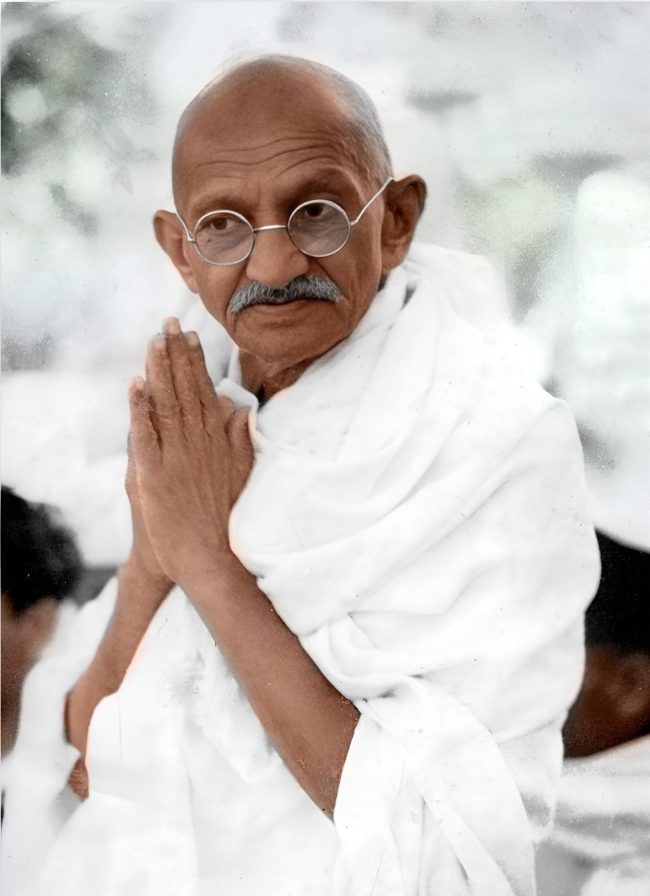
I am no great fan of Gandhi. As a student at IIM Ahmedabad I spent half my time at his Sabarmati Ashram, and like any curious student I have kept questioning him ever since; I have disagreed with him on more than one count. But criticism is one thing and slander quite another. … Einstein once said that generations to come would scarcely believe such a man had ever walked the earth in flesh and blood. Given how he is spoken of in parts of his own country today, those words are coming true sooner than anyone expected. – Acharya Prashant
Gandhiji’s 157th birth anniversary falls on 2nd October. The United Nations observes it as the International Day of Non-Violence. Few faces are more familiar to Indians than his. His image appears on currency notes and classroom walls, and most people carry some early memory of him, an essay written in school or a story told at home. He came to be called the Father of the Nation, and for decades discourses have been delivered in his name, speeches made, seminars held. Many of them carry a gentle lament that the country is forgetting his thought. The truth may be quieter than that. The country is not so much forgetting him as never having quite understood him.
Out of that half-understanding, two Gandhis have grown. The first is garlanded every October as a gentle saint who preached non-violence to the world. The second, in some town or other, has shoes and filth thrown at his statue, a villain whose every failing is paraded and whose every choice is called a betrayal. Between the garland and the stone, the man himself has gone missing.
Truth is not an ideology. Ahimsa is not an ideology either. When lofty words are attached to a person, then whenever that person is rejected, for whatever reason, the words are rejected along with him and fall into disrepute. That is what has happened here. Satya and ahimsa have been bound so tightly to one man that the words now rise and fall with his reputation, and whatever is thrown at him lands on them too.
Truth does not mean that if someone asks how much money I have in my pocket, and I have 555 rupees, I tell him 555. Ahimsa does not mean that someone slaps me and I say, never mind, I will not hit back, please sit, have some jaggery, drink some water. Neither word is a rule of behaviour, and neither began with Gandhi.
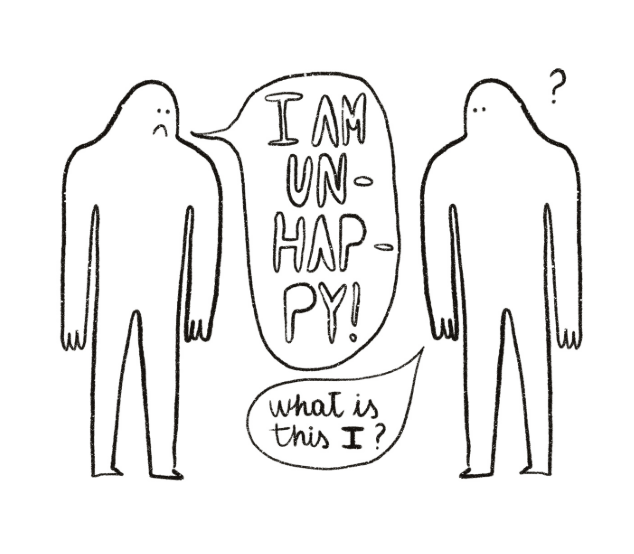
What, then, is truth? At one end of every duality sits the ego, the one who says “I”. When that ego turns and looks at itself, the duality it was holding up is seen to have no ground. That seeing is truth. There is no doctrine in it and no principle to be carried around; it is immediate, and it has to happen afresh each time.
I will bring nothing new about Gandhi. Whatever has long been said about him, I will only try to bring some clarity to it.
A Word Older Than the Man
Gandhi did not give birth to the word “ahimsa”. It is very old. The Buddha came before Gandhi, and ahimsa is older than the Buddha; it is there in the Upanishads. So ahimsa certainly cannot be about becoming weak or fearful. Its real meaning has to be understood.
Human beings, this species, first commit violence against themselves, and every other violence starts from there. Ahimsa is not ruining one’s own life; it is being sensitive towards oneself. The ego that sits within, the sense of “I am”, must keep a love for liberation. That is ahimsa towards oneself. To sell oneself from within and accept bondage is violence. To say, I will not be sold and I will not bow, and to keep moving against bondage all one’s life, is love for oneself, a love that wants one’s freedom rather than one’s comfort. That very love is ahimsa. Ahimsa means first defeating the enemy that sits within, the weakness within, and fighting that real enemy fiercely; and it includes, where necessary, taking on the one outside as well. When this love is present within, it shows up in every relationship one has.
What has been attempted all these years instead? Nothing within, and ahimsa performed only on the outside. So a known bribe-taker is told to his face that no one is more honourable, and an aunt who wishes one ruin is assured that one knows how deeply she cares. All of this is violence, yet exactly this counterfeit conduct has been taught as ahimsa. People will recite a couplet and explain that ahimsa means never hurting anyone’s heart. In real ahimsa, one may have to hurt not only the heart but, if needed, the body too, as the Gita’s own battlefield shows.
The idea that has settled into the culture, that one must speak sweetly to everyone and respect everyone, is itself a form of violence. Speak sweetly to Duryodhana? With him the conversation will be through arrows. Respect him? He should get the mace, and on the thigh. Is he even worthy of respect? Perhaps my love for him lies precisely in refusing him respect, because if I keep respecting him, why would he ever change?
Gandhi called the Gita his mother, and the Gita is spoken on a battlefield where arrows are about to rain. If ahimsa meant that no one’s heart must ever be hurt, Gandhi could never have given that book such a place in his life. In the Gita and the war it leads into, desires and ambitions are hurt at every step. Duryodhana wants the throne of Hastinapur, and Krishna tells Arjuna to fight, because this man is not fit and the kingdom must not pass into his hands. His heart is certainly being hurt. Hearts are the least of it; in the war that followed, so many were killed, and by so many different methods. One method was used with Karna, another with Drona, another with Bhishma, yet another with Duryodhana. No pattern of conduct, then, can be called ahimsa. If conduct were ahimsa, the Gita too would stand condemned as a violent book.
Blood has been shed near Delhi more than once. Arjuna brought down bodies on that ground, and centuries later Timur brought down bodies in Delhi itself, in the massacre of 1398. The difference between the two is great, and it has to be understood. Arjuna fights after his own confusion, ignorance and ego have been laid bare before him. He is not killing to serve a personal interest. He is fighting for dharma, and by dharma I do not mean a sect, a community or a religion; I mean that which is right. Timur kills to expand an empire and spread his dominion. The same act can be violence, and it can be ahimsa. Whether violence has happened is not measured by whether blood was shed; it is measured by whether the mind stands with consciousness or against it. Had Arjuna gone to war for a throne, out of ego, that would have been violence. Having heard Krishna and understood him, what he did on that field was ahimsa.
Gandhi saw the danger of confusing ahimsa with weakness. In “The Doctrine of the Sword“, written for Young India in August 1920, he said that where the only choice lay between cowardice and violence, he would advise violence. He knew cowardice could arrive wearing the name of ahimsa, and he wanted it understood that cowardice is not ahimsa; better violence than cowardice. At the same time he held that ahimsa is certainly higher than violence.
The meaning Gandhi gave to ahimsa was sound, but it stayed at the level of behaviour. At its root, ahimsa is paramarthik (highest truth, ultimate reality), and there it asks for something far more radical. Where there is an other, I too am there; the very existence of the other means ego, means “I am”. And the other, simply by being other, is held at a distance as a stranger. That estrangement is the violence. So ahimsa, at this depth, is neither keeping good relations with the other nor even loving the other. It is seeing that what makes the other an other, what makes him a stranger, is the ego, and that this ego is false. Ahimsa, finally, means there is no other.
Gandhi never spoke at that depth. His gifts lay elsewhere than in philosophy; when he wrote on the Gita, I find innumerable holes in his reading of it. Whether he understood it inwardly, I cannot say. When I visited his Anasakti Ashram in Uttarakhand and read his words displayed there, they spoke more of practice than of philosophical depth. But he knew the worth of non-attachment, and that alone sets him apart from most. Those who lived at that depth recognised something in him. Ramana Maharshi, the tallest sage of the first half of the last century, held him in deep regard, and Gandhi, for his part, would send people who came to him with restless minds off to Ramana’s ashram. Understanding and living are not the same thing. His life went further than his words about ahimsa, and it is in the life that he has to be read.
The Man Who Would Not Bend
It should not be forgotten that Gandhi did not personally hate anyone. But he was fiercely confrontational. He never retreated; he would plant himself in front of you and stay there. Violent he was not, but confrontational he certainly was, and not only with the British. He held firm against Mountbatten and Jinnah, and against the Congress itself. Many times he stood against the people of India. When riots broke out, he would place himself before the crowd and demand that the killing stop. By the definition of ahimsa now in circulation, even Gandhi would not qualify as non-violent, because he too would go and dig in. His message was plain: you are wrong, you will have to bend, and if you will not, I am fasting from this moment. I may die, but I am telling you that you are wrong.
If he is to be remembered, he should be remembered neither for truth nor for ahimsa but for his insistence, his aagrah (pertinacity). Learn aagrah from Gandhi, not ahimsa. Once something seemed right to him, it seemed right; whether it truly was right is a separate question, but having found it right, he stood on it. His name is usually linked to truth and non-violence, but the resolve made him unforgettable, and everyone dreaded that stubbornness. A thin, frail, elderly man, quick on his feet, stands there immovable, and it is not only the British who are unnerved. Indians are unnerved too. Beyond his opponents, Jinnah, Mountbatten and Churchill, even the members of his own party worry that he may take a stand yet again over something new.
Insistence by itself is no virtue; every stubborn ego insists. His was worth something because it was first turned against himself, and then carried outward in widening circles, each costing him more than the last.
The first circle was himself. That insistence did not come to him ready-made. If ahimsa begins with refusing to sell oneself, the first battle had to be fought within himself. In his early years he could not stand up to others and would often give way under pressure. Of very ordinary build, he had no commanding presence, and speaking before people frightened him. Even after studying in Britain, he was so afraid of arguing in court that he took to drafting petitions instead; in his own account, his voice would not come out. That same man went on to speak to vast gatherings across the country for the rest of his life.
In his youth he stole money from home, ate meat, went to a brothel, told lies. His desire was once so strong that at his father’s final hour he could not remain by his side and was drawn away to his wife. At one stage his faith in his own religion wavered so far that the Christian friends urging him to convert nearly won him over. In England he admired the English so much that he spent a good deal of money only to learn their manners and acquire their clothes; later that same man stood up to the English so firmly that they came to dread him. In 1906 he entered brahmacharya, and understood it in its deeper sense: for him it meant not only restraint of the body but freedom from the afflictions of the mind, without which the vow meant nothing.
Every ordinary failing was present in him, and he admitted each of them himself. Seeing his failings was not enough; he set himself against each one. Very few people, while being called Mahatma, have the courage to lay their own lives open for anyone to see. He kept saying that he was experimenting, that he did not know. He said his life was his message, and he let that life be read, flaws included. He meant it as an invitation: what had been possible for him is possible for anyone. That an entirely ordinary man, a man of clay, kept overcoming his weaknesses one after another and kept moving forward is the thing about him that moves me most.
The next circle was his own household. With his wife, things did not settle for many years, because, coming from the family background he did, he tried to dominate her. Kasturba resisted him quietly and would not be cowed, and he later said that he learnt the lesson of non-violence from her when he tried to bend her to his will. Only after decades of marriage did the two arrive at harmony and a deeper affection. He was not very successful as a father either, and he said so himself.
The same household saw him at his most unbending. In 1915, soon after founding his first ashram in India, at Kochrab near Ahmedabad, he admitted a Dalit family with their little daughter, Lakshmi. Donors withdrew their money, residents protested, and Kasturba herself resisted. He would not yield. If this child could not stay, then nobody would stay; everyone could leave, and he would leave too. He was ready to close the ashram rather than turn the family away, and he later raised Lakshmi as his own daughter. His stand was simple. What is right is right, and if others would not accept it, he would not let things go on as they were; at the very least, he would not cooperate. That was his whole method, non-cooperation. If he could not stop a wrong from happening, he could at least withdraw his hand from it.
Was he, then, a saint or a politician? The question assumes that sainthood is a profession, which it is not. One cannot ask a saint what hours his sainthood keeps, whether it is a five-day week, how many days of leave it allows. Saintliness is not a role but a devotion to the truth, and one so devoted will do outwardly whatever the time and circumstances demand. When the circle had to widen to a whole nation, the time demanded that he enter politics and lead the country, and he did that as well.
He came to that scale slowly. In South Africa he was an ordinary lawyer of no particular natural gift who saw injustice and stood up against it, and in time his practice flourished and respect came with it. He left all that and came home, and for his first years in India he mostly watched, trying to understand what was actually happening to the country. Once he understood, he asked himself how he could go to these people in a suit and coat. If he was to serve the poorest, he would go to them as one of them.
At the scale of a nation, non-cooperation became his gift to those who had nothing. He taught dignity to the class that had no resources. He told them, you have nothing else to resist with, but you have your life. You have neither weapons nor money, neither a voice in society nor political power, but you do have your own life; stand your ground with it. That is his contribution. And what did he himself have? A small length of cloth, spun by his own hands, and a resolve that said: I will stand by what I find right.
His own life was the stake he put down most often. Insistence of that kind is no small thing, and that much strength comes only when one insists on what one sincerely finds right. Nobody can fast unto death for a whim. Were someone to announce “I will not eat” over some shallow matter, within two days the sound of a refrigerator door would be heard from somewhere in the house.
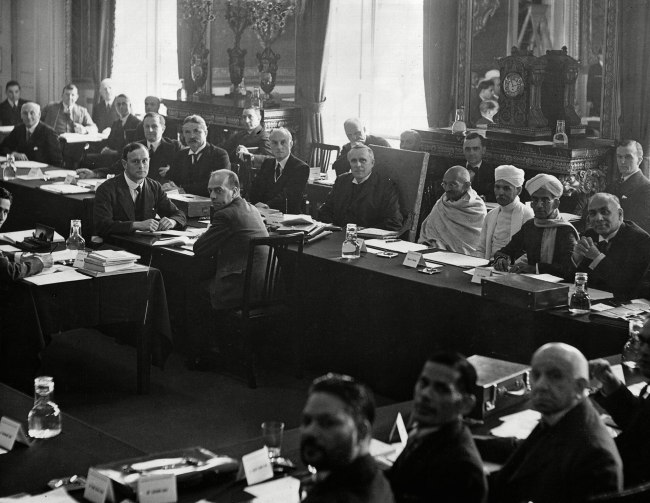
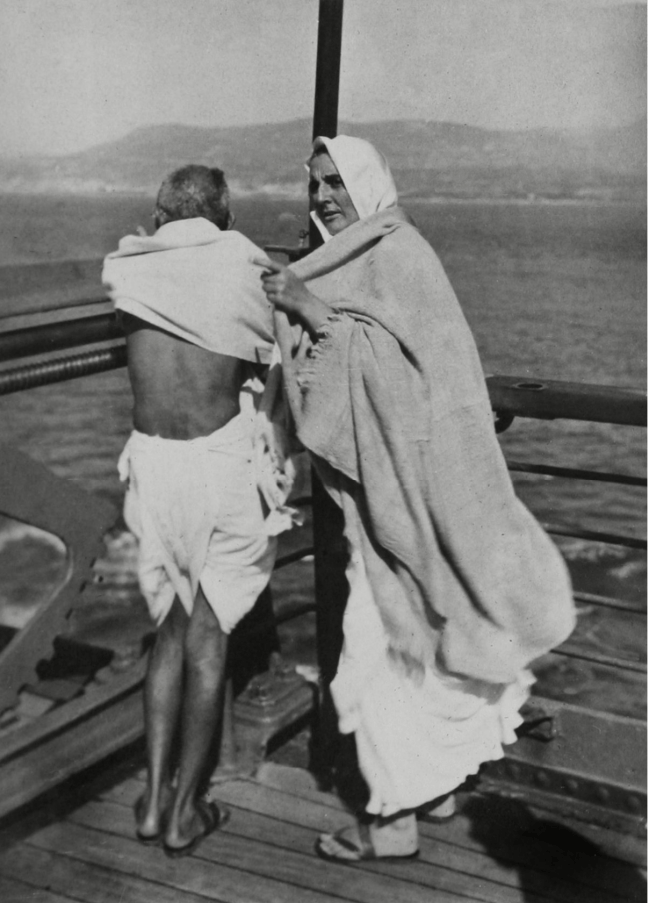
At the Round Table Conference in London in 1931, the Congress sent him as its sole representative. The photographs are still there to see. Most of the others are in suits, warm winter suits at that, and in their midst sits one barely clothed man who has left every one of them feeling small. The loincloth was a choice; he had given up not only foreign clothes but even the ordinary dress of the common man. The bareness itself is his weapon, and he has used it deliberately, as if to say: I am India, and I am alone; I have neither numbers nor force, nor even money, and yet before me all of you are ashamed. Churchill refused even to meet him on that visit, having earlier called it nauseating to see this lawyer “striding half-naked up the steps of the Viceregal Palace”. Churchill could not bear him. Were Gandhi to stand before an audience today, people would listen spellbound; they might call much of what he said impractical, but none of them would call him lightweight.
The last circle was the hardest, because it held his own people. He resigned from the Congress in 1934, thirteen years before independence, and though he held no office in it thereafter, his word still carried great weight. His work now, he said, was social reform: removing untouchability from India, cleaning away the filth of the villages and of the body and mind. He took up the name Harijan, from the poet-saint Narsinh Mehta, for the Dalits and asked that wells, temples and schools be opened to them. One may certainly say he should have done more, and I agree; but nobody is stopping anyone from doing more today, and it is not right to discredit what one man did.
In his final years he was struggling against communal hatred itself. When riots tore through Noakhali, he went there and stayed, refusing to let the killing continue. On 15 August 1947, while Delhi celebrated, he was in riot-torn Calcutta, fasting and praying. When the country was rejoicing in its freedom, he was walking against the violence of his own countrymen, and in the end he took the bullets for it. A life like this ought to be hard to misread. India has managed to misread it twice over.
The Garland and the Stone
The stone comes first, and those who throw it are, for the most part, the least interested in Gandhi. Most have never read him and have no wish to. They are trying to build something, and he stands in the way. If one wants a society that is illiberal and split along communal lines, the symbol of liberalism and communal harmony has to be dragged down first. Wherever ignorance means to rule, anyone who stands for light becomes an enemy. Gandhi is not only a person; he is a thought, and the stone is aimed at the thought.
Its heaviest charge is that his ahimsa made Indians cowards. Why did so many fall to so few in the first place? This was an entire subcontinent, not only today’s India but Pakistan, Bangladesh and more besides. The British came from a few small islands off the north-western edge of Europe, by sea, on voyages of many months, long before electricity or the telegraph, and before long they had made Indians their subjects and ruled them for close to two centuries. Something had rotted within the Indian condition, some deep inner weakness, a want of discipline, a faith in caste and similar follies, all of them the ego’s comforts. That is why it gave way so easily. If the causes of that defeat were still present in 1921, how was the same people to defeat the British now, when British power had only grown?
The India of a hundred years ago, the India of 1922, has to be seen beside the Britain of that time, the empire on which the sun never set, fresh from its victory over Germany. What would one have had him do, incite violence? Should he have told these hungry, ragged, weakened, destitute people to take to the streets and drive the British out by force? The Raj was run largely by Indians, many of them so hungry that they would do anything to fill their bellies, and the informers who kept delivering the revolutionaries into custody were Indians too. With no food, no schooling, sunk in a hundred superstitions and drowning in caste and squalor, how could such a people have been led into a violent mass uprising? So, step by step, he asked them for civil disobedience. Do not fight them, he said, but do not obey them either. One may say there was one Bhagat Singh and there could have been ten thousand; but there were not, and had there been, it was not Gandhi who would have held them back.
This is also why he did what he did at Chauri Chaura. In February 1922, when a mob set fire to the police station there and policemen died in the blaze, he called off the Non-Cooperation Movement at its height, to the dismay of many in the Congress. He began each movement on his own judgment and ended it on his own judgment, and what his judgment saw this time was that the impatience was still there, the indiscipline was still there, and no one seemed willing to ask why India had been defeated in the first place; the ego would rather blame an enemy than look at itself.
Having ruled out the gun, he chose carefully where to strike instead. Indian cotton had long fed Britain’s textile mills, and India was the largest market for the cloth those mills sold back. The bonfires of fine foreign cloth he led people to light were no small matter; Manchester knew his name well. His reasoning was simple. These were traders, and they were hungry for money; London was growing fat on India’s plunder, and he would stop the plunder. His countrymen had no guns, and he would not ask them to fire any, because it was they who would die, and in lakhs. So he would strike where it hurt. Khadi and the salt satyagraha both served that purpose.
As for cowardice, he was its sharpest critic; it was he who would advise violence sooner than cowardice. The charge also proves too much. If turning first to face oneself makes a man a coward, the accusation cannot stop at Gandhi; it would have to be laid against the whole line of seers and sages before him, from the Buddha onward. The very word Jina means a conqueror, one who has conquered himself. How does facing one’s own reality make anyone a coward? Every one of them taught that the greatest courage lies in first conquering oneself. How many of them will you kill?
The second charge, that he appeased Pakistan, rests mostly on a sum of money, one his assassin named as his reason. After Partition the government withheld ₹55 crore, Pakistan’s remaining share of undivided India’s cash balances, until his last fast in January 1948 led to its release. Had the money not been paid, would Pakistan have given up its claim on Kashmir? Did it send in the raiders because it was about to receive the money? The raiders had entered Kashmir in October 1947, three months before the money was released. Pakistan would have done in Kashmir what it did regardless. The only difference would have been the loss of the higher ground India stood upon, that of a nation that honours its word. Nothing would have been gained by keeping the money; it was owed in any case.
Did Gandhi make Pakistan, then? No one insisted more firmly than Gandhi that India would not be divided; if there was one man Jinnah dreaded, it was Gandhi. Writing in Harijan in May 1942, he called the vivisection of India a sin. By 1946 and 1947, though, the fires of communalism had been stoked so far that killings were spreading across whole provinces, and two communities steeped in hatred of each other could not be held together by one man’s will. If partition was to be averted, the right steps were needed decades earlier. One may still argue that he misjudged something along the way; that would be an error of judgment, and nothing more.
Criticism of him is fair, and he invited it all his life. I am no great fan of his. As a student at IIM Ahmedabad I spent half my time at his Sabarmati Ashram, and like any curious student I have kept questioning him ever since; I have disagreed with him on more than one count. But criticism is one thing and slander quite another. In recent years, around Gandhi Jayanti, statues have been defaced in several places and filth flung on his face. He was killed once, and that, it seems, was not enough; now attempts are made to kill him in other ways. But certain things cannot be killed. He hid nothing. What he did, he disclosed himself, in his books or whenever he was asked, and today he is mocked for the very things he confessed. Before judging a man who concealed so little, one might ask how much of one’s own life one would be willing to lay open. Einstein once said that generations to come would scarcely believe such a man had ever walked the earth in flesh and blood. Given how he is spoken of in parts of his own country today, those words are coming true sooner than anyone expected.
The garland is gentler, and no truer. Was he a Mahatma, a rishi? I would not call him either, and he never claimed to be. People grew fond of him and called him Mahatma, and that was their doing. He never asked for it, and he never encouraged any notion of divinity about himself. It was Rabindranath, by the usual account, who gave him the title, and Subhas Chandra Bose who called him the Father of the Nation, over Azad Hind Radio in 1944. The argument today proceeds as if he had demanded these honours and his critics were exposing an impostor, when in truth he sought none of them. Those who knew him best never made a god of him either. Nehru, Patel and Bose all disagreed with him, some of them sharply. Rabindranath himself opposed the charkha and distrusted Gandhi’s nationalism, and still held him in deep regard. They argued with him without reviling him, and that healthy exchange is a long way from the sloganeering of today.
As a title, “Father of the Nation” expresses affection more than it makes a literal claim. The country may be new as a political entity, but the nation is ancient, and its roots go back to the rishis who composed the Upanishads and the hymns, and to Truth itself. If this nation has fathers, they are those. Gandhi, who sought none of these honours, would hardly have claimed otherwise.
The title came from the people, and so did the stature. Had anyone higher than Gandhi stood up, the people would have followed; no one did. For decades a poor country gave to him in trust, not only industrialists but farmers with almost nothing, a few paise, a rupee or two, as an offering to the cause of freedom. They watched a frail old man keep walking from one village to the next, past seventy and on towards eighty, and they grew fond of him. Were earlier generations simply fools to revere him? They were not; they saw something in that man. No one who walked like that, at that age, for that many years, could be dismissed lightly.
To see him as a man is also to see his limits. Many of his ideas, particularly in economics, would not serve a modern nation if applied today. When I was studying textile engineering at IIT Delhi, the question of how India’s textile industry fell so far behind would often come up, and his principles played a real part in the answer. A handloom cannot compete with a power loom, and a nation cannot become internationally competitive by spinning the charkha. But that does not make him a villain; he did not ask people to wear khadi because he wished India harm. He offered what he truly believed would serve the country, and the man deserves credit for putting forward with courage whatever he found right, and for leading a nation to act on it.
Nor did he win freedom single-handed, as a popular film song would suggest. The Second World War, the naval mutiny of 1946, the revolutionaries who took the path of violence and the efforts of Subhas Chandra Bose all brought the date nearer. But would freedom have come on the same day had there been no Gandhi? To say that Gandhi alone brought freedom is wrong, and to say that he contributed nothing is far more wrong. The complaint that his stature left other freedom fighters in shadow may hold some truth. He grew into so vast a tree that much beneath it went unseen. The answer is to bring their stories into the light and honour them fully, and none of that requires reviling him. As Kabir Saheb put it: saar saar ko gahi rahai, thotha dei udaay. Keep the grain and let the husk blow away.
The stone and the garland look like opposites, but they do the same work. Whoever throws the stone and whoever hangs the garland are both spared the trouble of reading him, and of reading themselves. The difficulty lies deeper than the man. Gandhi tried to live by principles that are very old, and hardly any of them has been understood: what the ego is, or what ahimsa and asteya mean. A society that has not understood these will not understand anyone who speaks of them, today or tomorrow. Indian society today needs neither satyagraha of the old mould nor ahimsa of the old mould. It needs rebellion and fire; satyagraha was always pointing towards that rebellion, and ahimsa begins in the fire that burns falsehood away.
The first thing that rebellion must refuse to cooperate with is whatever keeps pulling us away from ourselves. Those forces have never been stronger. Media and politics alike keep the eyes fixed outward, on some temptation or some enemy, some sensation or some snake said to be waiting to strike, so that the eyes never turn within. A man whose whole method was to withdraw his hand from what was wrong would know where to begin.
Every Gandhi Jayanti, the two words are spoken everywhere. Schoolchildren recite them, and ministers lay wreaths beneath them, and by evening both words are folded away for another year.
Nobody is obliged to walk his path, follow his principles or adopt his ideals. But he deserves to be read once, properly, and known. It is not easy to become Gandhi, and no one is being asked to. The question he leaves is a smaller and harder one: what has been sold within, and which chains accepted, for the sake of being left in peace? – The Pioneer, 3 October 2026
› Acharya Prashant is a philosopher and author whose work centres on self-inquiry and its application to contemporary life.