Vande Mataram marginalised in the name of secularism – Utpal Kumar

Bharat Mata (Tamil Vijaya Mag 1909).

The Congress, in its post-Independence avatar, began to craft a “secular” nationalism that saw overt Hindu imagery as regressive, even dangerous. In doing so, it vacated a cultural space that epitomised the soul of Bharat. – Utpal Kumar

In his seminal work The Open Society and Its Enemies (1945), Karl Popper explains what he calls the “paradox of tolerance”. He writes, “Unlimited tolerance must lead to the disappearance of tolerance. If we extend unlimited tolerance even to those who are intolerant, if we are not prepared to defend a tolerant society against the onslaught of the intolerant, then the tolerant will be destroyed, and tolerance with them.” Popper, however, adds a rider, saying that as long as one can counter intolerant views “by rational argument and keep them in check by public opinion, suppression would certainly be most unwise”.

Seven decades later, Nassim Nicholas Taleb reaches a similar conclusion in his 2018 book Skin in the Game, where he explains how it is the most intolerant, however minuscule they might be, who succeed in imposing their views on the majority. Among others, he gives the example of halal food to show how a small, stubborn group’s preferences dictate changes for everyone.

Today, as we celebrate 150 years of ‘Vande Mataram’, composed by sage and seer Bankim Chandra Chattopadhyay in 1875 and later included in his novel Anandamath (1881), Popper’s “paradox of tolerance” and Taleb’s “minority rule theory” seem vindicated as never before.

Few symbols capture the trajectory of Bharat’s nationalist evolution—and its post-Independence identity crisis—as poignantly as Vande Mataram. Once the heartbeat of the freedom struggle, this ode to Bharat Mata (the motherland) became, over time, an inconvenient liability—an “extra”, to use Swapan Dasgupta’s term in his book Awakening Bharat Mata—awkwardly preserved but carefully marginalised too.

Vande Mataram’s journey from revolutionary anthem and rallying cry of the nationalist movement to contested, “communal” symbol reflects not only Bharat’s pseudo-secular identity politics but also the deliberate reshaping of national consciousness to accommodate the intolerant, who brand their intransigence as the anxieties of a besieged minority.

The retreat of Vande Mataram was threefold. While it became an “extra” post-Independence, this wasn’t the only time this song was viciously assaulted. The verses of Vande Mataram inspired one of the most enduring icons of Indian nationalism—the image of Bharat Mata. As per Bankim’s notion, she is an embodiment of both divine power (Shakti) and cultural identity:

Terrible with the clamorous shouts of seventy million throats,
and the sharpness of swords raised in twice seventy million hands,
Who sayeth to thee, Mother, that thou art weak?
Holder of multitudinous strength,
I bow to her who saves,
to her who drives from her the armies of her foemen,
the Mother!

Yet, by the early 20th century, alternative depictions began to emerge. Abanindranath Tagore’s 1905 painting of Bharat Mata showed a saffron-robed, serene woman—gentle, ascetic and unarmed. This transformation from Shakti to Sadhvi was further solidified when Mahatma Gandhi entered the freedom movement arena in the country.

Gandhi, though deeply religious, was wary of any symbol that could alienate Muslims. He revered Vande Mataram but readily surrendered to the opposition: “It never occurred to me that it was a Hindu song. … But in such times it is wisdom not to market pure gold.” His retreat symbolised the nationalist leadership’s helplessness—which was more like surrender—to the intolerant. The Congress, anxious to sustain Hindu-Muslim unity, began to treat Vande Mataram with utmost restraint.

The Muslim League, led by Mohammad Ali Jinnah, rejected Vande Mataram outright, calling it “idolatrous” and “anti-Muslim”. Its depiction of the nation as a goddess was deemed an affront to Islamic monotheism. To pacify Muslim sentiment, the Congress decided that only the first two stanzas—devoid of explicit religious imagery—would be sung, and even then, never by compulsion.

This compromise of the majority didn’t stop the rise of Muslim separatism; it gave it further impetus. The country got its independence but at the cost of partition—in the name of religion. And as happens with concessions, one leads to another—the smaller takes us to the bigger ones.

On January 24, 1950, the Constituent Assembly adopted Rabindranath Tagore’s Jana Gana Mana as the country’s national anthem. Interestingly, the decision was reached without debate or vote. Vande Mataram was given “equal honour”, yet it was relegated to ceremonial margins—sung only in part, on rare occasions.

The author’s intent isn’t to question Jana Gana Mana, and it is ludicrously silly to link it with the British monarchy. The point being raised here is the discomfort which first the Gandhian worldview and then the post-Independence Nehruvian ecosystem had with Hindu imagery and underpinnings. The Congress, in its post-Independence avatar, began to craft a “secular” nationalism that saw overt Hindu imagery as regressive, even dangerous. In doing so, it vacated a cultural space that epitomised the soul of Bharat.

The assertive spiritual nationalism of the early freedom struggle was recast as an embarrassment—something to be remembered but not revered. Vande Mataram thus became the “extra” of Indian nationalism—honoured in rhetoric bereft of its Sanatana sacredness and explicit Hindu imagery, thus denying its rightful place at the centre of national identity.

The story of Vande Mataram is the story of Bharat struggling to reconcile its ancient Sanatana soul with its modern “secular” anxieties. It is also a reminder that concessions to a bully, even if he is a minority, do not pay. They backfire. – Firstpost, 9 November 2025

› Utpal Kumar is Opinion Editor at Firstpost and News18 and is the author of the book Eminent Distorians: Twists and Truths in Bharat’s History.

Vande Mataram

2 – The Koenraad Elst Interview – Surajit Dasgupta

Dr Koenraad Elst
Dr Koenraad Elst is a Belgium Indologist who calls himself an “Orientalist”. He is a leading author with Voice of India and has many publications on India behind him. – Surajit Dasgupta

Q : While Swarajya has published articles exposing how Marxist historians hound peers who disagree with them out of academic institutions, we have got news from different sources that you are finding it difficult to get employed even in Belgium. Is it true? If yes, what precisely is the objection of your detractors? Can you name the people who have raised objection to your appointment in a Belgian university? Did you receive regret letters from Belgian academic authorities, explaining why they couldn’t appoint you? Did they communicate verbally to you why they thought you were unemployable?

A : After giving this matter some thought, I have decided against offering much detail here. Firstly, I am not privileged to know the details of decision-making instances that lead to my own exclusion. Even if sending an official “regret letter”, they would not give in writing the real reason behind their decision (as anyone experienced with job applications knows).

Secondly, even though no law was broken, going into this still has the character of an allegation, and that requires proof. Some cases of deliberate exclusion or dis-invitation were simply obvious, but my standards of proof are higher than that. Thus, recently I missed an appointment at a Belgian university and in that rare case I was unofficially but fully informed of the details by an insider (of course I was vetoed for reputedly being too embroiled with Islam criticism), but now that this crown witness has died, it would only be my word against theirs; which would not be good enough. So, I simply want to close this chapter. Let’s not bother, everybody has his problems, and these career hurdles are mine. In fact, I have had quite a bit of luck in my life, including help from individual Hindus whenever the need arose (air tickets paid, hospitality etc.), so any fussing about this boycott against me would be disproportionate. Let’s just assume I missed those opportunities because I was not good enough. Or because of Karma, whatever.

The topic in general is important, though. The Leftist dominance of the Humanities departments in India, often amounting to total control, results from the wilful and systematic “ethnic cleansing” (to borrow Madhu Kishwar’s term) of any young scholar suspected of pro-Hindu sympathies. Exceptions are the people who entered on the strength of ideologically neutral work, or of initially toeing the line, but coming out with pro-Hindu convictions only after getting tenure.

This cleansing of enemies stems from the old Marxist mentality: a war psychology treating everyone with a different opinion as an enemy inviting merciless destruction; and a boundless self-righteousness rooted in the belief of being on the forward side of history. As an ideological wave, Marxism is waning even in India, but that attitude is still rife among the anti-Hindu forces, both in India and among Western India-watchers.

Q : We refer to the established historians in India as Marxist historians, not to their knowledge because they look at this country through the Marxist lens of “class conflicts”. You refer to them sarcastically as “eminent” historians. Please explain your choice of words.

A : “Eminent historians” is what they call one another, and what their fans call them. When they don’t have an answer to an opponent’s arguments, they pompously dismiss him as not having enough “eminence”. So when Arun Shourie wrote about some abuses in this sector, he called his book Eminent Historians. It is also a pun on an old book about prominent colonial-age personalities,Eminent Victorians.

“Eminence” in this case refers to their position and relative glory. The Communists always made sure to confer position and prestige, as opposed to the Sangh Parivar, which fawns over people with position but doesn’t realize that those people have only acquired their position by toeing the anti-Hindu line. In a way, you have to concede that the Left has honestly fought for its power position. Half their battle was already won by the Hindu side’s complete absence from the battlefield.

One example of the Sangh’s ineptness at playing this game. In 2002, the supposedly Hindu government of AB Vajpayee founded the Chair for Indic Studies in Oxford. The media cried “saffronization” and, as usual, portrayed the BJP as a wily party fanatically committed to Hindu causes. However, the clueless time-servers at the head of the BJP nominated a known and proven opponent of Hindu Nationalism, Sanjay Subrahmaniam, who thus became the poster-boy for “saffronization”. This way, they hoped to achieve their highest ambition in life: a pat on the shoulder by the secularists. That pat on the shoulder, already begged for so many times, remained elusive, but the tangible result was that they too had conferred even more prestige on an “Eminent Historian”, all while denying it to their own scholars (if any).

Q : What would you tell your peers who say that the “Out of India Theory” (OIT) is a fringe theory?

A : Of course it is a fringe theory, at least internationally, where the Aryan Invasion Theory (AIT) is still the official paradigm. In India, though, it has the support of most archaeologists, who fail to find a trace of this Aryan influx and instead find cultural continuity. As for the situation abroad: most scholars assume the invasionist paradigm, but only very few also argue in an informed manner for the invasionist theory, not many more than those who argue against it. But anyway, this “fringe” aspect doesn’t impress me at all. When Copernicus put the sun rather than the earth in the middle of the solar system, he was in a minority of one, very “fringe” indeed; but he won the day.

Q : What is the evidence against the Aryan Invasion Theory?

A : First of all: that there is no evidence in its favour. Archaeologists have spent a century of well-funded excavations for a trace, any trace, of the Aryans moving into India. Even the invasionists concede that “as yet” no such thing has been found. The new genetic evidence, while still immature, generally goes in favour of emigrations from India and, while leaving room for immigrations too, is emphatically failing to pinpoint an invasion coinciding in time with the hypothetical Aryan invasion.

Meanwhile, the written record emphatically points to an emigration scenario. That the Iranians lived in India and had to leave westwards is reported in the Rg-Veda, a text thoroughly analysed and shown to support an “Aryan emigration” by Shrikant Talageri. It can equally be deduced from the Avesta. Even earlier migrations are mentioned in the Puranas. These are of course very mixed and unreliable as a source of history, but it is a bad historian who discards them altogether. Their core, later fancifully embellished, consists in dynastic lists. Keeping that ancestral information was the proper job of court poets, and they devised mnemotechnical tricks to transmit it for many generations. In this case, it too does convey a basic scenario of indigenousness and emigration.

Finally, there is the linguistic evidence. Many Indians believe the hearsay that it has somehow proven the invasion. It hasn’t. But permit me to forego discussing those data: too technical for an interview.

Q : Of late, the Marxist historians have revised “invasion” to “migration”. They say that there might not have been a war when the so-called Aryans arrived here, but they have no doubt that the ancestors of today’s north Indians, especially the upper castes, by and large migrated from central Asia into India. In other words, the Marxists say that we Indians were originally not Indians—invasion or no invasion! Does this “revision” satisfy you?

A : Exasperated at not finding a visible trace of this invasion, conformist scholars have theorized an alternative that doesn’t require such visible remains: a migration under the radar. Often, when they try to give details, they still mean a military invasion rather than a gradual migration, since they bring in the military advantage of horses and chariots to explain how such a large and civilized Harappan population could be overrun by a handful of outsiders.

But even if they genuinely mean a migration, it still amounts to the same scenario as an invasion, viz. the Vedic Aryans came from abroad and the natives took over the language and religion of the intruders. So, anyone who thinks that the migration theory is a breakthrough away from the invasion theory really shows he doesn’t understand the issue. “Migration” effectively means “invasion” but avoids the burden of proof that the more dramatic term “invasion” implies.

To be sure, it doesn’t much matter who came from where. The so-called adivasis (a British term coined in ca. 1930) or “natives” of Nagalim in the Northeast have settled in their present habitat only a thousand years ago; which is fairly recent by Indian standards. So, ironically, they are genuine “immigrants” or “invaders”, yet no Indian begrudges them their place inside India. Many countries have an immigration or conquest of their present territory as a proud part of their national myth: Madagascar, Romania, the Siberian part of Russia, Hungary, Turkey, Sri Lanka, Pakistan, etc. If the Indo-Aryans, or indeed the Dravidians (theorized to have come from Iran or even Central Asia), had really immigrated, that would then have been a pre-Vedic event, at least 3500 years ago, and that time-span ought to have been enough for integration into the national mainstream.

So this Homeland debate ought to have been a non-issue, only of interest to ivory-tower scholars. But different non- or anti-Hindu forces decided to politicize it. Abroad, these were the British colonialists, White supremacists in the US and Europe, and among them the Nazis, who considered the AIT as a cornerstone and eloquent illustration of their worldview. Inside India, first of all the Christian missionaries, then followed by the non-Brahmin movement, the Dravidianists, Nehruvians and Ambedkarites, followed in turn by their Western supporters. The AIT was used to break up Indian unity and pit upper castes against lower castes, non-tribals against tribals, and North Indians against South Indians. After this massive politicization, the partisans of Indian unity finally decided to give some feeble support to the fledgling Out-of-India Theory (OIT). Yet, scholars rejecting the OIT because of its alleged political use have no qualms about espousing the AIT, politicized since far longer, in many more countries, and not as a pastime of a few historians but as the basis for government policies.

Q : On the one hand, the unaffiliated or apolitical Indian student loves your theories; your passages are quoted widely in debates on ancient Indian history. On the other, you do not seem to get along well with the so-called right-wing historians of this country either. You have written a blog against them. Please comment.

A : Well, I have nothing but good to say about some Indian researchers, both naturalized ones like Michel Danino and natives like Meenakshi Jain or Srikant Talageri. But then, there are others too. Certainly the name P. N. Oak rings a bell? In the second half of last century, he spread all these theories that the Taj Mahal was a Shiva temple; that the Kaaba was built by Vikramaditya as a Shiva temple; that the Vatican (originally the Roman “Poets’ Hill”) is really “Veda Vatika“; that my mother tongue, Dutch, is the language of the Daityas (demons), etc. The bad thing is that numerous Hindus have run away with these stories, and even some NRI surgeons and engineers of my acquaintance believe in diluted versions of the same. In a less extreme manner, this disdain for historical method is widespread among traditionalist Hindu “history rewriters”. They frequently put out claims that would make legitimate historians shudder.

Many of these rewriters thought that with Narendra Modi’s accession to power, their time had come. I know, for instance, that many of them have sent in proposals to the ICHR. None of these was accepted because they ignored the elementary rules of scholarship. Any student writing a thesis knows that before you can develop your own hypothesis, you first have to survey the field and assess what previous scholars have found or theorized. But these traditionalist history rewriters just don’t bother about the rest of the world, they are satisfied to have convinced themselves. Their horizon is not larger than an internet list of like-minded people.

In itself, it is no problem that their knowledge and method leave much to be desired. People can learn. Unfortunately, they are too smug to do that. They actively misinform Hindus by claiming that the Aryan Invasion Theory has long been discarded. They also do a lot of harm to the bona-fide historians with whom they get juxtaposed. So it is true that I have lost patience with them.

Q : Since the Narendra Modi government came to power in 2014, has there been an effort to revise the subject of Indian history in academic curricula, which, many in India believe, is politically motivated? Has the Government of India approached you with the request of being a part of any such initiative? If yes, how is the project going?

A : No, there has been no such request at all. However, I myself have sent in an application to the Indian Council of Historical Research, but that has run into technical difficulties, mainly to do with my foreign passport. So, the situation is and remains that institutionally, I have nothing to do with the Indian history scene.

The version of history taught by the Nehruvians was politically motivated. The feeble Hindu attempt to counterbalance this (“saffronization”) in ca. 2002 was confused and largely incompetent. Humbled by this experience, the BJP today is not even trying to impose its own version. Contrary to the Nehruvians’ hue and cry, allegations about the BJP’s interference in history-teaching or more generally in academe are simply not true.

Here we are only talking of changing some lines in the textbooks, and even that seems a Himalayan effort to the BJP. Yet, what is really needed is a far more thorough overhaul. Except for some scholars without any power, nobody is even thinking about this very needed long-term job.

Q : If no, could the reason be that RSS-affiliated historians and you are not particularly fond of each other and this government is influenced by the Sangh?

A : Any Sangh-affiliated historians would not need me to arrive at their positions or to devise a policy if called upon to do so by the present Government. But again, I am not aware of any governmental interest in correcting the distorted history propagated by the Nehruvians. I would welcome it if it happened, but so far the BJP, still begging to be recognized as “secular”, only has its eye on “development”.

I am happy to report that there are some as yet insignificant private initiatives, though. Once they achieve results, there will be more to say on them.

Q : Would you say or agree that the Government of India, regardless of the political party that runs it, would be uncomfortable appointing or commissioning an academic who is perceived as being anti-Muslim?

A : Certainly.  Though it never had any problem with anti-Hindu candidates to even the highest post. Long ago, it even managed to appoint to the chair of the Constitution Commission, no less, a man who had expressed his outspoken aversion to both Hinduism and Islam: Dr B. R. Ambedkar.

Q : Does the genesis of your problem with anti-left historians in India lie in the fact that on the issue of Babri Masjid, if you do not agree with the left, you do not agree with the right-wing either? If it is something else, please explain the problem.

A : On Ayodhya, there has never been a conflict with any non-Left historian. To be sure, I have my disagreements on some minor points, but they have never been the object of a controversy. So: no, on Ayodhya I may have minor and friendly differences of opinion with “right-wing” historians, but no serious quarrel. In that debate, the long-standing quarrel has been with the Eminent Historians, their supporters in media and politics, and their foreign dupes. They were on the wrong side of the history debate all along, and it is time they concede it.

In the case of the Eminent Historians, it is also time for the surviving ones to own up their responsibility for the whole conflict. The then PM, Rajiv Gandhi, was on course towards a peaceful settlement, allotting the site to the Hindus and buying the militant Muslim leadership off with some typically Congressite horse-trading. Not too principled, but at least with the virtue of avoiding bloodshed. It is the shrill and mendacious declaration of the Eminent Historians in 1989, amplified by all the vocal secularists, that made the politicians back off.

Not only have they falsely alleged that no Rama temple ever stood on the contentious site: their more fundamental lie was to bring in history at all. Ayodhya belongs to the Hindus not because it was their pilgrimage site a thousand years ago, nor because of “revenge” for a temple destruction effected eight hundred or five hundred years ago, but because it is a Hindu sacred site today. No Muslim ever cares to go to Ayodhya, and in spite of being egged on by the Eminent Historians, enough Muslim leaders have expressed their willingness to leave the site to the Hindus. This whole controversy was unnecessary, but for the Nehruvians’ pathetic nomination of the Babri Masjid as the last bulwark of secularism.

Q : If all the archaeological findings from Ayodhya are arranged chronologically, what story of the disputed plot of land comes to the fore? Did a temple of Lord Rama stand there, which Babar’s general Mir Baqi demolished to build the mosque? Or, did Mir Baqi find ruins on the spot, which were a mix of a dilapidated Muslim graveyard and remains of a temple of an even older generation? 

A : That a Hindu temple was demolished by Muslim invaders is certain, on that we all agree. But there is less consensus around, or even awareness of, the fact that this happened several times: by Salar Masud Ghaznavi in 1030 (the rebuilt Rajput temple after this must be the one of the excavated pillar-bases), by Qutbuddin Aibak’s troops in 1193, and by Mir Baqi on Babar’s behalf in 1526.

What it was that was replaced by Babar’s mosque, is not fully clear. I speculate that in the rough and tumble of the collapsing Delhi Sultanate, Hindus had managed to take over the site and started worship there even though the building they used was a mosque imposed on the site. That was exactly the situation in 1949-92, and I think it also applied towards 1526. Babar destroyed a Hindu pilgrimage centre, a Hindu presence at the site, but not the Rajput temple from the 11th century of which the foundations were excavated in 2003.

Was the temple’s demolition just an odd event, or was it the necessary materialization of an ideology, repeated many times and in many places? When Mohammed Shahabuddin Ghori and his lieutenants conquered the entire Ganga basin in 1192-94, they destroyed every Hindu temple they could find. Only a few survived, and that is because they lay out-of-the-way of the Muslim armies, in the (then) forest, notably in Khajuraho and in Bodh Gaya. But all the Buddhist universities, all the temples in Varanasi etc. were destroyed. Ayodhya became a provincial capital of the Delhi Sultanate, and it is inconceivable that the Sultanate regime would have allowed a major temple to remain standing there.

So, the narrative propagated by the Sangh Parivar, that Babar destroyed the 11th-century temple, cannot be true, for that temple was no longer there. When Babar arrived on the scene, Hindus may have worshipped Rama in a makeshift temple, or in a mosque building provisionally used as a temple, but the main temple that used to be there, had already been destroyed in 1193. See, Ayodhya’s history becomes more interesting once you discard the lies of the Eminent Historians as well as the naïve version of the Sangh Parivar.

The controversial part lies herein, that the persistence of the temple all through the Sultanate period would have implied a certain tolerance even during the fiercest part of Muslim rule. In reality, the demolition of Rama’s birthplace temple was not an odd and single event, but a repeated event in application of a general theology of iconoclasm imposed by the Prophet.

Q : Was it a temple of Lord Vishnu rather? Or, were they quite a few temples of one or more deities built in different periods by different kings?

A : In her book from 2013, Rama and Ayodhya, Prof. Meenakshi Jain has detailed all the scholarly evidence and the debate around it, including the embarrassing collapse of the Eminent Historians’ case once they took the witness stand in Court. She shows that the Rama cult has already left traces more than 2000 years ago. Attempts to make Rama worship a recent phenomenon were just part of the sabotage attempts by the Eminent Historians. Also, the site of Ayodhya, though probably older, is at least beyond doubt since Vikramaditya in the 1st century BC. All indications are that the disputed site was already visited by pilgrims as Rama’s birthplace since well before the Muslim conquest.

So, this was a long-standing pilgrimage site for Rama. Against the utter simplicity of this scenario, anti-Hindu polemicists of various stripes have tried all kinds of diversionary tactics: saying that Rama was born elsewhere, or that the temple belonged to other cults. This Vishnu-but-not-his-incarnation-Rama theory, or the claim of a Shaiva or Buddhist origin, came about as some of those diversionary tactics; they are totally inauthentic and artificial. Alright, among historians we can discuss every possible hypothesis. But from the very relevant viewpoint of Islamic iconoclasm, all these distinctions don’t matter: all those sects were false, leading men astray, away from the one true religion, and therefore they all, and certainly their idols and idol houses, were to be destroyed.

Q : Whatever be the story, which community do you believe has a greater right of ownership over that disputed site?

A : The community that holds the site sacred. Muslims go through all this trouble to travel to far-away Mecca, why don’t they go on a cheap and easy pilgrimage to Ayodhya instead? It seems they have made their choice. So let us respect their choice, and also the choice of the Rama worshippers who do care for Ayodhya, by leaving the site to the latter. Case closed.

Q : Do you hate Muslims or Islam?

A : No, I do not hate Muslims. They are people like ourselves. Having travelled in Pakistan and the Gulf States, I even dare say I feel good in Muslim environments. And if I desire the liberation of Muslims from Islam, that is precisely because I like them. Suppose you discover that a friend of you still believes in fairy-tales: wouldn’t you consider it your duty to set him straight and confront him with the true story, precisely because he is your friend?

But then, perhaps the writer of the Quran “hated” the unbelievers when he wished them godspeed to hell.

And I do not “hate” Islam either. If a teacher uses his red pencil to cross out a grammatical mistake in a pupil’s homework, we do not say that he “hates” the mistake. He simply notices very dispassionately that it is wrong. The use of the word “hate” in this case stems from an attempt to distort the debate and misrepresent the argument by means of emotive language. The belief that someone heard the word of God, dictating the Quranic verses, is just one of the many irrational and mistaken beliefs that have plagued mankind since the beginning. 

Q : You have been on record saying at a function in Goa in late 2014 that a general impression must be created that being a Muslim is “uncool”! Representatives of some Islamic countries reportedly walked out of the venue in protest of your statement. Would you explain what happened at that event?

A : We had been given to understand that it was going to be a Hindu think-fest where the only constraint on our free discussion was going to be the truth. Satyameva Jayate! The offer of first-class airplane tickets (which I refused as unnecessarily luxurious) should already have alerted me to a different agenda: a glamorous diplomatic show. Arriving on-site, and seeing some high-profile Muslim guests from West Asia (what were they doing at an “India Ideas Conclave”?), I proposed the organizers to change the topic from what I had been invited for: the roots of religious terrorism. Thus, an evaluation of the BJP Government’s record from the angle of its Hindu reputation seemed to me an excellent topic that as yet no one was scheduled to talk about. But no, they insisted I talk about the roots of Islamic terrorism, then colourfully illustrated by the frequent video reports of beheadings by the Islamic State, apart from the more usual bomb attacks. Even when I warned them that I was not going to parrot the diplomatic white lies churned out by Obama and Cameron (and, very recently, in my presence, by Narendra Modi speaking in Brussels), viz. that jihad “has nothing to do with Islam”, they still persisted.

So they got what they had bargained for. I detailed the justification for all of the Islamic State’s actions from the Quran and the Prophet’s precedents. The reaction of the Hindu audience was very warm and enthusiastic. Finally someone who didn’t try to shift the blame to the victims, as the Nehruvians always do. A few foreigners were not so happy, and neither were the BJP organizers. They had preferred a diplomatic lie to the truth, so I had spoiled their show, intended to prove how nice and “secular” those ugly Hindu Nationalists really were.

On the panel there was also the advocate of “moderate Islam”, Sultan Shahin. I liked him as a person, and I also understand that the stand he took was risky. For Muslims, it is more dangerous to stray from the orthodox line than for non-Muslims to even criticize Islam. I have to knock on wood here, given the attacks on the Satanic Verses translators and the Danish or French cartoonists, but still Kafirs (Pagans) have more leeway than Muslims who risk being treated as apostates. So, I concede the bravery of “moderate Muslims”. But all the same, they are wrong.  They are probably being truthful when they swear that they themselves would never countenance such terrorist violence. But that is because of their normal inborn human feelings, not because of (but rather, in spite of) their later conditioning by Islam. They try to reconcile their human tolerance with the religion they have been taught by their beloved parents. It is humanly understandable, and I sympathize with them, being myself an apostate from my home religion, Catholicism. But alas, I cannot spare them the difficulties inherent in outgrowing your native religions. And I can testify that the end result is worth these steps on the way.

As Taslima Nasrin has said: “What the Muslim world needs is not moderate Muslims but ex-Muslims.”

Making Islam uncool? I have been part of a massive walk-out from the Church. For intellectuals, the decisive reason was the dawning insight that Christian belief was irrational. But for the masses, it was mainly that it was no longer cool to be a believer. People started feeling embarrassed for still being associated with this untenable doctrine, and are none the worse for having left the beliefs they were brought up in. I wish Muslims a similar evolution, a similar liberation. I do not wish on them anything that I have not been through myself.

Q : How do you view the recent terrorist attack on Belgium? To what extent is migration from Islamic countries responsible for terrorism on European soil?

A : As Ché Guevara said, a Guerrilla fighter is among the masses like a fish in the water. In this case, the Jihad fighters had found safety and comfort in the Muslim community. So the demographic Islamization of some neighbourhoods in Brussels (due to our own silly policies) has indeed played a role. But I expect you to retort that there were also other factors, and that is true.

Q : How do you react to the Muslim refrain that the terrorists in their community are a creation of America and NATO’s flawed foreign policy and interventions in Afghanistan, Iraq, Libya, Syria, etc?

A : It is simply not true that Ghaznavi or Aurangzeb took to Jihad and iconoclasm in reaction to British colonialism or American bombings. They were inspired by an older source, viz. the Prophet’s precedent, Islam. However, it is true that many contemporary Jihad fighters have indeed been fired up by a specific circumstance, viz. Western aggression against Muslim countries.

Assenting to Quranic lessons about Jihad is one thing, but actually volunteering for the front-line of Jihad it quite another. In most people, it needs a trigger. The illegal invasions of Iraq or Libya, or footage of an Afghan wedding bombed from American jets, provided such a trigger. I am very aware that being bombed is just as unpleasant for wedding guests in Kandahar as for commuters in Brussels or Mumbai. Right now, even little Belgium has five bomber planes in Iraq as part of the US-led war effort against IS. These bombers must already have killed, along with some Jihad fighters, more civilians than were killed in the terrorist attacks in Brussels.

In Belgium, I have drawn some attention with my defence of the Syria volunteers: young Muslims grown up in Brussels or Antwerp and going to fight for the Islamic State. Our politicians call them “monsters”, “crazy” and other derogatory names, but in fact they are pious idealists. They may be misguided in their beliefs, and I dare say they are, but they do have the courage of their conviction. Without any pressure on them, they volunteer for putting their lives on the line in the Syrian desert. You cannot deny them bravery and self-sacrifice.

The Western invasions and bombings in Muslim countries have brought nothing but misery, and I have opposed them all along. What the Muslim world needs, is not more civil wars, sectarian wars, foreign military interventions, which all serve to polarize the minds, to freeze them in existing antagonisms. What it needs is a thaw. Here again, I speak from my own experience: the post-war climate of peace and prosperity in Europe has allowed a genuine cultural revolution, an emancipation from the stranglehold of Christianity. The Muslim world will only evolve if it attains a modicum of peace and stability.

Note that the military interventions have nothing to do with Islam criticism, nowadays slandered as “Islamophobia”. On the contrary. Without exception, all the politicians ordering interventions in Muslim countries have praised Islam, calling it “the religion of peace” that is being “misused” by the terrorists. Not a single word of Islam criticism has ever crossed their lips. A legitimate Islam critic like the late historian Sita Ram Goel has never harmed a hair on the head of a Muslim. Islamophiles such as these politicians, by contrast, have killed many thousands of innocent Muslims.

Q : How would you advise Indians to fight terrorism?

A : Security measures and repression are not my field nor my favourite solution, but I understand that sometimes they are necessary. So I want to spare a moment to praise the men in uniform who risk their lives to provide safety. However, this approach won’t go very far and won’t provide a lasting solution if it is not accompanied by a more fundamental ideological struggle. That is what I am working on. – Koenraad Elst Blog, 6 May 2016

» Surajit Dasgupta is National Affairs Editor for Swarajya.

Ram Temple Ayodhya

“The community that holds the site sacred has the right to it.” – Dr Koenraad Elst

1 – The Koenraad Elst Interview – Shitanshu Shekhar Shukla

Koenraad Elst

Dr Koenraad Elst, a scholar from Belgium who deliberately calls himself an “Orientalist”, is the author of many publications on Indian religion and politics. Among them is the book On Modi Time (VOI 2015), evaluating how the BJP’s policies measure up to its erstwhile Hindu ideals.

He says that the BJP is assiduously following a roadmap towards massive defeat. The party’s inconsistent economic policies are chasing away several of its natural constituencies.

Shitanshu Shekhar Shukla speaks to him. Excerpts of the interview:

Q : Do you think the BJP is still in opposition, ideologically speaking? If so, what must the party do to turn the tables on the secularists?

A : On economic issues, the party has the advantage of the identification of its adversaries with mismanagement. The Congress’s return to socialism undid the high growth rate India enjoyed at the end of the previous BJP government. However, the blind adoption of American free-market policies is at odds with any Swadeshi commitment the BJP once had, and is chasing away some important constituents.

On the cultural front, the less said, the better. Even when in power — no, let me correct that: when in office, for “power” means the ability to change things according to your own designs, and the BJP shows no signs of wanting to change anything. So, even when in office, the BJP plays by enemy rules and even thinks in the categories laid down by its enemies, with Hindus as an ugly overbearing majority that needs to be kept in check, and the poor hapless minorities as needing extra favours.

Everybody could see this at the time of Barack Obama’s visit. Fed hostile stories about the BJP’s “Hindu fanaticism” by the secularists, he berated this government for injustice to the minorities. Instead of giving the arrogant US president a lecture about India as a shining example in its treatment of religious minorities and refugees, Modi swallowed the misplaced reprimand and reproduced it himself to his own countrymen the next day. That was Hindu-bashing secularism issuing from the mouth of the Hindu Hridaya Samrat. It was Nehru speaking through Modi.

Q : How will you like to describe the volatile situation in India in the wake of incidents in JNU? Is it rise of internet Hindus or that of angry India?

A : Freedom of speech does include the right to make anti-national statements. If it doesn’t mean the freedom to offend, it doesn’t mean anything. The Motherland is not above criticism, even if misguided, just as the Prophet is not above criticism. So I am sorry to break ranks with most Hindus, but I think these anti-national slogans at JNU are much ado about nothing. It is commotion over mere words illustrating a lack of action, of real steps towards more national integration. Angry India should calm down and instead do the needful to fully Indianise Kashmir.

Q : What do you think the Modi government must do for the right without offending the minority community? Especially when he has been knocked out of Delhi and Bihar?

A : Where does the minority come in? Apart from raising the Hajj subsidy, how has Modi harmed any minority? At any rate, nobody should be harmed, not Akbar, not Anthony, and not Amar either. You worry about not offending the minorities, but the majority should not be offended either. In that regard, some constitutional, legal and policy reforms are needed to undo the existing discriminations against the Hindus, especially in education and temple management — and all this without diminishing a single prerogative of the minorities. But the Modi government is not moving at all in this regard.

Moreover, it is a bit rich to call Indian Muslims and Christians “minorities”. Not only are they more numerous than the population of many countries (say, Saudi Arabia), but they are only the Indian branch of worldwide movements. They benefit from international financial and media support that the Hindus cannot even dream of.

More fundamentally, the concept of “minority” is reprehensible in itself. Every democrat can understand that the law should equally apply to all, regardless of religion. Every Indian citizen may sociologically be a member of one or more communities, but legally, he is just an Indian citizen. That is the minimum for a state to be secular. India today is not a secular state at all. An Indian political analyst or a foreign India-watcher outs himself as incompetent when he asserts or implies: “India is a secular state.” It is not.

On Modi Time: Merits and Flaws of Hindu Activism in its Days of IncumbencyQ : What do you think should be roadmap for the BJP to return to power in next Lok Sabha elections in 2019?

A : Right now, the BJP is assiduously following a roadmap towards massive defeat. The BJP secularists, dominant in the party’s upper layer, claim that this government was elected on a secular platform of development. But even charitably assuming this, the party’s inconsistent economic policies are chasing away several of its natural constituencies.

In reality, Narendra Modi was brought to power because the dominant hostile media had successfully portrayed him as a militant Hindu—an image which the BJP itself downplayed or denied. The often sceptical Hindu voters turned out in large numbers because here at last they saw a man whom they expected to fight for Hindu causes. Baba Ramdev spoke for millions of Hindus when he said: “I voted for Modi, not for the BJP.” But once in office, the BJP disowned the numerous volunteers who had worked for Modi’s victory and systematically let its Hindu constituents down. Millions of Hindus will not return for the next campaign nor even in the voting booth. And if they do, it will not be to support the BJP.

Two factors still work in the BJP’s favour. One is the opposition’s weakness. Its capacity to unite and defeat the BJP, as in Delhi and Bihar, is harder to repeat at the national level; and Congress remains impotent as long as it doesn’t side-line Rahul Gandhi.

Second and most important, the BJP might still develop a Hindu conscience. (A third potential factor is: winning an Indo-Pak war just before the elections, as in 1999.)

Not that these mindless time-servers will suddenly feel guilty about having betrayed the Hindu cause. But politicians care about winning elections, and it might suddenly dawn on them that the secular vikaswallahs (“development”-ists) in the government will never gain them a majority. These BJP secularists have been useful in the BJP’s bid for a pat on the shoulder from the Nehruvians (in vain, but count on the BJP not to notice this outcome), but they are not the ones who will do the campaigning for the party.

Only Hindu volunteers, including many RSS militants, will do that. I have plenty of criticism of the RSS, but I acknowledge that its rank-and-file has its heart in the right place and is willing to put in real work for the Hindu cause. However, if they don’t get to feel that this has been a really Hindu government, they will fail to show up in 2019. And without them, the BJP has no chance.

An insider to the BJP’s core group told me that the A. B. Vajpayee government erred in not doing anything visibly pro-Hindu at all. He admitted that this had been a major cause of the BJP’s surprise defeat in the 2004 elections. The proper lesson would be to implement pro-Hindu policies this time around.

Abolishing the anti-Hindu discriminations in education and temple management would not ruffle feathers among the minorities, all while being very consequential for the future of Hinduism; so a pro-Hindu government should not waste time in taking these issues up. (By contrast, enacting a Common Civil Code, while fully a demand of secularism, would arouse a revolt among the Muslims.)

However, that is not what the BJP has in mind. All they want to do is to “keep the pot boiling”: whip up some Hindu emotions, but without doing anything. So, when visiting Dhaka or Kathmandu, BJP dignitaries make sure to be filmed while visiting a local temple in order to suggest a difference with the previous, secular government. That costs them nothing and yields Hindu society nothing, but it looks Hindu. The cow slaughter issue also came in handy, it arouses real feelings among the Hindu masses. But in the long run, this is not going to save the BJP. You can’t run after the approval of your enemies (who will never vote for you anyway) while spitting on your core constituency.

Q : How do you look at serious negationism (historical revisionism) in India when one talks about Islam?

A : The issue should not be dramatized. It is only history. And of course contemporary Muslims should be left free to distance themselves from the crimes of Ghaznavi or Aurangzeb. But the true story must be told. However, after Murli Manohar Joshi’s failed attempt to rewrite the history textbooks ca. 2002 (a horror show of incompetence), there is not even an attempt in this direction.

On this front, the mendacious secularists have been gaining a lot of ground, in spite of eating humble pie in the Ayodhya controversy. The attempt by the Eminent Historians (and their Indian and foreign dupes) to deny the existence of temple foundations under the Babri mosque has been completely discredited. Yet, their underlying message that there never was an Islamic policy of temple destruction, and that it emulated a similar pre-existent Hindu policy, has won the day.

Thus, when I speak about the Ayodhya affair, there is always someone in the audience who asks whether that temple destruction wasn’t but an imitation of what Hindus had done. That belief wasn’t around twenty years ago.

This shows the systematicity of secularist propaganda. While the Eminent Historians thought they could simply enforce their denial of Islamic iconoclasm, their American sympathizer Richard Eaton understood that at least some iconoclasm had to be admitted, but that the blame for it could be passed on to the Hindus.

So he spun the story that a few cases of “idol abduction” by Hindu warlords, who re-installed captured icons in their own temples to continue their worship, amounted to the same thing as the thousandfold Islamic cases of destruction of icons.

Immediately the secularists seized upon this story and propagated it through all channels. By contrast, my paper refuting this story was completely ignored by the Hindu militants, too smug and lazy to even take notice. The result in a sizable anti-Hindu switch in public opinion, even among common Hindus.

Q : The Hindus are more individualistic. They lack collectiveness. Is it a death instinct?

A : To some extent it is a healthy attitude. The Indian Republic is very correct in giving only a negative definition of “Hindu”: any Indian who is not a Muslim, Christian or Parsi. That is also the historical definition applied by the Islamic invaders who imported the word “Hindu”. A Hindu is just a normal person who happens to live in India, whereas Christians and Muslims are defined by their adherence to a superstitious belief. But yes, this common belief unites and mobilizes them, whereas the Hindus have to do without this standard to rally around.

Q : Must the Hindus in India have a media house exclusive to the community? Kindly elaborate.

A : “A media house exclusive to the community” is the kind of refuge that a minority would seek comfort in. Hindus should be more ambitious, and wrest the leading media houses back from the secularist stranglehold. They don’t need to be exclusively Hindu. Just fair to Hindu positions, open to Hindu contributions, free from their present Hindu-bashing, that is good enough. Exclusive media support to one religion, like state support to religion, is a bad thing.

Long ago, I lived in Varanasi, and my landlord was Prof. Veer Bhadra Mishra, the head priest of the famous Sankat Mochan Temple. When, some ten years ago, Islamic terrorists killed many worshippers at his temple, he gained a lot of applause with his plea for self-control and against Hindu revenge. He made a very important point on the need to keep religion and state separate: “A religion that is supported by the state, will become weak.”

When I see the religious landscape in Belgium, with a once-dominant Catholic Church completely crumbling in spite of plenty of state support, I can confirm the wisdom of Mishra’s words. So, Hinduism does not need media houses of its own, it simply needs a level playing field. And that is an achievable goal: the anti-Hindu discriminations in the Constitution, the laws, policies and media, should go. – Swarajya, 16 April 2016

» Shitanshu Shekhar Shukla is a senior journalist and columnist.

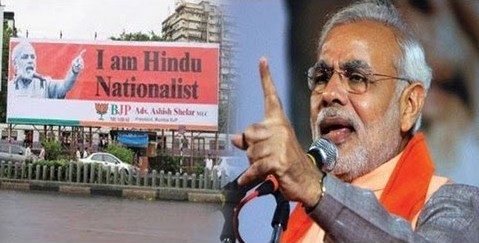
Narendra Modi

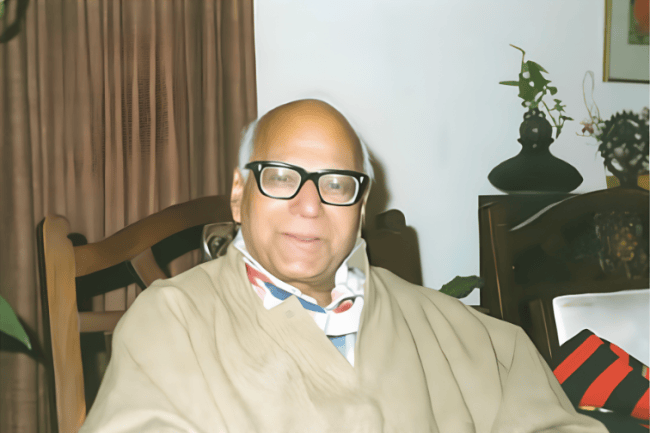
Ram Swarup: Outline of a biography – Koenraad Elst

Ram Swarup

The wittiest mind in Delhi

In the long run, Ram Swarup will probably prove to have been the most influential Hindu thinker in the second half of the 20th century. He has, at any rate, been a crucial influence on most other Hindu Revivalist authors of the last couple of decades.

Ram Swarup was born in 1920 as the son of a rais/banker in Sonipat, Haryana, in the Garg gotra of the merchant Agrawal caste. He was a good student and earned a degree in Economics from Delhi University in 1941. He joined the Gandhian movement and acted as the overground contact (“postbox”) for underground activists including Aruna Asaf Ali during the Quit India agitation of 1942. He spent a week in custody when a letter bearing his name was found in the house of another activist, the later homeopath Ram Singh Rana. After his release, and until the end of the war, he worked as a clerk in the American office in Delhi which had been set up in the context of the Allied war effort against Japan.

In that period, his wit made him quite popular in progressive circles in the capital. He was a declared socialist, a great fan of Aldous Huxley and a literary imitator of George Bernard Shaw. In 1944, he started the “Changers’ Club”, alluding to Karl Marx’s dictum that philosophers have interpreted the world instead of changing it. Of course, it was never more than a discussion forum for a dozen young intellectuals, including the future diplomat L. C. Jain, the future Planning Commission member Raj Krishna, future Times of India editor Girilal Jain, and historian Sita Ram Goel. At that time, Ram Swarup was a committed atheist, and in the Changers’ Club manifesto he put it in so many words: “Butter is more important than God.”

The Changers’ Club published two essays, both by Ram Swarup: Indictment, a highly critical review of the failed 1942 Quit India movement, and Mahatma Gandhi and His Assassin, written immediately after the murder of the Mahatma by the Pune-based journalist and Hindu Mahasabha activist Nathuram Godse on 30 January 1948. Written from a purely Gandhian perspective, its main thesis was that a society of small men cannot stand the presence of such a great man for very long: martyrdom was only befitting a man of Gandhiji’s greatness. Ram Swarup showed no interest in Godse’s motives, but he did appreciate that after the disaster of Partition, the urge to exact some punishment somewhere, though misguided (and in targeting Gandhi, misdirected), was a sign that Hindu society was not entirely dead, for suffering a calamity like the Partition and swallowing it without reaction would be a sure sign of virtual death.

At that time, the Changers’ Club was already disintegrating because its members plunged into real life, e.g. L. C. Jain became the commander of the largest camp for Partition refugees and organized the rehabilitation of Hindu refugees from the North-West Frontier Province in Faridabad, outside Delhi. In 1948-49 Ram Swarup briefly worked for Gandhi’s English disciple Mira Behn (Miss Madeleine Slade) when she retired to Rishikesh to edit her correspondence with Gandhiji. The project was not completed, but he was to remain close to Gandhism for the rest of his life.

Anti-Communism

Just around the time of Independence, Ram Swarup developed strong opinions about the ideology which was rapidly gaining ground among the intelligentsia around him: Communism. His first doubts developed in connection with purely Indian aspects of Communist policy. When the CPI defended the Partition scheme with contrived socio-economic arguments, he objected that the Partition would only benefit the haves among the Muslims, not the have-nots. His doubts deepening, he moved in a direction opposite to the ideological fashion of the day, and became one of India’s leading anti-Communists.

In 1949, Ram Swarup and Sita Ram Goel set up their own anti-Communist think-tank in Calcutta, then as now the centre of Indian Communism. It was called the Society for the Defence of Freedom in Asia. Among its first publications was Ram Swarup’s book Russian Imperialism: How to Stop It, written during the conquest of China by Mao Zedong, when the onward march of Communism seemed unstoppable. The book drew the attention of top Congress leaders worried about Jawaharlal Nehru’s steering the country in a pro-Soviet direction.

Still in 1949, Home Minister Sardar Vallabhbhai Patel decided to set up a think-tank specifically devoted to monitoring Communism, the Democratic Research Service, which was formally started in November 1950. (Related in Minoo Masani: Against the Tide, p.54.) It was sponsored by the industrialist Birla family, and initially led by Morarji Desai, who passed the job on to Minoo Masani (1905-98), a Parsi and former co-founder of the Congress Socialist Party (1934), later founder of the pro-Western Swatantra Party (1959-75). It was as secretary of the DRS that Ram Swarup prepared a History of the Communist Party of India, which Masani published in his own name.

A lot of bad blood developed between Masani and Ram Swarup, who quit the DRS to join Sita Ram Goel in Calcutta. Meanwhile, the DRS continued to be operative, but beyond publishing the meritorious periodical Freedom First, it never became very dynamic. In his memoirs about the anti-Communist struggle, Against the Tide, Masani did not even mention Ram Swarup or Sita Ram Goel, much less acknowledge Ram Swarup’s hand in the History of the CPI.

There was yet another anti-Communist centre in India, the Congress for Cultural Freedom, an international network with chapters in most countries of the free world. In India, it published the periodical Quest (Calcutta) and, for the Chinese public, China Report (New Delhi); Girilal Jain was among its Indian collaborators. However, it lost all credit when, in 1966-67, it was found out to be financed by the CIA (though by early 1966, its financing had been taken over by the Ford Foundation). (See K. Vanden Berghe: Het Congres voor de Vrijheid van de Cultuur, Onze Alma Mater, Leuven, 1997/2, p.193-211.)

The most authentic and effective Indian centre of fact-finding and consciousness-raising about the Communist menace was and remained undoubtedly the Society for the Defence of Freedom in Asia. Though routinely accused of being lavishly financed by the CIA, this organization started with just Rs. 30,000, half of which was brought in by Goel personally, and continued its work with the help of donations by friends, its budget seldom exceeding Rs. 10,000. It published some important studies, which were acclaimed by leading anti-Communists in the West and Taiwan, and on one occasion vehemently denounced in the Pravda and the Izvestia. Until its closing in December 1955, the centre was the main independent focus of ideological opposition to Communism in the Third World.

Ram Swarup’s main books on Communism are:

  • Let us Fight the Communist Menace (1949);
  • Russian Imperialism: How to Stop It (1950);
  • Communism and Peasantry: Implications of Collectivist Agriculture for Asian Countries (1950, but only published in 1954);
  • Gandhism and Communism (1954);
  • Foundations of Maoism (1956).

His Gandhism and Communism, which emphasized the need to raise the struggle against Communism from a military to a moral and ideological level, was brought to the attention of Western anti-Communists including several US Congressmen, and some of its ideas were adopted by the Eisenhower administration in its agenda for the Geneva Conference in 1955.

Later, Arun Shourie wrote about Ram Swarup’s struggle against Communism: “Ram Swarup, now in his seventies, is a scholar of the first rank. In the 1950s when our intellectuals were singing paeans to Marxism, and to Mao in particular, he wrote critiques of communism and of the actual—that is, dismal—performance of communist governments. He showed that the ‘sacrifices’ which the people were being compelled to make had nothing to do with building a new society in which at some future date they would be heirs to milk and honey. (…) He showed that the claims to efficiency and productivity, to equitable distribution and to high morale which were being made by these governments, and even more so by their apologists in countries such as India, were wholly sustainable, that in fact they were fabrications. Today, any one reading those critiques would characterise them as prophetic. But thirty years ago, so noxious was the intellectual climate in India that all he got was abuse, and ostracism.” (“Fomenting reaction”, in A. Shourie: Indian Controversies, p.293.)

Ram Swarup as a Hindu Revivalist

Initially, Ram Swarup saw Gandhism as the alternative to Communism, and he has never really rejected Gandhism. He continued to explore the relevance of Gandhism to real-life problems, e.g. in his booklet Gandhian Economics (1977). Gandhian inspiration is also palpable in his The Hindu View of Education (1971), the text of a speech given before the convention of the RSS student organization Akhil Bharatiya Vidyarthi Parishad. But gradually, he moved from the Gandhian version of Hinduism to a more comprehensive understanding of the ancient Hindu tradition.

His first booklet on Hindu religion was written just after Dr. Bhimrao Ambedkar’s conversion to Buddhism in 1956: Buddhism vis-a-vis Hinduism (1958, revised 1984). It took a moderate view of the much-debated relation of Buddhism to its mother tradition, affirming that the Buddha was a Hindu (just as Jesus was a Jew), but conceding that Buddhism had a typical atmosphere setting it apart from the Hindu mainstream.

By the late 1970s, his focus had decisively turned to religious issues. Apart from a large number of articles published in Organiser, in Hinduism Today (Honolulu), and in some mainstream dailies (in the 1980s The Telegraph, The Times of India and the Indian Express, in recent years mostly the Observer of Business and Politics and the Birla family’s paper Hindustan Times), Ram Swarup’s contribution to the religious debate consists of the following books:

  • The Word as Revelation: Names of Gods (1980), on the rationale of polytheism;
  • Hinduism vis-a-vis Christianity and Islam (1982, revised 1992);
  • Christianity, an Imperialist Ideology (1983, with Major T.R. Vedantham and Sita Ram Goel);
  • Understanding Islam through Hadis (1983 in the USA by Arvind Ghosh, Houston; Indian reprint by Voice of India, 1984); in 1990, the Hindi translation was banned;
  • Foreword to a republication of D. S. Margoliouth’s Mohammed and the Rise of Islam (1985, original in 1905);
  • Foreword to a republication of William Muir’s The Life of Mahomet (1992, original in 1894);
  • Woman in Islam (1994); Hindu Dharma, Isaiat aur Islam (1985, Hindi: “Hindu Dharma, Christianity and Islam”); Hindu View of Christianity and Islam (1993, a republication of the above-mentioned forewords to books on Mohammed by Muir and Margoliouth plus an enlarged version of Hinduism vis-a-vis Christianity and Islam).

Syed Shahabuddin, who had managed to get Salman Rushdie’s The Satanic Verses banned (September 1988), made an attempt to get Hindu View of Christianity and Islam banned as well, but a prompt reaction by Arun Shourie in his weekly column and a petition of intellectuals led by Prof. K. S. Lal contributed to the defeat of this attempt. (See K. Elst: “Banning Hindu Revaluation”, Observer of Business and Politics, 1-12-1993, and S. R. Goel, ed.: Freedom of Expression, 1998).

  • Ramakrishna Mission. Search for a New Identity (1986), a critique of the RK Mission’s attempt to redefine itself as “non-Hindu”;
  • Cultural Alienation and Some Problems Hinduism Faces (1987);
  • Foreword to Anirvan: Inner Yoga (1988, reprint 1995);
  • Hindu-Sikh Relationship (1985);
  • Foreword to the republication of Sardar Gurbachan Singh Talib, ed.: Muslim League Attack on Sikhs and Hindus in the Punjab, 1947 (1991; the original had been published in 1950 by the Shiromani Gurdwara Prabandhak Committee, Amritsar), also separately published as Whither Sikhism? (1991);
  • Hindu-Buddhist Rejoinder to Pope John-Paul II on Eastern
  • Religions and Yoga (1995), a rejoinder to a papal statement opposing yogic spirituality.

Departing

Ram Swarup was a quiet and reflective type of person. He never married, never went into business, hardly ever had a job, never stood for an election, never joined an organization or party. When I first met him in 1990, he lived in a rooftop room in the house of the late industrialist Hari Prasad Lohia, a sponsor of a variety of Hindu sages (including even Bhagwan Shree Rajneesh). He had been living with the Lohia family in their Calcutta or Delhi property since 1955; in 1996 he moved to his late brother’s house. At any rate, his biography is not very eventful apart from his daily yoga practice and his pioneering intellectual work.

He had been in rather good health when unexpectedly, he was found dead on his bed after his afternoon nap on 26 December 1998. The family doctor gave brain hemorrhage as the cause of death. He left no children but many Hindus felt orphaned when the flames consumed Ram Swarup’s earthly remains.

» Dr Koenraad Elst is a Belgium historian and orientatist who publishes with Voice of India.

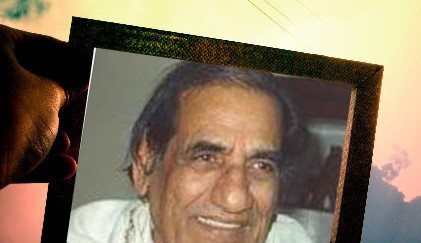
Sita Ram Goel: The sagely activist – Pradeep Kumar Goel with Rajiv Malik

Sita Ram Goel

Pradeep Goel“We are proud that Sita Ram Goel brought forward new ideas in defense of Hindu society, and that they were well written. We can now see that people from all over the country and around the world were affected by this literature. Even the RSS (Rashtriya Swayamsevak Sangh) and the BJP (Bharatiya Janata Party), both Hindu nationalist organizations, used his literature. Not having such material themselves, they used Voice of India publications to give their positions substance.” – Pradeep Kumar Goel

Sita Ram Goel will be remembered by Hindus in India and around the world for a long time. For most of the last half of the twentieth century, he and mentor-friend Ram Swarup produced hundreds of books, articles and pamphlets extolling the glories of Hinduism while warning of its most malicious foes. They were a bold and outspoken twosome who published their works through the Voice of India (VOI), a publication house they created just for this purpose. Although both Sita Ram Goel and Ram Swarup have now passed away, the VOI is still active—dedicated exclusively to the promotion of issues important to the modern-day Renaissance of Hinduism, a cause for which Sita Ram Goel gladly and courageously dedicated his life.

Born on October 16, 1921, Sita Ram Goel finished his formal education with an MA in History in 1944 from the University of Delhi. Yet he spent his entire life pursuing and sharing a broad spectrum of knowledge on a variety of subjects. He was well versed in several languages and came to be respected as a scholar of literature, philosophy, religion, and sociology. By his own account, he drew his primary inspiration on all these subjects from Plato and Sri Aurobindo.

Although he developed a keen interest in communism during his college years, he turned against the ideology in 1949 when he came to understand the plight of people living in communist Russia. After 1950, he committed himself to informing the Indian people of the real theory and practice of communism in Stalin’s Russia and Mao’s China. His careful and tediously researched work during this time rightly earned him a reputation as a formidable activist.

Rivals both respected and feared his mighty insights, which were too often too true and well-articulated to easily refute. Sita Ram Goel chose to fight his battles so far above the common, war-torn terrain of human emotions that contenders not matching his wit were left to look like fools. Hence, direct challenges to his writings were few, if any. The most damaging effect upon his work came from rivals following a strategy of “strangling by silence, ” a crafty tactic of blocking the publication of his name and his works. Such a passive confinement, however, was not nearly enough to stop his intellectual assault on anti-Hindu forces. The writings of Sita Ram Goel are alive and well today.

On December 3, 2003, at the age of 83, Sita Ram Goel passed away peacefully in his sleep following a long illness. It was a quiet end to a humble yet dynamic life dedicated to the revitalization of Hinduism and the evolution of India. We at Hinduism Today were honored to have maintained a fruitful association with him for more than 20 years and will long remember our visits with him in New Delhi at his home and during his one visit with us here in Hawaii. He is survived by his two sons, Saroj Kumar Goel and Pradeep Kumar Goel.

Today, [Aditya Goel, Pradeep’s son] manages the Voice of India—[Pradeep passed away suddenly in January 2005]—which is supported both by donations and by VOI profits which are invested back into publications. Hinduism Today correspondent Rajiv Malik recently chatted with Pradeep in New Delhi about his father, the state of Hinduism today and the prospects for India tomorrow. Here are some excerpts.

Q : When did you first realize your father was a Hindu activist?

A : In 1952 my father brought us to New Delhi from Calcutta. I was just seven years old then and too young to understand the kind of work he was doing. In 1964 there was some talk of his being arrested, but even at that time I was not really aware of what was going on. All I knew was that he had written a book criticizing Nehru, following the war with China, and a lot of people were getting upset. As time went on, my father brought together some Hindu scholars interested in defending Hindu society. This group stimulated the creation of the Voice of India in 1980. It was only then that I began to read my father’s articles with interest and finally understood his work as a Hindu activist. At that time I was 35 years of age. Now I am 54.

Q : What inspired your father to become an activist?

A :  He felt that the Hindu society was going through a crisis and that a Hindu renaissance was necessary. He wanted to do his part in bringing about change, but gained the confidence and guidance to do so from Ram Swarup, his close friend and advisor. Together, these two men wrote pamphlets that were forceful and strong, with titles like Hindu Society Under Siege, Defense of Hinduism and Perversion of India’s Political Parlance. Eventually they decided that, to do this kind of controversial work, they needed their own publication house.

Q : What was your father’s most important contribution to the Hindu renaissance?

A : We are proud that he brought forward new ideas in defense of Hindu society, and that they were well written. We can now see that people from all over the country and around the world were affected by this literature. Even the RSS (Rashtriya Swayamsevak Sangh) and the BJP (Bharatiya Janata Party), both Hindu nationalist organizations, used his literature. Not having such material themselves, they used Voice of India publications to give their positions substance.

Q : What was the core of your father’s message?

A : In the good old days, my father used to run an organization called the Society for Defense of Freedom in Asia. Ram Swarup, who was also associated with this organization, helped to bring about its focus. He proclaimed that humanity had suffered three terrible tragedies: Christianity, Islam and Communism.

Christianity is not now as bad as it used to be. The cruelties once practiced in the name of that religion have been eliminated by reforms. Now the only threat from the Christians comes from their missionary work. Because of the collapse of Soviet Russia, communism has also suffered a setback and has been weakened. The biggest danger humanity faces today comes from militant Islam. Sooner or later, we must take care of this threat that comes from these people. My father was saying this years ago. As I review his works today, I realize that his assessment of so many things was absolutely correct. He was ahead of his time.

Q : Did you ever feel that your father and your family were in danger because of his work?

A : Were there ever any threats? I could not say that we were really ever in danger. We may have thought so at the time. But, yes, there were some threats. My father would get postcards saying he was indulging in anti-Muslim activities and that one day his sons and grandsons would be converted to Islam. Also, the fact that father’s friends were frequently coming to him and advising him to act cautiously had us all a little worried. But he used to say that he had fulfilled his duties and was ready to face whatever consequences might come. He definitely had some spiritual power backing him up. All these threats that we received affected our family only monetarily, and only for a short time.

Q : Was there one single incident that alarmed you more than the rest?

A : Yes, one incident stands out. We were working on the Hindi edition of Ram Swarup’s book, Understanding Islam Through Hades. We had finished printing the book and had taken it to the bindery. This bindery was located in the Muslim area of Old Delhi. Although a Hindu owned it, some of the workers there were Muslim.

One Muslim boy saw the word Hades in the title of the book and took it to a Muslim priest, who declared the book anti-Islam. About a hundred people then gathered around the bindery in protest, and the binder called my father on the phone saying, “These people want to burn down my shop!” The police picked up the son of the shop owner and took him to the police station for questioning. Because my father was the publisher of the book, he was also picked up. As a result of all this, our Hindu friends and well-wishers also gathered at the police station. That was a night of turmoil. Our whole family was quite disturbed and worried that father might be tortured.

The next day was Sunday. A special court was convened to listen to our case. Although my father was released, the case took a long time to settle. It was introduced in 1987 and was finally settled sometime in 2000. In the end, all that happened was we were asked to delete certain portions of the book. We complied. But the antagonism of the whole incident really wore us down.

Q : Did your father have a support group during troubled times?

A : Most of my father’s Muslim and Christian friends deserted him when they came to know that his writings spoke against their religious beliefs. Although father put across his views in a very polite and analytical manner, there was often strong reaction. He used to say that just because he criticized Christianity, that did not mean he did not like Christians. He even invited critics to speak up against Hinduism in his same spirit. However, he did emphatically declare that it was clearly not fair to condemn Hinduism, then convert people from it.

Back in the eighties, my father aggressively defended Hinduism when there was a mass conversion of Hindus to Christianity at Meenakshipuram in South India. That one event was an important signal to my father that Hinduism was facing a major crisis and that something should be done to meet the challenge.

Q : Tell us about your father? What kind of person was he?

A : He was a very simple man with very few requirements. His food was simple. His life was simple. When we provided him with a car on behalf of our business, we asked him many times to engage a driver, but he never did. He said that a driver would just waste a lot of time waiting around for him.

My father’s general approach to life was always very humanitarian. He never wanted anyone else to get held up because of him. When he was active, he never required people to come to his house for a meeting. Rather, he would go and meet them at a place of their choosing.

Although he could have easily remained fully occupied writing his own books, he was always willing to help edit and organize the works of others. In fact, he used to insist that it was a part of his duty to promote the work of other deserving scholars. His first concern was to help the Hindu cause. He was a selfless man.

Q : Can you tell us a little about your mother?

A : My mother was always at home looking after us and performing her puja (worship). She was a pious lady. Her primary duty was to take care of the family. She was not really concerned with what my father was doing. She had a high regard for Ram Swarup and took him to be an enlightened person. She always assumed that, because my father was always working with him, nothing could go wrong. She died in 1981.

Q : How did your father’s work impact you and the rest of his family?

A : By 1980 my father had fulfilled his familial obligations and had lived a full life. All of his children were married and further business dealings were of no interest to him. He told us that he wanted to go full-time into writing and explained why.

“There are four types of debts, ” he said. “bhuta rin, deva rin, pitra rin and rishi rin. (Rin means “debt.”) Bhuta rin is one’s debt toward the ancestors. Deva rin is one’s debt toward the Gods. Pitra rin is one’s debt to the father, which includes taking care of the family. Rishi rin is one’s debt to the saints and rishis.”

My father felt that he was at the stage in life when he should be working to settle his debt with the rishis and saints by spreading their message. He felt that the vidya (knowledge) of the rishis should be passed on to mankind. He used to emphasize that he was doing this work without hope of getting a reward or becoming famous.

Q : Did your father cultivate any “disciples” to carry on his work?

A : Only Dr. Koenraad Elst, who lives in Belgium, could be considered a true disciple. Another person who was strongly influenced by my father and is now doing good work is N. S. Rajaram. Mr. Rajaram is based in South India and even today is a fearless fighter for the Hindu cause.

Other well-known scholars have extracted extravagantly from my father’s writings but have neglected to give him credit. This is plagiarism, no doubt. But my father used to insist that he was not bothered by it, so long as the right idea got promoted. Initially, I had our publication rights drawn up with a copyright clause, but my father directed me to remove it and let the people use the material any way they wanted.

Q : Why did your father write only in English?

A : Many people asked my father why he did not write in Hindi. His response was that because the Christians and Muslims were using English to put forward their message, and the media supporting them was English-based, he felt it was appropriate that his work should be published in English. He also made the point that the people who spoke Hindi as a first language were already with him ideologically and did not need to be educated or persuaded.

Q : What do people most frequently request from VOI?

A : We are contacted often for our publications on Hindu philosophy. Our best authors in this field are David Frawley and Koenraad Elst. Of course, the works of my father and Ram Swarup are also in demand, but they focused on Islam and Christianity.

Q : How would you assess the current response to VOI publications?

A : Today, the response is quite satisfactory, but our publications are fairly low-priced and therefore yield low profit margins for book sellers, which means the books are not usually kept in stock in the stores but rather are kept on display so that orders can be made directly to us by interested parties. Today, we have 95 titles in print. Twenty-nine are authored by Sita Ram Goel himself.

To be honest, the literary value of a book has little significance in the book selling business. The physical value of the book is what counts. If you want books by Aurobindo, you have to buy them from the Aurobindo Ashram. They are not available anywhere else. Books on Gandhi are only published by the government. It is the same with most good Hindu literature. If Gita Press does not publish it, no one will. There is just not much money in it.

Q : What guidelines did your father set up for you to do this work, yet make a good living and support your family?

A : My father’s guidelines stipulated first that I fulfill my responsibilities to my family. Then as time and resources allowed, I was to perpetuate the services of the VOI. To earn my livelihood, I manage Biblia Impex, a book export business that my father formed in 1964 to provide financial security for our family.

My father started Biblia Impex from a small table in a friend’s office. He would sit on one side of the table, and his typist would sit on the other side. He was one of the first Indian publishers to send books abroad without asking for advance payment. Other export businesses would never do this. They would always require money in advance. My father understood European integrity. He knew they were trustworthy.

Father used to tell me that I should not work for more than I required. Years ago, I had an opportunity to purchase some properties that could have made us very wealthy, but I did not do so.

Q : What are your plans to keep your father’s books in print, as well as produce edited versions, collections, and more?

A : My father used to make it clear that he had said what we wanted to say and that the work was complete. I feel that it is my duty now to see to it that the publications of the established writers for VOI—Sita Ram Goel, Ram Swarup, David Frawley, Rajaram and Koenraad Elst—are made available to the people. I will keep doing this as long as I am able.

So far as editing these publications is concerned, we would need some very highly qualified people to do this, writers who are at least as qualified as my father and Ram Swarup. At the moment, I am not aware of such people. It is far better that we just ask our established writers to present their own points of view rather than have them attempt to modify the works of people who were established experts in the subjects they handled.

Q : What about bringing his writings to the Internet?

A : Right now, we have 28 titles on the Internet. Our website is www.bharatvani.org/books. I must admit, however, that this effort is minimal at most. We just do not have the capacity to go into a more elaborate web presentation. Others might offer to undertake this work on our behalf, but we ourselves cannot. Our primary obligation is to perpetuate the printed material. Also, putting these works on the Internet is expensive. The Voice of India is not a commercial venture. Whatever money comes from selling the VOI publications is invested back into printing and distribution.

Q : Can you summarize your father’s legacy?

A : My father created an awareness of certain surreptitious forces threatening Hinduism and the fundamental culture of India. He made it his life’s mission to expose the real intentions of people who were disguised as benefactors but were secretly intent upon serving selfish ends. In his book entitled Hindu Society Under Siege, he clearly laid out how we Hindus are under attack from many fronts. He emphasized that the biggest problem was a lack of awareness of the problem.

He and Ram Swarup were always challenging Christian and Islamic tactics, and in their analyses of these strategies did much to clarify Hinduism. Initially people did not know how to compare Hinduism with Christianity and Islam. People assumed that because the Christians set up hospitals and schools, they were good people with well-meaning intentions. They did not understand that they might have ulterior motives.

My father realized that, to expose these Christian missionaries, it was necessary to analyze their literature and critique them in a logical manner. This in itself was a big revelation that brought about many positive results.

The people also did not understand Islam. None of us knew about Mohammad Sahib, Akbar, Babar and Aurengzeb. We just thought that they were rulers of India. We had no idea about the many injustices they had ruthlessly inflicted upon Hindus. Ram Swarup and my father presented the activities of these people clearly and within a historical perspective. They won our hearts with their minds.” – Hinduism Today, July/August/September, 2004

Sita Ram Goel and Voice of India