Modi’s rulership on probation, should prepare for a million mutinies now – R. Jagannathan

Narendra Modi

The problem with the Modi government is that well-meaning decisions driven from the top may not seem as good on the ground. Among the younger crowd, which is not used to listening to authority, they may even be seen as an imposition rather than a solution to a problem. … The important thing is to change the government’s DNA from rulership to consultation. – R. Jagannathan

By letting Dharmendra Pradhan go, albeit reluctantly, the Modi government may have bought itself some time to recoup political capital and rework its political calculations.

But the time it has bought may be weeks, not months. For once triggered, the chances are that every major citizen grievance will now be aired in public. Some could also lead to Jantar Mantar.

Already there is an E20 Janta Party in the making, comprising vehicle owners miffed about what E20, petrol blended with 20 per cent ethanol, may be doing to their vehicles. Soon you could have farmers and other groups vying to get into the action.

The Prime Minister, realising that the Jantar Mantar protests were driven by Gen Z, those in the 15–29 age group, and their Instagram posts, has himself gone on Instagram.

While there is no harm in this, he should not assume that his presence on the platform will change perceptions about this government. Reason: the Prime Minister is himself showing his age, and putting it on repeated view for a younger generation may not work with Gen Z.

So what exactly should the government be doing?

One, and most important, it must choose engagement with the youth over action driven from the top. The Gen Z grouse is not about any specific issue but about those in power not listening to what they are thinking, what they want out of life, and which things must be prioritised.

Of course, future careers are a big issue in our country, but it will not end with that. This cohort wants to be listened to. Having tasted blood at its first coming-out party, Gen Z is not going to go back to its studies.

The problem with the Modi government is that well-meaning decisions driven from the top may not seem as good on the ground. Among the younger crowd, which is not used to listening to authority, they may even be seen as an imposition rather than a solution to a problem.

The government has to develop the habit of listening to the youth and other social groups and then coming to decisions, rather than assuming that its own good intent is enough to justify a decision, as is the case with E20.

At the very least, it must offer alternatives to E20, even if 100 per cent petrol is priced higher. While ordinary vehicle owners are not going to create a chakka jam at Jantar Mantar, fleet operators and taxi owners might well do so.

So this is one trouble the government should see coming right now, and it should choose to engage with those raising concerns about E20. It is of course true that offering two fuel options may take time to implement, but being heard is the important thing here.

Two, this is also a kind of taxpayer revolt. While the vast majority of citizens do not pay any income tax, they do pay indirectly through the goods and services tax.

They also pay ‘private taxes’ in the form of bribes to various officials at the state or municipal levels, whether for traffic violations, birth and death certificates, or hospital and other subsidised services.

Our definition of the tax-paying middle class needs to change from one framed by income groups to a broader definition that looks at the middle-class mindset: anyone seeking to write competitive exams and pursue higher education, or consuming packaged foods, for example, should be considered middle class.

The emerging consuming classes are the larger middle class, even if their income levels do not always indicate their membership of this group.

Three, as Santosh Desai argues in his Times of India column of 27 July 2026, for Gen Z the only government they have known is the Modi government, not least because it has been seen everywhere and is also seen to be winning many elections.

So it will demand maximum accountability from the Modi government, even if most of their problems are not created by the Central government.

The Modi government would do well to start the process of devolving power to state governments, and to ask the latter to further devolve power to local bodies, for this is where citizens most interact with the state. The state governments will start feeling the heat soon enough.

The message is not merely to the Modi government but to all state governments and municipal authorities, none of whom is actually delivering good quality citizen services. They will all be vulnerable, but as the party which dominates Indian politics both at the Centre and in many states, the BJP will face searing heat.

Four, the CJP protests did not have any overt caste undertones, but many of the students protesting the NEET mess-up, and the larger problem of a lack of career opportunities, were also worried about the creeping nature of educational and job reservations.

But anyone who tries to interfere with reservations as they currently exist will inevitably face a political backlash, which could well set off a caste war.

This is precisely what will sink the BJP’s boat, for it is dependent on a Hindu vote consolidation that subsumes caste. If we end up with caste-based conflict, 2029 will be an uphill battle for the BJP, especially since minority consolidation against it is a reality.

Five, all political parties now need to heed the call for better governance and citizen services. Till now, thanks to the government’s ability to offer freebies using the Jan Dhan–Aadhaar–Mobile facility, politicians have been busy emptying the exchequer to win elections.

While no one can discount the probability of a well-aimed freebie bringing in the incremental vote, future elections will be about freebie-plus, not just freebies. If NEET can cause a political convulsion, why not garbage and traffic jams and poor health services?

Six, the judiciary and the news media should not consider themselves free from large-scale scrutiny. At the Jantar Mantar protests, many journalists were given abusive treatment, sometimes even with physical jostling.

The judiciary has not yet been a direct target, but the students on the prowl at Jantar Mantar did not have much reverence for it either. In fact the term ‘cockroach’ itself came courtesy of a casual remark made by the Chief Justice of India.

So, to repeat, what should the Modi government, or any government at any level, do?

One, it should consider initiating huge reforms by consulting Gen Z representatives, among others, apart from experts. This does not mean only the CJP, but many more youth leaders and organisations who understand the pulse of this cohort. Other political parties and citizen groups should also be kept in the loop.

Two, there should be committees and consultations for reforms in agriculture, education, health, skilling, bureaucracy, judiciary and, most important, political reforms. The last is the biggest cause of corruption.

The judiciary should know that while the executive will be held accountable for its lapses, the judiciary itself is one of the worst-performing arms of the state. So too is the bureaucracy. These reforms will not happen in a day, but if Modi is smart he will use the opportunity to drive change in the judiciary and bureaucracy too.

Three, the Modi cabinet could do with a huge amount of spring cleaning. It clearly needs fresh blood, young blood, and this must be visible. Some performing ministers, such as Ashwini Vaishnaw, are clearly overburdened, and some others seem compromised.

Nitin Gadkari is one of the performers, but he was seen to be insensitive to the concerns of vehicle owners on E20. He does not need to resign, but he could, along with petroleum minister Hardeep Singh Puri, consider setting up a panel with the aggrieved parties to take a relook at the whole E20 plan, including the possibility of gradually separating E20 from 100 per cent petrol priced higher. Consultation is key to forward movement.

Already, even after Pradhan’s exit, the Modi government has missed two opportunities.

First, it announced the formation of a committee headed by Nandan Nilekani for fixing the exam system and its infirmities. But it could have done this in consultation with some Gen Z representatives.

Second, it named Pralhad Joshi as the new Education Minister. But he does not represent change. A younger face in the ministry, even at the Minister of State level, would have been better.

The CJP movement is ultimately not about NEET or Dharmendra Pradhan. It is about demanding a higher quality of governance and performance from all arms of the state.

The Modi government is on probation, but so is the system itself. How Narendra Modi navigates these challenges over the next few years will determine whether he gets to influence the 2029 elections or is pushed aside by a rising tide of dissent. India is again at the threshold of a million mutinies.

But this is not just a threat. If Modi navigates it successfully, his legacy will not only survive but thrive. The important thing is to change the government’s DNA from rulership to consultation. – TheJaggi, 26 July 2026

› R. Jagannathan is senior journalist and former editorial director at Swarajya magazine. 

India's GenZ

Somnath: A thousand years of unbroken faith – Narendra Modi

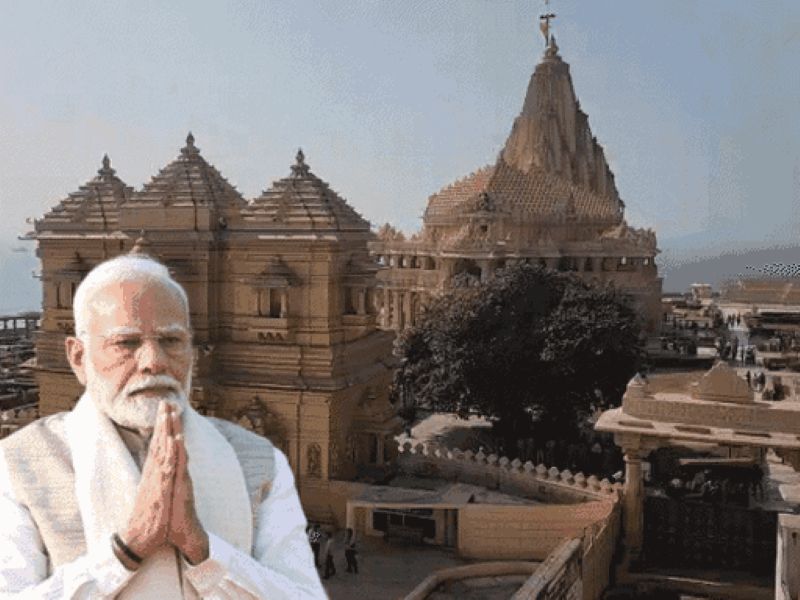
Narendra Modi at the Somnath Temple.

If the Somnath Temple, which was attacked a thousand years ago and faced continuous attacks thereon, could rise again and again, then we can surely restore our great nation to the glory it embodied a thousand years ago before the invasions. – PM Narendra Modi

Somnath … hearing this word instils a sense of pride in our hearts and minds. It is the eternal proclamation of India’s soul. This majestic temple is situated on the western coast of India in Gujarat, at a place called Prabhas Patan. The Dwadasha Jyotirling Stotram mentions the 12 Jyotirlings across India. The stotram begins with “सौराष्ट्रे सोमनाथं च…” symbolising the civilisational and spiritual importance of Somnath as the first Jyotirling.

It is also said:

सोमलिङ्गं नरो दृष्ट्वा सर्वपापैः प्रमुच्यते ।

लभते फलं मनोवाञ्छितं मृतः स्वर्गं समाश्रयेत्॥

It means: Just the sight of Somnath Shivling ensures that a person is freed of sins, achieves their righteous desires and attains heaven after death.

Tragically, this very Somnath, which drew the reverence and prayers of millions, was attacked by foreign invaders, whose agenda was demolition, not devotion.

The year 2026 is significant for the Somnath Temple. It has been 1,000 years since the first attack on this great shrine. It was in January of 1026 that Mahmud of Ghazni attacked this temple, seeking to destroy a great symbol of faith and civilisation, through a violent and barbaric invasion.

Yet, one thousand years later, the temple stands as glorious as ever because of numerous efforts to restore Somnath to its grandeur. One such milestone completes 75 years in 2026. It was during a ceremony on May 11th 1951, in the presence of the then President of India, Dr. Rajendra Prasad, that the restored temple opened its doors to devotees.

The first invasion of Somnath a thousand years ago in 1026, the cruelty that was unleashed upon the people of the town and the devastation that was inflicted upon the shrine have been documented in great detail in various historical accounts. When you read them, the heart trembles. Each line carries the weight of grief, cruelty and a sorrow that refuses to fade with time.

Imagine the impact it had on Bharat and the morale of the people. After all, Somnath had great spiritual significance. It was also on the coast, giving strength to a society with great economic prowess, whose sea traders and seafarers carried tales of its grandeur far and wide.

Yet, I am proud to state unequivocally that the story of Somnath, a thousand years after the first attack, is not defined by destruction. It is defined by the unbreakable courage of crores of children of Bharat Mata.

The medieval barbarism that began a thousand years ago in 1026 went on to ‘inspire’ others to repeatedly attack Somnath. It was the start of an attempt to enslave our people and culture. But, each time the temple was attacked, we also had great men and women who stood up to defend it and even made the ultimate sacrifice. And every single time, generation after generation, the people of our great civilisation picked themselves up, rebuilt and rejuvenated the temple. It is our privilege to have been nurtured by the same soil that has nurtured greats like Ahilyabai Holkar, who made a noble attempt to ensure devotees can pray at Somnath.

In the 1890s, Swami Vivekananda visited Somnath and that experience moved him. He expressed his feelings during a lecture in Chennai in 1897 when he said:

“Some of these old temples of Southern India and those like Somnath of Gujarat will teach you volumes of wisdom, will give you a keener insight into the history of the race than any amount of books.

“Mark how these temples bear the marks of a hundred attacks and a hundred regenerations, continually destroyed and continually springing up out of the ruins, rejuvenated and strong as ever! That is the national mind, that is the national life-current. Follow it and it leads to glory. Give it up and you die; death will be the only result, annihilation, the only effect, the moment you step beyond that life current.”

The sacred duty of rebuilding the Somnath Temple after independence came to the able hands of Sardar Vallabhbhai Patel. A visit during Diwali time in 1947 moved him so much that he announced that the temple will be rebuilt there. Finally, on May 11th 1951, a grand temple in Somnath opened its doors to devotees and Dr. Rajendra Prasad was present there. The great Sardar Sahib was not alive to see this historic day, but the fulfilment of his dream stood tall before the nation.

The then Prime Minister, Pandit Jawaharlal Nehru, was not too enthused with this development. He did not want the Honourable President as well as Ministers to associate with this special event. He said that this event created a bad impression of India. But Dr. Rajendra Prasad stood firm and the rest is history. No mention of Somnath is complete without recalling the efforts of K.M. Munshi, who supported Sardar Patel very effectively. His works on Somnath, including the book, Somanatha: The Shrine Eternal, are extremely informative and educative.

Indeed, as the title of Munshiji’s book conveys, we are a civilisation that carries a sense of conviction about the eternity of spirit and of ideas. We firmly believe that that which is eternal is indestructible, as outlined in the famous Gita verse “नैनं छिन्दन्ति शस्त्राणि….” There can be no better example of our civilisation’s indomitable spirit than Somnath, which stands gloriously, overcoming odds and struggles.

It is this same spirit that is visible in our nation, one of the brightest spots of global growth, having overcome centuries of invasions and colonial loot. It is our value systems and the determination of our people that have made India the centre of global attention today. The world is seeing India with hope and optimism.

They want to invest in our innovative youngsters. Our art, culture, music and several festivals are going global. Yoga and Ayurveda are making a worldwide impact, boosting healthy living. Solutions to some of the most pressing global challenges are coming from India.

Since time immemorial, Somnath has brought together people from different walks of life. Centuries ago, Kalikal Sarvagna Hemchandracharya, a respected Jain monk, came to Somnath. It is said that after praying there, he recited a verse, “भवबीजाङ्करजनना रागाद्या: क्षयमुपगता यस्य।”. It means: “Salutations to That One in whom the seeds of worldly becoming are destroyed, in whom passion and all afflictions have withered away.” Today, Somnath holds the same ability to awaken something profound within the mind and soul.

A thousand years after the first attack in 1026, the sea at Somnath still roars with the same intensity as it did back then. The waves that wash the shores of Somnath tell a story. No matter what, just like the waves, it kept rising again and again.

The aggressors of the past are now dust in the wind, their names synonymous with destruction. They are footnotes in the annals of history, while Somnath stands bright, radiating far beyond the horizon, reminding us of the eternal spirit that remained undiminished by the attack of 1026. Somnath is a song of hope that tells us that while hate and fanaticism may have the power to destroy for a moment, faith and conviction in the power of goodness have the power to create for eternity.

If the Somnath Temple, which was attacked a thousand years ago and faced continuous attacks thereon, could rise again and again, then we can surely restore our great nation to the glory it embodied a thousand years ago before the invasions. With the blessings of Shree Somnath Mahadev, we move forward with a renewed resolve to build a Viksit Bharat, where civilisational wisdom guides us to work for the welfare of the whole world.

Jai Somnath! – The New Indian Express, 5 January 2026

› Narendra Modi is the Prime Minister of India and Chairman of the Shri Somnath Temple Trust.

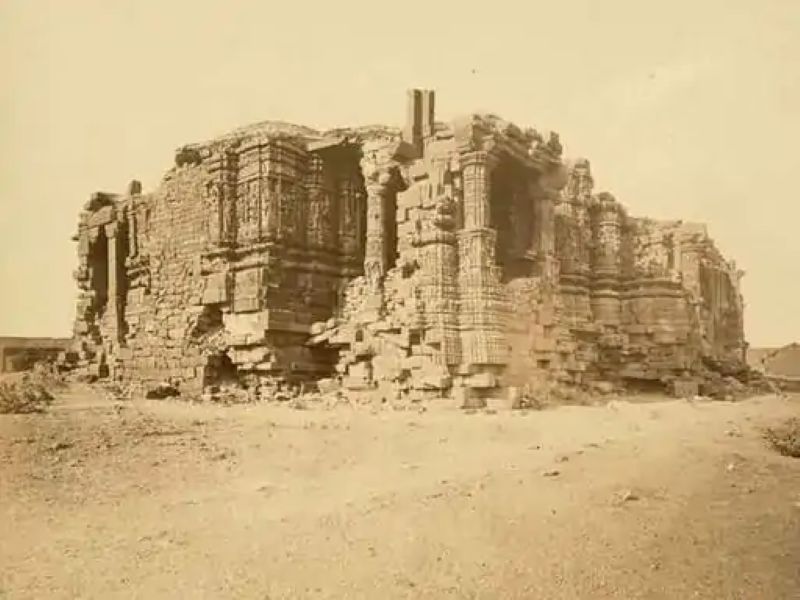
Ruins of Somnath as viewed in 1869

Colonised Minds: Modi didn’t speak the whole truth at Ayodhya – Balbir Punj

PM Modi raising the flag over the Ram Temple at Ayodhya (Nov.25, 2025).

What Modi said at Ayodhya about the Macaulay mindset is true, but unfortunately not the whole truth. India’s influential political, intellectual, and social elite has long been influenced not only by Macaulay but also by the ideological legacy of Karl Marx. Since independence, this powerful network has worked tirelessly—both jointly and separately—to carry forward the unfinished agenda of these two, who never met but shared a hatred for India’s timeless civilisation. – Balbir Punj

Recently, Prime Minister Narendra Modi vowed to liberate India completely from the Macaulayite mindset. In his words:

“Alongside pride in our heritage, one more task is equally vital-and that is the complete eradication of the mindset of servitude. Nearly 190 years ago, in 1835, a Briton named Macaulay sowed the seeds of uprooting India from her civilisational roots. It was Macaulay who laid the foundation of India’s mental colonisation. Ten years from now, in 2035, that unfortunate episode will complete two hundred years. Only a few days ago, at another event, I urged the nation to adopt the coming decade as a mission-a resolve that in these ten years, we shall free India entirely from this mindset of slavery.”

PM Modi hit the nail on the head, and what better place than Ayodhya to do so. The seven-decade delay in building the Shri Ram Janmabhoomi Temple symbolises the lingering scars of colonised mindsets. The temple could have been constructed soon after independence and marked the conclusion of India’s struggle to reclaim its self-respect and identity.

However, opposition driven by Macaulay-Marxist influences turned it into a Hindu-Muslim issue. Their colonial mindset created misleading narratives, resulting in endless litigation, damage to Hindu-Muslim relations, and the loss of many innocent lives and properties. I have explored this topic in detail in my book Tryst with Ayodhya: Decolonisation of India.

What Modi said about the Macaulay mindset is true, but unfortunately not the whole truth. India’s influential political, intellectual, and social elite has long been influenced not only by Macaulay but also by the ideological legacy of Karl Marx. Since independence, this powerful network has worked tirelessly—both jointly and separately—to carry forward the unfinished agenda of these two, who never met but shared a hatred for India’s timeless civilisation.

Thomas Babington Macaulay was a staunch capitalist and imperialist. In contrast, Karl Marx was the pioneer of Leftist ideology, focusing on class struggle while sharply criticising capitalism. Despite their ideological differences, both shared a common goal: to diminish India’s presence in the minds and hearts of its people. As a result, when the British, in collusion with the Muslim League, moved the subcontinent towards an inevitable partition, the contemporary Left intelligentsia not only justified it but also mused about breaking India into more than fifteen smaller pieces.

Macaulay’s 1835 education policy aimed at shaping a class of Indians who would be “Indian in blood and colour, but English in taste, in opinions, in morals and in intellect”-a group that would support British rule. His policies encouraged Indians to look down on their own civilisational roots and to detach mentally from their cultural foundations. So strong was his disdain that he famously claimed the entire “native literature of India” and learning was not “worth” even a “single shelf of a good European library”.

Macaulay’s project was not merely colonial; it was deeply evangelical. Writing to his father on  October  12, 1836, he declared:

“… Our English schools are flourishing wonderfully… The effect of this education on the Hindoos is prodigious. No Hindoo who has received an English education ever continues to be sincerely attached to his religion. Some continue to profess it as a matter of policy, and some embrace Christianity… It is my firm belief that, if our plans of education are followed up, there will not be a single idolater among the respectable classes in Bengal thirty years hence. …”

Macaulay’s thoughts aligned with the 1813 Charter Act of the East India Company, which encouraged European missionaries’ evangelical efforts in India. From this colonial origin, divisive ideas like the Aryan Invasion Theory, the Dravidian Movement, and the claim that “India is not a nation” arose, still influencing Indian politics and academia.

British rule in India, ironically, fulfilled Marx’s worldview, at least in one way. His satisfaction is evident in his column—“The Future Results of British Rule in India” published on 8 August 1853 in the New York Daily Tribune, where he wrote:

“The British were the first conquerors superior, and therefore inaccessible to Hindoo civilisation. They destroyed it by breaking up the native communities, by uprooting the native industry, and by levelling all that was great and elevated in the native society.”

Mark these words, “… they destroyed it by breaking up the native communities, by uprooting the native industry…” This sentence by Marx, over 170 years old, summarises how India was culturally and economically destroyed by colonial powers. Marx celebrated this destruction of Indian culture and industry as necessary for revolution, as culture and economics are intertwined—destroying one kills the other.

He further added in “The Future Results of British Rule in India”:

“England has to fulfil a double mission in India: one destructive, the other regenerating—the annihilation of old Asiatic society and laying the material foundations of Western society in Asia.”

Marx’s contempt for Indian traditions was further exposed in another New York Daily Tribune article “The British Rule in India,” dated 25 June 1853:

“… We must not forget that these little communities were contaminated by distinctions of caste and by slavery, that they subjugated man to external circumstances instead of elevating man the sovereign of circumstances, that they transformed a self-developing social state into never-changing natural destiny, and thus brought about a brutalising worship of nature, exhibiting its degradation in the fact that man, the sovereign of nature, fell down on his knees in adoration of Hanuman, the monkey, and Sabala, the cow. …”

Marx authored this caricature without visiting India, yet many of his ideological successors spread this disdain in independent India. Sanatan philosophy views man as part of the cosmic order, not its master. India’s Vedic culture, with deep roots, supported a thriving economy from the first to the seventeenth century, acknowledged by global research.

The liberation from the colonial Macaulay-Marx mindset—an emancipation that should have started immediately after independence—only gained momentum after 2014, with some exceptions. The Guardian’s May 18, 2014 editorial highlighted this shift:

”Narendra Modi’s victory in the elections marks the end of a long era in which the structures of power did not differ greatly from those through which Britain ruled the subcontinent. India under the Congress party was in many ways a continuation of the British Raj by other means. The last of midnight’s children are now a dwindling handful of almost 70-year-olds, but it is not the passing of the independence generation that makes the difference.”

Post-independence, there was a unanimous demand in Ayodhya from civil society, the political leadership of United Provinces (as Uttar Pradesh was called then), and the top echelons of state bureaucracy for handing over the Shri Ram Janmabhoomi site to Hindus, but the colonialists led by the then Prime Minister Nehru wouldn’t let that happen.

In this context, the Shri Ram Janmabhoomi Temple in Ayodhya stands as a living symbol of Sanatan resurgence and a national resolve to break free from colonial consciousness.

When, amid Vedic rituals on  November 25, the PM raised the standard of Sanatan in Ayodhya, it was a definitive statement about India’s civilisational renaissance and its quest to dismantle the colonial mindset. No wonder the Macaulay-Marxist pack is in a funk.

› Balbir Punj is an eminent columnist and the author of “Tryst with Ayodhya: Decolonisation of India” and “Narrative ka Mayajaal”.