The false promise tactic deployed at Troy, and which Odysseus regrets, mirrors one used by Western and Northern Europeans from the 15th century onwards to colonise the world. Although deception is inherently woven into warfare, the scale and systematic nature of colonial deception set it apart. – Dr. Kadira Pethiyagoda
The defining themes in Christopher Nolan’s new epic are trust and regret. The main character, Odysseus, regrets many things, but perhaps most overarching is his regret at the fundamental breach of trust that was the Trojan Horse. The Greeks exploited the trust of the Trojans in order to obtain a victory they were unable to win on the battlefield.
Matt Damon’s Odysseus laments this lie as helping to plunge the world into darkness, a mistake that may be made again in the distant future (differing from Homer’s original). Damon’s character was correct. Two and a half millennia later, Western and Northern Europeans would use deception as a key tool to dominate the world. The trust of indigenous civilisations and peoples would be breached over and over again in order to defeat and subjugate them—from the Spanish deceiving the Aztecs to the British surreptitiously taking control of Indian kingdoms they had promised to ally with.
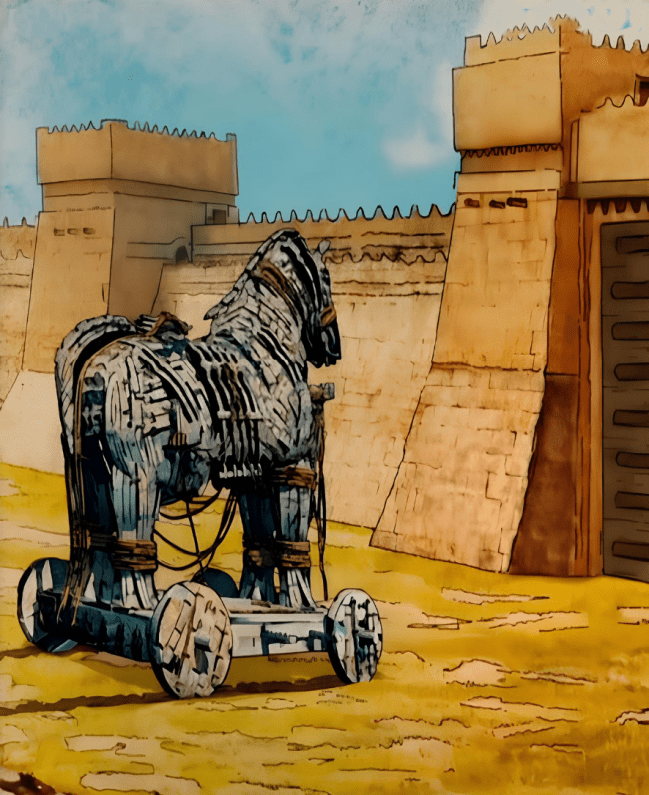
Throughout the Odyssey film, we are told of Zeus’s law, xenia, the welcoming of strangers—an act underpinned by deep trust. Odysseus holds the principle of trust dear, even plucking his bow to warn prey when hunting. But the backstory to the Odyssey is one of deception. The Greeks told the Trojans that the enormous wooden horse they had left on the beach was an offering to the gods and a peace offering to the Trojans. The Trojans, presumably trusting that no one would cynically exploit sacred rituals, brought the horse inside their fortified gates. The Greeks, some of whom had been hiding in the horse, then proceeded to open Troy’s gates from the inside so that the city could be ransacked and the kingdom toppled.
Both the ancient Greeks and Trojans were Mediterranean, polytheistic peoples who interacted more with the civilisations of West Asia than they did with the tribes of Western and Northern Europe. The ancient Greeks engaged in more diplomatic, economic and cultural exchange with ancient India (e.g. Greco-Buddhist art) than with Bronze Age Britain. Nevertheless, the tactic deployed at Troy, and which Odysseus regrets, mirrors one used by Western and Northern Europeans from the 15th century onwards to colonise the world. Although deception is inherently woven into warfare, the scale and systematic nature of colonial deception set it apart.
In the 1500s, after landing in Central America, the Spanish conquistador Cortés pretended to be an ambassador sent by the world’s most powerful king to deliver greetings and establish trade. He knew the Aztecs would adhere to their codes of conduct, preventing them from attacking a peaceful envoy. The Aztec ruler Montezuma welcomed the Spaniards, lodging them in the palace of his late father. Within one week, they had taken Montezuma hostage inside the very same palace. Within one century, 56 million indigenous people had died as a result of European colonisation of the Americas.
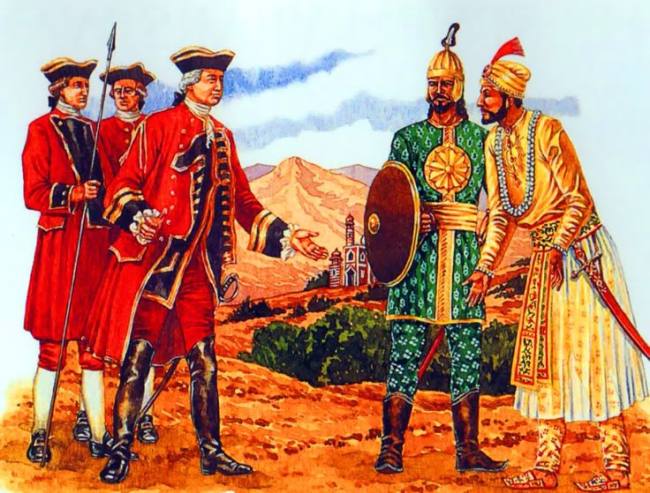
Colonisers would go on to use several Trojan horse-style tactics. Merchants, surveyors and missionaries gathered strategic information before conquest. The Great Trigonometrical Survey mapped the Indian subcontinent, providing military and administrative knowledge. The British East India Company arrived in 1608 as a trading enterprise. By the late 18th century, it had become the dominant political power. The British often posed as allies of one South Asian kingdom in its struggles against another.
At Plassey, they secured the defection of Mir Jafar and other elites, defeating Nawab Siraj-ud-Daulah. British troops presented themselves as providing ‘protection’ for local rulers, who ultimately ceded control over foreign policy, becoming effectively dependent. Under the guise of law, Governor-General James Broun-Ramsay, better known as Lord Dalhousie, invoked the Doctrine of Lapse to annex states such as Satara and Jhansi because adopted heirs were ‘unrecognised’. By the time they left, the Empire had extracted an estimated $64.82 trillion from the Indian subcontinent.
In Sri Lanka, unable to defeat the Kandyans in the First Kandyan War, the British posed as liberators to persuade local elites to turn against their king in the Second Kandyan War. They promised that their Buddhist religion, customs and domestic power would be protected—that nothing would change except that they would pledge allegiance to the British Crown. These promises were not kept. Within three years, dissatisfaction contributed to the Uva-Wellassa Rebellion, or Third Kandyan War, which the British suppressed with scorched-earth tactics: land confiscation, deportation of people, and widespread destruction of crops and villages.
Following the Indian Rebellion of 1857, the British Crown increasingly justified imperial rule under the moral Trojan horses of ‘good government’ and the ‘civilising mission’. They painted themselves as the benevolent protector of India’s women from oppression via sati.
Today, covert action is often the preferred initial method of warfare by major powers. In the 20th century, many NGOs and media entities entered countries with apparent humanitarian agendas, only to act as Trojan horses for the foreign policy goals of the states that influence them. Prior to the Libya regime-change war, a foreign-educated researcher claimed that Gaddafi’s troops had been supplied with Viagra to undertake mass rape to justify intervention—something later found to be baseless. In India, the Centre for Policy Research had its foreign funding credentials revoked after allegations that funds had been used for ‘undesirable purposes’. Most recently, during peace negotiations, the US decapitated Iran’s leadership.
In the Odyssey film, Odysseus warns that the Trojan Horse tactic and the ensuing shattering of trust and xenia would lead to the end of the era of civilisation. In Game Theory’s Grim Trigger strategy, an initial betrayal of trust by one player triggers permanent mutual distrust and the restructuring of others’ behaviour. Today, theoretically honourable doctrines such as Responsibility to Protect have had their legitimacy permanently hobbled by deceptive intentions. Trust between states is non-existent.
However, the very fact that the world’s indigenous civilisations and peoples were often trusting enough to be deceived by such tactics demonstrates that another way of thinking may be possible—one that returns moral codes to the conduct of world affairs.
› Dr. Kadira Pethiyagoda is a former diplomat, political advisor and geopolitical strategist.