The Problem of Christianism – Sita Ram Goel

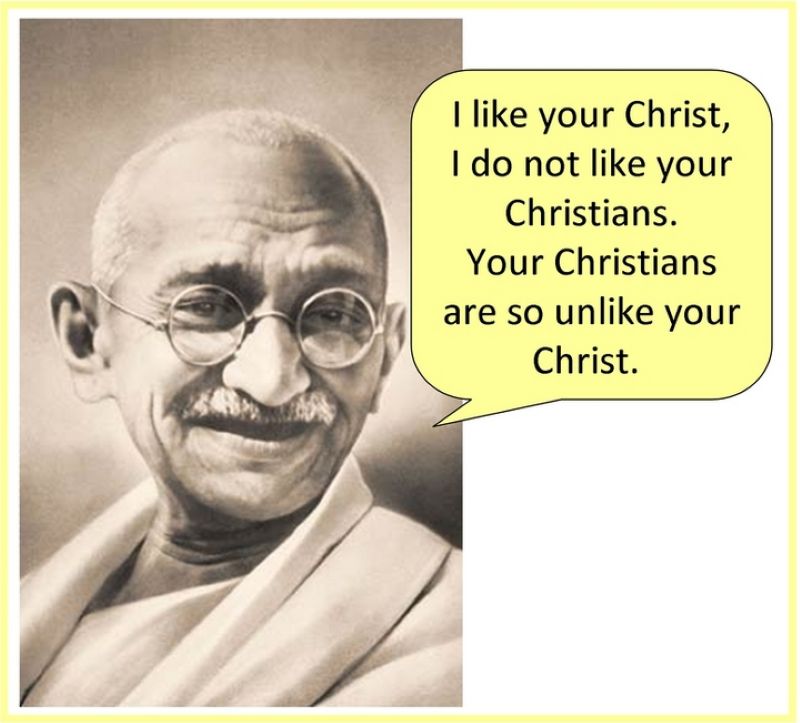
Gandhi Quote

It is impossible for me to reconcile myself to the idea of conversion after the style that goes on in India and elsewhere today. It is an error which is perhaps the greatest impediment to the world’s progress toward peace. Why should a Christian want to convert a Hindu to Christianity? Why should he not be satisfied if the Hindu is a good or godly man? – M.K. Gandhi

The British rule in India crystallised two residues—Christianism and Macaulayism.

Certain strains of Macaulayism developed what is euphemistically described as a “revolutionary temper” in the later stages of the British rule and joined hands with Communism after the Bolshevik victory in Russia. The whole of Communism, which is also hostile to Hindu society and culture, is not Macaulayism. Yet, if Macaulayism had not prepared the ideological ground, Communism could not have made the strides it did in this country.

We shall analyse Christianism first. It was the first to make itself felt forcefully at the onset of the British rule in India.

We, however, wish to make it clear at the very outset that Christianism in India does not refer to the Christians in this country. They are our own people who at a certain stage of our history went over to a foreign faith in an atmosphere created and exploited by Christianism. But although they have renounced their ancestral faith, they have, by and large, not shown any marked hostility towards Hindu society and culture. Nor have they so far served as vehicles of Christianism except in certain areas of the Northeast, notably Meghalaya, Mizoram and Nagaland.  Christianism in India is centered in the numerous Christian missions operating all over the country, particularly in the so-called tribal belts.

The eight fundamentals of Christianism in India may be summarised as follows:

1. That the Hindus have never had a Saviour whose historicity can be ascertained, with the possible exception of the Buddha;

2. That Jesus Christ whose historicity cannot be questioned has superseded all earlier Saviours of Hinduism—if they were Saviours at all and not disciples of Lucifer—and rendered superfluous all subsequent Hindu saints and sages;

3. That St. Thomas, an apostle of Jesus himself, was specially chosen by the Church to win India for his Master’s message;

4. That St. Thomas could not complete his mission in India because he met an untimely martyrdom at the hands of some Hindu, most probably Brahmin, heathens; [1]

5. That the converts made by St. Thomas, the first century Christians of the South, establish beyond doubt that Christianity is an ancient Indian religion and not a Western import as alleged by the Hindus;

6. That it is the sacred task of the Christian Church to complete the mission of St. Thomas and see to it that India becomes a Christian country, once and for all;

7. That if there is any thing good and wholesome in Hindu religion, it is not because Hindu saints and sages ever made any direct or conscious contact with Truth but because they merely stumbled upon some of it in the workings of Universal Nature which was preparing itself over a long time for the advent of Jesus Christ;

8. That no Hindu, even if he follows the Ten Commandments in letter and spirit and lives by the Sermon on the Mount, can ever hope to escape eternal hell-fire unless he has been baptised in a Christian church and administered the Christian sacraments.

These tenets have their source in the Christian religion which also, like Islam, is an extremely exclusive religion. [2] Christianity too claims for itself a monopoly of truth and virtue, swears by the only true God, the only true Saviour or the only Son of the only true God, the only true Revelation, the only true way of worship, and so on. It too has to its discredit a long and unrelieved record of wanton destruction of ancient religions and cultures and a large-scale killing of heathens. The annals of Europe, Asia Minor, North Africa and America, particularly Central and South America, provide harrowing details of this destruction and bloodshed.

We in this country do not associate Christianity with misdeeds similar to those of Islam because the British invaders who finally succeeded in capturing power in India did not allow the Christian crusaders to use state power, directly and in an uninhibited manner. They had perhaps become wiser by a reading of Muslim history in India and did not allow their religion to interfere with the business of building a stable empire. A more tenable explanation of this British refusal to patronise Christianity beyond the point of no return is the Renaissance in Europe which had considerably discredited this creed in its own homeland by the time British arms were triumphant in India.
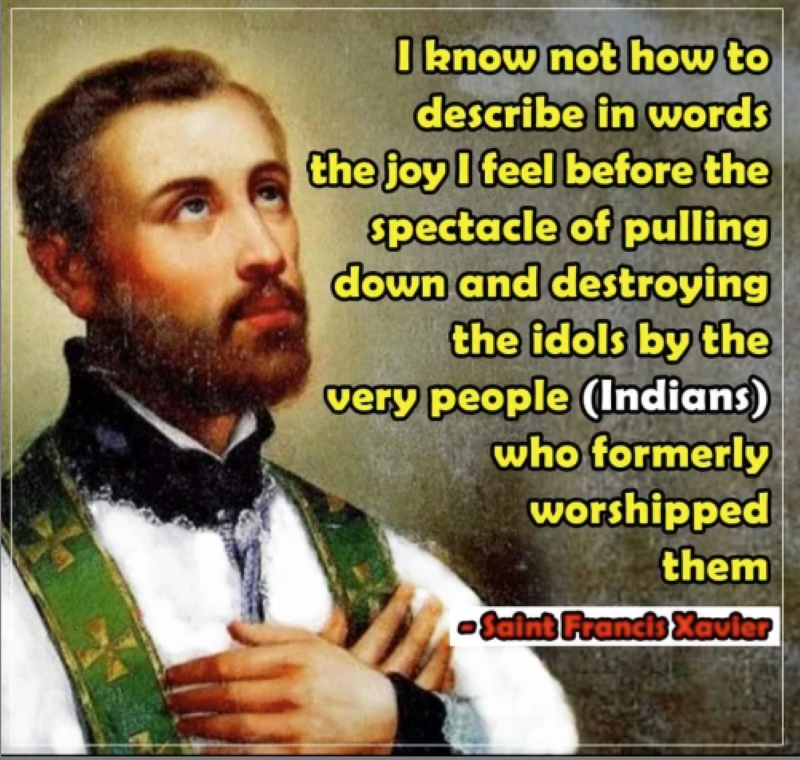
St. Francis Xavier

But we did have a taste of the intrinsic spirit of Christian aggression in our first encounter with the missionaries who swarmed towards our shores in the wake of Western victories from the 16th century onwards. When the Portuguese seized Goa and adjoining territories the Catholic Church lost no time in setting up an Inquisition for the benefit of native converts who were likely to recant or relax in their faith. Francis Xavier, whom the Catholic Church hails as the Patron Saint of the East, expressed a deep satisfaction at the sight of six thousand dead Muslims whom the Portuguese had slaughtered. He also made forcible conversions, demolished Hindu temples, smashed Hindu idols, and inaugurated that anti-Brahmanism which has by now become the sine qua non of all progressive thought and politics in India.

The triumphal march of British arms in India in the second half of the 18th century convinced the Christian missionaries that British victories were due not to a superiority in the art of warfare but to the superiority of the Christian creed by which the British generals and soldiers swore. They immediately started pouring venom on Hindu religion, culture and society. No lie was vile enough in the service of Christian “truth”. No fraud was foul enough in the service of Christian “virtue”.

An example will serve to illustrate the spiteful spirit of the Christian missionaries at that time. They spread a canard in India and abroad that many Hindus voluntarily rushed under the wheels of the great chariot during the annual rathayatra at Puri, and got themselves crushed to death in order to attain salvation. The great chariot, according to them, was always accompanied by droves of dancing girls who sang lascivious songs and made obscene gestures towards crowds on both sides of the broad street. The “great” William Wilberforce, who ruled the circle of Christian crusaders in Britain and who adamantly advocated the Christianization of India by an unstinted use of state power, demanded immediately that the temple of Jagannath be demolished to stop this “devil-dance” for good. The British Commissioner of Puri at that time saved the situation by writing a long letter to a liberal British MP in which he stated that he along with many other British civilians in the district had been a regular witness of the rathayatra for twenty years but had never witnessed a single victim under the wheels nor found anything immodest in the songs and symbolic gestures of the dancing girls. The English word “Juggernaut”, which according to the Chambers Twentieth Century Dictionary means “any relentless destroying force”, is a living witness to the inventive imagination of the early Christian missionaries.

This campaign of calumny against everything Hindu continued till late in the 19th century. Swami Vivekanada was referring to this crude campaign when he cried with anguish in the Parliament of Religions at Chicago that “if we Hindus dig out all the dirt from the bottom of the Pacific Ocean and throw it in your faces, it will be but a speck compared to what your missionaries have done to our religion and culture”.

Had not the Hindus come out in defence of their religion and culture, this missionary mischief would have multiplied by leaps and bounds. The Brahmo Samaj and the Arya Samaj were the earliest expressions of this Hindu spirit of resistance. A notable contribution was made by the Theosophical Society whose founder, Madame Blavatsky, exposed the spiritual and moral claims of Christianity and whose chief apostle in India, Mrs. Annie Besant, inspired no small pride in the Hindu heritage. The Ramakrishna Mission also came to the rescue at a later stage. Mahatma Gandhi gave no quarter to Christian theology or to Jesus Christ as the only Son of God and Saviour of mankind. He had his own charming method of recommending Sermon on the Mount while showing compassion for the victims of the missionaries whom he described as “rice Christians”. [3]

Perhaps the main reason for the weakening of this malicious and mendacious campaign was the collapse of Christianity in its own homeland, the Western countries. The West had taken a decisive turn towards the scientific spirit. Meanwhile, the message of Hindu spirituality had also spread to the centres of learning in the West. The exponents of Hindu religion and culture like Ramakrishna Paramahansa, Swami Vivekananda, Sri Aurobindo, Raman Maharshi, Rabindranath Tagore, Ananda Coomaraswami and Mahatma Gandhi were demonstrating by their words and deeds the profound promise which Hindu Dharma held for mankind. The missionaries had to change their methods.

The core of Christianism in India, however, remains intact. They now know that the fortress of Hindu society cannot be seized by a frontal assault. They are, therefore, busy in the backyards and have hidden themselves behind the smoke-screens of several theologies. Some of these covert methods can be listed as follows:

1. Training of more and more native missionaries in their far-flung, well-equipped and fabulously financed seminaries so that missionary work looks no more like an undertaking manned mostly by foreigners;

2. Hinduising the outer accoutrements of Christian priests, liturgy and sacraments in order to convince the Hindus that Christianity is not an imported creed, and that Christianism is not out to corrode Hindu culture;

3. Directing their powerful press and publishing houses not to attack Hindu religion and culture openly but to develop a scholarly and comparative critique of Hindu religion, culture and society, always to the ultimate disadvantage of the latter;

4. To establish and extend educational institutions which at least immunise the upper class Hindu children and youth against whatever Hindu ways still survive in their homes, wherever they do not succeed in attracting them towards Christianity;

5. To build and expand hospitals and undertake other social work in order to attract an all-round respect for the Christian spirit of social service, and neutralise as narrow bigotry any questioning of their missionary motives;

6. To open orphanages and homes for the handicapped where proselytization can proceed safely and unnoticed;

7. To concentrate on Hindu tribals who are removed from the main centres of Hindu population, so that there is no untoward publicity;

8. To take out promising candidates for conversion on prolonged tours of Western countries in order to impress upon them the wonders worked by Christian culture and civilization;

9. To encourage well-to-do and willing Christians in the West to adopt boys and girls from poor Indian families, send them to missionary schools and colleges, and provide them with monetary assistance till they are converted;

10. To finance and promote political campaigns for separate states, inside or outside the Union of India, in those areas where the Christian population has attained majority or dominance.

There are plenty of methods which the missionaries employ to harangue and/or hoodwink the unsuspecting Hindus. Some of these methods are pretty crude, especially those employed by the American missionaries who aim a loud and simplistic promise, “you also can be saved” or a sweet scolding, “don’t you want to save yourself?” through big advertisements in daily newspapers, regular radio broadcasts and door to door pedlars of salvation. The other methods are sophisticated and disguised as “Indian theology”. [4]

But what looms large at the back of all these methods is the mammoth finance which flows in freely from the coffers of the Christian churches and communities in Europe and America. An idea of the magnitude of this finance can be got from a recent incident which was widely reported in the daily press. An imaginative and enterprising but poor South Indian palmed off on a Christian missionary a lot of faked literary and archaeological evidence about the adventures of St. Thomas in South India against a cash payment of fifteen lakh rupees—a paltry sum in the total budget of the mission concerned. And there are hundreds of such missions in India.

The Statesman dated 17 August 1981 has published an interesting news item from Aachen in West Germany: The Nobel Peace Prize Winner, Mother Teresa, has asked her supporters to suspend charity donations, reports UNI-DPA. The German Section of the International Association of Friends of Mother Teresa which donated six million marks in 1980 is to be disbanded at the end of this year in response to the plea. Mother Teresa who won the prize in 1979 after years of work aiding the poorest of the poor called for a temporary halt to contributions “until we have used up what we have”. “I will then ask you again,” the founder of the Missionaries of Charity said in a circular. Excessive support of a single charity leading to the needs of thousands of others being forgotten was probably behind the request.”

Six million West German marks amount to approximately two and a half crores of rupees. The amounts contributed by other sections of the International Association of Friends of Mothers Teresa are most likely to total up to many times this sum. Mother Teresa is not in a position to use all the money that has already been given to her. So the torrent has been halted temporarily. It will start pouring again as soon as she gives the signal. And hers is only one of the “thousands of other charities”.  One can well imagine the staggering finance at the disposal of Christianism in India.

The free flow of this Western wealth enables the missionaries to live in and have at their disposal palatial mansions in which their missions and seminaries are housed. Their vow of poverty never comes in the way of their having modern sanitation facilities, kitchens, communications and transport. They can travel not only over the length and breadth of this country but to the ends of the earth to attend conferences, congregations, seminars and symposia. Everywhere they go they can stay in similar sumptuous style. It is but human if the superiority of their style of living gets confused with the superiority of the Christian creed.

Recently some missionaries, particularly in the Catholic missions, have started talking a new language—the language of radicalism and revolution. It is not unoften that this language comes most easily to those who do not have to share the woes and wants of people with whom they commiserate. They make the best of both the worlds. Our Communist leaders are an excellent example of such synthetic radicalism.

The West has lost its fascination for the faith. It is becoming increasingly difficult to find men and women in the West who would take the holy orders and become wedded to vows of chastity, poverty and obedience. But the West does not mind parting with plenty of cash which its prosperity can spare with ease. Christianity is, therefore, making a bold bid to establish a safer haven in the East while the going is good.

India provides a particularly soft target. The Christian missions are welcome to open their purse strings in the Islamic and Communist countries of Asia. But the missions there are barred from winning new converts. Hindu India, drowned in poverty and suffering from cultural self-forgetfulness, is the only country in Asia which provides the quid pro quo. [5] – Extracted from Hindu Society Under Seige, 1996

Footnotes

1 See Ishwar Sharan, Myth of St. Thomas and the Mylapore Shiva Temple, Voice of India, New Delhi, 1991.

2 See Sita Ram Goel, Papacy: Its Doctrine and History, Voice of India, New Delhi, 1986.

3 See Sita Ram Goel, History of Hindu-Christian Encounters, Voice of India, New Delhi, 1989.

4 See Catholic Ashrams: Adopting and Adapting Hindu Dharma, Voice of India, New Delhi, 1988.

5 See Ram Swarup, Cultural Self-Alienation and Some Problems Hinduism Faces, Voice of India, New Delhi, 1987.

St. Thomas

The Problem of Macaulayism – Sita Ram Goel

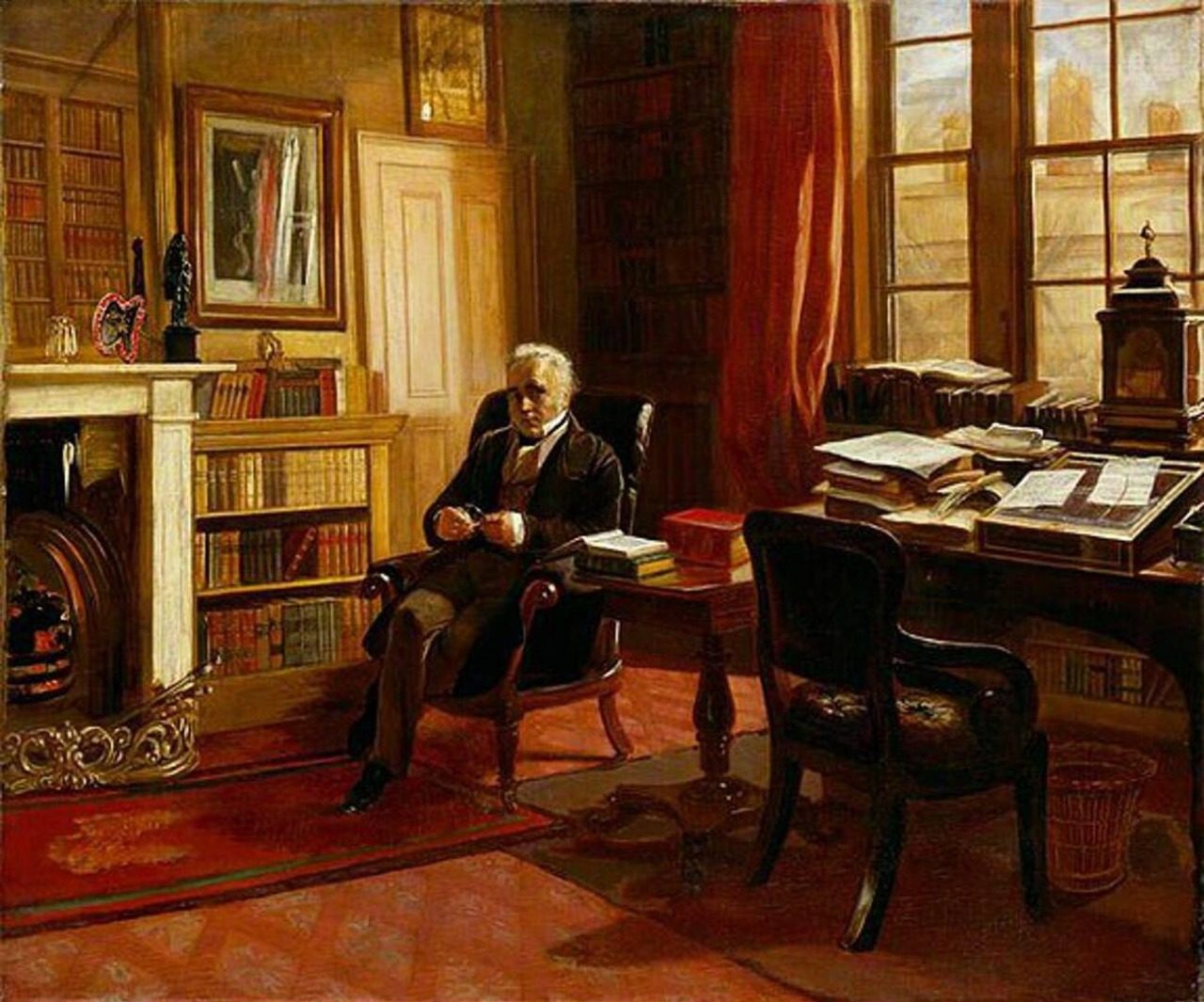
Baron Thomas Babington Macaulay (25 October 1800 – 28 December 1859)

It is not easy to define the doctrine of Macaulayism in as authentic terms as we could do in the case of Islamism and Christianism. … Macaulayism [is not] malevolent like Islamism or mischievous like Christianism. It is rather mild and well-meaning, more like an imperceptible breeze which blows in silently, fins up the psychological atmosphere, creates a mental mood, inspires an intellectual attitude, and finally settles down as a cultural climate—pervasive, protean and ubiquitous. – Sita Ram Goel

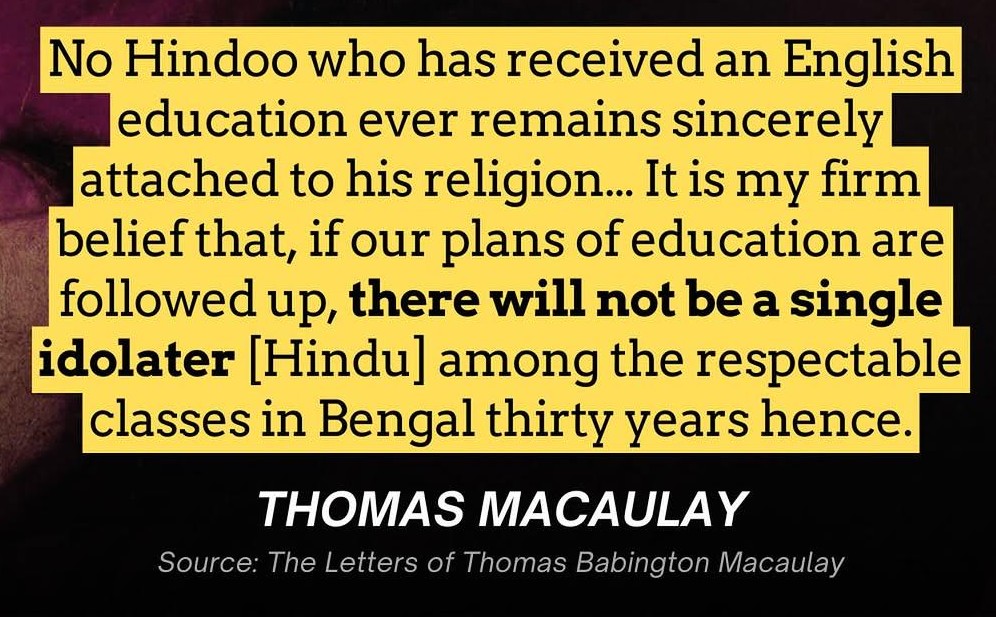
Now for [that] residue of British rule, Macaulayism. The term derives from Thomas Babington Macaulay, a member of the Governor General’s Council in the 1830s. Earlier, the British Government of India had completed a survey of the indigenous system of education in the Presidencies of Bengal, Bombay and Madras. A debate was going on whether the indigenous system should be retained or a new system introduced. Macaulay was the chief advocate of a new system. This, he expected, will produce a class of Indians brown of skin but English in taste and temperament. The expectation has been more than fulfilled.

There is a widespread impression among “educated” classes in India that this country had no worthwhile system of education before the advent of the British. The great universities like those at Takshashila, Nalanda, Vikramashila and Udantapuri had disappeared during Muslim invasions and rule. What remained, we are told, were some pathashalas in which a rudimentary instruction in arithmetic, and reading and writing was imparted by semi-educated teachers, mostly to the children of the upper castes, particularly the Brahmins. But the impression is not supported by known and verifiable facts.

Speaking before a select audience at Chatham House, London, on October 20, 1931, Mahatma Gandhi had said:

“I say without fear of my figures being successfully challenged that India today is more illiterate than it was before a fifty or hundred years ago, and so is Burma, because the British administrators when they came to India, instead of taking hold of things as they were, began to root them out. They scratched the soil and began to look at the root and left the root like that and the beautiful tree perished.”

What the Mahatma had stated negatively, that is, in terms of illiteracy was documented positively, that is, in terms of literacy by a number of Indian scholars, notably Sri Daulat Ram, in the debate which followed the Mahatma’s statement, with Sir Philip Hartog, an eminent British educationist, on the other side. Now Shri Dharampal who compiled Indian Science and Technology in the Eighteenth Century: Some Contemporary European Accounts in 1971 has completed The  Beautiful Tree, a book on the state of indigenous education in India on the eve of the British conquest.

Shri Dharampal has documented from old British archives, particularly those in Madras, that the indigenous system of education compared more than favourably with the system obtaining in England at about the same time. The Indian system was admittedly in a state of decay when it was surveyed by the British Collectors in Bengal, Bombay and Madras. Yet, as the data brought up by them proved conclusively, the Indian system was better than the English in terms of (1) the number of schools and colleges proportionately to the population, (2) the number of students attending these institutions, (3) the duration of time spent in school by the students, (4) the quality of teachers, (5) the diligence as well as intelligence of the students, (6) the financial support needed to see the students through school and college, (7) the high percentage of lower class (Sudra and other castes) students attending these schools as compared to the upper class (Brahmin, Kshatriya and Vaisya) students, and (8) in terms of subjects taught.

This indigenous system was discarded and left to die out by the British not because its educational capacity was inferior but because it was not thought fit for serving the purpose they had in mind. The purpose was, first, to introduce the same system of administration in India as was obtaining in England at that time. The English system was highly centralised, geared towards maximisation of state revenues, manned by “gentlemen” who despised the “lower classes” and were, therefore, ruthless in suppression of any mass discontent. Secondly, the new system of education aimed at promoting and patronising a new Indian upper class who, in turn, would hail the blessings of British Raj and cooperate in securing its stability in India. The indigenous system of education was capable neither of training such administrators nor of raising such a social elite, not at home anywhere.

The system of education introduced by the British performed more or less as Macaulay had anticipated. Hindus like Bankim Chandra Chatterjee, Swami Vivekananda, Lokmanya Tilak, Mahatma Gandhi, Mahamanã Malaviya, Veer Savarkar, M.S. Golwalker, to name only the most notable amongst those who escaped its magic spell and rediscovered their roots, were great souls, strong enough to survive the heavy dose of a deliberate denationalisation. For the rest, it has eminently succeeded in sweeping an ancient and highly cultured people off its feet. Macaulay does deserve the honour of a whole ‘ism’ of which we have not seen the last yet.

It is not easy to define the doctrine of Macaulayism in as authentic terms as we could do in the case of Islamism and Christianism. Doctrinally, Macaulayism is quite diffused. It does not swear by a historical prophet whom it proclaims as the latest as well as the last and the best. It does not bestow a monopoly of truth and wisdom on a single book. It does not lay down a single code of conduct distilled from the doings of a prophet or the sacerdotal tradition of a church.

Nor is Macaulayism malevolent like Islamism or mischievous like Christianism. It is rather mild and well-meaning, more like an imperceptible breeze which blows in silently, fins up the psychological atmosphere, creates a mental mood, inspires an intellectual attitude, and finally settles down as a cultural climate-pervasive, protean and ubiquitous.

Unlike Islamism and Christianism, Macaulayism does not employ any meticulously matured methods to propagate or proliferate itself. It is not out to use a specified section of Indian society as a vehicle of its virulence. It is not a potent potion like Islamism which destroys the body of a culture in one fell sweep. It is not subtle like Christianism which subverts a society surreptitiously. But at the same time, it is a creeping toxemia which corrodes the soul of a culture and corrupts a social system in slow stages. And its target is every section of Indian society.

Yet, as we survey the spread of its spell over Hindu society, particularly Hindu intelligentsia, we can spot some of its paralysing processes. The most prominent are the following five:

1. A sceptical, if not negative, attitude towards Hindu spirituality, cultural creations and social institutions with solemn airs of scholarship and superior knowledge. Nothing in Hindu India, past or present, is to be approved unless recognised and recommended by an appropriate authority in the West;

2. A positive, if not worshipful, attitude towards everything in Western society and culture, past as well present, in the name of progress, reason and science. Nothing from the West is to be rejected unless it has first been weighed and found wanting by a Western evaluation;

3. An intellectual inclination to compare Hindu ideals and institutions from the past not with their contemporaneous ideals and institutions in the West but with what the West has achieved in its recent history-the 19th and the 20th Centuries;

4. A mental mood to judge the West in terms of the ideals and utopias it proclaims from time to time, while judging the Hindus with an all too supercilious reference to what prevails in Hindu society and culture at the present time when the Hindus have hardly emerged from a long period of struggle against foreign invasions;

5. A psychological propensity to scrutinise, interpret and evaluate Hindu culture, history, society and spirituality with the help of concepts and tools of analysis evolved by Western scholarship. It is never granted that the Hindus too have well-developed concepts and tools of analysis, derived from their own philosophical foundations, that it would be more profitable to use these concepts and tools of analysis for a proper understanding of the Hindu heritage, and that it is less than fair to employ alien and incompatible methods of evaluation while judging this heritage. If the Hindus use their own concepts and tools of analysis to process and weigh the Western heritage, our Macaulayists always throw up their hands and denounce the exercise as unscientific and irrelevant to the universe of discourse.

The intellectual and cultural fashions and fads of our Macaulayists change as freely and frequently as the intellectual and cultural climate in the West. Now it is English Utilitarianism, now German Idealism, now Russian Nihilism, now French Positivism or Existentialism, now American Consumerism—whatever be the dominant trend in the West, it immediately finds its flock among the educated Hindus. But one thing remains constant. The platform must first be prepared in the West before it could or should find an audience in India.

And this process of approving, rejecting, judging and justifying which Macaulayism promotes among its Hindu protagonists does not remain a mere mental mood or an intellectual inclination or a psychological propensity, that is to say, a subjective stance on men and matters. It inevitably and very soon expresses itself in a whole life-style which goes on rejecting and replacing Hindu mores and manners indiscriminately in favour of those which the West recommends as the latest and the best. The land from which the new styles of life are imported may be England as upto the end of the Second World War or the United States of America as ever since. But it must always be ensured that the land is located somewhere in the Western hemisphere. “Phoren” is always fine.

The models which are thus imported from the West in ever-increasing numbers need not have any relevance to the concrete conditions obtaining in India such as her geography, climate, economic resources, technological talent, administrative ability, etc. If the imported model fails to flourish on the Indian soil and in India’s socio-economico-cultural conditions, these must be beaten and forced into as much of a receptive shape as possible, if need be by a ruthless use of state power. But if the receptacle remains imperfect even after all these efforts, let the finished product reflect that imperfection. A model imported from the West and implanted on Indian soil even in half or a quarter is always preferable to any indigenous design evolved in keeping with native needs and adapted to local conditions.

Starting from the secular and socialist state and planned economy, travelling through a casteless society and scientific culture, and arriving at day-to-day consumption in Hindu homes, we witness the same servile scenario unfolding itself in an endless endeavour. Our parliamentary institutions, our public and private enterprises, our infrastructure of power and transport, our medicine, public health and housing, our education and entertainment, our dress, food, furniture, crockery, table manners, even the way we gesticulate, grin and smile have to be carbon copies of what they are currently doing in the West.

Drain-pipes, bell-bottoms, long hair, drooping moustaches; girls dressed up in jeans; parents being addressed as mom and pa and mummy and daddy; demand for convent schooling in matrimonial ads: and natives speaking their mother tongues in affected accents after the English civilian who was helpless to do otherwise—these are perhaps small and insignificant details which would not have mattered if the Hindus had retained pride in the more substantial segments of their cultural heritage. But in the current context of kowtowing before the West, they are painful portents of a whole culture being forced to feel inferior and go down the drain.

The Hindu may sometimes need to feel some pride in his ancestral heritage, particularly when he wants to overcome his sense of inferiority in the presence of visitors from the West. Macaulayism will gladly permit him that privilege, provided Kalidasa is admired as the Shakespeare of India and Samudragupta certified as India’s Napoleon. The Hindu is permitted to take pride in that piece of native literature which some Western critic has lauded. Of course, the Hindu should read it in its English translation. He is also permitted to praise those specimens of Hindu architecture, sculpture, painting, music, dance and drama which some connoisseurs from the West have patronised, preferable in an exhibition or performance before a Western audience. But he is not permitted to do this praising and pride-taking in a native language nor in an English which does not have the accepted accent.

The Hindu who is thus addicted to Macaulayism lives in a world of his own which has hardly any contact with the traditional Hindu society. He looks forward to the day when India will become a society like societies in the West where the rate of growth, the gross national product and the standard of living are the only criteria of progress. He is tolerant towards religion to the extent that it remains a matter of private indulgence and does not interfere with the smooth unfoldment of the socio-political scene. Personally for him, religion is irrelevant, though some of its rituals and festivities can occasionally add some colour to life. For the rest, religion is so much obscurantism, primitive superstition and, in the Indian context at present, a creator of communal riots.

Macaulay Quote

It should not, therefore, be surprising if this self-forgetful, self-alienated Hindu who often suffers from an incurable anti-Hindu animus a la Nirad Chaudhry, turns his back upon Hindu society and culture and becomes indifferent to their fate. He cannot help having not much patience with the traditional Hindu who is still attached to his spiritual tradition, who flocks to hallowed places of pilgrimage, who celebrates his festivals with solemnity, who regulates his daily life with rituals and sacraments, and who honours his forefathers, particularly the old saints, sages and heroes. He also cannot help being indulgent towards those who are hostile to the traditional Hindu and who heap contempt and ridicule on him, no matter to what community or faith they belong, though he may not share their own variety of religious or ideological fanaticism.

The traditional Hindu, on the other hand, wants to live in peace and amity with all his compatriots. He is normally very tolerant towards his Muslim and Christian countrymen, and gladly grants them the right to their own way of worship. He goes further and quite often upholds Muslim and Christian religions as good as his own. He shows all due respect to Muslim and Christian prophets, scriptures and saints. He does not try to prevent anyone from freely discussing, dissecting, even ridiculing his religion and culture. He never mobilises murderous mobs against those Hindus who do not share his convictions about his ancestral heritage. He turns a blind eye to his Gods and Goddesses being turned into cheap models in calendars and commercial advertisements. Nor does he go out converting people of other faiths to his own.

The traditional Hindu, however, does get stirred when the Muslims and Christians cross the limits and threaten the unity and integrity of his country. He does want to retain his majority in his only homeland against Muslim and Christian attempts to reduce him to a minority by fraudulent mass conversions. He does believe that Hindu society and culture have a right to survive and put up some defence in exercise of that right. But the Hindu addict of Macaulayism stubbornly refuses to concede that right to Hindu society and culture. He cannot see the need for defence because he cannot see the danger. And he has many strings to his bow to run down the Hindu who dares defy his diktat. His attitude can by summarised as follows:

1. To start with, he refuses to recognise any danger to Hindu society and culture even when irrefutable facts are placed under his nose. He accuses and denounces as alarmists, communalists, chauvinists and fascists all those who give a call for self-defence to the Hindus. Better, he explains away the aggression from other faiths in terms of the aggression which ‘Hindu communalism’ has committed in the first instance;

2. Next, he paints a pitiful picture of the aggressor as a poor, deprived and down-trodden minority whom the Hindus refuse to recognise as equal citizens, constitutionally entitled to a just share in the national cake;

3. At a later stage, he assumes sanctimonious airs and assigns to the Hindus an inescapable moral responsibility to rescue their less privileged brethren from the plight into which the Hindus have pressed them. In any case, the Hindus stand to lose nothing substantial if they make some generous gestures to their younger brethren even if the latter are slightly in the wrong;

4. In the next round, he harangues the Hindus that any danger to them, if really real and worth worrying about, arises not from an external aggression against them but from the injustice and oppression in their own social system which drives away its less privileged sections towards other social systems based on better premises and promises. Does not Islam promise an equality of social status because of its great ideal of the brotherhood of men? Does not Christianity present an example of dedicated social service a la Mother Teresa?

5. If the Hindus are not convinced by all these arguments and become bent upon organising some sort of a self-defence, he comes out with a fool-proof formula for that eventuality as well. The Hindus are advised to put their own house in order which, in his opinion, is the best defence they can put up. They should immediately abolish the caste system, start inter-dining and inter-marrying between the upper and lower castes, particularly the Harijans, and so on and so forth. It never occurs to him that social reform is a slow process which takes time to mature and that in the meanwhile a society is entitled to self-defence in the interests of its sheer survival;

6. If the Hindus still remain adamant, he tries his last and best ballistics upon them. He suddenly puts on a spiritual mask and lovingly appeals to the Hindus in the name of their long tradition of religious tolerance. How can the followers of Gautama and Gandhi descend to the same level as Islam and Christianity which have never known religious tolerance? The Hindus would cease to be Hindus if they also start behaving like followers of the Semitic faiths which have been conditioned differently due to historical circumstances of their birth. But he never dares put in one single word of advice to the followers of Islamism and Christianism to desist from always having it their own way. He knows it in his bones that such an advice will immediately bring upon his head the same abusive accusations which Islamism and Christianism hurl at the Hindus. This is the outcome which he dreads worse than death. He cannot risk his reputation of being secular and progressive which Islamism and Christianism confer upon him only so long as he defends their tirades against the Hindus.

But the stance which suits Macaulayism best is to sit on the fences and call a plague on both houses. The search for fairness and justice is somehow always too strenuous for a follower of Macaulayism. The one thing he loathes from the bottom of his heart is taking sides in a dispute, even if he is privately convinced as to who is the aggressor and who the victim of aggression. He views the battle as a disinterested outsider and finds it somewhat entertaining. The reports and reviews which some of our eminent journalists have filed in the daily and the periodical press about happenings in Meenakshipuram and other places where Islamism is again on the prowl, leaves an unmistakable impression that these gentlemen are not members of Hindu society but visitors from some outer space on a temporary sojourn to witness a breed of lesser beings fighting about Tweedledum and Tweedledee.

An adherent of Macaulayism can well afford to take this neutral, even hostile stance, away from and above Hindu society, its problems and its struggles, because, in the last analysis, he no more regards Hindu society as his own or as his indispensable benefactor. He has already managed to monopolise most of the political and administrative power in this country and the best jobs in business and the professions. He has secured a stranglehold on the most prestigious publicity media. The political upstarts and the neo-rich look up to him as their paragon and try to mould their sons and daughters in his image.

But what is uppermost in his mind, if not his conscious calculation, is the plenty of patrons, protectors and pay-masters he has in the West, particularly the United States of America. The scholars and social scientists over there in the progressive West approve and applaud whenever he pontificates about India’s socio-economico-cultural malaise and prescribes the proper occidental cures. They invite him to international seminars and on well-paid lecture tours to enlighten Western audiences about the true state of things in this “unfortunate” country and the rest of the “under-developed” world. He can travel extensively in the West with all expenses paid on a lavish scale. Even in this country he alone is entitled to move and establish the right contacts in social circles frequented by the powerful and the prestigious from the West.

And, God forbid, if the worst comes to the worst and the “fanatics like the RSS fascists” or the Muslim fundamentalists or the Communist totalitarians take over this country, he can always find a safe refuge in one Western country or the other. There are plenty of places which can use his talents to mutual profit. The salaries they pay and the expense accounts they allow are quite attractive. The level of living with all those latest gadgets is simply lovable. In any case, he has all those sons and daughters, nephews and nieces, cousins and close relatives ensconsed in all those cushy jobs over there—the UN agencies, the fabulous foundations, the business corporations, the universities and research institutions.

So, Hindu society with all its hullabaloo of religion and culture be damned. This society, and not he, stands to lose if he is not permitted to work out his plans for progress in peace. In any case, this society cannot pay even for his shoes getting polished properly. – Extracted from Hindu Society Under Seige, 1996

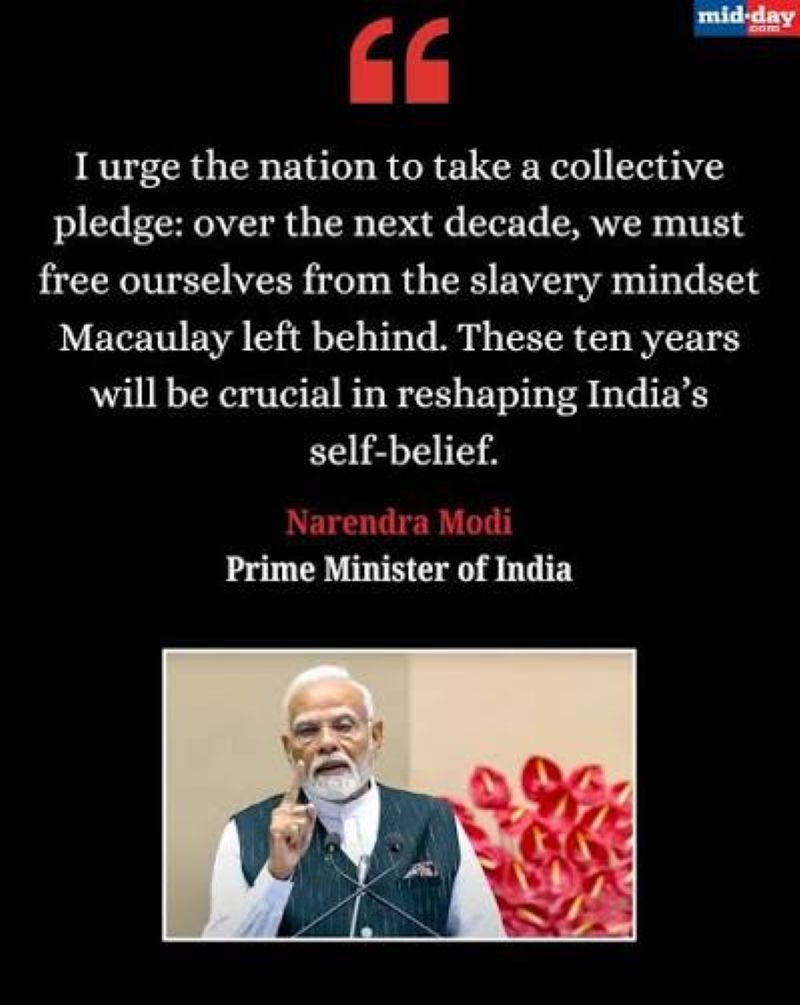
Narendra Modi Quote

Romila Thapar and the collapse of the ‘eminent’ Marxist monopoly – Utpal Kumar

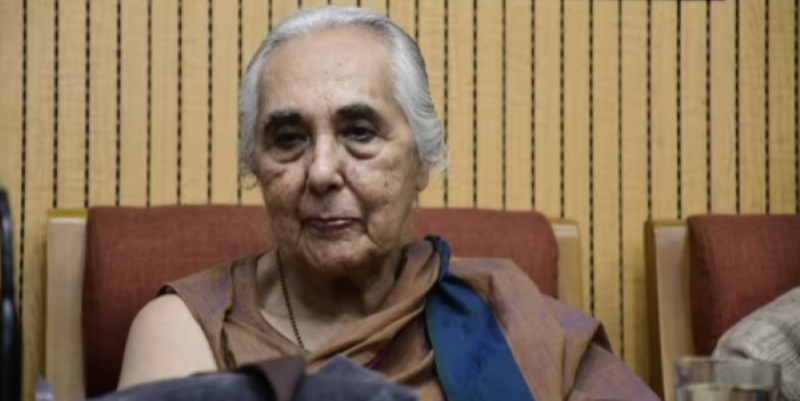
Romila Thapar

The real challenge before Indian historiography today is not the existence of competing narratives, but the treatment of one ideological school as the sole custodian of intellectual legitimacy while dismissing all dissent as ignorance. – Utpal Kumar ‘

Sometimes the crisis of Indian historiography can be captured through a single viral clip.

In the video, eminent historian Romila Thapar confidently claims that Patanjali described the relationship between Brahmins and Sramanas as being like that between a snake and a mongoose. It is a striking image, perfectly suited to the Marxist interpretation of ancient Bharat as a perpetual battlefield of social conflict. There is, however, one problem: the passage does not exist in Patanjali’s Mahabhashya. As author Nityananda Mishra explains in the viral clip, Patanjali refers to Sramanas and Brahmins together only once, and even there the snake-mongoose analogy is absent. Interestingly, the same claim had appeared in Thapar’s earlier works, including Interpreting Early India (1992) and Cultural Pasts (2000).

This incident is important not merely because it reveals the truth about a disputed quotation. It is important because it raises uncomfortable questions about the authority exercised by certain schools of Indian historiography and the reluctance within parts of academia to subject “eminent” historians to the same scrutiny they routinely apply to others.

For decades, a relatively small ideological circle dominated the country’s historical discourse. Their influence rested not merely on scholarship, but also on institutional power. They wrote textbooks, controlled college and university departments, influenced media narratives, and determined who truly qualified to be a “serious” historian. Those who questioned them were dismissed as communal, revivalist, unscientific, or simply “unqualified”. The irony, of course, is that many of these guardians of “scientific history” were themselves shielded from the most elementary standards of scrutiny.

That immunity is now gone.

Romila Thapar’s recent memoir, Just Being, reflects this anxiety. She laments the growing influence of what she calls “non-historians” in shaping public understandings of the past and argues that official support is increasingly going towards narratives different from those produced by “professionally trained historians”.

“Until a decade or two ago,” Thapar writes, “historical scholarship was not interfered with by unqualified people. That situation has now changed. The perception of history that is being popularised and has official backing is distinct from that which is being researched by scholars. The two are moving in opposite directions. The danger is that the latter may be nullified by the official support given to the former.”

The complaint reveals a deeper unease. After all, the first time since Independence, Marxist historiography in the country no longer enjoys uncontested intellectual authority. It is this erosion of monopoly, more than disagreement itself, that seems to have generated such anxiety, if not anger.

If one looks back, the country’s “eminent” historians evaded intellectual accountability for most of the post-Independence era. In fact, the only time they were put in the dock—quite literally—was when they went to the Allahabad High Court as “expert witnesses” in the Ram Janmabhoomi case. The Ayodhya case was unusual because it compelled our “professionally trained” historians to leave classrooms and seminar halls to enter a courtroom, where claims had to withstand cross-examination rather than ideological consensus. As author Arvind Singh writes in India’s Rogue Historians, the Ram Janmabhoomi dispute was “perhaps the only instance where Marxist historiography was weighed on jurisprudence”.

The results were devastating. One after another, “expert witnesses” collapsed under cross-examination. Behind the intimidating academic reputations lay conjecture, second-hand assumptions, ideological certainties, and in some cases startling unfamiliarity with the very primary evidence on which they claimed expertise.

One striking example was Prof Suresh Chandra Mishra, who appeared before the court as an expert witness and epigraphist. Prof Mishra initially claimed that inscriptions found at the disputed structure were written in Arabic. Later, he revised the statement and said they were in Persian. Eventually, under cross-examination, he admitted that he knew neither Persian nor Arabic. The contradiction was devastating because epigraphic expertise necessarily depends upon linguistic competence.

The matter became even more awkward when Prof. Mishra claimed he had compared the inscriptions with passages from the Baburnama, which he said he carried inside the disputed premises. When he was cornered by the other side, which argued that one was not allowed to carry anything inside, he changed his statement again, saying he had relied on memory to compare the inscriptions after coming out of the site. Justice Sudhir Agarwal dryly noted this “wonderful memory”, particularly given Mishra’s admission that he knew “neither Persian nor Arabic”.

Then came archaeologist Suraj Bhan, another prominent figure of the academic establishment. His credentials appeared impressive in public debates, but under oath the limitations became apparent. Despite holding degrees involving Sanskrit, he admitted he could neither read nor speak the language. Justice Agarwal observed that Bhan “has not read the text of the inscriptions as published in different books from time to time and had no occasion to compare them”, and that parts of his testimony rested on “pure conjecture and surmise”.

Similarly, Prof. Suvira Jaiswal reportedly acknowledged that, despite appearing as an “expert witness” in the Ayodhya case, she had not read key primary sources such as the Baburnama. Another star expert witness, Prof. Shirin Musavi, reportedly stated that she had never personally visited Ayodhya to examine the disputed structure; she believed such examination was unnecessary for a historian.

These were the historians who were supported and patronised, often openly, by the country’s leading historians led by Romila Thapar, R.S. Sharma, D.N. Jha and Irfan Habib, among others. It is interesting that while these second-rank historians took the lead in supporting the Babri Masjid cause, the top historians avoided doing so. They knew the pitfalls of their historiography. They knew it would not withstand cross-questioning. They were also not used to being questioned in public.

The case exposes a contradiction at the heart of elite academic discourse in the country. Historians who insist upon methodological rigour and denounce dissenters as “non-historians” were themselves, in a case as significant as Ayodhya, found relying on assumptions, ideological predispositions, or incomplete engagement with primary evidence.

The larger issue, however, is not that historians can make mistakes. Genuine scholarship always leaves room for error, revision and correction. The real problem is the culture of intellectual insulation that protected certain historians from sustained scrutiny for decades. Within academic and media ecosystems, their assertions were often treated as settled truth. Critical examination was discouraged because it threatened the ideological consensus that dominated post-Independence intellectual life.

The real challenge before Indian historiography today is not the existence of competing narratives. A confident civilisation can accommodate disagreements. The danger lies instead in treating one ideological school as the sole custodian of intellectual legitimacy while dismissing all dissent as ignorance.

Ironically, as Romila Thapar’s memoir itself suggests, the decline of intellectual monopolies often produces resentment. Much of the current anxiety and anger directed at “non-historians” appears rooted less in questions of qualification than in the loss of cultural and institutional control.

History does not—and cannot—belong permanently to any ideological priesthood. – Firstpost, 25 May 2026

Utpal Kumar is the author of the book, ‘Eminent Distorians: Twists and Truths in Bharat’s History’. 

Historian Cartoon