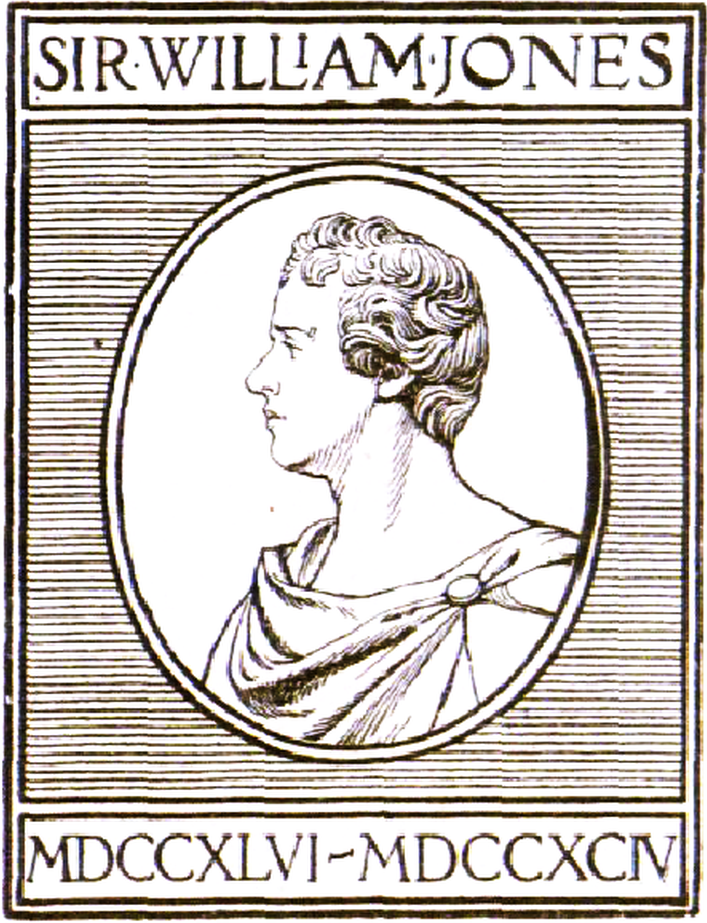
Today, science gives us advantages that William Jones lacked. But sadly, some accounts of Indian history are still stuck in outdated methods of dating – Dr. Nanditha Krishna
In 1650, Irish theologian James Ussher claimed that the world was created on Sunday, October 23, 4004 BCE. Ussher based his calculation on a correlation of the Christian holy writ and West Asian and Mediterranean histories.
Tragically, his unscientific dating became a basis for dating Indian history—and, for some, continues even today.
In 1783, William Jones was appointed judge at Fort William in Bengal. He studied Sanskrit, the Vedas and ancient Hindu laws. He was captivated by Indian culture and founded the Asiatic Society in Calcutta. He proposed a relationship between European and Indo-Aryan languages, now known as the Indo-European languages. He suggested that Sanskrit, Greek and Latin had a common root and postulated a proto-Indo-European language uniting Sanskrit, Iranian, Greek, Latin, Germanic and Celtic.
Jones, a follower of Ussher, believed that “the foundation of the Indian empire (sic) was about 3,800 years” before 1790 CE, that is, between Ussher’s date of 4004 BCE and the Great Flood that Jones believed took place in 2350 BCE. He dated the Rig Veda unscientifically to 1500-1000 BCE and proposed an Aryan invasion of India, an idea that lacked any evidence.
For a long time, the West supposed India jumped from the Stone Age to the Buddha, whose date became very important for ancient Indian history. Eastern Buddhist tradition in China, Japan, Vietnam and Korea dated Siddhartha between his birth in 1026 BCE and his death in 949 BCE.
In 1821, John Davy chose the Sinhalese date of Buddha’s Nirvana as 543 BCE, when the Sinhalese system of reckoning time begins. This gave time between Jones’s date for the Vedas (1500 BCE) and the Buddha; hence it was “chosen”. Mahavira was never properly dated and was regarded merely as Buddha’s contemporary.
Alexander’s foray into Punjab in 326 BCE turned up yet another date. Jones decided that Sandrocottus, mentioned by Megasthenes as Seleucus Nicator’s Greek ambassador to Pataliputra, was Chandragupta Maurya. Why not Chandragupta I or II of the Gupta dynasty? They too ruled from Pataliputra. But that did not suit the British dating of the Vedic period, the Buddha and later Ashoka.
Jones decided that Megasthenes had visited Chandragupta Maurya’s empire, founded in 322 BCE. But we know of Chandragupta’s life only from Vishakhadatta’s Mudrarakshasa, where there are no Greeks or Megasthenes, and which was written over a thousand years later.
It is only with Ashoka’s inscriptions that scientific methodology entered Indian archaeology. James Prinsep worked at the Calcutta mint in 1819 and stayed for a while in Benares. He interpreted the three stages of Indian numismatics as punch-marked, die-struck and cast coins. But his greatest contribution was deciphering the Brahmi script.
Edicts from all over India were sent to him. The edicts mentioned a King Devanampiyadasi who filled Indian rocks and pillars with messages of dharma. Prinsep initially assumed him to be Sri Lankan.
The identification of Devanampiyadasi and Ashoka as the same person was established by the Maski and Gujarra inscriptions, which used both the names Devanampiyadasi and Ashokaraja. In his inscriptions, Ashoka also mentions Antiochus, Ptolemy, Antigonus, Magas and Alexanderas as receivers of his message of dharma. But they lived beyond India. The names on this list, though intriguing, were ignored in the dating process.
In the early 20th century, the ruins of Harappa and Mohenjo Daro were discovered by Indian archaeologists Daya Ram Sahni and Rakhal Das Banerji. Overnight, Indian civilisation went back in time from the 6th century to 3300-1300 BCE, and to 2600-1900 BCE in the ‘mature Harappan’ phase. It was spread over an area larger than the contemporary Egyptian and Mesopotamian civilisations.
It extended from Balochistan in the west to western Uttar Pradesh in the east, from Afghanistan in the north to Maharashtra in the south. Later, agriculture was found to have emerged in 7000 BCE in Balochistan. The dating was based on archaeology, and not 4004 BCE.
It was declared as pre-Vedic and Dravidian, but when was Vedic and what was Dravidian? It remains an enigma.
In the 19th century, the river Sarasvati, described in the Rig Veda as a ‘mighty’ one flowing from the hills to the sea, was identified with the Ghaggar-Hakra river system that now ends in the Thar desert. ISRO observed from satellite pictures that most Indus civilisation sites from Haryana and Rajasthan to Gujarat lay along its course. When the monsoons diminished, the river dried up some 4,000 years ago and the Harappan civilisation declined.
Now archaeology was used to delineate Indian history. New discoveries cropped up all over India: Arikamedu and Poompuhar in the south, Dwarka under the sea off the coast of Gujarat and so on. Mahabharata was identified with painted greyware sites dating to 1200 BCE. So the Vedas had to be much older.
Yet, students are still taught dates that are calculated from 4004 BCE. Their textbooks say that the Aryans came to India in 1500 BCE, the date of the Vedas, that the writing of the Mahabharata dates back to 500 BCE, that Chandragupta Maurya met Alexander and so on.
No effort has been made to study the dating system of Indian kings as mentioned in their inscriptions or their chronology lists. This too needs archaeological corroboration. The Buddha died in Kushinagara. His remains could be scientifically tested to find out the exact date of his death.
Today, science gives us advantages that William Jones lacked. But sadly, some accounts of history are still stuck in outdated methods of dating. – The New Indian Express, 29 September 2024
› Dr. Nanditha Krishna is an author, historian, and environmentalist based in Chennai


