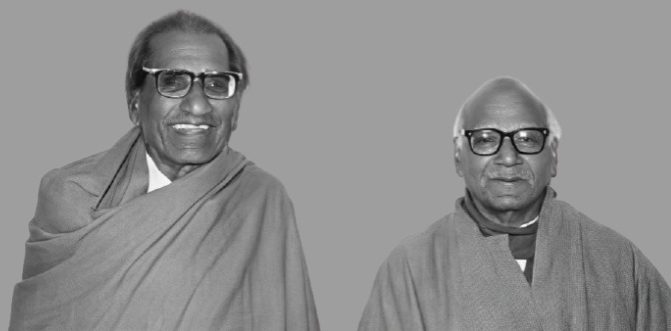
Tracing the roots of hostility among Jews, Christians and Muslims – Arvind Sharma

Abrahamic Religions

The Arabs trace their origin to Ishmael, and the Jews trace their origin to Isaac. The struggle between them, therefore, dates back to the question: Who was the rightful heir to Abraham? – Prof. Arvind Sharma

The current tensions in the Middle East compel one to probe the roots of the hostility of the Christians and the Muslims towards the Jews, especially the hostility between the Jews and the Muslims. To trace the roots, one needs to go back to around 1800 BCE. That is the age in which Abraham, who is venerated by all three traditions, lived.

The Arabs trace their origin to Ishmael, and the Jews trace their origin to Isaac. The struggle between them, therefore, dates back to the question: Who was the rightful heir to Abraham? This issue has been the source of a lasting sibling rivalry.

It is not all conflict, however. According to the standard narrative, both the brothers buried Abraham together when he passed away.

The Jews, descendants of Isaac, finally found their kingdom in the promised land. They prospered, especially around 1000 BCE, giving us the legendary figures of David and Solomon. Thereafter, however, the Jewish kingdom fell prey to the various empires which arose in the Middle East, such as the Assyrian, the Babylonian, the Persian, and the Roman.

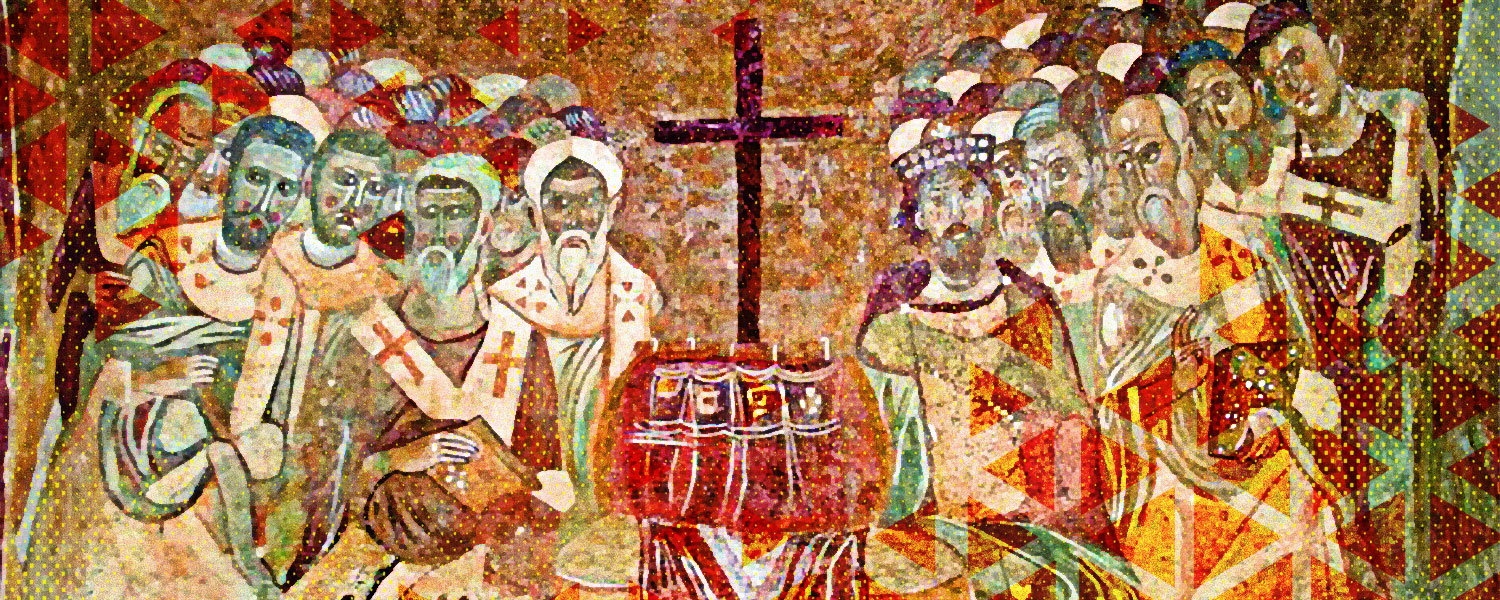
We fast forward now to the beginning of the Christian era when the Romans were ruling over the Jews. The prolonged period of political servitude had instilled in the Jews the hope that a great saviour, a messiah, would arise in due course to restore their sovereignty. It was in such an atmosphere of messianic expectation that Jesus was born. His charismatic personality and the miracles he performed raised the expectation in some quarters that he might be the messiah. But others wondered whether that could be the case, because of the aura of non-violence around him. Those who continued to believe that he was the messiah, even after his crucifixion, became the founders of Christianity. In other words, the key issue between the Jews and the Christians is whether Jesus was the messiah. The Christians accept him as such, and the Jews reject him as such.*

Just as the difference between the Jews and the Muslims goes back to the legacy of Abraham; the difference between the Jews and the Christians goes back to the legacy of Jesus Christ.

The difference between the Jews and the Christians is aggravated by the fact that, in the Christian scriptures, the Jews are depicted as responsible for the crucifixion of Jesus, although the crucifixion was formally carried out by the Romans. In Christian theology, Jesus is sometimes identified with God and, therefore, the Christians held the Jews responsible not just for the killing of Jesus Christ, but for killing God, or what is known as deicide.

Some historians argue that this was the result of the spread of Christianity in the Roman Empire. The Romans could not be held responsible for killing Jesus, because they were proving receptive to the message of Christianity, and therefore the blame for the death of Jesus Christ had to be shifted to the Jews. Christian theology not only aggravates but also complicates the relationship between the Jews and the Christians. Because Jews and Christians worship the same God, the Christians felt that God’s word to the Jews had also to be redeemed in some form. That is why Jews survived as a sect in the Roman Empire even though Christianity eliminated all other rival sects within the empire once it became the official religion.

Thus the hostility of both the Muslims and the Christians towards the Jews has deep historical roots. In recent times, however, the hostility between the Christians and the Jews has diminished because of the Holocaust, in which almost six million Jews were eliminated during the Nazi regime. Many Christians now feel guilty about this, and therefore tend to favour Israel.

The hostility between the Jews and the Muslims also went through a period when it was not as acute as it is now. During the sixteenth century, when the Jews were expelled from Christian Spain, they found shelter in the Muslim Ottoman Empire. Therefore, although the hostility between the Jews and the Muslims and the Jews and the Christians has deep historical roots, one should not fall prey to historical determinism and imagine it must always be so. It is possible that a modus vivendi may yet emerge. – News18, 23 November 2023

* Jews also reject the prophethood of Muhammad. – Editor

Prof. Arvind Sharma is the Birks Professor of Comparative Religion at McGill University in Montreal Canada, where he has taught for over thirty years. He has also taught in Australia and the United States and at Nalanda University in India. He has published extensively in the fields of Indian religions and world religions.

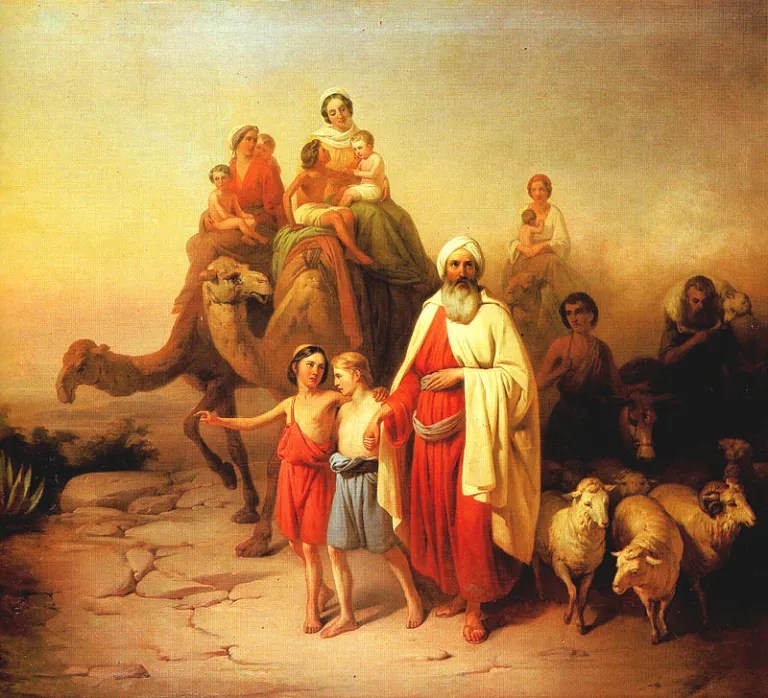
Abraham with Sarah and Hagar and their respective childrem Isaac and Ishmael.

Why ‘eminent historians’ still swear by the debunked Aryan theory – Makkhan Lal

Image depicting the imaginary Aryan invasion of India from the Caspian Sea.

“It is difficult to say that all the earliest Aryans belonged to one race, but their culture was more or less the same type. Originally the Aryans seem to have lived somewhere in the steppes stretching from Southern Russia to Central Asia. On their way to India the Aryans first appeared in Central Asia and Iran. A little earlier than 1500 BC the Aryans appeared in India.” – R.S. Sharma

“By 1500 BC when the Aryans began to arrive in India, the Harappan culture had collapsed. We do not know where they came from; perhaps they came from north-eastern Iran or the region near the Caspian Sea or Central Asia.” – Romila Thapar

The two quotations from India’s two “eminent historians” sum up their approach to the Aryan Invasion Theory. Just look at expressions “difficult to say”, “seems to have”, “somewhere in steppes”, “we do not know where they come from”, “perhaps they came from north-eastern Iran or the region near Caspian Sea or Central Asia”. Despite so many probabilities, they are certain that Aryans came from outside. When and from where? No idea!

Despite all evidence to the contrary, why does the Aryan invasion/migration theory (AIT) continue to remain the lifeline of Indian Marxist historians? Let us now look at the AIT in historical perspectives.

Linguistic Evidence

Florentine merchant, Filippo Sassetti, who lived in Goa from AD 1583 to 1588, was struck by similarities between Sanskrit and European languages, especially Latin and Greek. Later, the relationship between Sanskrit and European languages was further elaborated by William Jones and many other scholars in the service of the East India Company. The efforts made towards understanding these linguistic similarities between Sanskrit on the one hand and Greek, Latin and some other modern European languages on the other gave rise to a new discipline called ‘comparative linguistics’. Its birth had questionably motivated considerations and in the last 200 years the discipline (if at all it is a discipline) of ‘Comparative Linguistics’ has shown a far greater variety of gymnastic exercises than the sport of gymnastics itself.

Since the earliest books (i.e. the Vedas) of the Aryans and so also all human beings are written in Sanskrit, it came to be recognised as the language of the Aryans. In the beginning, all European languages, along with Sanskrit, came to be clubbed as Aryan languages, and Sanskrit got identified as not only the oldest of all but also the mother of all European languages. Lord Monboddo was convinced that “Greek was derived from Sanskrit”. Frederick Schlegel, a highly respected German linguist wrote, “The Indian language is older and others [European languages] younger and derived from it.” Thus, Sanskrit came to be recognised as the mother of “all the less ancient Indo-European languages, as well as the modern European tongues and dialects”.

But these opinions did not last very long. Local pride, racial complexes and Evangelical considerations overshadowed everything as a part of a shift from ‘Indo-mania’ to ‘Indo-phobia’.

Though William Jones could not accept the earlier view that Sanskrit is the ‘mother’ of all Aryan languages. He advocated that Sanskrit is just a ‘sister’, i.e. a co-descendant of an earlier ancestor language. Following the lead provided by Jones, F. Bopp wrote: “I do not believe that Greek, Latin and other European languages are to be considered as derived from Sanskrit. I feel rather inclined to consider them together as subsequent variations of one original tongue, which however, the Sanskrit has preserved more perfect than its kindred dialects.”

So, a search for the original homeland of a language, namely ‘Proto-Indo-European’, led different scholars to different places. This search for the imagined original language homeland also meant the search for the ‘Original Homeland of Aryans’. This also gave rise to forging labels such as the ‘Indo-Aryan’, ‘Indo-European’, ‘Aryan languages’, ‘Indo-Aryan languages’, and the ‘Indo-European languages’. Sometime around the 1820s, the word ‘Aryan’ began to be dropped and it simply became ‘Indo-European’. Some German scholars even started using the term ‘Indo-German’ on the presumption that the Sanskrit and German languages, between them, covered the entire Indo-European speaking area—the farthest language to the east being Indic and German to the west.

Sanskrit, even today, may be “the greatest language of the world” or even if it “is of a wonderful structure, more perfect than Greek, more copious than Latin and more exquisitely refined” but so what? How could a language spoken by ‘niggers’ have been once the mother of languages today spoken by Europeans, i.e. white people? This position could not be accepted even by William Jones and Max Mueller, who have been so wholesome in their praise for Sanskrit.

Sanskrit was first demoted from mother to the position of a mere sister of all the ancient and modern European languages, but later on, with further building-up of the language tree, it came to be demoted to the position of grand-daughter, when it got linked to the so-called Indo-Iranian family. Thus, the position is: Proto-Indo-European language gave birth to the Indo-Iranian, which in turn produced Sanskrit. It’s already almost 200 years and the search for the grand-mother of Sanskrit (i.e. the Proto-Indo-European) is still on. We still do not know what she (the Proto-Indo-European Language) may have looked like, of what colour she may have been, or what may have been her physical and metaphysical structure. She still remains formless even in dreams. Quite often, these practitioners of philology were so illogical, so incoherent, so absurd, so adamant and arrogant, but, indeed, their impact has been so devastating that it has aptly been termed as ‘linguistic tyranny’.

Central Place Argument and Aryan Invasion

Once Sanskrit was demoted from the honoured status of being mother to all Indo-European languages and made a mere sister or niece of the European languages, a search started for the ‘original tongue’ i.e. the ‘Proto-Indo-European’. This cleared the deck also for legitimising the Aryan invasion of India; a theory which suggested that Sanskrit was brought here from the place where this imaginary language called ‘Proto-Indo-European’ was spoken. In 1842, A.W. von Schlegel claimed: “It is completely unlikely that the migrations which had peopled such a large part of the globe would have begun at its southern extremity (i.e. India) and would have continually directed themselves from there towards the northwest. On the contrary everything compels us to believe that the colonies set out in diverging directions from a central region.”

And for Schlegel this central region consisted of the areas around the Caspian Sea.

With the increasing hold of the British on India, the colonial and the Evangelical interests soon became a force in shaping Indian history for the rest of the academic world. Following the lead provided by A.W. von Schlegel, Max Mueller reiterated his position on the issue of the Aryan invasion and said in 1887: “If an answer must be given as to the place where our Aryan ancestors dwelt before their separation … I should still say, as I said forty years ago, ‘somewhere in Central Asia’ and no more.”

However, Srinivas Ayengar wrote in 1914: “The Aryans [in their entire literature] do not refer to any foreign country as their original home, do not refer to themselves as coming from beyond India, do not name any place in India after the names of places in their original land as conquerors and colonisers do, but speak of themselves exactly as sons of the soil would do. If they had been foreign invaders, it would have been humanly impossible for all memory of such invasion to have been utterly obliterated from memory in such a short time as represents the differences between the Vedic and Avestan dialects.”

It must be reiterated that it does not refer to a single name of flora and fauna found in Central Asia, Russia and Europe. If Rig Vedic people came from Central Asia how come they have no memory of it. Historically, linguistically and as per the oral traditions it is simply impossible.

The fallacy of this central-place theory as the origin of an imaginary language and then spreading all around can be explained with a contemporary example—English. Consider a situation wherein after a couple of thousand years, people forget that England was the place where the English language developed and spread from, and start looking for the place of its origin. The Central Place Theory will exclude England in the very first instance, as it is located on the outskirts of the world of the English language. The United States of America would be the natural choice from where it spread to Europe and Asia in the east, and Australia, New Zealand, Hawaii, etc, in the west and Canada in the north.

Lexicographic Evidence

Lexicography (the vocabulary of spoken/written words) is another area which was pressed in the service. Besides collecting a large number of the common words in various languages to prove their affinity, a number of words were chosen to prove the location of the language. For example, it has been argued that since there is no common word for the ocean in the Indo-European language, we can safely conclude that the Indo-European people were not aware of the ocean.

Varadpande rightly presses the points: “If we carry this reasoning further we shall have to suppose that ‘Indo-Europeans’ were living in a region where there was no air and no water, since there are no common words for air and water in all the ‘Indo-European’ Languages.”

The whole situation is that first a conjecture is turned into a hypothesis; to be later treated as a fact to be used in support of a new theory. For instance, language like Proto-Indo-European, Proto-Indo-Iranian and Proto-Dravidian are no more than hypothetical constructions, which may or may not have really existed; and yet these modern creations are often imposed on populations that lived thousands of years ago, to prove migrations theories.

Shaffer writes: “The Indo-Aryan invasion(s) as an academic concept in 18th-19th century Europe reflected the cultural milieu of that period. Linguistic data was used to validate the concept, which in turn, was used to interpret archaeological and anthropological data. What was theory, became an unquestioned fact that was used to interpret and organise all subsequent data. It is time to end the ‘linguistic tyranny’ that has prescribed interpretative frameworks of pre-and proto-historic cultural development in South Asia.”

The question of Aryan invasion/Aryan migration vis-a-vis philology has always been questioned. In the beginning of the last century, Aurobindo, while commenting on the philology, wrote: “Comparative philology has hardly moved a step beyond its origins; all the rest has been a mass of conjectural and ingenious learning of which the brilliance is equalled only by the uncertainty and unsoundness. … The very idea of the science of language is chimera.”

It is important to point out that in the last 30 years renowned linguists like Ram Bilash Sharma, S.S. Misra, S.G. Talgeri, N.S. Rajaram and Koenraad Elst have proved, on the basis of linguistic evidence itself, that this whole theory of Aryan invasion/migration is a fallacy.

Aryans, Racialism and Rig Veda

Subjugation of India by the British filled the masters with a desire to prove their all-round superiority. Racialism was one angle of it. Writings of Grant, Mill, Marx, Macaulay and their accomplices denigrated Indian people, culture, civilisation, society, history and religion.

Trautmann has traced the emergence of racialism and the development of physical anthropology as a resolution of the inescapable philological reality with the colonial need for cultural superiority over the natives of India. One of the most striking types of evidence of such an attitude is best seen in the writings of ACL Carlleyle. In 1879 he wrote: “We, British Europeans are Aryans, and far more pure and genuine Aryans than the Hindus, and no talk of the Hindus can alter our race, or make us any less or any different from what we are. It is the Hindus who have altered and deteriorated, and not we. The Hindus have become the coffee dregs, while we have remained the cream of the Aryan race. The Hindus are like the monkey.”

Some scholars think that the linguistic affinities of Indians and Europeans were also responsible for the development of physical anthropology leading the whole debate towards racialism. Most of the European scholars could not accept the view that Indians (‘niggers’, that is how most of the time Indians have been referred to in those writings) could have been once related to them and could have, indeed, been their forefathers, a conclusion which comparative linguistics was suggesting.

Edwin Bryant expresses it in the following words: “Even during the earlier phase of the homeland quest, when India was still a popular candidate, many scholars were uncomfortable about moving the Indo-Europeans too far from their biblical origins somewhere in the Near East. There were those among the British, in particular, whose colonial sensibilities made them reluctant to acknowledge any potential cultural indebtedness to the forefathers of the rickshaw pullers of Calcutta, and who preferred to hang on to the biblical Adam far more than their European contemporaries.”

Max Mueller himself was sad to note the mood of the day: “They would not have it, they would not believe that there could be any community origin between the people of Athens and Rome, and the so-called niggers of India.”

The newly developing science of physical anthropology was pressed into service to project Aryans as tall, white-skinned, blue-eyed, with sharp and high nose, and dolichocephalic. The non-Aryans came to be identified as natives with dark skin, flat nose, short stature, and so on. The dasas mentioned in the Rigveda were made to represent non-Aryans, i.e., the indigenous local population of India. Thus, the frame of the invasion of Aryans and the subjugation of the non-Aryan local population got corroborated with the evidence from Physical Anthropology.

The racial theory had a devastating impact on European polity. Each nation/state started claiming to be the real descendent of the Aryan race and considered others as inferiors. Max Mueller tried to intervene by declaring again and again: “If I say Aryans, I mean neither blood nor bones, nor hair nor skull. … How many misunderstandings and how many controversies are due to what is deduced by arguing from language to blood-relationship or from blood-relationship to language. … An ethnologist who speaks of an Aryan race, Aryan eyes and hair, and Aryan blood is as great a sinner as a linguist who speaks of a dolichocephalic dictionary or brachycephalic grammar.”

Alas! It was too late. The djinn created by Max Mueller had now grown up and was no longer under Mueller’s command. In the twilight years of his life, Max Mueller realised the devastating impact of distortions that he had made in Indian history in order to please his employers and the newly acquired faith. He died a sad man, preaching at the end of his career things like India: What Can It Teach Us.

He described India as: “The country most richly endowed with all the wealth, power and beauty that nature can bestow, … a very paradise on earth, … [a place where] human mind has most fully developed some of its choicest gifts, has most deeply pondered on the greatest problems of life.”

Racialism and DNA Evidence

In this context it will be useful to recall the studies carried out by K.A.R. Kennedy and his colleagues. For almost five decades they carried out a detailed study of a large number of pre- and proto-historic skeletons found in excavations from a large number of archaeological sites from all over the Indian sub-continent.

On the basis of their research, Kennedy and his colleagues concluded: “As for the question of biological continuity within the Indus valley, two discontinuities appear to exist. The first occurs between 6,000 and 4,500 B.C. The second occurs at some point after 800 B.C. but before 200 B.C.”

Both discontinuities exclude any adjustment for Aryan Invasion.

Besides the studies of Kennedy and his colleagues on ancient skeletons, an important study has come out recently on modern humans. Keeping in mind the AIT, Kivishield and his colleagues carried out a detailed study on gene pools of Western Eurasians and people of the Indian subcontinent. They studied the ‘genetic inheritance aspect’ of genes through the Mitochondrial DNA Test. It may be mentioned here that the mitochondrial DNA test can reveal the whole history of genetic changes and mutations that may have taken place even in the remote past i.e. several thousand years ago.

Kivishield and his colleagues have reached the conclusion that the Mitochondrial DNA, typical of Western Eurasians, is present among Europeans up to 70 percent whereas among Indians it is only up to 5.2 percent. The DNA gene pool of Western Europeans is very different from that of Indians. It has been very clearly stated that if there was any Aryan invasion of India a few thousand years ago, it must be visible in the mitochondrial DNA tests in terms of a splash in percentage of Western Eurasian genes. But this is not so. Further, the percentage and types of Western Eurasian genes present among south Indians and north Indians are almost the same. This fact establishes that there is no difference between the south Indian and north Indian gene pools, and the same goes against the Aryan invasion theory.

Conclusions

Now over a period of 200 years, the meaning of ‘Aryans’ has been constructed and reconstructed as being nomadic, pastoralists, sedentary agriculturists, dolichocephalic, brachycephalic, blond and fair, and from brown-haired to dark-haired. The Aryan homeland has been located and relocated everywhere, virtually from the North Pole to the South Pole, and from the shores of the Atlantic to Chinese deserts—South India, North India, Central India, Tibet, Bactria, Iran, the Black Sea, the Caspian Sea, Lithuania, the Caucasus, the Urals, the Volga Mountains, South Russia, the Steppes of Central Asia, Western Asia, Palestine, Anatolia, Scandinavia, Finland, Sweden, the Baltic, western Europe, northern Europe, central Europe, and eastern Europe.

The Aryan homeland, however, still remains elusive. J.P. Mallory has put the whole thing very succinctly: “One does not ask, ‘Where is the Indo-European homeland?’ but rather ‘where they put it now?’”

Anthropologist Edmund Leach of Cambridge University has most aptly summed up the whole question of the Aryan Invasion Theory. In 1990 in his article, Aryan Invasions over Four Millennia, Leach wrote: “Why do serious scholars persist in believing in the Aryan invasion? Why is this sort of thing attractive? Who finds it attractive? Why has the development of Sanskrit come so dogmatically associated with the Aryan invasion? The details of this theory fit in with this racist framework. … The origin myth of British imperialism helped the elite administrators in the Indian Civil Service to see themselves as bringing ‘pure’ civilisation to a country in which civilisation of the most sophisticated kind was already nearly 6,000 years old. Here, I will only remark that the hold of this myth on the British middle-class imagination is so strong that even today, 44 years after the death of Hitler and 43 years after the creation of an independent India and independent Pakistan, the Aryan invasions of the second millennium BC are still treated as if they were an established fact of history. … The Aryan invasion never happened at all.” – Firstpost, 20 July 2022

  Prof. Dr. Makkhan Lal is a well-known historian and the founder director of the Delhi Institute of Heritage Research and Management.

Rig Veda

Why we must worship Goddess Kali – David Frawley

Ma Kali at Dakshineshwar

“Ma Kali has a crucial social relevance today. Kali as the transforming power of time can usher us into a new era of global peace and understanding, if we can accept her demand for a real change of consciousness. Kali asks us to live for eternity, not merely for fleeting enjoyments or outer material gains.” — Dr David Frawley 

Ma Kali is the most misunderstood of all Hindu Goddesses, though She is often regarded as the most powerful. Kali’s dark and fierce form is certainly intimidating and hard to fathom, unless one is willing to look with discernment behind the veil of sensational images about Her.

Sri Ramakrishna ParamahamsaMa Kali was first introduced to the modern world by Ramakrishna Paramahamsa as the Supreme Mother of the Universe. Through Ramakrishna—an avatar for many—the inspiration of Ma Kali awoke India to its ancient spiritual heritage and brought the unifying message of yoga to the world.

This was at a time in which the world was dominated by colonial powers and the idea of a Universal Mother was not accepted—much less a World Mother who was dark in colour and fierce in demeanour from a backward country like India!

Yet instead of following Ramakrishna’s yogic teachings about Kali, most scholars today look at Kali in an alien and diminished light. What psychologists tell us about Kali often reveals more about their own fascinations with the subconscious mind, rather than the Great Goddess who looks over all of us with wisdom and compassion.

Yogic deities can be best understood according to meditation practises. They relate to energies of higher consciousness beyond the dualities of the mind and the urges of the body. As such, their appearances are dramatic and paradoxical—mind-blowing as it were, and intentionally so.

Nature of Ma Kali

Ma Kali is kala shakti or the power of time. She indicates the impermanence of all things, which is why She wears a garland of skulls. Yet She is also the ultimate transforming power of time, which is to take us from death to immortality. Along with endless time, Kali is boundless space, the limitless void, indicated by Her dark blue colour. Her magical dance of transformation is all existence.

Kali holds the vidyut shakti, the lightning or electrical force of consciousness that is the supreme power. All the goddesses and the entire universe manifests from Her indomitable force. Kali’s seed mantra is “kreem,” which is the kriya shakti or power of transformation behind the vast movement of life.

Kali is not the goddess of death and destruction as some see Her but, on the contrary, represents the complete victory of the Divine over all death and destruction. Her warrior goddess form removes all the illusions of the mind and reveals the undying presence of our inmost Self that is one with all.

Ma Kali as the yoga shakti

Kali is the inner power of yoga or yoga shakti. Yoga in the true sense is a practice of mergence and return to the Divine source of existence. Yoga rests upon nirodha, the full concentration of the mind and dissolution of the ego. Kali is the nirodha shakti, the power of negation, neti-neti, not this, not that, of the Upanishads.

Kundalini shakti, the secret yogic power of transformation within us, works through Kali’s grace and motivation. Kundalini ascends and dissolves all the chakras, or energy centres within us, back into the state of pure unity consciousness that is Ma Kali’s ultimate abode.

Kali is the shakti inherent in Shiva as Mahakala, the great lord of eternity. She dances on Shiva in a prone form, showing the Divine life and joy that manifests out of absolute stillness and transcendence.

Kali reminds one of Tagore’s verses “Let me carry death in life that I may know life in death.”

Yet, Ma Kali has a crucial social relevance today. Kali as the transforming power of time can usher us into a new era of global peace and understanding, if we can accept Her demand for a real change of consciousness. Kali asks us to live for eternity, not merely for fleeting enjoyments or outer material gains.

Those seeking to bring the Divine Light into the world should worship Ma Kali.

Ma Kali as the supreme form of the Universal Mother absorbs Her children back into Her blissful embrace. She takes us across the deepest darkness to reach the highest light.

Jai Ma Kali! – Daily-O, 6 April 2016

› Dr David Frawley (Pandit Vamadeva Shastri) has a D. Litt. (Doctor of Letters), the highest educational title possible in the field of Yoga and Vedic sciences, from Swami Vivekananda Yoga Anusandhana Samsthana, the only deemed Yoga university recognised by the Government of India.

Ma Kali and the Kalighat temple complex.

Ram Swarup: The greatest Hindu thinker since Sri Aurobindo – Aravindan Neelakandan

Ram Swarup

Whether it is Dharmic darshanas, global Pagan revival, study of Western philosophies and theologies from Hindu perspective, study of language from Hindu framework or, resistance to monopolistic ideologies—Ram Swarup has gifted every aspiring Hindu with vision, values and tools for his or her search . – Aravindan Neelakandan

The globalised environment today has created both challenges and opportunities for local, natural cultures. Among such natural cultures and spiritual traditions, Hindu Dharma represents the largest and the longest-continuing traditions. In fact, Hindus are the last standing nation of such a natural culture and spirituality.

With predatory and monopolistic forces threatening such a theo-diversity-laden ecosystem as Hindu Dharma and society, how should Hindus respond?

How do Hindus interact with other cultures and be a blessing to humanity while being rooted in their traditions, and without insulating themselves?

The answer may well lie with the works of Ram Swarup, who should be considered and can be considered as the greatest Hindu thinker and seer after Sri Aurobindo.

In many ways, he carried forward the thinking and vision of both Sri Aurobindo and Swami Vivekananda into the future, meeting head-on the challenges of the present and showing the thinking Hindu the opportunities embedded in every challenge.

For many millennial Hindutvaites, Ram Swarup would be known as the mentor of Sita Ram Goel.

The duo was like Sri Krishna and Arjuna in the dharma kshetra of life and rashtra.

Just as Sri Krishna is far more than the charioteer of Arjuna and Gitacharya, though that is a core dimension of the avatar, Ram Swarup was the mentor and guide of Sita Ram Goel and the sattvic energy behind Voice of India, but he was also much more than that.

And it will benefit the Hindu society to go through these other dimensions of Sri Ram Swarup as his centennial celebrations commence this year. And with the Ram Swarup foundation, we will also understand and utilise the work of Sita Ram Goel better.

In 1981, through Voice of India, he published The Word as Revelation: Names of Gods.

By any reckoning, this work should be considered a milestone in both study of religions and the study of languages.

Here, Ram Swarup takes linguistics to a different plane entirely. The magnificent view that Ram Swarup shows here is not partisan to any sectarian group of humanity.

Though he has limited his study to what he calls the “Indo-European” languages, he points out that “if speech and meaning are deeply human phenomena and if they follow deeply-laid patterns of the mind and heart, then they must share certain common characteristics, however differently clothed, and certain truths must hold good for them all”.

Going through this book, one is immersed into the beauty of words and their meaning—where the perspective is deeply Hindu, and the phenomenon studied is universal.

The book has two parts. In Part I, he explores how words are formed and what creates the relation between a word and its meaning.

He states:

“The process of naming is complicated and deeply psychological. It operates at subconscious level. Different elements that go into making of a name—the referent, the sound, the meaning—all tend to coalesce in the mind so much so that it is difficult to separate them from one another. … The process of naming may also be too much forced or fanciful; it may not be keeping with the deeper wisdom of the mind.”

What Ram Swarup talks about is an important aspect which educationists who are working to provide science and technical education in mother languages should pay attention to.

For example, in Tamil Nadu, the Dravidianists have only one purpose in their attempt to create Tamil terms for science and technology; it is not taking the concepts to the child but to remove Sanskrit from the words they coin. But still, they must use the term “kanakku” for mathematics which in turn is derived from Sanskrit gana and ganitham.

Similarly, “botany” is “thavaraviyal”, which in turn is derived from the Sanskrit sthavara.

Our tradition, from poet Kalidasa to sage Kumaragurupara, has handed over the relation between the word and the meaning as Shakti and Shiva and pure consciousness as the substratum from which the word and the meaning arise.

Sri Ramana Maharishi takes this further and hints at a roadmap for preserving linguistic diversity through this common spiritual matrix. In his famous Aksharamanamalaihe speaks of the non-dual union as the union of azhaku and sundaram—both being Tamil and Sanskrit terms for the same aspect: beauty.

In Part II of the book, Ram Swarup studies the names of gods. Here, he shows how humanity reaches its greatest linguistic possibilities in arriving at the names of the divine. Language, through the names of the divine, becomes a tool to elevate human consciousness to reach more “profound heights”.

The way Ram Swarup harmonises the spiritual elements in various traditions of the world is very important for every Hindu. He has provided a solid foundation for engaging in a proper dialogue with mutual respect for non-Hindu religions.

In discussing the names of the Vedic gods, he points out that all gods have multiple names and the knowledge of these multiple names is an important and holy knowledge.

Then he says:

“In all spiritual traditions, there is something analogous to it. The God of the Jews has many names. … But according to Jewish mysticism, God has also a secret name which should not even be uttered. Therefore, the Jews simply called it ‘the Great Name’ or ‘the Great Precious Name’ or just ‘the Name’. … Islam too admits of God’s Names though it denies His Forms. But the admission receives a certain narrowing at the hands of the more orthodox and faithful. … Socrates presents this idea in the language of understanding. He proclaims the awe, mystery and unknowability of Gods and their names but also tells us how these are ultimately names of man’s own intentions and meanings. … According to Hindu thought too, the names of Gods are not names of external beings. These are names of the truths of man’s highest Self.”

One can see how softly but sharply Ram Swarup creates a Hindu framework for the study of monopolistic religions—preserving whatever spiritual components they have and pointing out where the sublime truth is lost to rigidity inevitable to monopolistic theology.

His critique of the emergence of monopolistic rigidity traces to Paul who represented “a passionate attachment to a fixed idea which is closed to wider viewpoints and larger truths of life”.

To him, this was more an ideology than a spiritual idea. From the very early days to the present, this had worked in aid of imperialism. If rigidity and closing minds to larger truths of existence plague monotheism “polytheism too is subject to the despiritualizing influence of externalizing mind”.

As against these two, he points out that the Vedic approach “gives unity without sacrificing diversity … a deeper unity and deeper diversity beyond the power of ordinary monotheism and polytheism”.

Ram Swarup writes:

“God transcends every one of His Names; He also lives fully and indivisibly in each one of them. In one Name we should be able to see all the Names; in one God, we must be able to see all the Gods; otherwise, our knowledge of a God and His Names is not sufficient. We must also be able to see that a God exceeds all his Forms and Names, individually and collectively. The heart of a God is an enigma.”

Here is an interesting self-experiment for the inquisitive reader.

After reading the chapters on the names of gods in The Word as Revelation, one should read the science fiction short story The Nine Billion Names of God (1953) by Arthur C Clarke.

It will be rewarding to see how Ram Swarup’s framework transforms the way the short story gets internalised.

Another must read is On Hinduism: Reviews and Reflections (2000). Published posthumously, the book has eight long essays and contains his very early writing on Hinduism.

Here is an example of the alertness and conceptual clarity of Ram Swarup. One of the essays is “Buddhism vis-a-vis Hinduism“, originally published in July 1958.

Impressed by this essay, Rajaji wrote the following in Swarajya (21 May 1966):

“I read with great interest Sri Ram Swarup’s scholarly paper on the intimate connection, amounting almost to identity, between the Buddhistic philosophy and the Vedanta of the Upanishads. Hindu conformism sensed the danger lurking in a close identity with a school of thought which may well be misunderstood to be denial of God and soul. … Sri Ram Swarup’s paper explains how Hinduism saved itself from the dangers of its own philosophical dialectics through the cult of Bhakti and surrender. …”

Ram Swarup responded to this much later in a detailed footnote when he was updating the essay for a new reprint.

He wrote:

“[Rajaji] was a sage and a great spokesman of Hinduism. His views command our greatest respect. But I beg to make one clarification. Sri Rajagopalacharya agrees that there was a great affinity between the Vedanta and the Buddhist philosophy, but according to him Hinduism saw in it a danger at being misunderstood and identified with a school which denied God and soul; and it met the danger by developing the school of Bhakti and surrender. I believe Hinduism sensed no such danger and it did not panic into Bhakti and surrender because of any such danger. The fact is Bhakti and surrender even as a ‘school’ are older than Buddhism. … At no point there was any intention of keeping Buddhism ‘out of pale’. … [Hindus] protected Buddhism and defended it when it was threatened; they gave refugee to Buddhists when they were persecuted in Persia, Khurasan, Iraq, Mosul by king Gushtap and his descendants—in the same manner they are doing it at present to Buddhist Chakmas fleeing from persecution in Bangladesh.”

The importance of this response cannot be overstated. The idea that Bhakti movement was a reactionary movement against Buddhism and Jainism is one of the cornerstones of colonial and Marxist indology. It had been internalised by almost all scholars of Hinduism of that time. This continues to this day.

Well-meaning Hindu scholars too fell into this trap and spoke of Bhakti as a response to either Buddhist-Jain movements or Islamist invasion and persecution.

While Bhakti did allow a strong resistance movement against Islamist invasion, that was not its origin or motive. Nor did Bhakti movement in Tamil Nadu or elsewhere emerge as a strategy or response to counter Buddhism.

Ram Swarup stands for eternity as the pioneering Hindu scholar, whose deeply penetrating Hindu insight identified this fallacy and cautioned students of Hindu Dharma against this.

Every aspiring young Hindu intellectual should also read his essay “Development in Huxley’s Thought: Hindu-Buddhist influences“, which is also in this collection.

This essay, running to almost 40 pages, is an excellent guide for anyone who wants to study Hindu influence on the Western philosophical traditions, particularly in modern times.

Here is Ram Swarup’s analysis of Aldous Huxley’s critique of Christian art.

“Despite non-representative Christian mystics like Eckhart, Tauler and Ruysbroeck, the profound inner mystic landscape and its elements could not find their expression in Christian art. Huxley observes that there is nowhere ‘equivalents of those Far Eastern Buddhas and Bodhisattvas who incarnate, in stone and print, the experience of ultimate reality.’”

Ram Swarup, pointing out that Huxley stops here and does not get into the deeper cause, analyses further:

“Christian artists were talented and innovative; they performed all the tasks set for them by their religion and fulfilled all its needs for what they were worth. … Similarly, they discovered important techniques like perspective and foreshortening by which they could portray the third dimension and render horizons and depth in space. … The fact is that Christian art failed at a deeper level. It failed not in execution but in conception and vision and this failure was at bottom failure of Christian theology in which mysticism is rudimentary and peripheral. … A deeper iconography needed the support of a deeper theology and vision. This explains why Christian art has no equivalents of Far Eastern Buddhas and Bodhisattvas as Huxley notices.”

Another important work of his which too was published posthumously is Meditations Yogas, Gods, Religions.

In the essay, “Gods, God, Unity, Unit” which deals with the origin of Hindutva, some striking parallels between what Ram Swarup puts forth and the way some pioneering neuro-psychological studies look at the evolution of religions, have been shown.

Ram Swarup proves to possess a perspective which, in hindsight, was more scientific and holistic than that of the Western psychologists.

Whether it is Dharmic darshanas, global Pagan revival, study of Western philosophies and theologies from Hindu perspective, study of language from Hindu framework, literary criticism, resistance to monopolistic ideologies, Dharmic ecology—Ram Swarup has gifted every aspiring Hindu with vision, values and tools for his or her search.

It is amazing that a person could do all these in one life.

There was no Internet then. He neither sought nor had any cult following as many have and seek now. He worked in solitude, his writing was his sadhana, his tapas, his yajna—the fruits of which shall always be there for generations of seekers.

Thus, among us lived a rishi. And he was born a hundred years ago. – Swarajya, 14 October 2020

Aravindan Neelakandan is an author, psychology and economics major, and contributing editor at Swarajya.

Ram Swarup's Books


Is India’s national anthem secular? – Koenraad Elst

Rabindranath Tagore (1861–1941)

The song Jana Gana Mana does not commit itself to a specific political system, such as monarchy by glorifying the ruler. It merely expresses love for the nation through all its variegated landscapes and experiences—plus a veneration for the divine Guru. – Dr Koenraad Elst

India’s anthem, written by Rabindranath Tagore, opens by addressing the Jana Gana Mana Adhinayak or “commander of the people’s minds”, the Bharata Bhagya Vidhata or “dispenser of India’s destiny”. Who is this?

Before focusing on the Indian anthem and wondering to whom it is directed, I want to remind my readers of some fairly well-known facts concerning the anthems of a few other countries, and the unexpected overlaps between them.  This will lay out a framework within which we can evaluate India’s anthem.

God Save the Queen

Indians will probably know, if only from historical movies about the colonial age, Britain’s anthem, the oldest anthem in the world. The writer is unknown, but the attribution to John Bull ca. 1618 is common. It is addressed to God, but otherwise, it is all about the monarch:

God save our gracious Queen [c.q. King], God save our noble Queen, God save the Queen. Lead her victorious, happy and glorious, ever to reign over us, God save the Queen.

As you will notice, the focus is not at all on the people but entirely upon the monarch, in whom the ideals of victory, prosperity and good governance are embodied. This is the traditional monarchical scheme: the ruler as the embodiment of the nation.

Heil dir im Siegerkranz

Less well-known is that the same tune once provided the anthem to several countries, including even imperial Russia (1816-33). When devising national symbols, new nation-states just assumed that the tune of the venerable British empire’s anthem naturally and intrinsically was the melody of the national song. Prussia adopted it in 1795, and after its chancellor, Otto von Bismarck, unified the German states (minus Austria and Switzerland) and presided over the founding of the German empire in 1871, it adopted as anthem the Prussian national song. So, this was set to the tune from God Save the Queen, but with the lyrics:

Heil dir im Siegerkranz, Herrscher des Vaterlands, Heil Kaiser dir. “Hail thee in victor’s laurels, ruler of the fatherland, hail to thee, emperor.”  It is not about God and only tangentially about the nation, but mostly about the monarch. Patriotism is lauded, but again only subordinate to the monarchy: Liebe des Vaterlands, Liebe des freien Manns, gründen den Herrscherthron, wie Fels im Meer, “Love of the fatherland, love by the free man, found the ruler’s throne like a rock in the sea.”

In 1918, after losing the Great War, the emperor had to abdicate and the anthem lapsed. As we shall see, the succeeding Weimar republic would choose a different one, ultimately more controversial.

Wilhelmus

While God save the Queen played a pioneering role in spreading the notion that a state needs an anthem, it was nevertheless not the oldest song to become anthem. That honour goes to the Wilhelmus, written ca. 1572 by Filips van Marnix van Sint-Aldegonde, mayor of Antwerp (the city where I presently live), in honour of Willem van Oranje-Nassau, the founder of the Netherlands. The tune had only recently been composed, 1568, and had served to animate the Huguenot (Protestant) defenders of Chartres in France against their Catholic besiegers. Ideally, after declaring independence from Spain, the country should have encompassed Belgium (including Antwerp), Luxemburg and a slice of France as well, but those territories were reconquered by Spain.

William of Orange never became king nor wanted to: the Netherlands became a republic and the head of state was a Stadhouder (“city-holder”, maintainer of the public sphere, effectively president-for-life). The Netherlands became the trailblazer of modern liberties, first adopted by England in founding the parliamentary rule, then the budding United States and France. Nevertheless, the monarchical mentality was so engrained that this song might as well have been written for a king. It is not about the nation or patriotism, it is about the person of William of Orange. (After Napoleon, when the Netherlands regained their Independence, the Great Powers gathered at the Vienna Conference insisted that the country become a kingdom, not to encourage liberal ideas elsewhere; so William’s descendants became queen or king of the Netherlands; which didn’t increase their power nor decrease their popularity.)

The song goes, in translation: “Wilhelmus of Nassau, am I of German blood.” (Explanation: the dialects that were to become Dutch and German then still formed a single continuum, the way Tamil and Malayalam did before parting company. They were called Duytsch/Dietsch, “folkish”, as distinct from Latin, used by priests and scholars, and when the names were later distinguished, they came to mean “German” c.q. “Netherlandic”/Dutch. Until ca. 1800, Dutch was regularly called Nederduytsch, “low-German”. Moreover, William’s hereditary fief Nassau did indeed lie in what became Germany. This expression explains why during the German occupation in World War II, this 1st stanza was avoided in favour of the anti-tyrannical 6th.) “True to the fatherland I remain until death. A prince of Orange I remain, free and fearless. The king of Spain I have always honoured.”

The song is written from William’s own viewpoint and reflects his profound dilemma between his loyalty to his suzerain, the king of Spain, and his God-given duty to his people. The central part of the very long song, the rarely performed 8th stanza, likens him to the Biblical king David, showing the Bible-solid Calvinist inspiration of its author. The better-known 6th stanza clearly subordinates him to God: “My shield and trust art Thou, oh God my Lord. On Thee I want to build, don’t ever leave me. May I remain pious, Thy servant at all times, and drive away the tyranny that wounds my heart.”

When the song was written, there was no notion of a national anthem yet. During the 19th century, a different song served as the anthem, and it was only in 1932 that the Wilhelmus was adopted. But meanwhile, its tune had been used to turn a different poem into a song.

In 1814, at the fag end of the Napoleontic occupation, Max von Schenckendorf wrote a poem expressing German patriotism: Wenn alle untreu werden, so bleiben wir doch treu, dass immer noch auf Erden für euch ein Fähnlein sei, “When all become disloyal, even then we remain loyal, so that always your flag will stand somewhere on earth.” It is a nationalist poem, ending in a pledge to the German Reich, which didn’t exist at the time, though its shadowy existence had only been abolished by Napoleon in 1806. The memory was still fresh, and as an ideal, it lived on. It illustrates, as do many of these poems and songs, how Christianity shaded over into nationalism, by likening the worship of “false gods” to the submission to foreign rulers.

The poem was soon put to music using the Wilhelmus tune. Then, more than a century after the poem had been recited and sung, it was adopted by the Nazi elite corps SS. In many contemporary sources, you will find it mentioned as SS-Treuelied, “SS Loyalty Song”. This is a symptom of a common hypersensitivity for anything associated with Nazism, especially in people with a Nazi-centric worldview (such as Leftists who have to hide their own crimes behind a maximized memory of WWII, when even Winston Churchill had to accept Josef Stalin as a good guy only for fighting the Nazis). In reality, the Treuelied owed nothing at all to National Socialism, any more than other much older symbols such as the Swastika or the “Black Sun” (a kind of 12-armed swastika, present on the Wewelsburg castle floor where the SS had chosen to install its headquarters). It will nevertheless still take some time before these symbols, tainted by association, can be completely healed and used again without complications.

The Wilhelmus, though, was never seriously affected. The Dutch have never considered disowning their anthem because of the late and temporary association with the SS. By contrast, another innocent song, or at least part of its lyrics, was demonized.

Gott erhalte unsern Kaiser

For his birthday in 1797, the Austrian emperor Franz was treated to a new song, with lyrics by leading poet Lorenz Leopold Haschka and music by the famous composer Joseph Haydn. When visiting England, Haydn had been enthused by the ready presence of a good song that everybody knew and that expressed their national togetherness. Though he was composer enough to compose his own tune, he too had been inspired by God Save the Queen as the model of an anthem. The lyrics too were somewhat modelled on the British text:

Gott erhalte unsern Kaiser, unsern guten Kaiser Franz, “God save emperor Francis, our good emperor Francis.” And it goes on about: “Long live Francis the Emperor in the brightest splendour of bliss! May laurel branches bloom for him, wherever he goes, as a wreath of honour”, etc. It is his well-being that counts, not the nation, though he is posited modestly below God.

Here too, the defeat of 1918 rendered the song without object, so the lyrics were replaced but the tune, after a decade of disuse, was revived in 1929. The lyrics had now become thoroughly republican, focused on the nation instead of the head of state, but with God still lurking in the background: Sei gesegnet ohne Ende, “be blessed without end”. It lapsed in 1938, when Austria was annexed by Germany.

La Marseillaise

After the French Revolution of 1789, the Revolutionaries who came to power were first of all nationalists. Today’s Leftists, who advocate open borders, demonize military service and laugh at nationalist propaganda, like to forget it, but on the said issues, they were poles apart with their French role models. In 1792, they devised a song, which in 1795 they adopted as anthem, wherein neither king nor God played a role (Ni Dieu ni maître, “neither God nor master”). The focus was fully on the nation, the tone combative: Allons enfants de la patrie, le jour de gloire est arrive, “Let’s go, children of the fatherland, the hour of glory has arrived”. This set the template for a number of secular anthems in new states the world over. It was rich in energy and self-righteousness, but poor in wisdom.

The Star-Spangled Banner

The anthem of the USA was written in 1814, to the tune of an existing popular song from Britain, by Frances Scott Key, a lawyer who had witnessed a scene from the British-American War of 1812 from a rare vantage point: as a prisoner held on a British ship participating in a British naval siege of Baltimore. He had been impressed with the American flag on the tower of a coastal fort, and saw how after a night of fighting, it was still there is the morning. That, then, is the focus of the song: not God, not the ruler, only tangentially the nation (“the land of the free and the home of the brave”), but the national flag, plus the bravery of the American soldiers who defended it. It served as the semi-official anthem for a century, until in 1931 a law was enacted officially declaring it the anthem.

La Brabançonne   

The Marseillaise, “(the song) of Marseille”, named after volunteers from Marseille who had intoned the song while entering Paris, served as the model for the Belgian national anthem, La Brabançonne, “(the song) of Brabant”. This is the province where Brussels is located, somewhat like “Kashi” for “Varanasi”. That song has no God either, but peripherally it does venerate the king, as the country (1830) had to make its way in a world where the post-Napoleontic Vienna Conference of 1914-15 had installed a system of monarchical anti-Revolutionary regimes: …le roi, la loi, la liberté, “…law, king and liberty”. As an exceptionally liberal country, with freedom of the press and asylum for foreign dissenters, Belgium has its anthem contain the liberal phrase: het woord getrouw dat g’onbevreesd moogt spreken, “true to the word that you are allowed to speak without fear”. But the focus is on the nation itself and its territory: O dierbaar België, o heilig land der vaad’ren, onze ziel en ons hart zijn u gewijd, “Oh precious Belgium, oh holy land of the ancestors, our souls and our hearts are vowed to thee.”

Das Lied der Deutschen

At the end of 1918, Germany became a republic. A new anthem did not have to be devised. The lyrics had been available in a nationalist poem from 1841 by August Heinrich Hoffmann von Fallersleben, and since then it had been sung to the tune of the well-known Austrian Emperor’s Hymn. It was the time of German unification, and the song called on all Germans to put their loyalties to their own local states between brackets and focus on the then-fragmented Germany as a whole. Hence the song’s title: Das Lied der Deutschen, “The Song of the Germans”, or the Deutschlandlied, “Germany’s Song”. Foreigners usually know it through its opening line, Deutschland über Alles, “Germany above all”. This sentence had nothing to do with condescension towards non-Germans, only with a hierarchy between Germany as a whole and its parts: Germany above Bavaria, Germany above the Rhineland, etc.

It did not address a monarch, but the German nation. The liberal nationalists then in the forefront contrasted their own modern liberal and predominantly secular nationalism with loyalty to the erstwhile Holy Roman Emperor and the contemporaneous Austrian emperor. In the revolution year 1848, it represented a rebellion of the people against the transnational nobility. It is for this reason that in 1922, the Weimar Republic chose Das Lied der Deutschen as its anthem, marking a break with the Imperial Germany of the preceding half century.

Somewhat like Jana Gana Mana, the song situated the country geographically, not by listing its component parts (“Panjaba, Sindhu, Gujarata, Maratha…”), but by listing its borders, roughly: “Von der Maas bis and die Memel, von der Etsch bis an den Belt.” These are the borders, flatteringly but not imperialistically defined, of the German speech area with the French/Dutch, c.q. the Baltic, Italian and Danish speech areas during the mid-19th century. Note that then a unified Germany was still an ideal and its borders were still being debated: it was deemed desirable to include Austria and hence the border would be with Italy. Around 1920 too, the Etsch border with Italy was a realistic proposition, for it was the outspoken desire of the Austrian people to be included in Germany, as is clear from the massive majority that this proposal received in a referendum. (However, France as a victor in the Great War disallowed it.)

The song remained national anthem when the National Socialists under Adolf Hitler came to power in 1933, including when they occupied much of Europe in 1939-45. The latter circumstance gave the song a highly negative connotation. Outsiders reinterpreted the opening line as meaning: “Germany above every other nation in the world.” When Dutch children saw the British bombers fly over their country to drop their load over German cities, they inverted the sentence: Alles, Alles über Deutschland, “(Drop) everything on Germany”.

After 1945, the same anthem continued, or at least its melody. Of the lyrics, only the 3rd stanza has an official status. It carries the liberal bias of Hoffmann von Fallersleben’s unification movement: Einigkeit und Recht und Freiheit für das deutsche Vaterland, danach last uns Alle streben, brüderlich mit Herz und Hand…, “Unity and Justice and Freedom for the German fatherland, for that let us all strive, fraternally with heart and hand”. The 2nd stanza is innocent but not deemed dignified enough to serve as an anthem, and the first is frowned upon as irredentistically seeking the restoration of Germany’s pre-1945 borders: with the loss of East Prussia, the Memel river is now hundreds of miles from the German borders, and with the definitive independence of Austria, Germany has lost all pretence of bordering Italy. Now, the listing of these borders has acquired a decisively imperialistic meaning which originally it did not have.

Many laymen think there is something Nazi about this song (as also about the Treuelied). These are not just tamasic Leftists who fill their empty minds with endless Hitler references in order to assure themselves of a moral high ground, but also the mass of people who are simply ignorant. However, the true story is just the reverse: it is politically liberal, pro-constitution, pro-democracy, and emphasizes the non-aristocratic, people-oriented angle of nationalism. It lays no claim to non-German lands and does not contain even a germ of hatred against other nations or communities such as the Jews. When all is said and done, it is just a song, set to the beautiful music by Haydn.

Jana Gana Mana

This survey of the trail-blazing European anthems, upon which all other anthems were modelled, indicates three possible foci: God, the monarch, and the nation. Traditional monarchies tend to have anthems focusing on the monarch, either putting him in the shadow of God (God Save the Queen, Wilhelmus), or presenting him as the highest authority by himself (Heil dir im Siegerkranz). Modern songs emanating from secular elites tend to avoid God, such as the French and German republican anthems, and they have a conspicuous absence of references to the head of state, who is simply one of us, one of the nation that is already being glorified.

In what category does Jana Gana Mana fall? What did it mean at the time when it was composed? In the rest of this essay, we will find out.

The song was written in 1911 by the Bengali poet Rabindranath Tagore in a high Bengali bordering on Sanskrit. (Among his other poems, one more made it to the status of national anthem: Amar Sonar Bangla, “My Golden Bengal”, written in 1905, was adopted as anthem by Bangladesh in 1971.) In a multilingual country, it has the virtue of being understandable to every citizen with even just a smattering of education. It was first performed at a conference of the Indian National Congress.

The song was first performed with the status of the national anthem by Subhas Chandra Bose’s troops. Before his well-known leadership of the Indian National Army under Japanese tutelage in 1943-45, he had commanded a smaller army, recruited from among the Indian soldiers in the British regiments taken prisoner at Dunkirk, as part of the Nazi-German war effort in 1941-42. It was in Germany that men, for the first time, stood to attention for Jana Gana Mana as India’s national anthem.

The Bharata Bhagya Vidhata is not King George

The song is frankly nationalist to the extent that it glorifies the nation and its territory, of which it enumerates the provinces. However, it also addresses and glorifies the Jana Gana Mana Adhinayak, the “commander of the people’s mind”, who is at the same time the Bharata Bhagya Vidhata, the “dispenser of India’s destiny’. Does this refer to the country’s hereditary or appointed or elected ruler?

We can imagine the vainglorious Jawaharlal Nehru, as Prime Minister in the 1950s, feeling flattered whenever the crowds in front of him were intoning these words. But then, he was not seriously in the picture yet in 1911. At that time, the British king George V was India’s ruler. Moreover, he was to pay a visit to India only weeks after the song was first performed—at a Congress meeting where a proper reception for the king was central on the agenda.

By connecting these dots, the British press at the time, and many of its Indian readers, believed that Tagore composed the song in honour of the king. The claim proved particularly tenacious, and it is occasionally heard even today. Yet, the poet was to deny this, later in life even vehemently. But the first years, this correction did not reach the public.

The confusion in the British and British-Indian press partly came about due to the existence of another song by an Indian that did genuinely glorify the British king-emperor. This was Bâdshâh Hamâra, “Our King”, written in Urdu by Rambhuj Chaudhary, and it was sung on the same occasion but explicitly in praise of the monarch. At that time, Congress was still committed only to dominion status within the British Empire, so with King George as its legitimate ruler.

The mistaken belief that Tagore had wanted to praise the British king and thus further legitimize his rule over India had its bright side. It crucially helped in convincing the Nobel committee to award its 1913 prize for literature for the first time to a non-Westerner. Gitañjali, Tagore’s award-winning collection, is no doubt fine poetry, but to win the Nobel Prize, it was best to satisfy a preliminary condition. Tagore was deemed a loyalist of the colonial dispensation, and therefore a convert to civilization uplifting his own more backward countrymen. Now that was the kind of merit to be rewarded.

If questioned, the Swedes on the committee would probably not have opposed or condemned India’s nationalist movement. But at the same time, Europe in those days was abuzz with stories of murderous rebels and of brave colonials who went there to tame them. So, to actually give open support to a rebellious colonial underling would have been too much even for the well-meaning Swedish bourgeoisie. In these circumstances, the mistaken impression that Tagore had put his literary services at the feet of the British monarch came in handy.

Then who is the Bharata Bhagya Vidhata?

In a letter dated 10 November 1937, Tagore explained the true story:

A certain high official in His Majesty’s service, who was also my friend, had requested that I write a song of felicitation towards the Emperor. The request simply amazed me. It caused a great stir in my heart. In response to that great mental turmoil, I pronounced the victory in Jana Gana Mana of that Bhagya Bidhata [Bengali pronunciation; “dispenser of destiny”] of India who has from age after age held steadfast the reins of India’s chariot through rise and fall, through the straight path and the curved. That Lord of Destiny, that Reader of the Collective Mind of India, that Perennial Guide, could never be George V, George VI, or any other George. Even my official friend understood this about the song. After all, even if his admiration for the crown was excessive, he was not lacking in simple common sense.

Here Tagore already lets on the real identity of this Dispenser of India’s Destiny. As a scion of the Brahmo Samaj, which frowned upon the variety of god-figures from devotional Hinduism, he avoided mentioning by name any god. Yet, he leaves no one in doubt that he means the Eternal Charioteer leading the pilgrims on their journey through countless ages of the timeless history of mankind. This clearly refers to the Krishna of the Bhagavad Gita, who is there as Arjuna’s charioteer. He is worshipped as an incarnation of Vishnu, who takes birth from age to age, whenever Dharma has weakened and needs to be strengthened.

Usually, only the first stanza is publicly sung. But if you read on or sing on to the third stanza, it all becomes clear enough. The iconography of Vishnu and Krishna (chariot, conch, the expression yuge yuge, “age after age”) is exuberantly sung there, and the singers describe themselves as yatri, “pilgrims”. King George, Prime Minister Nehru or any otherworldly ruler is absent, the entire focus is on Krishna, the guide and charioteer. He is said to “deliver from sorrow and pain”, which would be too much honour for a mere state leader; and to be “the people’s guide on the path”. Hail to the Bharata Bhagya Vidhata!

Is it secular?

For a republic that is always praised as “secular”, we might expect a secular anthem, somewhat like La Marseillaise or Heil dir im Siegerkranz. But whereas these two simply ignore religion altogether, Jana Gana Mana does at most have a passage that could be termed secular in the Gandhian sense, viz. an equally positive recognition of all religions by the state. India only calls itself secular since 1975, when Indira Gandhi’s Emergency dictatorship inserted the words “secular, socialist” into the Constitutional description of India as a “democratic, federal republic”. That makes these two words the only ones in the Constitution that did not go through a proper parliamentary debate. In the days of the Constituent Assembly, by contrast, Dr. B. R. Ambedkar, chairman of the Constitution Drafting Committee, explicitly refused to include “secular”. When, 28 years later, the term did get inserted, it had acquired the meaning “anti-Hindu”, yet most Hindus accept the term because they naïvely assume it still has the meaning “secular”.

That word was not in the air yet when Tagore composed the song, in 1911. But he did support religious pluralism. In fact, like most Hindus, he took it for granted as self-evident, not in need of being articulated as a separate doctrine. It was in his case vaguely the Gandhian idea of “equal respect for all religions”. Consider another unsung stanza, the second. To a superficial reader, this might give the impression of espousing religiously neutrality: “We heed Your gracious call. / The Hindus, Buddhists, Sikhs, Jains, Parsis, / Muslims, and Christians, / The East and the West come together, / To the side of Your throne, / And weave the garland of love. / Oh! You who bring in the unity of the people!”

Indian Muslims and Christians still have a lot of un-Islamic or un-Christian feelings in them, inherited from their Hindu ancestors, adopted from their Hindu environment, or simply stemming from universal human nature. Thus, they generally have a strong attachment to their motherland, overruling their tutored orientation to Mecca, Jerusalem or Rome. In that sense, their attachment to India does bring them together with their Hindu compatriots. Most Hindus are not too serious about doctrines, they overlook the specific points which set Islam and Christianity against all other religions, and hence they tend to welcome all sects into the Indian fold.

But this stance is not reciprocated. The attitude that takes all sects to be one happy family, is emphatically not Muslim and not Christian, for these sects vow only hellfire upon all the others. The spirit of this second stanza is not also-a-bit-Muslim nor also-a-bit-Christian, it is not a bit of everything; it is thoroughly Hindu.

Also ran

When the Freedom Movement and later the Constituent Assembly deliberated upon the choice of an anthem, there were three candidates. Sare jahan se accha Hindustan hamara, “Of the whole world, the best is our Hindustan”, was an Urdu song by Mohammed Iqbal, composed in 1904. Having studied in Germany, he may well have been inspired by Deutschland über Alles, but with the wrong though now common idea that this means: Germany is superior to the rest. At any rate, his opening line said in so many words that India is superior to the rest. Whatever the merits of the lyrics and the melody, any choice for an Iqbal song came to leave a bad taste in the mouth when, shortly before his death in 1938, he became the spiritual father of the fledgling Pakistan movement. Nonetheless, it has never ceased to enjoy a certain recognition within the Indian Army.

Another option was Vande Mataram, “I salute thee, Mother”, meaning Mother India. It was drawn from a novel by Bankim Chandra Chatterji, Anandamath, “Abbey of Bliss” (1882). Covertly, the story appealed to its readers to rise up against the colonizers, at that time the British. But in its explicit narrative, it was set in an earlier age, when the occupiers against whom to revolt were Muslims. As was to be expected, Muslims and Nehruvian secularists objected.

Moreover, and perhaps even more decisively, Muslims proposed a theological objection: this veneration of the Mother Goddess, easily recognizable as the warrior-goddess Durga, was idolatry pure and simple. Only Allah should be worshipped, and to the extent an anthem with all its pomp and ceremony was acceptable at all (the Jehovah’s Witnesses reject it), it should emphatically not deify the nation nor any symbol or deity associated with it. Till today, Muslims regularly boycott public performances of Vande Mataram.

But in fact, Jana Gana Mana’s “dispenser of India’s destiny”, while not its past or present ruler, unambiguously signifies the divine Guide, the eternal Guru, Krishna. If Vande Mataram is “communal”, then so is Jana Gana Mana.

Nehru supported the Muslims in their objections against Vande Mataram, thus, in fact, misdirecting their attention and deflecting further scrutiny of Jana Gana Mana. But to give his own plea against it a less communal colouring, he took an entirely different line and objected that the song is too difficult to sing. Though this objection was disingenuous and had to hide another reason, it had a core of truth. In the functions where I have seen it sung, it was typically performed by a professional singer, while the public kept mum. In comparison, Jana Gana Mana is a pleasant and beautiful hymn that anyone can sing. As far as my opinion counts for anything, I think the Constituent Assembly made the correct choice.

Conclusion

Yet, it may have been a choice based on incomplete information. Clearly, most voting members were unaware of Jana Gana Mana’s third stanza. Alternatively, they may have considered it as not really part of the national anthem anyway. Or, they may not have cared for secularism anyway. At any rate, when including the third stanza, the song is emphatically God-oriented and Hindu.

India’s anthem is not ruler-oriented like Heil dir im Siegerkranz. It is not ruler and God-oriented, like the Wilhelmus, God Save the Queen, or Gott erhalte unsern Kaiser. It is not secularly nation-and-state-oriented, like the Marseillaise, the Star-Spangled Banner, the Brabançonne or Das Lied der Deutschen. It is emphatically nation-and-God oriented, God in this case probably being identifiable as Krishna, or more abstractly the idea of the Divine involving Itself in this world whenever Dharma requires it. The song does not commit itself to a specific political system, such as monarchy, by glorifying the ruler. It merely expresses love for the nation through all its variegated landscapes and experiences—plus a veneration for the divine Guru.

According to Rabindranath Tagore, and according to all Indian citizens who intone or honour his anthem, India is not complete without a heaven-oriented, sacred dimension. – Pragyata, 17 March 2017

» Dr Elst is an historian and indologist with MA degrees in Sinology, Indology and Philosophy. He lives in Antwerp, Belgium.

Krishan and Arjuna

About the ungodlike Abrahamic god – Michel Danino

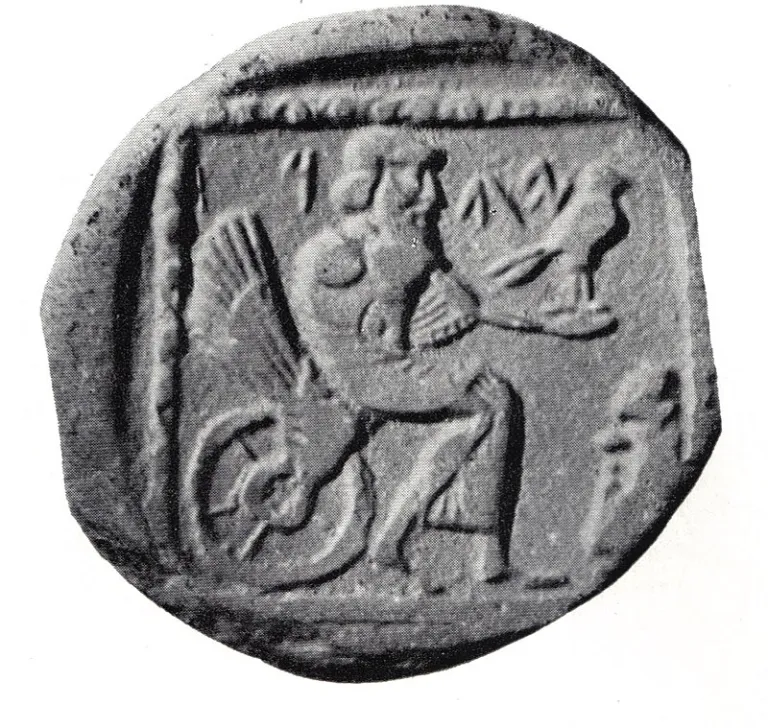
Yahweh / Jehovah / Allah

I find it highly symbolic that Judaism should have been born in blood and fear, not out of love for its founding deity. It was a radical, unprecedented departure from the ancient world cultures. Naturally, it did not stop there and went on to find more fertile soils in Christianity and Islam. – Prof Michel Danino

Our first task … is to examine the Abrahamic concept of God at the root of the three monotheistic religions: Yahweh (later Jehovah) or Allah. I do not refer here to more ancient Greek, Norse or Celtic gods since, as we know, they lost the war against God with a capital “G”. (Some of them are now striving to revive, but even if they partly succeed, they will be little more than pale replicas of their original selves.)

The first thing that strikes the discerning Indian reader of the Old Testament, especially the Exodus, in which Jehovah first introduces himself to Moses under that name, is his ungodlike character. Jehovah is admittedly jealous: the second of the Ten Commandments reads, “You shall have no other gods before me,” while the third explicitly forbids the making and worship of any idols, “for I am a jealous God, punishing the children for the sin of the fathers”. Jehovah does speak as often of punishment as he does of sin, and periodically goes into a state of “fierce anger”, promising the most complete devastation of the Hebrews who reject him. Not content with cursing his reluctant followers, he also curses nation after nation, and finally the earth itself, which, as I pointed out earlier, he holds responsible for man’s sins: “The day of the Lord is coming—a cruel day, with wrath and fierce anger—to make the land desolate and destroy the sinners within it”. (Isaiah, 13:9). In fact, he is so obsessed with sin that one looks in vain in his oppressive berating and legislating for any hint of a higher spirituality, such as we find in the Upanishads or the Gita. Contrast his jealousy with Krishna’s insistence on spiritual freedom: “Whatever form of me any devotee with faith desires to worship, I make that faith of his firm and undeviating” (Gita, 7.21), or again: “Others … worship me in my oneness and in every separate being and in all my million universal faces” (9:15). But the god of the Bible and the Koran will have none of this catholicity.

If Jehovah had stopped there we might have found him to be simply a foul-tempered and libidinous god; after all, some Puranic gods too have such defects, although they usually retain a sense of their limits and compassion of which Jehovah is spotlessly guiltless. But he has a plan, he means business and knows that coercion alone can establish his rule: when the Hebrews over whom he is so keen to hold sway go back to their former worship of a “golden calf”, he orders through Moses that each of the faithful should “kill his brother and friend and neighbour” (Exodus 32:37). Instructions which were promptly complied with, for we are informed that 3,000 were killed on that fateful day; to crown his punishment, Jehovah “struck the people with a plague.”

Sri AurobindoI find it highly symbolic that Judaism should have been born in blood and fear, not out of love for its founding deity. As Sri Aurobindo put it, “The Jew invented the God-fearing man; India the God-knower and God-lover.” It probably took centuries for the old cults to disappear altogether, and a stream of prophets who sought to strike terror into the hearts of the Israelites. It was a radical, unprecedented departure from the ancient world cultures. Naturally, it did not stop there and went on to find more fertile soils in Christianity and Islam: earlier, Jehovah was content with being the god of the Hebrews alone; now, reborn in the new creeds, his ambition extended to the whole earth.

Increasingly aware of this cruel, irritable, egocentric and exclusivist character of Jehovah, many Western thinkers, specially from the eighteenth century onwards, rejected his claim to be the supreme and only god. Voltaire, one of the first to expose the countless inconsistencies in the Bible, could hardly disguise how it filled him with “horror and indignation at every page”. In particular, he found the plethora of laws dictated by Jehovah “barbaric and ridiculous”. The U.S. revolutionary leader and thinker Thomas Paine wrote of the Old Testament in his Age of Reason:

Whenever we read the obscene stories, the voluptuous debaucheries, the cruel and torturous executions, the unrelenting vindictiveness with which more than half the Bible is filled, it would be more consistent that we called it the word of a demon that the word of God. It is a history of wickedness, that has served  to corrupt and brutalise mankind; and, for my own part, I sincerely detest it, as I detest everything that is cruel.

Because a few intellectuals had the courage to state the obvious, the power of Christianity was greatly reduced in the West. Yet I have always marvelled that Indians should learn about Christianity neither from those bold Western thinkers nor from their own inquiry, but from bigots who continue to pretend that the Age of Enlightenment never happened. With the growth of materialistic science, in particular Darwinian evolution, such views which were revolutionary at the time of Voltaire, became widespread. Bernard Shaw, for example, described the Bible god as “a thundering, earth quaking, famine striking, pestilence launching, blinding, deafening, killing, destructively omnipotent Bogey Man.” Elizabeth Cady Stanton, the courageous U.S. pioneer of woman rights movement, wrote in 1898, “Surely the writers [of the Old Testament] had a very low idea of the nature of their God. They make Him not only anthropomorphic, but of the very lowest type, jealous and revengeful, loving violence rather than mercy. I know of no other books which so fully teach the subjection and degradation of woman.”  Mark Twain put it in his own way: “Our Bible reveals to us the character of our god with minute and remorseless exactness. The portrait is substantially that of a man—if one can imagine a man charged and overcharged with evil impulses far beyond the human limit…. It is perhaps the most damnatory biography that exists in print anywhere. It makes Nero an angel of light and leading by contrast.”  On another occasion he added, “It ain’t the parts of the Bible that I can’t understand that bother me, it is the parts that I do understand.” Freud, seeing in Jehovah an all too human creation, subjected him to psychoanalysis—a dream of a subject for a psychoanalyst. Aldous Huxley called the Old Testament “a treasure trove of barbarous stupidity [full of] justifications for every crime and folly.” In fact,  Huxley traced the “wholesale massacres” perpetrated by Christianity to Jehovah’s “wrathful, jealous, vindictive character, just as he attributed “the wholesale slaughter” of Buddhists and Hindus by invading Muslims to their devotion for a “despotic person”. Albert Einstein said, “I cannot imagine a God who rewards and punishes the objects of his creation, whose purposes are modelled after our own—a God, in short, who is but a reflection of human frailty.”

But is that all there is to the Abrahamic god? Are we simply faced with a man-made demon or the product of some fevered brain?  If you look at Jehovah in the light of Indian experience, it is striking that he has all the characteristic of an asura. Recall for a moment a being such as Hiranyakashipu: did he not, too, forbid all other cults? Did he not order that he alone should be worshipped as the supreme god? Did he not use fear and violence to try and coerce Prahlada? That he was stopped by a Divine manifestation, like many other asuras eager to possess this world, is another story; the point is that we find here the same seed of pride and cruelty as in Jehovah.

Now, to pinpoint Jehovah’s identity we must remember that he himself explains how “Yahweh” is a new name to the Hebrews: “By that name I did not make myself known to them” (Exodus 3:14 – 15, 6:3). But in the Old Testament Jehovah does not reveal his earlier name; it is only the early Christian Gnostic tradition, which was brutally suppressed by the growing orthodox school, that provides us with an answer—or rather two. In the Gnostic Gospels which survived centuries of persecution Jehovah is named either Samael, which means (appropriately) “the god of the blind”, or Ialdabaoth, “the son of chaos”. Thus one of the texts contain this revealing passage:

Ialdabaoth became arrogant in spirit, boasted himself over all those who were below him, and explained, “I am father, and God, and above me there is no one.”  His mother, hearing him speak thus, cried out against him, “Do not lie, Ialdabaoth; for the father of all, the primal Anthropos, is above you.

So not only was Jehovah not the Supreme God, but he also had a mother! For the Gnostics, like the Indians, refused to portray God as male only; God has to be equally female—and ultimately everything.

Another text , in the Secret Book of John, asks pertinently:

By announcing [that he is a jealous God] he indicated that another God does exist; for if there were no other one, of whom he be jealous?

In fact Jehovah is viewed in the Gnostic Gospels as no more than a demiurge or a subordinate deity—exactly as asuras are in Indian tradition. The French novelist Anatole France made use of apocryphal Gospels (rather the new fragments known in his time, for he wrote a few decades before the Nag Hammadi finds). In his perceptive novel The Revolt of the Angels, one of the rebellious angels depicts Jehovah thus:

I no longer think he is the one and only God; for a long time he himself did not believe so: he was a polytheist at first. Later on; his pride and flattery of his followers turned him into a monotheist…. And in fact, rather than a god he is a vain and ignorant demiurge. Those who, like me, know his true nature, call him “Ialdabaoth”…. Having seized a minuscule fragment of the universe, he has sown it with pain and death.

Now contrast this notion of God as tyrannical ruler wholly separate from his creation with the Indian notion of an all-encompassing, all-pervasive, all-loving Divine essence. In the language of the Upanishads:

He is the secret Self in all existence…. Eternal, pervading in all things and impalpable, that which is Imperishable … the Truth of things…. All this is Brahman alone, all this magnificent Universe.

If Jehovah depicts a radical departure from the ancient worships, it is in that he is “wholly other”, as Huxley puts it. Because of the unbridgeable gulf between him and his creation, no Jew or Christian would dare to declare, “I am Jehovah”, no  Muslim would dream of saying, “I am Allah.” But to the Hindu, so’ham asmi, “He am I”, or tat twam asi, “You are That”, is the most natural thing in the world—it is, in truth, the very first fact of the world. Again, can Christian parents christen their son “Jehovah” or Muslim parents name theirs “Allah” in the way a Hindu child can be called “Maheshwari”, “Purushottama” or “Parameshwara”?

Clearly, thus, if we use a single word—“God”—for such widely dissimilar concepts, we will land ourselves in total confusion. “God is one”, is perhaps, in the Vedantic sense that all is ultimately one, because all is ultimately Divine, and yet Hindu inquiry always discerned a whole hierarchy of beings, not all equally true or luminous:  a rakshasa, for instance, cannot be equated with a Krishna. Some may object to calling the Biblical or Koranic god an asura, but I use the word in the original sense of a mighty god who comes to his fall owing to ambition or pride. Moreover, the Indian approach has always claimed absolute freedom to inquire into every aspect of Divinity, from the most personal to the most transcendental: if the Abrahamic god happens to have the attributes of an asura rather than those of a supreme Reality, why should we look away from that essential difference? — Excerpt from Michel Danino’s book Indian Culture and India’s Future, via IndiaFacts, 17 December 2015

› French-born Prof Michel Danino is a historian and the author of The Lost River: On the Trail of the Sarasvati and Indian Culture and India’s Future. He used to teach at IIT Gandhinagar and is a member of the Indian Council of Historical Research.

Yahweh & Asherah