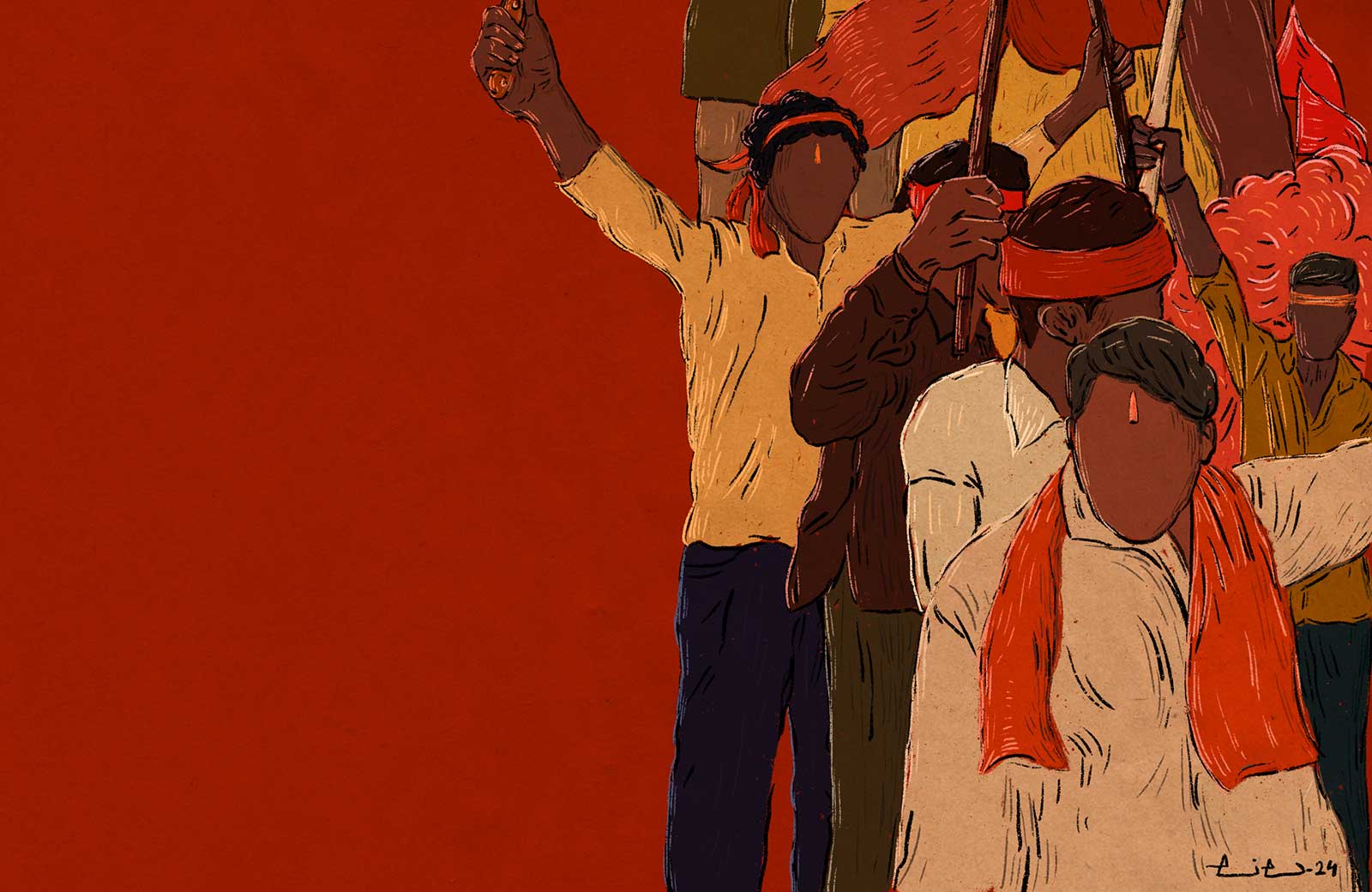
With elections approaching in Uttar Pradesh—the epicentre of national renaissance—the objective of the detractors is crystal clear: use the theft to fracture the temple movement which recalled and reinstated the pre-independence political philosophy of Hindu nationalism. – S. Gurumurthy
Part 1
The cash theft at Ram Mandir that dominates national and international media headlines, has escalated into a massive political controversy, recalling the ideological conflicts of the 1990s. Just as the Mandir movement assumed immense political significance then, the theft at the temple too has gained political traction with the assembly elections in UP, the nerve centre of the Mandir movement, just months away.
While this political interest is natural and understandable, the situation today presents a stark difference. The Mandir movement then did not have to face today’s hyper-competitive, minute-by-minute breaking news media. When such a frenzied media apparatus mixes with political agendas, truth can be uncovered only by taking a helicopter view that avoids the narratives arrested by contextual sensationalism.
Ram’s opponents now His devotees
The theft has miraculously transformed the erstwhile opponents of Ram Mandir into his ardent devotees chanting “Jai Shri Ram”. The Congress party, which boycotted the Pran Pratishtha ceremony in 2024, dispatched a nine-member high-level delegation for Ram Lala’s darshan last week. Even if driven by pure political opportunism, this is a welcome development, as Mahatma Gandhi, whom it swears by, regarded “Ram Naam” as cure for all ills, national and personal.
Arvind Kejriwal, who had boycotted the 2024 Mandir ceremony, too has undergone instant metamorphosis into a Ram Bhakt, declaring that the theft had deeply pained all Sanatanis and announcing his Friday visit for darshan. Most ironically, when Mulayam Singh Yadav was chief minister in 1990, he ordered the police to fire and kill 16 kar sevaks and later proudly declared he would have issued the same order even if 30 had to die. Today, his Samajwadi Party sheds tears, claiming Ram Bhakts have been cheated.
The overexcited Indian media competing for breaking news, too joined this political chorus. One media predicted long-term damage to the BJP. Another claimed this was a severe setback to BJP’s promise of Ram Rajya—the gold standard of probity in governance.
Capitalising on the geopolitical significance of the temple, global media entities with a history of anti-India and anti-Hindu bias, the Reuters, BBC, and Al-Jazeera, painted the incident as if it were a billion-dollar heist. “Stealing from the gods: India’s Ram Temple hit by corruption scandal. The temple is mired in embezzlement allegations before crucial state elections, embarrassing PM Modi’s government,” screamed Al-Jazeera.
A theft—not corruption or a scam
What has happened at the Ram Mandir is a theft. A pilferage easily executed by lower-level staff handling cash. Not a corruption or a scam. It would be corruption only if the top management had attempted to hush it up. On the contrary, within days of the theft coming to light, the higher-ups initiated severe, uncompromising action. There was no sign of an institutional cover-up which only will make it a scam.
Theft happens everywhere. To know the times we live in, one must recall Swami Chinmayananda’s observation: “In the Krita Yuga, good and evil lived in different worlds (Devas and Asuras). In Treta Yuga, they existed in the same world (Ram and Ravana). In Dwapara Yuga, they were in the same family (Pandavas and Kauravas). But in Kali Yuga, they exist within the same human being.” We live in Kali Yuga, where good and evil reside simultaneously in man.
When desire and greed overpower even inherently good people, crimes can occur in the most sacred of spaces—be it churches, mosques or temples. Stealing from a temple hundi (donation box) is notoriously easy. As the C.P. Ramaswami Iyer Committee report on temple administration astutely noted, money dropped into a hundi is sacred, but the moment it is taken out, it becomes mere currency notes. It was based on this very logic that the judiciary permitted secular governments to take over temple funds.
The true metric of integrity in any institution is not the absence of wrong doing—which is ideal—but the speed and decisiveness with which authorities respond to it. Covering up a theft is what constitutes corruption and fraud—usually orchestrated to protect higher-ups. The Bofors scandal was exposed in 1987. As it involved the then prime minister Rajiv Gandhi, no FIR was registered till he was ousted from power. It was filed three years later, in 1990, after he was voted out. Let us examine the Ram Temple Trust’s actions against this historical backdrop of cover-ups in recent cases of theft in temples involving the government as trustee.
The Ram Mandir theft is undoubtedly shocking and painful to anyone who cares about the nation’s reputation symbolised by the geopolitical reputation of the Mandir. Yet, the tsunami of hyperbolic news and allegations that obscured crucial facts, have unfairly cast an avoidable shadow on the national brand. Even neutral commentators have sadly failed to notice the sheer speed at which the Trust and the UP government acted, which was in direct contrast to similar instances of temple thefts, but was drowned out in the noise. Read on.
Speed of Action: Govt temple trusts versus Ram Mandir Trust
Recall the allegations of property misappropriation and idol thefts in government-administered temples in Sabarimala, Thiruvananthapuram, Puri, and Tamil Nadu. Comparing the response of the government bodies to that of the Ram Temple Trust reveals the stark difference between the Ram Mandir Trust response and government-controlled trusts in those cases. It doesn’t need turning the pages of decades of history. Today, the AI tool brings the history with references on the computer screen.
When AI tool Gemini was prompted to compare the scenarios of how the Ram Mandir Trust and government trusts in those cases acted, it replied: “Compared to how governments blocked and delayed action on allegations in temples under their control, the Ram Temple Trust’s swift action is astonishingly different.”
It noted that in cases like Sabarimala, Puri, and the Tamil Nadu idol thefts, the sheer inaction of government boards forced courts to intervene and order probes, delaying justice by years, sometimes decades. In stark contrast, the Ram Temple Trust requested the UP government to form a Special Investigation Team (SIT) within days of the crime coming to light.
The AI rightly summarised: “Driven by its ideology and self-esteem, the Ram Mandir Trust took immediate action. Conversely, government trusts acted sluggishly in a bid to protect their systems and bureaucracy.” (The very ideology that some media claimed would be tainted by this theft is precisely what catalysed such uncompromising action.)
The AI tool also said, “Furthermore, top officials of the Ram Temple took moral responsibility and resigned immediately. In government temple scandals, officials not only cling to their posts but fight legal battles using taxpayer money to protect their positions.” It concluded: Everything regarding the Ram Mandir theft—from the SIT probe to the official report and mass arrests—happened in a matter of days.
Further, it said “the Trust voluntarily submitted its finances to a comprehensive five-year re-audit. Government-run temples routinely dodge external audits citing tradition or autonomy.” An AI savvy 10th class student could have done this comparison by clicking the laptop mouse, which the multi trillion dollar global and India media in its excitement failed to do.
The unprecedented actions by the Ram Mandir Trust also clearly imply that this was a low-level theft, not a high-level scam. For political leaders, aided by the media, to suspect it as a high level affair is a tragedy. Now let us turn to the “stark contrast” in facts of the Ram Mandir Trust’s action as compared to the temple Trusts mentioned.
June 4 to 26: A timeline of lightning-speed action
It is baffling that the media missed this stark contrast: government trusts covering up wrongs till courts intervene versus the Ram Mandir Trust acting against the wrong voluntarily, at lightning speed. See the chronology of facts:
June 4: First clue emerges. An unclaimed bag containing Rs 2 lakh in cash found in a washroom in the Mandir complex. Trust officials immediately begin reviewing CCTV footage.
June 5: General Secretary Champat Rai orders an internal probe targeting key suspect Avinash Shukla. His house is raided, and Rs 58 lakh is recovered before the police even arrive. Rai struck first against a man in his own inner circle. This severe crackdown terrified other accomplices into quietly depositing stolen money back into bank accounts, leading the Trust to believe for a while that the issue could be resolved internally.
June 7: News of the recovery leaks, sparking wild rumours of stolen gold and silver. Rai, relying on preliminary assessments that the money could be fully recovered internally, states that audits showed no significant discrepancies.
June 13: Realising that assessment was wrong, the Trust formally requests the UP government to set up a high-level SIT probe. This six-day stagnation was the only delay in the entire action.
June 25: SIT probe reveals that Manish Yadav, a cash counter employee, repeatedly stole money by exploiting CCTV blind spots. An FIR is registered. Midnight raids are conducted with lightning speed into the early hours of June 26, resulting in eight arrests.
June 26: Taking absolute moral responsibility for the administrative lapses, General Secretary Champat Rai and Trustee Anil Mishra resign.
Rai, an RSS pracharak who has dedicated his entire life to the nation, is a symbol of honesty and integrity. The media unfortunately drags him into the controversy, not mentioning that he was the first to initiate action ahead of the police.
Tomorrow, read how the theft may be less than half of Rs 7.5 crore suspected by SIT, how pseudo-secular political forces are trying to weaponise the Mandir theft to smear the Hindu nationalist perspective, and how their chances of finding resonance in battleground UP are slim. – The New Indian Express, 7 July 2026
Part 2
Will theft affect Hindutva, UP poll?
The Shri Ram Janmabhoomi Teerth Kshetra Trust had outsourced the cash-counting process to the local SBI branch, which in turn hired an external agency, Sainik Security Services. SBI deployed 19 personnel, which included the few recommended by the Trust.
Of the eight arrested, six were from this counting team, and two were Trust employees—one of whom betrayed the immense trust placed in him by Trust general secretary Champat Rai on the quintessential RSS ethos that “trust breeds trust”.
The theft occurred because of over reliance on personal trust instead of systemic rigour. The counting protocols were overly relaxed, allowing for collusion.
This led to administrative negligence, paving the way for the theft. As Champat Rai himself noted, he was betrayed by someone he trusted deeply.
Bulldozer action
To date, Rs 80 lakh out of the stolen cash has been recovered. The Special Investigation Team (SIT) set up by the UP government is actively tracking the remaining assets of the accused and investigating if any other valuables were compromised. The government’s resolve against the wrongdoers is manifest in the move to bulldoze a Rs 80-lakh house built by one of the thieves whose salary was a mere Rs 20,000.
Stolen cash a small sum?
The Ram Mandir is said to have received over Rs 3,000 crore in donations to date, with reportedly more than 90% arriving securely via bank transfers. Between April 2025 and February 2026, Rs 74 crore was reportedly collected in cash via the hundi. It was only from this cash pool that theft occurred.
Based on internal audits and preliminary SIT reports, the embezzled amount was reportedly estimated at Rs 7 crore to 7.5 crore initially. The latest estimate of the theft gathered from Trust sources is far less, out of which most has been recovered partly in cash and partly traced as properties.
Trust sources confirm that there is not a single gram of jewellery lost. The latest estimate of the stolen cash, and the absence of any loss of jewellery, if finally established by SIT, will be a serious blow to the reckless opposition charge of a huge Rs 200 crore scam.
Already, their demand for a court-monitored investigation ignores the stark contrast between inaction in government trust cases forcing the courts to step in to initiate the probe and the super promptness of the Mandir Trust’s action.
Now come to the politics and ideological clashes triggered by the theft that is inevitable as the Mandir battleground of UP goes to polls early next year.
Hindu Nationalism: Preached by Vivekananda, accepted by Gandhi, reclaimed by Ram
Even a single rupee stolen is a tragic betrayal of Shri Ram. Ram is not merely an idol. He is the very soul of this ancient nation. He is the very symbol of the Ayodhya movement that decisively course-corrected the pseudo-secular polity, which fractured our civilisational ethos. To recall how the Ram Mandir movement reoriented our national life, here is a bit of history that the media often forgets.
After independence, the inspiring ideals and symbols of the freedom movement—the concept of Hindu nationalism expounded by Swami Vivekananda and Maharishi Aurobindo, Mahatma Gandhi’s vision of Ram Rajya, the rallying freedom battle cries of Bharat Mata Ki Jai and Vande Mataram—were marginalised. The Ram Mandir movement catalysed their renaissance.
Most of those guiding the national discourse are unaware that the concept of a Hindu Rashtra (Hindu nationalism) is not an invention of the RSS. Yes, it is not the RSS’s conception. Decades before the RSS was formed, this nationalism was preached by Vivekananda and Aurobindo. It became the driving force of the freedom struggle. It was thoroughly embraced by leaders like—believe it!—Gandhi, Nehru, and even Communist stalwart Rajani Palme Dutt.
In his seminal work Hind Swaraj (1909), Gandhi wrote that Hindu theerth yatras, pilgrimage to chardhams and reverence for Ganga jal symbolise and proclaim our national integration and nationalism. He wrote that they “make us as one in the sense in which no two Englishmen are”. When asked about Muslims, he said they must be assimilated into the overarching national mainstream. How many in the media know this?
Jawaharlal Nehru hailed Swami Vivekananda as the pioneer of India’s freedom movement. He wrote in his Glimpses of World History (1935), “The Hindu nationalism preached by the Swami was rooted deeply in Hindu religion and culture, yet was in no way anti-Muslim.” (p. 437)
Further, Nehru acknowledged, “It is not easy to draw a line between Hindu nationalism and true nationalism. The two blend together, as India is the only home of the Hindus and they form a majority there.” (p. 720) How many participants in public discourse today have read Nehru’s Glimpses of World History?
Rajani Palme Dutt, the Indian who founded the Communist Party of Great Britain, wrote in his book titled India Today that even if Indians had grown up in monastic isolation learning only the Sanskrit Vedas, they would have undoubtedly drawn inspiration required for the freedom struggle from them. How many in the media know his name, know that he wrote that book in 1939 and revised it in 1973 and still did not change what he had said in 1939?
This freedom movement, firmly anchored in Hindu nationalism, changed course drastically on one specific day—22 March 1940. That was the day the Muslim League under M.A. Jinnah passed the resolution for partition of the nation. From that day, the Hindu nationalist perspective was systematically erased from the freedom narrative.
Vande Mataram and Bharat Mata Ki Jai began fading from public life. After independence, the Nehru-led Congress actively rejected the very ideals and symbols Nehru himself had once celebrated. The foundational pillars of our independence—Hindu nationalism, Vande Mataram, Bharat Mata Ki Jai, and Ram Rajya—were orphaned by the pseudo secular political establishment. It was the RSS which kept the flame of these noble thoughts and symbols alive amid the pseudo-secular tsunami drive for vote bank politics.
Finally, it was the RSS-led mass Ram Mandir movement that reclaimed the pre-independence values of Hindu nationalism and reoriented the derailed national polity. When pseudo-secularists challenged Hindutva as not compatible with India’s secular Constitution, the Supreme Court delivered a historic verdict in 1996, and ruled unequivocally that Hindutva is the national soul, culture, and way of life of the Indian people. When approached to review the ruling several times later, the court refused, thus confirming the Hindu foundations of our nation and nationalism.
Weaponising theft to sabotage nationalism
The Ram Mandir movement had successfully dismantled the pseudo-secular politics based on vote, thus restoring the Hindu nationalist perspective to its rightful place in the Constitution. Now, weaponising this Mandir theft, the forces that vehemently opposed the course-correction of the nation by the Ram Mandir movement, are desperately trying to derail it and drag the nation back into the abyss of pseudo-secularism.
The coordinated attempts by opposition parties and sections of the national and international media to undermine the reputation of the Ram Mandir movement is the present political and electoral challenge to the RSS and BJP. With elections approaching in Uttar Pradesh—the epicentre of national renaissance—the objective of the detractors is crystal clear: use the theft to fracture the temple movement which recalled and reinstated the pre-independence political philosophy of Hindu nationalism.
Since the UP election is months away, the opposition’s effort to use the theft to make an impact will depend on their capacity to keep the issue alive till polling. For, in the social media-driven ecosystem, the shelf-life of all issues is increasingly becoming short. If the SIT establishes the theft to be a smaller affair and that no jewellery was lost, the opposition will have egg on its face and the issue itself will be consigned to history well before the elections. – The New Indian Express, 8 July 2026
› S. Gurumurthy is the Editor of Thuglak Tamil Magazine and Chairman of the Vivekananda International Foundation Strategic Think Tank.