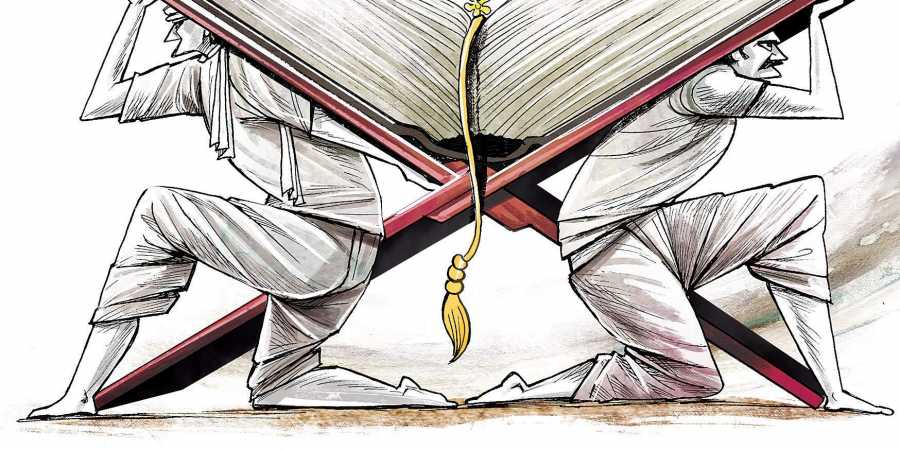
Thomas Babington Macaulay … declared that traditional Indian knowledge consists of “false history, false astronomy, false medicine … in company with a false religion”, many Indian academics and intellectuals have implicitly or explicitly accepted that knowledge from the West is the real thing. – Prof. Michel Danino
Indian civilization’s obsession with knowledge was our last “master idea,” with endless and still poorly explored contributions in nearly every field (“India as a Knowledge Creator”). But there is another side to the story, which in many ways characterizes the paradox of Indian culture.
No Indian university, IIT or IIM has a regular, comprehensive course on Indian knowledge systems (IKS) (though IIT Gandhinagar made a beginning a few years ago). There are, no doubt, a few scattered courses on systems of ancient science (IIT Bombay and Kharagpur), and a few universities teach courses on Indian philosophical systems or even “Indology”, whatever that means. By and large, however, indifference, neglect, or hostility to IKS is the rule.
All three are part of India’s colonial legacy: ever since Thomas Babington Macaulay, a powerful British figure of the first half of the nineteenth century, declared that traditional Indian knowledge consists of “false history, false astronomy, false medicine … in company with a false religion”, many Indian academics and intellectuals have implicitly or explicitly accepted that knowledge from the West is the real thing.
Our philosophy courses cover mostly European philosophy; the same goes with psychology (from which yogic systems of self-knowledge are generally excluded); contemporary Indian literature is often studied; classical texts rarely are. Students of Ayurveda are compelled to devote much time to modern medicine, but not vice versa. Political scientists generally know nothing of the systems of polity that prevailed in ancient India. And so forth. In 1946, the freedom-fighter and statesman K.M. Munshi wrote: “Modern education in India assumes that Indian culture is dead, only requiring post-mortem dissection, and that a new culture can be developed by imitating the West. No attention is paid to the importance of a ceaseless reintegration.”
That accounts for the indifference and neglect. But why hostility? I see it essentially as a survival of the colonial-cum-missionary stereotype that Indian knowledge systems were “elitist”, “upper caste” when not “Brahminical”, and denied to the lower castes and “untouchables”. Such declarations are usually based on a few Dharma Shastra texts prohibiting the teaching of the Vedas to lower castes. Granted, those texts and a few more were Brahminical and set down a caste-based order for the society.
However, the said society was far from circumscribed or defined by a few orthodox texts. A careful look at the mechanisms of transmission of knowledge gives a very different picture. “Brahminical” texts of mathematics produced number systems and calculation methods that were, in time, adopted by the population at large, down to the carpenter and the farmer. Astronomy created calendars that punctuated people’s lives and stood behind astrology and the ever-popular panchangas (almanacs).
Architecture was rooted in Vedic principles but practised by Vishvakarmas: technically Shudras, they often regarded themselves as higher than the Brahmins in their application of those concepts to temple construction and iconography (for the making of bronze or stone images), and themselves wrote manuscripts in both Sanskrit and regional languages. So too, texts of medicine, metallurgy, agriculture, animal and plant treatment, water management and other civil engineering techniques, were often written by the practitioners of those disciplines rather than by “upper caste” theoreticians.
All this points to a sustained, intense and complex dialogue between the Shastras (the theories or systems) and the popular practices (loka parampara). From the Ayurvedic classic which declares that for the knowledge of medicinal plants one should consult the hunter or the tribal, to Kautilya’s Arthashastra which explains how the quality of a metal ore is to be assessed through its taste and smell, this dialogue has clearly enriched the two sides, if at all there are sides. In literature and the arts, it is the much-discussed marga-desi interplay, or classic (generally pan-Indian and Sanskritic) vs. popular (regional and often non-Sanskritic) texts and art forms. Again, it is a story of mutual enrichment, with classical forms often emerging from popular ones and eventually influencing them back. This is perceptible in the epic genre (Mahabharata and Ramayana), in all performing 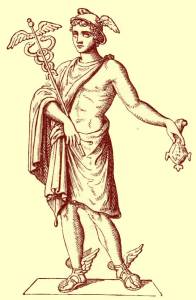 arts (drama, dance, music), and in sculpture. A scholar friend of mine has compared this interaction to the double helix of the DNA molecule; as the helices, though joined by numerous bridges, never meet, I prefer the symbol of Hermes’s caduceus with its two intertwined snakes.
In 1920, Sri Aurobindo wrote to his younger brother, “I believe that the main cause of India’s weakness is not subjection, nor poverty, nor a lack of spirituality or Dharma, but a diminution of thought-power, the spread of ignorance in the motherland of Knowledge. Everywhere I see an inability or unwillingness to think—incapacity of thought or ‘thought-phobia’.” The last term perfectly applies to our cultural negationists of the day. Indian knowledge systems were not “elitist” or exclusivist, even if specialized fields did exist for the various castes. Overall, while they invoked lofty concepts, they were often remarkably pragmatic. No, they did not tell us how to construct vimanas or nuclear weapons; instead, they sought to equip the society with all the tools it needed for a complete development in the material, aesthetic, intellectual, ethical and spiritual fields. – The New Indian Express, 31 December 2018
› Prof. Michel Danino is a French-born Indian author, scholar of ancient India, and former educator at IIT Gandhinagar.
 VOICE OF INDIA