Let’s honour the India that is Bharat and the Hinduism that is Sanatana Dharma – David Frawley

Bharat Mata

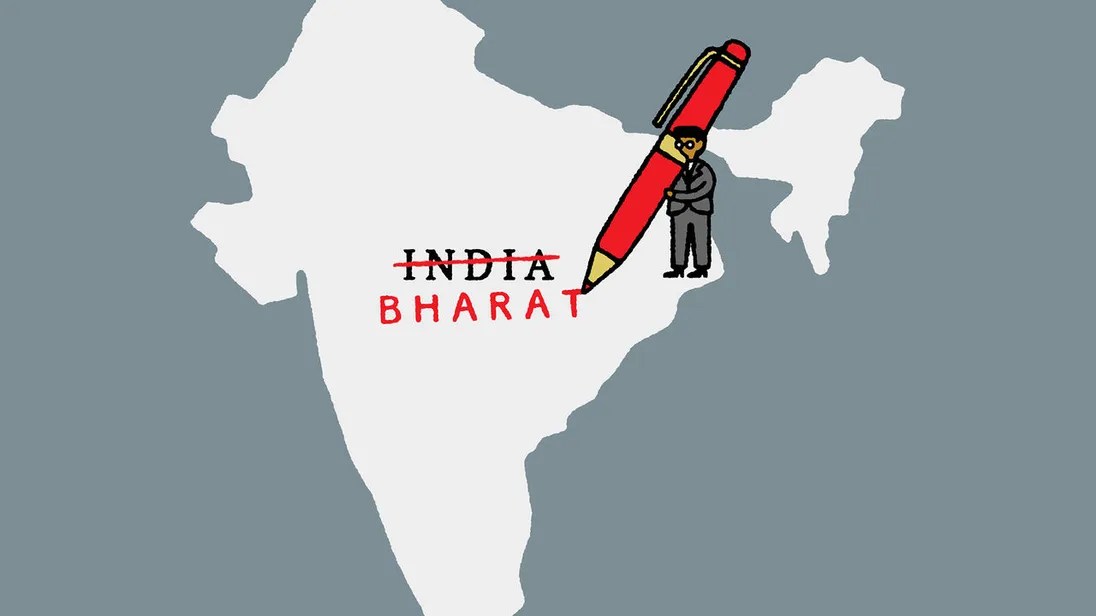
India that is Bharat, which occurs in the beginning of India’s Constitution, highlights the need for a civilisational revival that was an integral part of India’s independence movement, not just creating another modern nation-state. – Dr. David Frawley

India cannot be understood without an equation with its traditional name of BharatIndia is a much older civilisation than Europe and has maintained its continuity uniquely over the millennia. The term Bharat brings that ancient history to mind and its cultural identity as Bharatiya Samskriti, a vast dharmic civilisation with its own unique voice and global influence.

India that is Bharat, which occurs in the beginning of India’s Constitution, highlights the need for a civilisational revival that was an integral part of India’s independence movement, not just creating another modern nation-state.

Similarly, Hinduism cannot be understood without its equation with Sanatana Dharma, meaning the universal, eternal and perpetual Dharma. Sanatana Dharma shows the need to understand the dharmic traditions of Bharat in their own right and according to their own terminology: a profound spiritual, religious, philosophical, scientific, artistic and cultural tradition, with numerous great rishis, yogis and gurus, deity forms and temples, all reflecting a pursuit of higher consciousness and Self-realisation. We should equate Hinduism, Hindu Dharma and Sanatana Dharma, not simply by name but by meaning and implications.

It is great to see India’s politicians today using the term Bharat, or India/Bharat for their identification at diplomatic programs. It is an essential part of decolonization and calls for a reexamination of the global identity of India and what it represents as a civilisation. Similarly, it is important to identify Hinduism as Sanatana Dharma.

Sanatana Dharma refers to the term dharma in a generic way, embracing dharma in all its names, actions, vision and wisdom. Hindu Dharma is known for its many sects and sampradayas, whether Shaivite, Vaishnava, Shakta, Ganapata and Saura such as Adi Shankara recognised long ago, and as Vedic, Itihasa/Purana and Tantra with many modern movements as well. These diverse Hindu teachings are all expressions of a unitary Sanatana Dharma.

Vedic sciences like Yoga, Ayurveda, Vedanta, Jyotish and Vastu that are spreading worldwide reflect the Sanatana Dharma vision of universal consciousness at the foundation of Hinduism. Hindu art and culture with its music, dance, festivals and customs express the vibrant Sanatana way of life, embodied in its magnificent temples, their mystical designs and ornate sculptures.

Bharat and Sanatana Dharma

We must also note that Bharat cannot be understood without its inherent connection with Sanatana Dharma, as Bharat always viewed itself as a dharmic civilisation. Yet this does not mean that by using the terms Bharat and Sanatana Dharma, one will be creating a limited religious state. It will be acknowledging India’s dharmic civilisation and its experiential search for universal truth and consciousness, as in Yoga and Vedanta.

Let us, therefore, remember Bharat as the inner reality behind what is called India, and Sanatana Dharma as the essence of what people refer to as Hinduism. Sanatana Dharma highlights Hindu Dharma as embracing all humanity and all living beings, rooted in the Earth and nature, not any dogma. It has the vision of the world as one family, and the universe, both animate and inanimate as part of one’s own Self, with the Divine not apart from us.

I am not saying we should give up the terms Hinduism or Hindu Dharma but recognise Sanatana Dharma as its foundation. Even the word India we cannot give up, given its global usage, but can equate it with its Bharatiya essence for greater clarity and understanding.

Sanatana Dharma and national elections

Sadly, we still see an equation of Hinduism/Sanatana Dharma in a negative light at a political level with new assertions of the same old prejudices. This is most glaring in anti-Hindu anti-Sanatana Dharma state governments like the Communists in Kerala and DMK in Tamil Nadu who are trying to discredit and eradicate it for their own personal advantage. Meanwhile, India’s Congress party today, their ally, remains silent in the face of these virulent attacks, though it still claims to be Hindu when convenient, but lacks any conviction to express or defend Sanatana Dharma from such denigration.

We must remember that Sanatana Dharma is the ancient basis of Kerala and Tamil cultures, honouring Vedic knowledge and sustaining numerous monumental Hindu temples. Sanatana Dharma was the original basis of India’s Independence movement inspired by the Bhagavad Gita, and there can be no real Congress party apart from it.

Such political parties that oppose this dharmic heritage should be rejected in [any] national election. If they have no place for Bharat or Sanatana Dharma in what they respect or represent, what country, culture or civilisation can they claim to uphold or be part of?

Let us honour the India that is Bharat and the Hinduism that is Sanatana Dharma and we will understand the greatness of both. – News18, 9 Decemeber 2023

› Dr. David Frawley is the director of the American Institute of Vedic Studies and the author of more than 30 books on Yoga and Vedic traditions. 

Map of India

Hollywood’s distortion of Hindu symbols – Gautam Chintamani

J.R. Oppenheimer

By blurring the sacred with the profane, Hollywood erodes the capacity for distinction itself. If the Hindu swastika and the Nazi cross are interchangeable, if Krishna’s revelation and the mushroom cloud are comparable, if Bushido is nothing more than gangster loyalty, then moral categories collapse. The West’s darkest deeds can be cloaked in Eastern wisdom, while the East’s oldest traditions are dragged into the West’s nightmare. – Gautam Chintamani

Hollywood has always had a way of flattening differences. In the grand illusion of cinema, two things as far apart as night and day can, with the right framing, appear indistinguishable. The business of film thrives on archetypes, but sometimes the archetypes are chosen with so little care—or perhaps so much calculation—that they collapse distinct histories and philosophies into one misleading picture. As the world approaches the eightieth anniversary of the end of the Second World War, it is worth revisiting how Hollywood has systematically placed Eastern symbols into Western nightmares, encouraging audiences to see the sacred through the lens of the profane.

Two films, separated by more than sixty years, offer a striking study of this phenomenon: Stanley Kramer’s Judgment at Nuremberg (1961) and Christopher Nolan’s Oppenheimer (2023). Both films confront cataclysmic episodes in modern history—the Nazi crimes against humanity and the making of the atomic bomb—yet each imports Hindu symbols at decisive moments, almost as if to suggest that the moral ambiguities of the West and the spiritual legacies of the East occupy the same continuum. To the uninitiated viewer—and let us assume this is the overwhelming majority—these moments collapse cultural distances, turning difference into sameness.

Consider Judgment at Nuremberg, whose opening credits depict the shattering of a swastika. At first glance, the symbolism is unambiguous: the icon of Nazi horror reduced to rubble. Yet the image that lingers on screen is not the crooked, tilted hakenkreuz of Hitler’s Reich but the upright, balanced form of the Hindu swastika, a sacred sign of prosperity and cosmic order that predates Nazism by millennia. The misrepresentation is not trivial. Symbols are repositories of collective memory. The Hindu swastika embodies cycles of life, cosmic balance, and good fortune; it appears on thresholds, marriage rituals, and the opening pages of business ledgers. By confusing it with a twentieth-century emblem of genocide, the film extends the Nazi theft of the symbol into the cultural memory of the West. The original meaning is obscured, the millennia-old inheritance distorted.

This conflation continues to reverberate. In 2021, a bill introduced in the New York Senate proposed that schools teach the swastika as a hate symbol, without distinction. Hindu and Buddhist organisations protested, pleading for nuance, but the damage was already in place. Once a sign has been recast on screen, it tends to stay recast.

If Kramer’s film blurs visual iconography, Nolan’s Oppenheimer entwines philosophy with spectacle. In one of the film’s most startling sequences, Robert Oppenheimer quotes from the Bhagavad Gita not in the laboratory or the lecture hall, but in the intimacy of a sexual encounter. As Jean Tatlock presses him to read aloud from a Sanskrit verse, he recites Krishna’s cosmic proclamation: “Now I am become Death, the destroyer of worlds.” The scene conflates erotic vulnerability with spiritual revelation, suggesting that the scientist’s deepest confession emerges not through moral reckoning but through carnal intimacy.

The quotation itself has long been debated. Oppenheimer knew Sanskrit and genuinely engaged with the Gita. Yet in the film, the context trivialises the source. Krishna’s words on the battlefield of Kurukshetra are a divine disclosure of cosmic duty and the eternity of the soul; they are not an endorsement of technological annihilation. By placing this moment in a boudoir rather than a battleground, the film distorts not just the scripture but its moral gravity. More troubling is the film’s broader posture.

Nolan’s portrait of Oppenheimer is sympathetic, even indulgent. The architect of the atomic bomb emerges as a tragic genius, crushed by politics and scapegoated by lesser men. The deaths at Hiroshima and Nagasaki recede into abstraction, almost footnotes to the protagonist’s inner torment. The climactic scene with President Truman, who dismisses Oppenheimer as a “crybaby,” allows the audience to pity the scientist while diverting attention from the annihilated civilians. The film invites us to grieve for the maker, not the victims. Hardly surprising then that the studios were clear in not releasing the film in Japan in its initial run—a market that for long has been second home for Hollywood.

In this reframing, Eastern philosophy functions as an alibi. The Gita becomes the text that gives Oppenheimer a language for his burden, as if the destruction of worlds could be sanctified by scripture. The appropriation universalises the bomb: no longer the invention of one nation’s scientists, but the cosmic destiny of humankind.

The misappropriation of Hindu symbols is not an isolated case. Hollywood has long repurposed Asian traditions, plucking them from their contexts and suturing them into Western narratives where their meanings are inverted or hollowed out.

As the world marks eighty years since the end of the Second World War, it is crucial to remember not only the horrors perpetrated but the symbols misused in their narration. The hakenkreuz was not the swastika; the Gita was not a manual for atomic warfare. Each had meanings far older, richer, and more humane than the distortions allowed.

These are not small distortions. Why do they persist? One answer lies in Hollywood’s appetite for the exotic. For decades, India, Japan, and China have been backdrops of mysticism, storehouses of symbols repurposed to lend profundity or menace.

Another answer is more unsettling. By blurring the sacred with the profane, Hollywood erodes the capacity for distinction itself. If the Hindu swastika and the Nazi cross are interchangeable, if Krishna’s revelation and the mushroom cloud are comparable, if Bushido is nothing more than gangster loyalty, then moral categories collapse. The West’s darkest deeds can be cloaked in Eastern wisdom, while the East’s oldest traditions are dragged into the West’s nightmare.

This was never a mere accident. Hollywood has long been an unofficial arm of the American state. FBI files and Cold War records show cultural appropriation was part of the soft-power playbook: projecting American myths while bending other civilisations’ icons inward. When the swastika is recast as eternal evil, or the Gita becomes the language of apocalypse, the damage is geopolitical.

A generation in India grows up unsure of what belongs to them, quick to doubt their inheritance. And the irony is unbearable: heirs to millennia of civilisation outsourcing their doubts to California while their certainties wither at home. Unless we wake up to these distortions, the oldest philosophies in the world will survive only as Hollywood subtitles — mistranslated, misused, and mistaken for someone else’s truth. – News18, 30 september 2025

Gautam Chintamani is a film historian, a voracious cinephile attuned to writing on the world cinema, Bollywood and everything in between.

Hakenkreuz in the Benedictine Monastery, Lambach, Austria.

Max Müller to Doniger to Orsini: The West sends Trojan horses to India – Abhijit Majumder

Trojan Horse

The West repeatedly sends academic Trojan horses who would erase and distort Indian history, attack self-esteem, construct divisive narratives, and collude with India’s own sell-out intelligentsia to project credibility. – Abhijit Majumder

India is the imperialist’s unfinished project. Few lands that have been touched by Christian or Islamic imperialists have managed to remain largely unconverted and geopolitically intact. In a little over 100 years since 1900, the centuries-old fluid indigenous faiths in the entire African continent, for instance, dwindled from 76 per cent of the population to just 8 per cent, having been replaced by the two hardcoded religions.

Bharat, or what remains of it after Pakistan and Bangladesh were created, still has not given in. Sanatan Dharma is still the way of life for more than 75 per cent of Indians, and in spite of the best efforts of invaders and colonialists, its nationalism and civilisational self is rising again, its economy rapidly growing, its military gaining muscle.

The mere presence of Bharat—with its staggering size, diversity, and potential—has unnerved the West enough across ages to repeatedly send academic Trojan horses who would erase and distort history, attack self-esteem, construct divisive narratives, and collude with India’s own sell-out intelligentsia to project credibility.

The controversy around Francesca Orsini, Hindi scholar from London-based SOAS, is a continuation of that. A white woman specialising in an Indian language may fascinate us, but a look into her political activism in academic guise begins to reveal a different story.

She accuses the very language she teaches, Hindi, of political usurpation of other languages. She has a problem with Indian nationalism. In 2020, she introduced a resolution in the Seattle City Council against India’s Citizenship Amendment Act (CAA) and the National Register of Citizens (NRC).

While India is not obligated to host those arriving to spread intellectual poison, Orsini was deported recently after landing in Delhi for gross violation of visa conditions during her previous visits. Orsini is a rather mediocre entrant in the galaxy of Western radicals who have got into the study of Indology, history, Sanskrit and other languages only to undermine Bharat.

German philologist Friedrich Max Müller, hired by the British colonialists in 1847, came with a mission to bury the Vedas, which he described in a letter to his wife as “the root of their religion, and to show them what that root is, I feel sure, the only way of uprooting all that has sprung from it during the last 3,000 years”. He also wrote: “The ancient religion of India is doomed, and if Christianity does not step in, whose fault will it be?”

Then there was James Mill, a Scottish historian and economist whose work, The History of British India (1817), divided Indian history into Hindu, Muslim, and British periods. In his book, Mill extensively describes Hindus as “uncivilised”, “barbaric”, “savage”, and “rude”. This gentleman wrote with astonishing confidence on India without once stepping on this land and no knowledge whatsoever of Indian languages.

The more recent gift horses from the West to India like Wendy Doniger, Sheldon Pollock, and Audrey Truschke employ a more sophisticated packaging but are no less venomous. Doniger uses psychoanalytic quackery to introduce a homosexual angle to the relationship between Ramkrishna Paramhansa and his disciple Swami Vivekananda; Pollock blames the Sanskrit language for the Holocaust; and Truschke swoons over the genocidal Mughal Aurangzeb.

India’s intellectual tradition is among the most welcoming mindscapes in the world. Bharat has continuously assimilated knowledge and made “outsiders” its own. Even in the modern era, it has been enriched by foreigners from Sister Nivedita to David Frawley, Michael Danino to Koenraad Elst, Francois Gautier to Maria Wirth. These scholars have taken a dharmic approach. They did not approach Indic knowledge with the mission to debase it.

But ultimately, Indians will have to take a major part of the blame for not taking up their own knowledge universe seriously, neglecting languages like Sanskrit, writing their own history, and leaving a vast vacuum for the likes of Orsini to fill.

Unless Bharat begins to take its own story seriously, vultures will come to feast. – News18, 25 October 2025

Abhijit Majumder is a senior journalist and editor-in-chief at Earshot Media, New Delhi. He is the author of the book, ‘India’s New Right’. 

George Orwell Quote


Scholastic Apartheid: Western intellectual colonialism in India – Hindol Sengupta

Francesca Orsini

It is impossible to ignore that Western scholars—overwhelmingly White—have exercised an unrestrained entitlement to interpret, categorise, and often diminish Indian culture, religion, and society with little pushback from Indian institutions themselves. – Hindol Sengupta

In 1998, Jaswant Singh wrote one of the fiercest defences of India’s choice of acquiring nuclear weapons with an essay called ‘Against Nuclear Apartheid’. The time has come to focus on a different—but no less problematic—apartheid.

India has endured a long history of scholastic apartheid, especially in the humanities. The term “scholastic apartheid” here refers to the entrenched and systematic cultural and institutional barriers that have long prevented Indian or non-Western scholars from critically engaging, on equal terms, with the West and its intellectual traditions. Western, especially White, scholars, on the other hand, are not only permitted but encouraged to dissect, critique, and even deride Indian society, civilisation, religion, and history.

It is impossible to ignore that Western scholars—overwhelmingly White—have exercised an unrestrained entitlement to interpret, categorise, and often diminish Indian culture, religion, and society with little pushback from Indian institutions themselves. These analyses, interpretations, and often prejudiced criticisms not only gain currency within the academy and mainstream media in the West but are frequently internalised by Indian intellectuals and the broader Indian public, who often lap up Western validation with scant scepticism.

At the same time, no Indian scholar—no matter how credentialed, nuanced, or deeply trained in the Western humanities—has ever been afforded a comparable footing to turn the gaze on Western civilisation. While the Indian academy is populated by numerous ‘experts’ on the West who largely parrot or celebrate Western thought, rarely do critical studies produced in India or by Indians elsewhere, particularly those that challenge fundamental Western narratives, get any meaningful hearing or space in Western institutions, media, or discourse networks.

This asymmetry is not simply a matter of academic preference. It is rooted in deeper epistemic and institutional racism and the continued coloniality of Western academia.

For instance, any German historian working on Indian topics is treated with a presumed authority and seriousness by institutions in both Germany and India, but if an Indian historian proposes to research, say, the Protestant Reformation or the intellectual legacy of the Enlightenment from a critical Indic perspective, they are met with cold indifference, suspicion, or even ridicule.

Such work is seldom, if ever, funded, published, or incorporated into major Western scholarly discourse. One of the most powerful critiques by Indian scholars of German Indology and its profound biases, Vishwa Adluri and Joydeep Bagchee’s The Nay Science: A History of German Indology (2014) received little attention, and mostly derision, from the Western academic world. Sadly, it is so complicit in the Indian system in such neglect that it never got much attention even from Indian institutions.

Imagine, for a moment, an Indian academic proposing a deep, critical study of the enduring racial caste system in the United States, not as a sympathetic outsider, but as a critical analyst pointing out the systemic failures and foundational hypocrisies of its democracy. Imagine a researcher from Delhi securing a major grant to study the role of French laïcité as an instrument of state-sponsored anti-religious hegemony, particularly against its minority populations. Imagine a team from Mumbai or Kolkata publishing a definitive, critical ethnography of the British class system, exposing its role in perpetuating social immobility and political dysfunction.

Where would such a scholar publish? Which major Western university press would champion this work? Which mainstream media outlet, from The New York Times to The Guardian, would grant it a serious, respectful review, let alone a celebratory feature? The answer is self-evident.

Such work would be marginalised from the beginning. It would be dismissed as “biased”, “polemical”, “un-rigorous”, or “lacking in theoretical grounding”—a coded phrase meaning it does not originate from or pay sufficient fealty to the established Western theoretical canon. The non-White scholar is permitted to speak, but only as a “native informant”, providing raw data about their own exotic society. They are never, ever accepted as a peer, a theorist, or a critic with the standing to analyse the analyst.

One cannot, therefore, treat questions like, “Which Western scholar has been denied access to India?” as if this is an equivalent dilemma. It is in fact a deflection—a refusal to confront the deeply embedded structure of global knowledge production, which is predicated on the assumption that Western civilisation is the universal norm, and everything else is an object of study, not a subject with agency.

The phenomenon has a long history. From the early colonial period, British administrators and Orientalists set themselves up as intellectual “trustees” of Indian civilisation, pronouncing on the nature of Indian society, translating and systematically reinterpreting Indian texts, and mapping them onto a Western meta-narrative. Indian voices—literate, nuanced, and deeply engaged with their own historical experience—were either co-opted or sidelined entirely. Today, the small bunch of academically well-known Indian names in the Western academy almost always focus their critical gaze on India and rarely, if ever, on their adopted societies and cultures.

It is therefore disingenuous to only focus on which (of the very few) Westerners are denied access to India when the deeper and more damaging problem is the persistence of scholastic apartheid.

While writing this essay, I asked Perplexity and Gemini which Indians have written major critical histories of Western societies that have won wide recognition in the West? Two names came up, which illustrate the problem: Jawaharlal Nehru and the British-Mauritian Sudhir Hazareesingh.

The struggle is thus not simply for representation, but for reversing the flow of intellectual power. It is a struggle for a world in which Indians and other non-Western peoples are fully entitled and institutionally supported to analyse, critique, and theorise Western societies—as they wish, on their own terms, for their own publics, and as equals in the global commons. – Firstpost, 24 October 2025

Dr. Hindol Sengupta is professor of international relations, and director of the India Institute, at OP Jindal Global University.

Western Colonialism

The secularisation of Diwali – Utpal Kumar


Rama arrives in Ayodhya on Diwali 2025.

You begin to liquidate a people by taking away its memory. You destroy its books, its culture, its history. And then others write other books for it, give another culture to it, invent another history for it. Then the people slowly begin to forget what it is and what it was. The world at large forgets it still faster. – Milan Kundera, in The Book of Laughter and Forgetting

We are living in an era of great Hindu awakening. After centuries of civilisational amnesia imposed through colonisation, political manipulation, and intellectual distortion, Hindus are rediscovering who they are. There is a growing self-awareness and self-esteem—a recognition that Sanatana Dharma is not a relic of the past but a living, breathing continuum that is as ancient as it is modern, as sacred as it is rational, and as religious as it is scientific.

Yet, as this consciousness rises, so too does a more sophisticated form of opposition. Gone are the crude, overt attacks on Hinduism. The new offensive is subtler: it praises the tradition outwardly while hollowing it out from within. The sacred is stripped away, leaving behind only a cultural shell—sanitised, commercialised, and secularised.

Diwali is a classic example.

Once a deeply spiritual celebration grounded in profound human and moral values, Diwali is now often reduced to a vague “festival of lights” symbolising the victory of “good over evil” and “light over darkness”—but stripped of its rich Hindu context. While these phrases aren’t inherently wrong, divorced from their sacred roots they detach Diwali from the core religio-cultural traditions that give it true meaning: the joyous return of Sri Rama to Ayodhya, Krishna’s slaying of Narakasura, and Goddess Kali’s triumph over demonic forces.

Imagine if Christmas were explained merely as a “festival of love conquering hate”, with all references to Jesus erased. That’s what has happened to Diwali. No gods, no demons, no religion, no story—just a feel-good celebration. At this rate, even “light” might soon be declared polluting. Recall how a Samajwadi Party leader recently questioned the rationale of spending on diyas, drawing parallels with Christmas celebrations abroad, and suggested Bharat should emulate them. One day, someone may well ask why Diwali is even needed when Christmas is just a month away. Why not club the two together—to save money for a “poor” country like Bharat?

And this secularisation—or should one say desacralisation?—is not accidental. Each Hindu festival now faces its own “civilising campaign”. Before Diwali, one is compulsively reminded to save the environment; before Holi, the campaign gains ground to conserve water; before Raksha Bandhan, gender rights come to the fore; and before Shivratri, one witnesses an online movement to stop “wasting milk”. Under the guise of modern-day morality and sensibility, the sacred fabric of these festivals is systematically targeted and assaulted.

Environmental consciousness and social justice are causes worth emulating, but their selective invocation only against Hindu festivals betrays their dubious, anti-Hindu intent.

The problem with the “Festival of Lights” narrative is that it seeks to secularise Diwali by divorcing it from its sacred roots. It distorts the Indic notion of festivity—one that embraces diversity while being bound by a shared civilisational core.

Diwali in the North celebrates Rama’s homecoming; in the South, Krishna’s victory over Narakasura; and in Bengal, Kali’s triumph over demons. In Tamil homes, Diwali morning begins with an oil bath, invoking the presence of Goddess Lakshmi and the sacred waters of the Ganga. “Ganga snanam aacha?” (Have you had your holy dip in the River Ganga?): This is a customary greeting exchanged on Diwali, referring to the ceremonial oil bath. Invoking Ganga manifests a strong sense of civilisational unity in the Sanatana Dharma.

Such assaults aren’t just limited to the popular/cultural arena; they run deeper into academia as well. Sheldon Pollock, a prominent American Indologist, for instance, has interpreted Sanskrit texts and traditions as a tool of oppression and elitism. In his book The Battle for Sanskrit, Rajiv Malhotra exposes how Pollock has worked tirelessly to strip Sanskrit of its sacred identity.

The American Indologist, for instance, has accused Sanskrit of “Brahmin elitism”, besides influencing British colonialism and German Nazism. Pollock describes Sanskrit as “at once a record of civilisation and a record of barbarism—of extraordinary inequality and other social poisons”.

His discomfort with Sanskrit’s Sanatana roots is such that he interprets the Ramayana as a political code through which “proto-communalist relations could be activated and theocratic legitimations rendered”. He alleges that the Ramayana’s portrayal of Ravan and the Rakshasas as “others” forms the ideological foundation for later-day hatred for Muslims. In his view, the sacred Hindu epic itself has been instrumental in legitimising violence against Muslims.

Pollock’s dangerous assertions aren’t mere academic theories. They are ideological weapons designed to delegitimise Hindu civilisation by attacking its moral and spiritual core.

When sacred stories are desacralised, the culture they sustain begins to erode. Once memory fades, replacement histories can be written. That is how a civilisation is colonised—this time, not by armies, but by narratives.

The battle, therefore, is not about fireworks or rituals—it’s about their sacred, innate meaning. It’s about whether Hindus will continue to define their festivals, their texts, and their traditions, or whether others will define them for them.

As Kundera warned, when people lose their memory, they lose themselves.

The “modern” sanitisation of Hindu festivals, the intellectual deconstruction of its sacred texts, and the cultural detachment from its civilisational roots are all parts of the same process—a slow liquidation of Bharat’s civilisational identity.

Diwali is merely the battleground; the real target is Sanatana Dharma. – Firstpost, 21 octoberv 2025

Utpal Kumar is Opinion Editor at Firstpost and News18 and is the author of the book Eminent Distorians: Twists and Truths in Bharat’s History.

George Orwell Quote

Why Hindu Americans can’t do what Jewish and Muslim Americans can – Surajit Dasgupt

Hindu Americans

The grievance that Hindu Americans do not lobby for India as Jews do for Israel is both premature and misplaced. Diaspora power is earned over generations, not asserted overnight. As Indian Americans mature politically, their challenge will be to balance pride in their roots with the pluralism that defines their adopted homeland. – Surajit Dasgupt

When Shashi Tharoor raised a seemingly provocative question about the global Hindu community’s inability to lobby for India the way Jews in the US advocate for Israel or Muslims campaign for Palestine, he tapped into a long-standing unease within sections of India’s diaspora. His remarks, made at a public event, drew swift responses from several non-resident Indians (NRIs) and persons of Indian origin (PIOs) in America. They countered that India’s decision-makers seldom consult them before taking major policy decisions—such as buying oil from Russia or voting at the United Nations—and that they are often treated merely as emotional extensions of the homeland rather than as stakeholders in policy outcomes.

At one level, the NRI lament is outlandish. No sovereign country consults its overseas citizens before making foreign or economic policy choices. Yet, Tharoor’s pin prick touched a raw nerve because it revealed a deeper question about influence: Why have Hindu Americans, despite their wealth and education, not attained the political leverage that Jewish-Americans enjoy, or the ideological coherence that binds American Muslims on issues like Palestine?

This comparison is not new, but it is newly urgent. Indian-Americans have risen rapidly in visibility over the past two decades, producing senior officials, business leaders and even members of Congress. Still, their collective political voice remains fragmented. To understand why, it helps to explore how other diasporas—particularly Jewish-Americans—built power over generations. That contrast begins with history.

Jewish experience, American integration

Jewish migration to America began in waves through the 19th century, driven by persecution in Europe and the promise of religious freedom. It was not easy, as American Christians were no less swayed by the notion that Jews were the ‘killers’ of Jesus Christ. One thing that the older Americans perhaps did not throw at the Jews is envy. European Christians—as much as Asian Muslims—were jealous of Jews, seeing the Israelites become the first among the followers of the three Abrahamic faiths to become rich, thanks to the business of interest on money considered evil in Christianity and Islam but not in Judaism. There were enough rich men in the capitalist US to resent Jewish riches.

Yet, the early Jewish settlers faced hostility, discrimination and exclusion. If Europe saw Jews portrayed as villains, American cinema portrayed Jews (and Blacks) as villains too.

Examples from classic English literature

  • The Canterbury Tales (c 1400): In “The Prioress’s Tale,” Jewish characters are depicted in a classic antisemitic blood libel, accused of murdering a devout Christian child.
  • The Jew of Malta (1590s): Christopher Marlowe’s play features Barabas, a greedy, treacherous, and murderous character, who helped define the “villain Jew” stereotype on the English stage.
  • The Merchant of Venice (c 1600): William Shakespeare’s Shylock is the most famous example of this archetype. Though given a humanising monologue, he is characterised as a vengeful moneylender who demands a “pound of flesh” and is ultimately forced to convert to Christianity—a “happy ending” for the Christian characters.
  • Oliver Twist (1838): Charles Dickens’s Fagin is a villainous “crafty old Jew” who runs a school for child pickpockets. Dickens initially referred to Fagin as “the Jew” over 250 times, reinforcing the association of criminality with his Jewish identity. After a Jewish reader criticised the portrayal, Dickens removed many of the references in later editions and created a positive Jewish character, Riah, in a later novel.
  • Trilby (1894): George du Maurier’s novel features Svengali, a manipulative Jewish rogue and hypnotist who dominates a young woman. The character was so influential that his name entered the English language as a term for a sinister manipulator.

When film emerged in the 20th century, many of these same stereotypes were transferred to the screen.

  • Antisemitic caricatures: The early 20th century saw the phenomenon of “Jewface,” vaudeville acts that featured exaggerated Jewish stereotypes with props like putty noses and fake beards. Early cinema adapted many of these tropes.
    Nazi propaganda: In the 1930s and 1940s, Nazi Germany weaponised these historical caricatures in its propaganda films to portray Jewish people as satanic, greedy, and inferior.
  • A 1943 production of The Merchant of Venice in Vienna, for example, depicted Shylock as a demonic figure to support Nazi ideology.
  • Controversial adaptations: The 1948 film adaptation of Oliver Twist was denounced by Jewish groups in America for its antisemitic depiction of Fagin, leading to the film’s postponement in the US.
  • The “Jewish American Princess” stereotype: Post-war Jewish male writers, and later cinema, popularised the “JAP” stereotype, portraying young, materialistic, and spoiled Jewish women.

That was until several rights movements in the 1960s forced the American racists to climb down their high horses.

Over time, the Jews in America organised themselves into tight-knit communities centred on synagogues, charities and cultural institutions. From the outset, Jewish immigrants recognised the necessity of solidarity to survive in a majority-Christian society. That solidarity evolved into political coordination.

By the early 20th century, Jewish newspapers, cultural organisations and philanthropic networks had formed a vast informal infrastructure for communal representation. After the horrors of the Holocaust, Jewish activism entered a new phase: moral urgency fused with political strategy. Groups such as the American Jewish Committee, the Anti-Defamation League (ADL), and later the American Israel Public Affairs Committee (AIPAC) refined lobbying into an art. They cultivated bipartisan connections, funded research centres and established think-tanks that shaped American opinion about Israel and anti-Semitism.

It took decades of sustained effort. Jewish leaders worked patiently to normalise pro-Israel positions within Washington’s mainstream. When critics today call US Middle East policy “tilted” towards Israel, they overlook how that tilt emerged from generations of community-building, strategic philanthropy and civic participation. The result is not merely influence over foreign policy but a broad societal sympathy for Jewish concerns—a by-product of cultural immersion through education, arts and civil rights movements.

Muslim identity, shared faith

The Muslim-American story is very different but equally instructive. Muslims in the US are far more ethnically diverse—comprising Arabs, South Asians, Africans and converts—yet they have gradually coalesced around faith-based advocacy. Their political influence is still evolving, but organisations such as the Council on American-Islamic Relations (CAIR) and the Islamic Society of North America (ISNA) have given them a public voice.

The Palestinian issue provides a coherent moral and political framework to all Muslims in the US, transcending their respective nationalities, with their advocacy prioritising a global Muslim identity. This communal psychology contributes to their emotional unity. Not the case with the Hindu-American community! Predominantly Indian in origin, Hindus in the US represent a single country but lack an equivalent unifying ideology. Moreover, if individually, Indians constitute no more than 1% of the American population—too small for lobbying—and Pakistanis, Bangladeshis, or Arabs are fewer than Indians, the Islamic collective makes up for the absence of a large number of migrants from one given country.

As a saving grace, Indian-Americans are hardly casteist and their separate denominations—like Vaishnava, Shaiva, Shakta, Smartha, etc—do not manifest in the US to the point where Hindu unity would become a tough ask. However, India’s internal political polarisation often spills into the diaspora, dividing Indian-Americans between secular liberals and those aligned with the ruling Bharatiya Janata Party (BJP).

Indian-American paradox

Indian-Americans are among the most prosperous ethnic groups in the United States, with high median incomes and remarkable educational attainment. Silicon Valley, academia and medicine are full of Indian success stories. Yet political power does not automatically follow economic success. Unlike Jewish or Muslim groups, Indian-Americans have not built long-term institutions for coordinated lobbying. The existing organisations—such as the US-India Political Action Committee (USINPAC) or the Hindu American Foundation (HAF)—operate in silos and often struggle for mainstream acceptance.

There is also a generational factor. The first wave of Indian immigrants in the 1960s and 70s arrived under professional visas, focused on assimilation and career advancement. Political activism was rare. Their children, more culturally confident and socially integrated, are beginning to enter politics—figures such as Pramila Jayapal, Ro Khanna, and Vivek Ramaswamy illustrate this new visibility—but ideological divisions persist. Jayapal’s left-leaning stance on India’s human rights record often clashes with the nationalist sentiment of conservative Hindus. Consider how desperate Ramaswamy was during the Trump campaign to prove Hinduism isn’t too un-Christian, after all!

Most awkwardly, Hindus under the overseas wings of the Sangh Parivar need to work in coordination with Pakistani and Indian Muslims—including with CAIR and ISNA activists—in the US so that the South Asian identity looks significant and prominent enough to pressure the American policy makers.

Even symbolic recognition has come slowly. When one American state declared October 2022 as the “Hindu Heritage Month”, it was celebrated as a milestone. But as the activists who pushed for it admitted, Hispanics took nearly three decades to achieve comparable recognition. Diaspora influence takes time—and unity.

Politics of access, perception of influence

The optics of Prime Minister Narendra Modi’s warm rapport with Donald Trump during the latter’s first presidency created an illusion of extraordinary Indian-American influence. The “Howdy Modi” rally in Houston in 2019, where the two leaders walked hand in hand before a cheering crowd, suggested that the community had arrived as a political force. Yet that perception was misleading. It reflected personal chemistry, not institutional power.

When Trump returned to office for a second term, expectations of deeper India-US alignment quickly met geopolitical reality. Washington’s interests in China, trade and global security do not shift with diaspora enthusiasm. The limits of Indian-American leverage became clear, underscoring how different it is from the entrenched Jewish lobby or even the organised Muslim advocacy on Palestine and civil rights.

Long road to influence

Diaspora influence, as history shows, matures over generations. The Jewish experience offers the clearest example. From the early 20th century to the post-Holocaust era, Jewish-Americans worked through education, philanthropy and coalition-building. They forged alliances with African-Americans during the civil rights movement, ensuring moral reciprocity when they later defended Israel’s legitimacy. Their activism was institutional, not episodic.

For Indian-Americans, such institutional continuity is still forming. The community’s philanthropic energies are vast but scattered. Major donors fund temples, educational foundations and disaster relief, yet few invest strategically in think-tanks or policy advocacy. Nor is there consensus on which issues to champion. Should lobbying focus on India’s image, on global Hindu identity, or on broader multicultural representation? Each objective attracts different constituencies, often at cross purposes.

Cultural perception, historical memory

Then, influence does not depend on money or access alone; your narrative is an edifice built upon the foundation of the memories of your community as a collective. For Jewish-Americans, the memory of persecution provided a moral foundation for activism. Anti-Semitism in Western literature and film gradually gave way to empathy and representation, transforming public attitudes. Today, Jewish characters in American media are complex, human and often central to moral storytelling. This cultural normalisation underpins political legitimacy.

Indian-Americans, by contrast, are still defining their narrative. The Western imagination often reduces India to stereotypes of spirituality or poverty. Despite recent Bollywood popularity and the global reach of Indian cuisine, the Hindu identity remains poorly understood. Worse, political controversies—over caste, majoritarianism or Kashmir—have made the term “Hindutva” contentious abroad, complicating outreach efforts.

Future of diaspora advocacy

If Indian-Americans are to build real influence, they must learn from the patience and organisation of their Jewish counterparts. Effective lobbying requires consensus, credible institutions and a shared sense of purpose beyond partisan divides. It also demands bridging the gap between India’s domestic politics and the pluralist expectations of American democracy.

For now, the community’s most powerful asset remains its credibility: hardworking professionals with high civic participation and low crime rates. Translating that respectability into political leverage will take time—and strategic discipline.

The grievance that Hindus do not lobby for India as Jews do for Israel is, therefore, both premature and misplaced. Diaspora power is earned over generations, not asserted overnight. As Indian-Americans mature politically, their challenge will be to balance pride in their roots with the pluralism that defines their adopted homeland.

Tharoor’s question, then, was less an accusation than an invitation—to imagine what an organised, confident and inclusive Indian-American voice could achieve if it learned from history. – News18, 15 October 2025

Surajit Dasgupta is a senior journalist and writer.

Hinduphobia


Hindutva and other peoples’ nationalism – Koenraad Elst

Hindu & India Flags

Along with falling from cultural Hindu nationalism to empty secular-territorial nationalism, the BJP has also fallen from solidarity with other oppressed and colonised nations to a short-sighted ethnocentrism. – Dr. Koenraad Elst

The BJP’s subordination of any and every ideological or religious conflict to questions of “national unity and integrity”, this most mindless form of territorial nationalism, is also a worrying retreat from the historical Hindu conception of Indian nationhood and its implications for the evaluation of foreign problems of national unity. Along with Mahatma Gandhi and other Freedom Fighters, the BJS used to be convinced that India was a self-conscious civilisational unit since several thousands of years, strengthened in its realisation of unity by the Sanskrit language, the Brahmin caste, the pilgrimage cycles which brought pilgrims from every part of India all around the country (“country” rather than the “Subcontinent” or “South Asia”, terms which intrinsically question this unity), and other socio-cultural factors of national integration. The notions that India was an artificial creation of the British and a “nation in the making”, were floated by the British themselves and by Jawaharlal Nehru, respectively, and both are obvious cases of unfounded self-flattery. Gandhi’s and the BJS’s viewpoint that India is an ancient nation conscious of its own unity is historically more accurate.

In foreign policy, one can expect two opposite attitudes to follow from these two conceptions of India, the Gandhian one which derives India’s political unity from a pre-existent cultural unity, and the Nehruvian one which denies this cultural unity and sees political unity as a baseless coincidence, an artificial creation of external historical forces. In its own self-interest, an artificially created state devoid of underlying legitimacy tends to support any and every other state, regardless of whether that state is the political embodiment of a popular will or a cultural coherence. The reason is that any successful separatism at the expense of a fellow artificial state is a threat to the state’s own legitimacy. That is, for instance, why the founding member states of the Organisation of African Unity decided from the outset that the ethnically absurd colonial borders were not to be altered. It is also why countries like Great Britain and France, whose own legitimacy within their present borders is questioned by their Irish, Corsican and other minorities, were reluctant to give diplomatic recognition to Lithuania when it broke away from the Soviet Union.

By contrast, those who believe that states are merely political instruments in the service of existing ethnic or cultural units, accept that state structures and borders are not sacrosanct in themselves and that they may consequently be altered. That is why Aleksandr Solzhenitsyn proposed to allow the non-Slavic republics to leave the Soviet Union, and why as a sterling Russian patriot he pleaded in favour of Chechen independence from the Russian Federation: it is no use trying to keep Turks and Slavs, or Chechens and Russians, under one roof against their will. If Russia is meant to be the political expression of the collective will of the Russian people, it is only harmful to include other nations by force, as the Chechens and Turkic peoples once were.

To be sure, even partisans of this concept of “meaningful” (as opposed to arbitrary) states will concede that there may be limitations to this project of adjusting state structures and state borders to existing ethnic and cultural realities, especially where coherent communities have been ripped apart and relocated, as has happened in Russia. Also, cultural and ethnic identities are not static givens (e.g. the “Muslim” character of India’s principal minority), so we should not oversimplify the question to an idyllic picture of a permanent division of the world in states allotted to God-given national entities. But at least the general principle can be accepted: states should as much as possible be the embodiment of coherent cultural units. That, at any rate, is the Hindu-nationalist understanding of the Indian state: as the political embodiment of Hindu civilisation.

Now, what is the position of the BJS/BJP regarding the right of a state to self-preservation as against the aspirations of ethnic-cultural communities or nations? The BJS originally had no problem supporting separatism in certain specific cases, esp. the liberation of East Turkestan (Sinkiang/Xinjiang), Inner Mongolia and Tibet from Chinese rule. At the time, the BJS still adhered to the Gandhian position: India should be one independent state because it is one culturally, and so should Tibet for the same reason. Meanwhile, however, this plank in its platform has been quietly withdrawn.

As A.B. Vajpayee told the Chinese when he was Janata Party Foreign Minister, and as Brijesh Mishra, head of the BJP’s Foreign Policy Cell, reconfirmed to me (February 1996): India, including the BJP, considers Tibet and other ethnic territories in the People’s Republic as inalienable parts of China.[1] The BJP has decisively shifted towards the Nehruvian position: every state, by virtue of its very existence, must be defended against separatist tendencies, no matter how well-founded the latter may be in cultural, ethnic or historical respects. That is, for example, why the BJP is not supporting Kurdish sovereignty against Iraqi and Turkish imperialism.[2] Along with falling from cultural Hindu nationalism to empty secular-territorial nationalism, the BJP has also fallen from solidarity with other oppressed and colonised nations to a short-sighted ethnocentrism.

When you ask why the BJP has abandoned its support for the Tibetan freedom movement, the standard reply is that this would justify other separatisms, including those in Kashmir and Punjab. Exactly the same position is taken by non-BJP politicians and diplomats. But from a Hindu and from an Indian nationalist viewpoint, this position does injustice to India’s claim on Kashmir and Punjab, which should not be put on a par with all other anti-separatism positions in the world. Firstly, while Tibet was never a part of China, and while Chechnya was only recently (19th century) forcibly annexed to Russia, Kashmir and Punjab have been part of the heartland of Hindu culture since at least 5,000 years. Secondly, in contrast with the annexations of Chechnya and Tibet, the accession of Punjab (including the nominally independent princedoms in it) and the whole of the former princedom of Jammu & Kashmir to the Republic of India were entirely legal, following procedures duly agreed upon by the parties concerned.

Therefore, Indian nationalists are harming their own case by equating Kashmiri separatism with independentism in Tibet, which did not accede to China of its own free will and following due procedure, and which was not historically a part of China. To equate Kashmir with Tibet or Chechnya is to deny the profound historical and cultural Indianness of Kashmir, and to undermine India’s case against Kashmiri separatism. Here again, we see the harmful effect of the BJP’s intellectual sloppiness.

To be fair, we should mention that the party considers its own compromising position on Tibet as very clever and statesmanlike: now that it is preparing itself for Government, it is now already removing any obstacles in the way of its acceptance by China and the USA (who would both be irritated with the “destabilising” impact of a Government in Delhi which is serious about challenging Beijing’s annexation of Tibet). In reality, a clever statesman would reason the other way around: possibly there is no realistic scope for support to Tibetan independence, but then that can be conceded at the negotiation table, in exchange for real Chinese concessions, quid pro quo.[3] If you swallow your own hard positions beforehand, you will have nothing left to bargain with when you want to extract concessions on the other party’s hard positions, i.e., China’s territorial claims on Ladakh, Sikkim and Arunachal Pradesh, and its support to Burmese claims on the Andaman and Nicobar islands. International diplomacy should teach the BJP what it refuses to learn from its Indian experiences, viz. that being eager to please your enemies doesn’t pay. – Pragyata, 13 May 2020 (excerpt taken from BJP vis-a-vis Hindu Resurgence by  Koenraad Elst and published by Aditya Prakashan, New Delhi).

› Belgian scholar Dr Koenraad Elst is an author, linguist, and historian who visits India often to study and lecture. 

References

  1. If earlier BJP manifestos still mentioned Sino-Indian cooperation “with due safeguards for Tibet”, meaningless enough, the 1996 manifesto does not even mention Tibet. Nor does it unambiguously reclaim the China-occupied Indian territories; it vaguely settles for “resolv[ing] the border question in a fair and equitable manner”.(p.32)
  2. In October 1996, a handful of BJP men bravely demonstrated before the American Embassy against the American retaliation to the Iraqi troops’ entry in the Kurdish zone from which it was barred by the UNO. There was every reason to demonstrate: while punishing Iraq, the Americans allow Turkish aggression against Iraqi Kurdistan, the so-called “protected” zone, and fail to support Kurdish independence in deference to Turkey’s objections. But that was not the target of the BJP protest, which merely opposed any and every threat against the “unity and integrity” of Iraq, a totally artificial state with artificial and unjustifiable borders (as Saddam Hussain himself argued during the Gulf War, pointing to the artificial British-imposed border between the Mesopotamian population centre and the Kuwaiti oil fields).
  3. This is not to suggest that demanding freedom for Tibet should only be done to have a bargaining chip, merely to illustrate the principle that concessions, even if unavoidable under the circumstances, should still be made known as such, i.e. in exchange for concessions from the other party, and not made beforehand in exchange for nothing. But Beijing politics may develop in such a way that Tibetan sovereignty becomes a realistic proposition again.

Tibetan Independence

How Bombay experienced the Great Uprising of 1857 – Dinyar Patel

British blowing mutinous Indian sepoys from guns.

In 1857, fear and panic in Bombay laid bare the brittle, ultimately ephemeral nature of the British Empire, the most powerful empire in world history. – Dinyar Patel

About a century ago, the historian Georges Lefebvre pored over historical records dating from the late summer of 1789 in France. Here, he traced a seismic wave of panic, the “Great Fear”, when large parts of the country worried that armies of brigands were about to violently derail the French Revolution.

“Fear bred fear,” LeFebvre pronounced, outlining an archival paper trail of rumour and terrifying anxiety.

A similar paper trail exists in India, a shiver of fear detectable in archival holdings from mid-1857 through 1858, the time of the Great Uprising. Much of that archive focuses on the North Indian heartland—epicentres of the rebellion such as Delhi, Kanpur, and Lucknow.

But panic never exists within neat geographical boundaries. In places far removed from sepoy control, fear once more bred fear, with colonial authorities from Aden through Rangoon writing in tones of marked desperation.

What follows is a brief account of the Uprising in one such place rarely mentioned in the history of that momentous year: Bombay. It is an account culled from crumbling folios in the Maharashtra State Archives, which represent a tiny stratum in the overall set of records pertaining to 1857 in India. Though small, this particular paper trail nevertheless demonstrates how, in the span of weeks and months, and in one of the most secure locations in British India, imperial hubris gave way to a state of utter terror. This is a portrait of a city on edge.

Colonel John Finnis was the first European officer to be killed in the uprising in Meerut (The Illustrated Times).

Mutiny in Meerut

On May 10, 1857, sepoys in Meerut mutinied and killed several of their British officers. News of this incident reached Bombay with remarkable speed: the next day, via a telegram from Agra. By the following morning, readers of the Bombay Times digested the contents of this telegram under a headline blaring “Serious Intelligence: MUTINY AT MEERUT.” With rebels having subsequently cut telegraph lines, Bombay citizens awaited confirmation of this report via overland dak and private correspondence.

At the time, Bombay was the administrative headquarters of a vast arc of western India stretching from Karachi in the northwest to Dharwar in the southeast. Now, from across this territory, reports streamed into Bombay Castle, the nerve centre of the colonial bureaucracy, detailing alarming developments.

A deadly riot in Bharuch in May. A plot, discovered in June, to kill Europeans in Satara and Mahabaleshwar and restore the Maratha dynasty. A mutiny of the 27th Infantry in Kolhapur in July, coupled with rumblings about Bhil insurrections in Khandesh. In the eyes of many colonial officers, this smacked of a broad-based, coordinated conspiracy.

Thereafter, small events triggered all sorts of conspiracy theories. In North India, British officials had panicked over the distribution of chapatis from village to village, a supposed harbinger of revolt. Something far more prosaic caused dread and foreboding in western India: twigs. Officials in Bombay Castle lost sleep over reports of villagers near Cambay passing along bundles of the stuff.

Was it a signal for insurrection? While administrators ultimately accepted the explanation of locals—that it was a method to apprehend a common thief, whose foot imprint was the size of the twigs—they implored the Indian legislative council in Calcutta to make all systems of “carrying signs from village to village” a penal offence. Carrying twigs was now a borderline traitorous activity.

Bombay remained quiet, but the governor, Lord Elphinstone, a man once rumoured to be romantically linked to Queen Victoria, nervously apprised the strength of the European forces in the city. He counted only 200 infantrymen, with perhaps 50 or 60 additional artillerymen. Although authorities in London had dispatched thousands of troops, they would take at least two more months to arrive – perhaps longer since they were, confoundingly, being routed via the Cape of Good Hope rather than the quicker route through Egypt.

J.M. Shortt, commander of the garrison in Bombay, bluntly told Elphinstone that they would therefore have to rely on Indian sepoys, regardless of worries about disaffection within the ranks. “There is no choice,” he stated.

Fear bred suspicion, and suspicion hardened into a policy of repression. Soon, the jail at Thana was bursting at its seams, overcrowded with prisoners oftentimes rounded up on the flimsiest of charges. Butcher’s Island, in the harbour, housed elite detainees, such as the family of the deposed raja of Satara, believed to be involved in the conspiracy in that former princely state and in Mahabaleshwar.

The wider dragnet scooped up some curious characters, such as an Irish convert to Islam and a Jewish man from Warsaw who happened to be visiting Ratnagiri. Officials like Charles Forjett, Bombay’s ruthlessly efficient deputy commissioner of police (and a Eurasian, the offspring of an Indian mother), justified the detention of such Europeans.

He alerted his superiors to vague intelligence that parties of Europeans were “on their way to India to afford assistance to the Mutineers.” Consequently, Forjett suggested employing a “trustworthy Foreigner” to spy on and monitor the movements of any Europeans arriving in the harbour. The white man was now suspect, as well.

As paranoia spread, so did intelligence-gathering efforts. Authorities began opening and reading private correspondence, alert for any signs of sympathy for the sepoys. Some letters were flagged for almost comically absurd reasons.

A Muslim man from Aurangabad harangued a Bombay friend for not writing to him or sending him money, but was impolitic enough to include a throwaway line hoping that the forces of the Mughal emperor would soon reach the Deccan.

Other correspondence no doubt raised the hairs on the necks of eavesdropping Britons. A separate missive from Aurangabad moved quickly from commercial matters to discussion of how local Muslims planned to wage jihad and massacre Europeans during Muharram.

Educated Indians, often considered a key constituency of support for the Raj, also came under suspicion. Police infiltrated a library to monitor the conversations of Keru Luxumon Chhatre, an accomplished mathematician who later moved in the same circles as Mahadev Govind Ranade and Dadabhai Naoroji.

They also targeted Jagannath Shankarsheth, the respected Maharashtrian commercial magnate, accusing him of communicating with rebels, including Nana Saheb, one of the Uprising’s leading commanders.

As anxieties rose about a wide cross-section of the Indian population, authorities nervously eyed the religious calendar. Certain festivals had long provoked concerns about safety or communal harmony in the city. Now, they struck a decisively different form of terror in the minds of Europeans, who feared ripe moments for mass rebellion.

During Bakri Eid, in early August 1857, a “state of alarm” seized the European community, causing many families to take refuge in the Fort or on boats docked in the harbour. In Bombay Castle, British administrators recoiled at this very public expression of the vulnerability of the ruling class. “It is an evil the recurrence of which should be cautiously avoided since it serves to create the very danger that is apprehended,” declared one official.

A “large & influential body of English Gentlemen” soon convened to make sure that this did not happen again.

Muharram, however, loomed in the distance, and was a greater cause of concern, since it was, at the time, a very public occasion which brought together Hindus and Muslims. Panic once more spread throughout European quarters, forcing the hands of Elphinstone and his ministers. They devised an elaborate plan, “a chain of posts round the Native Town”—the densely-packed districts sprawling from Girgaum to Dongri—manned by police and troops, which could contain any disturbance.

Constructing this chain compelled officials to see Bombay’s geography in a stark new light, assessing positions of strength and vulnerability. One vital point, Elphinstone believed, was today’s Nana Chowk, then the site of Jagannath Shankarsheth’s house and a Parsi club house.

Elphinstone suggested placing one company of European and Indian troops here, along with a battery and guns soon to arrive from Bushire in Persia. Another strategic location was the Byculla railway station: here, Elphinstone argued, a train “would carry away the ladies & children” (of white complexion; the welfare of Indians was not factored in) while men could remain to defend the bridge over the railway line.

As Europeans counted down the days to Muharram, Bombay must have appeared as a city preparing for a siege. Shortt, the commander of the garrison, moved his troops out of the Colaba cantonment while keeping a small detachment on that island in case Indian troops rebelled.

The island was so narrow—no more than fifty yards in places—that he felt assured that a few men “could defend Colaba against an army”. At the Bori Bunder railway station—where, two decades later, work would begin on the Indo-Gothic Victoria Terminus—a train was kept “always prepared” to allow for the quick movement of soldiers. A picket guarded the foot of Malabar Hill at night.

Forjett, meanwhile, began identifying “rendezvous points,” places where Europeans could gather and seek shelter in case Muharram turned into a mutiny. Long discussions ensued, with various locations considered. Finally, the government produced neatly printed flyers, marked “Private,” which instructed Europeans on the rendezvous points in their vicinity, such as the house of William Yardley, the chief justice of the supreme court, for residents of Mahalaxmi and Breach Candy. Officials determined that Europeans in the Peninsular and Oriental Steam Navigation Company could defend their own establishment in Mazagaon, perhaps with help from the navy, although Shortt worried that sailors were “difficult to manage and to keep away from liquor.”

Muharram seemed to pass without incident. Diwali, however, nearly became explosive. Some days before the festival of lights, Forjett began spying on some sepoys. Dressed in disguise, he monitored nighttime conversations through slits in the wall of a house where they gathered. Here, he heard the sepoys discuss “the Plunder of Bombay” and acknowledge that they had originally planned to “rise and slay and plunder” during Muharram. Police soon swooped down on the sepoys and arrested them.

After a summary trial, they were condemned to be blown from the mouths of cannons.

On the day of their grisly execution, a large throng of curious onlookers gathered at the site, a corner of the Esplanade opposite today’s Metro Cinema. Amongst the crowd was one of the future founders of the Indian National Congress, Dinsha Wacha, then a 13-year-old student at the Elphinstone Institution. Fresh from afternoon classes, he watched as the convicted sepoys were chained to the cannons. Fuses were lit and commanders barked orders to fire. “The burnt flesh sent an unpleasant odour which we all could easily sniff,” Wacha recalled. “All was over.”

By this time, the worst of the panic in Bombay was over, as well. News had reached the city of the British recapture of Delhi, something which greatly soothed frayed nerves in Bombay Castle. While there were still many tense moments—in January 1858, Forjett claimed that members of the 10th and 11th Regiments were holding seditious meetings in the Native Town—the tone of correspondence in archival records began resuming their normal bureaucratic tenor.

Officials made plans to reward allies, punish suspected traitors, and disarm vast swaths of the population. A sense of imperial hubris returned.

The archival record, nevertheless, testifies to the sheer fragility of British rule in western India for a few months in 1857. One official in riot-torn Bharuch, for example, penned an emotional letter to Bombay Castle, telling his colleagues that he did not expect to survive the violence. Reports of the assassination of the magistrate of Satara, later refuted, momentarily threw into question the writ of British rule in the southern Deccan.

While records overwhelmingly provide the perspectives of ruling Britons, the voices of Indians are often audible, like the Parsis of Bharuch, who were so terrified of violence that they deliberately fed wild rumours to increase the British troop presence in the town.

Perhaps the most heartbreaking documents are petitions from Indians caught in the crossfire, claiming wrongful imprisonment and gross miscarriages of justice. Entire villages around Satara wrote to Elphinstone, accusing local British administrators of crimes and corruption.

“You have put to death the Ryots of the Southern Maratha Country without any fault on their part,” they declared. “We are prepared to die. If you wish, kill all of us now.”

Georges LeFebvre published his book, The Great Fear of 1789, in 1932. It helped pioneer a new historical perspective, one which accounted for the role of fear, panic, and rumour in human affairs. As LeFebvre pointed out, while looking at this phase of Revolutionary France, rumour regularly turned into fact, and suspicion into certainty, catalysing a whole host of political processes.

Nor was 1789 an aberration. There were numerous other bouts of mass panic during the Revolution and afterwards, as there were across eighteenth- and nineteenth-century Europe. In India, historians have identified similar episodes: “information panics” before and during the Great Uprising, periodic fears of another mutiny in the decades thereafter, and moments of mass hysteria during the Second World War.

Fear and panic remain major agents of change: simply recall the Covid-19 pandemic or survey social media-fuelled conspiracy theories spread by right-wing authoritarians. In 1857, fear and panic in Bombay laid bare the brittle, ultimately ephemeral nature of the British Empire, the most powerful empire in world history.

Today, these agents have shattered political and social norms, weakened democracies, and helped hurtle us into a “post-truth” era. Old certainties have crumbled with astonishing speed.

We have left a rich archive of fear and panic for future historians to explore. – Scroll, 27 July 2025

Prof. Dinyar Patel is an author and  Associate Professor of History at the SP Jain Institute of Management and Research in Mumbai. 

Sepoy uprising in Meerut (Illustrated Times, July 1857).

Hinduism & Buddhism: More similar than dissimilar – Ravi S. Kapoor

Mahabodhi Temple

In many parts of Asia—including India, Nepal, and Tibet—there is considerable similarity between Buddhist and Hindu practices, with communities often participating in each other’s festivals and visiting shared sacred sites. – Ravi Shanker Kapoor

With the Supreme Court agreeing to examine a plea for repealing the Bodh Gaya Temple Act, 1949, tensions between Buddhists and Hindus may rise shortly. As it is, there is a long-standing belief that Buddhism and Hinduism are fundamentally different from and antithetical to each other. This perception has led to the construction of oppositional binaries: egalitarian Buddhism versus iniquitous Hinduism, noble Buddhists versus wicked and scheming Brahmins, atheistic versus theistic, spiritual versus ritualistic. However, a closer examination of the philosophies, histories, and lived practices of the two traditions reveals that such binaries are misleading.

At the heart of both Hinduism and Buddhism lie the concepts of dharma and karma. These are not just abstract metaphysical principles but fundamental frameworks through which both traditions interpret human action and its consequences. In Hindu thought, dharma represents righteous duty, aligned with cosmic order. Karma refers to the principle of causation, where one’s actions directly influence future circumstances—either in this life or the next. Buddhism, especially in its early and classical forms, embraces these principles in similar ways.

While it is true that the Buddha rejected the authority of the Vedas and certain ritual practices associated with orthodox Brahmanical practices, he did not reject the ethical foundations of religious life. His teachings were a reformist response to what he saw as unnecessary ritualism and social stratification, not a wholesale rejection of spirituality. The roots of his thought remain embedded in the soil of the Indian subcontinent, and many of his core ideas are echoed in various strands of Hindu philosophy, especially in the Upanishads, Samkhya, and Vedanta schools.

From a theological perspective, there is a remarkable similarity between the philosophies of several Buddhist teachers and the great Hindu exponent of Vedanta, Adi Shankar. According to Encyclopedia Britannica, “His works reveal that he not only was versed in the orthodox Brahmanical traditions but also was well acquainted with Mahayana Buddhism. He is often criticized as a ‘Buddhist in disguise’ by his opponents because of the similarity between his doctrine and Buddhism. Despite this criticism, it should be noted that he made full use of his knowledge of Buddhism to attack Buddhist doctrines severely or to transmute them into his own Vedantic non-dualism.”

Another misconception often propagated is that Buddhism was inherently against Brahminical authority, that it was a movement against Brahmins. Historical evidence contradicts this simplistic narrative. A large number of early and influential Buddhist monks, scholars, and teachers were themselves Brahmins. Asanga and Vasubandhu, the fourth-century Gandhara-based Brahmin brothers, went on to found the Buddhist school of Yogacara (Practice of Yogā). It became a prominent school in China.

Kumarjiva (344-13), a brilliant translator of the Mahayana Buddhist texts like Lotus Sutra, was the son of a Brahmin. The great Buddhist philosopher of the Madhyamaka school, Nagarjuna, and the poet who embraced Buddhism after being its critic, Asvaghosha, also had Brahmin backgrounds.

Idols play a major role in Hinduism and Buddhism, though the followers of both faiths have different attitudes towards idols. In many parts of Asia—including India, Nepal, and Tibet—there is considerable similarity between Buddhist and Hindu practices, with communities often participating in each other’s festivals and visiting shared sacred sites.

The similarity in iconography is also quite evident. Also, images of the Buddha are often found in Hindu homes.

Another dimension where Hinduism and Buddhism have a common history is in the suffering and destruction inflicted by Muslim invasions, particularly during the medieval period. Between the 12th and 16th centuries, numerous Buddhist monasteries and Hindu temples were destroyed, their libraries burned, and monks and priests killed. The great Buddhist universities of Nalanda, Vikramashila, and Odantapuri, which were global centers of learning, were brutally attacked by Turkic and Afghan invaders. Hindu religious centers, too, faced similar devastation.

This shared trauma is a chapter in Indian history that remains insufficiently acknowledged in public discourse. Both traditions were marginalized, not only in terms of physical infrastructure but also in terms of cultural continuity. While Hinduism, with its vast rural roots and decentralised structure, managed to survive and revive over time, Buddhism, with its monastic dependency, suffered a more prolonged decline in India—though it flourished in other parts of Asia.

This is not to suggest that there was never any conflict between the two great traditions, but mostly it was peaceful coexistence. In India, as elsewhere. In The Golden Road: How Ancient India Transformed the World, William Dalrymple writes, “This free mixing of Hinduism and Buddhism is a striking feature of South-east Asian religion for this time onwards [sixth century]. … The Buddha and the Hindu gods accommodated each other and often appear folded in with local religious practices including ancestor worship, fertility ceremonies, and Naga and Yakshi worship as well as other spirit cults.”

To pit Hinduism and Buddhism against each other is to do a disservice to both. – News18, 1 September 2025

› Ravi Shanker Kapoor is an author and freelance journalist.

Muhammad Bakhtiyar Khalji

The RSS Century – Makarand R. Paranjape

Mohan Bhagwat and Narendra Modi with Hedgewar memorial at RSS headquarters in Nagpur.

The RSS set its sights on nation-building through cultural and political mobilisation. Its ideology emphasises a unified Hindu identity as the bedrock of Indian nationhood, a stance that has both inspired millions and provoked fierce opposition. – Prof. Makarand R. Paranjape

In the brouhaha over the ‘impossible’ retirement of Prime Minister Narendra Modi and the somewhat more probable demission of Rashtriya Swayamsevak Sangh (RSS) head Mohan Bhagwat, might we be forgetting an even more important milestone?

True that both Modi and Bhagwat will turn 75 in a few weeks, September 17 and September 11, respectively. Seventy-five, we needn’t remind ourselves, is the age at which leaders of the Sangh Parivar are expected to retreat gracefully both from public office and active duty, giving way to younger, even if not more capable, talent.

The prospects of Modi hanging up his boots, so to speak, seem not just unlikely, but remote. Despite his much-vaunted ‘almost sannyasi’ image as India’s most powerful renouncer. From all reports, not only does the Bharatiya Janata Party (BJP) need him, but he, too, has sent several signals to the effect that his work is far from done.

What about Bhagwat? Less implausible than Modi, but who can tell? RSS sarsanghchalaks lead by example. They are not politicians, though, almost as an occupational hazard, so embroiled in politics. Instead, a sarsanghchalak is supposed to embody the highest values, not only of the Sangh but of Sanatana Dharma itself.

My own contact with Mohan Bhagwat has convinced me that both his company and his conversation are spiritually elevating. At a crucial moment in my career, he suggested, quite simply and softly, that sticking to one’s own highest intention and integrity were far more valuable, in the long run, than ”playing the game”. A true intellectual, he remarked in passing, should never seek position or preferment: “Vat rahat nahi,” he said in Marathi. Which means, you lose respect.

Yes, we, in India, tend to revere individuals more than organisations. The personality cult comes naturally to us. But built into the Sangh’s DNA is the idea that the organisation is more important than the individual, society more important than the organisation, and the nation the most important of all.

As one pracharak or full-time worker, shifted out of what most would consider a very high-profile post to one of relative ano­nymity told me, “We are good to go wherever we are sent at very short notice.” He smiled when he said this and did not look at all unhappy or disappointed: “Apna jhola tham liya aur bus chal diye.” Get hold of one’s rucksack and just move on.

Such an attitude of egoless idealism and absence of attachment may not be universal among the cadres, but in the core group of those who actually make the Sangh what it is, it is less rare than common.

No wonder, rather than focusing on any individual, however great, the more significant jubilee that I am alluding to, of course, is the 100th anniversary of RSS.

Let us not forget that RSS has produced not only prime ministers like Narendra Modi and Atal Bihari Vajpayee but dozens of cabinet ministers, chief ministers, and governors. At least two vice presidents, Bhairon Singh Shekhawat and M. Venkaiah Naidu, and one president of India, Ram Nath Kovind, have come from its ranks. Not to mention luminaries in every branch of society.

With an estimated membership running into millions and over 75,000 active branches (shakhas) that are supposed to congregate daily, RSS is the world’s largest and most important voluntary socio-cultural organisation.

One would have to be blind or utterly prejudiced to disregard its unique and prodigious achievements. The RSS journey over the last 100 years has been nothing short of phenomenal. Its contributions to nation-building have, in my estimation, no parallel anywhere in the world.

On Vijayadashami 2025, the tenth victory day marking the culmination of In­dia’s autumn Navaratri festival, RSS completes 100 years of its existence. Celebrated all over the subcontinent and elsewhere as the triumph of good over evil, it coincides this year, quite ironically for critics, with the birthday of Mahatma Gandhi on October 2.

Unlike our political leaders, RSS shuns self-praise, avoids blowing its own trumpet. Of its six sarsanghchalaks, only its found­er, Dr. Keshav Baliram Hedgewar or Doctorji and, his anointed successor, Madhav Sadashiv Golwalkar or Guruji, have a specially consecrated joint memorial in Nagpur. No one else. There is no active personality cult around these two either.

I would not be surprised if, at least from the RSS side, its centenary celebrations might end up being relatively quiet. Closer to the date, however, the world, especially the Indian media, is bound to take notice.

Let us just say that I am starting a bit early.

Does the RSS centennial signify a spectacular and momentous accomplishment?

The answer is an unambiguous yes. Because, in the minds of many, RSS has done more in the service of Hindu society and the Indian nation than any other organisation or association.

Founded in Nagpur in 1925 by Hedgewar, RSS emerged at a time when India was grappling with colonial subjugation and internal divi­sions. Hedgewar, an ardent nationalist and physician trained at the Calcutta Medical College and Hospital, envi­sioned an organisation that would unify Hindus and foster a sense of cultural and national pride. RSS was not merely a response to British colonialism but also to the fragmentation of Hindu society, weakened by centuries of invasions, social stagnation, and religious disunity.

In addition to the threat of Muslim separatism, which was casting its long and sinister shadow over the motherland.

Hedgewar adopted a grassroots approach, establishing shakhas, daily gatherings where volunteers engaged in physical exercises, ideological discussions, and community service. This disciplined, decentralised model allowed RSS to penetrate deep into Indian society, from urban centres to remote villages. From its modest beginnings, RSS, as I have already shown, has become a mighty and, I dare to invoke a Gandhian phrase, a “beautiful tree”.

The RSS journey is marked by its unapologetic, at times aggressive, commitment to Hindu nationalism, or Hindutva, a term popularised by Vinayak Damodar Savarkar. Unlike other reform movements like the Arya Samaj or the Ramakrishna Mission, which focused primarily on religious or social reform, RSS set its sights on nation-build­ing through cultural and political mobilisation. Its ideology emphasises a unified Hindu identity as the bedrock of Indian nationhood, a stance that has both inspired millions and provoked fierce opposition.

Why is RSS is so feared, to the extent of being deliberately slandered and demonised? Because it alone, of all of India’s great Hindu reform movements, has dared to dedicate itself to nation formation. Also because its enemies want Hindus to remain divided and India to remain weak?

When Hindu society was at a parlous and precarious juncture, as during the bloody Partition of India in 1947, RSS played a critical role in saving the lives of hundreds of thousands of men, women, and children. RSS, since Independence, has also selflessly served the nation, whether during flood, famine, or, worse—the dreaded Emergency of 1975-77, often at great cost to itself and immense sacrifice of its members.

What is more, all this service has been rendered silently, with hardly any publicity or fanfare. Even if its fully dedicated cadre of workers, numbering not over an estimated 3,500, are called pracharaks or publicists—a better English rendering, were it not for the negative connotations, would actually be “super spreaders”.

This goal has embroiled it in the rough and tumble of politics. RSS not only inspired, seeded, and nurtured the Bharatiya Jana Sangh in 1951, but its successor, the Bharatiya Janata Party in 1980. The latter has been India’s ruling party at the Centre for over 11 years and is in power in 14 out of India’s 28 states.

Besides BJP and the Jana Sangh, RSS has also spawned over 100 important organisations from student to trade unions, schools, colleges, and ashrams, to cultural, social, and religious organisations.

It was RSS that founded the Akhil Bharatiya Vidyarthi Parishad (ABVP) in 1949 and the Vishva Hindu Parishad (VHP) in 1964. As also the Bajrang Dal in 1984.

The Bharatiya Mazdoor Sangh, the Bharatiya Kisan Dal, and Seva Bharati have been inspired and founded by RSS too. Its work is not confined, unlike a popular misconception, solely to men. Major women’s organisations such as the Rash­tra Sevika Samiti, Durga Vahini, and Matru Shakti have also been birthed by the Sangh. As dozens devoted to tribal and minority welfare have also been. These and a variety of other institutions have endeavoured to strengthen Hindu society and the Indian nation.

RSS is feared, reviled, and hated precisely because it has not shied away from seeking and wielding power, through its progenies and affiliates, in the interests of Hindus and India. This is the one simple reason why several groups, forces, and bodies from the extreme left to the farther right, not to mention India’s former ruling party Congress, all sought to ban, suppress, malign, denigrate, and delegitimise RSS.

But while its antagonists have failed and weakened over the decades, RSS has succeeded dramatically, even incredibly. That is why the last 100 years can justly be termed the RSS century.

And millions more may join its summons to national service in consonance with its beautifully moving and inspiring anthem. Inspired by Doctorji and composed by Narhari Narayan Bhide, let me invoke its opening line: Namaste Sada Vatsale Matrubhume (To Thee, ever-affectionate Motherland, my obeisance). – Open Magazine, 1 August 2025

Prof. Makarand R. Paranjape is an author, columnist, former teacher at JNU and former director of the Indian Institute of Advanced Study.

RSS flag march in Tamil Nadu.