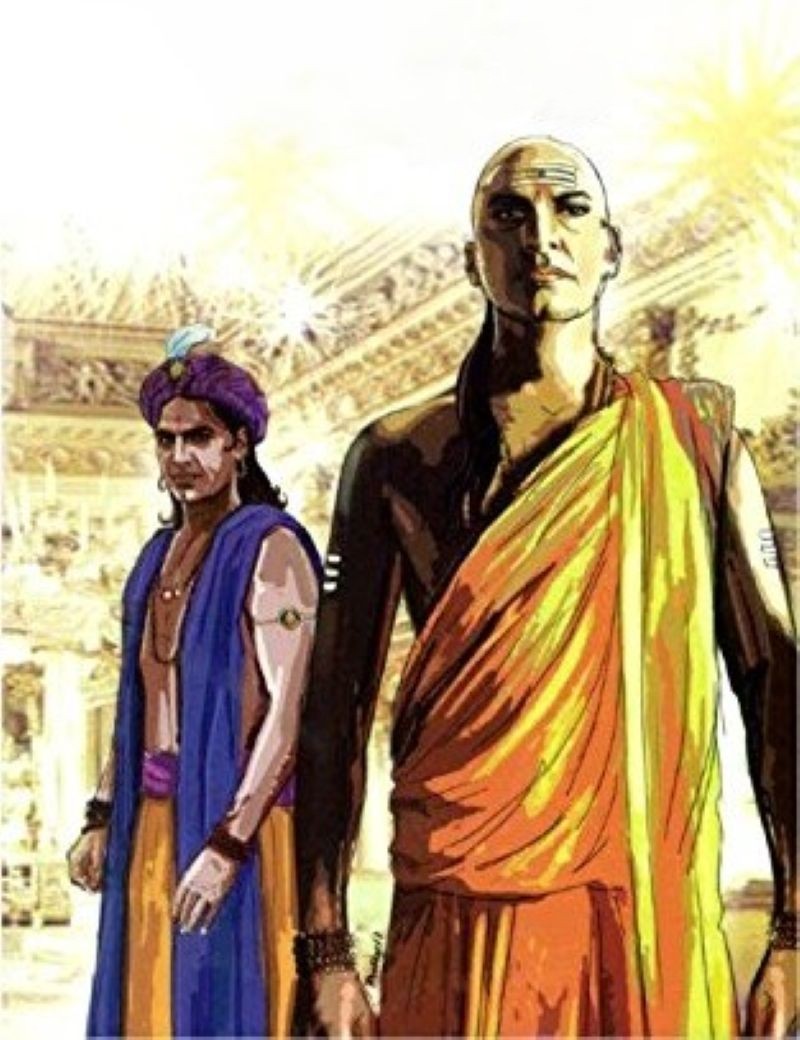
Chanakya was real, brilliant, and indispensable to India’s civilisational memory, no matter how inconvenient that fact may be for the modern political fantasist Devdutt Pattanaik. – Dr. Prosenjit Nath
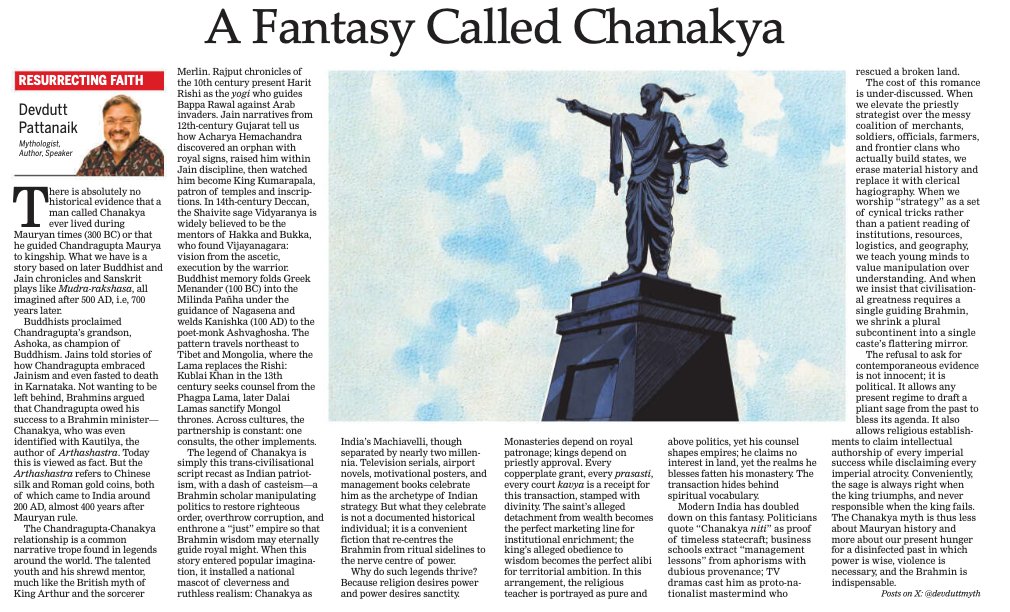
I read Devdutt Pattanaik’s article “A fantasy called Chanakya” in The New Indian Express (9 Nov. 2025). Had Chanakya himself been alive, Pattanaik’s fantasies would have survived about as long as the kusa grass Chanakya famously uprooted when he vowed to destroy the Nandas. Beneath the polished prose and familiar rhetoric lies an old ideological trick: confuse the reader with multiple names, shout “interpolation” often enough, wrap it all in modern caste politics, and hope a historical figure vanishes.
But history does not work that way. The moment one actually looks at primary sources, Pattanaik’s thesis collapses flat.
Let us begin precisely where he does not want readers to look: the Arthaśāstra itself. The text explicitly identifies its author in unmistakable terms: “विष्णुगुप्तेन आर्यकौटिल्येन च सम्पादितम्”—compiled by Viśnugupta, the noble Kautilya. And again: “समाप्तं कौटिलीयम् अर्थशास्त्रम्”—here ends the Arthaśāstra of Kautilya.
Pattanaik’s sleight of hand rests on manufacturing two doubts. First that since the author is called “Kautilya”, Chanakya must be fictional. Second, that if the Arthaśāstra can be pushed centuries later, Chanakya cannot belong to the Mauryan age or guide Chandragupta Maurya. Both doubts evaporate the moment chronology is taken seriously.
Ashoka’s edicts from the 3rd century BCE describe an empire run through mahamatras, welfare officials, judicial ethics, administrative surveillance, animal-protection days, and moral governance—all core elements laid out systematically in the Arthaśāstra. The Mauryan state cannot be built on a Kautilyan framework if that framework supposedly did not exist until 500 CE. The empire itself is the evidence. Kautilya must predate Ashoka, exactly as tradition maintains—at least the late 4th century BCE.
Then comes the Spitzer Manuscript, the oldest known Sanskrit manuscript (1st–2nd century CE), which contains unmistakable references to the Arthaśāstra. Its discovery location is devastating for Pattanaik’s narrative: a Buddhist monastery in Kizil, Xinjiang—thousands of kilometres from any imagined “Brahmin power structure”. Why would Buddhist monks preserve and study a supposedly late “Brahminical propaganda text”? They would not, unless the text was already ancient, authoritative, and indispensable. This single fact shatters the claim that Kautilya was invented centuries later.
But the knockout punch arrives with the Kāmandakīya Nītiśāra (4th century CE), authored by the Buddhist scholar Kāmandaki. He explicitly and admiringly states that Viśnugupta/Kautilya—the author of the Arthaśāstra—was the very strategist who overthrew the Nandas and established Chandragupta Maurya. This is not a Hindu text, nor a Brahminical self-glorification exercise. A Buddhist intellectual, with no incentive to mythologise a Brahmin minister, identifies Kautilya and Chanakya as the same revolutionary statesman. That is the missing bridge Pattanaik refuses to acknowledge.
The convergence does not stop there. Buddhist sources such as the Mahāvaṃsa and Divyāvadāna describe Chandragupta’s Brahmin mentor. Jain texts like the Nisītha-Cūrṇi and Hemacandra’s Pariśiṣṭaparvan narrate the same overthrow of the Nandas by Chanakya for Chandragupta. Gupta-era dramas like Mudrārākṣasa assume the identity of Kautilya and Chanakya is already common knowledge. Kashmiri traditions such as the Tantrākhyāyikā immortalise Chanakya as the archetype of political genius. Across Buddhist, Jain, Hindu, and regional traditions—often rivals, sometimes hostile—the same man performs the same acts under different names. That is not myth-making; it is historical convergence, the strongest form of evidence when dealing with antiquity.
Pattanaik makes much of multiple names, as if this were suspicious. It is not. In the ancient world, it was normal. Confucius was also Kong Qiu, Kongzi, and Zhongni. In India, Viśnugupta is the personal name, Kautilya the gotra or scholastic name, and Chanakya the patronymic. One man. Many names. Total consistency. Claiming otherwise is like arguing that Zhongni disproves Confucius.
The remaining tactics are equally flimsy. References to “China” and Roman dināra are used to push the Arthaśāstra centuries forward. Yet scholars like K.P. Jayaswal showed long ago that “Cina” refers to the Sina/Shina Himalayan region near Gilgit, not Han China—hence terms like kauseya and cinapatta, which are not Chinese words. Later interpolations do exist, just as they do in Homer, Euclid, or the Pentateuch. No serious scholar claims interpolations prove the author never existed. Pattanaik deploys this argument selectively because he needs the text to be late to sever it from Chanakya.
Finally, the caste obsession collapses entirely. The earliest sources identifying Chanakya as a Brahmin are Buddhist and Jain traditions—historically critical of Brahmin authority. If “Brahmins invented Chanakya”, why do rival traditions independently preserve the same identity centuries earlier? Because they were transmitting historical memory, not manufacturing propaganda.
To be clear: Chanakya, Kautilya, and Viśnugupta are not three different people. They are three traditional names for one historical genius—the architect of the Mauryan Empire. When multiple competing traditions over two millennia remember the same man overthrowing the same dynasty for the same emperor, coincidence becomes absurd. History, in this case, is unanimous.
Devdutt Pattanaik’s article is not courageous scholarship. It is ideological provocation dressed up as history—a soggy biscuit of pseudo-academia that dissolves the moment primary sources are allowed to speak. And they speak loudly: Chanakya was real, brilliant, and indispensable to India’s civilisational memory, no matter how inconvenient that fact may be for modern political fantasies. – News18, 1 January 2026
› Prosenjit Nath is a technocrat, political analyst, and author. He writes on national, geopolitical, and social issues.
 VOICE OF INDIA