What Mahmud of Ghazni did must not be forgotten – Reshmi Dasgupta

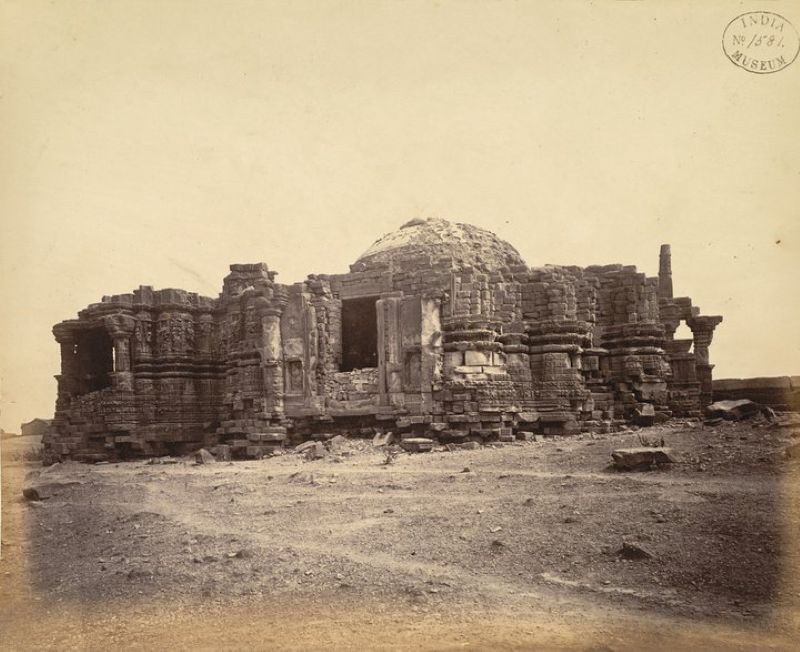
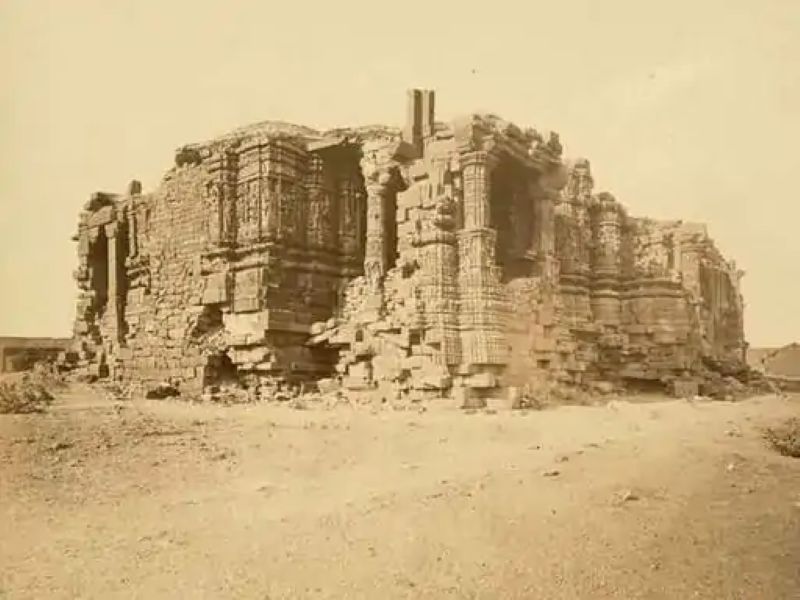
Somnath temple converted to mosque ca 1931.

What happened during this week 1,000 years ago was not a one-off assault by a greedy Central Asian despot who just incidentally happened to be Muslim. Mahmud’s destruction of Somnath set off a millennium-long assault on it by men who definitely had one thing in common apart from Islam: an animus towards the Jyotirlinga. – Reshmi Dasgupta

From January 6 to 9, 1026, the army of Mahmud of Ghazni lay siege to the wondrous temple of Somnath near the port city of Veraval. The defenders of the fortified shrine eventually could not repel the troops of the Central Asian invader and Somnath was captured. It was Mahmud’s 16th raid on India and loot was not the only target. Contemporary sources mention that Hindu merchants offered more money if he spared the idol; he refused and struck the first blow.

For that act, Mahmud earned the title “Butshikan” or idol-breaker, from an admiring Islamic world and his renown for the desecration of Somnath and other major Hindu temples in India persisted for centuries. Sultan Sikandar Shah earned the same Butshikan title in the 14th century for destroying temples in Kashmir in pursuance of the precepts of the Sufi preacher Mir Mohammad Hamadani. Even 600 years later, Aurangzeb appreciated Mahmud’s Islamic fervour.

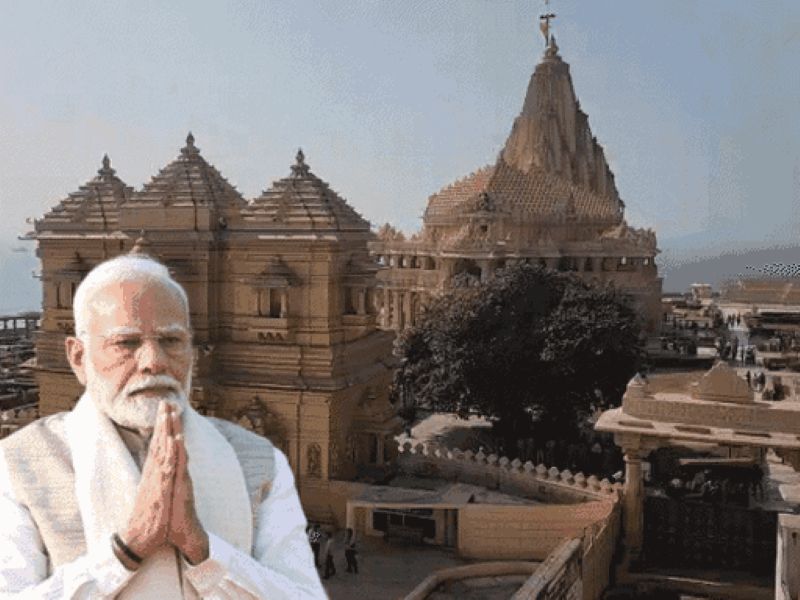
It is inevitable that Prime Minister Narendra Modi’s commemoration of the 1000th anniversary of the first destruction (as opposed to the misleading word “sacking” commonly used for the violent actions of Mahmud of Ghazni) of the Somnath temple will be countered with supposed “proof” of either “Arab” heroism or Hindu perfidy or both. It is now almost an article of faith among certain sections in India and abroad that Mahmud was more maligned than malevolent.

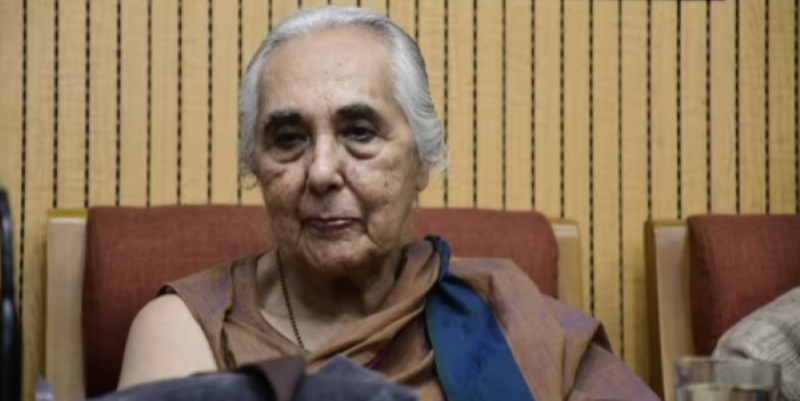
As has been often pointed out in recent times, the assertions of the high priestess of the secular camp Romila Thapar on the destruction of Somnath lack basis in actual facts even if delivered with withering condescension in impeccable upper class accented English. But there are plenty of willing believers in Thapar’s argument that Mahmud was not communal—merely venal—and that his destruction of the magnificent Shiva lingam at Somnath was incidental.

Indeed, the PM calling the repeated rebuilding of Somnath after each brutal destruction and plunder a symbol of the “unbreakable courage of countless children of Bharat Mata who protected our culture and civilisation” will be met with predictable counters. First, that “Arabs”—mainly traders who had settled in the area and married local women—died protecting Somnath from Mahmud’s marauders. Second, that there were many Hindus in Mahmud’s army.

There were indeed Hindus in Mahmud’s army, including battalion commanders, and he used them with varying effectiveness in campaigns on the subcontinent and even further north in Central Asia. But the phenomenon of mercenaries—soldiers of fortune who fight for the best paymaster—is well known. The presence of Hindus in his army cannot be taken to mean Mahmud was “secular” or that his actions were not intended to attack and diminish India’s majority faith.

There is no dependable account of Arabs dying while defending Somnath, but they could well have been miffed by their co-religionists from Ghazni disturbing their livelihoods. Arabs had all been Islamised by then although earlier traders and sailors may have adhered to pre-Islamic faiths including Christianity. So, it would be a stretch to imagine they would risk irking Allah by actually fighting alongside local Hindus kafirs to save Somnath from his holy warriors.

The Veraval Inscriptions (so named for the ancient port town next to the Somnath, which had a bustling mercantile trading business) dated to about 250 years after Mahmud’s destruction of the great Shiva lingam, highlight the dynamic between the two communities in the last millennium. The bilingual inscriptions from the reign of the Vaghela king Arjundev, records an agreement for the financing of the upkeep of a mosque at Somnath Patan built by a resident of Hormuz.

Curiously, the longer Sanskrit inscription lists the Hindu king and hierarchy but mendaciously describes the lord of the mosque as Vishwanatha and Shunyarupa and even calls Prophet Mohammed a “prabodhak” or preceptor. The Muslim shipowner donor from Hormuz Nuruddin Firoz is called a “dharmabandhav” of Sri Chhada who seems to be the mosque’s chief administrator. But in the shorter Arabic notation, there is no attempt to Indianise Allah or his Prophet.

The twin inscriptions seem to indicate that Hindu rulers bore no lasting animus against all Muslims—especially the Arab and Persian merchants from the Gulf—for the depredations of the Turkic invader from Ghazni 200 years before, and allowed them to set up mosques near the temple. But one sentence of the Arabic inscription points to the thinking of the Muslims even if they attempted to couch their initial outreach to the Hindus with seemingly syncretic gestures.

The Arabic inscription expresses the hope that Somnath will one day become a city of Islam, and that infidels and idols will eventually be banished from it. Why did the officials of the Vaghelas (the last Hindu kingdom of the region) allow that explicit expression of intent to pass unchallenged? Could they not read Arabic? Or were they persuaded, as indeed are some academics reading it 750 years later, that it was a “pro forma” statement and did not constitute a threat?In the event, though Somnath was revered enough for the 11th century Chalukya ruler Bhima I to rebuild it after Ghazni’s desecration, local inhabitants naively seemed to have borne no permanent suspicion of Muslims as the Veraval inscriptions two and a half centuries later seems to confirm. But a mere 35 years after those twin plaques were incised, the army of Delhi’s Sultan Alauddin Khilji under Ulugh Khan pillaged and destroyed Somnath yet again.

And that deed was approvingly chronicled by no less than the much-admired (even today) Persian poet Amir Khusro. In Khazain-ul-Futuh (Treasures of Victory), he gleefully wrote in 1310 (after Khilji’s armies attacked again in 1304 and annexed all of Gujarat):

“So the temple of Somnath was made to bow towards the Holy Mecca; and as the temple lowered its head and jumped into the sea, you may say that the building first said its prayers and then had a bath.”

He also added:

“It seemed as if the tongue of the imperial sword explained the meaning of the text: ‘So he (Abraham) broke them (the idols) into pieces except the chief of them, that haply they may return to it.’ A pagan country, the Mecca of the Infidels, now became the Medina of Islam. The followers of Abraham now acted as guides in place of the Brahman leaders. The robust-hearted true believers rigorously broke all idols and temples wherever they found them.”

Khusro also dispelled doubts about the intent of the Arabic Veraval inscription:

“Owing to the war, ‘takbir,’ and ‘shahadat’ was heard on every side; even the idols by their breaking affirmed the existence of God. In this ancient land of infidelity, the call to prayers rose so high that it was heard in Baghdad and Madain while the Khutba resounded in the dome of Abraham and over the water of Zamzam. The sword of Islam purified the land as the Sun purifies the earth.”

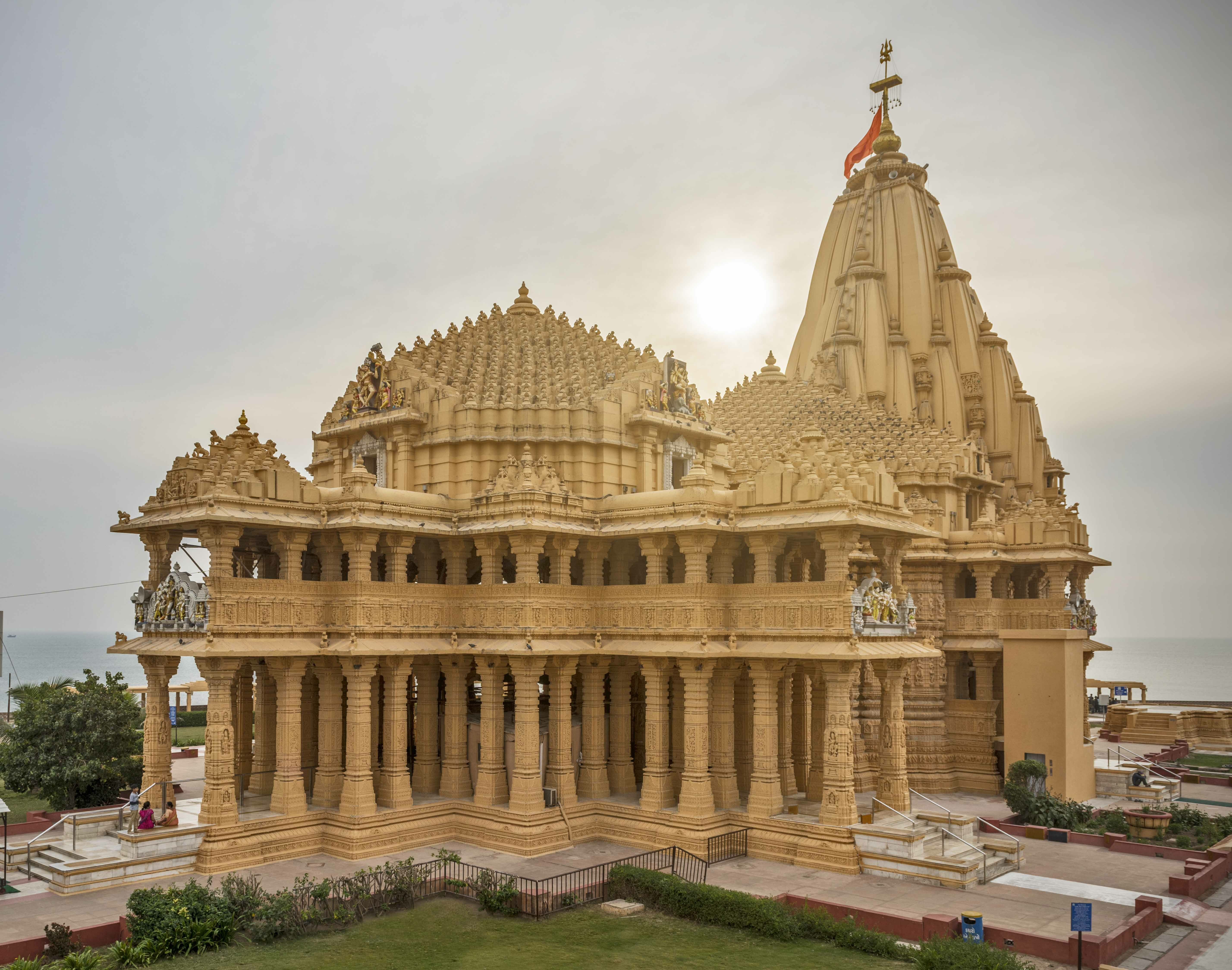
That Khusro described Somnath as the “Mecca of Infidels” underlines its primacy as a Hindu centre of worship, reiterating its pride of place as the first of the 12 Jyotirlingas listed in the Shiva Purana. So it is not surprising that every Muslim ruler thereafter who wanted to assert his religious cred and supremacy attacked Somnath, from Muzaffar Shah to Mahmud Begada to Aurangzeb. But it was restored, rebuilt, reconsecrated faithfully by Hindu rulers each time.

What is glossed over by apologists is that Somnath was not considerately left to resume worship. It was converted into a mosque by several Islamic attackers and then reconstructed repeatedly as a temple by Hindu monarchs. It was turned into a domed mosque by Aurangzeb in 1665. And the final rebuild happened in 1951, thanks to the determined efforts of Sardar Patel, KM Munshi and Dr Rajendra Prasad in the teeth of opposition from Prime Minister Jawaharlal Nehru.

In 1783, the formidable Maratha queen Ahilyabai Holkar had another Shiva temple constructed 200 metres from the original site of Somnath, whose added dome and minaret can be seen in late 19th century photographs now in the British Library. She had done the same three years earlier in Varanasi where the original Kashi Vishwanath temple had been mostly destroyed (only one wall left standing) and rebuilt as “Gyanvapi” mosque, also on Aurangzeb’s orders.

So, what happened during this week 1,000 years ago was not a one-off assault by a greedy Central Asian despot who just incidentally happened to be Muslim. Mahmud’s destruction of Somnath set off a millennium-long assault on it by men who definitely had one thing in common apart from Islam: an animus towards the Jyotirlinga. That it is standing proudly again is indeed a testament to the quiet determination and faith of the children of Bharat Mata, as PM Modi said. – News18, 7 January 2026

›  Reshmi Dasgupta is a freelance writer formerly with the Times of India Group. 
Somnath Temple

Somnath: A thousand years of unbroken faith – Narendra Modi

Narendra Modi at the Somnath Temple.

If the Somnath Temple, which was attacked a thousand years ago and faced continuous attacks thereon, could rise again and again, then we can surely restore our great nation to the glory it embodied a thousand years ago before the invasions. – PM Narendra Modi

Somnath … hearing this word instils a sense of pride in our hearts and minds. It is the eternal proclamation of India’s soul. This majestic temple is situated on the western coast of India in Gujarat, at a place called Prabhas Patan. The Dwadasha Jyotirling Stotram mentions the 12 Jyotirlings across India. The stotram begins with “सौराष्ट्रे सोमनाथं च…” symbolising the civilisational and spiritual importance of Somnath as the first Jyotirling.

It is also said:

सोमलिङ्गं नरो दृष्ट्वा सर्वपापैः प्रमुच्यते ।

लभते फलं मनोवाञ्छितं मृतः स्वर्गं समाश्रयेत्॥

It means: Just the sight of Somnath Shivling ensures that a person is freed of sins, achieves their righteous desires and attains heaven after death.

Tragically, this very Somnath, which drew the reverence and prayers of millions, was attacked by foreign invaders, whose agenda was demolition, not devotion.

The year 2026 is significant for the Somnath Temple. It has been 1,000 years since the first attack on this great shrine. It was in January of 1026 that Mahmud of Ghazni attacked this temple, seeking to destroy a great symbol of faith and civilisation, through a violent and barbaric invasion.

Yet, one thousand years later, the temple stands as glorious as ever because of numerous efforts to restore Somnath to its grandeur. One such milestone completes 75 years in 2026. It was during a ceremony on May 11th 1951, in the presence of the then President of India, Dr. Rajendra Prasad, that the restored temple opened its doors to devotees.

The first invasion of Somnath a thousand years ago in 1026, the cruelty that was unleashed upon the people of the town and the devastation that was inflicted upon the shrine have been documented in great detail in various historical accounts. When you read them, the heart trembles. Each line carries the weight of grief, cruelty and a sorrow that refuses to fade with time.

Imagine the impact it had on Bharat and the morale of the people. After all, Somnath had great spiritual significance. It was also on the coast, giving strength to a society with great economic prowess, whose sea traders and seafarers carried tales of its grandeur far and wide.

Yet, I am proud to state unequivocally that the story of Somnath, a thousand years after the first attack, is not defined by destruction. It is defined by the unbreakable courage of crores of children of Bharat Mata.

The medieval barbarism that began a thousand years ago in 1026 went on to ‘inspire’ others to repeatedly attack Somnath. It was the start of an attempt to enslave our people and culture. But, each time the temple was attacked, we also had great men and women who stood up to defend it and even made the ultimate sacrifice. And every single time, generation after generation, the people of our great civilisation picked themselves up, rebuilt and rejuvenated the temple. It is our privilege to have been nurtured by the same soil that has nurtured greats like Ahilyabai Holkar, who made a noble attempt to ensure devotees can pray at Somnath.

In the 1890s, Swami Vivekananda visited Somnath and that experience moved him. He expressed his feelings during a lecture in Chennai in 1897 when he said:

“Some of these old temples of Southern India and those like Somnath of Gujarat will teach you volumes of wisdom, will give you a keener insight into the history of the race than any amount of books.

“Mark how these temples bear the marks of a hundred attacks and a hundred regenerations, continually destroyed and continually springing up out of the ruins, rejuvenated and strong as ever! That is the national mind, that is the national life-current. Follow it and it leads to glory. Give it up and you die; death will be the only result, annihilation, the only effect, the moment you step beyond that life current.”

The sacred duty of rebuilding the Somnath Temple after independence came to the able hands of Sardar Vallabhbhai Patel. A visit during Diwali time in 1947 moved him so much that he announced that the temple will be rebuilt there. Finally, on May 11th 1951, a grand temple in Somnath opened its doors to devotees and Dr. Rajendra Prasad was present there. The great Sardar Sahib was not alive to see this historic day, but the fulfilment of his dream stood tall before the nation.

The then Prime Minister, Pandit Jawaharlal Nehru, was not too enthused with this development. He did not want the Honourable President as well as Ministers to associate with this special event. He said that this event created a bad impression of India. But Dr. Rajendra Prasad stood firm and the rest is history. No mention of Somnath is complete without recalling the efforts of K.M. Munshi, who supported Sardar Patel very effectively. His works on Somnath, including the book, Somanatha: The Shrine Eternal, are extremely informative and educative.

Indeed, as the title of Munshiji’s book conveys, we are a civilisation that carries a sense of conviction about the eternity of spirit and of ideas. We firmly believe that that which is eternal is indestructible, as outlined in the famous Gita verse “नैनं छिन्दन्ति शस्त्राणि….” There can be no better example of our civilisation’s indomitable spirit than Somnath, which stands gloriously, overcoming odds and struggles.

It is this same spirit that is visible in our nation, one of the brightest spots of global growth, having overcome centuries of invasions and colonial loot. It is our value systems and the determination of our people that have made India the centre of global attention today. The world is seeing India with hope and optimism.

They want to invest in our innovative youngsters. Our art, culture, music and several festivals are going global. Yoga and Ayurveda are making a worldwide impact, boosting healthy living. Solutions to some of the most pressing global challenges are coming from India.

Since time immemorial, Somnath has brought together people from different walks of life. Centuries ago, Kalikal Sarvagna Hemchandracharya, a respected Jain monk, came to Somnath. It is said that after praying there, he recited a verse, “भवबीजाङ्करजनना रागाद्या: क्षयमुपगता यस्य।”. It means: “Salutations to That One in whom the seeds of worldly becoming are destroyed, in whom passion and all afflictions have withered away.” Today, Somnath holds the same ability to awaken something profound within the mind and soul.

A thousand years after the first attack in 1026, the sea at Somnath still roars with the same intensity as it did back then. The waves that wash the shores of Somnath tell a story. No matter what, just like the waves, it kept rising again and again.

The aggressors of the past are now dust in the wind, their names synonymous with destruction. They are footnotes in the annals of history, while Somnath stands bright, radiating far beyond the horizon, reminding us of the eternal spirit that remained undiminished by the attack of 1026. Somnath is a song of hope that tells us that while hate and fanaticism may have the power to destroy for a moment, faith and conviction in the power of goodness have the power to create for eternity.

If the Somnath Temple, which was attacked a thousand years ago and faced continuous attacks thereon, could rise again and again, then we can surely restore our great nation to the glory it embodied a thousand years ago before the invasions. With the blessings of Shree Somnath Mahadev, we move forward with a renewed resolve to build a Viksit Bharat, where civilisational wisdom guides us to work for the welfare of the whole world.

Jai Somnath! – The New Indian Express, 5 January 2026

Narendra Modi is the Prime Minister of India and Chairman of the Shri Somnath Temple Trust.

Ruins of Somnath as viewed in 1869

Why are Indian historians in denial mode? – David Frawley

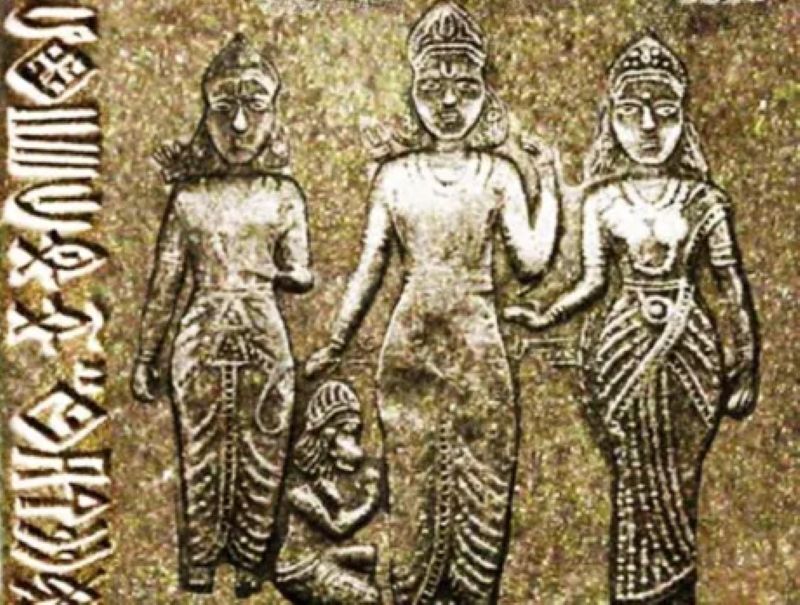
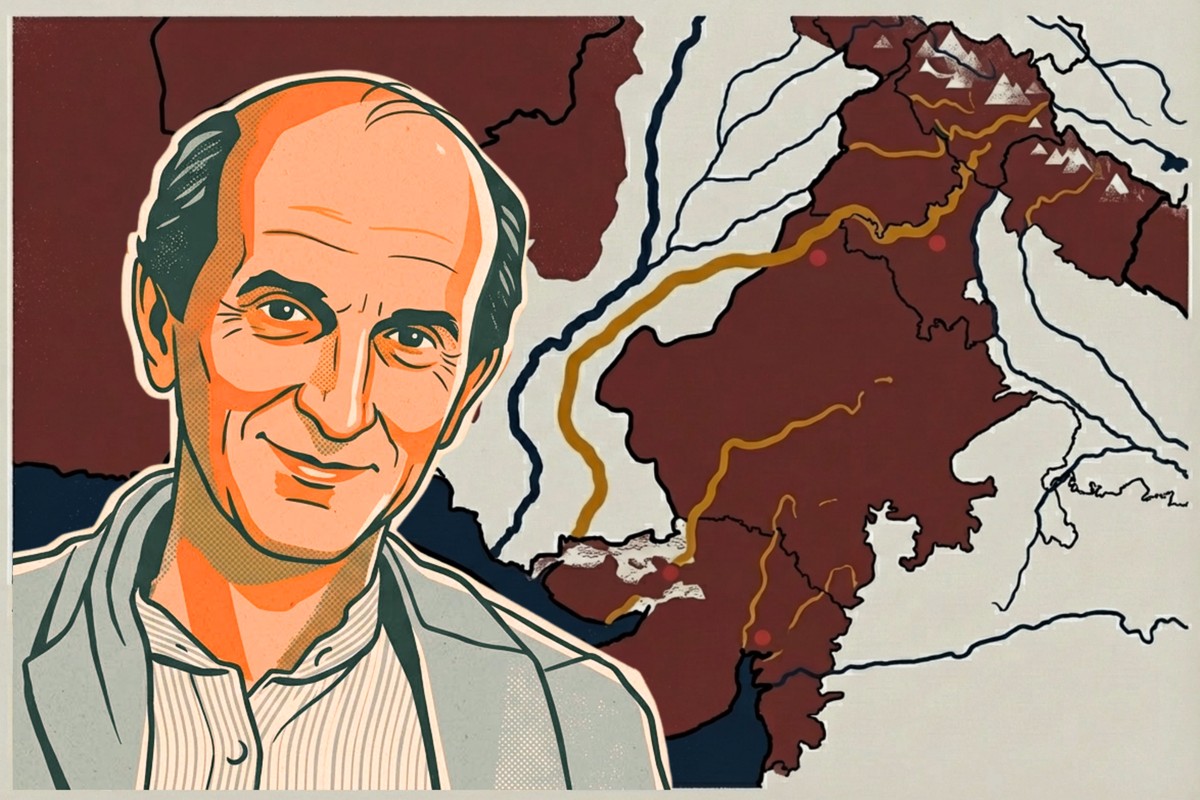
Indus Script

It is time for deconstructionist historians to be deconstructed. Such historians, whose view of the world is purely outward, do not have the insight to appreciate India. … Their historical accounts reflect the attempt of a recent ruling elite to rewrite history in its own image—and to deny legitimacy for any other group, even if it requires denying the very existence of India before they assumed power! – Dr. David Frawley

India today is a strange country in that, uniquely among the nations of the world, it seems to be afraid of its own history.

If we study current historical accounts, particularly by India’s academic Left, the most important fact about the history of India is that there is no real history of India. This is because such scholars are unable to see the existence of any cohesive entity called India before 1947.

India as a real country in their view is attributed mainly to Jawaharlal Nehru and his followers after independence on a region that, though previously under the umbrella of British rule, was otherwise lacking in unity, continuity or perhaps even civilisational depth.

Such historians are happy to negate the history of their own country. Their accounts of India’s history are largely denials of any enduring country, civilisation or culture worthy of the name. Their history of India is one of foreign invasions, temporary or vanished empires, internal social divisions and conflicts, and a disparate and confused cultural diversity. They regard India as a melting pot or conglomeration of widely separated peoples and cultures coming together by the accident of geography that hardly constitutes any united country or national identity.

Unfortunately, such Indian historians, particularly with political alliances with Left historians in UK and US, are introducing their anti-India ideas into Western academia, which still does not understand India’s very different civilisational model.

Such studies forget that national identity is cultural, not simply political. India did not become a British state under British rule or an Islamic state under Muslim rule. The older Indian/Bharatiya culture continued.

These anti-India views are easily countered by a number of historical facts.

The first is that outside people and countries have long recognised a civilisation called India.

After Alexander the Great came to India in the fourth century BCE, the Greek historian Megasthenes wrote a book on the region called Indika, in which he noted an existing tradition in the country of 153 kings going back over 6,400 years. The Greeks overall lauded the civilisation of India.

Buddhist pilgrims in the ancient and medieval period, particularly from China, honoured India and its great culture during their travels. India’s cultural influence spread to Indonesia and Indochina in the East and into Central Asia, extending on a religious level to China and Japan.

The ancient Romans lost much of their wealth in a one-sided trade with India and the Europeans long sought the riches of India. Columbus, of course, found America by chance while looking for a more direct sea route to India.

Second, India, like many countries, has more than one name. The Indian Constitution says the “India that is Bharat”. Bharat is the main ancient name for the region going back to King Bharat, an ancient ruler long before Rama, Krishna or Buddha.

The Bharatas were the main people of the ancient Rig Veda, who ruled from the Sarasvati region. They eventually split into several groups, one of which, the Kurus, became dominant in late ancient times, as the main people of the Mahabharata.

Modern historians can more easily deny history to the name India than to Bharat and so ignore the other name of the country.

Third, India has probably the oldest, largest and most continuous literature of any civilisation. The Vedas with their many thousands of pages dwarf anything from the Middle East, Egypt or Greece of the ancient period.

Geography is an important topic in these texts. The Vedas speak of a land of seven rivers, Sapta Sindhu, extending to the ocean, of which the Sarasvati River was the most important. The Persians in their oldest Zend-Avesta remember the area as Hapta Hindu. Sindhu, Hindu and India are related terms.

The Ramayana, Mahabharata and Puranas outline a sacred geography of India/Bharat from Kailas in the north to Lanka in the south, Assam in the east to beyond the Indus in the west. Buddhist and Jain texts do the same, showing a common culture and geography.

Around this sacred geography, Indians built numerous temples and recognised numerous sacred sites, revealing this vast region and its cultural unity.

Along with these sacred sites are numerous festivals and pilgrimages. We see this in modern India, which has the largest tradition of pilgrimage in the world, notably the massive Kumbha Melas that bring in tens of millions of pilgrims. Pilgrims throughout India visit these sites, with South Indians commonly travelling as far as the Himalayan temples of the north. Festivals like Diwali are elaborately celebrated throughout the country.

Ancient Indian literature contains a calendar system still widely followed, the Panchanga. Indian calendars extend from historical time of thousands of years to cosmic time of billions of years.

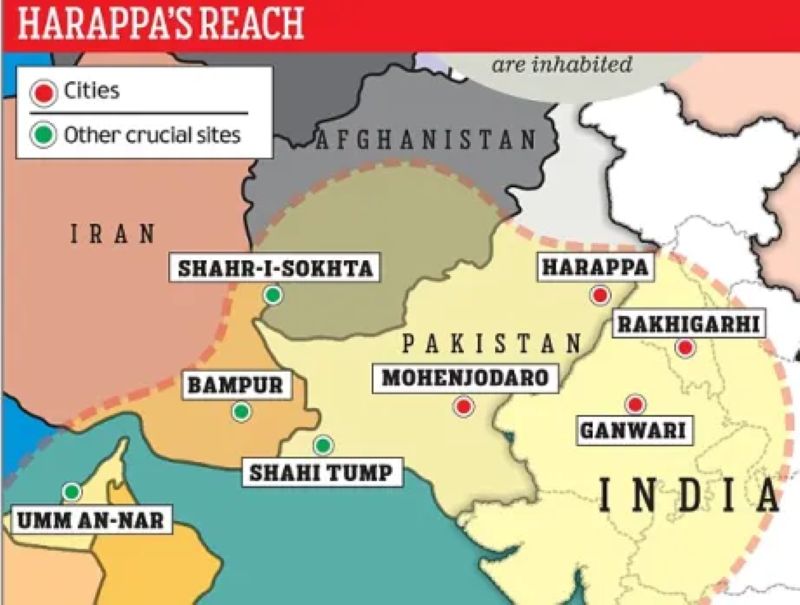
Fourth, extensive new evidence of archaeology upholds the cultural continuity of the region. The Archaeological Survey of India (ASI) claims that in the Haryana/Kurukshetra/Sarasvati river area there is evidence of a continual development of agriculture and civilisation from 8000 BCE, extending through the Harappan urban era. This area hosts Rakhigarhi, the largest Harappan site, more extensive than Mohenjodaro or Harappa.

The Harappan Civilization—also called the Indus Valley or Saraswati Civilisation—is the largest and most uniform urban civilisation of the ancient world in the third millennium BCE. It ended with the drying up of the Sarasvati River around 1900 BCE, which the Geological Survey of India (GSI) has verified. The Vedas refer to the different stages of the Sarasvati river from an ocean-going stream to drying up in the desert, showing they resided on the river long before its termination.

Consistent with their negative line of thought, Leftist historians ignore this information or accuse archaeologists of political bias in their findings.

Lastly, but equally important, the independence movement drew inspiration from the older history of India/Bharat, with such revered figures as Swami Vivekananda, Lokmanya Tilak and Sri Aurobindo seeking to revive the ancient culture. Even Mahatma Gandhi’s mantra was Ram and his idea of India was Ram Rajya.

Not surprisingly, most of these independence leaders have been ignored by the same group of historians, who have made Nehru tower over them, with some afforded diminished roles and others forgotten altogether.

The Congress party, the main support for such historians, has since named every major institution or initiative in India possible after the three members of the Nehru family who became prime ministers. They have little regard for other Congress prime ministers like P.V. Narasimha Rao, whom they have also almost erased from history.

Yet at the same time today, India’s great culture and civilisation through Yoga, Vedanta, Buddhism, Sanskrit, Indian music and dance is once more influencing the entire world—expanding in spite of this historical denigration.

It is time for these deconstructionist historians to be deconstructed. Such historians, whose view of the world is purely outward, do not have the insight to appreciate India, because it is not a mere political formation but a vast spiritual culture.

Their historical accounts reflect the attempt of a recent ruling elite to rewrite history in its own image—and to deny legitimacy for any other group, even if it requires denying the very existence of India before they assumed power! – Vedanet, 30 June 2016

›This article originally appeared in Swarajya Magazine

› Dr David Frawley (Pandit Vamadeva Shastri) is a Vedacharya and includes in his unusual wide scope of studies Ayurveda, Yoga, Vedic astrology, and Indian History.

Mohenjo-daro Graphic


Chanakya: Why Devdutt Pattanaik’s pseudo-history falls apart – Prosenjit Nath

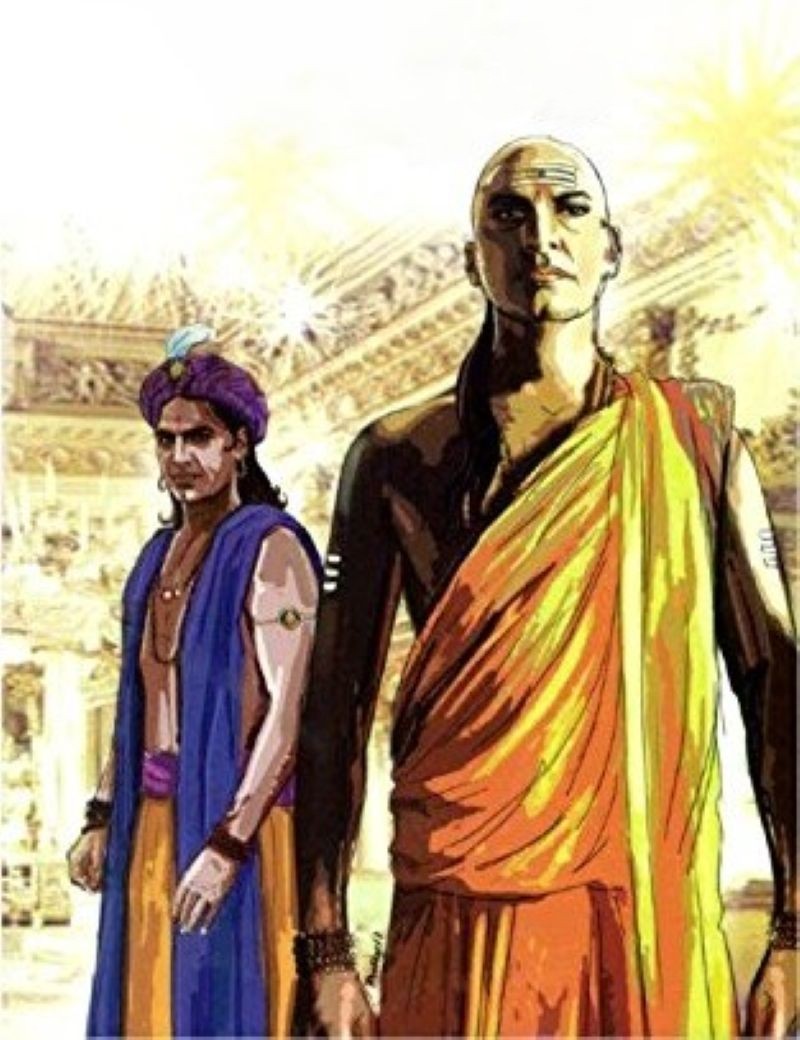
Chanakya & Chandragupta Maurya

Chanakya was real, brilliant, and indispensable to India’s civilisational memory, no matter how inconvenient that fact may be for the modern political fantasist Devdutt Pattanaik. – Dr. Prosenjit Nath

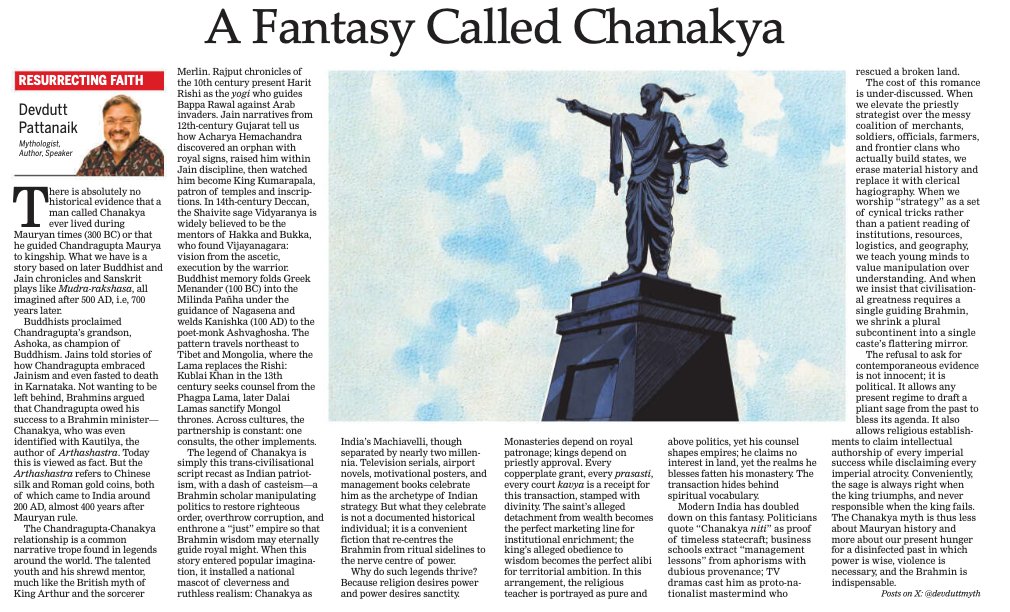
I read Devdutt Pattanaik’s article “A fantasy called Chanakya” in The New Indian Express (9 Nov. 2025). Had Chanakya himself been alive, Pattanaik’s fantasies would have survived about as long as the kusa grass Chanakya famously uprooted when he vowed to destroy the Nandas. Beneath the polished prose and familiar rhetoric lies an old ideological trick: confuse the reader with multiple names, shout “interpolation” often enough, wrap it all in modern caste politics, and hope a historical figure vanishes.

But history does not work that way. The moment one actually looks at primary sources, Pattanaik’s thesis collapses flat.

Let us begin precisely where he does not want readers to look: the Arthaśāstra itself. The text explicitly identifies its author in unmistakable terms: “विष्णुगुप्तेन आर्यकौटिल्येन च सम्पादितम्”—compiled by Viśnugupta, the noble Kautilya. And again: “समाप्तं कौटिलीयम् अर्थशास्त्रम्”—here ends the Arthaśāstra of Kautilya.

Pattanaik’s sleight of hand rests on manufacturing two doubts. First that since the author is called “Kautilya”, Chanakya must be fictional. Second, that if the Arthaśāstra can be pushed centuries later, Chanakya cannot belong to the Mauryan age or guide Chandragupta Maurya. Both doubts evaporate the moment chronology is taken seriously.

Ashoka’s edicts from the 3rd century BCE describe an empire run through mahamatras, welfare officials, judicial ethics, administrative surveillance, animal-protection days, and moral governance—all core elements laid out systematically in the Arthaśāstra. The Mauryan state cannot be built on a Kautilyan framework if that framework supposedly did not exist until 500 CE. The empire itself is the evidence. Kautilya must predate Ashoka, exactly as tradition maintains—at least the late 4th century BCE.

Then comes the Spitzer Manuscript, the oldest known Sanskrit manuscript (1st–2nd century CE), which contains unmistakable references to the Arthaśāstra. Its discovery location is devastating for Pattanaik’s narrative: a Buddhist monastery in Kizil, Xinjiang—thousands of kilometres from any imagined “Brahmin power structure”. Why would Buddhist monks preserve and study a supposedly late “Brahminical propaganda text”? They would not, unless the text was already ancient, authoritative, and indispensable. This single fact shatters the claim that Kautilya was invented centuries later.

But the knockout punch arrives with the Kāmandakīya Nītiśāra (4th century CE), authored by the Buddhist scholar Kāmandaki. He explicitly and admiringly states that Viśnugupta/Kautilya—the author of the Arthaśāstra—was the very strategist who overthrew the Nandas and established Chandragupta Maurya. This is not a Hindu text, nor a Brahminical self-glorification exercise. A Buddhist intellectual, with no incentive to mythologise a Brahmin minister, identifies Kautilya and Chanakya as the same revolutionary statesman. That is the missing bridge Pattanaik refuses to acknowledge.

The convergence does not stop there. Buddhist sources such as the Mahāvaṃsa and Divyāvadāna describe Chandragupta’s Brahmin mentor. Jain texts like the Nisītha-Cūrṇi and Hemacandra’s Pariśiṣṭaparvan narrate the same overthrow of the Nandas by Chanakya for Chandragupta. Gupta-era dramas like Mudrārākṣasa assume the identity of Kautilya and Chanakya is already common knowledge. Kashmiri traditions such as the Tantrākhyāyikā immortalise Chanakya as the archetype of political genius. Across Buddhist, Jain, Hindu, and regional traditions—often rivals, sometimes hostile—the same man performs the same acts under different names. That is not myth-making; it is historical convergence, the strongest form of evidence when dealing with antiquity.

Pattanaik makes much of multiple names, as if this were suspicious. It is not. In the ancient world, it was normal. Confucius was also Kong Qiu, Kongzi, and Zhongni. In India, Viśnugupta is the personal name, Kautilya the gotra or scholastic name, and Chanakya the patronymic. One man. Many names. Total consistency. Claiming otherwise is like arguing that Zhongni disproves Confucius.

The remaining tactics are equally flimsy. References to “China” and Roman dināra are used to push the Arthaśāstra centuries forward. Yet scholars like K.P. Jayaswal showed long ago that “Cina” refers to the Sina/Shina Himalayan region near Gilgit, not Han China—hence terms like kauseya and cinapatta, which are not Chinese words. Later interpolations do exist, just as they do in Homer, Euclid, or the Pentateuch. No serious scholar claims interpolations prove the author never existed. Pattanaik deploys this argument selectively because he needs the text to be late to sever it from Chanakya.

Finally, the caste obsession collapses entirely. The earliest sources identifying Chanakya as a Brahmin are Buddhist and Jain traditions—historically critical of Brahmin authority. If “Brahmins invented Chanakya”, why do rival traditions independently preserve the same identity centuries earlier? Because they were transmitting historical memory, not manufacturing propaganda.

To be clear: Chanakya, Kautilya, and Viśnugupta are not three different people. They are three traditional names for one historical genius—the architect of the Mauryan Empire. When multiple competing traditions over two millennia remember the same man overthrowing the same dynasty for the same emperor, coincidence becomes absurd. History, in this case, is unanimous.

Devdutt Pattanaik’s article is not courageous scholarship. It is ideological provocation dressed up as history—a soggy biscuit of pseudo-academia that dissolves the moment primary sources are allowed to speak. And they speak loudly: Chanakya was real, brilliant, and indispensable to India’s civilisational memory, no matter how inconvenient that fact may be for modern political fantasies. – News18, 1 January 2026

Prosenjit Nath is a technocrat, political analyst, and author. He writes on national, geopolitical, and social issues.

A Fantasy Called Chanakya by Devdutt Pattanaik

Nehru, Patel and the Babri Masjid: Rajnath Singh exposes Nehruvian double-speak – Utpal Kumar

Nehru & Patel

Rajnath Singh’s remarks on Nehru, Patel, Somnath and Babri Masjid, rather than being fabrications or distortions of history, reflect realities that were suppressed later by the Nehruvian ecosystem. – Utpal Kumar

Truth can often be stranger than fiction. This became obvious when Defence Minister Rajnath Singh’s recent statement about Jawaharlal Nehru, Sardar Vallabhbhai Patel and the Babri Masjid opened a Pandora’s box, pushing the country to revisit the uneasy truths of its early years as an independent entity.

The Congress, quite expectedly and duly supported by its ecosystem, has strongly denied Singh’s assertions, calling them “lies” devoid of archival backing. Yet, when one turns to the memoirs, diaries, and biographies written by contemporaries of Nehru and Patel, a more complex picture emerges—one that suggests history is more often than not written by victors, which in the country’s case were Nehru and his acolytes.

Rajnath Singh’s intervention touches on two sensitive issues: one, whether Nehru had proposed using government funds to build the Babri Masjid; and two, the first prime minister’s alleged reluctance to support a national memorial for Sardar Patel. Contrary to claims that Singh is distorting or inventing history, the fact is that these incidents were explicitly recorded in books and personal documents from the 1950s and 1960s.

The Babri Masjid Question

The most striking material comes from the diary of Maniben Patel, Sardar Patel’s daughter. In one of her entries, she notes that Nehru had raised the question of the Babri Masjid and its reconstruction. According to her account, Sardar Patel immediately made it clear that the government could not spend public money to build or rebuild a mosque. He also reminded Nehru that the case of the Somnath temple had been entirely different. In her entry dated September 20, 1950, Maniben Patel writes,

“Bapu (Sardar) said (the) government cannot give money for building a mosque? He knew it very well so that Junagadh was taken over well in advance, and land [was] obtained from [the] Junagadh government for Somnath, and a trust was created and credited Rs 30 lakh. Panditji wrote a chit to Munshi that [the] government cannot spend money on Somnath, as ours is a secular state. Munshi transferred [it] to him (Bapu). He replied that this is a trust of which Jamshed is chairman and Munshi a member and no government money is going to be used in it. He (PM) was silenced then.”

This diary entry is significant because it directly contradicts the categorical denials made today that Nehru ever entertained any proposal regarding government involvement with the Babri Masjid. It also supports Rajnath Singh’s remark that Patel had explicitly opposed such an idea. The suggestion that Nehru even considered using public funds for the mosque complicates the popular portrayal of him as a secularist who maintained a firm line separating religion and state.

The Somnath Saga

The Nehruvian double standard becomes more acute when one looks at the Somnath temple reconstruction episode. In his book Pilgrimage to Freedom, K.M. Munshi, a key leader in the Somnath project, recounts that when Junagadh acceded to India, Sardar Patel, as deputy prime minister, pledged the government to rebuild the temple. Munshi writes that the Union Cabinet, with Nehru presiding, initially approved the reconstruction at government expense.

It was Mahatma Gandhi, not Nehru, who advised that the temple must be rebuilt not with state funds but with voluntary contributions from Hindus. Sardar Patel accepted Gandhi’s advice and swiftly set in motion the creation of a trust to oversee public fundraising. Munshi himself was appointed chairman of the advisory committee for reconstruction.

What surprised Munshi was Nehru’s conduct after Sardar Patel’s death. He records that Nehru repeatedly criticised him for his involvement, despite the fact that the early Cabinet decision had Nehru’s own assent. Munshi writes that he had to remind the prime minister in a detailed letter that “everything was done … in accordance with the decision of the Cabinet taken under his guidance”.

The Somnath saga thus exposes another, little-known aspect of Nehruvian hostility to things Hindu—that the first prime minister’s opposition to state involvement in temple reconstruction was not a position he held from the start; it emerged only later, especially when he became all-powerful after the death of Sardar Patel. And, more damningly, this secular posturing did not stop him from discussing public support for the Babri Masjid, as Maniben Patel’s diary shows.

The Unfinished Legacy of Sardar Patel

The second part of Rajnath Singh’s critique concerns the systematic neglect of Sardar Patel’s memory and legacy after his death. Here, too, the archival material is extensive.

In his book The Sardar of India, P.N. Chopra describes how a plan to build a national memorial for Patel was approved by the Congress Working Committee. The target was Rs 1 crore. Industrialist G.D. Birla, a close aide of both Mahatma Gandhi and Sardar Patel, raised Rs 50 lakh and handed it to the All-India Congress Committee, while state units began collecting contributions.

Yet the project stalled. According to S.K. Patil, a Congressman, as quoted by Chopra, Nehru “remained passive throughout” and eventually suggested that since Patel had been an “agriculturist” and “friend of villagers”, the collected money should be used instead for digging wells and constructing village roads. S.K. Patil found the suggestion “nonsensical”, as “digging of wells and constructing roads was the normal responsibility of the government. That responsibility could not be shared by the memorial fund”.

Chopra also records that Nehru objected even to raising Patel’s statue at Vijay Chowk. Only after much difficulty was a new site secured on Parliament Street, funded not by the Congress’s official memorial fund but by money raised separately in Bombay, now Mumbai.

More startling is the account related by R.L. Handa in his book Rajendra Prasad: Twelve Years of Triumph and Despair. Handa, who was the press secretary to President Rajendra Prasad, writes that upon Patel’s death in 1950, Nehru issued a direction to ministers and secretaries asking them not to go to Bombay for the funeral. When he requested President Rajendra Prasad to avoid attending as well, Prasad refused. Durga Das, in his book India: From Curzon to Nehru and After, corroborates this, noting that Prasad felt Nehru was attempting to diminish Patel’s stature.

These testimonies strengthen Rajnath Singh’s argument that there was a concerned attempt to diminish Patel’s legacy in the years following Independence—an observation shared not merely by modern political actors but by several of Sardar Patel’s contemporaries.

Rajnath Singh’s remarks, rather than being fabrications or distortions of history, reflect realities that were suppressed later by the Nehruvian ecosystem. They show that the early years of the republic were far from monolithic, carved from Nehruvian stone, as is being projected today, and that the country’s slide towards amoral, soulless secularism detached from ageless Sanatana ethos was neither inevitable nor uncontested. In that sense, the ongoing debate sparked by Rajnath Singh has reopened a window onto a past that continues to challenge our assumptions, proving yet again that truth is indeed stranger than fiction. – News18,

Utpal Kumar is Opinion Editor at Firstpost and News18 and is the author of the book Eminent Distorians: Twists and Truths in Bharat’s History.

Max Müller to Doniger to Orsini: The West sends Trojan horses to India – Abhijit Majumder

Trojan Horse

The West repeatedly sends academic Trojan horses who would erase and distort Indian history, attack self-esteem, construct divisive narratives, and collude with India’s own sell-out intelligentsia to project credibility. – Abhijit Majumder

India is the imperialist’s unfinished project. Few lands that have been touched by Christian or Islamic imperialists have managed to remain largely unconverted and geopolitically intact. In a little over 100 years since 1900, the centuries-old fluid indigenous faiths in the entire African continent, for instance, dwindled from 76 per cent of the population to just 8 per cent, having been replaced by the two hardcoded religions.

Bharat, or what remains of it after Pakistan and Bangladesh were created, still has not given in. Sanatan Dharma is still the way of life for more than 75 per cent of Indians, and in spite of the best efforts of invaders and colonialists, its nationalism and civilisational self is rising again, its economy rapidly growing, its military gaining muscle.

The mere presence of Bharat—with its staggering size, diversity, and potential—has unnerved the West enough across ages to repeatedly send academic Trojan horses who would erase and distort history, attack self-esteem, construct divisive narratives, and collude with India’s own sell-out intelligentsia to project credibility.

The controversy around Francesca Orsini, Hindi scholar from London-based SOAS, is a continuation of that. A white woman specialising in an Indian language may fascinate us, but a look into her political activism in academic guise begins to reveal a different story.

She accuses the very language she teaches, Hindi, of political usurpation of other languages. She has a problem with Indian nationalism. In 2020, she introduced a resolution in the Seattle City Council against India’s Citizenship Amendment Act (CAA) and the National Register of Citizens (NRC).

While India is not obligated to host those arriving to spread intellectual poison, Orsini was deported recently after landing in Delhi for gross violation of visa conditions during her previous visits. Orsini is a rather mediocre entrant in the galaxy of Western radicals who have got into the study of Indology, history, Sanskrit and other languages only to undermine Bharat.

German philologist Friedrich Max Müller, hired by the British colonialists in 1847, came with a mission to bury the Vedas, which he described in a letter to his wife as “the root of their religion, and to show them what that root is, I feel sure, the only way of uprooting all that has sprung from it during the last 3,000 years”. He also wrote: “The ancient religion of India is doomed, and if Christianity does not step in, whose fault will it be?”

Then there was James Mill, a Scottish historian and economist whose work, The History of British India (1817), divided Indian history into Hindu, Muslim, and British periods. In his book, Mill extensively describes Hindus as “uncivilised”, “barbaric”, “savage”, and “rude”. This gentleman wrote with astonishing confidence on India without once stepping on this land and no knowledge whatsoever of Indian languages.

The more recent gift horses from the West to India like Wendy Doniger, Sheldon Pollock, and Audrey Truschke employ a more sophisticated packaging but are no less venomous. Doniger uses psychoanalytic quackery to introduce a homosexual angle to the relationship between Ramkrishna Paramhansa and his disciple Swami Vivekananda; Pollock blames the Sanskrit language for the Holocaust; and Truschke swoons over the genocidal Mughal Aurangzeb.

India’s intellectual tradition is among the most welcoming mindscapes in the world. Bharat has continuously assimilated knowledge and made “outsiders” its own. Even in the modern era, it has been enriched by foreigners from Sister Nivedita to David Frawley, Michael Danino to Koenraad Elst, Francois Gautier to Maria Wirth. These scholars have taken a dharmic approach. They did not approach Indic knowledge with the mission to debase it.

But ultimately, Indians will have to take a major part of the blame for not taking up their own knowledge universe seriously, neglecting languages like Sanskrit, writing their own history, and leaving a vast vacuum for the likes of Orsini to fill.

Unless Bharat begins to take its own story seriously, vultures will come to feast. – News18, 25 October 2025

Abhijit Majumder is a senior journalist and editor-in-chief at Earshot Media, New Delhi. He is the author of the book, ‘India’s New Right’. 

George Orwell Quote


How Bombay experienced the Great Uprising of 1857 – Dinyar Patel

British blowing mutinous Indian sepoys from guns.

In 1857, fear and panic in Bombay laid bare the brittle, ultimately ephemeral nature of the British Empire, the most powerful empire in world history. – Dinyar Patel

About a century ago, the historian Georges Lefebvre pored over historical records dating from the late summer of 1789 in France. Here, he traced a seismic wave of panic, the “Great Fear”, when large parts of the country worried that armies of brigands were about to violently derail the French Revolution.

“Fear bred fear,” LeFebvre pronounced, outlining an archival paper trail of rumour and terrifying anxiety.

A similar paper trail exists in India, a shiver of fear detectable in archival holdings from mid-1857 through 1858, the time of the Great Uprising. Much of that archive focuses on the North Indian heartland—epicentres of the rebellion such as Delhi, Kanpur, and Lucknow.

But panic never exists within neat geographical boundaries. In places far removed from sepoy control, fear once more bred fear, with colonial authorities from Aden through Rangoon writing in tones of marked desperation.

What follows is a brief account of the Uprising in one such place rarely mentioned in the history of that momentous year: Bombay. It is an account culled from crumbling folios in the Maharashtra State Archives, which represent a tiny stratum in the overall set of records pertaining to 1857 in India. Though small, this particular paper trail nevertheless demonstrates how, in the span of weeks and months, and in one of the most secure locations in British India, imperial hubris gave way to a state of utter terror. This is a portrait of a city on edge.

Colonel John Finnis was the first European officer to be killed in the uprising in Meerut (The Illustrated Times).

Mutiny in Meerut

On May 10, 1857, sepoys in Meerut mutinied and killed several of their British officers. News of this incident reached Bombay with remarkable speed: the next day, via a telegram from Agra. By the following morning, readers of the Bombay Times digested the contents of this telegram under a headline blaring “Serious Intelligence: MUTINY AT MEERUT.” With rebels having subsequently cut telegraph lines, Bombay citizens awaited confirmation of this report via overland dak and private correspondence.

At the time, Bombay was the administrative headquarters of a vast arc of western India stretching from Karachi in the northwest to Dharwar in the southeast. Now, from across this territory, reports streamed into Bombay Castle, the nerve centre of the colonial bureaucracy, detailing alarming developments.

A deadly riot in Bharuch in May. A plot, discovered in June, to kill Europeans in Satara and Mahabaleshwar and restore the Maratha dynasty. A mutiny of the 27th Infantry in Kolhapur in July, coupled with rumblings about Bhil insurrections in Khandesh. In the eyes of many colonial officers, this smacked of a broad-based, coordinated conspiracy.

Thereafter, small events triggered all sorts of conspiracy theories. In North India, British officials had panicked over the distribution of chapatis from village to village, a supposed harbinger of revolt. Something far more prosaic caused dread and foreboding in western India: twigs. Officials in Bombay Castle lost sleep over reports of villagers near Cambay passing along bundles of the stuff.

Was it a signal for insurrection? While administrators ultimately accepted the explanation of locals—that it was a method to apprehend a common thief, whose foot imprint was the size of the twigs—they implored the Indian legislative council in Calcutta to make all systems of “carrying signs from village to village” a penal offence. Carrying twigs was now a borderline traitorous activity.

Bombay remained quiet, but the governor, Lord Elphinstone, a man once rumoured to be romantically linked to Queen Victoria, nervously apprised the strength of the European forces in the city. He counted only 200 infantrymen, with perhaps 50 or 60 additional artillerymen. Although authorities in London had dispatched thousands of troops, they would take at least two more months to arrive – perhaps longer since they were, confoundingly, being routed via the Cape of Good Hope rather than the quicker route through Egypt.

J.M. Shortt, commander of the garrison in Bombay, bluntly told Elphinstone that they would therefore have to rely on Indian sepoys, regardless of worries about disaffection within the ranks. “There is no choice,” he stated.

Fear bred suspicion, and suspicion hardened into a policy of repression. Soon, the jail at Thana was bursting at its seams, overcrowded with prisoners oftentimes rounded up on the flimsiest of charges. Butcher’s Island, in the harbour, housed elite detainees, such as the family of the deposed raja of Satara, believed to be involved in the conspiracy in that former princely state and in Mahabaleshwar.

The wider dragnet scooped up some curious characters, such as an Irish convert to Islam and a Jewish man from Warsaw who happened to be visiting Ratnagiri. Officials like Charles Forjett, Bombay’s ruthlessly efficient deputy commissioner of police (and a Eurasian, the offspring of an Indian mother), justified the detention of such Europeans.

He alerted his superiors to vague intelligence that parties of Europeans were “on their way to India to afford assistance to the Mutineers.” Consequently, Forjett suggested employing a “trustworthy Foreigner” to spy on and monitor the movements of any Europeans arriving in the harbour. The white man was now suspect, as well.

As paranoia spread, so did intelligence-gathering efforts. Authorities began opening and reading private correspondence, alert for any signs of sympathy for the sepoys. Some letters were flagged for almost comically absurd reasons.

A Muslim man from Aurangabad harangued a Bombay friend for not writing to him or sending him money, but was impolitic enough to include a throwaway line hoping that the forces of the Mughal emperor would soon reach the Deccan.

Other correspondence no doubt raised the hairs on the necks of eavesdropping Britons. A separate missive from Aurangabad moved quickly from commercial matters to discussion of how local Muslims planned to wage jihad and massacre Europeans during Muharram.

Educated Indians, often considered a key constituency of support for the Raj, also came under suspicion. Police infiltrated a library to monitor the conversations of Keru Luxumon Chhatre, an accomplished mathematician who later moved in the same circles as Mahadev Govind Ranade and Dadabhai Naoroji.

They also targeted Jagannath Shankarsheth, the respected Maharashtrian commercial magnate, accusing him of communicating with rebels, including Nana Saheb, one of the Uprising’s leading commanders.

As anxieties rose about a wide cross-section of the Indian population, authorities nervously eyed the religious calendar. Certain festivals had long provoked concerns about safety or communal harmony in the city. Now, they struck a decisively different form of terror in the minds of Europeans, who feared ripe moments for mass rebellion.

During Bakri Eid, in early August 1857, a “state of alarm” seized the European community, causing many families to take refuge in the Fort or on boats docked in the harbour. In Bombay Castle, British administrators recoiled at this very public expression of the vulnerability of the ruling class. “It is an evil the recurrence of which should be cautiously avoided since it serves to create the very danger that is apprehended,” declared one official.

A “large & influential body of English Gentlemen” soon convened to make sure that this did not happen again.

Muharram, however, loomed in the distance, and was a greater cause of concern, since it was, at the time, a very public occasion which brought together Hindus and Muslims. Panic once more spread throughout European quarters, forcing the hands of Elphinstone and his ministers. They devised an elaborate plan, “a chain of posts round the Native Town”—the densely-packed districts sprawling from Girgaum to Dongri—manned by police and troops, which could contain any disturbance.

Constructing this chain compelled officials to see Bombay’s geography in a stark new light, assessing positions of strength and vulnerability. One vital point, Elphinstone believed, was today’s Nana Chowk, then the site of Jagannath Shankarsheth’s house and a Parsi club house.

Elphinstone suggested placing one company of European and Indian troops here, along with a battery and guns soon to arrive from Bushire in Persia. Another strategic location was the Byculla railway station: here, Elphinstone argued, a train “would carry away the ladies & children” (of white complexion; the welfare of Indians was not factored in) while men could remain to defend the bridge over the railway line.

As Europeans counted down the days to Muharram, Bombay must have appeared as a city preparing for a siege. Shortt, the commander of the garrison, moved his troops out of the Colaba cantonment while keeping a small detachment on that island in case Indian troops rebelled.

The island was so narrow—no more than fifty yards in places—that he felt assured that a few men “could defend Colaba against an army”. At the Bori Bunder railway station—where, two decades later, work would begin on the Indo-Gothic Victoria Terminus—a train was kept “always prepared” to allow for the quick movement of soldiers. A picket guarded the foot of Malabar Hill at night.

Forjett, meanwhile, began identifying “rendezvous points,” places where Europeans could gather and seek shelter in case Muharram turned into a mutiny. Long discussions ensued, with various locations considered. Finally, the government produced neatly printed flyers, marked “Private,” which instructed Europeans on the rendezvous points in their vicinity, such as the house of William Yardley, the chief justice of the supreme court, for residents of Mahalaxmi and Breach Candy. Officials determined that Europeans in the Peninsular and Oriental Steam Navigation Company could defend their own establishment in Mazagaon, perhaps with help from the navy, although Shortt worried that sailors were “difficult to manage and to keep away from liquor.”

Muharram seemed to pass without incident. Diwali, however, nearly became explosive. Some days before the festival of lights, Forjett began spying on some sepoys. Dressed in disguise, he monitored nighttime conversations through slits in the wall of a house where they gathered. Here, he heard the sepoys discuss “the Plunder of Bombay” and acknowledge that they had originally planned to “rise and slay and plunder” during Muharram. Police soon swooped down on the sepoys and arrested them.

After a summary trial, they were condemned to be blown from the mouths of cannons.

On the day of their grisly execution, a large throng of curious onlookers gathered at the site, a corner of the Esplanade opposite today’s Metro Cinema. Amongst the crowd was one of the future founders of the Indian National Congress, Dinsha Wacha, then a 13-year-old student at the Elphinstone Institution. Fresh from afternoon classes, he watched as the convicted sepoys were chained to the cannons. Fuses were lit and commanders barked orders to fire. “The burnt flesh sent an unpleasant odour which we all could easily sniff,” Wacha recalled. “All was over.”

By this time, the worst of the panic in Bombay was over, as well. News had reached the city of the British recapture of Delhi, something which greatly soothed frayed nerves in Bombay Castle. While there were still many tense moments—in January 1858, Forjett claimed that members of the 10th and 11th Regiments were holding seditious meetings in the Native Town—the tone of correspondence in archival records began resuming their normal bureaucratic tenor.

Officials made plans to reward allies, punish suspected traitors, and disarm vast swaths of the population. A sense of imperial hubris returned.

The archival record, nevertheless, testifies to the sheer fragility of British rule in western India for a few months in 1857. One official in riot-torn Bharuch, for example, penned an emotional letter to Bombay Castle, telling his colleagues that he did not expect to survive the violence. Reports of the assassination of the magistrate of Satara, later refuted, momentarily threw into question the writ of British rule in the southern Deccan.

While records overwhelmingly provide the perspectives of ruling Britons, the voices of Indians are often audible, like the Parsis of Bharuch, who were so terrified of violence that they deliberately fed wild rumours to increase the British troop presence in the town.

Perhaps the most heartbreaking documents are petitions from Indians caught in the crossfire, claiming wrongful imprisonment and gross miscarriages of justice. Entire villages around Satara wrote to Elphinstone, accusing local British administrators of crimes and corruption.

“You have put to death the Ryots of the Southern Maratha Country without any fault on their part,” they declared. “We are prepared to die. If you wish, kill all of us now.”

Georges LeFebvre published his book, The Great Fear of 1789, in 1932. It helped pioneer a new historical perspective, one which accounted for the role of fear, panic, and rumour in human affairs. As LeFebvre pointed out, while looking at this phase of Revolutionary France, rumour regularly turned into fact, and suspicion into certainty, catalysing a whole host of political processes.

Nor was 1789 an aberration. There were numerous other bouts of mass panic during the Revolution and afterwards, as there were across eighteenth- and nineteenth-century Europe. In India, historians have identified similar episodes: “information panics” before and during the Great Uprising, periodic fears of another mutiny in the decades thereafter, and moments of mass hysteria during the Second World War.

Fear and panic remain major agents of change: simply recall the Covid-19 pandemic or survey social media-fuelled conspiracy theories spread by right-wing authoritarians. In 1857, fear and panic in Bombay laid bare the brittle, ultimately ephemeral nature of the British Empire, the most powerful empire in world history.

Today, these agents have shattered political and social norms, weakened democracies, and helped hurtle us into a “post-truth” era. Old certainties have crumbled with astonishing speed.

We have left a rich archive of fear and panic for future historians to explore. – Scroll, 27 July 2025

Prof. Dinyar Patel is an author and  Associate Professor of History at the SP Jain Institute of Management and Research in Mumbai. 

Sepoy uprising in Meerut (Illustrated Times, July 1857).

How the West has sustained an anti-India bias on Kashmir till today – Claude Arpi

Maj. William Brown

Despite Raja Hari Singh having signed the Instrument of Accession and joined India, Maj. William Brown of the Gilgit Scouts refused to acknowledge the orders of the Maharaja, and on November 1, 1947, he handed over the entire area of Gilgit-Baltistan to Pakistan. – Claude Arpi

On May 4, during an interactive session at the Arctic Circle India Forum 2025, External Affairs Minister S. Jaishankar spoke of broader geopolitical upheavals affecting the world, in particular Europe, which “must display some sensitivity and mutuality of interest for deeper ties with India”.

Answering a question on India’s expectations from Europe, Jaishankar said, “When we look out at the world, we look for partners; we do not look for preachers, particularly preachers who do not practice at home and preach abroad.”

This sharp answer came after the EU’s top diplomat, Kaja Kallas, urged both India and Pakistan to exercise restraint.

Kaja Kallas, the High Representative of the European Union for Foreign Affairs and Security Policy, formerly a Prime Minister of Estonia, was obviously ill-informed about the situation in Kashmir (and along the India-Pakistan border).

The attitude of certain Western countries (as well as the UN General Secretary) represents a great danger for India today; it has been so in the past.

The Kashmir Issue

A few years ago, while researching in the Nehru papers, I came across a “Top Secret” note written in the early 1950s by Sir Girja Shankar Bajpai, then secretary-general of the Ministry of External Affairs and Commonwealth Affairs; it was entitled “Background to the Kashmir Issue: Facts of the Case”; it made fascinating reading.

It started with a historical dateline: “Invasion of the state by tribesmen and Pakistan nationals through or from Pakistan territory on October 20, 1947; the ruler’s offer of accession of the state to India supported by the National Conference, a predominantly Muslim though non-communal political organisation, on October 26, 1947; acceptance of the accession by the British Governor-General of India on October 27, 1947; under this accession, the state became an integral part of India.”

Unfortunately, in a separate note, Lord Mountbatten, the Governor General of India, mentioned a plebiscite which would “take place at a future date when law and order had been restored and the soil of the state cleared of the invader”, then “the people of the state were given the right to decide whether they should remain in India or not.”

It was an unnecessary addition, but Mountbatten wanted to show British (so-called) legendary fairness.

Anyway, the conditions were clear and in two parts: first, the Pakistani troops or irregulars should withdraw from the Indian territory that they occupied, and later a plebiscite could be envisaged.

Bajpai’s note also observed: “Pakistan, not content with assisting the invader, has itself become an invader, and its army is still occupying a large part of the soil of Kashmir, thus committing a continuing breach of international law.”

The Gift of Gilgit

Worse was to come; Maj. William Brown, a British officer, illegally offered Gilgit to Pakistan. The British paramountcy had lapsed on August 1, 1947, and Gilgit had reverted to the Maharaja’s control. Lt. Col. Roger Bacon, the British political agent, handed his charge to Brig. Ghansara Singh, the new governor appointed by Maharaja Hari Singh, while Maj. Brown remained in charge of the Gilgit Scouts.

Despite Hari Singh having signed the Instrument of Accession and joined India, Maj. Brown refused to acknowledge the orders of the Maharaja under the pretext that some leaders of the Frontier Districts Province (Gilgit-Baltistan) wanted to join Pakistan.

On November 1, 1947, he handed over the entire area to Pakistan, in all probability ordered by the British generals.

An interesting announcement appeared in the 1948 London Gazette mentioning that the King “has been graciously pleased … to give orders for … appointments to the Most Exalted Order of the British Empire.…” The list included “Brown, Major (acting) William Alexander, Special List (ex-Indian Army)”. Brown was knighted for having served the Empire.

At the time, the entire hierarchy of the Indian and Pakistan Army were still British. In Pakistan, Sir Frank Messervy was commander-in-chief of the Pakistan Army in 1947-48, and Sir Douglas Gracey served in 1948-51; while in India, the commander-in-chief was Sir Robert Lockhart (1947-48) and later Sir Roy Bucher (1948), and let us not forget that Sir Claude Auchinleck (later elevated to Field Marshal) served as the supreme commander (India and Pakistan) from August to November 1947.

Who can believe that all these senior generals were kept in the dark by a junior officer like Maj. Brown?

The Western influence or manipulation continued in the following years and decades; the Americans soon entered the scene too.

India and the Western Powers

After China invaded northern India in 1962, Delhi decided to ask for the help of the Western nations, particularly the United States. The latter was only too happy to offer it and thus gain leverage over India, which until that time had been “neutral and non-aligned”.

Seeing northern India invaded by Chinese troops, it seemed logical that the United States would come to India’s aid, but it turned out differently.

Soon after the ceasefire declared by the Chinese on November 22, 1962, and instead of helping India, Great Britain and the United States decided that the time had come to resolve the Kashmir dispute between their Pakistani ally and India, now begging for help.

Two days after the ceasefire, Averell Harriman, the US Under Secretary of State, and Duncan Sandys, the British Commonwealth Secretary, visited the two capitals of the subcontinent to persuade the “warring brothers” that it was time to bury the hatchet and find a solution to the fifteen-year-old Kashmir question. Harriman and Sandys signed a joint communiqué and asked the two countries to resume negotiations.

India’s invasion by China was forgotten.

Delhi, in a position of extreme weakness, had doubts about the possibility of obtaining positive results from negotiations conducted under such circumstances, but Nehru did not refuse the “offer”.

On December 22, 1962, he wrote to the provincial chief ministers: “I have to speak to you briefly on the Indo-Pakistan question, and particularly on Kashmir. In four days, Sardar Swaran Singh [the Minister of External Affairs] will lead a delegation to Pakistan to discuss these problems. We realise that this is not the right time to have a conference like this, as the Pakistani press has vitiated the atmosphere with insults and attacks directed against India. Nevertheless, we have agreed to go and will do our best to arrive at a reasonable solution.”

The two delegations ultimately held a series of six meetings; nothing came of them. The first negotiations took place in Rawalpindi; Swaran Singh and Zulfikar Ali Bhutto, Pakistan’s foreign minister, limited themselves to a historical presentation of the problem and the reiteration of their respective points of view. During the talks, India reaffirmed that it wanted to explore all possibilities to resolve the issue, as it wanted to live in peace with Pakistan, which insisted that the UN resolutions of August 1948 and January 1949 must be implemented as soon as possible (without them vacating the occupied part of Hari Singh’s kingdom).

The negotiations got off on a bad start: just before they began, the Pakistani government announced that it had reached an agreement in principle with China on its border issue. Just a month after the end of the Sino-Indian War, Pakistan was prepared to give China a piece of territory that India considered its own. What a slap in the face for India! Were the Western powers aware of the secret negotiations between Pakistan and China? Probably.

It is indeed surprising that Pakistan, an ally of the United States and the Western world, chose this moment to make this announcement. It was proof that Pakistan expected nothing from the talks with Delhi.

Negotiations on Kashmir continued between January 16 and 19, 1963, in Delhi and February 8 and 11 in Karachi, of course without any tangible results. Pakistan wanted a plebiscite, but India insisted on the prior demilitarisation of the regions occupied by Pakistan.

Talks took place in Calcutta between March 12 and 14. India proposed some readjustments of the Line of Control, but these were rejected by Pakistan.

During the fifth round of talks held in Karachi between April 22 and 25, India protested that Pakistan had ceded part of Kashmiri territory to China; there was no longer any chance of finding a negotiated solution to the Kashmir issue.

During the sixth and final round of talks, India clarified that it had no intention of replacing a democratically elected government with an international organisation that it believed had no knowledge of local issues. India therefore rejected the proposals.

Retrospectively, 63 years later, it is not surprising that in an interview with Sky News, when the interviewer Yalda Hakim questioned him about Pakistan’s long history of backing, supporting and training terrorist organisations, Pakistan Defence Minister Khawaja Asif admitted, “Well, we have been doing this dirty work for the United States for about three decades, you know, and the West, including Britain.”

India should indeed beware of some Western powers. – Firstpost, 10 May 2025

› Claude Arpi is Distinguished Fellow, Centre of Excellence for Himalayan Studies, Shiv Nadar Institution of Eminence, Delhi. He is the director of the Pavilion of Tibetan Culture at Auroville.

Kashmir Map

Op Sindoor Banner

India’s Pakistan conundrum – Claude Arpi

Attari-Wagha Border


India’s ‘dharmic genes’ have made it more generous towards a deceitful Pakistan without any receprocity. History can’t be rewritten, but one should perhaps learn from it. – Claude Arpi 

It has been argued that “Bharat has become a victim of its own innate dharmic nature—and, of course, democratic laws.”

This is a historical fact.

The Simla Agreement of 1972, repudiated by Pakistan after Delhi denounced the Indus Water Treaty of 1960, provided for the return of Pakistani prisoners of war. Unfortunately, India’s ‘dharmic’ genes accepted to release more than 90,000 Pakistani prisoners of war, against very little compensation. The Indian leadership probably thought that it was unethical (or adharmic) to keep so many Pakistani nationals in custody.

There are many more examples of the “dharmic” nature of the Indian leadership. We shall mention three here; if India had listened to saner elements, the situation would have been different on the borders today. It can, of course, be argued that it was plain stupidity, not ‘dharma’, which guided the Delhi establishment at that time.

Take Lahore

Lt. Gen Nathu Singh Rathore was one of the most remarkable officers of the Indian Army post-independence. When offered the post of first Indian Commander-in-Chief of the Indian Army, he refused and told the defence minister that Gen. K.M. Cariappa would do a better job than him.

But Gen. Nathu always spoke frankly, sometimes too frankly for the politicians in Delhi. At the end of 1947, he thought of taking Lahore to force the raiders and their Pakistani supporters to leave Kashmir and return to their bases. The general decided to speak to Nehru; his biographer wrote: “When he reached the prime minister’s house, he found him sitting on the lawn, talking to some ministers and civilian officials. Presently, Nehru got up and went inside. The others present there asked Nathu Singh for his views on the best way to deal with the crisis in Kashmir. Nathu Singh replied that if he had his way, he would use the minimum troops to hold the passes and, with maximum force, attack and capture Lahore. This would force Pakistan to withdraw and vacate all occupied territory in Jammu and Kashmir.”

The biographer continues: “The civilians were impressed by the logic of this argument, and when Nehru returned, they told him that the general had a good plan to throw out the invaders. When Nehru asked him to repeat what he had said, Nathu Singh demurred, saying that he would rather not, since he knew it would not find favour. But Nehru insisted, and Nathu repeated what he had told the others.”

But Nehru was horrified and became angry: “How can a responsible senior officer think of such a foolhardy scheme? It could cause an international crisis.”

Incidentally, in 1965, a similar plan was approved by Lal Bahadur Shastri, then prime minister, and the threat to Lahore probably saved Kashmir.

After the Pahalgam massacre, it is worth remembering this. Had the Indian Army advanced on Lahore in 1947, there would be no Kashmir issue today. But would the British have allowed it? This is another question.

Occupy Chumbi Valley

In October 1950, after the Chinese had captured Chamdo, the capital of Eastern Tibet, and were ready to advance towards Lhasa, Harishwar Dayal, an extremely bright ICS officer posted as Political Officer (PO) in Sikkim (looking after Tibet, Sikkim and Bhutan), wrote to the Ministry of External Affairs in Delhi about the Chinese advances on the Tibetan plateau.

Dayal quoted from a letter from Hugh Richardson, the Indian Head of the Mission in Lhasa dated June 15, 1949, who had then suggested that India might consider occupying Chumbi Valley up to Phari “in an extreme emergency” (meaning if China threatened to invade Tibet).

More than a year later, Dayal brought back the idea: “This suggestion was NOT favoured by the Government of India at the time. It was, however, proposed as a purely defensive measure and with NO aggressive intention. An attack on Sikkim or Bhutan would call for defensive military operations by the Government of India.”

China’s PLA planners today call this “active defence”.

Dayal explained his reasoning: “In such a situation, occupation of the Chumbi Valley might be a vital factor in defence. In former times it formed part of the territories of the rulers of Sikkim, from whom it was wrested by the Tibetans by force. It is now a thin wedge between Sikkim and Bhutan, and through it lie important routes to both these territories. Control of this region means control of both the Jelep La and Nathu La routes between Sikkim and Tibet as well as of the easiest routes into Western Bhutan, both from our side and from the Tibetan side.”

Dayal expressed his strategic views further: “It is a trough with high mountains to both east and west and thus offers good defensive possibilities. I would therefore suggest that the possibility of occupying the Chumbi Valley be included in any defensive military plans, though this step would NOT, of course, be taken unless we became involved in military operations in defence of our borders.”

Dayal had probably not realised that China was “friend” (or “brother”) of the leadership in Delhi; a few days earlier, the prime minister had already severely reprimanded the PO and Sumul Sinha, who had replaced Richardson in Lhasa, for not understanding that China was India’s friend.

What prompted Dayal to write this letter was probably his meeting with some of the members of the Himmat Singhji Committee, who would have asked him to put his views in writing in order to bring some pressure on the pacifists in South Block, who could only see the “wider perspectives”.

One can only wishfully dream of the implications an Indian advance in Chumbi would have had (no Siliguri Corridor, etc).

1971: Why not take Baltistan?

Another case: in August 1971, as the clouds were gathering over the Indo-Pakistan border, a young Ladakhi officer, Chewang Rinchen, joined again his old regiment, the Ladakh Scouts; he was asked to report with Colonel Udai Singh, his commanding officer, to his beloved Nubra Valley. Rinchen had already been awarded a Maha Vir Chakra in 1947 at the age of 17.

Rinchen confidently told his GOC that the Ladakhi Scouts and the Nubra Guards (known as the Nunnus they were later integrated into the Scouts) would do the “job” and repel the Pakistani forces.

The army base for the sector was located at Partapur in the Valley, and since 1960 an airfield had been opened at Thoise (till today the base camp for the operations on the Siachen Glacier).

The Nunnu was a good tactician; he always sought the cooperation of the local people, whether they were Buddhist, Muslim or Christian. He knew that most of the time, the troops had to depend upon local vegetables, meat and other supplies to survive.

While most of the commanders favoured a riverbed approach, Rinchen decided to cross over the mountains with his Dhal Force and follow the ridge. He argued that the enemy must be waiting with mines and machine gun nests near the river; he chose to capture Pt. 18,402, the highest Pakistan-occupied post, and then roll down to Chulunkha, the Pakistani base.

Soon after, on December 8, from the top of Pt. 18,402, Rinchen could see the entire valley from Turtok and Chulunkha in the east to the Indian Army headquarters at Partapur and the airfield at Thoise in the west. Rinchen’s tactics had paid off. He told his men, “Enjoy the Pakistani blankets and food”.

On December 9, advancing along the ridges, Rinchen and his men descended towards the Chulunkha defence complex, trying not to be seen by the enemy. Soon, Rinchen got a wireless message from Maj. Thapa informing him that Thapa’s team had managed to enter the enemy bunkers and a few Pakistani soldiers had been killed and a JCO captured.

On December 14 morning, soon after shelling started to destroy the roadblocks near the Turtok axis, the Dhal Force began its advance again.

At 10 pm, shelling was stopped, and the troops entered the Turtok village. Surprisingly, the village was absolutely silent.

The next phase of the operations was Tyakshi village, 6 km. from Turtok. It was concluded on December 14 in the evening. A few Pakistani soldiers were captured with arms and ammunition.

On December 17, Rinchen ordered his troops to get ready to launch an attack against Prahnu and Piun in Baltistan (Khapalu, the first large town in Baltistan, is located 28 miles away); it was never to happen.

In the afternoon, the Pakistani government agreed to a ceasefire. The Dhal Force was ordered to cease fire, greatly disappointing Chewang Rinchen’s men; they knew that in a few days they could liberate the entire Baltistan. Rinchen could not disobey orders from Delhi.

Had this been done, Pakistan would have lost its base for the Siachen Glacier operations, which were to start 13 years later.

Many such stories could be recounted, but history can’t be rewritten; but one should perhaps learn from history. – Firstpost, 27 April 2025

Claude Arpi is Distinguished Fellow, Centre of Excellence for Himalayan Studies, Shiv Nadar Institution of Eminence, Delhi. He is the director of the Pavilion of Tibetan Culture at Auroville.

Kashmir Map

Op Sindoor Banner

The legend of St. Thomas in India is not factual – Koenraad Elst

St. Thomas the Apostle: There was no Cross or Bible in the 1st century. Both were adopted by Christians for use after the 3rd/4th century.

The belief that Thomas settled in South India came about as an honest mistake, the claim that he was martyred by Brahmins was always a deliberate lie. … If Indian bishops have any honour, they will themselves remove this false allegation of murder from their discourse and their monuments. Indeed, they will issue a historic declaration expressing their indebtedness to Hindu hospitality and pluralism and pledging to renounce their anti-Hindu animus. – Dr. Koenraad Elst

A predictable component of platitudinous speeches by secularist politicians is that “Christianity was brought to India by the apostle Thomas in the 1st century AD, even before it was brought to Europe”. The intended thrust of this claim is that, unlike Hinduism which was imposed by the “Aryan invaders”, Christianity is somehow an Indian religion, even though it is expressly stated that it “was brought to India” from outside. As a matter of detail, St. Paul reported on Christian communities living in Greece, Rome and Spain in the 40s AD, [1] while St. Thomas even according to his followers only came to India in 52 AD, so by all accounts, Christianity still reached Europe before India. [2] At any rate, its origins lay in West Asia, outside India. But this geographical primacy is not the main issue here. More importantly, there is nothing factual, nor secular, about the claim that Thomas ever came to India.

That claim is a stark instance of what secularists would denounce in other cases as a “myth”. By this, I don’t mean that it was concocted in a backroom conspiracy, then propagated by obliging mercenary scribes (the way many Hindus imagine the colonial origins of the “Aryan invasion myth” came into being). It came about in a fairly innocent manner, through a misunderstanding, a misreading of an apocryphal text, the miracle-laden hagiography Acts of Thomas. This is not the place to discuss the unflattering picture painted of Thomas in his own hagiography, which credits him with many anti-social acts. The point for now is that the text never mentions nor describes the subcontinent but merely has the apostle go from Palestine eastwards to a desert-like country where people are “Mazdei” [Zoroastrian] and have Persian names. This is definitely not lush and green Kerala. Not only is there no independent record of Thomas ever coming near India, but the only source claimed for this story, doesn’t even make this claim either.

However, we know of a Thomas of Cana [3] who led a group of Christian refugees from Iran in the 4th century, when the christianisation of the Roman empire caused the Iranians to see their Syriac-speaking Christian minority as a Roman fifth column. The name “Thomas Christians” may originally have referred to this 4th-century leader. [4]

Then again, those refugees may also have been “Thomas Christians” before their migration to India in the sense that their Christian community had been founded in Iran by the apostle Thomas [viz. Church of Fars]. That he lived and worked in some Iranian region is attested and likely, but in no case did he ever settle in India.

Bishop Eusebius of Caesarea (c. 260/265 CE – 30 May 339 CE), Christianity's first historian, recorded that St. Thomas went to Parthia (Iran).

The Church Fathers Clement of Alexandra, Origen and Eusebius confirm explicitly that he settled in “Parthia”, a part of the Iranian world. From the 3rd century, we do note an increasing tendency among Christian authors to locate him in a place labelled “India”, as does the Acts of Thomas. But it must be borne in mind that this term was very vague, designating the whole region extending from Iran eastwards. [5] Remember that when Columbus had landed in America, which he thought was East Asia, he labelled the indigenous people “Indians”, meaning “Asians”. Afghanistan is one area that was Iranian-speaking and predominantly Mazdean [Zoroastrian] but often considered part of “India”. Moreover, in some periods of history it was even politically united with parts of “India” in the narrow sense. So, Afghanistan may well be the “Western India” where Pope Benedict placed St. Thomas in his controversial speech in September 2006, to the dismay of the South Indian bishops.

While the belief that Thomas settled in South India came about as an honest mistake, the claim that he was martyred by Brahmins was always a deliberate lie, playing upon a possible confusion between the consonants of the expression “be ruhme”, meaning “with a spear”, and those of “Brahma” (Semitic alphabets usually don’t specify vowels). That was the gratitude Hindus received in return for extending their hospitality to the Christian refugees: being blackened as the murderers of the refugees’ own hero. If the Indian bishops have any honour, they will themselves remove this false allegation from their discourse and their monuments, including the cathedral in Chennai built at the site of Thomas’s purported martyrdom (actually the site of a Shiva temple). Indeed, they will issue a historic declaration expressing their indebtedness to Hindu hospitality and pluralism and pledging to renounce their anti-Hindu animus.

Secularists keep on reminding us that there is no archaeological evidence for Rama’s travels, and from this they deduce the non sequitur that Rama never existed, indeed that “Rama’s story is only a myth”. But in Rama’s case, we at least do have a literary testimony, the Ramayana, which in the absence of material evidence may or may not be truthful, while in the case of Thomas’s alleged arrival in India, we don’t even have a literary account. The text cited in the story’s favour doesn’t even have him come to a region identifiable as South India. That is why Christian scholars outside India have no problem abandoning the myth of Thomas’s landing in Kerala and of his martyrdom in Tamil Nadu. I studied at the Catholic University of Louvain, and our Jesuit professor of religious history taught us that there is no data that could dignify the Thomas legend with the status of history.

This eliminates the last excuse the secularists might offer for repeating the Thomas legend, viz. that the historical truth would hurt the feelings of the Christian minority. It is clear enough that many Christians including the Pope have long given up the belief in Thomas’s Indian exploits, or (like the Church Fathers mentioned above) never believed in them in the first place. In contrast with European Christians today, Indian Christians live in a 17th century bubble, as if they are too puerile to stand in the daylight of solid historical fact. They remain in a twilight of legend and lies, at the command of ambitious “medieval” bishops who mislead them with the St. Thomas in India fable for purely selfish reasons. – Extracted from the foreword to The Myth of Saint Thomas and the Mylapore Shiva Temple, Voice of India, New Delhi, 1995.

› Dr. Koenraad Elst is an author and historian from Belgian who frequently visits India to lecture. He is a leading Voice of India author.

Notes

1. India’s political leaders are fond of telling their constituents and the nation that Christianity arrived in India before it arrived in Europe. This historical conceit is not true. Apostle Paul says in Romans 15:24 & 15:28 that he plans to visit Spain (which already had a Christian community). In Acts 19:21 he travels from Ephesus to Greece—Macedonia and Achaia—en route to Jerusalem, and then on to Rome. This took place in the 40s CE—some historians say he was writing after 44 CE. So even if it was true that Apostle Thomas landed in Kerala in 52 CE—the spurious date is of 19th century origin—Christianity would still have arrived in Europe a decade earlier. – IS

2. Pandit Jawaharlal Nehru provides an excellent example of how some innocents abroad lap up lies sold by powerful organizations. “You may be surprised to learn,” he wrote his daughter, Indira, on April 12, 1932, “that Christianity came to India long before it went to England or Western Europe, and when even in Rome it was a despised and proscribed sect. Within a hundred years or so of the death of Jesus, Christian missionaries came to South India by sea. … They converted a large number of people.” (Glimpses of World History, OUP reprint, 1987, quoted by Sita Ram Goel in History of Hindu-Christian Encounters: AD 304 to 1996, Second Revised Edition, Voice of India, New Delhi, 1996.) – IS

3. Thomas of Cana, known variously as Thomas Cananius, Thomas of Jerusalem, Thomas the Merchant, and to Syrian Christians as Knai Thoma, led the first group of 72 Syrian Christian families to India in 345 AD. There is no record of Christian communities in India prior to this date, and the date 345 AD is also not verified.  Thomas of Cana and his companion Bishop Joseph of Edessa brought with them the tradition of St. Thomas the Apostle of the East. Later, Christian communities in Kerala would identify Knai Thoma with Mar Thoma—Thomas of Cana with Thomas the Apostle—and claim St. Thomas had arrived in Kerala in AD 52 and established the first Christian church at Musiris—the ancient port near present day Kodungallur—the main trading center of the day.

The Rev. Dr. G. Milne Rae of the Madras Christian College, in The Syrian Church in India, did not allow that St. Thomas came further east than Afghanistan (Gandhara). He told the Syrian Christians that they reasoned fallaciously about their identity and wove a fictitious story of their origin. Their claim that they were called “St. Thomas” Christians from the 1st century was also false.

The Christian monk and merchant trader Cosmas Indicopleustes of Alexandria visited the Malabar coast in the 6th century and is the first writer to record the presence of Christian communities in India. The observation in his book Christian Topography (ca. 550 AD) is considered the first authentic record of Christians in India. – IS

4. Syrian Christians were called Nasranis (from Nazarean) or Nestorians (by Europeans) up to the 14th century. Bishop Giovanni dei Marignolli the Franciscan papal legate in Quilon invented the appellation “St. Thomas Christians” in 1348 to distinguish his Syrian Christian converts from the low-caste Hindu converts in his congregation. – IS

5. The oriental ubiquity of St. Thomas’s apostolate is explained by the fact that the geographical term “India” included, apart from the subcontinent of this name, the lands washed by the Indian Ocean as far as the China Sea in the east and the Arabian peninsula, Ethiopia, and the African coast in the west. Ancient writers used the designation “India” for all countries south and east of the Roman Empire’s frontiers. India included Ethiopia, Arabia Felix, Edessa in Syria (in the Latin version of the Syriac Diatessaron), Arachosia and Gandhara (Afghanistan and Pakistan), and many countries up to the China Sea. In the Acts of Thomas, the original key text to identify St. Thomas with India (which all other India references follow), historians agree that the term India refers to Parthia (Persia) and Gandhara (Afghanistan-Pakistan). The city of Andrapolis named in the Acts, where Judas Thomas and Abbanes landed in India, has been tentartively identified as Sandaruck (one of the ancient Alexandrias) in Balochistan. – IS

San Thome Cathedral: This tableau of St. Thomas and his Hindu assassin was built after the publication of Ishwar Sharan's book in 1995. Its objective is to malign the Hindu community with the accusation of the murder of a Christian apostle and saint, and to further the propagation of the St. Thomas legend which has made India's bishops very wealthy and supports their political claim on India.