Christianity’s fraudulent legacy – M. Paulkovich

Jesus saves ...or else!

The cult of Christianity has an incalculable amount of blood on its hands. And the Jesus tale seems to have been nothing more than oral legend, with plenty of hoax and fraud perpetrated along the ages. – Michael Paulkovich

Most historians hold the position I had once harbored as true, being a Bible skeptic but not a Christ mythicist. I had maintained that the Jesus person probably existed, having fantastic and impossible stories later foisted upon his earthly life, passed by oral tradition then recorded many decades after Jesus lived.

After exhaustive research for my first book, I began to perceive both the brilliance and darkness from history. I discovered that many early Christian fathers believed with all pious sincerity their savior never came to earth—or when he did, it was Star-Trekian style, beamed down pre-haloed and fully-grown, sans transvaginal egress. Moreover I expose many other startling bombshells in my book No Meek Messiah: Christianity’s Lies, Laws, and Legacy.

I embarked upon one exercise to revive research into Jesus-era writers who should have recorded Christ tales, but did not. John Remsburg enumerated forty-one “silent” historians in his book The Christ (1909). I dedicated months of research to augment Remsburg’s list, finally tripling his count. In No Meek Messiah I provide a list of 126 writers who should have recorded something of Jesus, with exhaustive references.

Perhaps the most bewildering “silent one” is the mythical super-savior himself, Jesus the Son of God ostensibly sent on a suicide mission to save us from the childish notion of “Adam’s Transgression” as we learn from Romans 5:14. The Jesus character is a phantom of a wisp of a personage who never wrote anything. So, add one more: 127.

The Jesus character is a phantom 

Jesus is lauded as a wise teacher, savior, and a perfect being. Yet Jesus believed in Noah’s Ark (Mt. 24:37, and Lk. 17:27), Adam and Eve and their son Abel (Lk. 3:38 and Lk. 11:51), Jonah living in a fish or whale (Mt. 12:40), and Lot’s wife turning into salt (Lk. 17:31-32). Jesus believed “devils” caused illness, and even bought into the OT notion (Jn. 3:14) that a magical pole proffered by the OT (Num. 21:9) could cure snake bites merely by gazing upon it.

Was Jesus smarter than a fifth grader?

Apollonius of Tyana

But perhaps no man is more fascinating than Apollonius Tyaneus, saintly first century adventurer and noble paladin. Apollonius was a magic-man of divine birth who cured the sick and blind, cleansed entire cities of plague, foretold the future and fed the masses. He was worshipped as a god, and son of god. Despite such nonsense claims, Apollonius was a real man recorded by reliable sources.

As Jesus ostensibly performed miracles of global expanse (e.g. Mt. 27), his words going “unto the ends of the whole world” (Rom. 10), one would expect virtually every literate person on earth to record those events during his time. A Jesus contemporary such as Apollonius should have done so, as well as those who wrote of Apollonius. Such is not the case. In Philostratus’ third century chronicle, Vita Apollonii, there is no hint of Jesus. Nor in the works of other Apollonius epistolarians and scriveners: Emperor Titus, Cassius Dio, Maximus, Moeragenes, Lucian, Soterichus Oasites, Euphrates, Marcus Aurelius, or Damis of Hierapolis. It seems none of these writers from first to third century ever heard of Jesus, global miracles and alleged worldwide fame be damned.

Another bewildering author is Philo of Alexandria. He spent his first century life in the Levant, even traversing Jesus-land. Philo chronicled Jesus contemporaries—Bassus, Pilate, Tiberius, Sejanus, Caligula—yet knew nothing of the storied prophet and rabble-rouser enveloped in glory and astral marvels. Historian Josephus published Jewish War ca. 95. He had lived in Japhia, one mile from Nazareth—yet Josephus seems to have been unaware of both Nazareth and Jesus. (I devoted a chapter to his interpolated works, pp. 191-198.) You may encounter Christian apologists claiming that Pliny the Younger, Tacitus, Suetonius, Phlegon, Thallus, Mara bar-Serapion, or Lucian wrote of Jesus contemporary to the time. In No Meek Messiah I thoroughly debunk such notions.

The Bible venerates the artist formerly known as Saul of Tarsus, an “apostle” essentially oblivious to his heavenly saviour. Paul is unaware of the virgin mother, and ignorant of Jesus’ nativity, parentage, life events, ministry, miracles, apostles, betrayal, trial and harrowing passion. Paul knows neither where nor when Jesus lived, and considers the crucifixion metaphorical (Gal. 2:19-20). Unlike the absurd Gospels, Paul never indicates Jesus had been to earth. And the “five hundred witnesses” claim (1 Cor. 15) is a well-known forgery.

Qumran, the stony and chalky hiding place for the Dead Sea Scrolls lies twelve miles from Bethlehem. The scroll writers, coeval and abutting the holiest of hamlets one jaunty jog eastward never heard of Jesus. Dr. Jodi Magness wrote, “Contrary to claims made by a few scholars, no copies of the New Testament (or precursors to it) are represented among the Dead Sea Scrolls.

Christianity was still wet behind its primitive and mythical ears in the second century, and Christian father Marcion of Pontus in 144 CE denied any virgin birth or childhood for Christ—Jesus’ infant circumcision (Lk. 2:21) was thus a lie, as well as the crucifixion! Marcion claimed Luke was corrupted, and his saviour self-spawned in omnipresence, a spirit without a body (see Dungan, 43). Reading the works of second century Christian father Athenagoras, one never encounters the word Jesus (or Ἰησοῦς or Ἰησοῦν, as he would have written)—Athenagoras was thus unacquainted with the name of his saviour it would seem. Athenagoras was another pious early Christian, unaware of Jesus (see also Barnard, 56).

The original booklet given the name “Mark” ended at 16:8, later forgers adding the fanciful resurrection tale (see Ehrman, 48). The booklet “John” in chapter 21 also describes post-death Jesus tales, another well-known and well-documented forgery (see Encyclopedia Biblica, vol. 2, 2543). Millions should have heard of the Jesus “crucifixion” with its astral enchantments: zombie armies and meteorological marvels (Mt. 27) recorded not by any historian, but only in the dubitable scriptures scribbled decades later by superstitious yokels. The Jesus saga is further deflated by the reality of Nazareth, having no settlement until after the 70 CE war—suspiciously around the time the Gospels were concocted, as René Salm demonstrates in his book. I also include in my book similarities of Jesus to earlier God-sons, too striking to disregard. The Oxford Classical Dictionary and Catholic Encyclopedia, as well as many others, corroborate. Quite a few son-of-gods myths existed before the Jesus tales, with startling similarities, usually of virgin mothers, magical births and resurrection: Sandan, Mithra, Horus, Attis, Buddha, Dionysus, Krishna, Hercules, Isiris, Orpheus, Adonis, Prometheus, etc.

The one true religion

If you encounter a Christian defending her faith purely based on its popularity, you would do well to inform her that Christianity was a very minor cult in the fourth century, while “pagan” religions, especially Mithraism, were much more popular in the Empire—and the Jesus cult would have faded into oblivion if not for an imperial decree.

From No Meek Messiah: It is 391 CE now as Roman Emperor Theodosius elevates Jesus (posthumously) to divinity, declaring Christianity the only “legitimate” religion of the world, under penalty of death. The ancient myth is rendered law. This decision by Theodosius is possibly the worst ever made in human history: what followed were century after century of torture and murder in the name of this false, faked, folkloric “prophesied saviour” of fictional virgin mother. Within a year after the decree by Theodosius, crazed Christian monks of Nitria destroy the majestic Alexandrian Library largely because philosophy and science are taught there—not the Bible. In Alexandria these are times of the highest of intellectual pursuits, all quashed by superstitious and ignorant Christians of the most godly and murderous variety: they had the “Holy Bible” on their side.

Emperor Theodosius I could have had no idea how much harm this blunder would cause humanity over the centuries that followed. Christianity was made the only legal cult of the empire, and for the next 1500 years, good Christians would murder all non-Christians they could find by the tens of millions.

Frauds and forgeries

Along the centuries the Church has sought to gain power and wealth, and No Meek Messiah exposes their many scams and deceits and obfuscations in detail including:

  • Abgar Forgeries (4th century)
  • Apostolic Canons (400 CE)
  • Hypatia the Witch (415 CE)
  • Symmachian Forgeries (6th century)
  • St. Peter Forgery (ca. 751)
  • False “Donation of Constantine” (8th century)
  • False Decretals (8th century)
  • Extermination of the Cathar “witches” (13th century)
  • Murder of the Stedinger “devils” (1233)
  • The Manifest Destiny decree (1845) and eradication of Native Americans
  • Invention of the “Immaculate Conception” (1854)
  • The Lateran Treaty (1929)

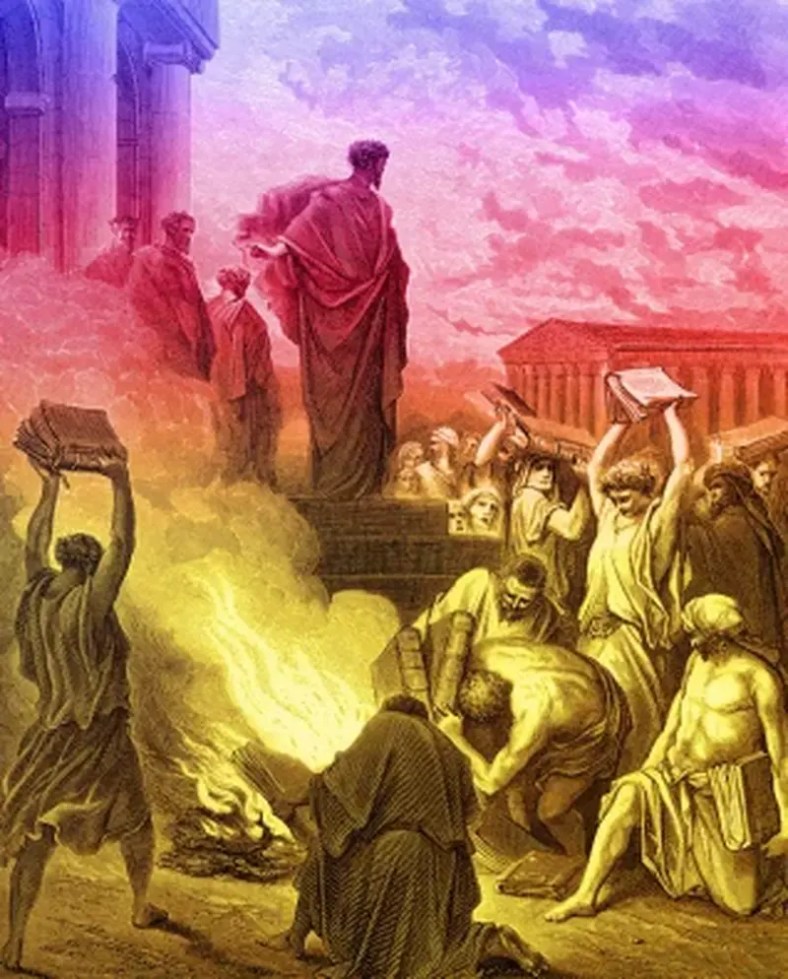
St. Paul overseeing the burning of books at Ephesus.

The good that Jesus brought

Early Christians believed all necessary knowledge was in the Bible and thus closed down schools, burned books, forbade teaching philosophy and destroyed libraries. The Jesus person portrayed in the Bible taught that “devils” and “sin” cause illness, and thus for some 1700 years good Christians ignored science and medicine to perform exorcisms on the ill.

The Bible decrees “Thou shalt not suffer a witch to live” (Ex. 22:18, with support from Dt. 18:10-12, Lev. 20:27, 2 Chr. 33:6, Micah. 5:12, and 1 Sam. 28:3). In the New Testament, Paul in Galatians 5:19-21 joins the anti-witchcraft credo. But let’s face it: Paul claims to be a devoted Hebrew, full of credulity and misogyny. Paul will “suffer not a woman to teach” and thus along the centuries women have been second-class citizens, especially within the Church. These juvenile and immoral Bible edicts are not left in the past.

From No Meek Messiah: Remember the witch hunts? Long ago and far away, past atrocities forgotten? So perhaps we should forgive and forget. Around the world, the Christian Bible is still used to accuse people, usually children, of “witchcraft” and to punish them. Refer to The Guardian, Sunday, 9 December 2007, “Child ‘witches’ in Africa”; Huffington Post, October 18, 2009, “African Children Denounced As ‘Witches’ By Christian Pastors”; and The Guardian, Friday 31 December 2010, “Why are ‘witches’ still being burned alive in Ghana?” The scripture normally cited regarding witches is Exodus 22:18, and there are many more. In Ghana, a study found that “accused witches were physically brutalised, tortured, neglected, and in two cases, murdered.” In Kinshasa, Congo, “80% of the 20,000 street children … are said to have been accused of being witches.” Even to this day the Bible’s proclamations against witches are still considered valid by many Christians. In places like Indonesia, Tanzania, the Congo and Ghana superstitious fundamental Christians actively pursue and execute witches, including murdering child “sorcerers.” In Malawi, accused witches are routinely jailed.

Christians are typically kept ignorant of certain evil and immoral words placed into the mouth of this mythical mystery-man:

“If any man come to me, and HATE NOT his father, and mother, and wife, and children, and brethren, and sisters, yea, and his own life also, he cannot be my disciple.” – Luke 14:26.

Jesus is actually portrayed as a pitiful man in desperate need of praise:

“He that loveth father or mother more than me is not worthy of me: and he that loveth son or daughter more than me is not worthy of me.” – Matt. 10:37.

Not only does Jesus never advise against slavery, but he recommends savage whipping of disobedient slaves:

“And that servant, which knew his lord’s will, and prepared not himself, neither did according to his will, shall be beaten with many stripes.” – Luke 12:47.

Jesus has nothing against stealing, as he instructs his apostles to pinch a horse and a donkey from their rightful owner:

“And when they drew nigh unto Jerusalem, and were come to Bethphage, unto the Mount of Olives, then sent Jesus two disciples, Saying unto them, Go into the village over against you, and straightway ye shall find an ass tied, and a colt with her: loose them, and bring them unto me. And if any man say ought unto you, ye shall say, The Lord hath need of them; and straightway he will send them.” – Matt. 21:1-3.

Gentle and meek and mythical

I personally know several Christians who accept evolution as scientific fact. Okay, they kind of ignore the Old Testament, but I asked one born again Christian about the genealogy of Jesus and she was only aware of another one in Luke.

From No Meek Messiah: Christianity absolutely depends on mythical “Adam.” Without Adam, Eve, and a talking snake, Jesus’ mission is moot and pointless and void. Christians are generally oblivious of this because they have been shown a genealogy in Matthew (which only goes back to “Abraham”), and are rarely if ever exposed to Luke’s disparate and childlike version—which if true would negate all of evolution and in fact most known history and science. According to the anonymous author of Luke, a mere seventy-five generations separate “Adam”—and the beginning of the universe—from the birth of Jesus some 2,000 years ago.

This “meek” messiah boasted he was “greater than Solomon” (Mt. 12:42), saying he “came not to send peace, but a sword” (Mt. 10:34), and  (Lk. 12:49). Jesus desperately needs your praise (Mt. 10:37), and advises you to beat your slaves.

Yahweh / Jehovah

This Jesus character speaks highly of father Yahweh‘s genocidal tantrums in Matthew 11:20-24. Jesus is referring to the book of Joshua where his father declares he will wipe out all people of Sidon: “All the inhabitants of the hill country from Lebanon unto Misrephoth-maim, and all the Sidonians, them will I drive out from before the children of Israel”.

You may have heard Christians claim that the only “god hates fags” verbiage comes from the Old Testament (Lev. 18:22), but both Paul (in Rom. 1:26-27) and Jesus speak out against it, as the J-man praises the ruin of Gaytown, Canaan: “But the same day that Lot went out of Sodom it rained fire and brimstone from heaven and destroyed them all.” – Luke 17:29.

Onward Christian soldiers

Christianity has a violent “holy book” as its authority, granting followers supremacy over the entire earth (e.g. Gen. 1:28) which they used to justify land grabs, genocide and holy conflicts. The following wars were perpetrated by Christians in the name of their saviour:

  1. War against the Donatists, 317 CE
  2. Roman-Persian War of 441 CE
  3. Roman-Persian War of 572-591 CE
  4. Charlemagne’s War against the Saxons, 8th century
  5. Spanish Christian-Muslim War of 912-928
  6. Spanish Christian-Muslim War of 977-997
  7. Spanish Christian-Muslim War of 1001-1031
  8. First Crusade, 1096
  9. Jerusalem Massacre, 1099
  10. Second Crusade, 1145-1149
  11. Spanish Christian-Muslim War, 1172-1212
  12. Third Crusade, 1189 CE
  13. War against the Livonians, 1198-1212
  14. Wars against the Curonians and Semigallians, 1201-90
  15. Fourth Crusade, 1202-04
  16. Wars against Saaremaa, 1206-61
  17. War against the Estonians, 1208-1224
  18. War against the Latgallians and Selonians, 1208-1224
  19. Children’s Crusade, 1212
  20. Fifth Crusade, 1213
  21. Sixth Crusade, 1228 War against the Livonians, 1198-1212
  22. Spanish Christian-Muslim War, 1230-1248
  23. Seventh Crusade, 1248
  24. Eighth Crusade, 1270
  25. Ninth Crusade, 1271-1272
  26. The Inquisitions
  27. War against the Cathars, 1209-1229 and onward
  28. War against the Stedingers of Friesland, 1233
  29. Spanish Christian-Muslim War, 1481-1492
  30. Four Years War of 1521-26
  31. Count’s War of 1534-36
  32. Schmalkaldic War, 1546
  33. Anglo-Scottish War of 1559-1560
  34. First War of Religion,1562
  35. Second War of Religion, 1567-68
  36. Third War of Religion, 1568-70
  37. Fourth War of Religion, 1572-73
  38. Fifth War of Religion, 1574-76
  39. Sixth War of Religion, 1576-77
  40. Seventh War of Religion, 1579-80
  41. Eighth War of Religion, 1585-98
  42. War of the Three Henrys, 1588
  43. Ninth War of Religion, 1589—1598
  44. Ottoman-Habsburg wars, 15th to 16th century
  45. War against the German Farmers (“peasants”), 16th Century
  46. The French Wars of Religion, 16th Century
  47. Shimabara Revolt, 1637
  48. Covenanters’ Rebellion of 1666
  49. Covenanters’ Rebellion of 1679
  50. Covenanters’ Rebellion of 1685
  51. The Thirty Years War, 17th Century
  52. The Irish rebellion of 1641
  53. Spanish Christian extermination of South American natives
  54. Manifest Destiny
  55. War of the Sonderbund, 1847
  56. Crimean War, 1853-1856
  57. Tukulor-French War, 1854-1864
  58. Taiping Rebellion, 1851 and 1864
  59. Serbo-Turkish War, 1876-78
  60. Russo-Turkish War, 1877-1878
  61. Russian Revolution, killing of Jews, late 19th century
  62. First Sudanese Civil War, 1955-1972
  63. Nigerian Civil War, 1967
  64. Lebanese Civil War, 1975
  65. Sabra and Shatila massacre, 1982
  66. Second Sudanese Civil War, 1983
  67. Yelwa Massacre, 2004
  68. Bosnian War, 1992-1995

A relatively unknown contrivance occurred in the thirteenth century when Pope Innocent III ordered a genocidal attack against the entire region of Languedoc France. The pope depicted the Cathars as witches; of being cannibals; desecrating the cross; and having “sexual orgies.”

Yet malefic sounds of sibilance emanated only from the Vatican, and not from its contrived enemies living peaceably in France with their pure and righteous ways. The Church murdered over a million innocent Cathars over the period of 35 years—men, women, children. Christian forces wiped them from the face of the planet. At the height of the siege, Christian forces were burning hundreds at the stake at a time. The Christian colossus exterminated them, then annexed much of Languedoc—some for the Church, some from northern French nobles. The extravagant Palais de la Berbie (construction began in 1228) and the Catholic fortress-cathedral Sainte Cécile (began 1282) are just two examples that remain to this day.

The Silent Historians

Conclusion

When I consider those 126 writers, all of whom should have heard of Jesus but did not, and Paul and Marcion and Athenagoras and Matthew with a tetralogy of opposing Christs, the silence from Qumran and Nazareth and Bethlehem, conflicting Bible stories, and so many other mysteries and omissions, I must conclude this “Jesus Christ” is a mythical character. “Jesus of Nazareth” was nothing more than urban (or desert) legend, likely an agglomeration of several evangelic and deluded rabbis who might have existed.

The “Jesus mythicist” position is regarded by Christians as a fringe group. But after my research I tend to side with Remsburg—and Frank Zindler, John M. Allegro, Thomas Paine, Godfrey Higgins, Robert M. Price, Charles Bradlaugh, Gerald Massey, Joseph McCabe, Abner Kneeland, Alvin Boyd Kuhn, Harold Leidner, Peter Jensen, Salomon Reinach, Samuel Lublinski, Charles-François Dupuis, Rudolf Steck, Arthur Drews, Prosper Alfaric, Georges Ory, Tom Harpur, Michael Martin, John Mackinnon Robertson, Alvar Ellegård, David Fitzgerald, Richard Carrier, René Salm, Timothy Freke, Peter Gandy, Barbara Walker, Thomas Brodie, Earl Doherty, Bruno Bauer and others—heretics and iconoclasts and freethinking dunces all, according to “mainstream” Bible scholars.

If all this evidence and non-evidence including 126 silent writers cannot convince, I’ll wager we will uncover much more. Yet this is but a tiny tip of the mythical Jesus iceberg: nothing adds up for the fable of the Christ. In the Conclusion of No Meek Messiah I summarise the madcap cult of Jesus worship that has plagued the world for centuries. It should be clear to even the most devout and inculcated reader that it is all up for Christianity, and in fact has been so for centuries. Its roots and foundation and rituals are borrowed from ancient cults: there is nothing magical or “God-inspired” about them. The “virgin birth prophecy” as well as the immaculate conception claims are fakeries, the former due to an erroneous translation of the Tanakh, the latter a nineteenth century Catholic apologetic contrivance, a desperate retrofitting.

Jesus was no perfect man, no meek or wise messiah: in fact his philosophies were and are largely immoral, often violent, as well as shallow and irrational. There have been many proposed sons of god, and this Jesus person is no more valid or profound than his priestly precursors. In fact, his contemporary Apollonius was unquestionably the superior logician and philosopher.

Christianity was a very minor and inconsequential cult founded late in the first century and then—while still quite minor—forced upon all the people of the Empire, and all rival kingdoms in the fourth century and beyond, as enforceable law with papal sanction. Christianity has caused more terror and torture and murder than any similar phenomenon. With its tyrannical preachments and directives for sightless and mindless obedience, the Bible is a violent and utterly useless volume, full of lies and immoral edicts and invented histories, no matter which of the many “versions” you may choose to read—including Thomas Jefferson’s radical if gallant abridgement.

The time to stop teaching the tall tales and nonsense to children, frightening them with eternal torture administered by God’s minions, has long ago passed. Parents who do so are likely deluded, and most surely are guilty of child abuse of the worst sort….

The cult of Christianity has an incalculable amount of blood on its hands. And the “Jesus” tale seems to have been nothing more than oral legend, with plenty of hoax and fraud perpetrated along the ages. It is my hope that mankind will someday grow up and relegate the Jesus tales to the same stewing pile that contains Zeus and his son Hercules, roiling away in their justifiable status as mere myth. – JNE, 19 July 2014

Thomas Paine Quote

Bibliography

  1. Catholic Encyclopedia, first edition. The Encyclopedia Press, 1907-1913.
  2. Dungan, David L., Constantine’s Bible, Minneapolis: Fortress Press, 2007.
  3. Ehrman, Bart, Jesus, Interrupted, New York: HarperCollins, 2009.
  4. Encyclopedia Biblica: A Critical Dictionary of the Literary, Political and Religious History: The Archeology, Geography and Natural History of the Bible, Edited by Thomas Kelly Cheyne and J. Sutherland Black. 1899.
  5. Magness, Jodi, The Archaeology of Qumran and the Dead Sea Scrolls, Grand Rapids: Eerdmans, 2002.
  6. Oxford Classical Dictionary. New York: Oxford University Press, 1996.
  7. Salm, René, The Myth of Nazareth, Parsippany: American Atheist Press, 2008.

Further Reading

  1. Alfaric, Prosper, Jésus a-t-il existé? 1932.
  2. Allegro, John M., The Dead Sea Scrolls and the Christian Myth, Amherst: Prometheus Books, 1992.
  3. Barnard, Leslie William, Athenagoras: A Study in Second Century Christian Apologetic, Paris: Éditions Beauchesne, 1972.
  4. Bradlaugh, Charles, Who Was Jesus Christ? London: Watts and Co., 1913.
    Brodie, Thomas, Beyond the Quest for the Historical Jesus: Memoir of a Discovery, Sheffield: Sheffield Phoenix, 2012.
  5. Carrier, Richard, Proving History: Bayes’s Theorem and the Quest for the Historical Jesus, Amherst: Prometheus, 2012.
  6. Doherty, Earl, Neither God nor Man, Ottawa: Age of Reason, 2009.
  7. Drews, Arthur, Hat Jesus gelebt? Mainz: 1924.
  8. Dupuis, Charles-François, L’origine de tous les cultes, ou la religion universelle, Paris: 1795.
  9. Ellegård, Alvar, Jesus One Hundred Years Before Christ, New York: Overlook Press, 2002.
  10. Fitzgerald, David, Nailed: Ten Christian Myths That Show Jesus Never Existed at All, Lulu.com, 2010.
  11. Freke, Timothy, and Gandy, Peter, The Jesus Mysteries: Was the “Original Jesus” a Pagan God? New York: Three Rivers Press, 1999.
  12. Harpur, Tom, The Pagan Christ: Recovering the Lost Light, Toronto: Thomas Allen Publishers, 2005.
  13. Higgins, Godfrey, Anacalypsis, A&B Books, 1992.
  14. Jensen, Peter, Moses, Jesus, Paul: Three Variations on the Babylonian Godman Gilgamesh, 1909.
  15. Kneeland, Abner, A Review of the Evidences of Christianity, Boston: Free Enquirer, 1829.
  16. Kuhn, A. B., Who Is This King of Glory? Kessinger Publishing, LLC; Facsimile Ed edition, 1992.
  17. Leidner, Harold, The Fabrication of the Christ Myth, Survey Press, 2000.
  18. Lublinski, Samuel, Die Entstehung des Christentums; Das werdende Dogma vom Leben Jesu, Köln: Eugen Diederichs, 1910.
  19. Martin, Michael, Atheism: A Philosophical Justification, Philadelphia: Temple University Press, 1992.
  20. Massey, Gerald, Ancient Egypt, the Light of the World, Sioux Falls: NuVision, 2009.
  21. McCabe, Joseph, The Myth of the Resurrection and Other Essays, Amherst: Prometheus Books, 1993.
  22. Ory, Georges, Le Christ et Jésus, Paris: Éditions du Pavillon, 1968.
  23. Paine, Thomas, The Age of Reason, Paris: Barrots, 1794.
  24. Price, Robert M., Deconstructing Jesus, Amherst: Prometheus, 2000.
  25. Price, Robert M., The Case Against the Case for Christ, Cranford: American Atheist Press, 2010.
  26. Reinach, Salomon, Orpheus, a History of Religions, New York: Liveright, 1933.
  27. Remsburg, John, The Christ, New York: Truth Seeker, 1909. Reprinted by Prometheus Books, 1994.
  28. Robertson, John M., A Short History of Christianity, London: Watts & Co., 1902.
  29. Steck, Rudolf, Der Galaterbrief nach seiner Echtheit untersucht nebst kritischen Bemerkungen zu den Paulinischen Hauptbriefen, Berlin: Georg Reimer, 1888.
  30. Walker, Barbara, The Women’s Encyclopedia of Myths and Secrets, New York: HarperOne, 1983.
  31. Zindler, Frank, The Jesus the Jews Never Knew, Cranford: American Atheist Press, 2003.

» Michael Paulkovich is an aerospace engineer, historical researcher, freelance writer, and a frequent contributor to Free Inquiry and Humanist Perspectives magazines. His book No Meek Messiah was published in 2013 by Spillix.

No Meek Messiah: Christianity's Lies, Laws and Legacy - Michael Paulkovich

Audrey Truschke: A demagogue with a megaphone – Sankrant Sanu

Audrey Truschke

Hinduism, as a non-Abrahamic tradition, remains open season in many Western academic spaces. This double standard isn’t just unjust—it’s intellectually dishonest. – Sankrant Sanu

On the streets of New York, Audrey Truschke—then assistant professor of South Asian history at Rutgers University—stood with a megaphone and declared to a crowd: “Prime Minister Narendra Modi and his political party, the BJP, openly adhere to Hindutva.”

She then launched into her historical comparison: “Hindutva came about roughly 100 years ago. … It was inspired in its early days by Nazism. Did I say Nazis? Yeah, I said Nazis.” She emphasised: “I want to be clear that I am talking about real, actual, historical Nazis.”

Then came the most inflammatory claim: “Early Hindutva espousers openly admired Hitler. … They praised Hitler’s treatment of the Jewish people in Germany as a good model for dealing with India’s Muslim minority.”

With this inflammatory rhetoric, she branded India’s ruling BJP and its adherence to Hindutva as Nazi-like—by extension tarring the hundreds of millions of Indians who democratically elected this government, as fascists. It wasn’t scholarship; it was street theatre designed to demonise an entire community. For Hindus across America, this wasn’t just academic discourse—it was public vilification. To rub salt into the wound, the department of history at Rutgers gleefully posted Truschke’s diatribe on their Facebook feed with the endorsement: “That’s what we call public history.”

Now, with her latest book India: 5,000 Years of History on the Subcontinent hitting shelves this month, Truschke’s troubling methodology is reaching an even wider audience. The timing couldn’t be more urgent for examining what happens when academic platforms become weapons of ideological warfare.

The Hitler Analogy: History stripped of context

Truschke’s accusation draws from a controversial passage in We or Our Nationhood Defined, published in March 1939 and attributed to M.S. Golwalkar of the RSS. The reality is more complex than her megaphone moment suggests.

The book wasn’t authored by Golwalkar but paraphrased and translated by him. The historical context matters crucially: in 1939, the full extent of Nazi atrocities against Jews was not yet known. The Holocaust — the systematic extermination of six million Jews—wouldn’t begin until 1941. For many colonised peoples worldwide, including some Indians, Hitler was viewed primarily as an enemy of Britain—their colonial oppressor.

The passage reflects the ideological uncertainty of that era, when colonised peoples worldwide were grappling with competing definitions of nationalism and looking to various models of national reorganisation. More importantly, the RSS has explicitly disavowed this misattributed quote, and decades of subsequent Hindutva writings have evolved far beyond these early formulations. But such nuance doesn’t fit Truschke’s narrative.

Most perversely, her Hitler comparison erases a remarkable historical truth: Hindus have never persecuted Jews. For over two millennia, India has been a haven for Jewish communities—in Kerala, Maharashtra, and Bengal. While Jews faced pogroms in Europe, ghettos in the Middle East, and extermination in Nazi camps, they found safety and dignity in Hindu-majority India.

To draw parallels between Hindutva and Hitler isn’t just inflammatory—it’s a moral inversion of history that anachronistically applies knowledge of the Holocaust to judge a misattributed quote from an earlier period—and then use that nearly 100-year-old aside to define a contemporary political movement. This is not academic history; it is political pamphleteering.

A pattern of distortion

This isn’t an isolated incident. Truschke’s 2017 book Aurangzeb: The Life and Legacy of India’s Most Controversial King whitewashes a well-documented record of temple destruction, discriminatory taxation, and forced conversions. Despite abundant evidence from Aurangzeb’s own firmans (imperial decrees) documenting systematic iconoclasm and forced conversion of Hindus, she claims he “simply left temples alone” and was a protector of Hindus, dismissing documented destructions as merely following “an Indian stance dating back, at least, to the Chalukyas and Pallavas”.

This false equivalency ignores a crucial theological distinction. When Aurangzeb’s contemporary sources praise him for hitting against the “infidels” and spreading Islam through “holy war,” these aren’t political calculations—they’re expressions of religious doctrine. In Islamic theology, idol worship is the gravest sin, making temple destruction an act of piety. Hinduism contains no such mandate. Political motivations aren’t identical to doctrinal imperatives.

Truschke dismisses scholars like Jadunath Sarkar as unreliable while downplaying Persian sources that contradict her narrative. Her approach isn’t history—it’s revisionism designed to obscure inconvenient truths.

Her recently published India: 5,000 Years of History on the Subcontinent promises more of the same: selective citations, interpretive sleights, and wholesale demagoguery. We can expect the 600-page tome to follows the familiar pattern—Hinduism cast as irredeemably oppressive, Islam framed as emancipatory. There’s little interest in balance, complexity, or competing narratives. It is only in the politicised ghetto of “South Asian Studies”, where practicing Hindus have little voice, that an academic would get away with this level of propaganda.

Silencing students, stifling dialogue 

At a recent Georgia Tech event, a Hindu student described confronting Truschke at Princeton about her portrayals. Instead of engaging his respectful questions, she dismissed his concerns as “Hindutva propaganda” and shut him down. The room fell silent—a moment of intimidation, not academic exchange.

Hindu students at Rutgers report similar experiences: hesitating to speak in her classes, fearing they’ll be branded bigots for defending their faith. Many now avoid her courses entirely. In 2021, students petitioned against her teaching Hinduism, citing her claim that the Bhagavad Gita “rationalises mass slaughter” and her suggestion linking Hindus to the January 6 Capitol riot.

Rutgers defended her academic freedom and promised dialogue with the Hindu community. That dialogue never materialised.

The double standard problem

American universities rightfully crack down on antisemitism, Islamophobia, and anti-Black racism. Yet when Hindu students raise similar concerns, institutions often look away, or worse, actively endorse such writing.

Truschke positions herself as the victim of “Hindu nationalist trolls” while sidestepping legitimate concerns from students who feel unsafe in her academic spaces. When she tweeted that Lord Rama was a “misogynistic pig”—later claiming scholarly translation—even Robert Goldman, the scholar she cited, publicly rejected her framing. One wonders how the academy would react if a professor used the same language about a different revered figure, say Prophet Mohammad.

The damage spreads beyond academia. Hindu students report being mocked as “cow piss drinkers”, stereotyped as “Brahmin oppressors”, or casually equated with fascists. When they respond, they’re accused of extremism—silenced not by force, but by fear.

Drawing the line

This isn’t about suppressing legitimate criticism of Hindutva politics. It’s about distinguishing between scholarly critique and rhetorical abuse.

Truschke’s defenders, including Romila Thapar and Sheldon Pollock, argue that attacking Hindutva isn’t Hinduphobia.  In practice, targeting Hindutva often disguises targeting Hindus.

When Truschke abuses Rama, she is attacking an iconic figure in the Hindu tradition, revered across the length and breadth of India. There can be no better evidence of what her target is.

Would such treatment be tolerated toward any other faith community?

The answer is obvious. Hinduism, as a non-Abrahamic tradition, remains open season in many Western academic spaces. This double standard isn’t just unjust—it’s intellectually dishonest.

The path forward

Universities must confront this hypocrisy. If “safe spaces” truly exist for all, Hindu students deserve the same dignity afforded every other community. That means distinguishing between legitimate academic inquiry and inflammatory demagoguery—whether delivered through peer-reviewed journals, street megaphones, or 600-page histories now being peddled as the history of India.

Academic freedom must be balanced with academic responsibility. Scholars have the right to challenge religious and political traditions, but they also have an obligation to maintain scholarly standards, engage in good faith, and create inclusive learning environments.

With Truschke’s latest work now in circulation, the stakes have never been higher. Her interpretive framework isn’t confined to specialised academic journals—it’s shaping how a new generation learns about Indian civilisation.

Until universities address this imbalance, the promise of inclusive academia remains hollow. Hindu Americans will continue raising their voices—not to suppress debate, but to demand what every community deserves: fairness, intellectual honesty, and basic respect.

The megaphone may be loud, but truth has a voice of its own. – News18, 16 June 2025

Sankrant Sanu is an author, entrepenour, and researcher based in Seattle nad Gurgoan.

Srinivasa Ramanujan: A genius who transformed mathematics – B. Sathish

Srinivasa Ramanujan

In just five years at Cambridge, Ramanujan earned the reputation of being the greatest mathematician of the twentieth century. He solved numerous complex mathematicam problems that had remained unsolved for centuries. – B. Sathish

Among the world’s legendary mathematicians, such as Leonhard Euler, Carl Gauss, and Carl Jacobi, a common trait is that they were trained by professionals. In stark contrast, Srinivasa Ramanujan (22nd Dec 1887–26th Apr 1920) was a self-taught mathematician. He once said, “An equation for me has no meaning unless it expresses a thought of God.” Ramanujan believed his mathematical insights were divine revelations bestowed by Goddess Namagiri Thayar of the ancient sixth-century temple in Namakkal. Deeply devout, he maintained that his discoveries were not merely the result of study, but were revealed to him in dreams by the Goddess.

Early Days

Ramanujan’s father, Kuppuswamy Srinivasa Iyengar, worked as a clerk in a sari shop, while his mother, Komalathammal, played a significant role in nurturing his early education. They lived in a small, traditional home in Kumbakonam. At the age of 21, Srinivasa Ramanujan married a ten-year-old girl, Janakiammal, on 14 July 1909. Although they had no children, Janakiammal’s life was remarkable in its own right. Ramanujan’s wife and mother lived with him until he left for England on 17 March 1914.

By the age of 15, Ramanujan had mastered trigonometry, algebra, geometry, cubic equations, and more. However, due to his intense obsession with mathematics, he lost his scholarship at Kumbakonam Government College in 1904 and subsequently failed to obtain a degree from Presidency College, Madras, in 1907. Interestingly, at just 18 years old, Ramanujan left home following a misunderstanding—an incident that was reported in The Hindu newspaper under the headline “A Missing Boy”.

Well-Wishers

Thanks to Ramaswamy Aiyer, the founder of the Indian Mathematical Society (IMS), who recognised the potential of this gifted mathematician. Ramanujan first published “Some Properties of Bernoulli’s Numbers” in 1910, and from then on, he published a total of 12 research papers in the Journal of the Indian Mathematical Society.

In 1912, after securing a clerical job at the Madras Port Trust, Ramanujan joined the University of Madras as its first research scholar in May 1913.

Ramaswamy Aiyer introduced him to Sheshu Aiyar, who, in turn, gave Ramanujan a note of recommendation to meet Dewan Bahadur R. Ramachandra Rao, the then District Collector of Nellore and a noted mathematics enthusiast. On the suggestion of Sheshu Aiyar, Ramanujan began writing to well-known mathematicians in Britain, starting with unsuccessful attempts to reach M.J.M. Hill, E.W. Hobson, and H.F. Baker.

It was in January 1913 that Ramanujan wrote one of the most famous letters in the history of mathematics. The recipient was G.H. Hardy, a lecturer at Trinity College, Cambridge, and one of Britain’s foremost pure mathematicians. Without Hardy’s intervention, Ramanujan might never have been recognised as the greatest mathematician of the twentieth century. It was Hardy who truly discovered Ramanujan’s genius. (Explore the Hardy–Ramanujan number 1729!)

Hardy wrote of Ramanujan: “Here was a man who could work out modular equations and theorems … to orders unheard of, whose mastery of continued fractions was … beyond that of any mathematician in the world.”

Ramanujan travelled to England on 17 March 1914, after seeking the permission of Goddess Namagiri Thayar of Namakkal, and stayed for about five years until 1919. In just five years, he earned the reputation of being the greatest mathematician of the twentieth century, even as the world was engulfed in the First World War. He solved numerous complex problems that had remained unsolved for centuries.

How could a non-mathematician even imagine such achievements? For his work, Ramanujan’s name was accepted for the Fellowship of the Royal Society, and he was also elected a Fellow of Trinity College, Cambridge.

In 2012, Ken Ono of Emory University, United States, finally solved a problem that had remained an open challenge to mathematicians for 90 years—a problem originating from Srinivasa Ramanujan’s last mysterious letter. Professor Ono referred to the problem mentioned in Ramanujan’s final letter to Professor G.H. Hardy. In his speech, Professor Ono said, “No one was talking about black holes back in the 1920s when Ramanujan first came up with the mock modular forms, and yet, his work may unlock secrets about them.”

Ramanujan’s most celebrated works include number theory, infinite series, elliptic functions, modular forms, and mock theta functions, among others.

School education departments should make it mandatory for students to visit the little-known Ramanujan Museum (established in 1993 in Parry’s, Chennai), which houses a collection of some of his works—thanks to the efforts of mathematics educator P.K. Srinivasan.

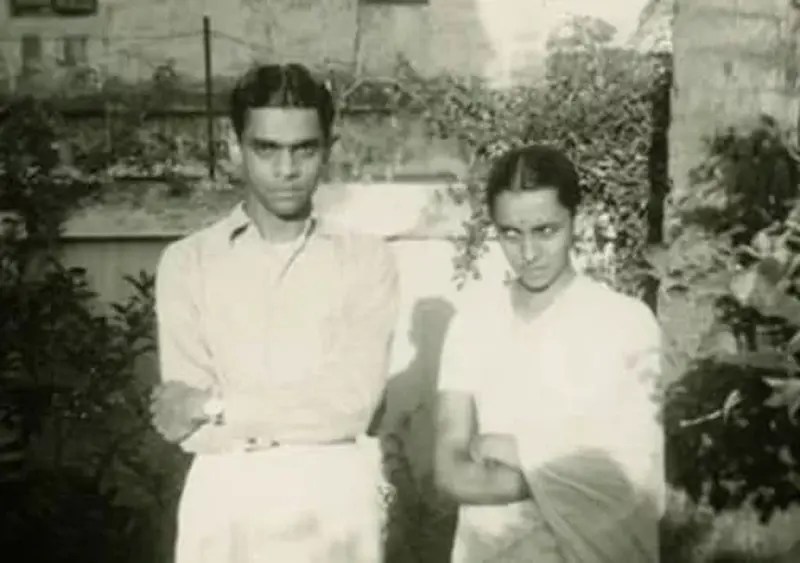
A young Ramanujan with his wife Janaki Ammal.

Janaki Ammal

It would be an injustice not to mention Janaki Ammal and how her life unfolded after the sudden demise of Ramanujan at the young age of 32. After Ramanujan’s passing, Janaki Ammal lived in Mumbai for eight years, where she learnt tailoring and English. She returned to Madras in 1932, choosing to live as an independent woman. Hanumantharayan Koil Street in Triplicane became her home for the next 50 years. Tailoring helped her to survive financially.

She later adopted W. Narayanan after her close friend Soundravalli passed away. As a foster mother, Janaki Ammal ensured that Narayanan received a proper education and got him married in 1972. Narayanan and his wife, Vaidehi, took great care of Janaki Ammal until her death on 13 April 1994, at the age of 94.

In her later years, Janaki Ammal fondly recalled: “I considered it my good fortune to give him rice, lemon juice, buttermilk, etc., at regular intervals and to give fomentation to his legs and chest when he reported pain. The two vessels used then for preparing hot water are still with me; these remind me often of those days.”

Thanks are due to the governments of Tamil Nadu, Andhra Pradesh, and West Bengal, Madras University, and various mathematical institutions for their constant financial support to Janaki Ammal. The Hinduja Foundation also donated Rs 20,000 towards her welfare.

Janaki Ammal was a philanthropist as well, providing financial support to many students.

In interviews conducted soon after the discovery of Ramanujan’s “lost” notebook by George Andrews in 1976, Janaki Ammal lamented that a statue of Ramanujan had never been made, despite earlier promises. After the efforts of hundreds of mathematicians, a bronze bust was finally created from the only authentic passport-sized photograph of Ramanujan by American sculptor Paul Granlund. A copy of the bust was presented to Mrs Ramanujan at a formal function at the University of Madras in 1985—after a gap of 60 years.

I leave it to readers: are we truly celebrating him? If not, we must learn about Srinivasa Ramanujan and educate our children about his legacy. It is not only the government’s responsibility; it is ours as well.

One can only hope that, as centuries pass, Srinivasa Ramanujan will be remembered alongside other luminaries such as Aryabhata, Brahmagupta, and Bhaskara. – New18, 26 April 2025

B. Sathish is an engineer in the automotive industry.

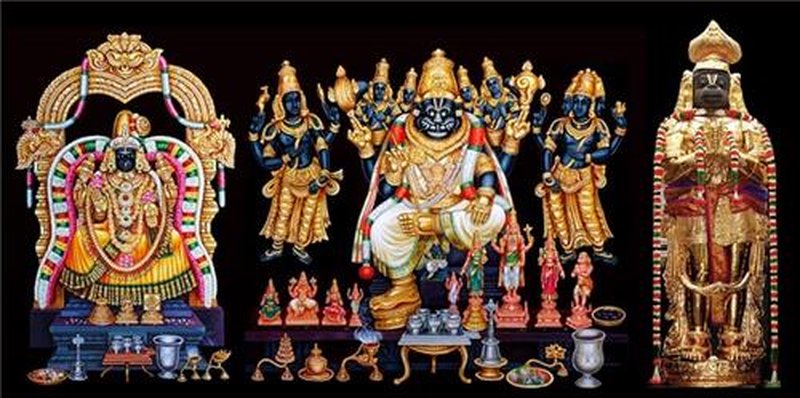
Sri Namagiri Lakshmi Narasimhaswami Temple, Nammakal.

Analysing the ‘phallacy’ of the Shiva lingam – Arvind Sharma

Shiva Lingabhavad Image

“The Shiva linga is part of a vast natural symbolism of ascending cosmic energy. Such linga forms include mountains, fire, trees, standing stones, pyramids, sun, moon, lightning, and OM. It’s sexual reduction by modern scholars is part of their sexual obsession overall.” – Dr David Frawley quoted by Prof. Sharma 

The claim that a Shiva linga may have been discovered at the Gyanvapi mosque in Varanasi has raised some questions about what it stands for. The issue is important considering the comments made on it on social media. The professor of a college in Delhi, on seeing its picture, wondered whether Lord Shiva had been circumcised. Another voice on social media seemed to wonder whether it spouted semen, perhaps because it was claimed to be a fountain by the opposing party. More recently, a lady from Jaipur seemed to give a foreplay dimension to the changes in its size mentioned at various times. And so on.

What is significant here is the temptation to take it, some would say mistake it, for a phallic symbol, which is its chosen interpretation in Western Indology. This tendency to take it as a body part, therefore, on the part of some may be attributed to the way Western Indology tends to view it. This leads to the next question: To what extent is this description justified?

Sometimes it is argued that the word itself stands for the penis. This is problematic because the term is used to signify gender in Sanskrit, and more generally stands for a mark or sign. Thus the words corresponding to masculine, feminine, and neuter gender in Sanskrit are pullinga, strilinga, and napunsakalinga. It is clear that translating these terms by using the word penis will lead to hilarious results. The use of the word varna and its apparent translation as colour, similarly, created serious problems in Indology from which it is still trying to emerge.

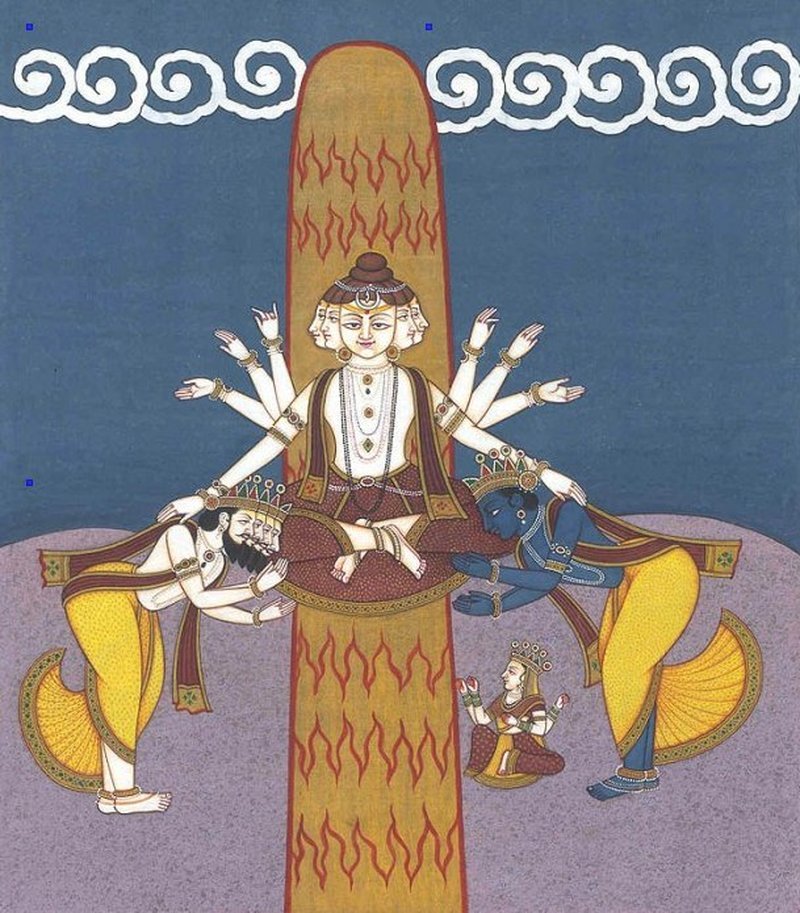
At a religious rather than verbal level, a Hindu, in general, finds the interpretation of the term linga as a phallus jarring, to say the least. Mahatma Gandhi noted that he first learnt from a book by a missionary that it had any “obscene” significance. This radical divergence in understanding the significance of the Shiva linga is a striking example of how the insider’s and the outsider’s perspective might differ on a point. The outsider may associate it with a fertility cult. In Hindu lore, however, the Shiva linga represents the axis mundi, the pillar upholding the universe as it were. In the Puranas it represents the pillar of fire or light, the form in which Shiva appeared when the three gods of the Hindu trinity—Brahma, Vishnu and Shiva—were competing among themselves to determine who was the greatest among them. Shiva proved his pre-eminence because the other gods could not discover the beginning or the end of the pillar, which the linga represents.

It is not that the Shiva linga has not been sometimes interpreted as a body part. According to one scholar, it happens about 10 per cent of the time. Thus this does not happen often, however, even when it happens its understanding continues to be an elevated one. For instance, in the Mahabharata, sage Upamanyu states that the use of the linga and yoni to depict Shiva and Parvati means that they pervade all beings. Ramakrishna states that we worship Shiva in this form to pray for release from the process of rebirth. In a Yogic context, the linga represents the conversion of sexual energy into spiritual energy. Paradoxically, the upright but unshed penis symbolises spiritual ascent brought about by celibacy. Alberuni, the Muslim savant, records that according to one account it denotes Shiva, because when Shiva was ordered by Brahma to create imperfect human beings, Shiva refused to do so, and indicated his displeasure by chopping off the symbol of creation and procreation.

The recovery of the Shiva linga at the Gyanvapi mosque would not be complete until we also recover its proper meaning from the obfuscations under which it has been buried. It is worth reflecting on the following comment by David Frawley at this point: “The Shiva linga is part of a vast natural symbolism of ascending cosmic energy. Such linga forms include mountains, fire, trees, standing stones, pyramid, sun, moon, lightning, and OM. It’s sexual reduction by modern scholars is part of their sexual obsession overall.”

In a review of two books by Wendy Doniger—The Hindus: An Alternative History (2009) and On Hinduism (2014)—in Foreign Affairs (September-October 2014), Ananya Vajpeyi notes how Doniger “argues that the lingam, a symbol of the Hindu deity Shiva that is found in temples should be understood ‘unequivocally as an iconic representation of the male sexual organ in erection, in particular as the erect phallus’.” The shock the Hindu feels in the face of such misrepresentation could only be compared to that of the Christian, upon being told that when the Christian participates in the Mass on Sunday he or she is practising cannibalism, as the Christian then consumes the flesh (wafer) and blood (wine) of Jesus Christ. – Firstpost, 12 June 2022

Prof. Arvind Sharma, formerly of the IAS, is the Birks Professor of Comparative Religion at McGill University in Montreal, Canada, where he has taught for over thirty years. He has also taught in Australia and the United States and at Nalanda University in India. He has published extensively in the fields of Indian religions and world religions. 

Worshiping a Shiva lingam in the Ganga.

Shiva lingams are not phallic symbols – Nanditha Krishna

Shiva lingams found in Harappa.

From being a small aniconic object that transcended popular representations of the divine, the lingam’s depiction has grown—but not as a phallic object, as described by Western Indologists. – Dr. Nanditha Krishna

Among the several domed conical stones found along the Indus Valley, two objects stand out—a small tapered cone seated on a round base and a dome-shaped cylinder on a flat base with a protrusion on one side. From being a small aniconic object that transcended popular representations of the divine as a superman, the lingam’s depiction has grown—but not as a phallic object, as described by Western Indologists. These depictions included simple cylindrical objects or pillars with carvings of Shiva’s face. It’s a Harappan legacy bequeathed to the Indian civilisation. The Rig Veda does not mention the lingam or even Shiva.

Lingam means sign or symbol—an abstract representation of Shiva. It’s fitted into the disc-shaped base called yoni, which means the source or womb. Together, the lingam and yoni represent the eternal process of creation and resurgence.

The Shwetashvatara Upanishad calls the lingam a symbol that establishes the existence of Brahman, one beyond any characteristics. The Linga Purana adds, “Shiva is without a symbol, without colour, taste or smell, beyond word or touch, without quality—motionless and changeless.”

As for the legend of their providence, there are four kinds: swayambhu (self-manifested), deivika (created by gods), arsha (created by rishis) and manusha (man-made). Among the swayambhu lingams are the frozen ice lingam at Amarnath and the naturally-formed rock lingam at Kedarnath. Even some triangular mountaintops are called Shiva lingam.

They are also classified by the material used or carvings. A mukha lingam generally has one, four or five faces, at times eight or more too. It’s sometimes carved with images of Shiva or of other deities. From the second century CE onwards, several lingams have been found in Mathura, with Shiva in the front or as one to the four faces around the pillar.

In Cambodia, there is a chaturmukha lingam with Brahma, Vishnu, Shiva and Buddha carved on the four sides. A famous panchamukha lingam in the Pashupatinath Temple in Nepal is six feet high and is five-faced: four facing the four cardinal directions and the fifth looking upwards. In the Buddhist Vajrayana Swayambhunath Temple not far from Pashupatinath, several four-faced lingams are carved with Buddhist deities on each side. So the multi-faced lingam does not represent a phallus.

The panchabhuta lingams represent the five elements of earth, water, air, fire and space. Sita is said to have made the sand lingam in Rameshwaram that’s still worshipped. There are several temples where Shiva appeared as a column of fire or jyotir lingam. Out of the original 64, 12 remain around India.

The earth lingam of Ekambareshwarar Temple in Kanchipuram is also made of sand and is bathed in oil, as water could dissolve it. The water lingam of Thiruvanaikaval in Tiruchirappalli sits on a perennial stream. The Arunachaleshwara of Tiruvannamalai sits on igneous rock, representing fire. The air lingam of Sri Kalahasti represents the wind: the flames inside flicker even when the airless garbhagriha is locked. Finally, the akasha lingam of Chidambaram is represented by empty space, his formless representation. None of these are phallic.

The earliest phallic lingam comes from the Parashurameshvara Temple at Gudimallam in Andhra Pradesh. Shiva stands before it, holding a goat in his right hand and a water pot and battle-axe in his left, on the shoulders of a gana. This lingam was probably originally situated beneath a tree. It has been dated to the 2nd century BCE, but its high degree of polish is typical of Mauryan art. The Gudimallam Shiva is probably the only surviving south Indian icon of the Mauryan period. He is a hunter, a popular form of the deity.

Hunter Kannappa Nayanar plucked out his eyes to offer them to the lingam at Sri Kalahasti, 40 km from Gudimallam, while Shiva is Kirita the hunter on the monolithic carvings at Mamallapuram, 160 km away. Lingodbhava, or Shiva emanating from the lingam, was probably inspired by the Gudimallam Shiva.

The Cholas were staunch Shaivas who built massive lingams in temples, although the smaller, original ones are also preserved and worshipped in several places. Neither of them is phallic. When a Chola king or queen died, the body was cremated and the ashes buried beneath a lingam. The temples around them were called pallipadai kovil. Many such temples were built in the 10th-12th centuries CE.

A chala or moveable lingam is worn as a pendent on a necklace by the Veerashaiva Lingayats, a tradition from Karnataka. Lingayat men and women wear an ishta lingam inside a box strung on a necklace. It is about divinity living and moving with the Lingayat devotee.

The signifier from Harappa was not phallic. And over the following millenniums, its depictions have taken various forms. Our culture is richer for this variety today. – The New Indian Express, 23 February 2025

Dr. Nanditha Krishna is an author, historian,and environmentalist based in Chennai.

Agni lingam on Arunachala Hill at Tiruvannamalai.

See also

Hinduism and its 33 million deities – Nanditha Krishna

Sri Ram's Padukas

It is said that there are 33 million deities in India. Yet every deity is a singular manifestation of the Supreme and the most important deity of the region. – Dr. Nanditha Krishna

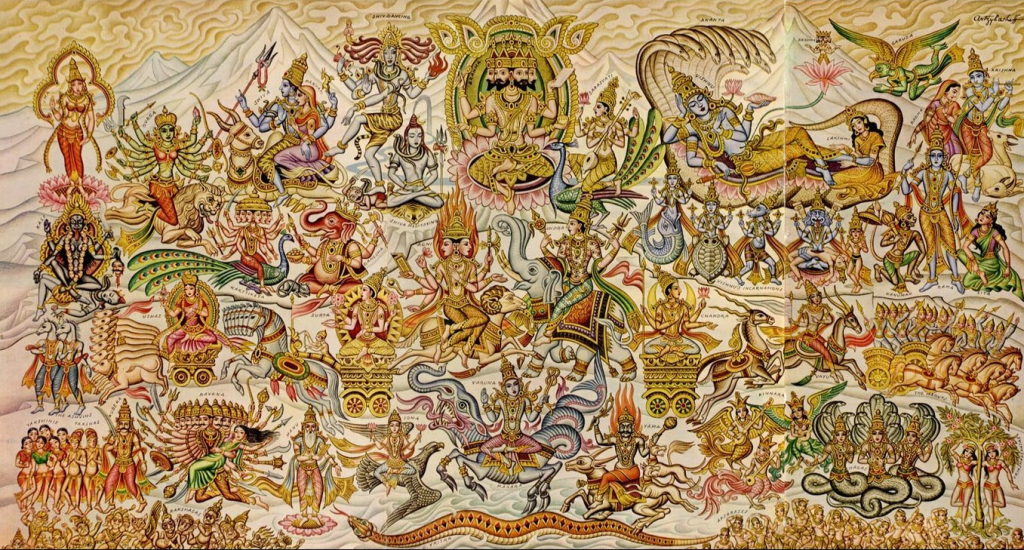
The Rigveda enumerates 33 devas or ‘shining ones’, representing primarily the forces of nature. Of these, three were important: Agni or fire, Indra or rain, and Soma, a plant. The popular deities today are two Vedic gods—Vishnu combined with a non-Vedic Narayana, and Rudra combined with a non-Vedic Shiva—and the many forms of Shakti, the supreme goddess. Agni, Indra and Soma, along with 28 others, became ‘minor deities’. Later, more minor deities were added to the Hindu pantheon: ashtadikpalas (the eight guardians of directions), navagrahas (nine planets), vasus (eight attendant deities), adityas (12 forms of the sun), rudras (11 forms of Shiva), avataras (10 incarnations of Vishnu), along with river goddesses, lesser-known forms of the main deities, village gods and goddesses and demi-gods of Buddhism and Jainism.

The original major deities of the Vedas became minor over time, while the minor deities are today among the most important deities all over India. Of the avatars, only Rama and Krishna attained cult status, while Shiva is worshipped in different forms. This is how Indian religions were made inclusive and expanded their pantheons to absorb everyone’s religious beliefs. Adi Shankara recognised six cults in his time: Vaishnava, Shaiva, Shakta, Ganapatya, Saura (Sun) and Kaumara (Kartikeya). While the six deities remain, Surya, once the ruling deity of temples in Khajuraho, Modhera, Martand and Gwalior, has been demoted to a mere navagraha.

Recently, the C. P. Ramaswami Aiyar Institute of Indological Research in Chennai organised a seminar on minor deities in Indian art. Scholars from various parts of India gathered to share the plurality and syncretism of Indian religious and social traditions, as represented in visual language. Religious syncretism is the blending of different belief systems, incorporating other beliefs into an existing tradition. This occurs when such traditions exist in proximity to each other and are catholic enough to accept each other’s belief systems. Hinduism, Buddhism and Jainism have made many adaptations over millenniums, assimilating elements of several religious traditions both in India and Southeast Asia.

Today’s Hinduism is a combination of different forms of beliefs and practices. It is no longer exclusively Vedic—it is the common people’s religion. Every village in India has a village deity, usually associated with fertility, rains, disease and so on. Shitala, a medicinal deity who cooled the body, became a dreaded goddess of disease in North India. Jvara, the deity of fever, who is propitiated as Jvarahareshwara in South India, is feared as the demon Jvarasura in Bengal. Mari originally meant rain and the pearl-like raindrops were called muthu-mari. Unfortunately, their resemblance to smallpox boils made Mariamman of Tamil Nadu into a dreaded goddess of disease. Thus, popular deities could change their character as social problems arose.

Village deities are generally made of terracotta, stucco or wood, and painted in brilliant colours. They may be situated in a wooden temple as in Kerala and Karnataka, or inside a simple brick-and-mortar shrine. Later, they were incorporated into exquisite stone sculpture. Each has a unique iconography. For example, Shitala in Rajasthan and Gujarat carries a broom and winnowing basket, and rides an ass. In Tamil Nadu, most village goddesses carry Durga’s weapons. But Ponni, the rice goddess, is depicted as a mere head: the earth on which the head is placed forms her body.

Folk deities may be grouped as gods of fertility, protector deities, fetishes (like stones and trees) and hero stones. The famous Ayyanaar is a protector, while goddesses protect children, combat disease and assure fertility. The popular Ayyappa of Kerala was originally a forest deity. Indian deities are associated with nature and natural resources like sacred groves and water bodies, the rain, a good harvest, disease and safety. By invoking the sanctity of rivers and lakes, animals and health, people protected the environment, controlled disease and ensured sustainable lifestyles for themselves and other creation.

What is amazing is the similarity among rural and tribal traditions across the country at a time when there was no easy communication. For example, votive offerings of terracotta horses to the deities of the sacred groves include the horses of Ayyanaar in Tamil Nadu and Bankura in Bengal. Every state shares this tradition, yet in no two states are the horses alike: that is the greatness of the Indian potter.

The minor deities were as important as the Vedic gods. A villager would never call his local goddess minor. She is all-important for him. Sometimes, the deity gets upgraded, such as Kamakshi of Kanchipuram, whose cult expanded when Rajasimha Pallava built a new temple and a new icon. Meenakshi, originally a goddess of fisherfolk, became the reigning deity of the new Pandya capital, Madurai. New mythologies were created, but old attributes were retained. They became aspects of Shakti or Vishnu or Shiva. This is how village deities were integrated into an all-Indian pantheon. The speakers at the seminar gave us a view of the many deities of their respective states, of dance forms like theyyam in Kerala and bhuta kola in Karnataka that are used to invoke gods.

No wonder it is said that there are ‘33 million deities’ in India. Yet every deity is a singular manifestation of the Supreme and the most important deity of the region. They are a reminder of a time when gods were invoked to protect people and the environment, and when religion was catholic enough to absorb other gods within an all-embracing belief system. That was syncretism, when the world was too small for more than one supreme deity, and all the gods and goddesses were merely different forms of the same Supreme Being and religious tradition. – The New Indian Express, 7 April 2024

Dr. Nanditha Krishna is an author, historian, and environmentalist based in Chennai.

Hindu Deities

Tracing the roots of hostility among Jews, Christians and Muslims – Arvind Sharma

Abrahamic Religions

The Arabs trace their origin to Ishmael, and the Jews trace their origin to Isaac. The struggle between them, therefore, dates back to the question: Who was the rightful heir to Abraham? – Prof. Arvind Sharma

The current tensions in the Middle East compel one to probe the roots of the hostility of the Christians and the Muslims towards the Jews, especially the hostility between the Jews and the Muslims. To trace the roots, one needs to go back to around 1800 BCE. That is the age in which Abraham, who is venerated by all three traditions, lived.

The Arabs trace their origin to Ishmael, and the Jews trace their origin to Isaac. The struggle between them, therefore, dates back to the question: Who was the rightful heir to Abraham? This issue has been the source of a lasting sibling rivalry.

It is not all conflict, however. According to the standard narrative, both the brothers buried Abraham together when he passed away.

The Jews, descendants of Isaac, finally found their kingdom in the promised land. They prospered, especially around 1000 BCE, giving us the legendary figures of David and Solomon. Thereafter, however, the Jewish kingdom fell prey to the various empires which arose in the Middle East, such as the Assyrian, the Babylonian, the Persian, and the Roman.

We fast forward now to the beginning of the Christian era when the Romans were ruling over the Jews. The prolonged period of political servitude had instilled in the Jews the hope that a great saviour, a messiah, would arise in due course to restore their sovereignty. It was in such an atmosphere of messianic expectation that Jesus was born. His charismatic personality and the miracles he performed raised the expectation in some quarters that he might be the messiah. But others wondered whether that could be the case, because of the aura of non-violence around him. Those who continued to believe that he was the messiah, even after his crucifixion, became the founders of Christianity. In other words, the key issue between the Jews and the Christians is whether Jesus was the messiah. The Christians accept him as such, and the Jews reject him as such.*

Just as the difference between the Jews and the Muslims goes back to the legacy of Abraham; the difference between the Jews and the Christians goes back to the legacy of Jesus Christ.

The difference between the Jews and the Christians is aggravated by the fact that, in the Christian scriptures, the Jews are depicted as responsible for the crucifixion of Jesus, although the crucifixion was formally carried out by the Romans. In Christian theology, Jesus is sometimes identified with God and, therefore, the Christians held the Jews responsible not just for the killing of Jesus Christ, but for killing God, or what is known as deicide.

Some historians argue that this was the result of the spread of Christianity in the Roman Empire. The Romans could not be held responsible for killing Jesus, because they were proving receptive to the message of Christianity, and therefore the blame for the death of Jesus Christ had to be shifted to the Jews. Christian theology not only aggravates but also complicates the relationship between the Jews and the Christians. Because Jews and Christians worship the same God, the Christians felt that God’s word to the Jews had also to be redeemed in some form. That is why Jews survived as a sect in the Roman Empire even though Christianity eliminated all other rival sects within the empire once it became the official religion.

Thus the hostility of both the Muslims and the Christians towards the Jews has deep historical roots. In recent times, however, the hostility between the Christians and the Jews has diminished because of the Holocaust, in which almost six million Jews were eliminated during the Nazi regime. Many Christians now feel guilty about this, and therefore tend to favour Israel.

The hostility between the Jews and the Muslims also went through a period when it was not as acute as it is now. During the sixteenth century, when the Jews were expelled from Christian Spain, they found shelter in the Muslim Ottoman Empire. Therefore, although the hostility between the Jews and the Muslims and the Jews and the Christians has deep historical roots, one should not fall prey to historical determinism and imagine it must always be so. It is possible that a modus vivendi may yet emerge. – News18, 23 November 2023

* Jews also reject the prophethood of Muhammad. – Editor

Prof. Arvind Sharma is the Birks Professor of Comparative Religion at McGill University in Montreal Canada, where he has taught for over thirty years. He has also taught in Australia and the United States and at Nalanda University in India. He has published extensively in the fields of Indian religions and world religions.

Abraham with Sarah and Hagar and their respective childrem Isaac and Ishmael.

Why ‘eminent historians’ still swear by the debunked Aryan theory – Makkhan Lal

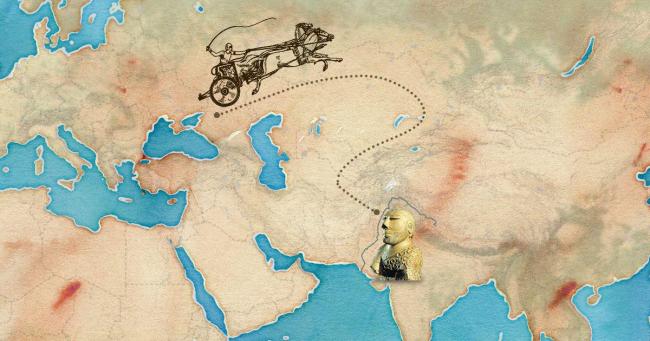
Image depicting the imaginary Aryan invasion of India from the Caspian Sea.

“It is difficult to say that all the earliest Aryans belonged to one race, but their culture was more or less the same type. Originally the Aryans seem to have lived somewhere in the steppes stretching from Southern Russia to Central Asia. On their way to India the Aryans first appeared in Central Asia and Iran. A little earlier than 1500 BC the Aryans appeared in India.” – R.S. Sharma

“By 1500 BC when the Aryans began to arrive in India, the Harappan culture had collapsed. We do not know where they came from; perhaps they came from north-eastern Iran or the region near the Caspian Sea or Central Asia.” – Romila Thapar

The two quotations from India’s two “eminent historians” sum up their approach to the Aryan Invasion Theory. Just look at expressions “difficult to say”, “seems to have”, “somewhere in steppes”, “we do not know where they come from”, “perhaps they came from north-eastern Iran or the region near Caspian Sea or Central Asia”. Despite so many probabilities, they are certain that Aryans came from outside. When and from where? No idea!

Despite all evidence to the contrary, why does the Aryan invasion/migration theory (AIT) continue to remain the lifeline of Indian Marxist historians? Let us now look at the AIT in historical perspectives.

Linguistic Evidence

Florentine merchant, Filippo Sassetti, who lived in Goa from AD 1583 to 1588, was struck by similarities between Sanskrit and European languages, especially Latin and Greek. Later, the relationship between Sanskrit and European languages was further elaborated by William Jones and many other scholars in the service of the East India Company. The efforts made towards understanding these linguistic similarities between Sanskrit on the one hand and Greek, Latin and some other modern European languages on the other gave rise to a new discipline called ‘comparative linguistics’. Its birth had questionably motivated considerations and in the last 200 years the discipline (if at all it is a discipline) of ‘Comparative Linguistics’ has shown a far greater variety of gymnastic exercises than the sport of gymnastics itself.

Since the earliest books (i.e. the Vedas) of the Aryans and so also all human beings are written in Sanskrit, it came to be recognised as the language of the Aryans. In the beginning, all European languages, along with Sanskrit, came to be clubbed as Aryan languages, and Sanskrit got identified as not only the oldest of all but also the mother of all European languages. Lord Monboddo was convinced that “Greek was derived from Sanskrit”. Frederick Schlegel, a highly respected German linguist wrote, “The Indian language is older and others [European languages] younger and derived from it.” Thus, Sanskrit came to be recognised as the mother of “all the less ancient Indo-European languages, as well as the modern European tongues and dialects”.

But these opinions did not last very long. Local pride, racial complexes and Evangelical considerations overshadowed everything as a part of a shift from ‘Indo-mania’ to ‘Indo-phobia’.

Though William Jones could not accept the earlier view that Sanskrit is the ‘mother’ of all Aryan languages. He advocated that Sanskrit is just a ‘sister’, i.e. a co-descendant of an earlier ancestor language. Following the lead provided by Jones, F. Bopp wrote: “I do not believe that Greek, Latin and other European languages are to be considered as derived from Sanskrit. I feel rather inclined to consider them together as subsequent variations of one original tongue, which however, the Sanskrit has preserved more perfect than its kindred dialects.”

So, a search for the original homeland of a language, namely ‘Proto-Indo-European’, led different scholars to different places. This search for the imagined original language homeland also meant the search for the ‘Original Homeland of Aryans’. This also gave rise to forging labels such as the ‘Indo-Aryan’, ‘Indo-European’, ‘Aryan languages’, ‘Indo-Aryan languages’, and the ‘Indo-European languages’. Sometime around the 1820s, the word ‘Aryan’ began to be dropped and it simply became ‘Indo-European’. Some German scholars even started using the term ‘Indo-German’ on the presumption that the Sanskrit and German languages, between them, covered the entire Indo-European speaking area—the farthest language to the east being Indic and German to the west.

Sanskrit, even today, may be “the greatest language of the world” or even if it “is of a wonderful structure, more perfect than Greek, more copious than Latin and more exquisitely refined” but so what? How could a language spoken by ‘niggers’ have been once the mother of languages today spoken by Europeans, i.e. white people? This position could not be accepted even by William Jones and Max Mueller, who have been so wholesome in their praise for Sanskrit.

Sanskrit was first demoted from mother to the position of a mere sister of all the ancient and modern European languages, but later on, with further building-up of the language tree, it came to be demoted to the position of grand-daughter, when it got linked to the so-called Indo-Iranian family. Thus, the position is: Proto-Indo-European language gave birth to the Indo-Iranian, which in turn produced Sanskrit. It’s already almost 200 years and the search for the grand-mother of Sanskrit (i.e. the Proto-Indo-European) is still on. We still do not know what she (the Proto-Indo-European Language) may have looked like, of what colour she may have been, or what may have been her physical and metaphysical structure. She still remains formless even in dreams. Quite often, these practitioners of philology were so illogical, so incoherent, so absurd, so adamant and arrogant, but, indeed, their impact has been so devastating that it has aptly been termed as ‘linguistic tyranny’.

Central Place Argument and Aryan Invasion

Once Sanskrit was demoted from the honoured status of being mother to all Indo-European languages and made a mere sister or niece of the European languages, a search started for the ‘original tongue’ i.e. the ‘Proto-Indo-European’. This cleared the deck also for legitimising the Aryan invasion of India; a theory which suggested that Sanskrit was brought here from the place where this imaginary language called ‘Proto-Indo-European’ was spoken. In 1842, A.W. von Schlegel claimed: “It is completely unlikely that the migrations which had peopled such a large part of the globe would have begun at its southern extremity (i.e. India) and would have continually directed themselves from there towards the northwest. On the contrary everything compels us to believe that the colonies set out in diverging directions from a central region.”

And for Schlegel this central region consisted of the areas around the Caspian Sea.

With the increasing hold of the British on India, the colonial and the Evangelical interests soon became a force in shaping Indian history for the rest of the academic world. Following the lead provided by A.W. von Schlegel, Max Mueller reiterated his position on the issue of the Aryan invasion and said in 1887: “If an answer must be given as to the place where our Aryan ancestors dwelt before their separation … I should still say, as I said forty years ago, ‘somewhere in Central Asia’ and no more.”

However, Srinivas Ayengar wrote in 1914: “The Aryans [in their entire literature] do not refer to any foreign country as their original home, do not refer to themselves as coming from beyond India, do not name any place in India after the names of places in their original land as conquerors and colonisers do, but speak of themselves exactly as sons of the soil would do. If they had been foreign invaders, it would have been humanly impossible for all memory of such invasion to have been utterly obliterated from memory in such a short time as represents the differences between the Vedic and Avestan dialects.”

It must be reiterated that it does not refer to a single name of flora and fauna found in Central Asia, Russia and Europe. If Rig Vedic people came from Central Asia how come they have no memory of it. Historically, linguistically and as per the oral traditions it is simply impossible.

The fallacy of this central-place theory as the origin of an imaginary language and then spreading all around can be explained with a contemporary example—English. Consider a situation wherein after a couple of thousand years, people forget that England was the place where the English language developed and spread from, and start looking for the place of its origin. The Central Place Theory will exclude England in the very first instance, as it is located on the outskirts of the world of the English language. The United States of America would be the natural choice from where it spread to Europe and Asia in the east, and Australia, New Zealand, Hawaii, etc, in the west and Canada in the north.

Lexicographic Evidence

Lexicography (the vocabulary of spoken/written words) is another area which was pressed in the service. Besides collecting a large number of the common words in various languages to prove their affinity, a number of words were chosen to prove the location of the language. For example, it has been argued that since there is no common word for the ocean in the Indo-European language, we can safely conclude that the Indo-European people were not aware of the ocean.

Varadpande rightly presses the points: “If we carry this reasoning further we shall have to suppose that ‘Indo-Europeans’ were living in a region where there was no air and no water, since there are no common words for air and water in all the ‘Indo-European’ Languages.”

The whole situation is that first a conjecture is turned into a hypothesis; to be later treated as a fact to be used in support of a new theory. For instance, language like Proto-Indo-European, Proto-Indo-Iranian and Proto-Dravidian are no more than hypothetical constructions, which may or may not have really existed; and yet these modern creations are often imposed on populations that lived thousands of years ago, to prove migrations theories.

Shaffer writes: “The Indo-Aryan invasion(s) as an academic concept in 18th-19th century Europe reflected the cultural milieu of that period. Linguistic data was used to validate the concept, which in turn, was used to interpret archaeological and anthropological data. What was theory, became an unquestioned fact that was used to interpret and organise all subsequent data. It is time to end the ‘linguistic tyranny’ that has prescribed interpretative frameworks of pre-and proto-historic cultural development in South Asia.”

The question of Aryan invasion/Aryan migration vis-a-vis philology has always been questioned. In the beginning of the last century, Aurobindo, while commenting on the philology, wrote: “Comparative philology has hardly moved a step beyond its origins; all the rest has been a mass of conjectural and ingenious learning of which the brilliance is equalled only by the uncertainty and unsoundness. … The very idea of the science of language is chimera.”

It is important to point out that in the last 30 years renowned linguists like Ram Bilash Sharma, S.S. Misra, S.G. Talgeri, N.S. Rajaram and Koenraad Elst have proved, on the basis of linguistic evidence itself, that this whole theory of Aryan invasion/migration is a fallacy.

Aryans, Racialism and Rig Veda

Subjugation of India by the British filled the masters with a desire to prove their all-round superiority. Racialism was one angle of it. Writings of Grant, Mill, Marx, Macaulay and their accomplices denigrated Indian people, culture, civilisation, society, history and religion.

Trautmann has traced the emergence of racialism and the development of physical anthropology as a resolution of the inescapable philological reality with the colonial need for cultural superiority over the natives of India. One of the most striking types of evidence of such an attitude is best seen in the writings of ACL Carlleyle. In 1879 he wrote: “We, British Europeans are Aryans, and far more pure and genuine Aryans than the Hindus, and no talk of the Hindus can alter our race, or make us any less or any different from what we are. It is the Hindus who have altered and deteriorated, and not we. The Hindus have become the coffee dregs, while we have remained the cream of the Aryan race. The Hindus are like the monkey.”

Some scholars think that the linguistic affinities of Indians and Europeans were also responsible for the development of physical anthropology leading the whole debate towards racialism. Most of the European scholars could not accept the view that Indians (‘niggers’, that is how most of the time Indians have been referred to in those writings) could have been once related to them and could have, indeed, been their forefathers, a conclusion which comparative linguistics was suggesting.

Edwin Bryant expresses it in the following words: “Even during the earlier phase of the homeland quest, when India was still a popular candidate, many scholars were uncomfortable about moving the Indo-Europeans too far from their biblical origins somewhere in the Near East. There were those among the British, in particular, whose colonial sensibilities made them reluctant to acknowledge any potential cultural indebtedness to the forefathers of the rickshaw pullers of Calcutta, and who preferred to hang on to the biblical Adam far more than their European contemporaries.”

Max Mueller himself was sad to note the mood of the day: “They would not have it, they would not believe that there could be any community origin between the people of Athens and Rome, and the so-called niggers of India.”

The newly developing science of physical anthropology was pressed into service to project Aryans as tall, white-skinned, blue-eyed, with sharp and high nose, and dolichocephalic. The non-Aryans came to be identified as natives with dark skin, flat nose, short stature, and so on. The dasas mentioned in the Rigveda were made to represent non-Aryans, i.e., the indigenous local population of India. Thus, the frame of the invasion of Aryans and the subjugation of the non-Aryan local population got corroborated with the evidence from Physical Anthropology.

The racial theory had a devastating impact on European polity. Each nation/state started claiming to be the real descendent of the Aryan race and considered others as inferiors. Max Mueller tried to intervene by declaring again and again: “If I say Aryans, I mean neither blood nor bones, nor hair nor skull. … How many misunderstandings and how many controversies are due to what is deduced by arguing from language to blood-relationship or from blood-relationship to language. … An ethnologist who speaks of an Aryan race, Aryan eyes and hair, and Aryan blood is as great a sinner as a linguist who speaks of a dolichocephalic dictionary or brachycephalic grammar.”

Alas! It was too late. The djinn created by Max Mueller had now grown up and was no longer under Mueller’s command. In the twilight years of his life, Max Mueller realised the devastating impact of distortions that he had made in Indian history in order to please his employers and the newly acquired faith. He died a sad man, preaching at the end of his career things like India: What Can It Teach Us.

He described India as: “The country most richly endowed with all the wealth, power and beauty that nature can bestow, … a very paradise on earth, … [a place where] human mind has most fully developed some of its choicest gifts, has most deeply pondered on the greatest problems of life.”

Racialism and DNA Evidence

In this context it will be useful to recall the studies carried out by K.A.R. Kennedy and his colleagues. For almost five decades they carried out a detailed study of a large number of pre- and proto-historic skeletons found in excavations from a large number of archaeological sites from all over the Indian sub-continent.

On the basis of their research, Kennedy and his colleagues concluded: “As for the question of biological continuity within the Indus valley, two discontinuities appear to exist. The first occurs between 6,000 and 4,500 B.C. The second occurs at some point after 800 B.C. but before 200 B.C.”

Both discontinuities exclude any adjustment for Aryan Invasion.

Besides the studies of Kennedy and his colleagues on ancient skeletons, an important study has come out recently on modern humans. Keeping in mind the AIT, Kivishield and his colleagues carried out a detailed study on gene pools of Western Eurasians and people of the Indian subcontinent. They studied the ‘genetic inheritance aspect’ of genes through the Mitochondrial DNA Test. It may be mentioned here that the mitochondrial DNA test can reveal the whole history of genetic changes and mutations that may have taken place even in the remote past i.e. several thousand years ago.

Kivishield and his colleagues have reached the conclusion that the Mitochondrial DNA, typical of Western Eurasians, is present among Europeans up to 70 percent whereas among Indians it is only up to 5.2 percent. The DNA gene pool of Western Europeans is very different from that of Indians. It has been very clearly stated that if there was any Aryan invasion of India a few thousand years ago, it must be visible in the mitochondrial DNA tests in terms of a splash in percentage of Western Eurasian genes. But this is not so. Further, the percentage and types of Western Eurasian genes present among south Indians and north Indians are almost the same. This fact establishes that there is no difference between the south Indian and north Indian gene pools, and the same goes against the Aryan invasion theory.

Conclusions

Now over a period of 200 years, the meaning of ‘Aryans’ has been constructed and reconstructed as being nomadic, pastoralists, sedentary agriculturists, dolichocephalic, brachycephalic, blond and fair, and from brown-haired to dark-haired. The Aryan homeland has been located and relocated everywhere, virtually from the North Pole to the South Pole, and from the shores of the Atlantic to Chinese deserts—South India, North India, Central India, Tibet, Bactria, Iran, the Black Sea, the Caspian Sea, Lithuania, the Caucasus, the Urals, the Volga Mountains, South Russia, the Steppes of Central Asia, Western Asia, Palestine, Anatolia, Scandinavia, Finland, Sweden, the Baltic, western Europe, northern Europe, central Europe, and eastern Europe.

The Aryan homeland, however, still remains elusive. J.P. Mallory has put the whole thing very succinctly: “One does not ask, ‘Where is the Indo-European homeland?’ but rather ‘where they put it now?’”

Anthropologist Edmund Leach of Cambridge University has most aptly summed up the whole question of the Aryan Invasion Theory. In 1990 in his article, Aryan Invasions over Four Millennia, Leach wrote: “Why do serious scholars persist in believing in the Aryan invasion? Why is this sort of thing attractive? Who finds it attractive? Why has the development of Sanskrit come so dogmatically associated with the Aryan invasion? The details of this theory fit in with this racist framework. … The origin myth of British imperialism helped the elite administrators in the Indian Civil Service to see themselves as bringing ‘pure’ civilisation to a country in which civilisation of the most sophisticated kind was already nearly 6,000 years old. Here, I will only remark that the hold of this myth on the British middle-class imagination is so strong that even today, 44 years after the death of Hitler and 43 years after the creation of an independent India and independent Pakistan, the Aryan invasions of the second millennium BC are still treated as if they were an established fact of history. … The Aryan invasion never happened at all.” – Firstpost, 20 July 2022

  Prof. Dr. Makkhan Lal is a well-known historian and the founder director of the Delhi Institute of Heritage Research and Management.

Rig Veda

Why we must worship Goddess Kali – David Frawley

Ma Kali at Dakshineshwar

“Ma Kali has a crucial social relevance today. Kali as the transforming power of time can usher us into a new era of global peace and understanding, if we can accept her demand for a real change of consciousness. Kali asks us to live for eternity, not merely for fleeting enjoyments or outer material gains.” — Dr David Frawley 

Ma Kali is the most misunderstood of all Hindu Goddesses, though She is often regarded as the most powerful. Kali’s dark and fierce form is certainly intimidating and hard to fathom, unless one is willing to look with discernment behind the veil of sensational images about Her.

Sri Ramakrishna ParamahamsaMa Kali was first introduced to the modern world by Ramakrishna Paramahamsa as the Supreme Mother of the Universe. Through Ramakrishna—an avatar for many—the inspiration of Ma Kali awoke India to its ancient spiritual heritage and brought the unifying message of yoga to the world.

This was at a time in which the world was dominated by colonial powers and the idea of a Universal Mother was not accepted—much less a World Mother who was dark in colour and fierce in demeanour from a backward country like India!

Yet instead of following Ramakrishna’s yogic teachings about Kali, most scholars today look at Kali in an alien and diminished light. What psychologists tell us about Kali often reveals more about their own fascinations with the subconscious mind, rather than the Great Goddess who looks over all of us with wisdom and compassion.

Yogic deities can be best understood according to meditation practises. They relate to energies of higher consciousness beyond the dualities of the mind and the urges of the body. As such, their appearances are dramatic and paradoxical—mind-blowing as it were, and intentionally so.

Nature of Ma Kali

Ma Kali is kala shakti or the power of time. She indicates the impermanence of all things, which is why She wears a garland of skulls. Yet She is also the ultimate transforming power of time, which is to take us from death to immortality. Along with endless time, Kali is boundless space, the limitless void, indicated by Her dark blue colour. Her magical dance of transformation is all existence.

Kali holds the vidyut shakti, the lightning or electrical force of consciousness that is the supreme power. All the goddesses and the entire universe manifests from Her indomitable force. Kali’s seed mantra is “kreem,” which is the kriya shakti or power of transformation behind the vast movement of life.

Kali is not the goddess of death and destruction as some see Her but, on the contrary, represents the complete victory of the Divine over all death and destruction. Her warrior goddess form removes all the illusions of the mind and reveals the undying presence of our inmost Self that is one with all.

Ma Kali as the yoga shakti

Kali is the inner power of yoga or yoga shakti. Yoga in the true sense is a practice of mergence and return to the Divine source of existence. Yoga rests upon nirodha, the full concentration of the mind and dissolution of the ego. Kali is the nirodha shakti, the power of negation, neti-neti, not this, not that, of the Upanishads.

Kundalini shakti, the secret yogic power of transformation within us, works through Kali’s grace and motivation. Kundalini ascends and dissolves all the chakras, or energy centres within us, back into the state of pure unity consciousness that is Ma Kali’s ultimate abode.

Kali is the shakti inherent in Shiva as Mahakala, the great lord of eternity. She dances on Shiva in a prone form, showing the Divine life and joy that manifests out of absolute stillness and transcendence.

Kali reminds one of Tagore’s verses “Let me carry death in life that I may know life in death.”

Yet, Ma Kali has a crucial social relevance today. Kali as the transforming power of time can usher us into a new era of global peace and understanding, if we can accept Her demand for a real change of consciousness. Kali asks us to live for eternity, not merely for fleeting enjoyments or outer material gains.

Those seeking to bring the Divine Light into the world should worship Ma Kali.

Ma Kali as the supreme form of the Universal Mother absorbs Her children back into Her blissful embrace. She takes us across the deepest darkness to reach the highest light.

Jai Ma Kali! – Daily-O, 6 April 2016

› Dr David Frawley (Pandit Vamadeva Shastri) has a D. Litt. (Doctor of Letters), the highest educational title possible in the field of Yoga and Vedic sciences, from Swami Vivekananda Yoga Anusandhana Samsthana, the only deemed Yoga university recognised by the Government of India.

Ma Kali and the Kalighat temple complex.

Ram Swarup: The greatest Hindu thinker since Sri Aurobindo – Aravindan Neelakandan

Ram Swarup

Whether it is Dharmic darshanas, global Pagan revival, study of Western philosophies and theologies from Hindu perspective, study of language from Hindu framework or, resistance to monopolistic ideologies—Ram Swarup has gifted every aspiring Hindu with vision, values and tools for his or her search . – Aravindan Neelakandan

The globalised environment today has created both challenges and opportunities for local, natural cultures. Among such natural cultures and spiritual traditions, Hindu Dharma represents the largest and the longest-continuing traditions. In fact, Hindus are the last standing nation of such a natural culture and spirituality.

With predatory and monopolistic forces threatening such a theo-diversity-laden ecosystem as Hindu Dharma and society, how should Hindus respond?

How do Hindus interact with other cultures and be a blessing to humanity while being rooted in their traditions, and without insulating themselves?

The answer may well lie with the works of Ram Swarup, who should be considered and can be considered as the greatest Hindu thinker and seer after Sri Aurobindo.

In many ways, he carried forward the thinking and vision of both Sri Aurobindo and Swami Vivekananda into the future, meeting head-on the challenges of the present and showing the thinking Hindu the opportunities embedded in every challenge.

For many millennial Hindutvaites, Ram Swarup would be known as the mentor of Sita Ram Goel.

The duo was like Sri Krishna and Arjuna in the dharma kshetra of life and rashtra.

Just as Sri Krishna is far more than the charioteer of Arjuna and Gitacharya, though that is a core dimension of the avatar, Ram Swarup was the mentor and guide of Sita Ram Goel and the sattvic energy behind Voice of India, but he was also much more than that.

And it will benefit the Hindu society to go through these other dimensions of Sri Ram Swarup as his centennial celebrations commence this year. And with the Ram Swarup foundation, we will also understand and utilise the work of Sita Ram Goel better.

In 1981, through Voice of India, he published The Word as Revelation: Names of Gods.

By any reckoning, this work should be considered a milestone in both study of religions and the study of languages.

Here, Ram Swarup takes linguistics to a different plane entirely. The magnificent view that Ram Swarup shows here is not partisan to any sectarian group of humanity.

Though he has limited his study to what he calls the “Indo-European” languages, he points out that “if speech and meaning are deeply human phenomena and if they follow deeply-laid patterns of the mind and heart, then they must share certain common characteristics, however differently clothed, and certain truths must hold good for them all”.

Going through this book, one is immersed into the beauty of words and their meaning—where the perspective is deeply Hindu, and the phenomenon studied is universal.

The book has two parts. In Part I, he explores how words are formed and what creates the relation between a word and its meaning.

He states:

“The process of naming is complicated and deeply psychological. It operates at subconscious level. Different elements that go into making of a name—the referent, the sound, the meaning—all tend to coalesce in the mind so much so that it is difficult to separate them from one another. … The process of naming may also be too much forced or fanciful; it may not be keeping with the deeper wisdom of the mind.”

What Ram Swarup talks about is an important aspect which educationists who are working to provide science and technical education in mother languages should pay attention to.

For example, in Tamil Nadu, the Dravidianists have only one purpose in their attempt to create Tamil terms for science and technology; it is not taking the concepts to the child but to remove Sanskrit from the words they coin. But still, they must use the term “kanakku” for mathematics which in turn is derived from Sanskrit gana and ganitham.

Similarly, “botany” is “thavaraviyal”, which in turn is derived from the Sanskrit sthavara.

Our tradition, from poet Kalidasa to sage Kumaragurupara, has handed over the relation between the word and the meaning as Shakti and Shiva and pure consciousness as the substratum from which the word and the meaning arise.

Sri Ramana Maharishi takes this further and hints at a roadmap for preserving linguistic diversity through this common spiritual matrix. In his famous Aksharamanamalaihe speaks of the non-dual union as the union of azhaku and sundaram—both being Tamil and Sanskrit terms for the same aspect: beauty.

In Part II of the book, Ram Swarup studies the names of gods. Here, he shows how humanity reaches its greatest linguistic possibilities in arriving at the names of the divine. Language, through the names of the divine, becomes a tool to elevate human consciousness to reach more “profound heights”.

The way Ram Swarup harmonises the spiritual elements in various traditions of the world is very important for every Hindu. He has provided a solid foundation for engaging in a proper dialogue with mutual respect for non-Hindu religions.

In discussing the names of the Vedic gods, he points out that all gods have multiple names and the knowledge of these multiple names is an important and holy knowledge.

Then he says:

“In all spiritual traditions, there is something analogous to it. The God of the Jews has many names. … But according to Jewish mysticism, God has also a secret name which should not even be uttered. Therefore, the Jews simply called it ‘the Great Name’ or ‘the Great Precious Name’ or just ‘the Name’. … Islam too admits of God’s Names though it denies His Forms. But the admission receives a certain narrowing at the hands of the more orthodox and faithful. … Socrates presents this idea in the language of understanding. He proclaims the awe, mystery and unknowability of Gods and their names but also tells us how these are ultimately names of man’s own intentions and meanings. … According to Hindu thought too, the names of Gods are not names of external beings. These are names of the truths of man’s highest Self.”

One can see how softly but sharply Ram Swarup creates a Hindu framework for the study of monopolistic religions—preserving whatever spiritual components they have and pointing out where the sublime truth is lost to rigidity inevitable to monopolistic theology.

His critique of the emergence of monopolistic rigidity traces to Paul who represented “a passionate attachment to a fixed idea which is closed to wider viewpoints and larger truths of life”.

To him, this was more an ideology than a spiritual idea. From the very early days to the present, this had worked in aid of imperialism. If rigidity and closing minds to larger truths of existence plague monotheism “polytheism too is subject to the despiritualizing influence of externalizing mind”.

As against these two, he points out that the Vedic approach “gives unity without sacrificing diversity … a deeper unity and deeper diversity beyond the power of ordinary monotheism and polytheism”.

Ram Swarup writes:

“God transcends every one of His Names; He also lives fully and indivisibly in each one of them. In one Name we should be able to see all the Names; in one God, we must be able to see all the Gods; otherwise, our knowledge of a God and His Names is not sufficient. We must also be able to see that a God exceeds all his Forms and Names, individually and collectively. The heart of a God is an enigma.”

Here is an interesting self-experiment for the inquisitive reader.

After reading the chapters on the names of gods in The Word as Revelation, one should read the science fiction short story The Nine Billion Names of God (1953) by Arthur C Clarke.

It will be rewarding to see how Ram Swarup’s framework transforms the way the short story gets internalised.

Another must read is On Hinduism: Reviews and Reflections (2000). Published posthumously, the book has eight long essays and contains his very early writing on Hinduism.

Here is an example of the alertness and conceptual clarity of Ram Swarup. One of the essays is “Buddhism vis-a-vis Hinduism“, originally published in July 1958.

Impressed by this essay, Rajaji wrote the following in Swarajya (21 May 1966):

“I read with great interest Sri Ram Swarup’s scholarly paper on the intimate connection, amounting almost to identity, between the Buddhistic philosophy and the Vedanta of the Upanishads. Hindu conformism sensed the danger lurking in a close identity with a school of thought which may well be misunderstood to be denial of God and soul. … Sri Ram Swarup’s paper explains how Hinduism saved itself from the dangers of its own philosophical dialectics through the cult of Bhakti and surrender. …”

Ram Swarup responded to this much later in a detailed footnote when he was updating the essay for a new reprint.

He wrote:

“[Rajaji] was a sage and a great spokesman of Hinduism. His views command our greatest respect. But I beg to make one clarification. Sri Rajagopalacharya agrees that there was a great affinity between the Vedanta and the Buddhist philosophy, but according to him Hinduism saw in it a danger at being misunderstood and identified with a school which denied God and soul; and it met the danger by developing the school of Bhakti and surrender. I believe Hinduism sensed no such danger and it did not panic into Bhakti and surrender because of any such danger. The fact is Bhakti and surrender even as a ‘school’ are older than Buddhism. … At no point there was any intention of keeping Buddhism ‘out of pale’. … [Hindus] protected Buddhism and defended it when it was threatened; they gave refugee to Buddhists when they were persecuted in Persia, Khurasan, Iraq, Mosul by king Gushtap and his descendants—in the same manner they are doing it at present to Buddhist Chakmas fleeing from persecution in Bangladesh.”

The importance of this response cannot be overstated. The idea that Bhakti movement was a reactionary movement against Buddhism and Jainism is one of the cornerstones of colonial and Marxist indology. It had been internalised by almost all scholars of Hinduism of that time. This continues to this day.

Well-meaning Hindu scholars too fell into this trap and spoke of Bhakti as a response to either Buddhist-Jain movements or Islamist invasion and persecution.

While Bhakti did allow a strong resistance movement against Islamist invasion, that was not its origin or motive. Nor did Bhakti movement in Tamil Nadu or elsewhere emerge as a strategy or response to counter Buddhism.

Ram Swarup stands for eternity as the pioneering Hindu scholar, whose deeply penetrating Hindu insight identified this fallacy and cautioned students of Hindu Dharma against this.

Every aspiring young Hindu intellectual should also read his essay “Development in Huxley’s Thought: Hindu-Buddhist influences“, which is also in this collection.

This essay, running to almost 40 pages, is an excellent guide for anyone who wants to study Hindu influence on the Western philosophical traditions, particularly in modern times.

Here is Ram Swarup’s analysis of Aldous Huxley’s critique of Christian art.

“Despite non-representative Christian mystics like Eckhart, Tauler and Ruysbroeck, the profound inner mystic landscape and its elements could not find their expression in Christian art. Huxley observes that there is nowhere ‘equivalents of those Far Eastern Buddhas and Bodhisattvas who incarnate, in stone and print, the experience of ultimate reality.’”

Ram Swarup, pointing out that Huxley stops here and does not get into the deeper cause, analyses further:

“Christian artists were talented and innovative; they performed all the tasks set for them by their religion and fulfilled all its needs for what they were worth. … Similarly, they discovered important techniques like perspective and foreshortening by which they could portray the third dimension and render horizons and depth in space. … The fact is that Christian art failed at a deeper level. It failed not in execution but in conception and vision and this failure was at bottom failure of Christian theology in which mysticism is rudimentary and peripheral. … A deeper iconography needed the support of a deeper theology and vision. This explains why Christian art has no equivalents of Far Eastern Buddhas and Bodhisattvas as Huxley notices.”

Another important work of his which too was published posthumously is Meditations Yogas, Gods, Religions.

In the essay, “Gods, God, Unity, Unit” which deals with the origin of Hindutva, some striking parallels between what Ram Swarup puts forth and the way some pioneering neuro-psychological studies look at the evolution of religions, have been shown.

Ram Swarup proves to possess a perspective which, in hindsight, was more scientific and holistic than that of the Western psychologists.

Whether it is Dharmic darshanas, global Pagan revival, study of Western philosophies and theologies from Hindu perspective, study of language from Hindu framework, literary criticism, resistance to monopolistic ideologies, Dharmic ecology—Ram Swarup has gifted every aspiring Hindu with vision, values and tools for his or her search.

It is amazing that a person could do all these in one life.

There was no Internet then. He neither sought nor had any cult following as many have and seek now. He worked in solitude, his writing was his sadhana, his tapas, his yajna—the fruits of which shall always be there for generations of seekers.

Thus, among us lived a rishi. And he was born a hundred years ago. – Swarajya, 14 October 2020

Aravindan Neelakandan is an author, psychology and economics major, and contributing editor at Swarajya.

Ram Swarup's Books