Rethinking the Indus Valley civilisation – Nanditha Krishna

Mohenjo-daro Dancing Girl (ca. 2300-1750 BCE).

Vasant Shinde, who has excavated several Harappan sites, was fortunate to isolate DNA from the skeleton of a Harappan lady at Rakhigarh. The result was a South Asian gene spread all over India, with no Steppe or Iranian ancestry. But Harappan genomes have been found in Iran and Turkmenistan, giving credence to the Out of India theory. – Nanditha Krishna

A seminar on ‘Art in the Indus Civilization’ was recently held in Chennai. Why art? Because the unverifiable readings of the Indus script are a major impediment, art becomes the most reliable source of information. This Bronze Age civilisation covered a vast area, from Balochistan in the west to Western UP in the east, from Afghanistan in the north to Gujarat in the south, the largest “empire” of the ancient world. Remains of agriculture from 6500 BCE are found in Mehrgarh, Balochistan.

Although Kalibangan (in India) was discovered first, Mohenjo Daro and Harappa were reported first but went to Pakistan during Partition. Subsequent excavations revealed that 75 per cent of the Indus civilisation is situated along the Ghaggar-Hakra, now identified with the river Saraswati. However, it is still known as the Indus Civilisation because the first sites were excavated there. Kalibangan, Dholavira, Lothal and Rakhigarhi are among the important sites subsequently excavated. In 1924, the Indus civilisation was declared a site of remote antiquity by the British, who had earlier maintained that Indian history began in 600 BCE!

The art of the Indus civilisation includes terracottas, ceramics, glyptics, sculpture, jewellery made of carnelian, steatite, gold, silver and, faience and beads. Art “expresses important ideas or feelings” of a people. Early terracottas are primitive, made of pressed clay and pinched, with huge holes for eyes. The mature period produced beautiful images of trees, animals, birds and deities engraved on seals and paintings on pottery. The art residues are distinctive spokespersons for this civilisation. The seals were made of steatite, faience and terracotta and used commercially and ritually. Dogs with collars and elephants with rugs over their back suggest that they had been domesticated. Images of horses, rhinos, monkeys, rams, other animals and birds appear either as toys or on seals. Ornaments, shells, turquoise and lapis lazuli were moved from 500 to 1500 km away.

Why is the naked bronze dancing girl presumed to be dancing? Why is the stone priest-king of Mohenjo Daro presumed to be a priest-king? There are no answers. Several images of yoga poses exist, while two naked male torsos of grey lime are outstanding. One twists a leg, a male dancing figure comparable to the Nataraja pose. The other is in samabhanga, perhaps a Tirthankara (Yajurveda mentions three). 

The earliest worship scene in India is a seal from the Indus Civilisation where a three-horned male figure stands inside a stylised pipal tree. There are several seals of male figures with three pipal leaves protruding from the head, recalling the Ashvatavriskshastotram. The second important seal type is a tree with prickly thorns and small leaves, the khejari or shami, with a female figure seated on a branch and a tiger below, reminiscent of the paalai or desert described by Tolkappiyar, whose goddess is Kotravai or Durga and plant, the prickly kotran. Durga’s vehicle is the tiger. In the Vedas, ashvata and shami were rubbed together to produce fire. Three-headed male figures meditate in yogic moolabandhaasana. All these are Harappan and Vedic iconography. Popular animal stories from the Panchatantra are painted on jars.

Vasant Shinde, who has excavated several Harappan sites, was fortunate to isolate DNA from the skeleton of a Harappan lady at Rakhigarh. The result was a South Asian gene spread all over India, with no Steppe or Iranian ancestry. But Harappan genomes have been found in Iran and Turkmenistan, giving credence to the Out of India theory. According to Dr Shinde, the dominant gene in most south Asians is 25 to 30 per cent Harappan. By craniofacial reconstruction, he found that Harappans resembled contemporary Haryanvis.

Radha and Krishna playing chess.

Some scholars believe that the second urbanisation of 1000 BCE was disconnected from Harappa, with a dark Vedic Age in between. This is false, says Prof Michel Danino, because the same technologies in pottery, water management, metallurgy and crafts are pursued throughout Indian culture. Fire altars and lingassindoor and Mother Goddess figurines, lost wax technique to cast bronze statues, and more have continued since Harappa. Tribal women wear Harappan-style bangles on their arms, and chessmen from Lothal and dice from Harappa are still popular games. Swastika and tree worship still prevailed, while the Harappan weight system continued throughout Indian culture. Check dams to avoid flooding, bathrooms with commodes and drainage lines with manholes for cleaning are Harappan legacies. So, did “untouchability” begin there? Unlike Egypt and Mesopotamia, the Indus people didn’t build pyramids and ziggurats, but made life comfortable for the common person in well-built cities.

When people travel with their musical instruments, they retain their names. The piano and violin retain their names everywhere. Shail Vyas researched Mesopotamian references to Meluha (as the Indus Valley was known there) and found the names of 30 Indian musical instruments and 60 items of trade, including animals, birds and timber species, from Meluha, all in Sanskrit, with similar Mesopotamian equivalents. These had gone with the sea-faring Meluhans of the Indus.

It is time to rethink the Harappan civilisation, a culture with much archaeology but little literature. Vedic culture is all literature, and no material remains—is it possible? The Vedas speak of copper, not iron, making it a Bronze Age civilisation like Harappa. The Vedic civilisation was riverine and agricultural, like the Harappan. The Early Harappan Period lasted from 3300 to 2900 BCE, the Mature period from 2900 to 1900 BCE and the Late Harappan from 1900 to 1500 BCE. By 1000 BCE, the Painted Grey-Ware of the Mahabharata period had appeared, so the Vedas would have to be much earlier. The Vedas do not speak of any homeland outside India. The two civilisations were contemporary, probably the same, for Meluhan Sanskrit in Mesopotamia is compelling evidence. It is time our history books reveal the truth. – The New Indian Express, 12 march 2023

> Nanditha Krishna is an author, historian, educationalist and environmentalist.

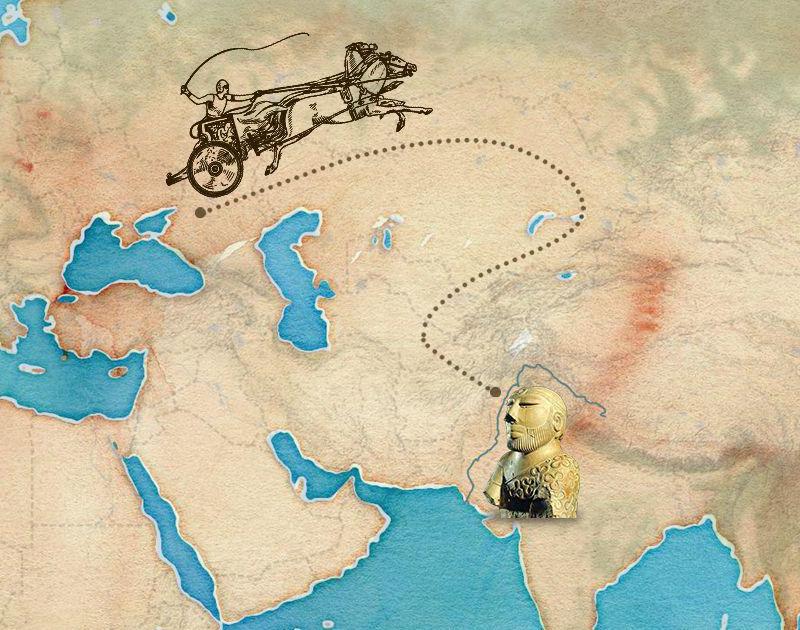
Sindhu-Saraswati (Indus Vally) Civilisation Map

Was Tipu Sultan really a patriot and great freedom fighter? – Jaithirth Rao

Tipu Sultan

The fact is Tipu was a brilliant military tactician and a weak military and political strategist. He allied with the French, who ended up on the losing side. He was bigoted and had megalomaniac pretensions of a Muslim conquest of India. – Jaithirth Rao

If only the Marxist editors of NCERT textbooks had admitted that Tipu Sultan was a flawed human being, perhaps some of us would not have many problems. The absence of such honesty makes us say: Ay, there’s the rub! In the Marxist version of the earlier sarkari sycophants, Tipu was a patriot, a tolerant, secular ruler, a great freedom fighter and so on. The question of “flaws” simply did not arise.

Tipu’s apologist, the Australian historian Kate Brittlebank, points out that he was virtually unique in being an Indian ruler who died fighting the British and did not take a pension from them. There is a considerable verisimilitude in that statement. But that does not automatically make Tipu a patriot. He allied with the French and if the fortunes of war had been different, India may have come under the rule of the French East India Company—not exactly a sanguine prospect for Indian patriots.

Misplaced patriotism of Tipu Sultan

The ruler of Mysore corresponded with the Sultan of Turkey and was not averse to that exalted person becoming the suzerain of India. At least for many of us, the British Raj was a better happenstance than an Ottoman Raj and that is our view as patriots. The Ottomans are unlikely to have built railways or set up universities, institutions that incidentally came up in the Ottoman Empire decades after they did in British India. Tipu wrote to Zaman Shah Durrani, the third king of the Durrani Empire in Afghanistan, to help throw out the British in India. Some of us see this as evidence of religious bigotry against Hindu Marathas, not secular patriotism.

In emphasising his anti-British credentials, which are taken as self-evident proof of his patriotism, the Delhi-JNU-Aligarh-Rutgers-Australia group of historians seem to forget that the British were not the only enemies of Tipu. In the last siege of Seringapatam (or Srirangapatna, if you so prefer) in 1799, there were more Hyderabad Nizam’s soldiers in the army attacking Tipu’s than those of the East India Company. And I assume that no one can accuse the Nizam of being a Hindu bigot. There were a lot of Maratha soldiers too. In fact, more soldiers loyal to Indian rulers, Hindus and Muslims, fought Tipu than the soldiers of the East India Company, which the Marxists love to hate.

My mother’s family is of “old Mysorean” vintage and many of these tales are stories I have heard from my grandfather Madhava Rao and my many granduncles. Our narrative is that while Tipu’s father and ruler of Mysore Hyder Ali was a usurper, he nevertheless maintained the fiction that he was a deputy of our beloved Wodeyar kings. It is Tipu who started calling himself “Sultan” and who marginalised our traditional rulers completely. The dowager Wodeyar Maharani Lakshmammanni was in correspondence with the British who she saw as legitimate “restorers” of order in our land and who looked upon Tipu as the disloyal, treacherous and, need I say, unpatriotic traitor. The Marxist historians will doubtless dismiss the venerable lady as a Hindu bigot or in current parlance as a supremacist.

Kodavas, Roman Catholics, Nairs, and the British

It is interesting to note how the Marxists of today are making light of the sufferings of Kodavas of Coorg (or Kodagu) and slyly portraying them as British agents. The fact is that most Kodavas hate Tipu who allegedly forcibly converted many of them. The descendants of this community of Kodava “converts” are still around.

Tipu was also brutal towards the Nair community of Travancore and Malabar. Again, forced conversions were the rule. And he followed it up with the destruction of temples. His worst depredations were against the Roman Catholic Christians of Mangalore. Forced marches, forced conversions, abductions of Mangalorean Christian women—all of these are documented and well-known. I wonder if the bishops of today’s crypto-Marxist Roman Church in India will even bother to talk about this. The Leftist historians of the world dismiss Tipu’s cruelty to British prisoners, including the forcible dressing of young drummer boys as girls and the violation of their civil rights as “imperialist propaganda.” It definitely was propaganda. But let us not forget the kernel of truth in these accounts.

The so-called secular historians talk endlessly about Tipu’s support of the Hindu temples of Srirangapatna and Nanjangud and of the Sringeri Mutt. Many of these are documented and cannot and should not be denied. But if the historians are neutral, they should have the integrity and courage to state that some of this support stemmed from Tipu’s faith in these temples possessing unique abilities in the realm of astrological predictions. Tipu was a believer in astrology. I give him credit for that. Will secular historians do the same?

A brilliant tactician but a weak strategist

The other point that the Marxist historians make is that Purnaiah, who was a Brahmin and a minister under Hyder Ali and Tipu, was pro-Tipu. This is true. But the same historians could have and should have added that many Mysoreans believed and still do that Purnaiah was a traitor a few times over!  I have a simple explanation. Purnaiah was perhaps a nobody until Hyder spotted him and his entire rise, including becoming the  Diwan of Mysore, was on account of Hyder and later Tipu. He was simply being loyal to his benefactors. Incidentally, in his later life, Purnaiah was equally loyal to the East India Company. Arthur Wellesley, who later became the Duke of Wellington, respected and admired Purnaiah. My grand-uncle Nagaraja Rao, a devout Brahmin himself, while talking about Purnaiah once told me that “Brahmins have a chameleon-like ability to adjust realistically to the powers that be.” That might sum up the Purnaiah story. Not loyalty or disloyalty, but realism.

Tipu called his government (which from our family’s point of view, was one of usurpers) the Sarkar-e-Khudadad, an Islamic Persian expression indicating that it was the government of God. Tipu deliberately introduced Persian into the land records of his dominion. Is it bigoted on our part to admire the British army officer Mark Cubbon who subsequently changed the rules and reintroduced Kannada and Marathi in the village maps? Who is the traitor? Who is the patriot? Who was benevolent? Who was malevolent? Important questions to ask. No wonder, even today, no political party wants to change the name of Cubbon Park in Bengaluru or remove his statue.

The fact is Tipu was a brilliant military tactician and a weak military and political strategist. He allied with the French, who ended up on the losing side. He was bigoted and had megalomaniac pretensions of a Muslim conquest of India. Hence his outreach to the Turks and the Afghans. He was a parvenu local Muslim and anathema to the Nizam who advertised his Persian ancestry. The Marathas saw him as a thorn in their side. The Nawab of Carnatic Muhammad Ali Khan Wallajah hated Tipu and was his unforgiving enemy. Many of Tipu’s subjects longed for the return of Wodeyar rule.

Hyder Ali was a military and political genius but his son Tipu, lacked his good sense. He allowed a large coalition—the Marathas, the Nizam, the British, the Kodavas, the Maharaja of Travancore and the Nawab of Carnatic to get together against him. He relied on the French who were irresolute and incompetent; he appealed to Turks and Afghans who were otherwise preoccupied and uninterested. He was clever. But unlike his father, he was not intelligent. He lost.

In any event, he was not a great, shining patriot. He was flawed, like most of us are. – The Print, 27 February 2023

Jaithirth Rao is a retired businessperson who lives in Mumbai.

Masjid-i-Ala (Jama Masjid)

Mysore Archaeological Dept Report 1935

Why a nation and its people must know their true history – Makkhan Lal

India History Cartoon

No country can become a great nation, a world guru and a world leader on borrowed ideas, borrowed cultures and borrowed systems. The greatness and leadership is built upon the solid foundation and the pride of their own past. – Dr. Makkhan Lal

History, history writing and history teaching have, indeed, become newsworthy not only in India but also in most other parts of the world. The reasons may be varied—construction of a national history curriculum in India, England and Wales, the design of national history standards in the US, the content of history textbooks in Japan, China, Korea, Pakistan, Israel, and Germany, the approach to invasion of Latin American countries by the Europeans, the development of new curricula in the successor states of the former USSR, or even the rewriting of history textbooks in Russia after the collapse of the former USSR. Issues of identities, heritage, and citizenship, all rooted in the past, have become the hot stuff of politics.

Similarly, an issue can be raised about the conquest of peaceful people belonging to Inca, Aztec and Maya civilisations by the gun-trotting Europeans. Whether the victory should be viewed as the discovery of a new world and new economic resources for Europe, as is generally viewed by European and North American historians, or it should be seen as the destruction of the independently developed three native civilisations by technologically more advanced nations that have an unending lust for looting others’ treasures and making other people subservient.

A South American historian may well say: “It may be a subject of celebrations for Europeans but for us it is a subject of mourning because just in a few years the Europeans destroyed our civilisation developed over several thousands of years!”

Why study history

Questions have often been raised that when there are so many problems and differences of opinions among historians why should we study history at all.

History is all about the past. In almost every country, city, town and village throughout the world, a large number of existing buildings were built in the past to meet the needs and aspirations of people, now dead. This is most obvious in existing temples, churches, mosques, fireplaces, houses, public buildings, and so on. The systems of governments, political ideas, religious beliefs, art, architecture, cultural practices, educational systems, customs and behaviours are all products of the past, recent or remote.

The past is all-pervasive which, indeed, means that we cannot escape from it. The past signifies what actually happened—events that have taken place, societies that have risen and fallen, ideas and institutions, eating habits, dressing habits, etc. History is precisely the study of this human past. The past is our heritage; we are part of it and the past is part of us in all aspects: Be it culture, behaviour, religious faith and practices, be it rituals, be it the tradition of political, social and economic systems. It is reflected in our day-to-day living.

History is also about roots. It provides societies and individuals with a dimension of longitudinal meaning over time which outlives the human life span. It connects us with our past. History also allows us to peep into the future by providing precedents for contemporary actions and forewarning against the repetition of past mistakes. From its sense of continuity, history offers the apparent form and purpose to the past, the present and the future. In the words of E.H. Carr: “The past is intelligible to us only in the light of the present, and we can fully understand the present only in the light of the past.” He further says that history is needed “to enable man to understand the society of the past and to increase his mastery over the society of the present.” There is a need for history. It has a deeper social value and meaning.

The study of history is not a luxury. It is a necessity. This necessity has been best summed up by Arthur Marwick. He writes: “Individuals, communities, societies could scarcely exist if all knowledge of the past is wiped out. As memory is to the individual, so history is to the community or the society. Without memory, individuals find great difficulty in relating to others, in finding their bearings, in taking intelligent decisions—they lose their sense of identity. A society without history would be in a similar condition. … A society without knowledge of its past would be like an individual without memory. … It is only through a sense of history that communities establish their identity, orientate themselves, understand their relationship to the past and to other communities and societies. Without history (knowledge of the past), we, and our communities, would be utterly adrift on an endless and featureless sea of time.”

We all move ahead through the past of our own cultures, own civilisations, and values and it is this accumulation of ideas and experience, transmitted through education and sheer daily living that gives our thoughts meaning and the patterns and purpose of our actions. It is not that we live in the past but we are defined by it, and so the success of even the most forward-looking developments must inevitably rest on their relation to the ideas and practices of the society they are meant to serve. Science may forget its own history, but a society cannot.

History is neither a simple chronicle of the past nor a list of rulers and kings and the narratives of their rules. The past is not simply a collection of distinct ages or a hotchpotch of facts. History is an extremely complex discipline. Another point that needs to be emphasised is that a historian’s job is not that of a cook who prepares dishes as per the liking of his customers and adds spices accordingly. It is not the job of a historian to write politically correct history. His obligation is to write factually correct history.

It will be helpful if all historians remember what Sir Jadunath Sarkar wrote about the job of a historian: “I would not care whether the truth is pleasant or unpleasant, and in consonance with, or opposed to, current views. I would not mind in the least whether the truth is, or is not, a blow to the glory of my country. If necessary, I shall bear in patience the ridicule and slander of friends and society for the sake of preaching the truth. But still, I shall seek truth, understand truth, and accept the truth. This should be the firm resolve of a historian.”

This brief discussion on the nature of history as an academic discipline should make it abundantly clear that history is neither a static discipline nor can the writings on and of history be put into a set mould. Each generation views and writes about the past in the light of its own experience. Therefore, all interpretations and explanations are and must be as temporary and provisional as the descriptions. But in all these endeavours the sanctity of truth and facts should not be forgotten. Unanimity or one’s efforts to make others surrender is a recognisable characteristic of dictatorships, and not that of a free state. Open and continuing discussions and debates are the essence and strength of history and, for that matter, a great strength of an open society of an intellectually vibrant nation.

And now a word of caution! There is a tendency among historians to act as judges and give moral sermons. Historians must write and rewrite history. They are not supposed to be moral judges. Benedetto Crose has rightly said: “Those, who on the plea of narrating history, bustle about as judges, condemning here and giving absolution there, because they think that this is the office of history … are generally recognised as devoid of historical sense.”

Problems in history writing

Historians recognise that they are all culturally and socially influenced in their endeavour to write history but make all efforts to deny that their work is culturally, or socially, determined or constructed. As has been discussed briefly in the Introduction, EH Carr in chapter two of his book What is History provides a useful summary on this aspect of history writing. He quotes Donne Devotion that society and individuals are inseparable. “No man is an island, entire of itself, every man is a piece of the continent, a part of the main.” Like any other individual, a historian too is a social phenomenon, both the product and the conscious and unconscious spokesperson of the society to which he belongs. It is in this capacity that he approaches the facts of the historical past.

Therefore, we must not forget that we cannot fully understand or appreciate the work of a historian unless we have first grasped the standpoint from which he himself approaches it, and that standpoint is itself rooted in social and historical background. It is, therefore, essential that before we study history, we must study the historian and study his historical and social environment. When some historians claim that they are writing scientific history, or that only their version of history is correct, one must conclude immediately that the historians are not only being untruthful but are also hiding their political agenda under the garb of a “scientific” history. There exists nothing like scientific history. On similar lines, Benedetto Croce also spoke with his characteristic bluntness:

“The historian must have a point of view, … an intimate personal conviction regarding the conception of the facts which he has undertaken to relate. … It suffices to read any book of history to discover at once the point of view of the author if he is a historian worthy of the name and knows his own business. … Absolutely historical historians do not and cannot exist. Can it be said that Thucydidus and Polybius, Livy and Tacitus, Machiavelli and Guicciardini, Giannone and Voltaire were without morals and political views; and in our own time, Guizot or Thiers, Macaulay or Balbo, Renke or Mommson? … If the historian is to escape from this inevitable necessity of taking sides, he must become a political and scientific eunuch; and history is not the business of eunuchs. … Historians who profess to wish to interrogate the facts without adding anything of their own, are not to be believed.”

Karl Marx buried among the crosses of Highgate Cemetery, London.

The problem with Marxist historiography and its relationship with history is much more curious. For Marx and his followers, i.e. Marxist historians, the problem of history is not just understanding “what happened”, “how it happened” and “why it happened”. For them, the problem is “how to change the world” by the use of history. At the core of this view lie two fundamental beliefs. Firstly, the Marxists believe in five universal stages of history.

These five stages are:

  1. Primitive Communism
  2. Slavery
  3. Feudalism
  4. Capitalism
  5. Communism

Secondly, they believe that the society we inhabit is a bad bourgeois society and, fortunately, this society is in a state of crisis. The good society which lies just around the corner can be easily attained if only “we” work systematically to destroy the language, the value, the culture, the ideology of this “bourgeois” society. This necessitates a massive, radical left-wing political programme, and everything the historians write, every criticism they make, is determined by that overriding objective. In this, the post-modernists are exceptions. They are fully convinced of the utterly evil nature of the “bourgeois” society but have lost all hope of change and have fallen back into destructive nihilism. They assert that the only way to achieve Marxism is to destroy society if it cannot be changed.

Marxist historians have failed to understand and appreciate the fact that the society we live in has evolved through a complex historical process, very different from the Marxist formula of the rise of feudalism over slavery and bourgeoisie overthrowing the feudal aristocracy. It is highly complex with respect to the distribution of power, authority, and influence. Just as it was not formed by the simple overthrow of aristocracy by the bourgeoisie, so, in its contemporary form, it does not consist simply of a bourgeois ruling class and a proletariat. The idea that we are now in the final period of the late-capitalist crisis is simply absurd. Marxists have been looking forward to the final capitalistic collapse for over a century—in 1848, 1866, 1918, 1946, 1963 and 1968, to mention just a few dates, but as fate would have it, they are themselves doomed forever.

Statements like “The pursuit of history is, whether practitioners choose to acknowledge it or not, a political occupation,” indeed, is not only exceptional but also far-fetched. At the same time, we have to acknowledge that the experience of colonisation around the world has shown that domination by a more powerful culture—which defines its reality in quite different ways—either totally destroys, or at least drives, the less powerful ones into a subservient role. What was considered culturally “valid” can be rendered “invalid”, and the politically weaker ones are somehow required to modify their reality to fit within the constraints of the new codes.

We, as historians, must learn to recognise: “The past is perceived in different ways by different cultures. Methods of interpreting, recording, managing and protecting the past also differ between cultures. … The way people define their existence, their world view and their creation stories, and how they value, interpret, manage and transmit their past will continue to be handed on from generation to generation.”

Conclusions

Let us remember that no country can become a great nation, a world guru and a world leader on borrowed ideas, borrowed cultures and borrowed systems. The greatness and leaderships are built upon the solid foundations and the pride of the past; deeper the foundations, taller are the superstructures. Even globalisation is built upon this foundation. Many countries are part of globalisation on a much larger scale than India without abandoning their history, culture and heritage. It is on this basis they are able to assert their authority and influence the world order. – Firstpost, 6 January 2022

› Prof. Dr. Makkhan Lal is a historian and the founder director of the Delhi Institute of Heritage Research and Management.

How the Nehruvian Congress manipulated Gandhi’s assassination to emasculate Hindu nationalism – Koenraad Elst

Had Nathuram Godse foreseen the consequences of the act he contemplated, he might have thought twice about going through with it – Dr. Koenraad Elst

There are some historical events that are momentous in nature but have not received the kind of attention and examination they deserved. The topic of Mahatma Gandhi’s assassination at the hands of Nathuram Godse on 30 January 1948 is one such incident. Though it comes up regularly for discussion, it is wantonly distorted to embarrass the RSS and the party associated with it, the BJP, which was actually founded in 1980, that too as a reincarnation of the Jan Sangh, which had equally been founded after the murder, in 1951. This then is the best-known long-term effect: The unrelenting allegation that anything smelling of Hindu nationalism, and certainly the RSS, necessarily leads to such crimes. But are we missing something?

Chitpavan massacre

The first consequence of the murder was immediate: Nathuram Godse’s own community, the Chitpavan Brahmins, was targeted for mass murder. The comparison with the mass killing of Sikhs by Congress secularists after Indira Gandhi’s murder is fairly exact, except that the 1984 massacre is well-known (even eclipsing the memory of the larger number of Punjabi Hindus murdered by Sikh separatists in the preceding years), whereas this one has been hushed up. The New York Times first drew attention to it, reporting 15 killings for the first day and only for the city of Mumbai (then Bombay). In fact, the killing went on for a week and all over Maharashtra, with V.D. Savarkar’s younger brother as best-known victim.

Arti Agarwal, who leads the research in “Hindu genocide”, estimates the death toll at about 8,000. On mass murders, estimates are often over-dramatised, but here we must count with a countervailing factor: The government’s active suppression of these data, as they would throw a negative light on Gandhism. But research on this painful episode has now started in earnest, and those presently trying to get at the real figures include Savarkar biographer Vikram Sampath.

Crackdown

The second consequence came right after: The government’s crackdown on the Hindu Mahasabha and the RSS. Their offices were closed down, their office-bearers imprisoned for a year or so, their stocks of literature impounded. It clipped their wings for years to come. The Hindu Mahasabha lost its president Syama Prasad Mukherjee, who went on to found the Jana Sangh. The Hindu Mahasabha would never recover from this blow. Its last MP was Mahant Avaidyanath, best known as a leader of the Rama Janmabhoomi movement and the guru of present UP chief minister Yogi Adityanath, defected to the BJP in 1991.

By contrast, the RSS did survive quite well, and even generated a whole “family” of like-minded organisations, including a new political party. In a numerical sense, it was to thrive; but in two other senses, it paid a high price.

The third consequence was a drastic change in the political landscape. After Partition, the Hindutva movement had the wind in the sails. All Congress’ assurances that warnings against Islamic separatism were mere British-engineered paranoia, had been refuted by reality. Gandhi’s promise that Partition would only come over his dead body, had proven false. The new-fangled ideology of secularism stood discredited at its birth. And yet, overnight, the Hindutva current was marginalised and Nehruvian secularism started its triumphant march. By his murder, Godse had smashed the window of opportunity of his own political movement.

Amputated backbone

Finally, the fourth consequence would only materialise over the long term: The Hindu movement began to lose its defining convictions. Rather than continuing to see India as an essentially Hindu nation, it bought into the secularist notion of a mere “Hindu community” juxtaposed to “minority communities” that were endowed with equal rights and increasingly with privileges vis-à-vis the Hindus.

When Jawaharlal Nehru was widely criticised for having facilitated the Chinese invasion, the RSS halted the publication of a Nehru-critical article by Sita Ram Goel in Organiser: Rather than clamouring that its guest author’s judgement of Nehru stood vindicated, it feared that if anything were to happen to Nehru, the RSS would again get the blame. As the Gandhi murder had shown, it wasn’t necessary to be actually guilty to still incur the punishment, viz, by “having created the atmosphere” for the crime. The RSS bought into the secularist narrative that the Hindu ideology had caused the murder and started amputating its own ideological backbone.

If Godse had foreseen these consequences of the act he contemplated, he might have thought twice about going through with it. – Firstpost, 27 July 2022

Dr. Koenraad Elst is a well-known Indologist from Belgium.

Gandhi's death reported in the NYT.

Why ‘eminent historians’ still swear by the debunked Aryan theory – Makkhan Lal

Image depicting the imaginary Aryan invasion of India from the Caspian Sea.

“It is difficult to say that all the earliest Aryans belonged to one race, but their culture was more or less the same type. Originally the Aryans seem to have lived somewhere in the steppes stretching from Southern Russia to Central Asia. On their way to India the Aryans first appeared in Central Asia and Iran. A little earlier than 1500 BC the Aryans appeared in India.” – R.S. Sharma

“By 1500 BC when the Aryans began to arrive in India, the Harappan culture had collapsed. We do not know where they came from; perhaps they came from north-eastern Iran or the region near the Caspian Sea or Central Asia.” – Romila Thapar

The two quotations from India’s two “eminent historians” sum up their approach to the Aryan Invasion Theory. Just look at expressions “difficult to say”, “seems to have”, “somewhere in steppes”, “we do not know where they come from”, “perhaps they came from north-eastern Iran or the region near Caspian Sea or Central Asia”. Despite so many probabilities, they are certain that Aryans came from outside. When and from where? No idea!

Despite all evidence to the contrary, why does the Aryan invasion/migration theory (AIT) continue to remain the lifeline of Indian Marxist historians? Let us now look at the AIT in historical perspectives.

Linguistic Evidence

Florentine merchant, Filippo Sassetti, who lived in Goa from AD 1583 to 1588, was struck by similarities between Sanskrit and European languages, especially Latin and Greek. Later, the relationship between Sanskrit and European languages was further elaborated by William Jones and many other scholars in the service of the East India Company. The efforts made towards understanding these linguistic similarities between Sanskrit on the one hand and Greek, Latin and some other modern European languages on the other gave rise to a new discipline called ‘comparative linguistics’. Its birth had questionably motivated considerations and in the last 200 years the discipline (if at all it is a discipline) of ‘Comparative Linguistics’ has shown a far greater variety of gymnastic exercises than the sport of gymnastics itself.

Since the earliest books (i.e. the Vedas) of the Aryans and so also all human beings are written in Sanskrit, it came to be recognised as the language of the Aryans. In the beginning, all European languages, along with Sanskrit, came to be clubbed as Aryan languages, and Sanskrit got identified as not only the oldest of all but also the mother of all European languages. Lord Monboddo was convinced that “Greek was derived from Sanskrit”. Frederick Schlegel, a highly respected German linguist wrote, “The Indian language is older and others [European languages] younger and derived from it.” Thus, Sanskrit came to be recognised as the mother of “all the less ancient Indo-European languages, as well as the modern European tongues and dialects”.

But these opinions did not last very long. Local pride, racial complexes and Evangelical considerations overshadowed everything as a part of a shift from ‘Indo-mania’ to ‘Indo-phobia’.

Though William Jones could not accept the earlier view that Sanskrit is the ‘mother’ of all Aryan languages. He advocated that Sanskrit is just a ‘sister’, i.e. a co-descendant of an earlier ancestor language. Following the lead provided by Jones, F. Bopp wrote: “I do not believe that Greek, Latin and other European languages are to be considered as derived from Sanskrit. I feel rather inclined to consider them together as subsequent variations of one original tongue, which however, the Sanskrit has preserved more perfect than its kindred dialects.”

So, a search for the original homeland of a language, namely ‘Proto-Indo-European’, led different scholars to different places. This search for the imagined original language homeland also meant the search for the ‘Original Homeland of Aryans’. This also gave rise to forging labels such as the ‘Indo-Aryan’, ‘Indo-European’, ‘Aryan languages’, ‘Indo-Aryan languages’, and the ‘Indo-European languages’. Sometime around the 1820s, the word ‘Aryan’ began to be dropped and it simply became ‘Indo-European’. Some German scholars even started using the term ‘Indo-German’ on the presumption that the Sanskrit and German languages, between them, covered the entire Indo-European speaking area—the farthest language to the east being Indic and German to the west.

Sanskrit, even today, may be “the greatest language of the world” or even if it “is of a wonderful structure, more perfect than Greek, more copious than Latin and more exquisitely refined” but so what? How could a language spoken by ‘niggers’ have been once the mother of languages today spoken by Europeans, i.e. white people? This position could not be accepted even by William Jones and Max Mueller, who have been so wholesome in their praise for Sanskrit.

Sanskrit was first demoted from mother to the position of a mere sister of all the ancient and modern European languages, but later on, with further building-up of the language tree, it came to be demoted to the position of grand-daughter, when it got linked to the so-called Indo-Iranian family. Thus, the position is: Proto-Indo-European language gave birth to the Indo-Iranian, which in turn produced Sanskrit. It’s already almost 200 years and the search for the grand-mother of Sanskrit (i.e. the Proto-Indo-European) is still on. We still do not know what she (the Proto-Indo-European Language) may have looked like, of what colour she may have been, or what may have been her physical and metaphysical structure. She still remains formless even in dreams. Quite often, these practitioners of philology were so illogical, so incoherent, so absurd, so adamant and arrogant, but, indeed, their impact has been so devastating that it has aptly been termed as ‘linguistic tyranny’.

Central Place Argument and Aryan Invasion

Once Sanskrit was demoted from the honoured status of being mother to all Indo-European languages and made a mere sister or niece of the European languages, a search started for the ‘original tongue’ i.e. the ‘Proto-Indo-European’. This cleared the deck also for legitimising the Aryan invasion of India; a theory which suggested that Sanskrit was brought here from the place where this imaginary language called ‘Proto-Indo-European’ was spoken. In 1842, A.W. von Schlegel claimed: “It is completely unlikely that the migrations which had peopled such a large part of the globe would have begun at its southern extremity (i.e. India) and would have continually directed themselves from there towards the northwest. On the contrary everything compels us to believe that the colonies set out in diverging directions from a central region.”

And for Schlegel this central region consisted of the areas around the Caspian Sea.

With the increasing hold of the British on India, the colonial and the Evangelical interests soon became a force in shaping Indian history for the rest of the academic world. Following the lead provided by A.W. von Schlegel, Max Mueller reiterated his position on the issue of the Aryan invasion and said in 1887: “If an answer must be given as to the place where our Aryan ancestors dwelt before their separation … I should still say, as I said forty years ago, ‘somewhere in Central Asia’ and no more.”

However, Srinivas Ayengar wrote in 1914: “The Aryans [in their entire literature] do not refer to any foreign country as their original home, do not refer to themselves as coming from beyond India, do not name any place in India after the names of places in their original land as conquerors and colonisers do, but speak of themselves exactly as sons of the soil would do. If they had been foreign invaders, it would have been humanly impossible for all memory of such invasion to have been utterly obliterated from memory in such a short time as represents the differences between the Vedic and Avestan dialects.”

It must be reiterated that it does not refer to a single name of flora and fauna found in Central Asia, Russia and Europe. If Rig Vedic people came from Central Asia how come they have no memory of it. Historically, linguistically and as per the oral traditions it is simply impossible.

The fallacy of this central-place theory as the origin of an imaginary language and then spreading all around can be explained with a contemporary example—English. Consider a situation wherein after a couple of thousand years, people forget that England was the place where the English language developed and spread from, and start looking for the place of its origin. The Central Place Theory will exclude England in the very first instance, as it is located on the outskirts of the world of the English language. The United States of America would be the natural choice from where it spread to Europe and Asia in the east, and Australia, New Zealand, Hawaii, etc, in the west and Canada in the north.

Lexicographic Evidence

Lexicography (the vocabulary of spoken/written words) is another area which was pressed in the service. Besides collecting a large number of the common words in various languages to prove their affinity, a number of words were chosen to prove the location of the language. For example, it has been argued that since there is no common word for the ocean in the Indo-European language, we can safely conclude that the Indo-European people were not aware of the ocean.

Varadpande rightly presses the points: “If we carry this reasoning further we shall have to suppose that ‘Indo-Europeans’ were living in a region where there was no air and no water, since there are no common words for air and water in all the ‘Indo-European’ Languages.”

The whole situation is that first a conjecture is turned into a hypothesis; to be later treated as a fact to be used in support of a new theory. For instance, language like Proto-Indo-European, Proto-Indo-Iranian and Proto-Dravidian are no more than hypothetical constructions, which may or may not have really existed; and yet these modern creations are often imposed on populations that lived thousands of years ago, to prove migrations theories.

Shaffer writes: “The Indo-Aryan invasion(s) as an academic concept in 18th-19th century Europe reflected the cultural milieu of that period. Linguistic data was used to validate the concept, which in turn, was used to interpret archaeological and anthropological data. What was theory, became an unquestioned fact that was used to interpret and organise all subsequent data. It is time to end the ‘linguistic tyranny’ that has prescribed interpretative frameworks of pre-and proto-historic cultural development in South Asia.”

The question of Aryan invasion/Aryan migration vis-a-vis philology has always been questioned. In the beginning of the last century, Aurobindo, while commenting on the philology, wrote: “Comparative philology has hardly moved a step beyond its origins; all the rest has been a mass of conjectural and ingenious learning of which the brilliance is equalled only by the uncertainty and unsoundness. … The very idea of the science of language is chimera.”

It is important to point out that in the last 30 years renowned linguists like Ram Bilash Sharma, S.S. Misra, S.G. Talgeri, N.S. Rajaram and Koenraad Elst have proved, on the basis of linguistic evidence itself, that this whole theory of Aryan invasion/migration is a fallacy.

Aryans, Racialism and Rig Veda

Subjugation of India by the British filled the masters with a desire to prove their all-round superiority. Racialism was one angle of it. Writings of Grant, Mill, Marx, Macaulay and their accomplices denigrated Indian people, culture, civilisation, society, history and religion.

Trautmann has traced the emergence of racialism and the development of physical anthropology as a resolution of the inescapable philological reality with the colonial need for cultural superiority over the natives of India. One of the most striking types of evidence of such an attitude is best seen in the writings of ACL Carlleyle. In 1879 he wrote: “We, British Europeans are Aryans, and far more pure and genuine Aryans than the Hindus, and no talk of the Hindus can alter our race, or make us any less or any different from what we are. It is the Hindus who have altered and deteriorated, and not we. The Hindus have become the coffee dregs, while we have remained the cream of the Aryan race. The Hindus are like the monkey.”

Some scholars think that the linguistic affinities of Indians and Europeans were also responsible for the development of physical anthropology leading the whole debate towards racialism. Most of the European scholars could not accept the view that Indians (‘niggers’, that is how most of the time Indians have been referred to in those writings) could have been once related to them and could have, indeed, been their forefathers, a conclusion which comparative linguistics was suggesting.

Edwin Bryant expresses it in the following words: “Even during the earlier phase of the homeland quest, when India was still a popular candidate, many scholars were uncomfortable about moving the Indo-Europeans too far from their biblical origins somewhere in the Near East. There were those among the British, in particular, whose colonial sensibilities made them reluctant to acknowledge any potential cultural indebtedness to the forefathers of the rickshaw pullers of Calcutta, and who preferred to hang on to the biblical Adam far more than their European contemporaries.”

Max Mueller himself was sad to note the mood of the day: “They would not have it, they would not believe that there could be any community origin between the people of Athens and Rome, and the so-called niggers of India.”

The newly developing science of physical anthropology was pressed into service to project Aryans as tall, white-skinned, blue-eyed, with sharp and high nose, and dolichocephalic. The non-Aryans came to be identified as natives with dark skin, flat nose, short stature, and so on. The dasas mentioned in the Rigveda were made to represent non-Aryans, i.e., the indigenous local population of India. Thus, the frame of the invasion of Aryans and the subjugation of the non-Aryan local population got corroborated with the evidence from Physical Anthropology.

The racial theory had a devastating impact on European polity. Each nation/state started claiming to be the real descendent of the Aryan race and considered others as inferiors. Max Mueller tried to intervene by declaring again and again: “If I say Aryans, I mean neither blood nor bones, nor hair nor skull. … How many misunderstandings and how many controversies are due to what is deduced by arguing from language to blood-relationship or from blood-relationship to language. … An ethnologist who speaks of an Aryan race, Aryan eyes and hair, and Aryan blood is as great a sinner as a linguist who speaks of a dolichocephalic dictionary or brachycephalic grammar.”

Alas! It was too late. The djinn created by Max Mueller had now grown up and was no longer under Mueller’s command. In the twilight years of his life, Max Mueller realised the devastating impact of distortions that he had made in Indian history in order to please his employers and the newly acquired faith. He died a sad man, preaching at the end of his career things like India: What Can It Teach Us.

He described India as: “The country most richly endowed with all the wealth, power and beauty that nature can bestow, … a very paradise on earth, … [a place where] human mind has most fully developed some of its choicest gifts, has most deeply pondered on the greatest problems of life.”

Racialism and DNA Evidence

In this context it will be useful to recall the studies carried out by K.A.R. Kennedy and his colleagues. For almost five decades they carried out a detailed study of a large number of pre- and proto-historic skeletons found in excavations from a large number of archaeological sites from all over the Indian sub-continent.

On the basis of their research, Kennedy and his colleagues concluded: “As for the question of biological continuity within the Indus valley, two discontinuities appear to exist. The first occurs between 6,000 and 4,500 B.C. The second occurs at some point after 800 B.C. but before 200 B.C.”

Both discontinuities exclude any adjustment for Aryan Invasion.

Besides the studies of Kennedy and his colleagues on ancient skeletons, an important study has come out recently on modern humans. Keeping in mind the AIT, Kivishield and his colleagues carried out a detailed study on gene pools of Western Eurasians and people of the Indian subcontinent. They studied the ‘genetic inheritance aspect’ of genes through the Mitochondrial DNA Test. It may be mentioned here that the mitochondrial DNA test can reveal the whole history of genetic changes and mutations that may have taken place even in the remote past i.e. several thousand years ago.

Kivishield and his colleagues have reached the conclusion that the Mitochondrial DNA, typical of Western Eurasians, is present among Europeans up to 70 percent whereas among Indians it is only up to 5.2 percent. The DNA gene pool of Western Europeans is very different from that of Indians. It has been very clearly stated that if there was any Aryan invasion of India a few thousand years ago, it must be visible in the mitochondrial DNA tests in terms of a splash in percentage of Western Eurasian genes. But this is not so. Further, the percentage and types of Western Eurasian genes present among south Indians and north Indians are almost the same. This fact establishes that there is no difference between the south Indian and north Indian gene pools, and the same goes against the Aryan invasion theory.

Conclusions

Now over a period of 200 years, the meaning of ‘Aryans’ has been constructed and reconstructed as being nomadic, pastoralists, sedentary agriculturists, dolichocephalic, brachycephalic, blond and fair, and from brown-haired to dark-haired. The Aryan homeland has been located and relocated everywhere, virtually from the North Pole to the South Pole, and from the shores of the Atlantic to Chinese deserts—South India, North India, Central India, Tibet, Bactria, Iran, the Black Sea, the Caspian Sea, Lithuania, the Caucasus, the Urals, the Volga Mountains, South Russia, the Steppes of Central Asia, Western Asia, Palestine, Anatolia, Scandinavia, Finland, Sweden, the Baltic, western Europe, northern Europe, central Europe, and eastern Europe.

The Aryan homeland, however, still remains elusive. J.P. Mallory has put the whole thing very succinctly: “One does not ask, ‘Where is the Indo-European homeland?’ but rather ‘where they put it now?’”

Anthropologist Edmund Leach of Cambridge University has most aptly summed up the whole question of the Aryan Invasion Theory. In 1990 in his article, Aryan Invasions over Four Millennia, Leach wrote: “Why do serious scholars persist in believing in the Aryan invasion? Why is this sort of thing attractive? Who finds it attractive? Why has the development of Sanskrit come so dogmatically associated with the Aryan invasion? The details of this theory fit in with this racist framework. … The origin myth of British imperialism helped the elite administrators in the Indian Civil Service to see themselves as bringing ‘pure’ civilisation to a country in which civilisation of the most sophisticated kind was already nearly 6,000 years old. Here, I will only remark that the hold of this myth on the British middle-class imagination is so strong that even today, 44 years after the death of Hitler and 43 years after the creation of an independent India and independent Pakistan, the Aryan invasions of the second millennium BC are still treated as if they were an established fact of history. … The Aryan invasion never happened at all.” – Firstpost, 20 July 2022

  Prof. Dr. Makkhan Lal is a well-known historian and the founder director of the Delhi Institute of Heritage Research and Management.

Rig Veda

Sita Ram Goel Vindicated: ‘Eminent historians’ no longer deny Islamic iconoclasm – R. Jagannathan

Sita Ram Goel

If the “eminent historians” now can acknowledge the reality of Islamic iconoclasm, surely they can promote Hindu-Muslim amity by getting Muslim groups to accept that damage was done in the past, and some remedy is called for in the present to let bygones become bygones. – R. Jagannathan

Our “eminent historians”, mostly from the Left, are showing signs that they are not beyond all education when hit repeatedly on their heads with facts and evidence. The late Sita Ram Goel, who was among the first to debunk the whitewashed versions of India’s Islamic history, stands vindicated.

Before the Babri was demolished, they repeatedly asserted that there was no temple below the mosque. Once the archaeological survey ordered by the Allahabad High Court established beyond doubt that there indeed was a temple below the Babri, their story-line changed from “no temple below the mosque”, to bland assertions that what was under the Babri was another mosque or even a Buddhist stupa. (Read some of what they said then here.)

When evidence kept surfacing of multiple temple demolitions under Islamic rule, the party line was that this was done not for religious reasons but political reasons. False equivalences were drawn between consistent and bigoted Islamic iconoclasm and the occasional damage done to temples or Buddhist and Jain places of worship. The latter were aberrations rather than the norm.

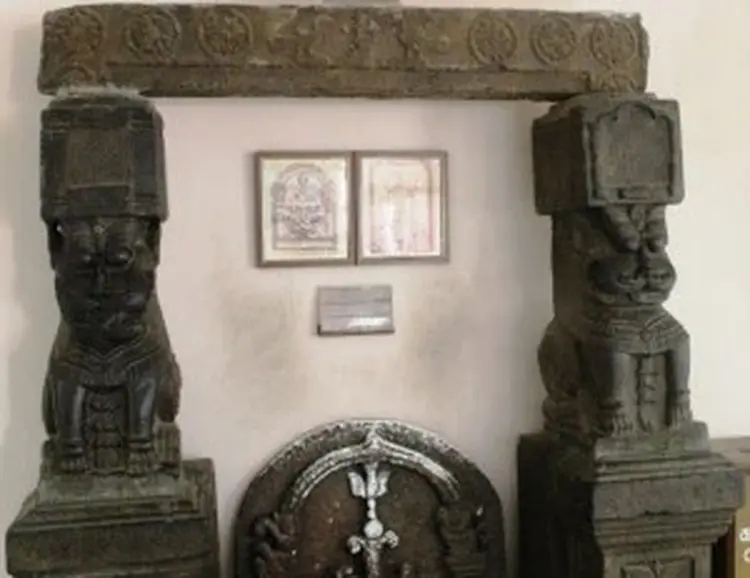
Now, with a survey seeking to establish the presence of Hindu carvings (and possibly a Shiv Linga) inside the Gyanvapi Mosque, these eminences are slowly abandoning the claim that no temples were destroyed.

In The Times of India today (24 May), there is a clear acceptance that Mughal rulers destroyed temples, though the argument has changed.

Irfan Habib, professor emeritus at the Aligarh Muslim University (AMU), is quoted thus: “Mughal emperor Aurangzeb destroyed temples in Varanasi and Mathura to raise mosques. However, the question today is whether what was done in 1670 should be repeated, despite the existence of the Indian Monuments Act. Should we do the same things as Mughal emperors did in the past?” (Read the details here.)

This is progress. Big progress. If we should not do what Aurangzeb did, it is an indirect admission that the Mughal emperor was a bigot. Facts are no longer denied, or conveniently misinterpreted as mere political acts of rulers in the past, though that is not entirely gone.

Shalin Jani of the Delhi University department of history is quoted as saying: “As far as Mughal India is concerned, we know about the politics of temple desecration during those times. We can’t resolve our contemporary problems by looking at the past.”

Well, maybe the Germans got it wrong when they refused to airbrush history or deny Hitler and the Nazi past. Without acknowledging the past, and making some amends, we cannot move forward.

The unwillingness to see religious bigotry behind temple desecration is not entirely gone, but the facts are no longer disputed.

Nadeem Rezavi, professor of mediaeval history at AMU, is clearer. “No one can justify what Aurangzeb did. However, we can’t behave like him and keep demolishing mosques to restore temples. What difference remains then between the Mughal ruler and rulers of today?”

Clearly, Audrey Truschke, who has tried to whitewash Aurangzeb’s reign in her book Aurangzeb: The Man and The Myth, clearly needs to hear what Habib and Rezavi now have to say. Aurangzeb was a bigot. Full stop. His temple desecrations were real, not just political fallout.

Clearly, the work done by Sita Ram Goel in volume two of his two-volume work on Hindu Temples: What Happened To Them  (Vol. 1 & Vol. 2), which examines both the Hindu and Muslim evidence, should now be required reading in all history departments, including AMU.

Later books by Meenakshi Jain (Rama & AyodhyaThe Battle For RamaFlight of Deities & Rebirth of Temples, Vasudeva Krishna and Mathura, have also completely sealed the evidence in favour of the Hindu version of Islamic destruction of key temples. It is also time to revisit the older historical works of R.C. Majumdar and Sir Jadunath Sarkar and not just junk them as “communal historians”.

The only way forward from here is not to live in the past, but to acknowledge it, and negotiate a deal to hand over the Kashi and Mathura temples back to Hindus fully in return for Hindus allowing the rest of the temple desecrations to remain as acknowledged facts of history with no recompense due.

If the “eminent historians” now can acknowledge the reality of Islamic iconoclasm, surely they can promote Hindu-Muslim amity by getting Muslim groups to accept that damage was done in the past, and some remedy is called for in the present to let bygones become bygones. – Swarajya, 4 May 2022

› R. Jagannathan is a senior journalist and editor and the Editorial Director of Swarajya Magazine.

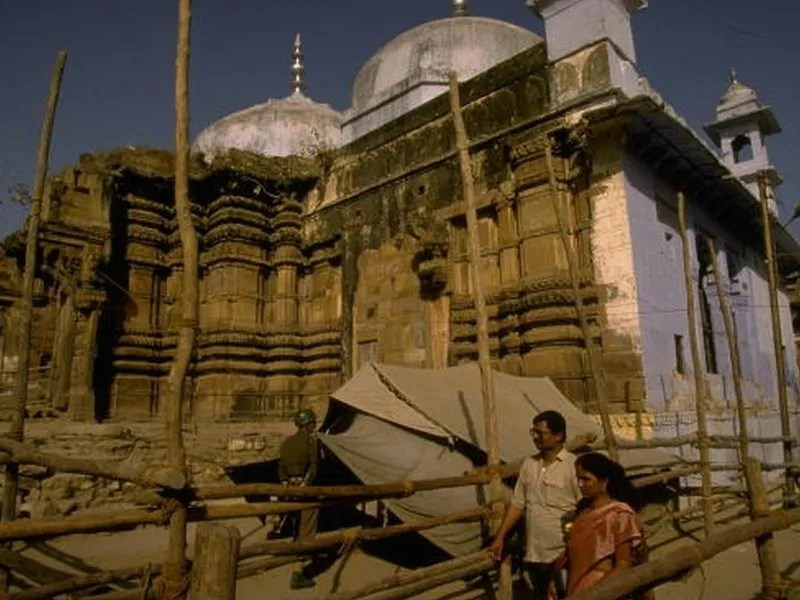
Gyanvapi Mosque back wall being the front wall of the ancient Vishwanath Temple.

Nightmare of Nehruism – Sita Ram Goel

Jawaharlal Nehru (London 1946)

The late Sita Ram Goel, a prominent historian, author, and publisher, had Left leanings during the 1940s, but later became an outspoken anti-Communist. He also wrote extensively on the damage to Bharatiya culture and heritage wrought by Nehruism. The article below is an extract from Goel’s book, How I Became a Hindu, first published by Voice of India in 1982.

Today, I view Pandit Jawaharlal Nehru as a bloated brown sahib, and Nehruism as the combined embodiment of all the imperialist ideologies—Islam, Christianity, White Man’s Burden, and Communism—that have flooded this country in the wake of foreign invasions. And I do not have the least doubt in my mind that if India is to live, Nehruism must die. Of course, it is already dying under the weight of its sins against the Indian people, their country, their society, their economy, their environment, and their culture. What I plead is that a conscious rejection of Nehruism in all its forms will hasten its demise, and save us from the mischief which it is bound to create further if it is allowed to linger.

I have reached this conclusion after a study of Pandit Nehru’s writings, speeches and policies ever since he started looming large on the Indian political scene. But lest my judgement sounds arbitrary, I am making clear the premises from which I proceed. These premises themselves have been worked out by me through prolonged reflection on the society and culture to which I belong.

I have already described how I returned to an abiding faith in Sanatana Dharma under the guidance of Ram Swarup. The next proposition which became increasingly clear to me in discussions with him, was that Hindu society which has been the vehicle of Sanatana Dharma is a great society and deserves all honour and devotion from its sons and daughters. Finally, Bharatavarsha became a holy land for me because it has been and remains the homeland of Hindu society.

There are Hindus who start the other way round, that is, with Bharatavarsha being a holy land (punyabhumi) simply because it happens to be their fatherland (pitribhumi) as well as the field of their activity (karmabhumi). They honour Hindu society because their forefathers belonged to it, and fought the foreign invaders as Hindus. Small wonder that their notion of nationalism is purely territorial, and their notion of Hindu society no more than tribal. For me, however, the starting point is Sanatana Dharma. Without Sanatana Dharma, Bharatavarsha for me is just another piece of land, and Hindu society just another assembly of human beings. So my commitment is to Sanatana Dharma, Hindu society, and Bharatavarsha—in that order.

In this perspective, my first premise is that Sanatana Dharma, which is known as Hinduism at present, is not only a religion but also a whole civilisation which has flourished in this country for ages untold, and which is struggling to come into its own again after a prolonged encounter with several sorts of predatory imperialism. On the other hand, I do not regard Islam and Christianity as religions at all. They are, for me, ideologies of imperialism. I see no place for them in India, now that India has defeated and dispersed Islamic and Christian regimes.

I have no use for a secularism which treats Hinduism as just another religion, and puts it on par with Islam and Christianity. For me, this concept of secularism is a gross perversion of the concept which arose in the modern West as a revolt against Christianity and which should mean, in the Indian context, a revolt against Islam as well. The other concept of secularism, namely, sarva dharma samabhava, was formulated by Mahatma Gandhi in order to cure Islam and Christianity of their aggressive self-righteousness, and stop them from effecting conversions from the Hindu fold. This second concept was abandoned when the Constitution of India conceded to Islam and Christianity the right to convert as a fundamental right. Those who invoke this concept in order to browbeat the Hindus are either ignorant of the Mahatma’s intention, or are deliberately distorting his message.

My second premise is that Hindus in their ancestral homeland are not a mere community. For me, the Hindus constitute the nation, and are the only people who are interested in the unity, integrity, peace and prosperity of this country. On the other hand, I do not regard the Muslims and the Christians as separate communities. For me, they are our own people who have been alienated by Islamic and Christian imperialism from their ancestral society and culture, and who are being used by imperialist forces abroad as their colonies for creating mischief and strife in the Hindu homeland. I therefore, do not subscribe to the thesis that Indian nationalism is something apart from and above Hindu nationalism.

For me, Hindu nationalism is the same as Indian nationalism. I have no use for the slogans of “composite culture”, “composite nationalism” and “composite state”. And I have not the slightest doubt in my mind that all those who mouth these slogans as well as the slogan of “Hindu communalism”, are wittingly or unwittingly being traitors to the cause of Indian nationalism, no matter what ideological attires they put on and what positions they occupy in the present set-up.

My third premise is that Bharatavarsha has been and remains the Hindu homeland par excellence. I repudiate the description of Bharatavarsha as the Indian or Indo-Pak subcontinent. I refuse to concede that Afghanistan, Pakistan, and Bangladesh have ceased to be integral parts of the Hindu homeland simply because they have passed under the heel of Islamic imperialism. Hindus have never laid claim to any land outside the natural and well-defined borders of their ancient homeland, either by right of conquest or by invoking a promise made in some scripture. I, therefore, see no reason why Hindus should surrender their claim to what they have legitimately inherited from their forefathers but what has been taken away from them by means of armed force. Moreover, unless the Hindus liberate those parts of their homeland from the stranglehold of Islam, they will continue to face the threat of aggression against the part that remains in their possession at present. These so-called Islamic countries have been used in the past, and are being used at present as launching pads for the conquest of India that has survived.

My fourth premise is that the history of Bharatavarsha is the history of Hindu society and culture. It is the history of how the Hindus created a civilisation which remained the dominant civilisation of the world for several millennia, how they became complacent due to excess of power and prosperity and neglected the defences of their homeland, how they threw back or absorbed in the vast complex of their society and culture a series of early invaders, and how they fought the onslaughts of Islamic, Christian, and British imperialism for several centuries and survived.

I do not recognise the Muslim rule in medieval India as an indigenous dispensation. For me, it was as much of a foreign rule as the latter-day British rule. The history of foreign invaders forms no part of the history of India, and remains a part of the history of those countries from which the invaders came, or of those cults to which they subscribed. And I do not accept the theory of an Aryan invasion of India in the second millennium BC. This theory was originally proposed by scholars as a tentative hypothesis for explaining the fact that the language spoken by the Indians, the Iranians and the Europeans belong to the same family. And a tentative hypothesis it has remained till today so far as the world of scholarship is concerned. It is only the anti-national and separatist forces in India which are presenting this hypothesis as a proven fact in order to browbeat the Hindus, and fortify their divisive designs. I have studied the subject in some depth, and find that the linguistic fact can be explained far more satisfactorily if the direction of Aryan migration is reversed.

These are my principal premises for passing judgement on Pandit Nehru and Nehruism. Many minor premises can be deduced from them for a detailed evaluation of India’s spiritual traditions, society, culture, history, and contemporary politics. It may be remembered that Pandit Nehru was by no means a unique character. Nor is Nehruism a unique phenomenon for that matter. Such weak-minded persons and such subservient thought processes have been seen in all societies that have suffered the misfortune of being conquered and subjected to alien rule for some time. There are always people in all societies who confuse superiority of armed might with superiority of culture, who start despising themselves as belonging to an inferior breed and end by taking to the ways of the conqueror in order to regain self-confidence, who begin finding faults with everything they have inherited from their forefathers, and who finally join hands with every force and factor which is out to subvert their ancestral society. Viewed in this perspective, Pandit Nehru was no more than a self-alienated Hindu, and Nehruism is not much more than Hindu-baiting born out of and sustained by a deep-seated sense of inferiority vis-a-vis Islam, Christianity, and the modern West.

Muslim rule in medieval India had produced a whole class of such self-alienated Hindus. They had interpreted the superiority of Muslim arms as symbolic of the superiority of Muslim culture. Over a period of time, they had come to think and behave like the conquerors and to look down upon their own people. They were most happy when employed in some Muslim establishment so that they might pass as members of the ruling elite. The only thing that could be said in their favour was that, for one reason or the other, they did not convert to Islam and merge themselves completely in Muslim society. But for the same reason, they had become Trojan horses of Islamic imperialism, and worked for pulling down the cultural defences of their own people. The same class walked over to the British side when British arms became triumphant. They retained most of those anti-Hindu prejudices which they had borrowed from their Muslim masters, and cultivated some more which were contributed by the British establishment and the Christian missions. That is how British rule became a divine dispensation for them. The most typical product of this double process was Raja Ram Mohun Roy.

Fortunately for Hindu society, however, the self-alienated Hindu had not become a dominant factor during the Muslim rule. His class was confined to the urban centres where alone Muslim influence was present in a significant measure. Second, the capacity of Islam for manipulating human minds by means of ideological warfare was less than poor. It worked mostly by means of brute force, and aroused strong resistance. Finally, throughout the period of Muslim rule, the education of Hindu children had remained in Hindu hands by and large. So the self-alienated Hindu existed and functioned only on the margins of Hindu society, and seldom in the mainstream.

All this changed with the coming of the British conquerors and the Christian missionaries. Their influence was not confined to the urban centres because their outposts had spread to the countryside as well. Second, they were equipped with a stock of ideas and the means for communicating them which were far more competent as compared to the corresponding equipment of Islam. And what made the big difference in the long run was that the education of Hindu children was taken over by the imperialist and the missionary establishments. As a cumulative result, the crop of self-alienated Hindus multiplied fast and several fold.

Add to that the blitzkrieg against authentic Hindus and in favour of the self-alienated Hindus mounted by the Communist apparatus built up by Soviet imperialism. It is no less than a wonder in human history that Hindu society and culture not only survived the storm, but also produced a counter-attack under Maharshi Dayananda, Swami Vivekanand, Sri Aurobindo and Mahatma Gandhi such as earned for them the esteem of the world at large. Even so, the self-alienated Hindus continued to multiply and flourish in a cultural milieu mostly dominated by the modern West.

And they came to the top in the post-Independence period when no stalwart of the Hindu resurgence remained on the scene. The power and prestige which Pandit Nehru acquired within a few years after the death of Sardar Vallabhbhai Patel had nothing to do with his own merits, either as a person, or as a political leader, or as a thinker. They were the outcome of a long historical process which had brought to the fore a whole class of self-alienated Hindus. Pandit Nehru would have never come to the top if this class had not been there. And this class would not have become dominant or remained so, had it not been sustained by establishments in the West, particularly that in the Soviet Union.

It is not an accident that the Nehruvian regime has behaved like the British Raj in most respects. The Nehruvians have looked at India not as a Hindu country but as a multi-racial, multi-religious and multi-cultural cockpit. They have tried their best, like the British, to suppress the mainstream society and culture with the help of “minorities”, that is, the colonies crystallised by imperialism. They have also tried to fragment Hindu society, and create more “minorities” in the process. In fact, it has been their whole-time occupation to eliminate every expression of Hindu culture, to subvert every symbol of Hindu pride, and persecute every Hindu organisation, in the name of protecting the “minorities”, Hindus have been presented as monsters who will commit cultural genocide if allowed to come to power.

The partition of the country was brought about by Islamic imperialism. But the Nehruvians blamed it shamelessly on what they stigmatised as Hindu communalism. A war on the newly born republic of India was waged by the Communists in the interests of Soviet imperialism. But the Nehruvians were busy apologising for these traitors, and running hammer and tongs after the RSS. There are many more parallels between the British Raj on the one hand and the Nehruvian regime on the other. I am not going into details because I am sure that the parallels will become obvious to anyone who applies his mind to the subject. The Nehruvian formula is that Hindus should stand accused in every situation, no matter who is the real culprit. – How I became a Hindu, 1982

Sita Ram Goel Quote

Why we must worship Goddess Kali – David Frawley

Ma Kali at Dakshineshwar

“Ma Kali has a crucial social relevance today. Kali as the transforming power of time can usher us into a new era of global peace and understanding, if we can accept her demand for a real change of consciousness. Kali asks us to live for eternity, not merely for fleeting enjoyments or outer material gains.” — Dr David Frawley 

Ma Kali is the most misunderstood of all Hindu Goddesses, though She is often regarded as the most powerful. Kali’s dark and fierce form is certainly intimidating and hard to fathom, unless one is willing to look with discernment behind the veil of sensational images about Her.

Sri Ramakrishna ParamahamsaMa Kali was first introduced to the modern world by Ramakrishna Paramahamsa as the Supreme Mother of the Universe. Through Ramakrishna—an avatar for many—the inspiration of Ma Kali awoke India to its ancient spiritual heritage and brought the unifying message of yoga to the world.

This was at a time in which the world was dominated by colonial powers and the idea of a Universal Mother was not accepted—much less a World Mother who was dark in colour and fierce in demeanour from a backward country like India!

Yet instead of following Ramakrishna’s yogic teachings about Kali, most scholars today look at Kali in an alien and diminished light. What psychologists tell us about Kali often reveals more about their own fascinations with the subconscious mind, rather than the Great Goddess who looks over all of us with wisdom and compassion.

Yogic deities can be best understood according to meditation practises. They relate to energies of higher consciousness beyond the dualities of the mind and the urges of the body. As such, their appearances are dramatic and paradoxical—mind-blowing as it were, and intentionally so.

Nature of Ma Kali

Ma Kali is kala shakti or the power of time. She indicates the impermanence of all things, which is why She wears a garland of skulls. Yet She is also the ultimate transforming power of time, which is to take us from death to immortality. Along with endless time, Kali is boundless space, the limitless void, indicated by Her dark blue colour. Her magical dance of transformation is all existence.

Kali holds the vidyut shakti, the lightning or electrical force of consciousness that is the supreme power. All the goddesses and the entire universe manifests from Her indomitable force. Kali’s seed mantra is “kreem,” which is the kriya shakti or power of transformation behind the vast movement of life.

Kali is not the goddess of death and destruction as some see Her but, on the contrary, represents the complete victory of the Divine over all death and destruction. Her warrior goddess form removes all the illusions of the mind and reveals the undying presence of our inmost Self that is one with all.

Ma Kali as the yoga shakti

Kali is the inner power of yoga or yoga shakti. Yoga in the true sense is a practice of mergence and return to the Divine source of existence. Yoga rests upon nirodha, the full concentration of the mind and dissolution of the ego. Kali is the nirodha shakti, the power of negation, neti-neti, not this, not that, of the Upanishads.

Kundalini shakti, the secret yogic power of transformation within us, works through Kali’s grace and motivation. Kundalini ascends and dissolves all the chakras, or energy centres within us, back into the state of pure unity consciousness that is Ma Kali’s ultimate abode.

Kali is the shakti inherent in Shiva as Mahakala, the great lord of eternity. She dances on Shiva in a prone form, showing the Divine life and joy that manifests out of absolute stillness and transcendence.

Kali reminds one of Tagore’s verses “Let me carry death in life that I may know life in death.”

Yet, Ma Kali has a crucial social relevance today. Kali as the transforming power of time can usher us into a new era of global peace and understanding, if we can accept Her demand for a real change of consciousness. Kali asks us to live for eternity, not merely for fleeting enjoyments or outer material gains.

Those seeking to bring the Divine Light into the world should worship Ma Kali.

Ma Kali as the supreme form of the Universal Mother absorbs Her children back into Her blissful embrace. She takes us across the deepest darkness to reach the highest light.

Jai Ma Kali! – Daily-O, 6 April 2016

› Dr David Frawley (Pandit Vamadeva Shastri) has a D. Litt. (Doctor of Letters), the highest educational title possible in the field of Yoga and Vedic sciences, from Swami Vivekananda Yoga Anusandhana Samsthana, the only deemed Yoga university recognised by the Government of India.

Ma Kali and the Kalighat temple complex.

Ram Swarup and Hinduphobia – Koenraad Elst

hindu-hate

As Socrates taught: evil is, upon closer analysis, a case of ignorance. Never attribute to malice what can be explained by incompetence. – Dr Koenraad Elst   

Let us consider what Ram Swarup said about Hindu-bashing, or what is nowadays called “Hinduphobia”. The word, though in existence since more than a century, was not yet in vogue as Hinduism’s ad hoc counterweight against the omnipresent propaganda term “Islamophobia”. But the phenomenon was already dominant in India and increasingly present abroad.

In fact, it was quite old. Several tribes of Muslims with a doctrinally motivated hatred for the Hindus, followed by the Portuguese Christians with a similar aversion, had actively persecuted Hinduism for centuries. They represent a permanent source of anti-Hindu violence that now takes the form of occupation of parts of the Hindu homeland by the Islamic states of Pakistan and Bangladesh; of Pakistani incursions; of terrorism and of rioting. But while they bludgeoned Hindu society and inflicted huge human and material losses on it, they did not penetrate it or take control of its institutions.

Tribes of haters

The British, by contrast, could rule India with more limited violence largely outsourced to native sepoys, but their influence penetrated far more deeply. Firstly, they managed to pit several Hindu sub-groups against the mainstream: most obviously the Sikhs, for whom the status of separate religion was made of whole cloth, promoted as a social reality and underpinned at the scholarly level. In several booklets, Ram Swarup went against this colonial-engineered separatism by documenting how, as per their own scriptures and history, Sikhism was a self-identified sect of Vedic Hinduism.

The creation of bad blood between Buddhism and mainstream Hinduism only took the institutional form of keeping Sri Lanka and later Burma outside of British India, but was far more influential at the scholarly level. There, the underlying paradigm of all Buddhist studies and of Indian histories as instilled through the schools became: “Hinduism bad, Buddhism good.”  Even before 1947, “Christian missionaries (…) were presenting Buddhism (as they have been doing with Sikhism) as (…) a revolt against ‘Brahmanism’ and the “Hindu” caste system.” (Hinduism and Monotheistic Religions, p.519, originally 1991) They had no use for the Buddha, except for making him into a stick to beat Hindu society with. The Macaulayites and Marxists followed this example: “they tried to use their learning and position to undermine Hinduism (…) and show that there was little difference between Marxism and Buddhism. Now Communist historians are telling us that Hindus demolished Hindu temples.” (p.519) 

Likewise with the Dalits and tribals, who came to benefit from an incipient reservation system, and with the non-Brahmin Tamils. The then-popular Aryan Invasion Theory was used to pit them against the upper castes and the North Indians. The thrust of the exercise was invariably to put Hindus into the dock and make them feel guilty for their very existence. Needless to say, this caste-based discrimination with a good social conscience has only become more encompassing over the years, and the [Aryan Invasion] paradigm still is the official one.

But the second effect was even more detrimental to Hindu assertiveness: “The British took over our education and taught us to look at ourselves through their eyes. They created a class Indian in blood and colour, but anti-Hindu in its intellectual and emotional orientation. This is the biggest problem rising India faces—the problem of self-alienated Hindus, of anti-Hindu Hindu intellectuals.” (p.45) 

Then again, in numerical terms, this impact on Hindu society was still quite small even by 1947. Many millions in the countryside had never seen a Briton, less than 1% of the population spoke good English. If the Indian leadership had wanted, it could have undone this influence in a matter of decades.

Ram-SwarupA crucial factor here was the choice of language. Ram Swarup himself was quite at home with British culture and thought, being most influenced by British liberalism: Bertrand Russell, George Bernard Shaw, Aldous Huxley, George Orwell. In his case, this didn’t stop him from fighting for freedom from British rule, with active participation in the Quit India Movement. But for less independent minds, gulping down English influence would only end up estranging them from their Hindu roots, as it had done in the case of Jawaharlal Nehru. The vote in the Constituent Assembly’s Language Committee should have been crucial: 50% voted for Sanskrit, 50% for Hindi (which was given victory by the deciding vote of the chairman), and 0% for English. For the generation that had achieved independence, it was completely obvious that decolonisation implied abolishing the coloniser’s language. Yet by 1965, when this abolition was due to become effective, the English-speaking elite had gathered enough power to overrule this solemn commitment. Ever since, the influence of English and of the thought systems conveyed by it has only gone on increasing, and at some levels, India is becoming a part of the Anglosphere—hardly what the freedom fighter envisioned. Today, most Anglophone secularists are nearly as knowledgeable about Hindu culture as first-time foreign tourists who have crammed up the Lonely Planet’s few pages summarising India’s religious landscape.

Marx and Mao

Compare with China, not formally colonised but having been repeatedly humiliated by colonial incursion, yet now again proud and assertive. Of course it has retained its language, and adopting a foreign language as medium for education or the judiciary is simply unthinkable. Ram Swarup, who wrote several books criticising the record of Maoism, wouldn’t emphasise this, but it is one thing the Communists undoubtedly achieved: a clean break with the colonial age. Under the nationalist regime (1912-49), China was increasingly under Anglo-American influence, and the Christian missions could operate on a large scale. Nationalist leader Jiang Jieshi (who later was to give an award to Ram Swarup’s and Sita Ram Goel’s anti-Communist think tank Society for the Defence of Freedom in Asia) was a Christian along with much of his family. By contrast, when Mao Zedong came to power, all missionaries were imprisoned, killed, or at best banished.    

On the other hand, by importing Marxism, China was opening itself up to another Western doctrine, and actively imposing it on its population. The same counted for those circles in India that came to espouse Marxism. Under Nehru, it started influencing the power-wielding circles, and from Indira Gandhi onwards, it achieved control over education policy and much of cultural policy. This ideology was “more Eurocentric than regular imperialism. It used radical slogans but its aims were reactionary. … Marx fully shared the contempt of the British imperialists for India. He fully subscribed to the theses of colonial scholarship that India was not a nation, had no history and was meant for subjugation. Marxism was Macaulayism at its most hostile. It blackened Indian history systematically. It gave to [the] Indian social and political system its own format, the one it had learnt from its European teachers. It saw in Hinduism not … a great spiritual civilisation but only communalism.” (p.45-46) 

Newer forms of Marxist or soft-Marxist thought (critics speak of “cultural Marxism”) remain entrenched in the Indian institutions, and are more powerful than ever in the relevant departments of Western universities. Their construction of Indian reality remains dominant and is more than ever spread to the new Hindu generations, leading to more culpabilisation c.q. sense of shame for Hinduism. 

Race to the exit

The trends unambiguously traced to colonial policies have not been reversed by the Nehruvian regime, but have instead been continued and magnified. Thus, the British policy of separating Hindu subsets from general Hinduism has continued with an affirmation at different times of minority status for Buddhism, Sikhism, the Arya Samaj, Jainism, Virashaivism and Sarna “animism”. In every case, the administrative separation was fortified with a change in discourse: the need for a non-Hindu identity was in each case buttressed by an increased blackening of Hinduism. This anti-Hindu attitude has even crept into Hindu organisations without the institutional ambition of minority status, e.g. the ISKCON (Hare Krishna) calls itself non-Hindu, except when it is canvassing for donations from Hindu communities.

When Ram Swarup wrote against separatism among the Sikhs, it was an interesting intellectual entertainment for his readers, but had no impact at all on policy-making. The Narasimha Rao government managed to neutralise armed Sikh separatism, but did nothing to change Sikh separatist thought, so that there remains a constant threat of its political revival. In a healthy society, we might expect power-wielders to listen to sages like Ram Swarup, but this was not the case; just as it is still not the case today.

As described in Ram Swarup’s booklet The Ramakrishna Mission in Search of a New Identity, the Ramakrishna Mission, besieged by the Communist-supported Teachers’ Union in its school network, felt compelled as a matter of survival to relieve this pressure. In India, by virtue of Article 30 of the Constitution, minority schools (and similarly, places of worship) are autonomous and immune from government take-over, whereas classification as Hindu makes them vulnerable to nationalisation. But the RK Mission did not try to have the discrimination against Hindu schools abolished, did not appeal to Hindu society, but did the dishonourable thing of trying to escape by seeking minority status, like a rat leaving a sinking ship. The Bengal High Court gave it the coveted minority status, then finally (or so it seemed) the Supreme Court denied it, entirely in accordance with RK Mission founder Swami Vivekananda’s assertion of Hindu pride. 

Superficial Hindus might jubilate that this was a victory for Hindu unity, but Ram Swarup warned that the Mission would now have to live down the anti-Hindu attitudes which it had come to espouse. Here again, some of its swamis make all the right noises for the respective audiences they address, sometimes calling themselves Hindu, but the “we are not Hindus” animus has not disappeared: when Mamata Banerjee’s Trinamool Congress won the state elections ending decades of Communist rule, the Mission asked her for minority status. And promptly it received her assurance that it would henceforth be treated as a minority, thus de facto overruling the “final” Supreme Court verdict. Ram Swarup always emphasised that institutional arrangements are unimportant in themselves, merely the materialisation of convictions and mentalities. If you want to stop the race to the exit, it is imperative to change people’s unfavourable impression of Hinduism. 

Down with conspiracy thinking

A final point for the attention of the rather hot-headed Hindu activists and polemicists. They always see conspiracies against Hinduism, e.g. the Aryan Invasion Theory was a “British concoction”, the Partition of India was “imposed by machinations by the British” who had “brainwashed” the Muslim League leadership. In this case, “Hinduphobia” is deemed to be an expression of an intractable “hatred” that for some reason (in the case of Westerners, “racism”) animates Hinduism’s numerous enemies. This fuming hot air in Hindu discourse puts off many neutral observers and produces Hinduphobes. But in all of Ram Swarup’s works, there is not a single example of this approach. 

For a single example, he describes a novel about the Buddha’s wife Yashodhara, Lady of the Lotus, by a well-meaning American, William E. Barrett. It has totally fictitious episodes about the couple’s visits to the quarters of the Untouchables: “They were revolted by the sight. They saw that ‘the traffic in the streets was, in the main, animal.’” And about the sight of hungry people: “Next day when they were in bed, light dawned on Siddharta that ‘No one has to be hungry … and no one should live as these people live.’” (p.527) In reality, the Buddha was not particularly interested in the difference between rich and poor, high and low; he taught that suffering was basic to the human condition in general. He did not propagate liberation from poverty, but liberation from the human condition. The socialist reinterpretation of the Buddha as a social rebel conflicts with the Buddha’s teachings. It is typical for the post-religious worldview to reduce religion to socio-economic considerations, i.e. to cultivate ignorance about the existential passions that have generated religions.   

The most interesting part of Ram Swarup’s account is: “The author was not hostile to India but he was doing his best to depict Hindus and their history as he knew it.” (p.528) This is crucial to understanding “Hinduphobia”: while some classes of people, say mullahs and missionaries, have an interest in blackening Hinduism, most people don’t. They just go by the information they have been fed. This American novelist has been fed the fable that the Buddha was a rebel against Hindu societal reality, so that is what he puts into his story: Buddhism social, Hinduism oppressive. As Socrates (translated into Hindi as Satyakām Sokratez by Ram Swarup’s friend Sita Ram Goel) taught: evil is, upon closer analysis, a case of ignorance. Never attribute to malice what can be explained by incompetence.   

Dr Koenraad Elst is an historian. linguist and orientalist from Belgium who visits India to study and lecture.

hindu-phobia

Ambedkar on Gandhi: Dismantling the Mahatma – Anand Ranganathan

INDIA-POLITICS-RIGHTS-PROTEST

Comparisons between great men are odious at best, but in the numerous interactions he had with Ambedkar, Gandhi comes across as a sophomore arguing with his dean—sometimes wide-eyed, sometimes a playground bully, unsure and disposed to bouts of arrogance; and then, as the last throw of dice, couching his ignorance with borrowed theological wisdom. – Prof Anand Ranganathan

It is not that we do not understand Ambedkar; it is that we fear him. Mahatma Gandhi was no different.

The fear of Ambedkar is justified, for how can one man be so authoritative on every subject he ever professed a view on, be it Islam, Communism, Hinduism, history, theology, science, economics, politics, society, literature, law, foreign policy, education,  and  journalism. One may, admittedly, veer towards bombast and hyperbole while acknowledging this to be a non-human trait. After all, it is but a thin line that separates fear from worship. Everyone makes mistakes, everyone is wrong at some point, or as the philosopher-mathematician Bertrand Russell put it: I would never die for my beliefs, for I might be wrong. What, then, would one call someone who overwhelmingly defies these maxims?

Bhimrao Ramji Ambedkar.

There is no other way of saying this. Mahatma Gandhi was frightened of Ambedkar’s intellect. We have all been there before, trying to hold our icy core before an adversary armed with a blowtorch—that awful, gut-wrenching moment when he smirks and decides not to embarrass you with the truth, that you were found wanting, that you have been defeated. Defeated, some retreat into humility, others into hubris. Gandhi chose the latter.

Ultimately, greatness is judged not by how right you were but, rather, how wrong. Gandhi got it wrong more times than Ambedkar got it right, which was, in this author’s opinion, almost always.

Gandhi was a kind man, he was a good man, and therefore fallible. He was prone to vanity and narcissism. Ambedkar wasn’t. He wasn’t because every single day of his life he was made aware of the fact that the mediocre have inherited the Earth and control it. And on days he wasn’t made to feel worthless, his worth was patronised. Nothing came easy to Ambedkar, least of all his genius.

Granted, comparisons between great men are odious at best, but in the numerous interactions he had with Ambedkar, Gandhi comes across as a sophomore arguing with his dean—sometimes wide-eyed, sometimes a playground bully, unsure and therefore disposed to bouts of arrogance; and then, as the last throw of dice, couching his ignorance with borrowed theological wisdom because it was underwritten by those as ignorant as him. These are not charitable words, but then an assessment of Gandhi is rarely charitable if it is to be ruthlessly objective. And who else but Ambedkar to have assessed Gandhi like no one ever dared to before or after him.

Gandhi was not a liberal—his beliefs on societal structure, on economy, on a concept-state, on what Indians should eat or drink, would make even the most ardent of conservatives blush. His theories were based less on logic and more on a bizarre sense of faith-based entitlement that can only be described as an inseparable emulsion of homeopathy and spirituality. Gandhi was an intelligent and cunning god-man. He was made for India. He held her pulse, pumped her heart. Ambedkar, on the other hand, was the only true liberal this nation has produced in the last many centuries. Gandhi was a theologian pretending to be a politician; Ambedkar, a supreme scholar. Gandhi was a Social Darwinian; Ambedkar, a Darwinian. Gandhi said he would not “weep over the disappearance of machinery”; Ambedkar wanted an industrialised India. Gandhi could have ruled independent India had he chosen to for as long as he wanted; Ambedkar lost an election by some margin. Twice. Gandhi saw the village as India’s liberator; Ambedkar called it a cesspool and a den of ignorance. Gandhi’s self-confidence was buttressed by the blind devotion of his countless followers; Ambedkar’s stemmed from his ability to speak his mind, stand all by himself, and appease no one.

Gandhi had an army of men; Ambedkar was a one-man army.

Ambedkar saw through Gandhi. Worse, the Mahatma gauged this, but, like a stunned ostrich, pretended to hold fort, employing as bulwarks his minions who were also petrified of Ambedkar’s intellect.

India has forever been a land of such tragedies. The one who truly was a Mahatma fought a man pretending to be one, and lost. But he went down fighting. And how.

That Gandhi was dealing with a different kind of man should have become obvious to him after their very first formal extended meeting. The conversation, which took place on 14 August 1931, has been recorded for posterity and is revealing beyond measure.

Gandhi: “I understand that you have got some grievances against the Congress and me. I may tell you that I have been thinking over the problem of Untouchables ever since my school days—when you were not even born.”

Ambedkar: “It is true, Mahatmaji, that you started to think about the problem of Untouchables before I was born. All old and elderly persons always like to emphasize the point of age.”

Gandhi 0, Ambedkar 1.

Gandhi: “The Congress has spent not less than rupees twenty lakhs on the uplift of the Untouchables.”

Ambedkar: “The Congress is not sincere about its professions. Had it been, it would have surely made the removal of untouchability a condition, like the wearing of khaddar, for becoming a member of the Congress. No person who did not employ untouchable women or men in his house, or rear up an untouchable student, or take food at home with an untouchable student at least once a week, should have been allowed to be a member of the Congress. Had there been such a condition, you could have avoided the ridiculous sight where the President of the District Congress Committee was seen opposing the temple entry of the Untouchables. You might say that Congress lacked strength and therefore it was unwise to lay down such a condition. Then my point is that Congress cares more for strength than for principles. This is my charge against you and the Congress. You say the British Government does not show a change of heart. I also say that the Hindus have not shown a change of heart in regard to our problem, and so long as they remain adamant, we would believe neither the Congress nor the Hindus. We believe in self-help and self-respect.”

Gandhi: “It is really surprising that men like you should offer opposition to me and to the Congress.”

Ambedkar: “We are not prepared to have faith in great leaders and mahatmas. Let me be brutally frank about it. History tells that mahatmas, like fleeting phantoms, raise dust, but raise no level.”

Game over.

It would be wrong to suggest that Ambedkar hated Gandhi. Hate cannot cloud the judgement of a man as rational and detached as Ambedkar, for if it did, he would no longer be the guardian of these virtues. What Ambedkar employed, instead, was logic, through which, slowly, methodically, year on year, decade on decade, he dismantled Gandhi’s sainthood. There was no hate involved, just the brute force of reasoning and judgement. Ambedkar was unsparing and unyielding, and the Mahatma was only too glad to oblige.

When the Great War ended with the disbanding of the Ottoman Empire, Gandhi persuaded the Congress to support the Khilafat Movement—a violent agitation for restoration of the Islamic Caliphate deposed by the victorious British. Before long, he pinched his nose and plunged into the murky waters of religious appeasement and terror rationalisation in the wake of the ghastly anti-Hindu violence perpetrated by the Malabar Muslims (Moplahs) in 1921.

Ambedkar, who saw Gandhi’s advocacy of the Khilafat Movement as a pernicious political stunt—(“The movement was started by the Muslims. It was taken up by Mr Gandhi with a tenacity and faith which must have surprised many Muslims themselves.”)—viewed the Moplah rebellion as nothing but jihad. The Muslim agitators, he said, “preached the doctrine that India under the British Government was Dar-ul-Harab [The Abode of War; a place where the Muslims are not in power] and that the Muslims must fight against it and if they could not, they must carry out the alternative principle of Hijrat.”

Ambedkar continued, pulling no punches. “The aim was to establish the kingdom of Islam by overthrowing the British Government. Knives, swords and spears were secretly manufactured, bands of desperadoes collected for an attack on British authority. On 20th August a severe encounter took place between the Moplahs and the British forces at Pinmangdi. Roads were blocked, telegraph lines cut, and the railway destroyed in a number of places. As soon as the administration had been paralysed, the Moplahs declared that Swaraj had been established. A certain Ali Mudaliar was proclaimed raja, Khilafat flags were flown, and Ernad and Wallurana were declared Khilafat kingdoms. As a rebellion against the British Government it was quite understandable. But what baffled most was the treatment accorded by the Moplahs to the Hindus of Malabar. The Hindus were visited by a dire fate at the hands of the Moplahs. Massacres, forcible conversions, desecration of temples, foul outrages upon women, such as ripping open pregnant women, pillage, arson and destruction—in short, all the accompaniments of brutal and unrestrained barbarism, were perpetrated freely by the Moplahs upon the Hindus until such time as troops could be hurried to the task of restoring order through a difficult and extensive tract of the country. This was not a Hindu-Moslem riot. This was just a Bartholomew [reference to the St. Bartholomew’s Day massacre in 1572].”

To Ambedkar’s horror, Gandhi laid the blame squarely on the Hindus. “Hindus,” said the Mahatma, “must find out the causes of Moplah fanaticism. They will find that they are not without blame. They have hitherto not cared for the Moplah. They have either treated him as a serf or dreaded him. They have not treated him as a friend and neighbour, to be reformed and respected. It is no use now becoming angry with the Moplahs or the Muslims in general.”

If such rationalisation wasn’t unpleasant enough, Gandhi went further, blaming everyone else for the Moplah barbarity but the Moplahs themselves. “The Government has thoroughly exploited the Moplahs’ madness,” he said. “They have punished the entire Moplah community for the madness of a few individuals and have incited the Hindus by exaggerating the facts. Malabar Hindus, like the Moplahs, are an excitable people and the Government has incited them against the latter.”

The outbreak, said Gandhi, “would not have taken place if the collector had consulted the religious sentiment of the Moplahs”.

That religious sentiment, as analysed by Ambedkar, was jihad. Indeed, Muslim leaders themselves agreed with Ambedkar. Maulana Hasrat Mohani, the eulogised freedom fighter and a friend of the Mahatma, and one who had coined the slogan “Inquilab Zindabad”, justified the massacre of Hindus by saying that this was Islamic jihad and that according to the rules of jihad, those who help the enemy become enemies themselves.

Shockingly, Gandhi was conciliatory towards the Maulana. “I do not blame the Maulana. He looks upon the British Government as an enemy. He would defend anything done in fighting it. He thinks that there is much untruth in what is being said against the Moplahs and he is, therefore, not prepared to see their error. I believe that this is his narrowness, but it should not hurt the Hindus. The Maulana speaks what is in his mind. He is an honest and courageous man. All know that he has no ill will against the Hindus.”

“In spite of his amazingly crude views about religion,” said Gandhi, “there is no greater nationalist nor a greater lover of Hindu-Muslim unity than the Maulana”.

So here was Gandhi, a Hindu, schooling a maulana on Islam. He wasn’t done yet. He transmogrified next into a maulana himself, quibbling on Islamic sanctions just so he could venture into the minds of the men who Ambedkar had called barbarians and rationalise their barbarity. “Their [the Moplahs’] notions of Islam were of a very crude type,” claimed the Mahatma.

“Forcible conversions are horrible things,” counselled Gandhi. “But Moplah bravery must command admiration. These Malabaris are not fighting for the love of it. They are fighting for what they consider is their religion and in the manner they consider is religious.”

Then came the cruellest of blows—a plea to the Hindus to rationalise the bloodbath by taking recourse in dharma.

“Even if one side is firm in doing its dharma,” said Gandhi, “there will be no enmity between the two. He alone may be said to be firm in his dharma who trusts his safety to God and, untroubled by anxiety, follows the path of virtue. If Hindus apply this rule to the Moplah affair, they will not, even when they see the error of the Moplahs, accuse the Muslims.”

“I see nothing impossible in asking the Hindus to develop courage and strength to die before accepting forced conversion,” preached the saint. “I was delighted to be told that there were Hindus who did prefer the Moplah hatchet to forced conversion.”

“Even so is it more necessary for a Hindu to love the Moplah and the Muslim more, when the latter is likely to injure him or has already injured him.”

“Why should a single Hindu have run away on account of the Moplahs’ atrocities?”

This was sheer lunacy. The Mahatma was beseeching the Hindus to hold their ground even as they were being hunted down and butchered.

One could quote more, much more, of this utterly reprehensible apologia from the Mahatma’s playbook were it not so tormenting. Of little comfort is the fact that the saint continued to hold such views despite condemnation by men like Ambedkar. Decades later, while preaching to those affected by the pre-partition Hindu-Muslim violence, he said: “Hindus should not harbour anger in their hearts against Muslims even if the latter wanted to destroy them. Even if the Muslims want to kill us all we should face death bravely. If they established their rule after killing Hindus we would be ushering in a new world by sacrificing our lives. None should fear death. Birth and death are inevitable for every human being. Why should we then rejoice or grieve? If we die with a smile we shall enter into a new life, we shall be ushering in a new India.”

Ambedkar was incensed at Gandhi’s selectivity, more so of his stand on the Moplah Massacre.

“Mr Gandhi has never called the Muslims to account even when they have been guilty of gross crimes against Hindus,” said Ambedkar. “Mr Gandhi has never protested against such murders [of prominent Hindus like Swami Shradhanand, Rajpal, Nathuramal Sharma]. Not only have the Muslims not condemned these outrages but even Mr Gandhi has never called upon the leading Muslims to condemn them. He has kept silent over them. Such an attitude can be explained only on the ground that Mr Gandhi was anxious to preserve Hindu-Muslim unity and did not mind the murders of a few Hindus, if it could be achieved by sacrificing their lives.”

Ambedkar next turned to Gandhi’s behaviour during the Moplah massacre, a pogrom he had condemned in the strongest of terms earlier. “This attitude to excuse the Muslims any wrong, lest it should injure the cause of unity, is well illustrated by what Mr Gandhi had to say in the matter of the Moplah riots. The blood-curdling atrocities committed by the Moplahs in Malabar against the Hindus were indescribable. All over Southern India, a wave of horrified feeling had spread among the Hindus of every shade of opinion, which was intensified when certain Khilafat leaders were so misguided as to pass resolutions of ‘congratulations to the Moplahs on the brave fight they were conducting for the sake of religion’. Any person could have said that this was too heavy a price for Hindu-Moslem unity. But Mr Gandhi was so much obsessed by the necessity of establishing Hindu-Moslem unity that he was prepared to make light of the doings of the Moplahs and the Khilafats who were congratulating them. He spoke of the Moplahs as the ‘brave God-fearing Moplahs who were fighting for what they consider as religion and in a manner which they consider as religious’.”

Another incident around the same time brought to light the differences between Ambedkar and Gandhi, underscoring further the gap that exists between objectivity and selectivity, and how the latter is used to devastating effect in politics. It was the publication of a pamphlet called Rangila Rasool, written as a retaliation for Sita ka Chhinala, a book penned by a Muslim that claimed Lord Rama’s wife, Sita, was a prostitute. Ambedkar stood for Mahashe Rajpal, the publisher of the pamphlet who was assassinated by a Muslim fanatic, Ilm-ud-din, this while Muhammad Ali Jinnah defended Ilm-ud-din in court, and none other than Allama Iqbal carried Ilm-ud-din’s coffin at the funeral.

Ambedkar was outraged at what was done to Rajpal; Gandhi was outraged at what Rajpal did. “I am no defender of the author of Rangila Rasool,” said Gandhi, adding that the book gave him “deep pain”. He called the book offensive and its author a mischief-maker. He wanted the law changed.

The law changed. In came the dreaded IPC section 295a, calling for punishing those who “hurt religious sensibilities”, and the India of the kind Ambedkar had imagined, an India proclaiming liberty and freedom of expression, changed forever. For the worse.

The dismantling of Gandhi’s sainthood by Ambedkar took a decisive turn in the late 1920s. It is revealing that of the 98 weighty volumes that make up the Collected Works of Mahatma Gandhi, Ambedkar’s name doesn’t figure till the fifty-third. From then on, there is a veritable Cambrian explosion and Ambedkar features regularly and copiously—the build-up to the Poona Pact, the Temple Entry Bill, the state of the so-called Depressed Classes and, tellingly, Gandhi’s anxiety that Ambedkar, and not he, was the true representative of Dalits.

Gandhi couldn’t stomach the rise of Ambedkar. Time and time again, he tries to show Ambedkar his place, is patronising to the extreme, displays uncharacteristic rudeness, and gets into banal contests as to who truly represented Dalits. And right through their duels, one cannot help but imagine Ambedkar eyeing the Mahatma with a wry smile while steaming his glasses and massaging them with his tie-end. The battle was over even before it had begun.

Here is Gandhi, bristling with unease and envy. “I repudiate his [Ambedkar’s] claim to represent them [the depressed classes]. I am the representative of the depressed classes. Get a mandate and I may not be elected but Ambedkar cannot be returned.”

What Gandhi blurted out was true. He not only would have been elected, he would have been elected with a thumping majority, and on any seat he wished to contest. India was eating out of his hands. Ambedkar, on the other hand, would have forfeited his deposit. He lost two elections that he later contested. Fame and foresight are rarely bedfellows.

The Mahatma, meanwhile, was relentless. It was almost as though he was canvassing door-to-door. “I am speaking with a due sense of responsibility, and I say that it is not a proper claim which is registered by Dr Ambedkar when he seeks to speak for the whole of the untouchables of India.”

When a delegation of Dalits asked him, “To what extent can we consider you as our man,” Gandhi replied, “Since before Ambedkar was born, I have been your man.”

And here is Gandhi displaying cringe-worthy condescension when confronted on the subject of “temple entry” by a cool and collected Ambedkar: “When you use derogatory and angry words for me, I tell myself that I deserved that. I will not get angry even if you spit on my face. I say this with God as witness. I know that you have drunk deep of the poisoned cup. However, I make a claim that will seem astounding to you. You are born an untouchable but I am an untouchable by adoption. And as a new convert I feel more for the welfare of the community than those who are already there.”

Ambedkar was beginning to get used to such patronising fluff. “I have no interest in the temples being thrown open to us,” he told Gandhi.

Things came to a head on the subject of untouchability, caste, and varna. Ambedkar’s views were well-known. He had honed them through decades of studying Hinduism. His thoughts weren’t meant to win political battles, but, rather, philosophical, even existential ones. The scholarship was astounding, as also seen later in The Annihilation of Caste and the Ranade Speech; each word a distillate of thoughtful reflection, each quote an exposition of philosophical depth. Gandhi stood no chance.

“The outcaste is a by-product of the caste system,” Ambedkar told Gandhi. “There will be outcastes as long as there are castes. Nothing can emancipate the outcaste except the destruction of the caste system. Nothing can help to save Hindus and ensure their survival in the coming struggle except the purging of the Hindu faith of this odious and vicious dogma.”

The Mahatma’s responses exposed him wholly for what he was—an unintentional casteist bigot. “I do not believe the caste system, even as distinguished from varnashrama, to be an odious and vicious dogma,” he asserted. “It has its limitations and its defects, but there is nothing sinful about it as there is about untouchability, and, if it is a by-product of the caste system it is only in the same sense that an ugly growth is of a body, or weeds of a crop. It is as wrong to destroy caste because of the outcastes as it would be to destroy a body because of an ugly growth in it, or a crop because of the weeds.”

As for casual casteism, he spoke of Ambedkar thus, thinking he was giving Ambedkar a compliment: “His exterior is as clean as that of the cleanest and the proudest Brahmin.”

When asked by a Dalit delegation about his views on the varna system, Gandhi replied: “All occupations should be hereditary. Millions of people are not going to become prime ministers and viceroys.”

There was nothing sinful about the caste system. It was not a vicious dogma. It was wrong to destroy it. Said the father of our nation.

Indeed. Millions of people are not going to become prime ministers. A chaiwalah must remain a chaiwalah and his progeny must carry forward the family tradition of pouring a steaming cup of milk tea in a kullarh without spilling a drop.

Gandhi was an ardent, almost militant supporter of the caste system, not just early on in his life (when one could be forgiven for subscribing to uninformed opinions) but well into his mature political and spiritual avatar. “I believe that if Hindu Society has been able to stand it is because it is founded on the caste system,” he declared as late as 1921, by which time he had already anointed himself as the saviour of Dalits.

“The seeds of swaraj are to be found in the caste system. Different castes are like different sections of military division. Each division is working for the good of the whole. A community that can create the caste system must be said to possess unique power of organisation. Caste has a ready-made means for spreading primary education. Every caste can take the responsibility for the education of the children of the caste. Caste has a political basis. It can work as an electorate for a representative body. Caste can perform judicial functions by electing persons to act as judges to decide disputes among members of the same caste. With castes it is easy to raise a defence force by requiring each caste to raise a brigade. I believe that inter-dining or intermarriage are not necessary for promoting national unity. Taking food is as dirty an act as answering the call of nature. The only difference is that after answering call of nature we get peace while after eating food we get discomfort. Just as we perform the act of answering the call of nature in seclusion so also the act of taking food must also be done in seclusion. To destroy caste system and adopt western European social system means that Hindus must give up the principle of hereditary occupation, which is the soul of the caste system. Hereditary principle is an eternal principle. To change it is to create disorder. I have no use for a Brahmin if I cannot call him a Brahmin for my life. It will be chaos if every day a Brahmin is to be changed into a Shudra and a Shudra is to be changed into a Brahmin. The caste system is the natural order of society. I am opposed to all those who are out to destroy the caste system.”

A few years down the line, Gandhi watered down his love for the caste system a little (without abandoning it) and bestowed his tenderness, instead, on the varna system. Except that now his views became even more bizarre and bigoted. “I believe that the divisions into varna is based on birth,” he asserted. “There is nothing in the varna system which stands in the way of the Shudra acquiring learning or studying military art of offence or defence. The varna system is no bar to him. What the varna system enjoins is that a Shudra will not make learning a way of earning a living. There is no harm if a person belonging to one varna acquires the knowledge or science and art specialised in by persons belonging to other varnas. But as far as the way of earning his living is concerned he must follow the occupation of the varna to which he belongs which means he must follow the hereditary profession of his forefathers. The object of the varna system is to prevent competition and class struggle and class war. I believe in the varna system because it fixes the duties and occupations of persons. Varna means the determination of a man’s occupation before he is born. In the varna system no man has any liberty to choose his occupation. His occupation is determined for him by heredity.”

These, then, were the views of the self-anointed Redeemer of Dalits—that a Shudra could gain and dispense knowledge, fight in a war, do business, but he must earn his living through serving others. Reading, fighting, and doing business were to be his hobbies, nothing more.

One cannot but appreciate the herculean restraint Ambedkar would have had to exercise in the face of such theories. Gandhi had become the supreme test for ahimsa himself.

There was no way out. The Mahatma just wouldn’t admit he could be wrong, that he was building a house of cards while tormented by a sneezing fit. Sadly, his crude, unscholarly churnings only increased in their ferocity and obstinacy with time, even as he could see he was on thin ice. Hereditary varnashramadharma was Hinduism’s greatest gift to mankind, he said, while what Ambedkar desires, he complained, “is complete destruction of varnashramadharma of his imagination. Varnashrama to him means the essence of superiority and inferiority. I admit that today varnashrama does mean that, if it also means much more, but the evil of high-and-low-ness is represented by untouchability. When, therefore, the latter is demolished, varnashrama will be purged of the very thing for which Dr Ambedkar abhors it.”

This was nonsense, and Ambedkar told him as much. “I shall have nothing to do with varnashrama that would keep me and mine for ever at the bottom of the social scale.”

On caste and the cruelty of it, Ambedkar’s masterpiece, The Annihilation of Caste, remains unsurpassed in its literary distinction and sheer raw energy. It has the power to move mountains. But not saints.

“I have questioned the authority of the Mahatma whom they revere,” says Ambedkar of his invitees in the opening pages of The Annihilation. “They hate me,” he laments. They hated him, alright. His invite was cancelled at the last moment.

Step by step, page by page, Ambedkar lays out in astonishing detail the evil nature of the caste system and the ambivalence in Hinduism that propagated and preserved it. Next, he turns to the varna system and demolishes its logic with stunning analytical precision, while emphasising that “destroying caste would not destroy Hinduism”. It is the work of a scientist-philosopher. Never has clarity of thought jumped out from every paragraph, every sentence, so effortlessly.

Ambedkar understood, experienced, and witnessed that the varna system was inherently and irrevocably intertwined with the caste system. Only a congenital idiot would believe in the chaturvarna as an ideal form of society, he once said.

“The names BrahminKshatriyaVaishya, and Shudra are names which are associated with a definite and fixed notion in the mind of every Hindu. That notion is that of a hierarchy based on birth. So long as these names continue, Hindus will continue to think of the Brahmin, Kshatriya, Vaishya, and Shudra as hierarchical divisions of high and low, based on birth, and to act accordingly. The Hindu must be made to unlearn all this. But how can this happen, if the old labels remain, and continue to recall to his mind old notions? If new notions are to be inculcated in the minds of people, it is necessary to give them new names. To continue the old names is to make the reform futile. To allow this chaturvarnya based on worth to be designated by such stinking labels as Brahmin, Kshatriya, Vaishya, Shudra, indicative of social divisions based on birth, is a snare.”

What Ambedkar says next is crucial for understanding the intertwining of the varna and the caste, a point missed by some who support the varna and not the caste, or others like Gandhi who support both the varna and the caste. “Chaturvarnya is based on worth. How are you going to compel people who have acquired a higher status based on birth, without reference to their worth, to vacate that status? How are you going to compel people to recognize the status due to a man, in accordance with his worth, who is occupying a lower status based on his birth? For this, you must first break up the caste system, in order to be able to establish the chaturvarnya system. How are you going to reduce the four thousand castes, based on birth, to the four varnas, based on worth? This is the first difficulty that the protagonists of the chaturvarnya must grapple with. Modern science has shown that the lumping together of individuals into a few sharply-marked-off classes is a superficial view of man, not worthy of serious consideration. Consequently, the utilisation of the qualities of individuals is incompatible with their stratification by classes, since the qualities of individuals are so variable. Chaturvarnya must fail for the very reason for which Plato’s republic must fail—namely, that it is not possible to pigeonhole men, according as they belong to one class or the other. That it is impossible to accurately classify people into four definite classes is proved by the fact that the original four classes have now become four thousand castes.”

Gandhi, true to his nature, hung on till his last in claiming there was a distinction between varna and caste, even though to him both were hereditary cohorts. No amount of brilliant, methodical, and detailed reasoning provided by Ambedkar could convince him to think otherwise. Gandhi’s rebuttal to The Annihilation of Caste was predictable and lacking in intellectual depth. “Dr Ambedkar is a challenge to Hinduism,” began Gandhi, and then tried to counter Ambedkar’s arguments on the need for forgoing caste and forgetting varna. It was secluded and patronising in tone.

Ambedkar rebutted Gandhi’s rebuttal. “I am not in the habit of entering into controversy with my opponents unless there are special reasons which compel me to act otherwise. Had my opponent been some mean and obscure person, I would not have pursued him. But my opponent being the Mahatma himself, I feel I must attempt to meet the case to the contrary which he has sought to put forth.”

Yet again, Ambedkar was forced to channel all his energies into countering Gandhi, and yet again he did it with precision and aplomb, ending with words that continue to resonate long after they have been read. “The Hindus, in the words of Matthew Arnold, are wandering between two worlds, one dead, the other powerless to be born. What are they to do? The Mahatma to whom they appeal for guidance does not believe in thinking, and can therefore give no guidance that can be said to stand the test of experience. The intellectual classes to whom the masses look for guidance are either too dishonest or too indifferent to educate them in the right direction. We are indeed witnesses to a great tragedy. In the face of this tragedy all one can do is to lament and say – such are thy Leaders, O Hindus!”

Ambedkar’s dismantling of the Mahatma was not linear or chronological in the sense that his rebuttals and critiques were not always immediate follow-up responses to Gandhi’s arguments. But Ambedkar made sure he never missed an opportunity to critique them in the strongest possible terms even if years had lapsed since they were uttered.

And it is then that one realises what Ambedkar was up to. He was preparing for posterity an enormous counter-balance resource against someone who, he knew only too well, was soon going to make the jump from a mahatma to a deity, the keeper of truth and purity of thought, a messiah who could not err. The entire world would fall at this apostle’s feet and any criticism of him would soon be considered blasphemous. Ambedkar was preparing us for that day. He even wrote a big fat book and titled it What Congress and Gandhi have done to the Untouchables with chapter headings that were self-explanatory: “Beware of Mr Gandhi”; “Gandhism: The Doom of the Untouchables”.

“Beware of Mr Gandhi” contains 14,075 words and each one of them speaks a thousand pictures. Ambedkar, as was his nature, charts out in piercing detail Gandhi’s political timeline beginning 1894, demonstrating beyond doubt that Gandhi was a fraud when it came to the Dalit cause.

In the next chapter, “Gandhism: The Doom of the Untouchables”, Ambedkar unwearyingly peels away all vestiges of Gandhi’s remaining credibility and his principles, leaving the reader breathless. From caste to varna to economy to hamlet utopia to industrialisation to class war to coercion to starvation blackmails to appeasement—the point-by-point exposé is unnerving, to say the least. Stop, Babasaheb, stop for the love of God, cries the reader; this is our Mahatma you are taking on, the great soul, the father of our nation, the saint who adorns our currency notes, the apostle who cannot be faulted. Stop, Babasaheb, I beg of you.

What Congress and Gandhi have done to the Untouchables is one spectacular demolition of Mahatma Gandhi, just as The Annihilation of Caste was of the proponents of varna and the caste system. Indeed, it could so easily have been titled “The Annihilation of Gandhi”. Some claim that the Congress banned this book, although one could find no evidence of this. In any case, very few know of its existence and even fewer have read it. Just as well because after absorbing its contents chapter and verse, one is forced to reflect on who really was this man we call “Mahatma” and the father of our nation.

Ambedkar had, of course, reflected on this very question for decades. In a rare radio interview to the BBC one year before his death, he explained the duplicitous core of the Mahatma with chilling lucidity. “I knew Gandhi better than most people because he opened his real fangs to me, and I could see the inside of the man. Gandhi was all the time double-dealing. He ran a paper in English and another in Gujarati, and if you read them both you will see how he was deceiving the people. In the English paper he posed himself as an opponent of the caste system and of untouchability and that he was a democrat, while in the Gujarati one he supported the caste system and professed all the orthodox dogmas that have kept India down all through the ages. Someone ought to write his biography by making a comparative study of the statements he made in these papers. The West reads only the English paper. Gandhi never wanted real upliftment of the Dalits. All he cared about were issues of absolutely no consequence to us like temple entry. Gandhi was never a reformer.”

“However strong and however filthy be the abuses that the Congress Press chooses to shower on me,” said Ambedkar once, “I must do my duty. I am no worshipper of idols. I believe in breaking them. I insist that if I hate Mr Gandhi and Mr Jinnah—I dislike them, I do not hate them—it is because I love India more. That is the true faith of a nationalist. I have hopes that my countrymen will some day learn that the country is greater than the men, that the worship of Mr Gandhi or Mr Jinnah and service to India are two very different things and may even be contradictory of each other.”

Yes, Gandhi birthed India in 1947 and so technically, he is her father. But whom does one call a father when honours are bestowed in the abstract?

Nations aren’t inspired through sharing ancestral genes; they aren’t shown the righteous path though gene-pool commandments. Nations need purity of the mind more than that of the heart. Nations need catharsis.

Ambedkar was not Gandhi. All his life he tried, but he could not touch in Indians that which Gandhi could, this thing called the soul. But Ambedkar touched something more important than the soul. He touched the mind.

Let there be no doubt. The real father of our nation is Bhimrao Ramji Ambedkar. – Swarajya, 14 April 2021

Prof Anand Ranganathan is the author of three novels, most recently The Rat Eater (co-authored).  He is a scientist who works in the area of Directed Evolution and Pathogenesis, with a special emphasis on Tuberculosis and Malaria. 

https://youtu.be/_FNSQcEx02A