Hinduism and its 33 million deities – Nanditha Krishna

Sri Ram's Padukas

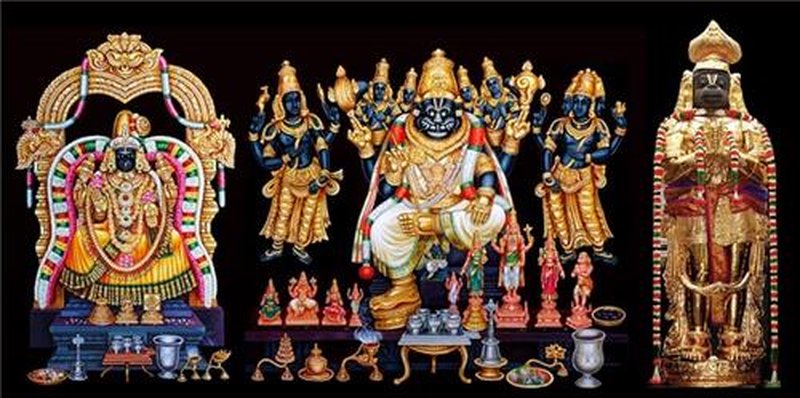
It is said that there are 33 million deities in India. Yet every deity is a singular manifestation of the Supreme and the most important deity of the region. – Dr. Nanditha Krishna

The Rigveda enumerates 33 devas or ‘shining ones’, representing primarily the forces of nature. Of these, three were important: Agni or fire, Indra or rain, and Soma, a plant. The popular deities today are two Vedic gods—Vishnu combined with a non-Vedic Narayana, and Rudra combined with a non-Vedic Shiva—and the many forms of Shakti, the supreme goddess. Agni, Indra and Soma, along with 28 others, became ‘minor deities’. Later, more minor deities were added to the Hindu pantheon: ashtadikpalas (the eight guardians of directions), navagrahas (nine planets), vasus (eight attendant deities), adityas (12 forms of the sun), rudras (11 forms of Shiva), avataras (10 incarnations of Vishnu), along with river goddesses, lesser-known forms of the main deities, village gods and goddesses and demi-gods of Buddhism and Jainism.

The original major deities of the Vedas became minor over time, while the minor deities are today among the most important deities all over India. Of the avatars, only Rama and Krishna attained cult status, while Shiva is worshipped in different forms. This is how Indian religions were made inclusive and expanded their pantheons to absorb everyone’s religious beliefs. Adi Shankara recognised six cults in his time: Vaishnava, Shaiva, Shakta, Ganapatya, Saura (Sun) and Kaumara (Kartikeya). While the six deities remain, Surya, once the ruling deity of temples in Khajuraho, Modhera, Martand and Gwalior, has been demoted to a mere navagraha.

Recently, the C. P. Ramaswami Aiyar Institute of Indological Research in Chennai organised a seminar on minor deities in Indian art. Scholars from various parts of India gathered to share the plurality and syncretism of Indian religious and social traditions, as represented in visual language. Religious syncretism is the blending of different belief systems, incorporating other beliefs into an existing tradition. This occurs when such traditions exist in proximity to each other and are catholic enough to accept each other’s belief systems. Hinduism, Buddhism and Jainism have made many adaptations over millenniums, assimilating elements of several religious traditions both in India and Southeast Asia.

Today’s Hinduism is a combination of different forms of beliefs and practices. It is no longer exclusively Vedic—it is the common people’s religion. Every village in India has a village deity, usually associated with fertility, rains, disease and so on. Shitala, a medicinal deity who cooled the body, became a dreaded goddess of disease in North India. Jvara, the deity of fever, who is propitiated as Jvarahareshwara in South India, is feared as the demon Jvarasura in Bengal. Mari originally meant rain and the pearl-like raindrops were called muthu-mari. Unfortunately, their resemblance to smallpox boils made Mariamman of Tamil Nadu into a dreaded goddess of disease. Thus, popular deities could change their character as social problems arose.

Village deities are generally made of terracotta, stucco or wood, and painted in brilliant colours. They may be situated in a wooden temple as in Kerala and Karnataka, or inside a simple brick-and-mortar shrine. Later, they were incorporated into exquisite stone sculpture. Each has a unique iconography. For example, Shitala in Rajasthan and Gujarat carries a broom and winnowing basket, and rides an ass. In Tamil Nadu, most village goddesses carry Durga’s weapons. But Ponni, the rice goddess, is depicted as a mere head: the earth on which the head is placed forms her body.

Folk deities may be grouped as gods of fertility, protector deities, fetishes (like stones and trees) and hero stones. The famous Ayyanaar is a protector, while goddesses protect children, combat disease and assure fertility. The popular Ayyappa of Kerala was originally a forest deity. Indian deities are associated with nature and natural resources like sacred groves and water bodies, the rain, a good harvest, disease and safety. By invoking the sanctity of rivers and lakes, animals and health, people protected the environment, controlled disease and ensured sustainable lifestyles for themselves and other creation.

What is amazing is the similarity among rural and tribal traditions across the country at a time when there was no easy communication. For example, votive offerings of terracotta horses to the deities of the sacred groves include the horses of Ayyanaar in Tamil Nadu and Bankura in Bengal. Every state shares this tradition, yet in no two states are the horses alike: that is the greatness of the Indian potter.

The minor deities were as important as the Vedic gods. A villager would never call his local goddess minor. She is all-important for him. Sometimes, the deity gets upgraded, such as Kamakshi of Kanchipuram, whose cult expanded when Rajasimha Pallava built a new temple and a new icon. Meenakshi, originally a goddess of fisherfolk, became the reigning deity of the new Pandya capital, Madurai. New mythologies were created, but old attributes were retained. They became aspects of Shakti or Vishnu or Shiva. This is how village deities were integrated into an all-Indian pantheon. The speakers at the seminar gave us a view of the many deities of their respective states, of dance forms like theyyam in Kerala and bhuta kola in Karnataka that are used to invoke gods.

No wonder it is said that there are ‘33 million deities’ in India. Yet every deity is a singular manifestation of the Supreme and the most important deity of the region. They are a reminder of a time when gods were invoked to protect people and the environment, and when religion was catholic enough to absorb other gods within an all-embracing belief system. That was syncretism, when the world was too small for more than one supreme deity, and all the gods and goddesses were merely different forms of the same Supreme Being and religious tradition. – The New Indian Express, 7 April 2024

Dr. Nanditha Krishna is an author, historian, and environmentalist based in Chennai.

Hindu Deities

A reasonable date for Adi Shankara – Venu Gopal Narayanan

Adi Shankaracharya

We see that there is nothing in Shankara’s works which contradict his dating to the 6th century BCE, nor historical evidence to either support or disprove a belief that Bimbisara, the Buddha, and Mahavira were his contemporaries. – Venu Gopal Narayanan

Historians have spent a century trying to determine when Adi Shankaracharya lived. Thus far, a total lack of archaeological evidence has frustrated their efforts. Instead, many have employed linguistic tools to assume that he lived sometime in the 8th to 9th centuries of the common era (CE).

While these arguments may appear convincing to the lay reader, they are all no more than inconclusive guesstimates; the simple truth is that we do not yet know when this remarkable mind bound our sacred land together using the logic of Advaita.

On the other hand, the Kanchi Kamakoti Peetham at Kanchipuram, in Tamil Nadu, maintains a list of head seers which says that it was founded by Shankara in 509 BCE. That is about 1500 years earlier than modern guesstimates.  The lineage list of the Govardhana Matha in Puri, Odisha, starts in 484 BCE. Similarly, the Dwaraka Matha in Saurashtra, Gujarat, maintains that it was established in 475 BCE.

The natural response for a Left Liberal thinker would be to declare a date of 6th century BCE as preposterous, and instantly dismiss it out of hand as some hoary tradition with no scientific basis. But the dharmic approach would be to test this thesis: what would be the impact on our history as we know it, if Shankara had indeed lived in the time of King Bimbisara of Magadha, Gautama the Buddha, and Mahavira the Tirthankara?

The most important test is whether such a date clashes with the dates of those texts referred to by Shankara in his works. Let us take the main ones:

One, the Brahma Sutra of Rishi Badarayana, which encapsulates the essence of the Upanishads—the concept of Brahman, and Vedanta—into dense aphorisms. Its opening line is, athato brahma jignyasa (then, therefore, the enquiry into Brahman). The basis of Shankara’s Advaita is his commentary on this work, called the Brahma Sutra Bhashya.

In the absence of any evidence, historians have dated this text with “great accuracy” to either the 5th or 2nd centuries BCE, or the 5th century CE.

Two, the Purva Mimamsa Sutra of Rishi Jaimini, who was an older contemporary of Rishi Badarayana. It aphoristically condenses the essence of the Brahmanas, Vedic texts detailing rituals and the concept of Dharma. Its opening line is, athato dharma jignyasa (then, therefore, the enquiry into Dharma). According to some legends, Shankara bested Mandana Mishra, the greatest proponent of Mimamsa, in a debate once, to establish the validity of Advaita with the ritualists.

Dating this text with any degree of assurance is an absolute non-starter because of nil epigraphical evidence till the medieval period. All we know is that it was composed in the same time period as the Brahma Sutra, since one cross-references the other.

Three, the Bhagavad Gita, and by extension, the two Epics. Shankara interpreted this celestial song using the logic of Advaita to demonstrate that it is the epitome of Vedic thought.

Once again, certain schools of historiography have gone to great pains to try and peg the Gita to a time after the Buddha, all without evidence of course. Assumptions chase conjectures through hoops of linguistics and philology to emerge as fact on the stages of academia.

There is a central reason why so much futile effort is expended: the date of the Vedas has to be held to 1500 BCE. Only then can horse-riding Aryans move from the steppes of Central Asia to the subcontinent. Only then can a yawning gap be created between the Vedic age and the supposedly earlier, supposedly different-in-every-way, Harappan/ Sindhu-Saraswati era.

Only then can Videgha Madhava of the Satapatha Brahmana carry Agni eastwards from the Saraswati River, around 1000 BCE, clear the forests along the Gandak, and settle his steppe folk in the Gangetic Plains. Now, in a tearing rush, the civilization can take root, compose the Upanishads, give birth to kingdoms, dynasties, legends, and initiate a lengthy intellectual journey which leads some millennia later to Shankara and Advaita.

However, if Shankara can be dated to the 6th century BCE, this elaborately fabricated historiography goes for a toss. Instead, and to the horror of our Marxist brethren, the date of Agni’s eastward journey gets pushed back by a thousand years at least, to well before the date they set for the Rig Veda, and bang in the middle of the Harappan era.

What Aryan invasion or migration theory then? This is what happens when our history is written for us by others, and what will persist if we allow that nefarious process to continue blithely forth without rigorous, scholarly contestation.

But mindsets are rapidly changing. The old assumptions are being hotly questioned, on merit. New data and new research show that Sanskrit is older than the Indus Valley Civilization, and, that Pali had evolved as a separate language by 4000 years ago. The discovery of the Sinauli chariot is both a new chapter of our ancient history waiting to be written, and the rewriting of conventional historiography; and one which points towards a far older date for Vidhega Madhava’s eastward passage.

Thus, we see that there is nothing in Shankara’s works which contradict his dating to the 6th century BCE, nor historical evidence to either support or disprove a belief that Bimbisara, the Buddha, and Mahavira were his contemporaries. But if this is so, then it turns some preconceived notions on their heads.

Rather than someone who contested the metaphysical intricacies of Buddhism only when it was deep into terminal decline in the subcontinent, which is how Shankara is popularly portrayed in modern scholarship, it means that he could have been there at the start, when the proliferation of heterodox sects began.

A date of 6th century BCE actually makes a lot more sense than one of 8th to 9th CE, because the motivations become a lot clearer, for bringing Brahman and Dharma—in essence, knowledge and action—together under one philosophical roof, for reinforcing the supremacy of the Vedas, and, for logically establishing with clear deductions, the umbilical Vedantic linkages between the Vedas, the Upanishads, and the Bhagavad Gita. It is all the philosophical protection Sanathana Dharma has ever needed to fend off the vagaries of history, and to preserve our way of life in our sacred land.

We may probably never know for sure which era Shankara lived in, but it feels good to imagine that a Malayalee sannyasi from Kaladi may have met and conversed with some great Biharis, in Sanskrit, in Uttar Pradesh, at a time of tremendous intellectual churn. – Swarajya, 25 February 2024

Venu Gopal Narayanan is an independent upstream petroleum consultant who focuses on energy, geopolitics, current affairs and electoral arithmetic. 

Adi Shankara's Digvijaya Route

Hindu temples existed before the 5th century CE – Monidipa Bose Dey

Sonkh Temple Artefact (Mathura, 1st century CE).

A narrative that keeps appearing in the media is the claim that there were no Hindu temples before the  5th century CE. This claim is false, a myth, and the propaganda is aimed at postulating that most pre-Gupta temple structural ruins were Buddhist in nature – Monidipa Bose Dey

A favourite narrative of the Left scholars that keeps appearing regularly in media is the claim that “there were no Hindu temples before the 5th century CE.” This claim is nothing but a myth, and the propaganda is primarily aimed at postulating that most pre-Gupta temple structural ruins were Buddhist in nature, and Hinduism, Hindu gods/murtis, and Hindu temples are a later development, with the concept of Hinduism and Hindu gods starting from around the Kushana period (1st century). This fake narrative has been force-fed to Indians through constant repetitions of the claim in academia, school and college textbooks, and the publishing of articles on this topic in various journals and media platforms written by so-called scholars.

Unfortunately, many gullible Indians growing up with this constant brainwashing believe this fake claim, thinking Hindus did not have any temples as such before the Gupta period. Recently, in an article, a slightly modified claim was made that large Hindu temples did not exist before the 5th century CE. From “no Hindu temples before 5th century CE” to “no large Hindu temples before 5th century CE,” the shift in narrative is noteworthy.

The standards of civilisation are often measured, among other things, by the then available scientific planning, longevity of structures built, aesthetic appeal, and successful completion of buildings that range from religious to military to residential structures. Seeing the antiquity and the advanced nature of Indian civilisation, it is not surprising to find Indian writers from ancient times quite taken up with the subject of architecture, and this obsession is evident in all forms of literature ranging from the Vedas to the Epics, Puranas, Buddhist texts, Jain texts, Agamic literature, and various historical and even political treatises. With such a vast spectrum of knowledge compiled in books, and India being a country that has always been deeply religious, it is completely illogical to think ancient Indian civilisation would have no Hindu temples.

This article will take a look at the various evidences that clearly show Hindu temples existed in ancient times and did not start from the 5th century CE, as Marxist scholars have always claimed.

Evidence from texts

Texts from ancient India help us to understand the nature of the worship of gods in India and the temples built for them. In the Astadhyayi (around the 4th century BCE), Panini gives names of Vedic deities, such as Agni, Indra, Varuna, Bhava, Sarva, Rudra, Mrda, Aryama, Tvasta, Súrya, Sóma, Indrani, Varunani, Agnayi, Usha, Prthivi, who were worshipped. Bhakti or theistic form of devotion was present in Panini’s time, which is clear by his reference to devotion to Vasudeva and Arjuna, while names like Varunadatta and Aryamadatta indicate sons were named after gods like Varuna and Aryama, to show devotion.

Panini also mentioned the use of images for worship (arcas), which indicate the existence of shrines where these arcas were worshipped.

Patanjali’s Mahabhasya (2nd century BCE), which is a detailed commentary on Panini’s work, mentions the worship of Vasudeva-Krishna as a deity; and specifically mentions temples of Dhanapati (Kubera), Rama (Balarama), and Kesava (Vasudeva), where worship would occur with various elaborate rituals, accompanied by music and dance. From around the same time, there have been found murtis of Kupiro yakho (Kubera yaksa) from Bharhut, and of Balarama from Mathura. A murti with the inscription of four-armed Vasudeva-Visnu carrying gada and chakra in his upper hand and holding a sankha (broken) in the lower hand, from Malhar (Bilaspur in Madhya Pradesh), is dated to the 2nd century BCE. These murtis would all be worshipped in temples of their own.

Kautilya’s Arthasastra refers to various temples within a fortified city that enshrined Shiva, Vaisravana, Asvinikumãras, Sri (Laksmi), and Madeira (a fertility goddess associated with the Mother Goddess sect). The Arthasastra mentions images of Aparajita (Durga), Apratihata (Visnu), and Jayanta (Kumara), which were worshipped by King Bhagabhadra (131 BCE, the fifth Sunga ruler); and Vaishnava shrines erected by Gautamiputra Bhagavata, the ninth Sunga ruler, in his 12th year.

Evidence from inscriptions

Three inscriptions from Nagar (Chittorgarh, Rajasthan), refer to the construction of a stone wall that enclosed a place for worship of Sankarsana and Väsudeva by King Sarvatata of the Kanva dynasty (250-300 BCE). The Nanaghat (Pune) inscription of Naganika of the 1st century BCE refers to Vedic sacrifices by the Satavahana royal family and starts with homages to divinities such as Dharma, Indra, Sankarsana-Vasudeva, Chandra-Surya, and the Lokapalas (Yama, Varuna, Kubera, and Vasava). An inscription from Mora (Mathura) during the reign of Mahaksatrapa Sodasa (10-25 CE) records the installation of murtis of the five Vrsni heroes in a stone temple. Another Mathura inscription of the same time, found engraved on a door-jamb, records the construction of a temple with torana and vedika for Vasudeva.

An inscription from Nandsa (Udaipur, Rajasthan, 226 CE), records the performance of Vedic sacrifices after the construction of temples dedicated to Brahma, Indra, Prajapati, and Visnu.

Structural evidence from Mauryan periods

From the time of Ashoka Maurya (272-232 BCE) to the early Kusana period, various pieces of evidence from rock-cut shrines and from surviving foundations of temples suggest that in those times, temples were built in circular (vitta), elliptical (vettäyata), and apsidal (capakara) forms. The Ajivika caves at Barabar (Gaya, Bihar) of Mauryan times, preserve both circular and elliptical shrines in hut forms with domed or vaulted roofs.

Belonging to the Mauryan period is a circular brick-and-timber shrine (plinth) of the 3rd century BCE, located at Bairat (Jaipur). Temple No. 40 at Sanci was originally an apsidal stone temple of the Mauryan period, raised on a high rectangular plinth, the superstructure likely built of wood that no longer exists.

Structural forms prevalent during the Mauryan period continued into later periods, as found recorded in many bas-reliefs from Sanchi, Mathura, Amaravati, etc. The apsidal plan for temples was more popular than the circular or elliptical plan during this period. Three stone apsidal shrines from the 1st century CE are known from Taxila (Takshasila), while Temple No. 18 at Sanchi was also an apsidal shrine, datable to the 2nd century BCE.

Remains of temples from pre-Shunga and Shunga era

The apsidal temple at Sonkh (Mathura, dated 1st century BCE) was one of such early temples. The Ghosundi inscription (1st century BCE, near Chittorgarh) talks of a temple complex named Narayana-vatika dedicated to Samkarshana-Vāsudeva; foundations of an elliptical structure, dated 2nd century BCE, found at the site of Besnagar in Vidisha is that of a Vaishnava temple; an identical structure discovered at Nagar (Chittorgarh) by Bhandarkar is dated to 350-300 BCE; while the Mora well inscription (1st century CE) refers to a temple in Mathura.

Hindu temple architecture from the post-Mauryan era is known from the remains of the temple foundations, pertaining to their ground plans, found during various archaeological excavations. Unfortunately, the superstructures of these ancient temples were not preserved, because they would often be built of wood or bricks.

Heliodorus Pillar (113 BCE)

One such example of a temple from ancient India is the Vasudeva shrine from the 3rd century BCE (approximately dated 200 BCE), found close to the Heliodorus pillar in Besnagar, near Vidisha, Madhya Pradesh. From a study of the archaeological report of the excavation of this site by D.R. Bhandarkar (ASI Annual Report 1913-14), it is very clear the temple which belonged to the Sunga period was by no means a small one. In fact, the word prasadottoma was found in an inscription on a pillar stump from the site, meaning the temple was the best among the ones in Vidisha, clearly indicating the Heliodorus Garuda pillar was built in front of the most celebrated temple of Vasudeva of that time. Thus, we find archaeological evidence of a large Hindu temple from the 3rd-2nd century BCE.

Another example of a Hindu temple from ancient India is the Vasudeva-Sankarshana temple found in Nagari, Rajasthan. Here, a stone enclosure for a Vasudeva-Sankarshana shrine is mentioned in an inscription which belonged to 300-250 BCE. The site preserves a massive stone enclosure and the plinth of an elliptical brick temple. Below the surface level of this stone enclosure, archaeologists found the remains of an earlier building that dated to 350-300 BCE. The Vasudeva-Sankarsana shrine structure was elliptical in shape with a puja-sila-prakara built around it, and only the lower moulding of the superstructure had survived which was 2 feet high, showing the temple was a large one. The shrine remained an active place for Vaishnava worship until the 7th century CE.

A series of apsidal temples from ancient India were excavated at Sonkh, dating to the 1st century BCE. The apsidal Temple No. 2 at Sonkh had a large stone railing surrounding the shrine that had engravings on both sides. On the southern side of the railing, carved ruins of a stone entrance were found that had two pillars supporting a superstructure of three architraves with voluted ends. An architectural piece from the bottom lintel of the doorway showed carvings depicting a naga and a nagin sitting on thrones, surrounded by attendants and devotees, thus denoting the temple as a Naga shrine.

Yaudheya coinage with temple engraving (ca. 200 BCE).

Numismatic evidence of Hindu temples in 200 BCE

Numismatically speaking, ancient Hindu temple architecture was found depicted on coins and coin moulds marked by the Yaudheyas. The Yaudheyas were a martial republican clan, who were at the peak of their power between 200 BCE to 400 CE, in areas of what is now Haryana, Punjab, and Rajasthan. Being a martial clan, most of the Yaudheya coins depicted the war-god Karttikeya (Brahmanyadeva). Among the many temples seen on Yaudheya coins, one structure with a dome-shaped roof and square plan stands out. It stood on an elevated adhishthana, consisting of four mouldings. The object of worship would have stood in the centre. Double domes were a popular design at that time, as evident from the many coins depicting them, while there are examples of even triple-domed temples. The third image clearly shows a Shiva temple with the Shiva linga at the centre of the sanctum. The existence of Shaiva shrines is confirmed by a four-pillared double-domed structure surmounted by a trident, which is the established emblem of Shiva. The trident on top of a four-pillared double-domed structure also confirms the Shaivite affiliation of such shrines.

Sometimes temples on Yaudheya coins show a dome marked by vertical divisions, which indicate wooden beams on the sanctum roof. A double or triple-domed structure having a square plan shows that the domes would have been covered by slanting slabs giving the sikhara a triangular look. One Yaudheya coin also depicts a structure topped with a vajra-like motif, clearly indicating a shrine dedicated to Indra Deva.

Thus, from the above-presented evidence (texts, archaeological, and numismatics), it is quite clear that Hindu temples were indeed present much before the 5th century CE, and they were often large shrines dedicated to various gods. – News18, 18 February 2024

› Monidipa Bose Dey is a well-known travel and heritage writer. 

Sonkh Temple Foundation

Sonkh Temple Frieze

James Prinsep: The Englishman who mapped the Adi Vishwanath Temple in Kashi – Yudhajit Shankar Das

James Prinsep

James Prinsep first served in Calcutta and then in Benaras for ten years. Prinsep’s stay in Varanasi—from 1820 to 1830—is what is of interest and importance against the backdrop of what is unfolding today. – Yudhajit Shankar Das

At a walking distance from Kolkata’s Eden Gardens is the Prinsep Ghat on the banks of the River Hooghly. One gets a close view of the Vidyasagar Setu and can take a boat ride on the Hooghly from Prinsep Ghat.

The ghat is named after James Prinsep, a British numismatist and archaeologist, who made significant contributions to India’s historiography. He came to India when he was 28 and was the youngest fellow of the British Asiatic Society.

It was Prinsep who deciphered the Brahmi and Kharosthi scripts and helped the world know about Emperor Ashoka’s reign. It was he who established that King Devanampriya Piyadasi, who is mentioned in several inscriptions from Sri Lanka to Afghanistan, was none other than Emperor Ashoka.

The ghat in Kolkata was named after Prinsep as a way to recognise his contributions after he passed away in London in 1840 at the young age of 41.

Benares Illustrated by James Prinsep

James Prinsep and his ‘Benares Illustrated’

James Prinsep first served in Calcutta (now Kolkata) and then in Benaras (now Varanasi) for ten years. Prinsep’s stay in Varanasi (from 1820 to 1830) is what is of interest and importance against the backdrop of what is unfolding now.

Prinsep built Varanasi’s underground sewage system, which is still operational, restored the Alamgir Mosque, built by Mughal Emperor Aurangzeb in 1669, and drew the city’s maps. He also brought out a book, Benares Illustrated, A Series of Drawings, in 1831.

That book and the map will be used as part of evidence by the Hindu side in the legal battle for the Gyanvapi complex, IndiaToday has been told.

In Benares Illustrated, James Prinsep used lithography to engrave every scene on paper and present information with evidence. Chapters and illustrations include Munikurnika Ghat, Bruhma Ghat, Procession of the Tazeeas and Hindoo Nach Girls.

Most importantly, James Prinsep, in Benares Illustrated, discussed the architecture of the old Vishweshwar Temple, and how the original place of worship was converted to the present Gyanvapi Mosque. Vishweshwar or Lord of the Universe is another name for Lord Shiva.

Engraving (1848) of Emperor Aurangzeb with his retenue.

Prinsep on Auranzeb’s bigotry

In Benares Illustrated, Prinsep details how Aurangzeb’s men used the material from the destroyed Kashi Vishweshwar Temple to build the Gyanvapi Mosque.

“The bigotry of Aurungzeb did not allow many vestiges of this more ancient style to remain. In 1660, for some trifling resistance to the imposition of a capitation tax, he took occasion to demolish the principal Shiwalas, and constructed Musjids or mosques with the same materials and upon the same foundations, leaving portions of the ancient walls exposed here and there, as evidence of the indignity to which the Hindoo religion had been subjected,” Princep writes.

The Kashi Vishweshwar Temple is of immense significance in Hinduism as it is one of the 12 Jyotirlingas or temples where Lord Shiva is said to have appeared as a column of light. Lord Shiva is said to have created a water-producing spot there hence the name Gyanvapi (well of knowledge).

The Adi Vishveshwara Temple was destroyed by Qutb ud-Din Aibak, the general of Muhammad Ghori, in 1194 but was rebuilt. It was Aurangzeb who razed the Kashi Vishweshwar Temple again in 1669 and built the Gyanvapi Mosque using the same foundations and materials.

It is very similar to the use of materials from the destroyed 12th-century temple that was used to build the Babri Masjid in Ayodhya. The Babri Masjid was constructed in 1528 by Babur’s commander, Mir Baqi.

Babur was the first Mughal ruler in India, while Aurangzeb was the last of that family to hold sway.

Distroyed Viswanath Temple replaced by Gyanvapi Mosque (James Princep 1834).
Plan of the ancient Kashi Vishwanath Temple. Fine dotted line in the plan image indicates the Gyanvapi Mosque build over the temple's foundation (James Prinsep 1832).

Prinsep’s 200-year-old map of Gyanvapi Temple

Prinsep then went on to reveal the old plan of the Vishweshwar Temple by drawing a map and marking on it how the Aurangzeb-built mosque stood on it.

But how could Prinsep, who came to Varanasi in the 19th century, come up with the map of the old Kashi Vishweshwar Temple, which was destroyed by Aurangzeb in the 17th Century, after a gap of about 160 years?

Prinsep explains in Benares Illustrated how he exactly managed to draw the map of the old Vishweshwar temple.

“Antiquarians will be well pleased that the Moosulmans, in their zeal for the triumph of their own religion, discovered a method of converting the original structure into a capacious Musjid, without destroying above one-half of its walls; so that not only the ground plan but the entire architectural elevation, may still be traced out,” he writes.

In the chapter “Plan of the old Vishveshwur Temple” of Benares Illustrated, Prinsep shares the map that shows that the old Kashi Visheshwar Temple had eight mandaps and the central section which Prinsep calls ‘Mahadeo’.

“The darkly shaded part shews the figure and foundations of the principal dewul: the fainter, those of the outer dewulees. The whole must have formed, when complete, a picturesque groupe of nine spires around a central pyramid. The heights diminishing from the centre towards the corners in the proportions of sixteen, eight, and six, as seen by the ground plan,” he writes.

The book and the map will be part of the evidence put forward in the Gyanvapi case, advocate Vishnu Jain, who represents the Hindu side in courts of law, confirmed to IndiaToday.

Shiva linga found in a well in Gyanvapi Mosque. According Muslims it is a wazukhana fountain (though there is no water connection and the top nozzle is added recently).

Prinsep on the ‘Lingam’ at Gyanvapi Masjid

“The principal lingam of Mahadeo stood in an ornamented reservoir in the centre, having a drain below to carry off the Ganges water continually poured over it by day and night,” writes James Prinsep in his Benares Illustrated.

“Prinsep has shown the place of Vishweshwar or Mahadev in the centre of the temple and indicates that the principal lingam was located in a water reservoir and that could be the so-called fountain in the wazukhana, which could have been originally the ornamented reservoir having the lingam,” B.R. Mani, Director General of National Museum, tells IndiaToday.

Mani, who led the Allahabad High Court-ordered excavation at the then-disputed Ram Janmabhoomi-Babri Masjid site in 2003, says that more research is needed to ascertain if it is, in fact, the ‘Lingam’ that James Prinsep mentions.

The wazukhana, or the ablution area, of the Gyanvapi Mosque was sealed in 2022 following a Supreme Court order. According to the Hindu side, the fountain-like structure in the wazukhana is a Shivling or lingam.

This is what Prinsep seems to have suggested in his 1831 book.

“If you draw a graph of human genius, James Prinsep would head the list along with Leonardo da Vinci,” said O.P. Kejariwal, then Director of Nehru Memorial Library, in 2001.

The Gyanvapi site is seeing fast-paced action. A Varanasi court has allowed Hindus to perform puja in one of the cellars, Vyas ji ka Tehkhana, which was ordered sealed by former Uttar Pradesh Chief Minister Mulayam Singh in 1993.

Amid the legal battle surrounding the Gyanvapi site, James Prinsep and his Benares Illustrated, A Series of Drawings of 1831 are interesting to revisit. Both will likely play a key role in the events that follow.

As all the focus is on the Gyanvapi site, about 680 km from Varanasi, stands Prinsep Ghat in Kolkata, in the balmy breeze blowing from the Hooghly River. – IndiaToday, 7 February 2024

Yudhajit Shankar Das is a deputy editor at IndiaToday.

Women doing abhishek to lingam in the Adi Vishwanath Temple (Peter Mindy 1632).

The word ‘spolia’ hides too many humiliations – Reshmi Dasgupta

Ionic pillar capital embedded in wall of St.Peter's Church, Kalyvia Thorikou, Greece.

For medieval European builders who used temple rubble in their churches, the older Pagan faith was totally snuffed out in the former Roman Empire, so no one was left to protest against the deliberate insult to the ancient Gods. But in India there are many left to seethe about temple ‘spolia’ in mosques. – Reshmi Dasgupta

‘Spolia’ is an interesting word. Taken from Latin, it means “spoils” (of war) but archaeologists and academics use it to describe stones and architectural elements retrieved from older structures and re-used in new constructions, as masonry or decoration, either in the same place or elsewhere. Many of those who use the word prefer it because ‘spolia‘ sounds passive, because most people do not know the real meaning, with its vivid allusions to violence and destruction.

Debris and rubble are the better known words that imply destruction and hence are less used as they give rise to uncomfortable questions. More so when certain sections of them are reused intact, so that their original purpose juxtaposed with their new ‘repurposed’ existence remains clear to those looking at it. Hindu and Jain temple ‘spolia’—pillars—used in the cloisters of the 12th century Quwwat-ul-Islam Mosque in New Delhi’s Mehrauli is one such example in India.

Quwwat-ul-Islam Mosque
Western wall of Gyanvapi Mosque is that of earlier hindu temple.

Of course, an entire wall of an older structure retained intact in a subsequent construction—one example of which is currently in the news here—cannot be called ‘spolia’ in the classical sense as technically, it is not in bits and pieces. But its impact on those who see it is far sharper than, say, statues of Pagan or forbidden gods embedded in walls or on stairs, of which there are many examples in the areas of the erstwhile Roman, Byzantine and Ottoman empires.

In this connection, it may be remembered that remains of old statues and columns which were used in later constructions in the Acropolis in Athens have been widely interpreted as a deliberate device to forever remind Athenians about the destruction wrought by Persian emperor Xerxes I in 480 BCE after the battle of Thermopylae. Only certain spolia were used, so as to ensure Athenians resolve to never let it happen again. This is called ‘purposeful memorialisation’.

The ‘spoliate colonnades’ of Rome, however, are even more apt in the context of Mehrauli as intact pre-Christian Roman pillars were deliberately re-used in churches. In Spolia Churches of Rome: Recycling Antiquity in the Middle Ages, Maria Fabricius Hansen writes how from the 4th century CE to the 13th century CE, Christians “re-used” columns, pediments and other spolia of ancient (Pagan) Rome prominently in churches. It even became an architectural style.

The assertion of Christianity over the earlier faith prevalent there was implicit in this exercise since the new churches not only used old material but were also eventually built on the very sites of Roman temples. Fortunately for those medieval church builders, the older faith was totally snuffed out in the former Roman Empire, so no one was left to protest against the deliberate insult to their ancient gods. But in India there are many left to seethe about ‘spolia’.

The term ‘purposeful memorialisation’ can be used to describe the use of ‘spolia’ in India too, but the intention was rather different. Although contemporary left-leaning historians have tried hard to find a continuity in terms of violence and destruction in India before and after the advent of Islamic rulers, there is little proof of wilful debasing. There is no evidence of Buddhist ‘spolia’, for example, being deliberately used in Hindu temples to humiliate and disparage.

On the contrary, the great Buddhist university or mahavihara at Nalanda (then in Magadha and now Bihar) was built by the Hindu emperor Kumaragupta in the 5th century and flourished under successive Hindu rulers and non-royal Hindu donors. It was destroyed in the 12th century by ‘Turks’ (almost certainly Bakhtiyar Khilji’s army) corroborated by contemporary accounts of monks. The site of another mahavihara Odantapur that Khilji razed became Bihar Sharif.

Many reused ‘older’ building materials in India without any idea of what the original structures were, of course. Bricks and pillars of the 2nd century BCE Amaravati mahachaitya buried for more than a millennia were reused by a local zamindar Raja Vesireddy Nayudu to build his new capital in the late 18th century. Bricks from the then-undiscovered Harappa were also used by the British as track ballast for the Lahore-Multan railway in the late 19th century.

The Indus-Saraswati civilisation was still unknown when the railway was being built and Amaravati was just a grassy mound of bricks. They both could just as well have belonged to abandoned settlements of relatively recent provenance, that too not of known importance. So, whether knowing the origin of the bricks and ‘spolia’ would have really made a difference in these two cases remains moot. But all use of ‘spolia’ in India has not been that unwitting.

Which explains why there has been a concerted effort to project that destruction of places of worship and use of ‘spolia’ in India predated the Islamic period. One example cited is of the Pallava king Narasimhavarman I’s Brahmin general Paranjothi who took away a Ganesha idol from the Chalukyan capital Vatapi (now Badami in Karnataka) after the defeat of Pulakeshin II in 642 AD and installed it in his village Tiruchenkattankudi in Tiruvarur district of Tamil Nadu. But those who cite it omit the fact that the razing of Vatapi exempted temples.

Not only did Paranjothi install the Ganesha idol with great devotion and respect in his village but there is an inscription by Narasimhavarman I in the Mallikarjuna Temple at Vatapi, proving that destruction of Chalukyan temples—much less raising another structure on the site to rub it in—was not on the agenda. Carrying away idols did not indicate contempt as they were not melted down, unlike those taken from southern temples by Alauddin Khilji’s general Malik Kafur.

Another example given is of Rajadhiraja Chola who defeated the Chalukyas and plundered their capital Kalyani, taking away a large black stone dwarapala. But the inscription on that dwarapala, now installed at the Darasuram Temple in Kumbakonam, attributing its presence there to Rajadhiraja, proves it was not demeaned or destroyed but respectfully given place in another temple. If this could be called ‘spolia’ at all, it had been given a dignified new home.

The actions of warring southern Hindu rulers were a marked contrast to the attitude of the invading Islamic armies from the north, especially the expeditions of Alauddin Khilji’s favourite general Malik Kafur. The many stories of idols hidden to prevent destruction and mutilated stone carvings of figures in the great temples of south India bear witness to the fury and intentions of these invaders, going beyond just plundering their gold, gems, horses and elephants.

This is conveyed in almost fawning detail by the admired 14th century bard Amir Khusrau (who was witness to many of those pillaging wars) in Tarikh-i-Alai. One description goes: “The holy places of the Hindus, which the Malik Kafur dug up from its foundations with the greatest care. … The stone idols called ling, which had existed for a long time and until now, the kick of the horse of Islam hadn’t attempted to break … the Mussalmans destroyed all the idols”.

In most cases though, the ‘spolia’ used by idol-breaking armies are not as evident as, say, at the Quwwat-ul-Islam mosque and certainly Gyanvapi. But the question is when (if at all) will India’s historians and intelligentsia take a cue from their counterparts (who have noted the same phenomenon around the Mediterranean) face up to the truth? They need to not only call a spade a spade but also disseminate the real meaning and purpose of ‘spolia’ in history. – FirstPost, 14 August 2023

Reshmi Dasgupta is an editor at the Times of India, New Delhi.

Temple pillars in Santhome Church museum, Mylapore.

The K.K. Muhammed Interview – TNIE

K.K. Muhammed

Archaeologist Dr. K.K. Muhammed, 71, was part of the Archaeological Survey of India team that excavated the Babri Masjid site in Ayodhya in 1976 where the Ram Temple now stands. While stating the demolition of Babri Masjid did shock him as an archaeologist, Dr. Muhammed is of the view Muslims must willingly hand over Gyanvapi and Mathura mosques to Hindus. He thinks that will heal many wounds. While stressing the Congress Party should have decided to participate in the inauguration of the Ram Temple on January 22, Dr. Muhammed terms the BJP rule under Narendra Modi a dark age for the ASI. Excerpts from his conversation with the New Indian Express Interrogation Team 

Q : You were part of the ASI team that excavated Babri Masjid/Ram Janmabhoomi in 1976. What were your findings?

A : It was a team led by Professor B.B. Lal that carried out the excavation and I was part of it. We came across pillars of a Hindu temple, with poornakalasa engraved on them. Forms of defaced gods and goddesses were also discovered. Terracotta statues traditionally associated with temples, too, were unearthed. We will never find statues of humans in mosques, as these are haram for Muslims. That’s how we concluded that a temple had stood there before the mosque was constructed.

Q : But some, like Professor Syed Ali Rizvi of AMU, allege you were not part of the excavation team? 

A : I was a postgraduate diploma student then at ASI’s School of Archaeology. Ten of us went as a team, including senior Congress leader Jairam Ramesh’s wife Jaisree Ramanathan. I was engaged in the excavation of Trench B.

Q : Have the findings of these studies been published in any academic journal?

A : Yes. It’s there in the Indian Archaeological Review. But ASI, especially Professor Lal, never wanted to make it an issue. It was more of an academic nature.

Q : ASI excavations found structures to prove that there was a temple. … But was there any proof of it being a Ram Temple?

A : Yes. They got an inscriptionVishnuharisila Phalakam—after the masjid was demolished in 1992. It clearly states that this temple is dedicated to the Mahavishnu who killed Bali.

Hari-Vishnu Inscription

Q : So the crucial evidence was discovered during demolition, not during excavation?  

A : Yes. They got this evidence after the Masjid demolition, not during excavation. The critics first said it was an 18th-century inscription. Later they backed out. In reality, it’s a 12th-century inscription. There was also an allegation that such evidence was planted there. So, we checked with the Lucknow Museum. They confirmed that the inscription they possess remains with them.

Q : The popular narrative is that Babar demolished a temple and constructed a masjid. But do we have evidence to prove that Babar had demolished the temple? 

A : Babar’s military commander Mir Baqi (Baqi Tashqandihad led the demolition of the temple. There was an inscription in Persian which said Mir Baqi had demolished the temple. It could also have been a dilapidated structure.

Q : But there is a huge difference between demolishing a temple to build a masjid and constructing a masjid on the ruins of a dilapidated temple…. 

A : Many temples were demolished in medieval India. If you visit Delhi you can see Quwwat-ul-Islam Mosque near Qutub Minar (the mosque was built over the site of a temple). Some pages of Babar Nama have gone missing. Pages describing the activities of three months are missing. But there was an inscription that Mir Baqi had constructed the masjid. The demolition was part of a war and the Muslims of the current generation are in no way responsible for the act. But at the same time, Muslims should not defend the demolition of temples by some invaders. Christians do not justify what the Portuguese did in Goa.

Q : What were the findings of the 2003 excavations?

A : In 2003, a team led by B.R. Mani carried out an excavation using the Ground Penetrating Radar and found out there was a structure underneath. During the excavation, 12 pillars and more than 50 brick bases were discovered. The excavation team had experts from JNU/AMU  in addition to the Waqf committee’s lawyers, VHP people and members of the judiciary. It was fully recorded. About one-fourth of the workers were Muslims.

Q : Going by what you say, there was a 12th-century temple, and later a masjid was built on top of it in the 16th century. As an archaeologist do you agree with the demolition of a structure to unearth another one? 

A : No archaeologist would agree to the demolition of any historical structure. In this case, it had already been demolished. We now need to think about what’s the way forward.

Q : As an archaeologist, what did you feel when Babri Masjid was demolished in 1992? 

A : We were all shaken. Senior IAS officer I. Mahadevan had stated that we should not do wrong to correct a historical mistake that happened centuries ago. We were all against the demolition. It shouldn’t have happened.

Q : And as an Indian Muslim?

A : An archaeologist can never be a Muslim or a Hindu. We look at such matters objectively. I have faced stiff opposition from the Muslim community and Hindu groups on various occasions.

Q : Similar demands are now being made about Gyanvapi and Mathura? 

A : The Muslim community should be ready to willingly hand over its rights (to the structures at) Varanasi and Mathura, too, to the Hindus. Tension is bound to be there. But from a historic perspective, there cannot be a lasting solution to the whole issue without handing these two over. I always remind the Muslims that India, even after Partition, remains a secular country because of its Hindu majority.

Aurangzeb's firman against the Keshava Rai Temple in Mathura (13 October 1666).

Q : But won’t it lead to more tension? 

A : Ayodhya, Kashi and Mathura are three places as important to Hindus as Mecca and Medina are to Muslims. Hence, Muslims should be ready to willingly hand over these places.

Q : Is there sufficient evidence in Gyanvapi to support claims of a temple there? 

A : Yes. There may be Islamic inscriptions, but in totality, it is a Hindu structure. Also, there are many literatures which support this. This issue has created a major divide between the Hindus and the Muslims. So, handing it over to Hindus is the only lasting solution.

Aurangzeb's firman ording the demolition of the Vishwanath Temple at Kashi (August 1669).

Q : Gyanvapi is an 18th century structure. As an archaeologist, do you support demolishing such an old structure? 

A : The same issue had come up about Babri Masjid too. We can transplant these structures as such, without demolishing them. So far only four such transplants have been carried out in India. Of these, two were led by me—the Kurudi Mahadeva Temple and the Chaubis Avatar Temple in Madhya Pradesh.

Q : Whether Babri Masjid or Gyanvapi Mosque, these structures came into being as part of some historical moments. If we start correcting such historical errors, where would it lead us to?

A : That’s right. It’ll go on without any beginning or end. In Kerala itself, there are many such Buddhist temples and Jain temples that have later become Hindu temples. But if we take these three places as an exception—Ram Janmabhoomi, Krishna’s birthplace and Siva temple—that could prove to be the only and lasting solution to this issue. I think, if these two are handed over, all religious groups together can resolve this issue once and for all.

Q : Isn’t that just wishful thinking? The RSS-VHP reportedly has a list of close to 2,000 temples that were demolished to construct mosques….  

A : There won’t be any end if we go on like this. But unlike Semitic religions, the Hindu mind will not approve of such aggressiveness. You have to remember that many Hindus have stood with the Muslims in the fight against the Ram Mandir movement. Can you remember one instance where the Muslims stood for the cause of the Hindus?

Q : Isn’t Ayodhya more of a political issue than an archaeological or historical issue?

A : Yes, correct. It’s a political issue. It’s a fact that the BJP and the RSS try to use it with a motive to make political gains. At the same time, we need to understand the pain of lakhs of ordinary Hindu devotees. It would have been better if the Muslims could understand the pain of the Hindus.

Q : But aren’t these emotions created by politicians?

A : I accept there were attempts to whip up emotions. But even during my visit to Ayodhya in 1976-77, I could understand the heart-wrenching agony of the poor Hindus. Had it been Mecca or Medina, how many bombs would have exploded by now? Hindus allowed that structure to remain there for 500 years. We have to understand this magnanimity of Indian culture and Hinduism.

Q : A 16th century structure has been demolished and a huge structure built using modern technology. Do you think justice has been served?

A : The issue is not whether the act is justified or not. The structure has been demolished. If it was not demolished, ASI would not have allowed the construction of another structure within 300 metres from the structure. The disputed structure has gone and the new building has been constructed considering the requirements of the current time. It is an issue of faith and we have to make some compromises.

Q : Do you think the Ram Temple issue had been a pan-India issue at any point of time?

A : It was not a pan-India issue. But now it is growing to such levels. I accept that it is a political project.

Q : You say the Hindus were magnanimous. Where can we see such large-hearted Hindus now?

A : Compared to (followers of) other religions, Hindus are far better even now. They may react recklessly, playing with emotions, but they will think and correct themselves later. The Semitic religions will never be ready to compromise on their faith.

Q : Do you think there is an attempt to Semiticise the Hindu religion?

A : Yes. The Semitic religions have started influencing Hinduism. But it is a temporary phenomenon and will not be sustained. I am more concerned about the false scientific claims of Pushpaka Vimana, surgery, and stem cells mooted by even educated people who are inspired by the Hindu revival. The king of Saudi Arabia will not present the claims of Arab mythology in a science congress. But PM Modi had presented the claims of Indian sages who pioneered surgery. This has created concerns that Hinduism is losing its values.

Q : The lock of Babri Masjid was opened, allowing pooja, during the term of former Prime Minister Rajiv Gandhi. How significant was that move?

A : Opening the lock of the Masjid, in 1986, was the first important decision. Later, in 1989, he allowed pooja at the disputed structure. There was an unwritten agreement between renowned Islamic scholar Abdul Hassan Ali Nadwi and Rajiv Gandhi to solve the issue. The agreement was that if the Muslims allowed the opening of Babri Masjid, the government would bring a bill to overcome the Shah Bano case verdict.

Q : What happened then?

A : The Waqf committee, including Syed Shahabuddin, had favoured the agreement. But once the Shah Bano bill was passed, all except Abdul Hassan Ali Nadwi changed their stance. After Rajiv Gandhi’s death, the agreement was forgotten.

Q : It is rumoured that historian Irfan Habib played a role in scuttling the agreement. Is it true?

A : I don’t know about his role. I will not be objective while speaking about Irfan Habib, because I have personal enmity with him. He is my teacher but I have no respect for him.

Q : Do you think the stand of Kerala CPM in the Babri Masjid issue is inspired by arguments of the Marxist historians?

A : Irfan Habib plays a prominent role in influencing the stand of the Communists. Besides, the CPM took it as a political stand to win the support of Muslims. I found the stand of the Muslim League more acceptable.

Q : How do you see Congress’ decision not to attend the consecration ceremony?

A : Congress should have come forward in these things because Rajiv Gandhi took the initiative to open the lock of Babri Masjid. Congress should have understood the feelings of Hindus, but those who control Congress do not think along those lines.

Q : Do you mean to say the Congress failed to understand the north Indian Hindu psyche?

A : That’s what I feel. And they are also scared of the consequences. If Congress becomes irrelevant, who else is remaining? BJP has become a group that can stoop to any level. We feel sad in seeing the misuse of the agencies like the ED.

Q : But many consider you a BJP person? 

A : That’s what people think. I didn’t attend their (BJP’s) meeting though they invited me. I can be considered a Congressman because I share their liberal ideology.

Q : Your book Njanenna Bharatheeyan has created a controversy because you stated that the ASI is in a dead state during the BJP rule? 

A : Yes. The ASI has become a dead organisation and 10 years of BJP rule is a dark age of the organisation. I had undertaken the renovation of 80 temples that were destroyed in the earthquake in the Chambal area. We expected they (BJP) would be in the forefront of the renovation efforts. But not a single temple has been renovated in the last nine years.

Bateshwar temple ruins in the Chambal Valley. MP.

Q : According to you, Modi has not shown any interest in renovating other temples, but was keen on Ayodhya temple. So, Modi’s interest in Ayodhya is not religious, but political?

A : They (BJP) themselves admit that it was a political project (laughs out). It is a mix of both (smiles).

Q : You are a person familiar with different archaeological structures. In your opinion, which are the most amazing structures in India?

A : Hampi and Halebidu in Karnataka. If they were renovated properly, they would be more beautiful than Rome.

Q : Have heard you saying that the collection of books that Hiuen Tsang took from India was the basis for China’s development?    

A : (Hiuen Tsang) carried 751 books on the back of 20 horses to China. I-tsing carried with him 400 manuscripts. They translated these works and used them for their future growth. But our knowledge collections were destroyed by invaders.

Q : But isn’t it a usual practice for kings and emperors to destroy temples or mosques as part of the conquests? Do you think there is a religious undertone to it? 

A : Damage is indeed a part of subjugation, but there is a religious undertone too in the case of Semitic religions. But in the case of Indian conquests of other countries, like Indonesia or Malaysia, you will not see this kind of destruction.

Q : But Marathas also ransacked  many temples during their raids. … Similarly, Pandya king is said to have torched the Kanthaloor Sala in Thiruvananthapuram….

A : Yes … they ransacked temples, but they did not destroy them like Semitic invaders. Semitic religions think only they are correct.

Q : Is there any archaeological proof for the happenings in Ramayana and Mahabharata?

A : Yes. Events in Mahabharata must have happened after iron ore was discovered. As per our estimate, it happened between 1200 BC and 1300 BC. Ramayana happened in 1500 BC. There are archaeological findings in the regions between Kurukshetra and Mathura where events in Mahabharata may have unfolded.

Q : So, Ramayana and Mahabharata are not mythology but history?

A : Communists will say these are mythologies while right-wingers say it happened two lakh years before. Archaeologists will not accept any of these. Truth is actually in between. Mahabharata war must have been a tribal warfare, and not a world war as it has been made out (smiles).

Q : What are the changes that you have observed in Indian society since the day you joined ASI in 1976?

A : People in general have become more religious. This change is more evident in the case of Hindus. I would say Hindus are in a way being forced to be more organised like the Semitic religions.

Q : Upanishads are your favourite books?

A : Yes. I am a follower of Vivekananda (smiles).

Q : Heard you received many threats after the Ayodhya verdict?

A : Yes, there were threats. I had police security for three years. Even now I don’t go out frequently.

Q : Have you received an invitation for the consecration of the Ram Temple?

A : Yes. I have received an invitation. But I may not go due to health reasons. – The New Indian Express, 14 January 2024

The New Indian Express Team

Vedic Saraswati Civilisation, not Harappan Civilisation – David Frawley

Archeological Survey of India has found 60 skeletons in excavations at Rakhigarhi.

The term ‘Harappa’ does not suggest any continuity in India’s history since the ancient period or give the Vedas any place in it. Those who proposed the name were proponents of the Aryan Invasion Theory like Mortimer Wheeler, and such a non-Vedic term was useful in perpetuating that theory. – Dr. David Frawley

It is time to remove the term ‘Harappan’ from designating the ancient civilisation of India, as it is inaccurate and ignores the nature and continuity of India’s civilisation as a whole. Harappan is an artificial and incidental term deriving from the archaeological site of Harappa in Pakistan along with Mohenjo-Daro, which were the major ancient urban sites in greater India discovered in the early twentieth century (1921-22) before the partition of the country. Western archaeologists arbitrarily chose it to designate an entire urban civilisation going back to 3500 BCE, which they viewed more as a lost civilisation than connected to the later history of India.

The term Harappa does not suggest any continuity in India’s history since the ancient period or give the Vedas any place in it. Those who proposed the name were proponents of the Aryan Invasion Theory like Mortimer Wheeler, and such a non-Vedic term was useful in perpetuating that theory. Wheeler also promoted the false theory of the massacre at Mohenjo-Daro by invading Aryans which has been archaeologically disproved.

Importance of Rakhigarhi

Today the site of Rakhigarhi in Haryana, located in the Saraswati River region of Kurukshetra, and traditionally regarded as the home of the Vedas, has been proven to be larger and older than Harappa and Mohenjo-Daro which were on the Indus. As Rakhigarhi is the largest Harappan site, it would be more accurate to associate this ancient Indian civilisation with Rakhigarhi rather than Harappa. It better reveals the geographical connections of these sites to later India and its prime historical regions.

The Harappan civilisation has also been called the Indus Valley Civilisation (IVC) as the Indus River (Sindhu in Indian languages) was the main location of the initial sites discovered. However, further excavations have revealed the majority of the so-called Harappan or Indus sites were located by the Saraswati River, famous in Vedic texts, which dried up around 4000 years ago, showing its antiquity.

An Ancient Maritime Civilisation

In addition, Harappan sites have been found in Gujarat by the ocean in what was then the delta region of the Saraswati River, indicating it was a maritime culture from the Saraswati to the sea. Vedic civilisation was also maritime, with 150 references to the ocean in the oldest Rig Veda alone, including noting the Saraswati River as flowing from the mountains to the sea.

Using nondescript terms like ‘Harappan’ fits in with the terminology of the Aryan Invasion Theory that separates the Vedas from the origins of India’s civilisation, which colonial scholars also maintained. Harappans are often called pre-Vedic or non-Vedic which the Rakhigarhi finds also disprove.

The rivers of Northwest India on which so-called Harappan sites have been found have ancient Vedic names including Sindhu, Saraswati, Vitasta, Parushni (Ravi), Vipas (Beas), Shutudri (Sutlej), Yamuna and Ganga. Vedic texts show a similar culture, artefacts and geography to what has been called Harappan, extending from fire altars to Shiva lingas. We see a continuity of civilisation in India from sites as old as 8000 years ago like Rakhigarhi or Bhirrana, another such ancient site in the Kurukshetra region in Haryana.

Saraswati-Sindhu Vedic Civilisation

In place of ‘Harappan’, the civilisation should be better called ‘Vedic Saraswati Civilisation’, or ‘Saraswati-Sindhu Civilisation’. Using the term ‘Harappan’ is misleading for the study of India’s history as it does not suggest the actual centre of the civilisation on the Saraswati River, along with its Vedic and Bharatiya connections.

Ramifications for India’s Textbook Accounts of History

Indian Marxist scholars like Romila Thapar and Irfan Habib who opposed the idea of the Saraswati civilisation were also, not surprisingly, the main academic opponents of the Ram Temple in Ayodhya. They denied that there ever was any Hindu temple at the Babri Masjid site, even after Prof. B.B Lal, Director General of the Archaeological Survey of India (ASI), showed the evidence. Lal also wrote extensively on the Harappan as a Saraswati and Vedic culture and was involved in the excavation of Harappan sites.

Unfortunately, these same Marxist scholars were given charge over India’s history textbooks by the Congress government, not only relative to the ancient period but medieval and modern periods as well, including India’s independence movement. The youth of India were given their distorted views of India’s history as authoritative, devised to get them to reject their own culture and dharmic civilisation, portraying India as a country of invaders and no such religion as Hinduism but only a series of local cults.

Congress did this trying to gain politically and made the Marxists their intellectual wing in a lack of any thinkers of their own. You can be certain that if the Congress ever came back to power, they would try to restore these academics and their views. Fortunately, Sri Ram has proved too strong for them and the Vedas can no longer be denied their core role in the history of Bharat. – Firstpost, 31 December 2023

› Dr. David Frawley (Pandit Vamadeva Shastri) is the director of the American Institute of Vedic Studies and the author of more than 30 books on yoga and Vedic traditions. 

Saraswati River Map

Warriors & Chariots: ASI finds proof Aryans were not invaders of India – Krishan Murari

Warrior burial site with chariots at Sinauli UP.

“Western scholars proposed that chariots and weapons came to India with the Aryan invasion. … The Sinauli excavation denies the entire agenda, as we have evidence of burials of warriors, weapons and chariots which is indigenous in nature.” – Dr. Sanjay Kumar Manjul

One of the knottiest and most hotly debated theories of ancient Indian history is that of the Aryan invasion around 2000-1500 BCE. The BJP and RSS have always claimed that India was the cradle of the Aryans—the tribe that introduced the chariot and horse to India and went on to compose the Vedas. Some biological evidence even points to this possibility.

Recent excavations from the nearly 4,000-year-old archaeological site in Sinauli, where a warrior tribe once lived around 1900 BCE, further bolsters this argument, at least according to the Archaeological Survey of India (ASI).

“Western scholars proposed that chariots and weapons came to India with the Aryan invasion, which changed society. The Sinauli excavation denies the entire agenda, as we have evidence of burials of warriors, weapons and chariots which is indigenous in nature,” said ASI’s joint director-general Sanjay Kumar Manjul at the National Museum in Delhi. The event was a lecture titled The Excavation of Sinauli: Revealing the Graves of Great Indian Warriors.

The excavations now form the earliest record of a warrior tribe in the subcontinent. It shows that these people were no ‘migrants’—but indigenous warriors with a culture distinct from that of the Harappan civilisation, though they existed around the same time as late Harappans. Their practices are echoed in ancient Hindu texts such as the Ramayana, Mahabharata and the Vedas.

Proving Mahabharata is no myth

Excavation of the Ganga-Yamuna doab in Sinauli, which is 70 km from Delhi, had begun in 2005 but was stalled for 13 years.

When the project was resumed in 2018, Manjul unearthed three chariots—and the possibility of re-examining widely accepted history. Now, carbon dating shows that the region was home to one of the earliest warrior tribes in the Indian subcontinent.  And archaeologists are still unpacking its secrets.

The chariots, along with the 10 other items Manjul’s team excavated, could be the missing link between ancient Indian history and Vedic culture, according to the ASI.

“The evidence at Sinauli is comparable with literature like the Mahabharata, Ramayana, and Vedas,” said Manjul. “There are references to great warriors like Ram, but there was no scientific proof for it.” For historians and archaeologists like Manjul, Sinauli is important for the cultural understanding of India’s literature.

“Sinauli opens a new chapter in the history of archaeology,” said director-general of National Museum B.R. Mani in his introduction to the lecture.

Chariots of war

In 2005, archaeologist D.V. Sharma was leading the project and discovered 116 burials; in 2018, Manjul and his team unearthed coffins, copper shields, and chariots dating back to the second millennium BCE—all pointing to the warrior nature of the Sinauli tribe. They found weapons with hilts and even a copper helmet. Slowly, they pieced together the culture of this tribe of the upper Ganga-Yamuna doab.

That this community was distinct from the Harappan civilisation can be proved due to the presence of ochre-coloured pottery (OCP), copper hoards, and burial sites in Sinauli, according to the ASI.

“The Yamuna belt has a different kind of culture, and 90 per cent of the things in Sinauli are indigenous,” said Manjul. Harappan imprint on Sinauli culture is only about a meagre 10 per cent.

The discovery of the three chariots changed everything for Manjul and his team—it was ‘myth’ getting materialised. The ‘vehicles’ were found buried with the dead warriors. “We only heard about chariots in our literature, but there was no physical evidence [for them],” said Manjul, who, through his 50-minute lecture, circled back many times to link the findings with Vedic literature while dismissing the Aryan invasion theory. He pointed out that the kind of wood used to make these chariots were similar to those described in the Vedas.

“The findings shocked the archaeological world and brought a new perspective about our history,” said Manjul.

All three chariots are two-wheeled and lightweight with a D-shaped chassis and copper decorations. They were built to be ridden by one person. While more research is needed, Manjul is inclined to believe that the chariot was invented in India.

The findings are in keeping with the RSS’s view. In an episode of the organisation’s Knowledge Series on YouTube titled The Myth of Aryan Invasions, RSS ideologue Krishna Gopal calls the invasion “a hypothesis of the British”.

“Arya means superior. The British questioned how the people of what they saw as a slave country could be superior. Hence, they gave a hypothesis that Aryans had come from outside,” he said.

The 2018 paper by 92 scientists that was published in the peer-reviewed journal Science concluded that the Aryans were Central Asian Steppe pastoralists who migrated to the Indian subcontinent roughly between 2000 BCE and 1500 BCE.

The rites of the dead

According to ASI, the antennae swords and their hilts attached with ornaments also played a ceremonial role. The Rig Veda mentions that warriors were buried in full attire with all their weapons. Many of the burials even have peculiar characteristics. “Some are wooden coffin burials, some are with copper sheathing and decorations with steatite inlays,” said Manjul, pointing to pictures on a slide show.

Manjul’s team also found the secret chamber where the priests performed the final rituals before the actual burial. The team postulates that the ritual could have been a day-long exercise.

The Sinauli findings are consistent with ancient Indian literature on another count—the ASI team discovered female remains at Sinauli. “In our literature [Mahabharata and Ramayana], we learned about the female warrior. Possibly the earlier clan [in Sinauli] had female warriors [too],” said Manjul.

A cat’s remains got everyone furrowing their eyebrows. “In previous excavations, archaeologists found burials of dogs. This is the first time a cat burial was found; possibly a domesticated cat,” said Manjul.

While most of the audience was hooked, some sat unconvinced that the Aryans were indigenous.

“They [ASI] just want to prove the Aryans are from this land, not the outsiders,” said Debadatta Ray, a retired engineer who was attending the event. – The Print, 17 November 2023

Krishan Murari is an author and senior subeditor at ThePrint.

Chariot found at Sinauli archaeological site in UP.

Hindus in South India must unite for their collective past and shared future – David Frawley

Thiruvalluvar

Hindus in South India must recognise that their vote is crucial in this democratic political era, where political influence is necessary for any social respect. To not vote for those who support you is to condemn yourself to be ruled by those who are against you. – Dr. David Frawley

South India has long been the most Hindu and Vedic part of India in terms of its culture and way of life. By South India we mean the states of Tamil Nadu, Kerala, Karnataka, Andhra Pradesh and Telangana.

South India has the largest, oldest, most numerous and most attended Hindu temples, particularly in Tamil Nadu, not simply museum pieces but centres of an active and devoted community.

Vedic culture is most studied and practised in South India, including Yoga, Vedanta, Ayurveda, Vedic Astrology, Vastu, Classical Indian Music and Dance, with Sanskrit Stotras and Vedic chanting. The three main Vedantic lines and Acharyas followed throughout India, Advaita and Shankaracharya, Vishishtadvaita and Ramanumujacharya, Dvaita and Madhvacharya, originated in South India and are still centred there. The main Himalayan temples like the Char Dham are run by priestly families from South India.

South Indian popular culture has the most Hindu influence, easy to see in their movies with stories and references to Hindu deities, which are now getting acclaimed throughout India. More people in South India have Sanskrit names, including politicians like Karunanidhi or Jayalalitha, while Sanskrit loan words are common in the vocabularies of its languages including Tamil or Malayalam.

South Indian kingdoms, notably the Vijayanagar Empire, whose capital city was one of the largest and richest in the world, preserved Vedic culture from destruction by the Muslim Turks. South Indian dynasties through history, notably the Pallava, Kakatiya, Hoysala, and the famous Cholas upheld Hinduism/Sanatana Dharma and its monumental temple culture. The Cholas in particular spread it from to Southeast Asia as far as Indonesia. The temple art and sculpture of these South Indian dynasties is still the most appreciated of India today, notably the Chola Shiva Nataraj statues.

Many great gurus honoured worldwide for their teachings on Yoga and Vedanta came from South India, including Bhagavan Ramana Maharshi, Swami Sivananda, Swami Chinmayananda, Swami Dayananda of Arsha Vidya, BKS Iyengar, and Tirumalai Krishnamacharya. Sri Aurobindo though from Bengal set up his ashram in Pondicherry. To study Yoga, Vedanta and Ayurveda today students come mainly to South India.

Increasing political contradiction for Hindus in South India

Yet in spite of Vedic practices prevailing in South India there is a dangerous contradiction that threatens the Hindus in the region, a new attack on its great traditions that have so far endured for millennia.

South Indians at a political level rarely vote to defend their Hindu culture, whether in state or national elections. They seldom vote to protect their human and social rights as Hindus. South India has been dominated by regional political influences which lack a national vision, many of which are staunchly anti-Hindu, like the Communists of Kerala and the DMK in Tamil Nadu.

Today the Communist influence in India (which still has not renounced Stalin or Mao) is most prominent in South India. In addition, Conversion activities targeting Hindus are prominent in South India, both Christian and Islamic. Islamic terrorist groups like PFI are most active in the South.

Christian missionaries have tried to subvert South Indian Hindu culture by creating their own Christian Bhajans, Christian Bharatnatyam, even Christian Yoga. Some churches are made to look like Hindu temples and perform aratis. Christian priests may wear saffron robes or rudrakasha malas. Missionaries have attempted to infiltrate and promote conversion at Hindu sacred sites extending to the most sacred Hindu site of Tirupati.

Aggression of anti-Hindu ‘Stalinism’

This anti-Hindu influence in South India has reached such a fevered pitch that a DMK leader like Udhaynidhi Stalin, with the support of his father Tamil Nadu Chief Minister M.K. Stalin, can vocally preach for the elimination of Hinduism/Sanatana Dharma, condemning it like a dangerous disease, proclaiming it is necessary to eradicate Sanatana Dharma for the sake of human equality and social progress as if it had no merits at all. Sadly, such a brazen call to harm Hindus and disrupt their way of life is ignored or downplayed, while a call to do so against other religious communities in India would have resulted in national and international outrage.

This DMK, though calling itself a Dravidian party, has in fact tried to suppress and destroy Dravidian culture, which has been largely Hindu and Vedic since the dawn of its long history. Even the ancient Matsya Purana says that Manu as a flood figure came from Kerala.

DMK is in denial of the great Hindu kingdoms, dynasties and temple culture of South India, its extraordinary art, sophisticated philosophies, profound Vedic sciences and yogic spirituality. There is little traditionally Dravidian about the DMK, except perhaps their Sanskrit names which highlights their own Hindu family past they are trying to erase.

DMK Dravidian politics, we should note, is not Indian, Bharatiya or traditional but an extension of European nationalism, where the different linguistic zones of Europe like Germany or France, wanted separate countries, defined according to western politics of the right and the left. Though claiming to be atheists and rationalists, it is Hindu traditions that the DMK criticises and maligns, not the others. Their main enemies that they target are the Brahmins not colonial rulers and their prejudices which they seem to share.

DMK’s inspiration Periyar on India’s Independence called for a day of mourning for Tamils for not getting their own separate state apart from India. He also supported a separate state for Pakistan and encouraged the partition of India. Clearly DMK began as an anti-India party, anti-Bharat, and so naturally anti-Sanatana Dharma, and retains that divisive mentality today. For them dictator Stalin remains a role model to be named after, not any of the leaders of the Indian Independence Movement or the great gurus of Tamil Nadu.

Challenging the danger ahead

Not bringing a Hindu spiritual and cultural Dravidian influence into politics has ceded the political field in South India and its powers to Leftists, Christians and Muslims that are more politically active, better organised and funded. It has resulted in a situation in which Hindus in South India are becoming misrepresented, marginalised and oppressed, with a declining political voice and decreasing social rights. Hindu temples remain under state control and expropriation. Public education portrays Hinduism in a negative light as regressive, while looking at anti-Hindu groups in a positive light as progressive, continuing the anti-Hindu colonial agenda in India.

This Hinduphobia is obvious in Communist-ruled Kerala like the Sabarimala temple issue. Overall, Kerala Hindus are marginalised and can be attacked if they give themselves a political voice. They may prefer to avoid public exposure at a political level to protect themselves and their families. In Kerala Communist political rallies, we see pictures of Marx, Engels, Lenin, Stalin, Mao, even Che Guevara, figures who promoted violent revolution and genocide. DMK anti-Brahminism resembles European anti-Semitic movements that resulted in oppression and genocide of the Jews.

Even the Congress party in Tamil Nadu has become under the rule of the DMK as a junior part of its alliance and accepts or defends their anti-Hindu propaganda. In Andhra Pradesh, Jagan Mohan Reddy and his YSR Congress caters to Christian missionary influences extending to direct financial support.

Fortunately, to counter this danger, a new Hindu resistance is arising in South India, though still in its initial phase. Notably, we find young Hindu leaders like K. Annamalai in Tamil Nadu and Tejasvi Surya in Karnataka taking up new Bharatiya activism. At the national level, PM Narendra Modi has honoured the traditional culture of South India with the Statue of Equality dedicated to Ramanujacharya’s ideas on equality in Hyderabad, by honouring Adi Shankara’s birthplace in Kerala, and by visiting Udupi and honouring the Madhva line as well.

In conclusion, Hindus in South India must recognise that their vote is crucial in this democratic political era, where political influence is necessary for any social respect. To not vote for those who support you is to condemn yourself to be ruled by those who are against you. In addition, Hindus need to challenge the anti-Hindu media in South India.

This call for a new political awareness is not a call for Hindus to oppress anyone, as it will likely be maligned, but for Hindus to have their right portrayal in history, their human, legal and religious rights, and freedom to live a Hindu way of life just like their ancestors did. It is very strange to find Hindus threatened in India with its Hindu majority and Hindu/Bharatiya past. But it is a real problem that must be addressed not only for Hindu human rights but for maintaining the cultural traditions of South India in all of its diversity and splendour, which is one of the greatest and oldest cultural heritages in the world. – Firstpost, 8 Septemeber 2023

› Dr. David Frawley (Pandit Vamadeva Shastri) is the director of the American Institute of Vedic Studies and the author of more than 30 books on Yoga and Vedic traditions. 

E.V. Ramaswamy Naicker Quote

Nandi’s Witness: The moral question and obvious evidence at Gyanvapi Mosque – Venu Gopal Narayanan

It is a moral question: if, by custom, tradition, belief, and history, Nandi has always been posted to watch over Shiva, why have legalistic delays and an otiose intransigence prevented him from resuming his duties for so long? – Venu Gopal Narayanan

The issue of whether the Gyanvapi mosque in Varanasi was built on a Shiva temple, or not, is entering its denouement phase in various courts.

A number of questions are being asked: many are legal; more are legalistic; others are technical; and some, as always, are wretchedly political ones pregnant with instigative intent.

Original Kashi Vishwanath Temple with Gyanwapi Mosque standing atop it.

At one level, the entire legal ruckus seems slightly mindless and wholly needless, since the three domes of the mosque rest on the intricately sculpted remnant western wall of what is clearly a Hindu temple.

But then, defending the indefensible using word play has long been the preferred modus operandi for some schools of politics.

Alleged Shiva linga found in a well in the Gyanvapi Mosque.

As a result, the questions are flying thick and fast: Is that linga-shaped object in the mosque’s forecourt a linga or a pillar? Is it old or new? Is it made of concrete or stone?

Will an archaeological survey bring out the truth? Why should a survey be allowed? Is the petition for a survey legally tenable? Why do ‘they’ want a survey? Won’t ‘they’ ever let us live in peace? Ad infinitum.

Separately, the media domain is filled with questions about the questioners.

Heady legal verbiage is distilled with reductionist severity, by self-styled experts blessed with only a passing knowledge of the law, to such an extent, that it makes the concept of ‘dumbing down’ seem intelligent.

It is entirely beside the point that most such efforts either miss the point, get it wrong, or merely muddy the pool further.

Auranzeb's firman ordering the destruction of the Kashi Vishwanath Temple (Sept. 1669).

Is that judge kosher? Why didn’t this lawyer make that point? What about the imperial firmans ordering the destruction of a temple at that very site? Can’t they be adduced as irrefutable evidence? Or, is it all a sinister majoritarian ploy? Again, ad infinitum.

And then, there is a statue of a seated bull at the northern perimeter of the Vishwanath temple at Kashi, which has been quietly asking a different query ever since the ruckus began some centuries ago. He is Nandi, Shiva’s mount.

According to the legends which made this sacred land, Nandi is the keeper of Shiva’s abode, be it atop Mount Kailash, at Kashi, or any one of the innumerable grihas where a dreadlocked trident-bearer is the resident deity.

Nandi is endowed with great strength, and his job is to keep the peace while his Lord attends to various matters; so strong, in fact, that even Ravana, the invincible Lankan king, had to suffer a humiliating chastisement at Nandi’s hooves, when the royal visitor once threw a petulant fit after being forced to wait for an audience with Shiva at Kailash.

It is a task demanding eternal devotion and great fortitude, for which reason, Nandi is always found seated facing the abode of his master.

Photo by Britisher Samuel Bourne taken in the 1860s with the caption "Gyanvati is not a mosque, but a temple".

But this Nandi of Kashi has not seen peace, and oddly not his Lord, in a long age, for he sits facing away from the jyotirlinga of Vishwanath, gazing at a mosque through tall barricades erected by thoughts alien to this land. That is why his query is different from any other.

It is a moral question: if, by custom, tradition, belief, and history, he has always been posted to watch over Shiva, why have legalistic delays and an otiose intransigence prevented Nandi from resuming his duties for so long? It is a question for the ages.

Our modern questioners would rush to answer, excitedly and volubly, that the delay is on account of a small, but extremely influential section of the Muslim aristocracy, along with the secularist parties, who have turned the issue into a cause celebre for political control of a vote bank, and vital electoral profit.

Perhaps they are right, from a legal or a technical standpoint, but theirs is not a moral answer.

The reason is that an article of faith goes far beyond a judge, a court, a law, or an archaeological survey. It is an issue of morality: is it right to hinder Nandi thus? And the issue will be resolved peaceably, the day that point is answered honestly.

Consequently, it is not a matter of which court will answer Nandi’s query, or about how justly it will be answered, but when, because some questions cannot be avoided.

That is the way of dharma. In the end, the natural order of things is always restored by the truth.

Just as the Yaksha Prashna to Yudhishthira was the question of the Dvapara Yuga, Nandi’s query is the question for this Yuga, and the time for an answer has arrived. – Swarajya, 25 July 2023

Venu Gopal Narayanan is an independent petroleum consultant who focuses on energy, geopolitics, current affairs and electoral arithmetic.

Vishwanath Temple Complex and Gyanvapi Mosque.