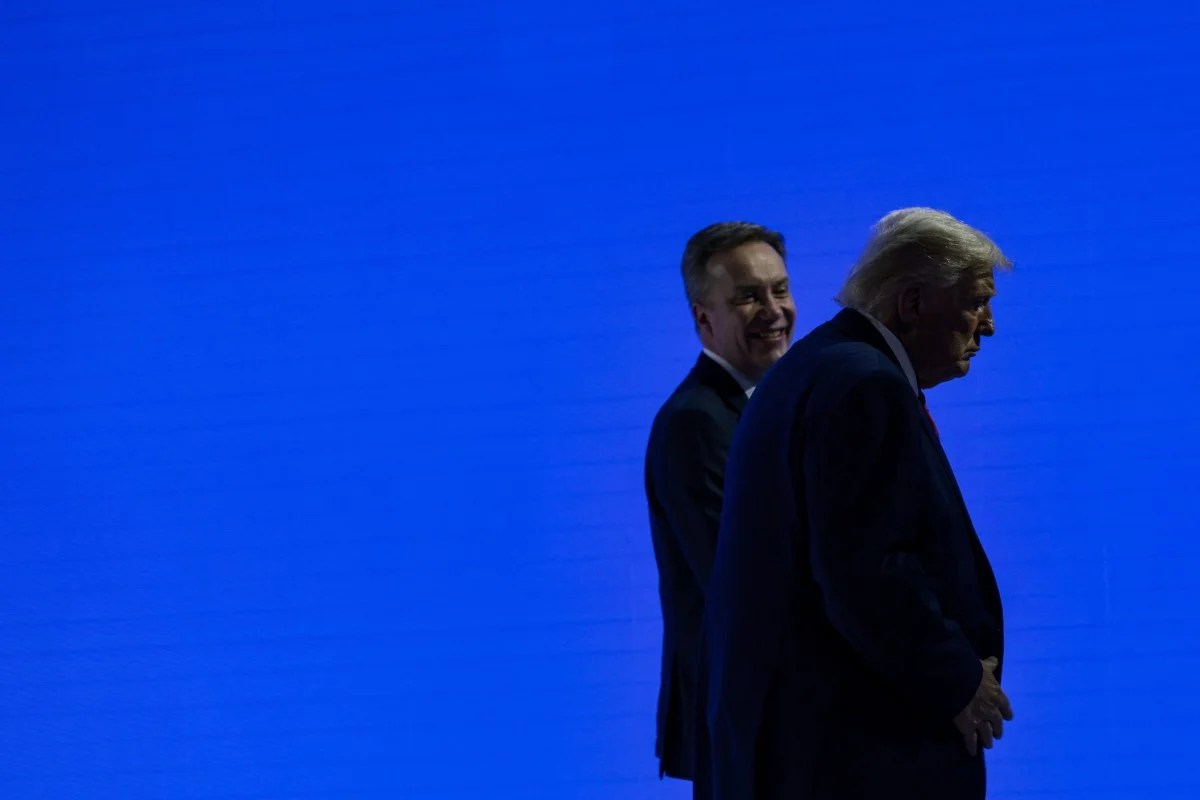
What the world witnessed at Davos was a president confusing bombast with leadership, swagger with strategy, and contradiction with strength. It was geopolitics performed as self-parody. – Christopher Bucktin
Donald Trump’s Davos appearance was billed as the moment the President of the United States would reassure a nervous world.
Instead, it became a spectacle of vanity, contradiction and geopolitical illiteracy that underlined just how dangerous his worldview has become. Standing before global leaders at the World Economic Forum, Trump did not so much deliver a foreign policy address as indulge in a performance aimed at his MAGA base and an imaginary audience that endlessly admires, fears, and obeys him.
The substance of the speech barely mattered. The damage did. What the world witnessed was a president confusing bombast with leadership, swagger with strategy, and contradiction with strength. It was geopolitics performed as self-parody. Nowhere was that clearer than in Trump’s fixation with Greenland. He presents it as if it were an underperforming golf resort he might snap up at auction, a frozen land waiting for the Trump logo.
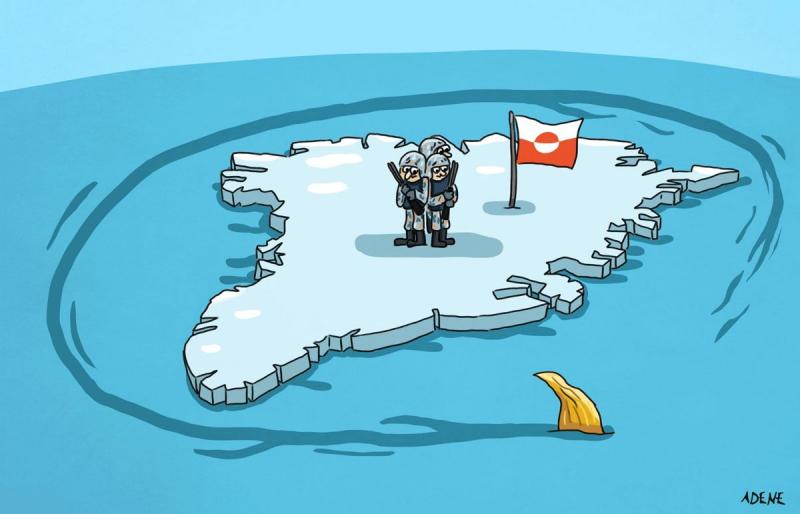
At Davos, he again insisted America must have “right title and ownership” of the island to defend it, as if sovereignty were a receipt you file away after purchase. The idea might sound comic, a billionaire landlord eyeing the world’s largest island like a distressed property, but the implications are not.
Greenland matters. It sits at a strategic junction between North America and Europe. As Arctic ice retreats, shipping routes open and the region’s military and economic value increases. The US already operates the strategically vital Pituffik Space Base, providing missile warning and surveillance across the North Atlantic.
Greenland also contains rare-earth minerals crucial to modern economies and defence systems. China understands this. Europe understands it. Britain understands it. America has understood it for decades. None of this has ever required ownership. Yet Trump cannot tell the difference between influence and possession. Cooperation bores him. Partnership is too subtle. Only control scratches the itch. His worldview is not that of a statesman balancing interests, but of a property developer pacing a showroom, demanding to know why the keys aren’t already in his hand.
For Europe, this is not an abstract concern. Greenland is an autonomous territory within the Kingdom of Denmark, a NATO ally. Trump’s casual talk of acquiring it, his maligning of Denmark’s defence spending and his flirtation with economic punishment crossed a basic line. If borders are treated as negotiable and sovereignty as optional, the post-war order starts to unravel. That is why European leaders reacted with barely concealed contempt. This was not anti-Americanism. It was alarm. Trump’s performance only deepened it.
He muddled Greenland with Iceland. He solemnly promised he would not use force before boasting that America would be “unstoppable” if it did. He reduced territorial acquisition to a cheeky request for “a piece of ice”. The contradictions piled up, delivered with the smug assurance of a man who believes confidence absolves him from coherence.
To be clear, American involvement in Greenland is not inherently sinister. The US presence has long helped secure the North Atlantic, and investment could support Greenland’s development while countering Chinese influence. But there is a chasm between partnership and coercion. Trump offers the latter and sells it as leadership, like a protection racket dressed up as diplomacy.
What made the episode truly farcical, however, was how quickly the strongman act collapsed. After weeks of sabre-rattling and Davos posturing, Trump quietly changed his tune. Suddenly, last night, there were talks. Suddenly, there was a “framework”. Suddenly, the threats to slap tariffs on European allies melted away.
On social media, Trump claimed discussions with NATO had been “very productive” and that a deal covering Greenland and the Arctic was emerging. Diplomatic reality was less obliging. There is no agreement for US ownership. No transfer of sovereignty. No Arctic land grab. The “framework” looks suspiciously like a retreat, hurriedly repackaged as victory.
While Trump was busy applauding himself, the most serious intervention at Davos came from Mark Carney, who articulated what many leaders now accept privately. The Canadian Prime Minister, who, despite being fairly new in office, has quickly grown to become the adult in the room.
He said the US-led global order is fractured, and that trust in American leadership has eroded. Allies can no longer assume that Washington, while under Trump, will act predictably or in good faith. Trump’s Greenland antics are not a blip; they are a symptom. When the leader of the world’s most powerful democracy treats alliances as transactional, sovereignty as inconvenient and diplomacy as a bullying exercise, the consequences ripple outward. Bad actors feel emboldened. Rules weaken. Uncertainty grows.
Into that vacuum steps more conflict, not less. Carney’s conclusion—that the future demands more multilateralism and less blind reliance on an America that has chosen to be unreliable—was hard to dispute. For us, this matters profoundly. Britain is a NATO power, a close US ally and a European neighbour. It depends on stability, rules and trust.
Trump’s approach to Greenland undermines all three. If borders become bargaining chips, middle powers lose leverage. If alliances resemble protection rackets, collective defence frays. If American commitments hinge on flattery, Britain must adjust.
That is why Keir Starmer was right to say the UK would not yield to Trump’s demands. Standing firm is not hostility towards the United States; it is respect for international law and for our own interests. Indulging Trump’s fantasies would only encourage fresh ones.
Trump will leave Davos claiming he had impressed the world. In reality, he confirmed its worst fears. He contradicted himself within sentences. He confused countries. He lied about NATO, ignoring that Article 5 has been invoked only once, in defence of the US after 9/11. He even recycled the lie that the 2020 election was “rigged”, informing a global audience that American democracy itself is fraudulent. It is not strength. It is instability, broadcast live. The ridicule is earned.
A president who boasts that world leaders call him “Daddy” is not projecting authority; he is advertising insecurity. A leader who thinks admiration can be demanded rather than earned is not commanding respect; he is pleading for it.
Beyond the mockery, however, lies a serious truth. Trump’s obsession with Greenland exposes a worldview that rejects equals, despises restraint and elevates ego above order.
It treats alliances as optional, law as an inconvenience and power as entitlement. That is why Europe pushed back. That is why Britain did too. Greenland is not just about ice, minerals or bases. It is about whether the rules governing international relations still matter. At Davos, Trump made clear that, for him, they do not. – Mirror, 22 January 2026
› Christopher Bucktin is the United States editor for the Mirror.
 VOICE OF INDIA