
James Prinsep first served in Calcutta and then in Benaras for ten years. Prinsep’s stay in Varanasi—from 1820 to 1830—is what is of interest and importance against the backdrop of what is unfolding today. – Yudhajit Shankar Das
At a walking distance from Kolkata’s Eden Gardens is the Prinsep Ghat on the banks of the River Hooghly. One gets a close view of the Vidyasagar Setu and can take a boat ride on the Hooghly from Prinsep Ghat.
The ghat is named after James Prinsep, a British numismatist and archaeologist, who made significant contributions to India’s historiography. He came to India when he was 28 and was the youngest fellow of the British Asiatic Society.
It was Prinsep who deciphered the Brahmi and Kharosthi scripts and helped the world know about Emperor Ashoka’s reign. It was he who established that King Devanampriya Piyadasi, who is mentioned in several inscriptions from Sri Lanka to Afghanistan, was none other than Emperor Ashoka.
The ghat in Kolkata was named after Prinsep as a way to recognise his contributions after he passed away in London in 1840 at the young age of 41.

James Prinsep and his ‘Benares Illustrated’
James Prinsep first served in Calcutta (now Kolkata) and then in Benaras (now Varanasi) for ten years. Prinsep’s stay in Varanasi (from 1820 to 1830) is what is of interest and importance against the backdrop of what is unfolding now.
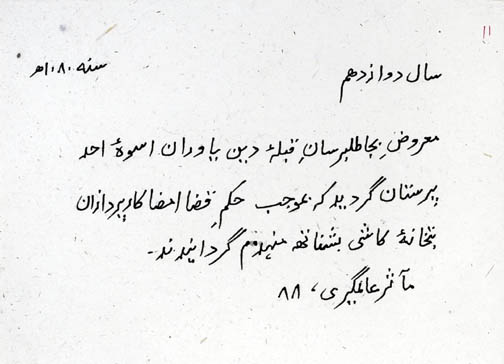
Prinsep built Varanasi’s underground sewage system, which is still operational, restored the Alamgir Mosque, built by Mughal Emperor Aurangzeb in 1669, and drew the city’s maps. He also brought out a book, Benares Illustrated, A Series of Drawings, in 1831.
That book and the map will be used as part of evidence by the Hindu side in the legal battle for the Gyanvapi complex, IndiaToday has been told.
In Benares Illustrated, James Prinsep used lithography to engrave every scene on paper and present information with evidence. Chapters and illustrations include Munikurnika Ghat, Bruhma Ghat, Procession of the Tazeeas and Hindoo Nach Girls.
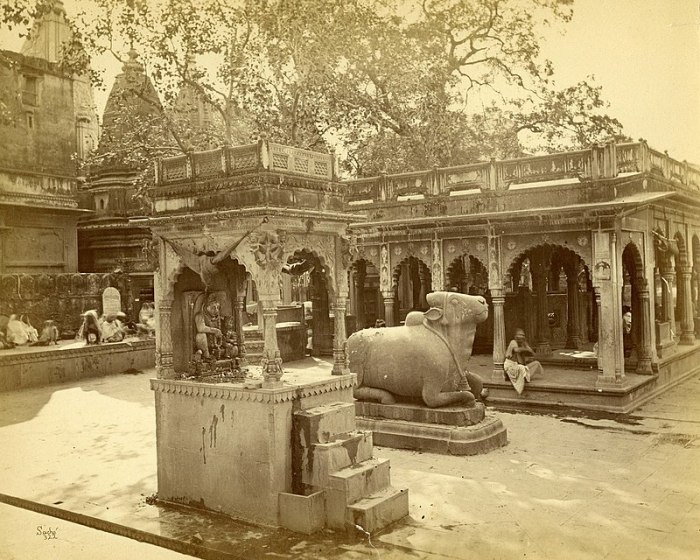
Most importantly, James Prinsep, in Benares Illustrated, discussed the architecture of the old Vishweshwar Temple, and how the original place of worship was converted to the present Gyanvapi Mosque. Vishweshwar or Lord of the Universe is another name for Lord Shiva.
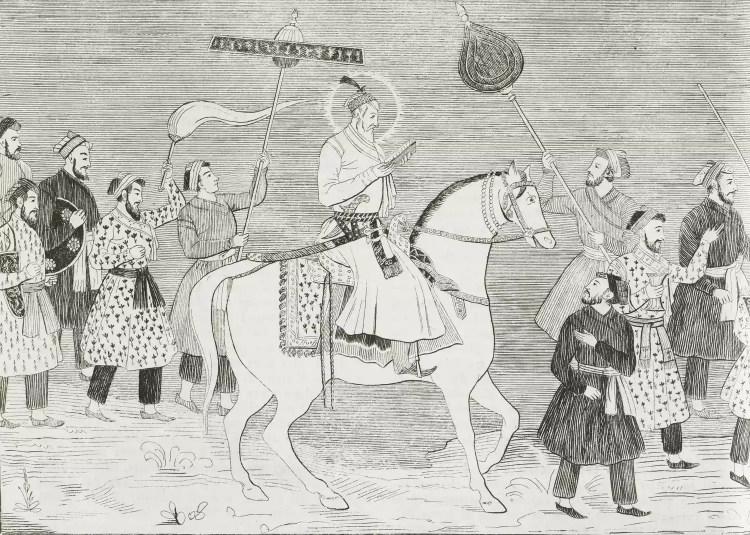
Prinsep on Auranzeb’s bigotry
In Benares Illustrated, Prinsep details how Aurangzeb’s men used the material from the destroyed Kashi Vishweshwar Temple to build the Gyanvapi Mosque.
“The bigotry of Aurungzeb did not allow many vestiges of this more ancient style to remain. In 1660, for some trifling resistance to the imposition of a capitation tax, he took occasion to demolish the principal Shiwalas, and constructed Musjids or mosques with the same materials and upon the same foundations, leaving portions of the ancient walls exposed here and there, as evidence of the indignity to which the Hindoo religion had been subjected,” Princep writes.
The Kashi Vishweshwar Temple is of immense significance in Hinduism as it is one of the 12 Jyotirlingas or temples where Lord Shiva is said to have appeared as a column of light. Lord Shiva is said to have created a water-producing spot there hence the name Gyanvapi (well of knowledge).
The Adi Vishveshwara Temple was destroyed by Qutb ud-Din Aibak, the general of Muhammad Ghori, in 1194 but was rebuilt. It was Aurangzeb who razed the Kashi Vishweshwar Temple again in 1669 and built the Gyanvapi Mosque using the same foundations and materials.
It is very similar to the use of materials from the destroyed 12th-century temple that was used to build the Babri Masjid in Ayodhya. The Babri Masjid was constructed in 1528 by Babur’s commander, Mir Baqi.
Babur was the first Mughal ruler in India, while Aurangzeb was the last of that family to hold sway.


Prinsep’s 200-year-old map of Gyanvapi Temple
Prinsep then went on to reveal the old plan of the Vishweshwar Temple by drawing a map and marking on it how the Aurangzeb-built mosque stood on it.
But how could Prinsep, who came to Varanasi in the 19th century, come up with the map of the old Kashi Vishweshwar Temple, which was destroyed by Aurangzeb in the 17th Century, after a gap of about 160 years?
Prinsep explains in Benares Illustrated how he exactly managed to draw the map of the old Vishweshwar temple.
“Antiquarians will be well pleased that the Moosulmans, in their zeal for the triumph of their own religion, discovered a method of converting the original structure into a capacious Musjid, without destroying above one-half of its walls; so that not only the ground plan but the entire architectural elevation, may still be traced out,” he writes.
In the chapter “Plan of the old Vishveshwur Temple” of Benares Illustrated, Prinsep shares the map that shows that the old Kashi Visheshwar Temple had eight mandaps and the central section which Prinsep calls ‘Mahadeo’.
“The darkly shaded part shews the figure and foundations of the principal dewul: the fainter, those of the outer dewulees. The whole must have formed, when complete, a picturesque groupe of nine spires around a central pyramid. The heights diminishing from the centre towards the corners in the proportions of sixteen, eight, and six, as seen by the ground plan,” he writes.
The book and the map will be part of the evidence put forward in the Gyanvapi case, advocate Vishnu Jain, who represents the Hindu side in courts of law, confirmed to IndiaToday.

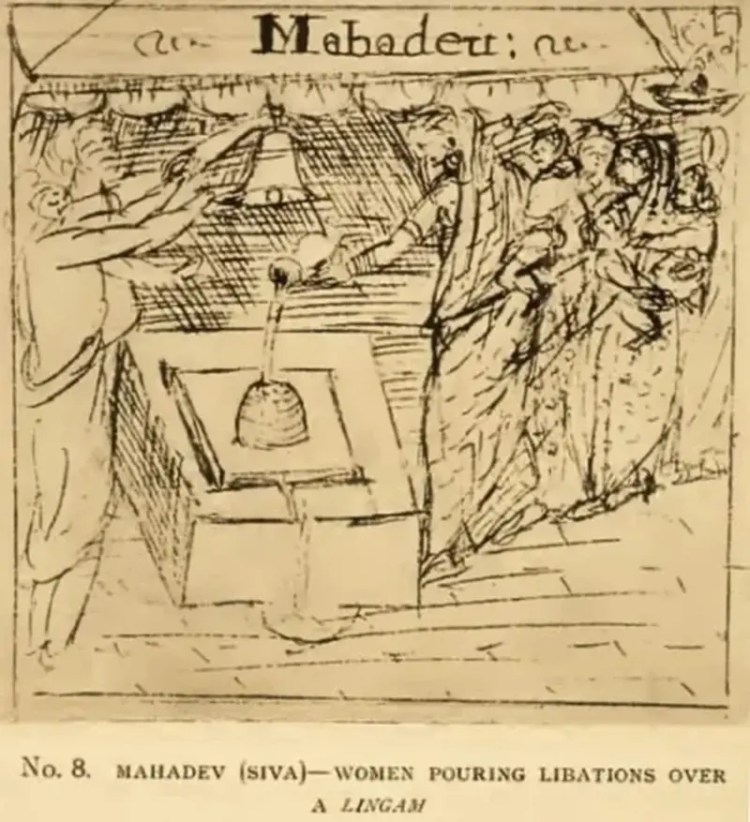
Prinsep on the ‘Lingam’ at Gyanvapi Masjid
“The principal lingam of Mahadeo stood in an ornamented reservoir in the centre, having a drain below to carry off the Ganges water continually poured over it by day and night,” writes James Prinsep in his Benares Illustrated.
“Prinsep has shown the place of Vishweshwar or Mahadev in the centre of the temple and indicates that the principal lingam was located in a water reservoir and that could be the so-called fountain in the wazukhana, which could have been originally the ornamented reservoir having the lingam,” B.R. Mani, Director General of National Museum, tells IndiaToday.
Mani, who led the Allahabad High Court-ordered excavation at the then-disputed Ram Janmabhoomi-Babri Masjid site in 2003, says that more research is needed to ascertain if it is, in fact, the ‘Lingam’ that James Prinsep mentions.
The wazukhana, or the ablution area, of the Gyanvapi Mosque was sealed in 2022 following a Supreme Court order. According to the Hindu side, the fountain-like structure in the wazukhana is a Shivling or lingam.
This is what Prinsep seems to have suggested in his 1831 book.
“If you draw a graph of human genius, James Prinsep would head the list along with Leonardo da Vinci,” said O.P. Kejariwal, then Director of Nehru Memorial Library, in 2001.
The Gyanvapi site is seeing fast-paced action. A Varanasi court has allowed Hindus to perform puja in one of the cellars, Vyas ji ka Tehkhana, which was ordered sealed by former Uttar Pradesh Chief Minister Mulayam Singh in 1993.
Amid the legal battle surrounding the Gyanvapi site, James Prinsep and his Benares Illustrated, A Series of Drawings of 1831 are interesting to revisit. Both will likely play a key role in the events that follow.
As all the focus is on the Gyanvapi site, about 680 km from Varanasi, stands Prinsep Ghat in Kolkata, in the balmy breeze blowing from the Hooghly River. – IndiaToday, 7 February 2024
› Yudhajit Shankar Das is a deputy editor at IndiaToday.




 VOICE OF INDIA