What Mahmud of Ghazni did must not be forgotten – Reshmi Dasgupta

Somnath temple converted to mosque ca 1931.

What happened during this week 1,000 years ago was not a one-off assault by a greedy Central Asian despot who just incidentally happened to be Muslim. Mahmud’s destruction of Somnath set off a millennium-long assault on it by men who definitely had one thing in common apart from Islam: an animus towards the Jyotirlinga. – Reshmi Dasgupta

From January 6 to 9, 1026, the army of Mahmud of Ghazni lay siege to the wondrous temple of Somnath near the port city of Veraval. The defenders of the fortified shrine eventually could not repel the troops of the Central Asian invader and Somnath was captured. It was Mahmud’s 16th raid on India and loot was not the only target. Contemporary sources mention that Hindu merchants offered more money if he spared the idol; he refused and struck the first blow.

For that act, Mahmud earned the title “Butshikan” or idol-breaker, from an admiring Islamic world and his renown for the desecration of Somnath and other major Hindu temples in India persisted for centuries. Sultan Sikandar Shah earned the same Butshikan title in the 14th century for destroying temples in Kashmir in pursuance of the precepts of the Sufi preacher Mir Mohammad Hamadani. Even 600 years later, Aurangzeb appreciated Mahmud’s Islamic fervour.

It is inevitable that Prime Minister Narendra Modi’s commemoration of the 1000th anniversary of the first destruction (as opposed to the misleading word “sacking” commonly used for the violent actions of Mahmud of Ghazni) of the Somnath temple will be countered with supposed “proof” of either “Arab” heroism or Hindu perfidy or both. It is now almost an article of faith among certain sections in India and abroad that Mahmud was more maligned than malevolent.

As has been often pointed out in recent times, the assertions of the high priestess of the secular camp Romila Thapar on the destruction of Somnath lack basis in actual facts even if delivered with withering condescension in impeccable upper class accented English. But there are plenty of willing believers in Thapar’s argument that Mahmud was not communal—merely venal—and that his destruction of the magnificent Shiva lingam at Somnath was incidental.

Indeed, the PM calling the repeated rebuilding of Somnath after each brutal destruction and plunder a symbol of the “unbreakable courage of countless children of Bharat Mata who protected our culture and civilisation” will be met with predictable counters. First, that “Arabs”—mainly traders who had settled in the area and married local women—died protecting Somnath from Mahmud’s marauders. Second, that there were many Hindus in Mahmud’s army.

There were indeed Hindus in Mahmud’s army, including battalion commanders, and he used them with varying effectiveness in campaigns on the subcontinent and even further north in Central Asia. But the phenomenon of mercenaries—soldiers of fortune who fight for the best paymaster—is well known. The presence of Hindus in his army cannot be taken to mean Mahmud was “secular” or that his actions were not intended to attack and diminish India’s majority faith.

There is no dependable account of Arabs dying while defending Somnath, but they could well have been miffed by their co-religionists from Ghazni disturbing their livelihoods. Arabs had all been Islamised by then although earlier traders and sailors may have adhered to pre-Islamic faiths including Christianity. So, it would be a stretch to imagine they would risk irking Allah by actually fighting alongside local Hindus kafirs to save Somnath from his holy warriors.

The Veraval Inscriptions (so named for the ancient port town next to the Somnath, which had a bustling mercantile trading business) dated to about 250 years after Mahmud’s destruction of the great Shiva lingam, highlight the dynamic between the two communities in the last millennium. The bilingual inscriptions from the reign of the Vaghela king Arjundev, records an agreement for the financing of the upkeep of a mosque at Somnath Patan built by a resident of Hormuz.

Curiously, the longer Sanskrit inscription lists the Hindu king and hierarchy but mendaciously describes the lord of the mosque as Vishwanatha and Shunyarupa and even calls Prophet Mohammed a “prabodhak” or preceptor. The Muslim shipowner donor from Hormuz Nuruddin Firoz is called a “dharmabandhav” of Sri Chhada who seems to be the mosque’s chief administrator. But in the shorter Arabic notation, there is no attempt to Indianise Allah or his Prophet.

The twin inscriptions seem to indicate that Hindu rulers bore no lasting animus against all Muslims—especially the Arab and Persian merchants from the Gulf—for the depredations of the Turkic invader from Ghazni 200 years before, and allowed them to set up mosques near the temple. But one sentence of the Arabic inscription points to the thinking of the Muslims even if they attempted to couch their initial outreach to the Hindus with seemingly syncretic gestures.

The Arabic inscription expresses the hope that Somnath will one day become a city of Islam, and that infidels and idols will eventually be banished from it. Why did the officials of the Vaghelas (the last Hindu kingdom of the region) allow that explicit expression of intent to pass unchallenged? Could they not read Arabic? Or were they persuaded, as indeed are some academics reading it 750 years later, that it was a “pro forma” statement and did not constitute a threat?In the event, though Somnath was revered enough for the 11th century Chalukya ruler Bhima I to rebuild it after Ghazni’s desecration, local inhabitants naively seemed to have borne no permanent suspicion of Muslims as the Veraval inscriptions two and a half centuries later seems to confirm. But a mere 35 years after those twin plaques were incised, the army of Delhi’s Sultan Alauddin Khilji under Ulugh Khan pillaged and destroyed Somnath yet again.

And that deed was approvingly chronicled by no less than the much-admired (even today) Persian poet Amir Khusro. In Khazain-ul-Futuh (Treasures of Victory), he gleefully wrote in 1310 (after Khilji’s armies attacked again in 1304 and annexed all of Gujarat):

“So the temple of Somnath was made to bow towards the Holy Mecca; and as the temple lowered its head and jumped into the sea, you may say that the building first said its prayers and then had a bath.”

He also added:

“It seemed as if the tongue of the imperial sword explained the meaning of the text: ‘So he (Abraham) broke them (the idols) into pieces except the chief of them, that haply they may return to it.’ A pagan country, the Mecca of the Infidels, now became the Medina of Islam. The followers of Abraham now acted as guides in place of the Brahman leaders. The robust-hearted true believers rigorously broke all idols and temples wherever they found them.”

Khusro also dispelled doubts about the intent of the Arabic Veraval inscription:

“Owing to the war, ‘takbir,’ and ‘shahadat’ was heard on every side; even the idols by their breaking affirmed the existence of God. In this ancient land of infidelity, the call to prayers rose so high that it was heard in Baghdad and Madain while the Khutba resounded in the dome of Abraham and over the water of Zamzam. The sword of Islam purified the land as the Sun purifies the earth.”

That Khusro described Somnath as the “Mecca of Infidels” underlines its primacy as a Hindu centre of worship, reiterating its pride of place as the first of the 12 Jyotirlingas listed in the Shiva Purana. So it is not surprising that every Muslim ruler thereafter who wanted to assert his religious cred and supremacy attacked Somnath, from Muzaffar Shah to Mahmud Begada to Aurangzeb. But it was restored, rebuilt, reconsecrated faithfully by Hindu rulers each time.

What is glossed over by apologists is that Somnath was not considerately left to resume worship. It was converted into a mosque by several Islamic attackers and then reconstructed repeatedly as a temple by Hindu monarchs. It was turned into a domed mosque by Aurangzeb in 1665. And the final rebuild happened in 1951, thanks to the determined efforts of Sardar Patel, KM Munshi and Dr Rajendra Prasad in the teeth of opposition from Prime Minister Jawaharlal Nehru.

In 1783, the formidable Maratha queen Ahilyabai Holkar had another Shiva temple constructed 200 metres from the original site of Somnath, whose added dome and minaret can be seen in late 19th century photographs now in the British Library. She had done the same three years earlier in Varanasi where the original Kashi Vishwanath temple had been mostly destroyed (only one wall left standing) and rebuilt as “Gyanvapi” mosque, also on Aurangzeb’s orders.

So, what happened during this week 1,000 years ago was not a one-off assault by a greedy Central Asian despot who just incidentally happened to be Muslim. Mahmud’s destruction of Somnath set off a millennium-long assault on it by men who definitely had one thing in common apart from Islam: an animus towards the Jyotirlinga. That it is standing proudly again is indeed a testament to the quiet determination and faith of the children of Bharat Mata, as PM Modi said. – News18, 7 January 2026

›  Reshmi Dasgupta is a freelance writer formerly with the Times of India Group. 
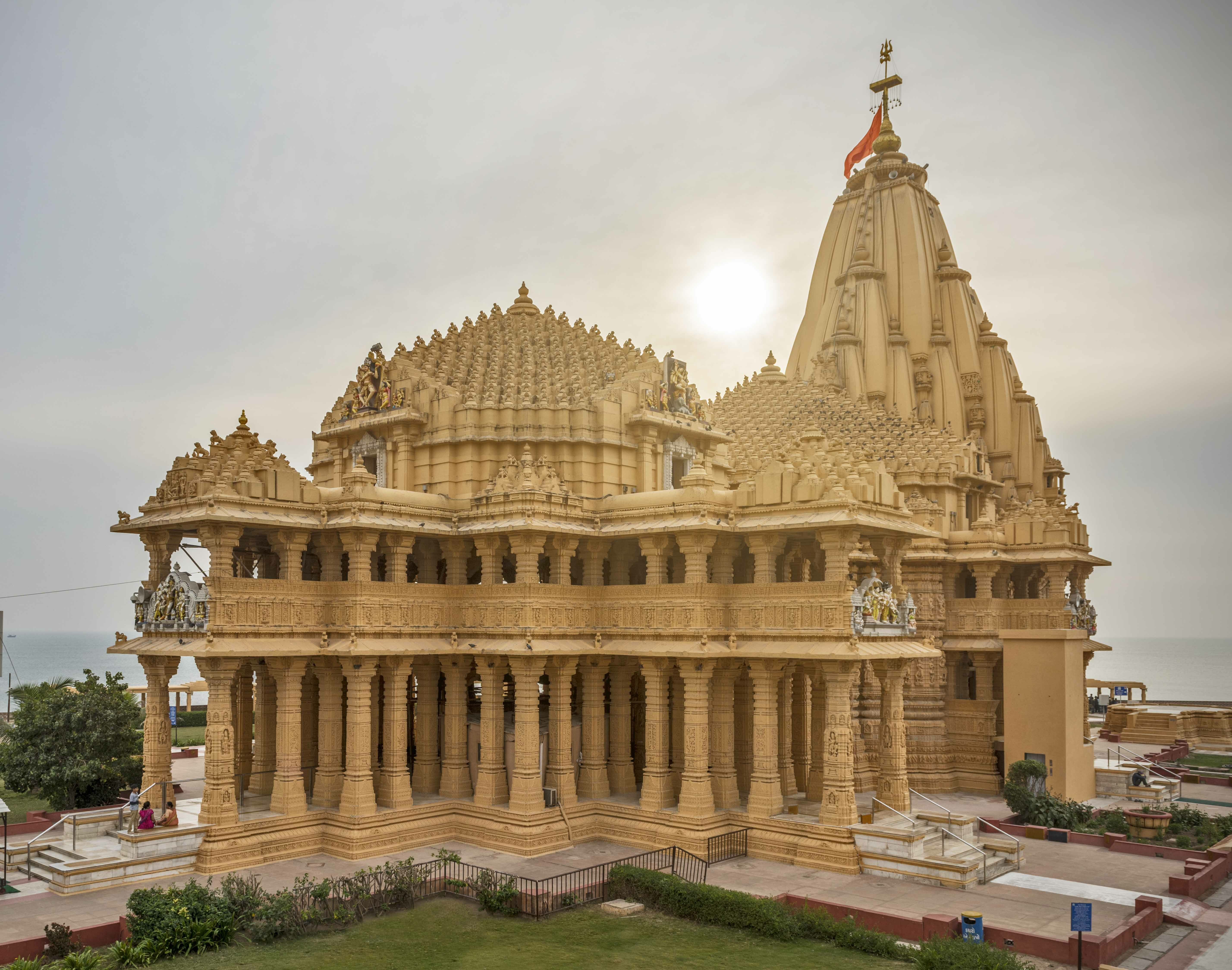
Somnath Temple

Somnath: A thousand years of unbroken faith – Narendra Modi

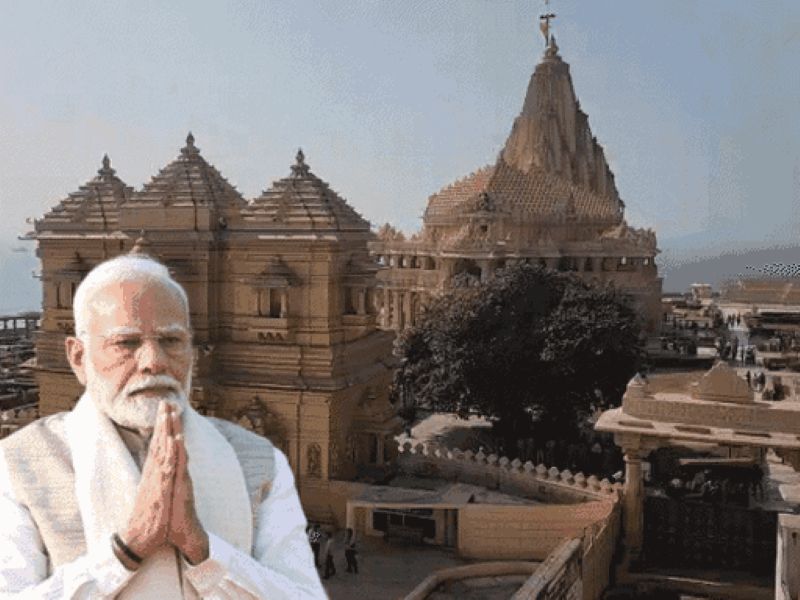
Narendra Modi at the Somnath Temple.

If the Somnath Temple, which was attacked a thousand years ago and faced continuous attacks thereon, could rise again and again, then we can surely restore our great nation to the glory it embodied a thousand years ago before the invasions. – PM Narendra Modi

Somnath … hearing this word instils a sense of pride in our hearts and minds. It is the eternal proclamation of India’s soul. This majestic temple is situated on the western coast of India in Gujarat, at a place called Prabhas Patan. The Dwadasha Jyotirling Stotram mentions the 12 Jyotirlings across India. The stotram begins with “सौराष्ट्रे सोमनाथं च…” symbolising the civilisational and spiritual importance of Somnath as the first Jyotirling.

It is also said:

सोमलिङ्गं नरो दृष्ट्वा सर्वपापैः प्रमुच्यते ।

लभते फलं मनोवाञ्छितं मृतः स्वर्गं समाश्रयेत्॥

It means: Just the sight of Somnath Shivling ensures that a person is freed of sins, achieves their righteous desires and attains heaven after death.

Tragically, this very Somnath, which drew the reverence and prayers of millions, was attacked by foreign invaders, whose agenda was demolition, not devotion.

The year 2026 is significant for the Somnath Temple. It has been 1,000 years since the first attack on this great shrine. It was in January of 1026 that Mahmud of Ghazni attacked this temple, seeking to destroy a great symbol of faith and civilisation, through a violent and barbaric invasion.

Yet, one thousand years later, the temple stands as glorious as ever because of numerous efforts to restore Somnath to its grandeur. One such milestone completes 75 years in 2026. It was during a ceremony on May 11th 1951, in the presence of the then President of India, Dr. Rajendra Prasad, that the restored temple opened its doors to devotees.

The first invasion of Somnath a thousand years ago in 1026, the cruelty that was unleashed upon the people of the town and the devastation that was inflicted upon the shrine have been documented in great detail in various historical accounts. When you read them, the heart trembles. Each line carries the weight of grief, cruelty and a sorrow that refuses to fade with time.

Imagine the impact it had on Bharat and the morale of the people. After all, Somnath had great spiritual significance. It was also on the coast, giving strength to a society with great economic prowess, whose sea traders and seafarers carried tales of its grandeur far and wide.

Yet, I am proud to state unequivocally that the story of Somnath, a thousand years after the first attack, is not defined by destruction. It is defined by the unbreakable courage of crores of children of Bharat Mata.

The medieval barbarism that began a thousand years ago in 1026 went on to ‘inspire’ others to repeatedly attack Somnath. It was the start of an attempt to enslave our people and culture. But, each time the temple was attacked, we also had great men and women who stood up to defend it and even made the ultimate sacrifice. And every single time, generation after generation, the people of our great civilisation picked themselves up, rebuilt and rejuvenated the temple. It is our privilege to have been nurtured by the same soil that has nurtured greats like Ahilyabai Holkar, who made a noble attempt to ensure devotees can pray at Somnath.

In the 1890s, Swami Vivekananda visited Somnath and that experience moved him. He expressed his feelings during a lecture in Chennai in 1897 when he said:

“Some of these old temples of Southern India and those like Somnath of Gujarat will teach you volumes of wisdom, will give you a keener insight into the history of the race than any amount of books.

“Mark how these temples bear the marks of a hundred attacks and a hundred regenerations, continually destroyed and continually springing up out of the ruins, rejuvenated and strong as ever! That is the national mind, that is the national life-current. Follow it and it leads to glory. Give it up and you die; death will be the only result, annihilation, the only effect, the moment you step beyond that life current.”

The sacred duty of rebuilding the Somnath Temple after independence came to the able hands of Sardar Vallabhbhai Patel. A visit during Diwali time in 1947 moved him so much that he announced that the temple will be rebuilt there. Finally, on May 11th 1951, a grand temple in Somnath opened its doors to devotees and Dr. Rajendra Prasad was present there. The great Sardar Sahib was not alive to see this historic day, but the fulfilment of his dream stood tall before the nation.

The then Prime Minister, Pandit Jawaharlal Nehru, was not too enthused with this development. He did not want the Honourable President as well as Ministers to associate with this special event. He said that this event created a bad impression of India. But Dr. Rajendra Prasad stood firm and the rest is history. No mention of Somnath is complete without recalling the efforts of K.M. Munshi, who supported Sardar Patel very effectively. His works on Somnath, including the book, Somanatha: The Shrine Eternal, are extremely informative and educative.

Indeed, as the title of Munshiji’s book conveys, we are a civilisation that carries a sense of conviction about the eternity of spirit and of ideas. We firmly believe that that which is eternal is indestructible, as outlined in the famous Gita verse “नैनं छिन्दन्ति शस्त्राणि….” There can be no better example of our civilisation’s indomitable spirit than Somnath, which stands gloriously, overcoming odds and struggles.

It is this same spirit that is visible in our nation, one of the brightest spots of global growth, having overcome centuries of invasions and colonial loot. It is our value systems and the determination of our people that have made India the centre of global attention today. The world is seeing India with hope and optimism.

They want to invest in our innovative youngsters. Our art, culture, music and several festivals are going global. Yoga and Ayurveda are making a worldwide impact, boosting healthy living. Solutions to some of the most pressing global challenges are coming from India.

Since time immemorial, Somnath has brought together people from different walks of life. Centuries ago, Kalikal Sarvagna Hemchandracharya, a respected Jain monk, came to Somnath. It is said that after praying there, he recited a verse, “भवबीजाङ्करजनना रागाद्या: क्षयमुपगता यस्य।”. It means: “Salutations to That One in whom the seeds of worldly becoming are destroyed, in whom passion and all afflictions have withered away.” Today, Somnath holds the same ability to awaken something profound within the mind and soul.

A thousand years after the first attack in 1026, the sea at Somnath still roars with the same intensity as it did back then. The waves that wash the shores of Somnath tell a story. No matter what, just like the waves, it kept rising again and again.

The aggressors of the past are now dust in the wind, their names synonymous with destruction. They are footnotes in the annals of history, while Somnath stands bright, radiating far beyond the horizon, reminding us of the eternal spirit that remained undiminished by the attack of 1026. Somnath is a song of hope that tells us that while hate and fanaticism may have the power to destroy for a moment, faith and conviction in the power of goodness have the power to create for eternity.

If the Somnath Temple, which was attacked a thousand years ago and faced continuous attacks thereon, could rise again and again, then we can surely restore our great nation to the glory it embodied a thousand years ago before the invasions. With the blessings of Shree Somnath Mahadev, we move forward with a renewed resolve to build a Viksit Bharat, where civilisational wisdom guides us to work for the welfare of the whole world.

Jai Somnath! – The New Indian Express, 5 January 2026

Narendra Modi is the Prime Minister of India and Chairman of the Shri Somnath Temple Trust.

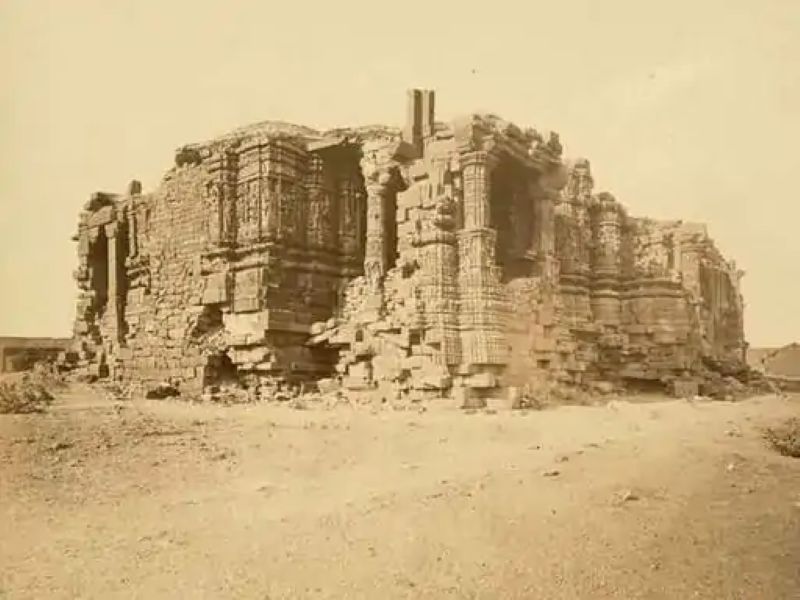
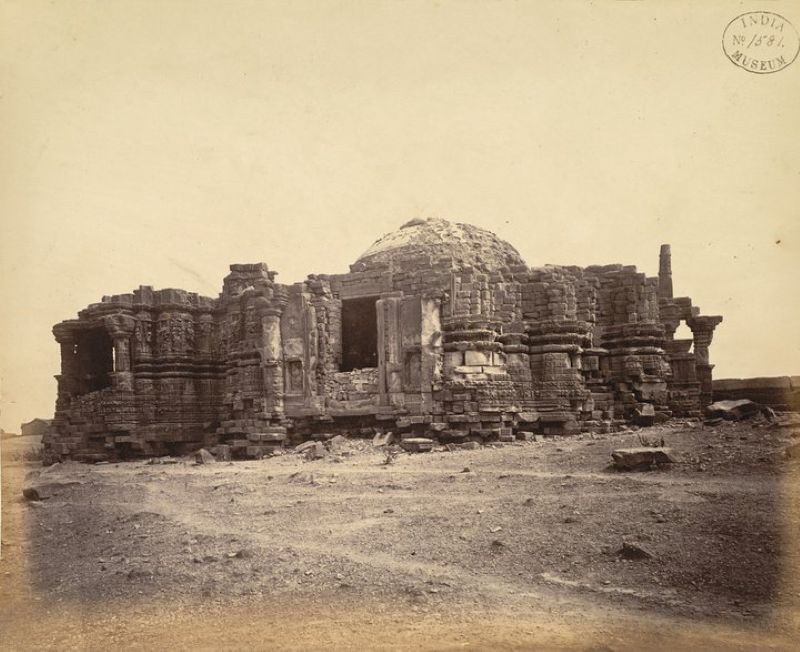
Ruins of Somnath as viewed in 1869

Nandi’s Witness: The moral question and obvious evidence at Gyanvapi Mosque – Venu Gopal Narayanan

It is a moral question: if, by custom, tradition, belief, and history, Nandi has always been posted to watch over Shiva, why have legalistic delays and an otiose intransigence prevented him from resuming his duties for so long? – Venu Gopal Narayanan

The issue of whether the Gyanvapi mosque in Varanasi was built on a Shiva temple, or not, is entering its denouement phase in various courts.

A number of questions are being asked: many are legal; more are legalistic; others are technical; and some, as always, are wretchedly political ones pregnant with instigative intent.

Original Kashi Vishwanath Temple with Gyanwapi Mosque standing atop it.

At one level, the entire legal ruckus seems slightly mindless and wholly needless, since the three domes of the mosque rest on the intricately sculpted remnant western wall of what is clearly a Hindu temple.

But then, defending the indefensible using word play has long been the preferred modus operandi for some schools of politics.

Alleged Shiva linga found in a well in the Gyanvapi Mosque.

As a result, the questions are flying thick and fast: Is that linga-shaped object in the mosque’s forecourt a linga or a pillar? Is it old or new? Is it made of concrete or stone?

Will an archaeological survey bring out the truth? Why should a survey be allowed? Is the petition for a survey legally tenable? Why do ‘they’ want a survey? Won’t ‘they’ ever let us live in peace? Ad infinitum.

Separately, the media domain is filled with questions about the questioners.

Heady legal verbiage is distilled with reductionist severity, by self-styled experts blessed with only a passing knowledge of the law, to such an extent, that it makes the concept of ‘dumbing down’ seem intelligent.

It is entirely beside the point that most such efforts either miss the point, get it wrong, or merely muddy the pool further.

Auranzeb's firman ordering the destruction of the Kashi Vishwanath Temple (Sept. 1669).

Is that judge kosher? Why didn’t this lawyer make that point? What about the imperial firmans ordering the destruction of a temple at that very site? Can’t they be adduced as irrefutable evidence? Or, is it all a sinister majoritarian ploy? Again, ad infinitum.

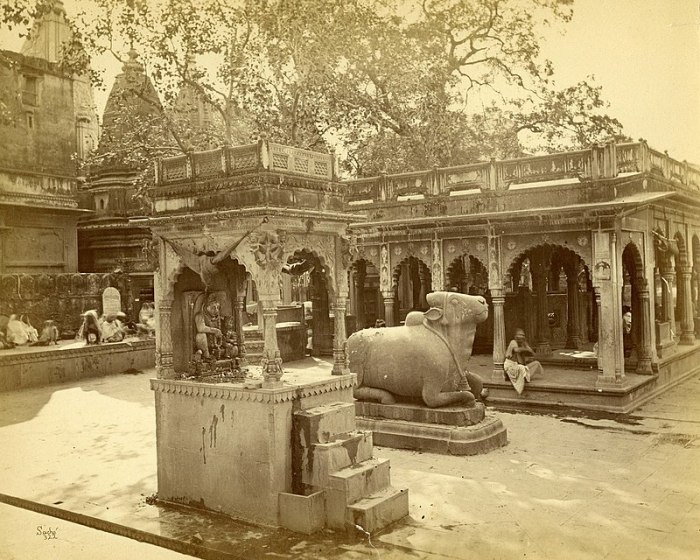
And then, there is a statue of a seated bull at the northern perimeter of the Vishwanath temple at Kashi, which has been quietly asking a different query ever since the ruckus began some centuries ago. He is Nandi, Shiva’s mount.

According to the legends which made this sacred land, Nandi is the keeper of Shiva’s abode, be it atop Mount Kailash, at Kashi, or any one of the innumerable grihas where a dreadlocked trident-bearer is the resident deity.

Nandi is endowed with great strength, and his job is to keep the peace while his Lord attends to various matters; so strong, in fact, that even Ravana, the invincible Lankan king, had to suffer a humiliating chastisement at Nandi’s hooves, when the royal visitor once threw a petulant fit after being forced to wait for an audience with Shiva at Kailash.

It is a task demanding eternal devotion and great fortitude, for which reason, Nandi is always found seated facing the abode of his master.

Photo by Britisher Samuel Bourne taken in the 1860s with the caption "Gyanvati is not a mosque, but a temple".

But this Nandi of Kashi has not seen peace, and oddly not his Lord, in a long age, for he sits facing away from the jyotirlinga of Vishwanath, gazing at a mosque through tall barricades erected by thoughts alien to this land. That is why his query is different from any other.

It is a moral question: if, by custom, tradition, belief, and history, he has always been posted to watch over Shiva, why have legalistic delays and an otiose intransigence prevented Nandi from resuming his duties for so long? It is a question for the ages.

Our modern questioners would rush to answer, excitedly and volubly, that the delay is on account of a small, but extremely influential section of the Muslim aristocracy, along with the secularist parties, who have turned the issue into a cause celebre for political control of a vote bank, and vital electoral profit.

Perhaps they are right, from a legal or a technical standpoint, but theirs is not a moral answer.

The reason is that an article of faith goes far beyond a judge, a court, a law, or an archaeological survey. It is an issue of morality: is it right to hinder Nandi thus? And the issue will be resolved peaceably, the day that point is answered honestly.

Consequently, it is not a matter of which court will answer Nandi’s query, or about how justly it will be answered, but when, because some questions cannot be avoided.

That is the way of dharma. In the end, the natural order of things is always restored by the truth.

Just as the Yaksha Prashna to Yudhishthira was the question of the Dvapara Yuga, Nandi’s query is the question for this Yuga, and the time for an answer has arrived. – Swarajya, 25 July 2023

Venu Gopal Narayanan is an independent petroleum consultant who focuses on energy, geopolitics, current affairs and electoral arithmetic.

Vishwanath Temple Complex and Gyanvapi Mosque.

Was Tipu Sultan really a patriot and great freedom fighter? – Jaithirth Rao

Tipu Sultan

The fact is Tipu was a brilliant military tactician and a weak military and political strategist. He allied with the French, who ended up on the losing side. He was bigoted and had megalomaniac pretensions of a Muslim conquest of India. – Jaithirth Rao

If only the Marxist editors of NCERT textbooks had admitted that Tipu Sultan was a flawed human being, perhaps some of us would not have many problems. The absence of such honesty makes us say: Ay, there’s the rub! In the Marxist version of the earlier sarkari sycophants, Tipu was a patriot, a tolerant, secular ruler, a great freedom fighter and so on. The question of “flaws” simply did not arise.

Tipu’s apologist, the Australian historian Kate Brittlebank, points out that he was virtually unique in being an Indian ruler who died fighting the British and did not take a pension from them. There is a considerable verisimilitude in that statement. But that does not automatically make Tipu a patriot. He allied with the French and if the fortunes of war had been different, India may have come under the rule of the French East India Company—not exactly a sanguine prospect for Indian patriots.

Misplaced patriotism of Tipu Sultan

The ruler of Mysore corresponded with the Sultan of Turkey and was not averse to that exalted person becoming the suzerain of India. At least for many of us, the British Raj was a better happenstance than an Ottoman Raj and that is our view as patriots. The Ottomans are unlikely to have built railways or set up universities, institutions that incidentally came up in the Ottoman Empire decades after they did in British India. Tipu wrote to Zaman Shah Durrani, the third king of the Durrani Empire in Afghanistan, to help throw out the British in India. Some of us see this as evidence of religious bigotry against Hindu Marathas, not secular patriotism.

In emphasising his anti-British credentials, which are taken as self-evident proof of his patriotism, the Delhi-JNU-Aligarh-Rutgers-Australia group of historians seem to forget that the British were not the only enemies of Tipu. In the last siege of Seringapatam (or Srirangapatna, if you so prefer) in 1799, there were more Hyderabad Nizam’s soldiers in the army attacking Tipu’s than those of the East India Company. And I assume that no one can accuse the Nizam of being a Hindu bigot. There were a lot of Maratha soldiers too. In fact, more soldiers loyal to Indian rulers, Hindus and Muslims, fought Tipu than the soldiers of the East India Company, which the Marxists love to hate.

My mother’s family is of “old Mysorean” vintage and many of these tales are stories I have heard from my grandfather Madhava Rao and my many granduncles. Our narrative is that while Tipu’s father and ruler of Mysore Hyder Ali was a usurper, he nevertheless maintained the fiction that he was a deputy of our beloved Wodeyar kings. It is Tipu who started calling himself “Sultan” and who marginalised our traditional rulers completely. The dowager Wodeyar Maharani Lakshmammanni was in correspondence with the British who she saw as legitimate “restorers” of order in our land and who looked upon Tipu as the disloyal, treacherous and, need I say, unpatriotic traitor. The Marxist historians will doubtless dismiss the venerable lady as a Hindu bigot or in current parlance as a supremacist.

Kodavas, Roman Catholics, Nairs, and the British

It is interesting to note how the Marxists of today are making light of the sufferings of Kodavas of Coorg (or Kodagu) and slyly portraying them as British agents. The fact is that most Kodavas hate Tipu who allegedly forcibly converted many of them. The descendants of this community of Kodava “converts” are still around.

Tipu was also brutal towards the Nair community of Travancore and Malabar. Again, forced conversions were the rule. And he followed it up with the destruction of temples. His worst depredations were against the Roman Catholic Christians of Mangalore. Forced marches, forced conversions, abductions of Mangalorean Christian women—all of these are documented and well-known. I wonder if the bishops of today’s crypto-Marxist Roman Church in India will even bother to talk about this. The Leftist historians of the world dismiss Tipu’s cruelty to British prisoners, including the forcible dressing of young drummer boys as girls and the violation of their civil rights as “imperialist propaganda.” It definitely was propaganda. But let us not forget the kernel of truth in these accounts.

The so-called secular historians talk endlessly about Tipu’s support of the Hindu temples of Srirangapatna and Nanjangud and of the Sringeri Mutt. Many of these are documented and cannot and should not be denied. But if the historians are neutral, they should have the integrity and courage to state that some of this support stemmed from Tipu’s faith in these temples possessing unique abilities in the realm of astrological predictions. Tipu was a believer in astrology. I give him credit for that. Will secular historians do the same?

A brilliant tactician but a weak strategist

The other point that the Marxist historians make is that Purnaiah, who was a Brahmin and a minister under Hyder Ali and Tipu, was pro-Tipu. This is true. But the same historians could have and should have added that many Mysoreans believed and still do that Purnaiah was a traitor a few times over!  I have a simple explanation. Purnaiah was perhaps a nobody until Hyder spotted him and his entire rise, including becoming the  Diwan of Mysore, was on account of Hyder and later Tipu. He was simply being loyal to his benefactors. Incidentally, in his later life, Purnaiah was equally loyal to the East India Company. Arthur Wellesley, who later became the Duke of Wellington, respected and admired Purnaiah. My grand-uncle Nagaraja Rao, a devout Brahmin himself, while talking about Purnaiah once told me that “Brahmins have a chameleon-like ability to adjust realistically to the powers that be.” That might sum up the Purnaiah story. Not loyalty or disloyalty, but realism.

Tipu called his government (which from our family’s point of view, was one of usurpers) the Sarkar-e-Khudadad, an Islamic Persian expression indicating that it was the government of God. Tipu deliberately introduced Persian into the land records of his dominion. Is it bigoted on our part to admire the British army officer Mark Cubbon who subsequently changed the rules and reintroduced Kannada and Marathi in the village maps? Who is the traitor? Who is the patriot? Who was benevolent? Who was malevolent? Important questions to ask. No wonder, even today, no political party wants to change the name of Cubbon Park in Bengaluru or remove his statue.

The fact is Tipu was a brilliant military tactician and a weak military and political strategist. He allied with the French, who ended up on the losing side. He was bigoted and had megalomaniac pretensions of a Muslim conquest of India. Hence his outreach to the Turks and the Afghans. He was a parvenu local Muslim and anathema to the Nizam who advertised his Persian ancestry. The Marathas saw him as a thorn in their side. The Nawab of Carnatic Muhammad Ali Khan Wallajah hated Tipu and was his unforgiving enemy. Many of Tipu’s subjects longed for the return of Wodeyar rule.

Hyder Ali was a military and political genius but his son Tipu, lacked his good sense. He allowed a large coalition—the Marathas, the Nizam, the British, the Kodavas, the Maharaja of Travancore and the Nawab of Carnatic to get together against him. He relied on the French who were irresolute and incompetent; he appealed to Turks and Afghans who were otherwise preoccupied and uninterested. He was clever. But unlike his father, he was not intelligent. He lost.

In any event, he was not a great, shining patriot. He was flawed, like most of us are. – The Print, 27 February 2023

Jaithirth Rao is a retired businessperson who lives in Mumbai.

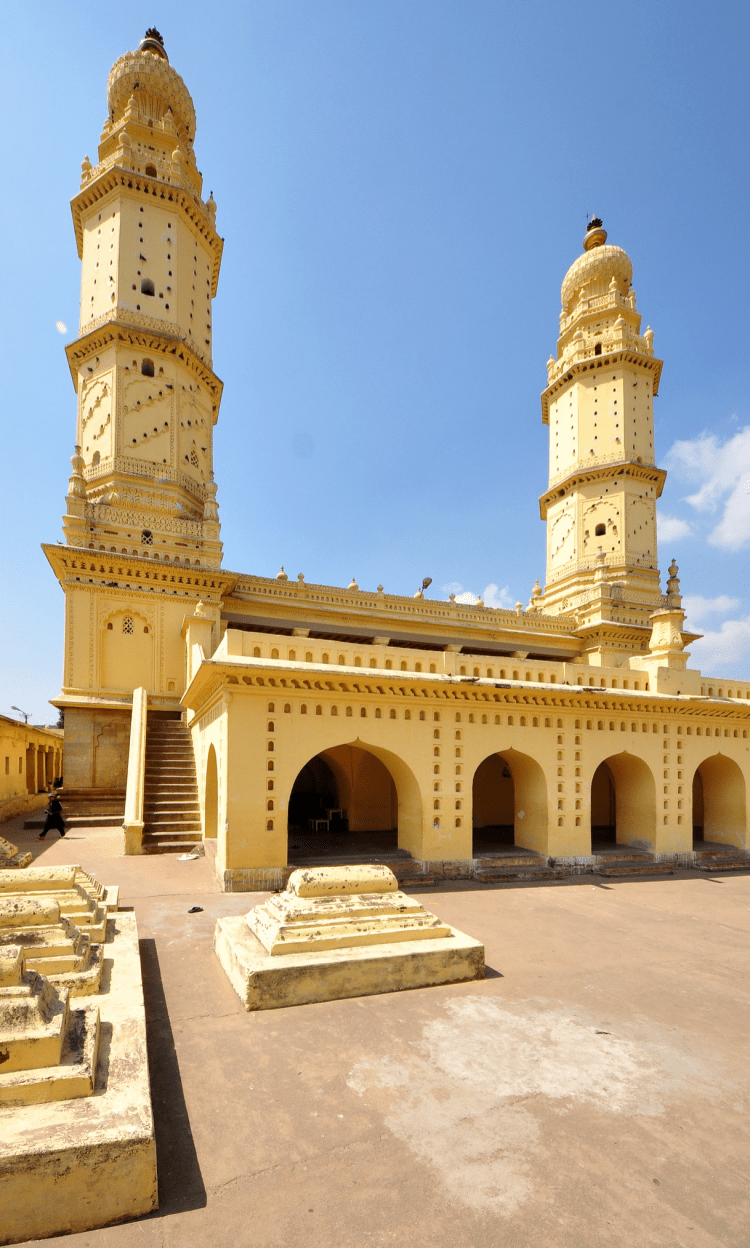
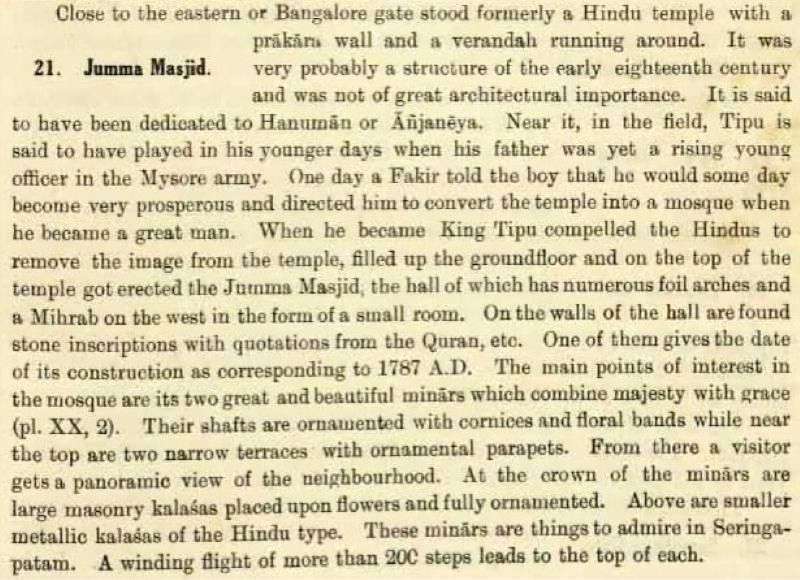
Masjid-i-Ala (Jama Masjid)

Mysore Archaeological Dept Report 1935

Tipu Sultan: Villain or Hero – Sita Ram Goel

Tipu Sultan

One can conclude quite safely that Nehruvian Secularism is a magic formula for transmitting base metals into twenty-four carat gold. How else do we explain the fact of Islam becoming a religion, and that too a religion of tolerance, social equality, and human brotherhood; or the fact of Muslim rule in medieval India becoming an indigenous dispensation; or the fact of Sirajuddaula, Mir Qasim, Hyder Ali, Tipu Sultan, and Bahadur Shah Zafar becoming the heroes of India’s freedom struggle against British imperialism? – Sita Ram Goel

Secularism per se is a doctrine which arose in the modem West as a revolt against the closed creed of Christianity. Its battle-cry was that the State should be freed from the stranglehold of the Church, and the citizen should be left to his own individual choice in matters of belief. And it met with great success in every Western democracy.

Had India borrowed this doctrine from the modem West, it would have meant a rejection of the closed creeds of Islam and Christianity, and a promotion of the Sanatana Dharma family of faiths which have been naturally secularist in the modern Western sense. But what happened actually was that Secularism in India became the greatest protector of closed creeds which had come here in the company of foreign invaders, and kept tormenting the national society for several centuries.

We should not, therefore, confuse India’s Secularism with its namesake in the modern West. The Secularism which Pandit Jawaharlal Nehru propounded and which has prospered in post-independence India, is a new concoction and should be recognized as such. We need not bother about its various definitions as put forward by its pandits. We shall do better if we have a close look at its concrete achievements.

Going by those achievements, one can conclude quite safely that Nehruvian Secularism is a magic formula for transmitting base metals into twenty-four carat gold. How else do we explain the fact of Islam becoming a religion, and that too a religion of tolerance, social equality, and human brotherhood; or the fact of Muslim rule in medieval India becoming an indigenous dispensation; or the fact of Muhammad bin Qasim becoming a liberator of the toiling masses in Sindh; or the fact of Mahmud Ghaznavi becoming the defreezer of productive wealth hoarded in Hindu temples; or the fact of Muhammad Ghuri becoming the harbinger of an urban revolution; or the fact of Muinuddin Chishti becoming the great Indian saint; or the fact of Amir Khusru becoming the pioneer of communal amity; or the fact of Alauddin Khilji becoming the first socialist in the annals of this country; or the fact of Akbar becoming the father of Indian nationalism; or the fact of Aurangzeb becoming the benefactor of Hindu temples; or the fact of Sirajuddaula, Mir Qasim, Hyder Ali, Tipu Sultan, and Bahadur Shah Zafar becoming the heroes of India’s freedom struggle against British imperialism or the fact of the Faraizis, the Wahhabis, and the Moplahs becoming peasant revolutionaries and foremost freedom fighters?

One has only to go to the original sources in order to understand the true character of Islam and its above-mentioned luminaries. And one can see immediately that their true character has nothing to do with that with which they have been invested in our school and college text-books. No deeper probe is needed for unraveling the mysteries of Nehruvian Secularism.

This is not the occasion to go into the implications of this Secularism vis-a-vis India’s own spiritual vision, India’s own cultural wealth, India’s own national society, and India’s own native nationalism. I have dealt with this theme elsewhere. Suffice it to say that the other face of this Secularism is Hindu-baiting, which profession has been perfected by many scholars, scribes, and politicians, and has so far proved immensely profitable. I need not give the names. The stalwarts in this field are very well known.

The Bombay Malayalee Samajam has, therefore, rendered a great service in providing a test case, that of Tipu Sultan, for exposing the true character of Nehruvian Secularism. To the best of my knowledge, this Secularism has never faced a challenge such as was posed before it by the scholars and men of public spirit whom we meet in the pages of this book, Tipu Sultan: Villain or Hero? The wealth of first-hand source materials presented in the articles that comprise this book, portray not only the base metal that was Tipu Sultan but also the components of that alchemy which has transmuted him into twenty-four carat gold. VOICE OF INDIA is proud that it should have the privilege of publishing this study of an arch villain being sold as a great hero.

The fight for truth which is described in this book, has proved fruitful. The Statesman dated May 24, 1993 reports: “Once again Tipu Sultan has become a controversial topic in Karnataka. First it was the serial produced by Sanjay Khan which attracted criticism and protests from people, now it is the bicentenary of his death which has created quite a stir. … The Karnataka Board of Wakfs has organized the bicentenary, Urs-e-Sharif, of Hazrat Tipu Sultan Shaheed (R.A.), from May 21 to May 23 this year…. This has led to speculation that the Government will again spend several lakhs of rupees in 1999 to observe the 200th death anniversary of Tipu. The State Government has, however, remained tight-lipped over the issue and left the Board of Wakfs to answer these questions.” Had there been no challenge to the serial, the State Government would not have remained tight-lipped. It would have immediately untied its purse strings, and joined hands with the Board of Wakfs for singing hymns of praise to the Hazrat and the Shaheed.

What the Hazrat and the Shaheed stood for is described by Mir Hussain Ali Kirmani in his book, Nishan-i-Haidari, which he completed in AD 1802, three years after Tipu’s death. Kirmani writes: “It happened one day that a fakir (a religious mendicant), a man of saint-like mind, passed that way, and seeing the Sultan gave him a life-bestowing benediction, saying to him, ‘Fortunate child, at a future time thou will be the king of this country, and when thy time comes, remember my words—take this temple and destroy it, and build a masjid in its place, and for ages it will remain a memorial of thee.’ The Sultan smiled, and in reply told him that ‘whenever, by his blessings, he should become a padishah, or king, he would do as he (the fakir) directed’. When, therefore, after a short time, his father became a prince, the possessor of wealth and territory, he remembered his promise, and after his return from Nagar and Gorial Bunder, he purchased the temple from the adorers of the image in it (which after all was nothing but the figure of a bull, made of brick and mortar) with their goodwill, and the Brahmins, therefore, taking away their image, placed it in the Deorhi Peenth, and the temple was pulled down, and the foundations of a new masjid raised on the site….” That is the Masjid-i-Ala or Jama Masjid standing in Srirangapatanam on the site of a Shiva temple. One need not comment on Kirmani’s statement that Tipu “purchased the temple from the adorers of the image … with their goodwill”. It is not unoften that terror has produced this sort of goodwill in the minds of its helpless victims. – Preface to Tipu Sultan: Villain or Hero

1. The Sword of Tipu Sultan – V.M. Korath

Tipu Sultan who succeeded his father, considered it his primary duty to continue this unfinished jîhâd started by Hyder Ali Khan. However, the Islamic fanaticism of Tipu Sultan was much worse than that of his father. His war-cry of jîhâd was “Sword” (death) or “Cap” (forcible conversion). This makes very clear the character of Tipu Sultan’s military operations started in 1783. The intensity and nature of sufferings which the Hindu population had to bear during the nightmarish days of Padayottakkalam (military regime) were vividly described in many historical records preserved in the royal houses of Zamorin and Kottayam (Pazhassi), Palghat Fort and East India Company’s office. There is no apparent reason to disbelieve them. It is absurd and against reason to describe all this evidence as being forged for the purpose of creating enmity between Hindus and Muslims. READ MORE HERE …

2. Religious Intolerance of Tipu Sultan – P.C.N. Raja

When that Brahmin Prime Minister, Purnaiyya, presented to Tipu Sultan 90,000 soldiers, three crore rupees, and invaluable ornaments made of precious stones, he was tempted to rule as the Emperor of the South India. Tipu did not consider the Hindu rulers of Maharashtra, Coorg and Travancore or the Muslim ruler Nizam as impediments. He was afraid of only the British. He had convinced himself that he could easily become the Emperor of South India if he could somehow vanquish the British. Because of his intense and-British attitude, the so-called progressive and secular historians have made a vain attempt to paint Tipu Sultan as a great national hero. … Opposition to foreign powers need not always be due to love for one’s country. To achieve his selfish goal and to face the British forces, Tipu Sultan sought the assistance of another foreign power, the French, who were manoeuvring to establish their own domination in the country. How is it possible, therefore, for Tipu Sultan to be an enemy of foreign forces when he himself had sought help from Napoleon who was then a prisoner in St. Helena Island and also the French King, Louis XVI? READ MORE HERE …

3. Tipu’s Own Testimony – C. Nandagopalan Menon

William Kirkpatrick, who compiled many of Tipu’s letters, writes in his book, Selected Letters of Tipoo Sultan (published in 1811): “Tipoo knew his will to be a law the propriety of which … would never be questioned or doubted by any of his slaves…. He probably measured the sentiments in question by a different standard from that with which we estimate them. Thus the various murders and acts of treachery which we see him directing to be carried into execution, were not criminal, but on the contrary just, and even meritorious, in his eyes.” … “The Koran taught him that it was not necessary to keep faith with infidels, or the enemies of the true religion, in which case it was not difficult for him to persuade himself that it was right to include all who opposed or refused to cooperate in his views for the extension of that religion; or, in other words, for his own aggrandisement.” … This observation of Kirkpatrick is found to be valid when one goes through the letter of January 19, 1790, sent to Budruz Zuman Khan by Tipu himself. It says: “Don’t you know I have achieved a great victory recently in Malabar and over four lakh Hindus were converted to Islam? I am determined to march against that cursed “Raman Nair” very soon (reference is to Rama Varma Raja of Travancore State who was popularly known as Dharma Raja). Since I am overjoyed at the prospect of converting him and his subjects to Islam, I have happily abandoned the idea of going back to Srirangapatnam now” (K.M. Panicker, Bhasha Poshini, August, 1923). READ MORE HERE …

4. Tipu Sultan: As Known in Kerala – Ravi Varma

The ruins of hundreds of Hindu temples destroyed, and heavy concentration of Mappilas, all along the invasion routes of Tipu’s army, are standing and conclusive proofs of the brutalities and atrocities committed by the fanatic Tipu Sultan in Kerala. He was, all through, waging a cruel Islamic war against the Hindu population of Kerala, with a large Muslim army under Muslim field commanders ably assisted by the French, and with powerful field-guns and European troops. The period of Tipu Sultan and his father Hyder Ali Khan from 1766 to 1792 is the darkest period in Kerala history for all types of Islamic atrocities including forcible conversions. In spite of all these, historical documents and records are being deliberately suppressed, distorted and falsified in order to project this fanatic Tipu Sultan of Mysore as a liberal and magnanimous Muslim king. Worse still, this Muslim tyrant from Mysore is being glorified and projected as a national hero like Chhatrapati Shivaji, Maharaja Ranjit Singh, Rana Pratap Singh, and Pazhassi Raja of Kerala. To perpetuate the memory of this tyrant Tipu Sultan, the Central Government has released a postal stamp. Doordarshan has sanctioned a video serial to glorify the deeds and life of Tipu Sultan. And a special rehabilitation programme is being worked out for the benefit of the descendants of Tipu Sultan in Calcutta. It is an insult to our national pride and also to the Hindus of Kerala. At this rate, who knows that tomorrow our secular Government and the motivated Muslim and Marxist historians of Jawaharlal Nehru, Aligarh and Islamia universities will not project as national heroes villains like Mahmud Ghaznavi who destroyed the Somnath Temple, Babar who destroyed the Sri Rama Temple at Ayodhya, and Aurangzeb who destroyed the Vishwanath Temple at Kashi and the Sri Krishna Temple at Mathura? What a shame! What a degradation! READ MORE  HERE …

5. Scandalous Tele-Serial of Tipu Sultan – Prakash Chandra Asdhir

The secularist tribe in this country must realise that no useful purpose will be served by putting secular garbs on these barbaric rulers who were only usurpers. Such actions only revive the centuries-old wounds and embitter the relations between Hindus and Muslims. The whole exercise, it should be realised, runs against the process of National Integration envisaged by the Government and the people of this country. Ghaznavis, Ghuris, Baburs, Aurangzebs, Hyder Alis and Tipu Sultans can only carry the coffin of secularism and nothing more. Let the souls of these tyrants lie in their graves and be raised only on the day of “Qiamat” (Doomsday) when Allah will put them on trial for their crimes against humanity. READ MORE HERE …

6. Tipu Sultan: A Fanatic Muslim – Ravi Varma

It was Tipu Sultan and his fanatic Muslim army who converted thousands of Hindus—Thiyyas, Nairs and tribals—to Islam all along the invasion route, and occupied areas in North Kerala, Coorg, Mangalore and other parts of Karnataka. Besides, over 8,000 Hindu temples were desecrated and/or destroyed by his Muslim army in Malabar, Cochin, Coorg, Mysore and Tamil Nadu. … Tipu Sultan was only a usurper. He fought a war of expansion against Cochin and Travancore after running over the lands of a weak Zamorin. He could not succeed in his ambition and became a cripple because of the joint resistance by Cochin and Travancore armies. Simply because Tipu Sultan died in Srirangapatnam while escaping in the night from the fort which had been surrounded by the British army, does not make him a national hero. He fought an imperialist war in South India seeking the help of the French Army. … To project Tipu Sultan as a national hero is not only a distortion of South Indian history, but also an insult to the seventy crore Hindus, especially of South India. READ MORE HERE …

7.  Tipu Sultan and Doordarshan – K. Govindan Kutty

Some years later—well before Gidwani came out with his eulogy [of Tipu Sultan]—there was a still more breathtaking re-evaluation of Tipu’s exploits in Malabar. Its author, C.K. Kareem, a former editor of the Kerala State Gazetteer, went so far as to show Tipu as a philosopher and a great sufi, who viewed the whole cosmos as a mosque! Kareem’s “finding” was that Tipu came to be painted black just because those who wrote history in Kerala were the descendants of people who had to suffer hardships after his advent. His argument was that the repression represented by Tipu was not for the sake of Islam but to govern a newly-conquered territory. … The Hindu view of Tipu’s conquest of Malabar has not changed in spite of Balakrishnan’s and Kareem’s attempt to make him out as a sufi and a reformer. The historical view taken by K.M. Panicker and K.P. Padmanabha Menon and showing Tipu as a tormentor, continues to hold sway. READ MORE HERE …

8. The Tele-Serial of Tipu Sultan – P. Parameswaran

Tipu Sultan had not only given some financial assistance to a few temples including Sringeri Mutt, but he had also destroyed hundreds of temples and carried out forcible mass conversions as well. He had also indulged in mass murders. Letters and orders directing to do such horrible things were also issued by Tipu Sultan. If such things are deliberately suppressed, that will amount to injustice to the population who were the victims of his cruel atrocities. Even if it is only for promoting communal harmony, blatant lies should not be deliberately propagated. For the promotion of communal harmony, let people produce novel, poetry or even cinema. In the case of history, acknowledging the mistakes would be the best way to correct the mistakes; and not to whitewash the mistakes. If it is not done, that will result in emotional outbursts. READ MORE HERE …

9. A Letter to Shri P. Upendra – P.C.C. Raja

As a member of the Zamorin’s family my blood gets boiled even today when I hear the very mention of Tipu’s name because the worst crimes and the worst sort of atrocities were really perpetrated by him on the Hindus of Malabar. In fact the Zamorin of Calicut and the members of his family are well known for their religious tolerance and catholicity of outlook as would be seen from recorded history. But wholesale conversion of all people into Islam was indulged in by Tipu Sultan at gun point. Those who did not obey had either to flee away from the country or to face the bayonet. No other option was available according to recorded history. It will be useful if you will kindly refer to the writings of Prof K.V. Kristina Iyer as well as Malayalam Encyclopedia (Volume 7, published by Sahithyaka Pravasthaka Sahakarna Sangham Ltd., Kottayam, p. 996, para 3, column 1). The several inhuman, barbarous, and brutal acts done at the behest of Tipu Sultan cannot be summarised even in a thousand printed pages. In the circumstances, a cryptic statement that Tipu’s controversial roles are not purported to be dealt with in the serial can hardly assuage the feelings of the victims and would hardly render justice to the injured, their families, and their successors. Kindly also refer to the report of a joint Commission of Bengal and Bombay appointed to inspect the state and conditions of the province of Malabar in the years 1792 and 1793 (Volume 1, paras 52, 64, 67) kept in the National Archives of India, Janpath, New Delhi. A bare perusal of the above report will convince anyone that Tipu Sultan, far from being a benevolent ruler, was one of the worst fanatics, and more inhuman than even the Nazis. READ MORE HERE …

10. The Agitation Against the Tipu Sultan Serial – B.N. Jog

Three years back, one news item which appeared on the pages of many dailies attracted my attention. The news item was about a big studio-fire in Bangalore, where shooting of Shri Sanjay Khan’s tele-serial, “The Sword of Tipu Sultan” was in progress. Scores of young artistes died and many others were injured in the studio-fire. While going through the press report, I was amazed to read that “in this TV serial Tipu Sultan is being depicted as a great warrior and secular benevolent ruler”. Tipu Sultan who forcibly converted thousands of Hindus and Christians to Islam, hanged to death hundreds of innocent women and children, and destroyed and looted scores of temples and churches in Malabar, Cochin, Coorg, Dindigal, Mangalore and Coimbatore, a secular, fair-minded ruler! Hypocrisy also must have some limit. READ MORE  HERE …

11. History of Legal Battle Against the TV Serial The Sword of Tipu Sultan – Madhavrao D. Pathak

The legal fight against the shameful and motivated attempt of Doordarshan and the Government of India to project the usurper king of Mysore, Tipu Sultan, as a national hero, was a long, expensive and frustrating ordeal. According to authentic and documented history of the period, Tipu Sultan had hanged to death and sold as slaves a large number of innocent men, women, and children; looted and destroyed and burnt down hundreds of Hindu temples and Christian churches; and circumcised and converted to Muhammadanism thousands of Hindus and Christians in Mangalore, Coorg, Coimbatore, Dindigal, and Kerala. He had made territorial concessions to the French whose help he sought to fight the British. He had also sent emissaries to Islamic countries – Afghanistan, Iran, and Turky – inviting them to conquer the whole of North India for the glory and spread of Islam. But the Doordarshan serial on Tipu Sultan, based on a novel entitled The Sword of Tipu Sultan by Bhagwan Gidwani, was full of deliberate distortion, fabrication, and suppression of recorded facts of history with the object of glorifying a villain as a national hero, a benevolent ruler, and a paragon of all virtues. READ MORE HERE …

» Sita Ram Goel  (1921–2003) was a historian, author and publisher who founded the Hindu publishing house Voice of India. He along with philosopher Ram Swarup, sought to correct the warped and distorted histories of India and Hinduism that had been put out by European indologists, Christian missionaries and their secular Indian Marxist camp-followers.
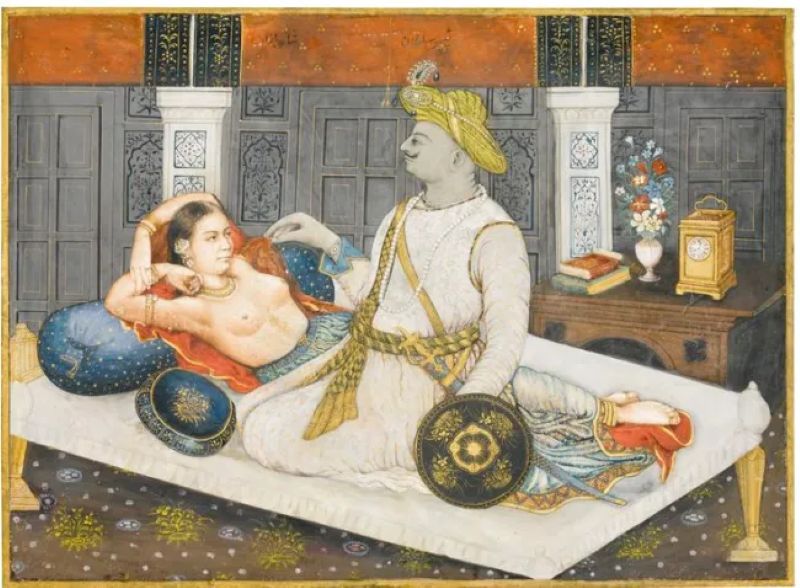
Tipu and Mistress