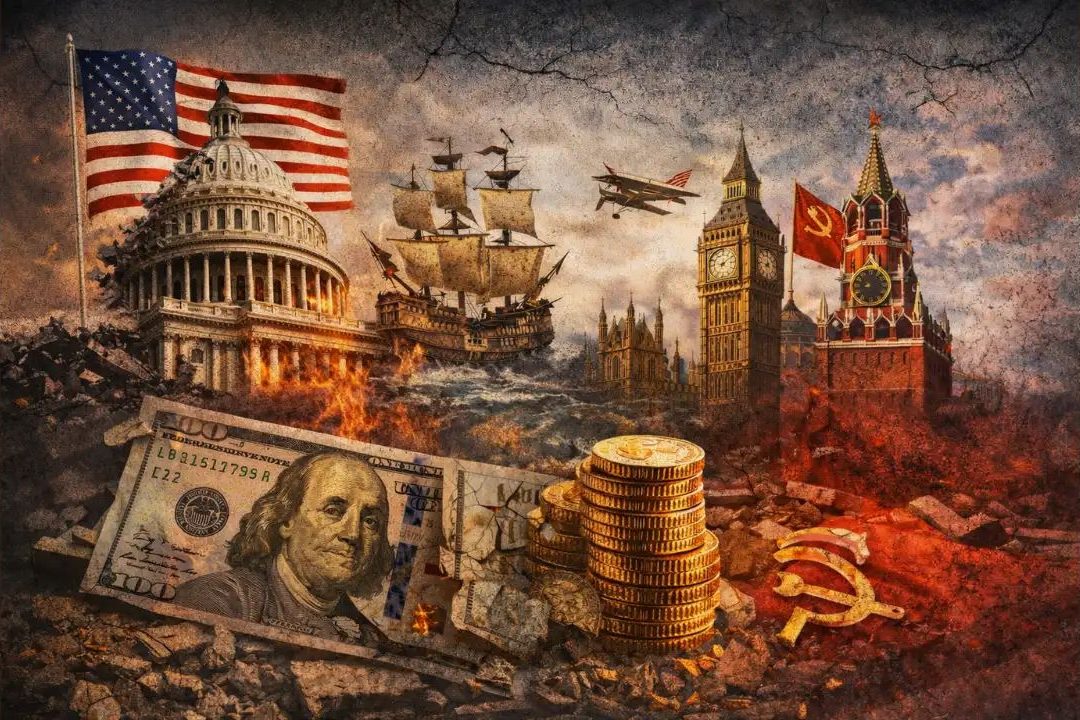
The United States, as the world’s leading superpower since the mid-20th century, exhibits many hallmarks of late-stage economic and imperial decline, patterns already seen in Spain, Britain, and the Soviet Union. – Samannay Biswas
All throughout history, major empires and superpowers have followed recurring patterns of economic decline, often resulting in collapse. This framework, popularised in analyses of Spain, Britain, and the Soviet Union, identifies seven stages driven by overextension, financial mismanagement, and societal shifts.
The “seven stages of empire” was a theory conceived by Lieutenant General Sir John Bagot Glubb, also known as “Glubb Pasha.” Glubb was a soldier in World War I and a long-time commander of the Arab Legion in Jordan until his retirement in 1956. During his retirement, he became a historian and an author.
In 1976, he wrote the essay The Fate of Empires and Search for Survival based on research of over a dozen empires over a period of 3,000 years, including the Assyrians and the British Empire. His observations were that the life span of most empires is typically around 250 years, with all empires following a cyclic pattern consisting of seven parts: the pioneers, the conquest, the commerce, affluence, intellect, decadence, and decline.
In his view, whether in a culture and technology-dominated world or a materialistic and fragmented one, the moral and social trajectory of an empire draws upon a same pattern of duty, discipline, and then materialism, fragmentation, and loss of unity. Though not a deterministic theory, Glubb’s idea was a caution, and it influences current arguments regarding an imperialism ascent and fall, including an America one.
With evidence drawn from historical data and current trends related to the US economy, as of January 2026, this article explores these phases, how they appeared within previous empires, and why it appears to be moving through these phases faster than projected. With evidence drawn from historical data and current trends related to the US economy, as of January 2026, this article explores
Stage 1: Military Overextension
It’s also a fact that the fall of many empires started with the thinning out of resources around the world.
There are many examples throughout history. Spain during the 16th century had military forces deployed on four different continents, with military expenditures accounting for half of its spending. The British Empire, which extended to six continents by 1900, had costs it couldn’t sustain during World War I, with expenditures reaching $40 billion, or $1 trillion in today’s currency. The Soviet Union supported wars ranging from Afghanistan to Africa with 15-20% of its spending.
Meanwhile, military expenditures for the U.S. recorded $900.6 billion during fiscal year 2026, surpassing the total military spending of the next 10 countries combined. Furthermore, despite maintaining more than 750 bases in 80 countries and deployed troops in 150 countries, the US is facing difficulties in maintaining its presence through aged military hardware and manpower deficiencies. Others see this repeating the same mistakes of the past.
Stage 2: Currency Debasement
To finance themselves, empires have no choice but to debase their currency.
Spain also brought a lot of copper into the silver currency; thus, the purity level of the silver currency fell from 100% to nearly 0% by the end of 1600. This increased inflation. Britain left the gold standard by 1931. This reduced the value of the pound by 25%. The ruble in the Soviet Union was not convertible, meaning that it relied on the exports of gold and oil.
The US lost the gold standard in 1971, and the fiat currency has been used since. But the US dollar has lost 98% of its value since then. The value of the money supply in the US has increased by 400% since the year 2000, and nearly $6 trillion has been printed since 2020. The decline of the US dollar currency in the modern era may cause potential inflation risks given the structure of the economy.
Stage 3: Debt Spiral
If left uncheckded, borrowing translates to defaults or unaffordable interest payments.
There were four bankruptcies between 1557 and 1596. Britain had $30 billion in debt by 1945, which was above GDP. Reserve depletion was a result of economic stagnation in the 1980s.
As of the data cut off of January 18, 2026, the US national debt was recorded at $38.62 trillion, with its debt-to-GDP ratio recorded at 123.6%. The interest payments are inching closer to $1 trillion, which even surpasses spending on the military. Also, the deficit for 2025 was recorded at $1.74 trillion, which is 5.9% of GDP, and it is forecasted to increase to 6.1% in 2035.
Stage 4: Loss of Productive Capacity
Wealth influxes result in deindustrialization.
The import of gold from Spain undermined the manufacturing industries in Spain. Britain’s relocation of industries after World War II undermined industries in Britain. The USSR’s central planning system led to inefficiencies in grain production, causing the USSR to import grains.
There has been a decrease of 49,000 factory jobs in the US between February and September 2025, marking the 70,000th job cut since April 2025, leading the overall employment level to 12.69 million, the lowest level since March 2022. The trade gap of the country has also escalated by 14% or 95.2 billion dollars in the first nine months of 2025, registering an acceleration of 131.3 billion dollars for goods imports. Importation of medications and electronics is still a notable component.
Stage 5: Social Decay
Economic strain manifests in societal breakdowns.
Spain experienced rising crime and emigration. Britain’s post-empire period was marked by inequality. The USSR faced disillusionment and brain drain.
In America, homelessness increased by 18% to 771,480 in 2024, with an increase of 23% in initial incidents since 2019. Drug overdose deaths decreased by 21% to approximately 73,000 in the year to August 2025, yet they continue to be high. Birth rates will also be lower, with slower growth in population due to an increase in overdose and suicide deaths. Trust in institutions has reached an all-time low with a rise in crime levels.
Stage 6: Loss of Reserve Currency Status
Countries that are allied start diversifying away from the dominant currency.
The loss of global acceptance was even worse for Spain. “The British pound depreciated from $4.03 in 1940 to $1.27 today. The ruble never became a reserve currency.”
“Dedollarization is gathering pace.” Countries within the BRICS are lining up alternatives, with central banks buying more gold than ever before for five straight years as of 2022. The value of China’s yuan-denominated trade is increasing, and Saudi Arabia has started accepting funds for oil exports in something other than US dollars. The dollar’s role in international reserves is at a two-decade low. This may heighten US vulnerabilities.
Stage 7: Total Collapse
Sudden crises frequently precede final collapse.
Spain became a secondary power by the year 1700. An empire was lost by Britain within two decades after the year 1945. The USSR fell apart in 1991, after about 900 days of acute crisis.
The US is arguably already in Stage 5, with warnings of Stage 6. The forces pushing for acceleration are rapid growth of debt, evidence of dedollarization, and increased societal stresses. Debt is projected to close in on 118% of GDP by 2035. But there are arguments opposing it, pointing to collapses that never occurred and with growth running at 1.8 to 1.9% CAGR.
The Decline of the Spanish Empire
The Spanish Empire reached its peak in the 16th century under rulers like Charles V and Philip II, controlling territories across Europe, the Americas, Africa, and Asia. At its peak around 1580, it dominated global gold and silver production, with the Spanish real serving as a reserve currency.
The Spanish Empire had decayed into a financially drained, non-preeminent state by the end of the 17th century. The decline was the result of economic neglect, military overextension, domestic rebellions, and inefficiency.
Spain waged warfare relentlessly, such as the Eighty Years’ War waged against rebels from the Netherlands or wars fought against the Ottoman Empire and the English or the French. By 1580, troops were spread across four continents, absorbing over fifty-percent of government expenditures.
The inflow of silver caused inflation, followed by bankruptcy and the collapse of domestic industry due to imports. The forced expulsion of Jews and Moriscos reduced the skilled workforce. Poor leadership and corruption exacerbated the decline of Spain, resulting in an empire that was large in terms of appearance but shallow in reality.
The Decline of the British Empire
At its height, the British Empire controlled 25% of the planet’s land surface and populations, and the pound sterling was the world’s reserve currency.
The decline accelerated following World War I and became irrevocable following World War II. Overextension of the military, war debts, decline of industry, and the rise of colonial nationalism contributed to the inability of the imperial power to maintain control. Britain went bankrupt following World War II with its debt level exceeding its GDP.
Currency devaluation, loss of colonies such as India, and geopolitical setbacks like the Suez Crisis confirmed Britain’s diminished status. By the late 20th century, the empire had dissolved into the Commonwealth, marking the end of Britain’s imperial era.
The Decline and Collapse of the Soviet Union
The Soviet Union found itself a superpower after World War II but disintegrated in 1991. Expenditures due to military build-up, economic stagnation, inefficiency in central planning, and a drop in oil prices were factors in its disintegration.
Reforms of Gorbachev revealed faults in the system that brought relaxation in control in politics and prompted movements for independence in Eastern Europe as well as the USSR. Factors such as ethnicity conflicts, corruption, decay in institutions, and poor governance led to dissolution without a major war.
Where The US Stands?
Even so, there are some traits indicative of a further six stages of decline which the United States shares with Spain, Britain, and the USSR. These include a powerful global position, but still some key advantages, such as innovation, flexibility, well-developed capital markets, or military might, that the United States has vis-à-vis its putative competitors. It is possible to trace signs of growing weaknesses in each stage.
What these trends foretell is that a possible decline might emerge sooner than the historical precedents had indicated in the past since the magnitude of global interdependence, debts, and new geopolitics are all involved.
Stage 1: Military Overextension
Military overextension has persisted, with the US maintaining the world’s largest defense budget. The Department of Defense’s fiscal year 2026 budget request is approximately $892.6 billion—near-flat from prior years but still above the combined spending of the next several major powers.
Commitments range from more than 750 bases in over 80 countries, NATO obligations in Europe, relationships in Asia such as Japan, South Korea, and the Philippines, to deterrence in China, Russia, and Iran. Recruitment difficulties, aging inventory, and possible multiple front situations such as Taiwan, Ukraine crises, and the Middle East war zones keep stretching their capacity.
These pressures mirror the unsustainable military burdens that exhausted prior empires.
Stage 2: Currency Debasement
Currency debasement has continued through fiat mechanisms. The dollar has lost about 98% of its purchasing power since the gold standard ended in 1971.
The massive monetary expansion-especially since 2020-has been a given source of sustained inflationary pressures, even if partly moderated in recent times. This is a similar dynamic to Spain’s coin debasement and Britain’s post-war struggles with currency stability, though it comes on a far larger scale given the dollar’s role as the global reserve currency.
Stage 3: Debt Spiral
The debt spiral has never been higher. As of January 7, 2026, the gross national debt is at $38.43 trillion, an increase of $2.25 trillion from last year, averaging a daily increase of a staggering $8.03 billion.
This translates to 120% of GDP and interest payments that are approaching and surpassing $1 trillion a year. The deficit impact for fiscal year 2026 has shown borrowing of $602 billion for the first three months.
In contrast to sovereign bankruptcies in Spain or the debt crises in post-WWII Britain, the US has the “benefit of being able to borrow in its own currency because its dollar is widely held as a foreign exchange reserve currency.” Still, the rising cost of borrowing and fiscal risk of “debt monetization”—monetary policy being used to pay debt—“may push the system to its tipping point sooner than before.”
Stage 4: Loss of Productive Capacity
Decreased productivity can also be seen in the deindustrialization of the economy. Factory employment plummeted in 2025, posting its eighth consecutive monthly decline in December, reaching around 12.692 million, which is the lowest in several years.
The industry lost tens of thousands of employment positions due to tariffs, supply chain shifts, and global forces, despite government policy initiatives targeting reshoring. Though the trade gap for the goods and services trade declined slightly late in 2025, deficits remain.
Heavy reliance on imports for electronics, pharmaceuticals, and critical components parallels Spain’s historical import dependence and Britain’s erosion of its industrial edge.
Stage 5: Social Decay
The various indicators are where social decay manifests. Homelessness reached record highs, with over 771,000 people affected in 2024, as housing costs and a widening inequality led to this movement.
New drug overdose deaths, despite recent declines, are elevated, and the fertility rate is continuing to trend downward. Population growth increasingly relies on immigration, and under current projections, natural decline is possible by 2030.
With political polarization, crime issues in urban centers, and emigration of skilled talent in certain sectors, confidence in institutions is at historic lows. These dynamics echo social fragmentation in previous empires under economic stress.
Stage 6: Loss of Reserve Currency Status
A loss of reserve currency status is already exhibiting visible, but increasing, trends. Central banks are stockpiling gold, alternative currencies, such as the yuan, are finding increasing use in the settlement of trades, and the BRICS countries are making progress in new systems.
The dollar’s holding in global reserves has been gradually reduced over two decades, but it remains around 57-60%. However, it remains dominant in global foreign exchange transactions. The move by Saudi Arabia away from dollar-denominated oil contracts, as well as attempts by China, Russia, and India to avoid dollar-based payment systems, show that there is momentum.
Stage 7: Total Collapse
While complete collapse is still a prospect rather than an imminent danger, the coincidence of the above factors, as well as possible external shocks in the form of large-scale geopolitical turmoil, sudden interest rate spikes, or speeded-up dedollarization, may start a abrupt collapse.
Historical cases of collapse have differed greatly in the speed of collapse: its taking several decades in Spain, its taking perhaps two decades in Britain following World War II, in contrast to the few years in the Soviet Union. The highly interconnected nature of the US’s role in the world means that whatever crisis emerges—whether debt ceiling crisis, a serious default scare, or a run on reserves—the US’s finance sectors are likely to be more susceptible to a faster cascade in a crisis.
While resilience factors such as innovation and policy flexibility remain, the arithmetic of compounding debt, eroding productive capacity, and shifting alliances suggests the window for course correction is narrowing, potentially leading to significant economic reconfiguration sooner than many anticipate. – Times Now, 18 January 2026
› Samannay Biswas writes financial stories for Times Now Digital.
 VOICE OF INDIA