Analysing the ‘phallacy’ of the Shiva lingam – Arvind Sharma

Shiva Lingabhavad Image

“The Shiva linga is part of a vast natural symbolism of ascending cosmic energy. Such linga forms include mountains, fire, trees, standing stones, pyramid, sun, moon, lightning, and OM. It’s sexual reduction by modern scholars is part of their sexual obsession overall.” – Dr David Frawley quoted by Prof. Sharma 

The claim that a Shiva linga may have been discovered at the Gyanvapi mosque in Varanasi has raised some questions about what it stands for. The issue is important considering the comments made on it on social media. The professor of a college in Delhi, on seeing its picture, wondered whether Lord Shiva had been circumcised. Another voice on social media seemed to wonder whether it spouted semen, perhaps because it was claimed to be a fountain by the opposing party. More recently, a lady from Jaipur seemed to give a foreplay dimension to the changes in its size mentioned at various times. And so on.

What is significant here is the temptation to take it, some would say mistake it, for a phallic symbol, which is its chosen interpretation in Western Indology. This tendency to take it as a body part, therefore, on the part of some may be attributed to the way Western Indology tends to view it. This leads to the next question: To what extent is this description justified?

Sometimes it is argued that the word itself stands for the penis. This is problematic because the term is used to signify gender in Sanskrit, and more generally stands for a mark or sign. Thus the words corresponding to masculine, feminine, and neuter gender in Sanskrit are pullinga, strilinga, and napunsakalinga. It is clear that translating these terms by using the word penis will lead to hilarious results. The use of the word varna and its apparent translation as colour, similarly, created serious problems in Indology from which it is still trying to emerge.

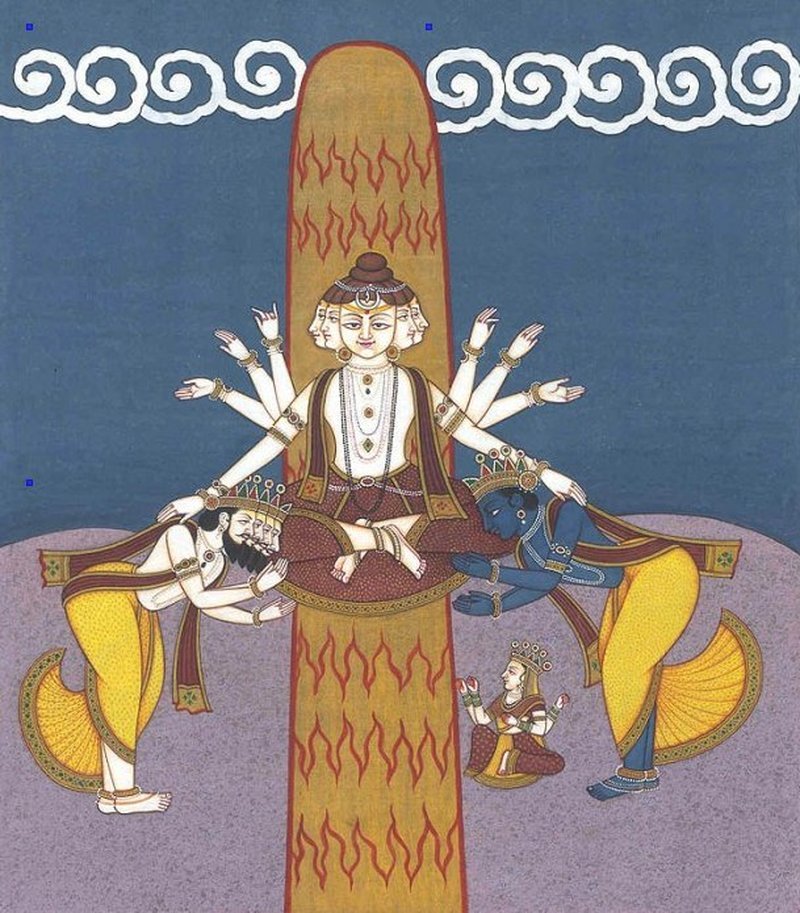
At a religious rather than verbal level, a Hindu, in general, finds the interpretation of the term linga as a phallus jarring, to say the least. Mahatma Gandhi noted that he first learnt from a book by a missionary that it had any “obscene” significance. This radical divergence in understanding the significance of the Shiva linga is a striking example of how the insider’s and the outsider’s perspective might differ on a point. The outsider may associate it with a fertility cult. In Hindu lore, however, the Shiva linga represents the axis mundi, the pillar upholding the universe as it were. In the Puranas it represents the pillar of fire or light, the form in which Shiva appeared when the three gods of the Hindu trinity—Brahma, Vishnu and Shiva—were competing among themselves to determine who was the greatest among them. Shiva proved his pre-eminence because the other gods could not discover the beginning or the end of the pillar, which the linga represents.

It is not that the Shiva linga has not been sometimes interpreted as a body part. According to one scholar, it happens about 10 per cent of the time. Thus this does not happen often, however, even when it happens its understanding continues to be an elevated one. For instance, in the Mahabharata, sage Upamanyu states that the use of the linga and yoni to depict Shiva and Parvati means that they pervade all beings. Ramakrishna states that we worship Shiva in this form to pray for release from the process of rebirth. In a Yogic context, the linga represents the conversion of sexual energy into spiritual energy. Paradoxically, the upright but unshed penis symbolises spiritual ascent brought about by celibacy. Alberuni, the Muslim savant, records that according to one account it denotes Shiva, because when Shiva was ordered by Brahma to create imperfect human beings, Shiva refused to do so, and indicated his displeasure by chopping off the symbol of creation and procreation.

The recovery of the Shiva linga at the Gyanvapi mosque would not be complete until we also recover its proper meaning from the obfuscations under which it has been buried. It is worth reflecting on the following comment by David Frawley at this point: “The Shiva linga is part of a vast natural symbolism of ascending cosmic energy. Such linga forms include mountains, fire, trees, standing stones, pyramid, sun, moon, lightning, and OM. It’s sexual reduction by modern scholars is part of their sexual obsession overall.”

In a review of two books by Wendy Doniger—The Hindus: An Alternative History (2009) and On Hinduism (2014)—in Foreign Affairs (September-October 2014), Ananya Vajpeyi notes how Doniger “argues that the lingam, a symbol of the Hindu deity Shiva that is found in temples should be understood ‘unequivocally as an iconic representation of the male sexual organ in erection, in particular as the erect phallus’.” The shock the Hindu feels in the face of such misrepresentation could only be compared to that of the Christian, upon being told that when the Christian participates in the Mass on Sunday he or she is practising cannibalism, as the Christian then consumes the flesh (wafer) and blood (wine) of Jesus Christ. – Firstpost, 12 June 2022

Prof. Arvind Sharma, formerly of the IAS, is the Birks Professor of Comparative Religion at McGill University in Montreal, Canada, where he has taught for over thirty years. He has also taught in Australia and the United States and at Nalanda University in India. He has published extensively in the fields of Indian religions and world religions. 

Worshiping a Shiva lingam in the Ganga.

Shiva lingams are not phallic symbols – Nanditha Krishna

Shiva lingams found in Harappa.

From being a small aniconic object that transcended popular representations of the divine, the lingam’s depiction has grown—but not as a phallic object, as described by Western Indologists. – Dr. Nanditha Krishna

Among the several domed conical stones found along the Indus Valley, two objects stand out—a small tapered cone seated on a round base and a dome-shaped cylinder on a flat base with a protrusion on one side. From being a small aniconic object that transcended popular representations of the divine as a superman, the lingam’s depiction has grown—but not as a phallic object, as described by Western Indologists. These depictions included simple cylindrical objects or pillars with carvings of Shiva’s face. It’s a Harappan legacy bequeathed to the Indian civilisation. The Rig Veda does not mention the lingam or even Shiva.

Lingam means sign or symbol—an abstract representation of Shiva. It’s fitted into the disc-shaped base called yoni, which means the source or womb. Together, the lingam and yoni represent the eternal process of creation and resurgence.

The Shwetashvatara Upanishad calls the lingam a symbol that establishes the existence of Brahman, one beyond any characteristics. The Linga Purana adds, “Shiva is without a symbol, without colour, taste or smell, beyond word or touch, without quality—motionless and changeless.”

As for the legend of their providence, there are four kinds: swayambhu (self-manifested), deivika (created by gods), arsha (created by rishis) and manusha (man-made). Among the swayambhu lingams are the frozen ice lingam at Amarnath and the naturally-formed rock lingam at Kedarnath. Even some triangular mountaintops are called Shiva lingam.

They are also classified by the material used or carvings. A mukha lingam generally has one, four or five faces, at times eight or more too. It’s sometimes carved with images of Shiva or of other deities. From the second century CE onwards, several lingams have been found in Mathura, with Shiva in the front or as one to the four faces around the pillar.

In Cambodia, there is a chaturmukha lingam with Brahma, Vishnu, Shiva and Buddha carved on the four sides. A famous panchamukha lingam in the Pashupatinath Temple in Nepal is six feet high and is five-faced: four facing the four cardinal directions and the fifth looking upwards. In the Buddhist Vajrayana Swayambhunath Temple not far from Pashupatinath, several four-faced lingams are carved with Buddhist deities on each side. So the multi-faced lingam does not represent a phallus.

The panchabhuta lingams represent the five elements of earth, water, air, fire and space. Sita is said to have made the sand lingam in Rameshwaram that’s still worshipped. There are several temples where Shiva appeared as a column of fire or jyotir lingam. Out of the original 64, 12 remain around India.

The earth lingam of Ekambareshwarar Temple in Kanchipuram is also made of sand and is bathed in oil, as water could dissolve it. The water lingam of Thiruvanaikaval in Tiruchirappalli sits on a perennial stream. The Arunachaleshwara of Tiruvannamalai sits on igneous rock, representing fire. The air lingam of Sri Kalahasti represents the wind: the flames inside flicker even when the airless garbhagriha is locked. Finally, the akasha lingam of Chidambaram is represented by empty space, his formless representation. None of these are phallic.

The earliest phallic lingam comes from the Parashurameshvara Temple at Gudimallam in Andhra Pradesh. Shiva stands before it, holding a goat in his right hand and a water pot and battle-axe in his left, on the shoulders of a gana. This lingam was probably originally situated beneath a tree. It has been dated to the 2nd century BCE, but its high degree of polish is typical of Mauryan art. The Gudimallam Shiva is probably the only surviving south Indian icon of the Mauryan period. He is a hunter, a popular form of the deity.

Hunter Kannappa Nayanar plucked out his eyes to offer them to the lingam at Sri Kalahasti, 40 km from Gudimallam, while Shiva is Kirita the hunter on the monolithic carvings at Mamallapuram, 160 km away. Lingodbhava, or Shiva emanating from the lingam, was probably inspired by the Gudimallam Shiva.

The Cholas were staunch Shaivas who built massive lingams in temples, although the smaller, original ones are also preserved and worshipped in several places. Neither of them is phallic. When a Chola king or queen died, the body was cremated and the ashes buried beneath a lingam. The temples around them were called pallipadai kovil. Many such temples were built in the 10th-12th centuries CE.

A chala or moveable lingam is worn as a pendent on a necklace by the Veerashaiva Lingayats, a tradition from Karnataka. Lingayat men and women wear an ishta lingam inside a box strung on a necklace. It is about divinity living and moving with the Lingayat devotee.

The signifier from Harappa was not phallic. And over the following millenniums, its depictions have taken various forms. Our culture is richer for this variety today. – The New Indian Express, 23 February 2025

Dr. Nanditha Krishna is an author, historian,and environmentalist based in Chennai.

Agni lingam on Arunachala Hill at Tiruvannamalai.

See also

Nandi’s Witness: The moral question and obvious evidence at Gyanvapi Mosque – Venu Gopal Narayanan

It is a moral question: if, by custom, tradition, belief, and history, Nandi has always been posted to watch over Shiva, why have legalistic delays and an otiose intransigence prevented him from resuming his duties for so long? – Venu Gopal Narayanan

The issue of whether the Gyanvapi mosque in Varanasi was built on a Shiva temple, or not, is entering its denouement phase in various courts.

A number of questions are being asked: many are legal; more are legalistic; others are technical; and some, as always, are wretchedly political ones pregnant with instigative intent.

Original Kashi Vishwanath Temple with Gyanwapi Mosque standing atop it.

At one level, the entire legal ruckus seems slightly mindless and wholly needless, since the three domes of the mosque rest on the intricately sculpted remnant western wall of what is clearly a Hindu temple.

But then, defending the indefensible using word play has long been the preferred modus operandi for some schools of politics.

Alleged Shiva linga found in a well in the Gyanvapi Mosque.

As a result, the questions are flying thick and fast: Is that linga-shaped object in the mosque’s forecourt a linga or a pillar? Is it old or new? Is it made of concrete or stone?

Will an archaeological survey bring out the truth? Why should a survey be allowed? Is the petition for a survey legally tenable? Why do ‘they’ want a survey? Won’t ‘they’ ever let us live in peace? Ad infinitum.

Separately, the media domain is filled with questions about the questioners.

Heady legal verbiage is distilled with reductionist severity, by self-styled experts blessed with only a passing knowledge of the law, to such an extent, that it makes the concept of ‘dumbing down’ seem intelligent.

It is entirely beside the point that most such efforts either miss the point, get it wrong, or merely muddy the pool further.

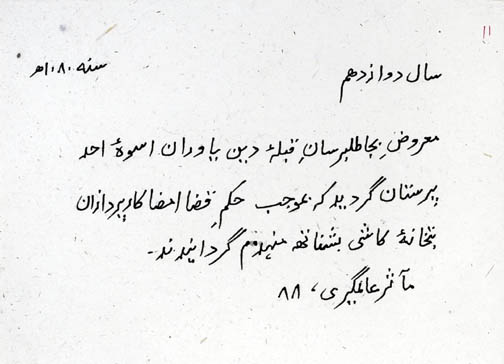
Auranzeb's firman ordering the destruction of the Kashi Vishwanath Temple (Sept. 1669).

Is that judge kosher? Why didn’t this lawyer make that point? What about the imperial firmans ordering the destruction of a temple at that very site? Can’t they be adduced as irrefutable evidence? Or, is it all a sinister majoritarian ploy? Again, ad infinitum.

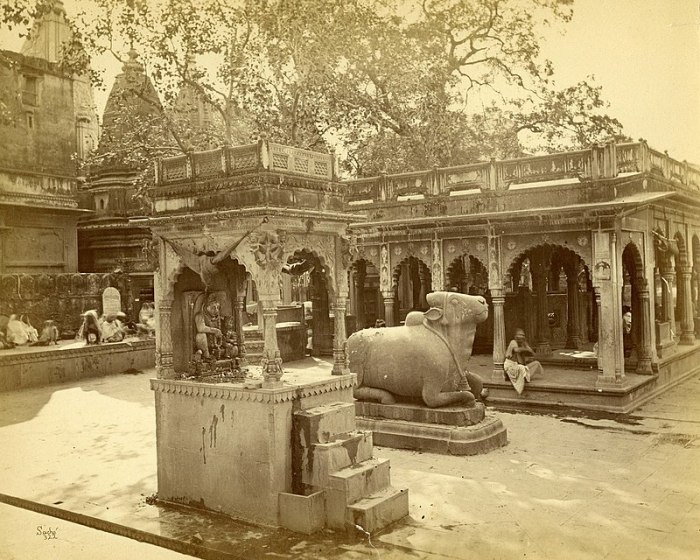
And then, there is a statue of a seated bull at the northern perimeter of the Vishwanath temple at Kashi, which has been quietly asking a different query ever since the ruckus began some centuries ago. He is Nandi, Shiva’s mount.

According to the legends which made this sacred land, Nandi is the keeper of Shiva’s abode, be it atop Mount Kailash, at Kashi, or any one of the innumerable grihas where a dreadlocked trident-bearer is the resident deity.

Nandi is endowed with great strength, and his job is to keep the peace while his Lord attends to various matters; so strong, in fact, that even Ravana, the invincible Lankan king, had to suffer a humiliating chastisement at Nandi’s hooves, when the royal visitor once threw a petulant fit after being forced to wait for an audience with Shiva at Kailash.

It is a task demanding eternal devotion and great fortitude, for which reason, Nandi is always found seated facing the abode of his master.

Photo by Britisher Samuel Bourne taken in the 1860s with the caption "Gyanvati is not a mosque, but a temple".

But this Nandi of Kashi has not seen peace, and oddly not his Lord, in a long age, for he sits facing away from the jyotirlinga of Vishwanath, gazing at a mosque through tall barricades erected by thoughts alien to this land. That is why his query is different from any other.

It is a moral question: if, by custom, tradition, belief, and history, he has always been posted to watch over Shiva, why have legalistic delays and an otiose intransigence prevented Nandi from resuming his duties for so long? It is a question for the ages.

Our modern questioners would rush to answer, excitedly and volubly, that the delay is on account of a small, but extremely influential section of the Muslim aristocracy, along with the secularist parties, who have turned the issue into a cause celebre for political control of a vote bank, and vital electoral profit.

Perhaps they are right, from a legal or a technical standpoint, but theirs is not a moral answer.

The reason is that an article of faith goes far beyond a judge, a court, a law, or an archaeological survey. It is an issue of morality: is it right to hinder Nandi thus? And the issue will be resolved peaceably, the day that point is answered honestly.

Consequently, it is not a matter of which court will answer Nandi’s query, or about how justly it will be answered, but when, because some questions cannot be avoided.

That is the way of dharma. In the end, the natural order of things is always restored by the truth.

Just as the Yaksha Prashna to Yudhishthira was the question of the Dvapara Yuga, Nandi’s query is the question for this Yuga, and the time for an answer has arrived. – Swarajya, 25 July 2023

Venu Gopal Narayanan is an independent petroleum consultant who focuses on energy, geopolitics, current affairs and electoral arithmetic.

Vishwanath Temple Complex and Gyanvapi Mosque.