This article was first published in Pragyata in 2017 and some of its observations are dated. However, the subject matter is still of interest to Hindus and the article is reposted here – Editor
On Friday Nov. 3, 2017, the Flemish broadcaster VRT Canvas, in its programme Terzake (“To the point”), presented a Dutch documentary from the series De Westerlingen (“The Westerners”), in which young Dutchmen meet youngsters in countries across the world to explore the differences in culture. In the past, the impression was that all cultural differences were on the way out because the non-Westerners were simply westernising. Now, it has become clear that some differences are here to stay, and that even in non-Muslim countries, there is a tough resistance against too much westernisation.
This time around, we were taken to India where a Dutch youngster called Nicolaas was meeting young Hindu nationalists. According to the announcement on the TV station’s website: “In India extremist associations acquire ever more influence. Nicolaas Veul meets activist young Hindu nationalists in the holy city of Allahabad. He goes around with Divya, Ritesh and Vikrant. They fight for a Hindu India, and against influences from outside.”
Hindu-baiting
At the outset, in the car on the way to an event of the Rashtriya Swayamsevak Sangha (National Volunteer Corps, RSS), he was quickly briefed by an Indian secularist about the Hindu nationalists. These were said to be “increasingly powerful”, to be issuing for use in schools “textbooks rewritten in a pro-Hindu sense”, and to be “openly linked with the Nazis”.
This was a nice summary of the power equation in the reporting on India worldwide and in all the different segments of the media: all press correspondents in and “experts” on India look at Indian society and especially the communal conflict through the glasses that a handful of secularists have put on their noses, reproducing the latter’s anti-Hindu bias and disinformation. For the average viewer, every topic in the ensuing meetings came under the cloud of these initial “revelations”, even though nothing in the RSS performance, effectively filmed, confirmed or illustrated any of them.
Since the 1980s, I have never heard the term “Hindu nationalists” without the addition that they are “emerging” or “increasingly powerful”. They should have been all-powerful by now. The only (partial) exception was the few years after the 2009 elections when the BJP had been defeated even worse than in 2004, so that supporters of the socialist-casteist parties, including partisan experts like Christophe Jaffrelot, concluded that Hindu nationalism was on the way out. However, instead of building on the existing power equation to push Hindutva deeper into oblivion, the secularist Congress wasted its chance because it got too wrapped up in driving corruption to unprecedented levels, too much for the electorate to stomach. Once the next electoral campaign got underway, even the secularists soon conceded that a BJP victory was becoming inevitable.
However, contrary to what the observers all think or say, the present BJP government under Narendra Modi, while numerically strong, is ideologically extremely weak. It is not in any way Hinduising or “saffronising” the polity or the education system. It is continuing the Congressite-Leftist anti-Hindu policies mandated by the Constitution, or at best looking the other way but not changing the Constitution to put a definitive stop to such policies. Thus, subsidised schools can be Christian or Muslim, but not Hindu: in the latter case, either they get taken over by the state and secularised, or at best, they have to do without subsidies. Temples are nationalised and their income channelled to non-Hindu purposes, a treatment against which the law protects churches and mosques. And this is no less the case in BJP-ruled states, where the Government could have chosen not to avail of the opportunities given to it by the Constitution.
Nowhere in this documentary would you pick up any hint to the main communal reality in India: the anti-majority discrimination. It is admittedly hard to explain to outsiders, and therefore easy to conceal or deny, but Hindus are indeed second-class citizens in their native country. I am aware that right now, many non-Indian readers will refuse to believe me, but it is really like that. Anywhere is the world you can download the text of the Indian Constitution, so please verify for yourself, starting with Article 25-30.
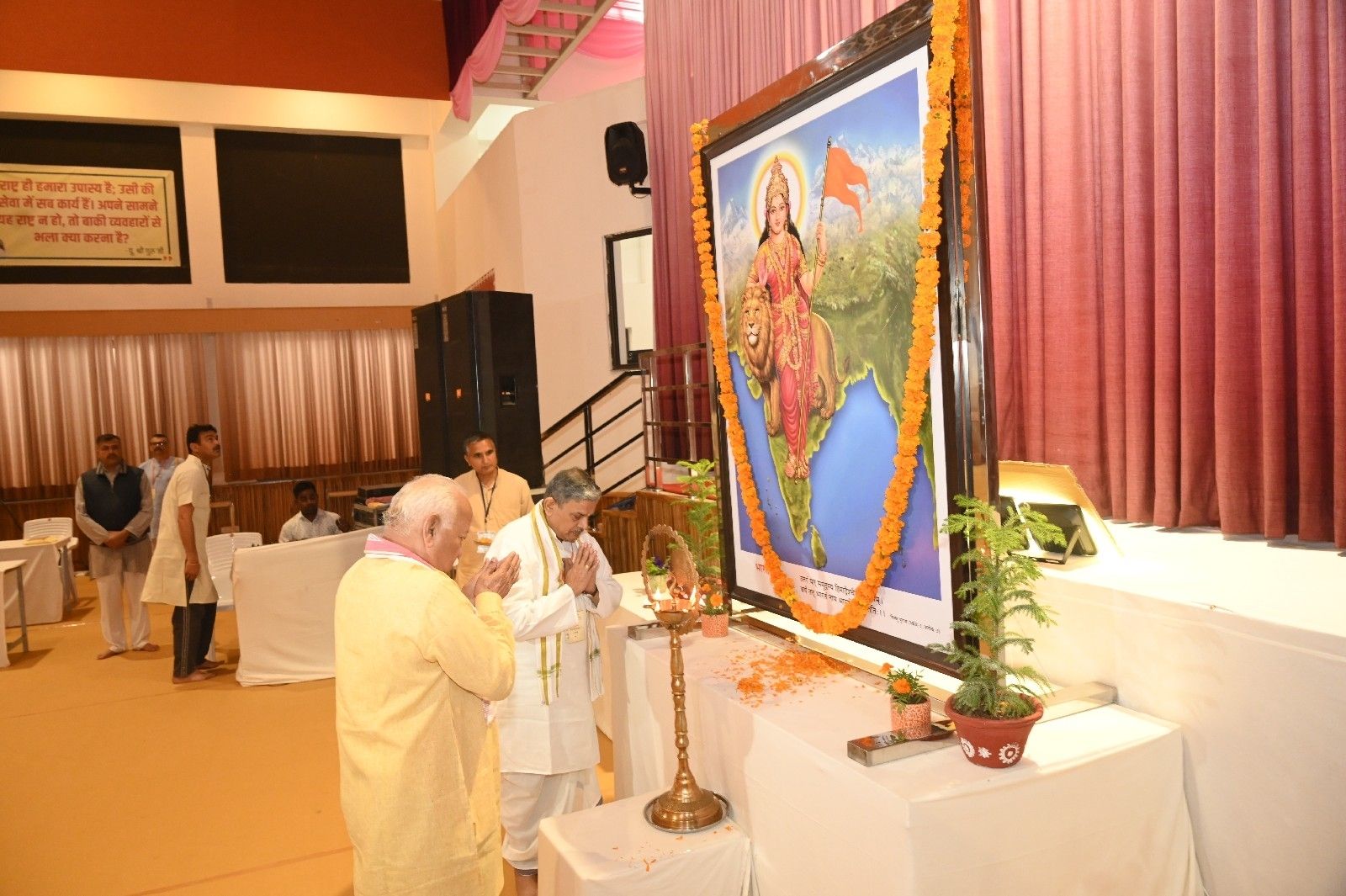
So, what did you get to see? Many people in the city were on the streets converging on an open ground where a meeting of a local RSS unit (shakha, branch) with physical and ideological training was about to take place. They were wearing (or in the case of newcomers, buying) the RSS outfit with white shirt and black cap and brown trousers. It was the new uniform, for till recently the brown trousers would have been khaki shorts, even more a colonial style. Their military style was highlighted, though everyone could see for himself that all the “weapons training” they did was with sticks, rather harmless in the age of the Kalashnikov. Naturally, there was no hint that an endless series of murders of RSS men has been committed by Kerala Communists, Khalistanis in Panjab, and others. The RSS youngsters also did not bring it up, or if they did, that part was not shown. The persistent suggestion was that they were the perpetrators of violence, not its victims, though no such violence was actually shown.
When interviewing these RSS activists, Nicolaas repeatedly remarked that this or that guy was actually impeccably friendly and quite nice. Not at all how we would picture the fascists announced initially by the secularist. Then what was wrong with them?
St. Valentine’s Day
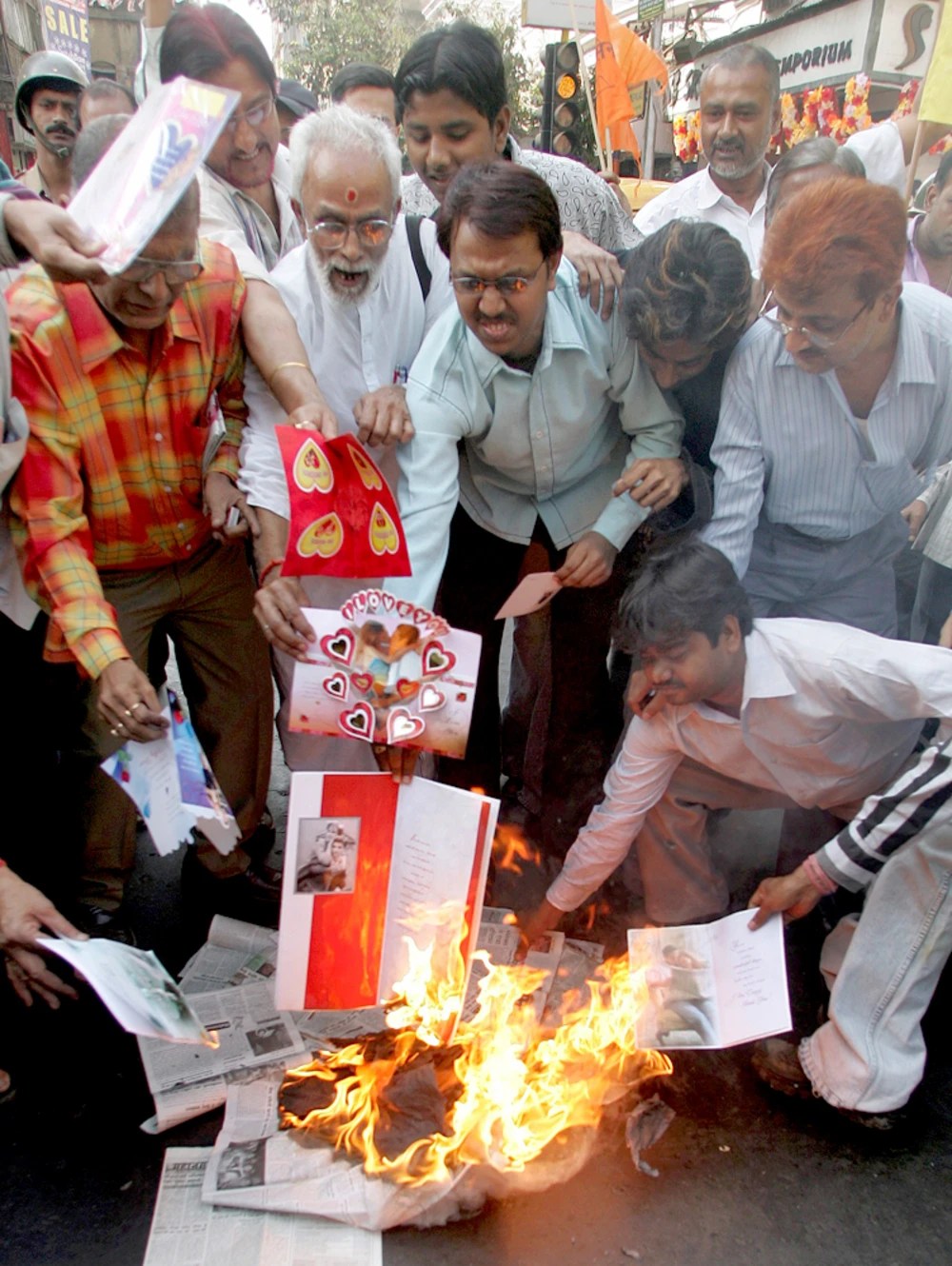
The real topic of this documentary series was the culture clash and the native resistance against westernization. And indeed, these young people refused to absorb the flood of westernising influences. One example of a pernicious influence was Valentine’s Day, taken straight from the existing western commercial pop culture. More ideologised people denounce it also as a “Christian” holiday. Valentine was a Roman Catholic priest who performed tabooed weddings, and when martyred and sainted, the Church gave him a day in the Saints’ Calendar, 14 February, coinciding with the pre-Christian fertility feast presided over by the goddess Juno Februata (“clean, purifying”) of 13-15 February. It took a thousand years, to the age of the troubadours and courtly love, before he graduated to patron-saint of romanticism.
As such, commerce catapulted him to the fore, and made the saint’s day into an occasion pious Christians would frown upon: the feast of sentimentalism and getting carried away with infatuation. Since the late 18th century, there is a whole literature, and later movies, about youngsters following their hearts and overcoming the resistance of their unfeeling narrow-minded parents. This is now re-enacted in India, where commerce and the secularist-promoted fondness of all things western is spreading the highly artificial celebration of Valentine’s Day. This has become the symbol of western decadence, in which the pursuit of emotional kicks takes precedence over long-term institution building, marriage, and the resulting children’s well-being. Nicolaas’s Indian interlocutor wants to spare his country the breakdown of family life that has come to characterise the modern West.
But in the documentary, in the interview with the RSS activist, we only see a humourless spoil-sport’s jaundiced rant against a day of innocent fun. The Dutch lad just doesn’t see that there is another side to it, and that the Hindu critique of Valentine has its legitimacy. This RSS fellow was voicing a very positive viewpoint, one in favour of the precious fabric of traditional social values, of the time-tested mos maiorum (ancestral custom), which is being undermined by modernist influences symbolised by Valentine’s Day. Possibly it is not good enough to overrule modernisation, but that remains to be seen, and the traditionalist view deserves a proper hearing.
In the streets, the Dutch newcomer to India saw westernisation all over the place. Western fashion, neon lights, shopping malls, Kentucky Fried Chicken, young couples kissing in public. Even an RSS spokesman admitted he sometimes goes to the McDonald’s. So, the final impression that the viewers will take home is that, in India at least, westernisation is unstoppable. It is not uncontested, true, but the nativists, though not convincingly put down as “fascists” anymore, are not very competent and are at any rate unable to stop it.
Communication
But then, come to think of it, the RSS fellow didn’t have the required communication skills to overturn an anti-Hindu bias instilled in the western public for decades. And by “anti-Hindu”, I do not mean the kind of grim animus seen in the missionaries or the secularists, but a background conditioning: Nicolaas has no quarrel with the Hindus as such, and he is probably not even aware of his implicit anti-Hindu bias, but like most Westerners with an interest in India, he has innocently absorbed the partisan view of India fostered by the really hostile people.
It is unrealistic to expect this one fleeting television conversation to change a bias built up over decades. Still, the RSS spokesman could have defended his position better. On the other hand, his peaceful and civilised but weak argumentation was a logical illustration of a deliberate policy pursued since the 1920s. It was in line with the old RSS’s boy-scout mentality of disdain for all communication (“do well and don’t look back”). Founder K.B. Hedgewar, who had started out as a member of a revolutionary wing of the Freedom Movement, with secretive and purely oral communication to avoid discovery by the police, installed in his new organisation a hostility to any concern for outside approval, and to the media and their narrative. A consequence today is that RSS spokesmen are gravely lacking in communication skills. On average, they have a far better case than their clumsy performance in interviews and TV debates would suggest.
Twice the RSS refused a media presence. I was somewhat surprised to see this. In the early nineties, when I went around to RSS/BJP centres to interview Hindu nationalist leaders, there was still plenty of distrust for outsiders, and communication was largely excluded. I knew then that I was exceptionally privileged to be allowed access, as a result of my lone pro-Hindu conclusions in my book on the Ayodhya temple/mosque conflict. But then private TV stations conquered India, gaining entry in the remotest villages, and finally the internet made communication unavoidable, even for the RSS. I had thought that this seclusion had by now become a thing of the past, but the RSS appears to have retained some of it.
The result is that RSS spokesmen, while not at all the “fascists” of secularist mythology, come across as village bumpkins. In this case, an interviewed RSS man suffered from a lack of serious historical knowledge, or of a chauvinist type of gullibility. He explained that India has invented plastic surgery and, as proven by the Ramayana, the air plane. This story has two related drawbacks: as far as evidence can tell, it is not true; and it is bad publicity, for while it may make a handful of gullible folk admire Hindu culture, it turns Hinduism into a superstitious laughing-stock for many more. When the Dutchman brought up homosexuality, the RSS man said: “That doesn’t exist in our country.” Just like it didn’t exist in the Soviet Union—“a symptom of bourgeois decadence”—nor in Africa according to Robert Mugabe—“they may be gay in America, but they will be sad people in Zimbabwe”. Again, even those Westerners who condemn odd sexual behaviour will laugh at these clumsy attempts to make it stop at your country’s border. This way the RSS tendency is particularly weak in the prime precondition for communication, viz. seeing things also through the eyes of your interlocutor.
Grim
Today, the image of Hinduism is less grim than when Hindu Nationalism realistically coveted power or for the first time came to power in the 1990s. One reason is reality: all the grim doomsday predictions about the Hindu nationalists “throwing all Muslims into the Indian Ocean” and “turning the clock back regarding Dalit emancipation”, failed to come true. Recently, Narendra Modi has conducted a very successful foreign policy, and the Western powers can only dream of the economic growth figures India takes for granted. Less importantly but tellingly, the Hindu parents are making progress in the California textbook affair, where some negative portrayals of Hindu culture will be amended, contrasting with the total defeat inflicted on the Hindus in 2006. The anti-Hindu lobby in American academe, largely consisting of NRIs and Indologists, has lost considerable steam.
Postscript
The same impression could be had from Sona Datta‘s documentary about Hindu art and temple architecture, broadcast a few days later. Over-all quite informative as well as full of awe for Hindu brilliance, it nonetheless started out with familiar secularist lies about pluralist Moghuls who “built their magnificent mosques next to Hindu temples” and presided over a peaceful and tolerant empire “when Europe was ravaged by wars of religion”. But unlike in the recent past, this propaganda was not that obtrusive. – Pragyata, 15 November 2017
› Dr. Koenraad Elst is a Belgium author, linguist and historian.


 VOICE OF INDIA