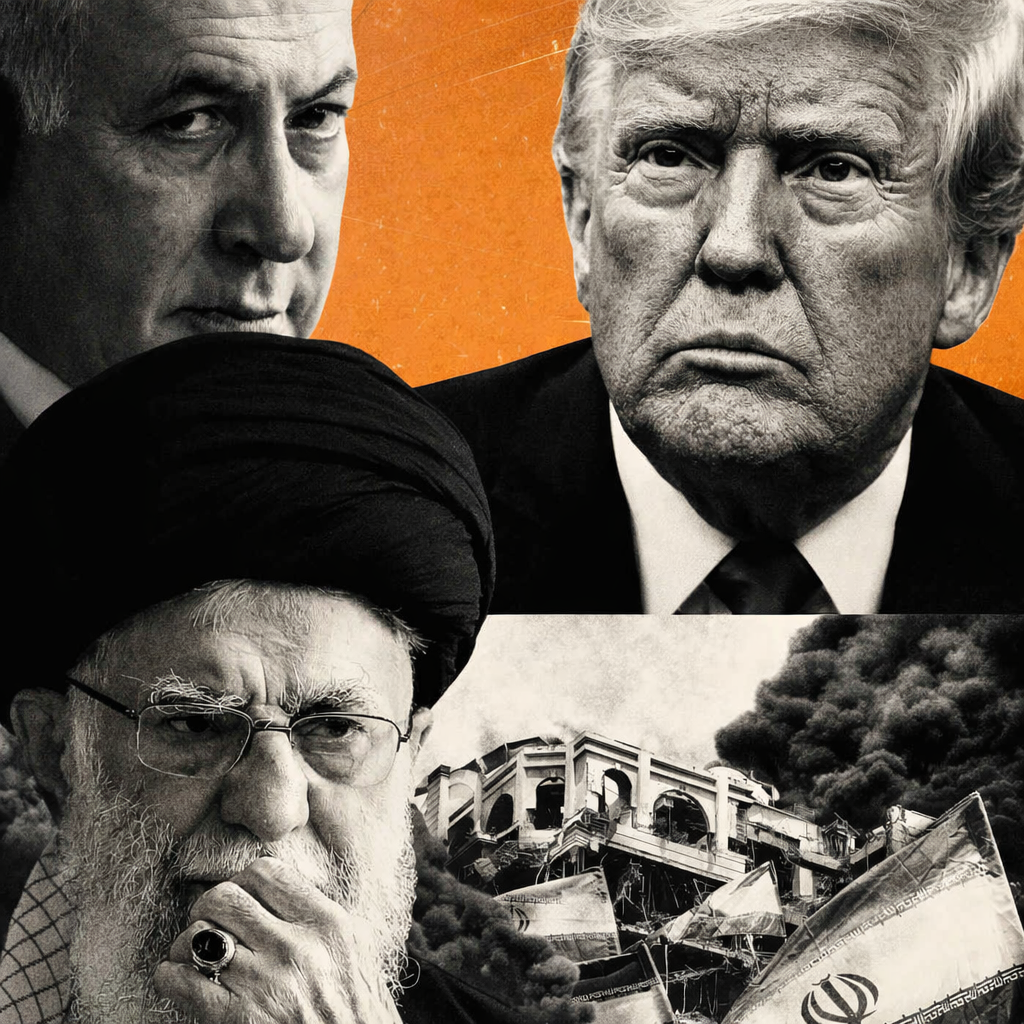
You cannot burn your neighbour’s house and rest in peace, not because of some mystical law, but because the act of burning changes the one who burns, and that changed person then returns to the home he imagined was safe and wonders why he cannot sleep. – Acharya Prashant
There is a question that goes unasked every time the world erupts in war, and its absence is more revealing than anything the analysts say. The question is not about which side is right, or which grievance is legitimate, or which alliance has been betrayed. Those questions get asked at great length, with great sophistication, by very worldly, credentialed people. The question that does not get asked is simpler and more dangerous: who is the one fighting? Not which nation, not which ideology, not which scripture, but who, actually, is doing this, what does this person want, and why does the wanting never stop?
That question is dangerous because it turns the lens around. All the other questions look outward, at the adversary, at the system, at the historical injustice. This one looks at the looker. And the looker, it turns out, has a very strong interest in not being looked at.
In the recent weeks, US and Israeli strikes on Iran have killed several top military and political figures, including senior leadership; Iran retaliated with strikes on Israeli positions and on American bases and allied targets in parts of the Gulf region; Pakistan launched strikes into Afghanistan; the Ukraine-Russia front continues its grinding attrition; and all this is happening while the devastating war in Gaza is still quite fresh in the collective memory. Across every editorial room and foreign ministry, the same machinery cranks into motion: geopolitical analysis, balance-of-power calculations, resource competition, historical grievance mapping. These explanations are not wrong, exactly. They describe the furniture of the room quite well. But what they do not explain is who is sitting in it, or why that person keeps setting the room on fire and then expressing surprise at the flames.
Nations Don’t Fight
There is no such thing as a nation as a conscious entity. A nation is a principle, and a principle has no agency of its own; it can only express the consciousness, or the unconsciousness, of the people who generate it. When a people is inwardly chaotic, driven by fear and the need for dominance, it produces a nation that is belligerent, exclusive, and always in search of an enemy to confirm its own identity. When a people is inwardly clear, the nation it generates can be genuinely civilising. But we do not speak this way. We say “the US attacked Iran” as though two abstract entities are in principled competition; the label launders the real actor, the human ego, into a flag, and the flag then takes the responsibility while the ego escapes into the applause.
Consider what a single historical fact does to the entire geopolitical narrative of the current US-Iran crisis. Until 1979, Iran and Israel were functional allies. Iran was an important oil supplier to Israel during the Shah’s era; Israeli and Iranian intelligence services collaborated closely; Iran extended de facto recognition to Israel in 1950 and maintained working relations with it throughout the Shah’s rule, at a time when every Arab neighbour had gone to war to prevent exactly that. Two countries that today describe each other in the language of surgical removal and satanic identity, “the cancerous tumour must be excised,” “the Little Satan must perish,” were, within living memory, strategic partners. No territory changed hands between them in 1979; no oil field was found or lost; no ancient wound was reopened. What changed decisively was the 1979 revolution that placed religious identity at the absolute centre of the Iranian state, and the same country that had been a partner became the enemy. The Islamic Republic made opposition to Israel a central ideological position of the new state, not because Israel had done anything new, but because a state founded entirely on theological identity requires its identity to be defined against something. A Jewish state served that purpose with theological precision.
This is not geopolitics wearing a religious costume. This is religion being worn by the ego as its most respectable armour, and it tells us everything we need to know about the nature of the conflict.
Religion exists to civilise the animal. Every great tradition, at its irreducible core, was attempting to do one thing: take the creature that emerges from the womb driven entirely by the biological logic of survival: consume, expand, eliminate the threat, secure the territory, and elevate it into something capable of clarity, compassion, and self-knowledge. That is the whole project. The animal, however, is remarkably resourceful. It can colonise the very force meant to tame it; it can drape itself in scripture, recite the holy verses with genuine feeling, and emerge looking not like a beast at all, but like a soldier of God. When that happens, religion does not merely fail at its purpose; it becomes the most potent accelerant the ego has ever discovered, because now the hunger for dominance carries the blessing of the divine, the violence is sanctified, and the enemy is not merely an adversary to be defeated but a heretic whose destruction is itself an act of devotion.
Look at the region, and the pattern is visible everywhere at once. The Shia-Sunni schism, a theological dispute over succession thirteen centuries old, continues to shape proxy wars across Iran, Saudi Arabia, Iraq, Syria, and Lebanon; the hatred between those who share the same God, the same Prophet, and nearly the same scripture exceeds in ferocity the hatred between people who share nothing. In the United States, some influential evangelical constituencies hold a literal belief in Biblical prophecy that makes their support for Israeli military policy not a political position but an eschatological one; they believe the Second Coming is contingent on certain territorial arrangements in the Middle East, and no diplomatic argument reaches a conviction rooted in the Book of Revelation. Hamas frames every missile launch in the language of holy liberation. The Israeli state, forged in the trauma of the Holocaust and the genuine existential terror of being a country the size of a few Indian districts surrounded by populations that have repeatedly declared their wish to see it gone, responds with a hardness the world has rarely seen directed so openly at a civilian population, and does so while invoking its own theological entitlement to the land. Every party has its scripture and its God. Every party’s God appears to have personally endorsed that party’s military strategy. One must pause and ask with full seriousness: what kind of God is this, who sides so reliably with whoever happens to be invoking him at the moment of the airstrike?
The answer, of course, is that this God does not exist. What exists is the ego, which has been using the name of God since it first discovered that the name confers immunity from examination.
Not Resources, But Identity.
Strip away the theological dressing and the geopolitical framework, and what remains is something both simpler and more intractable: the ego’s bottomless hunger to feel complete. This is the actual engine beneath every war, and no diplomatic architecture has ever been built to address it, because the architects themselves are running the same engine.
The resource explanation for the US-Iran confrontation is the most persistent alibi and the most easily dismantled. The United States is among the world’s largest energy producers; it has no material need for Iranian oil that could justify the risks of direct military confrontation with a nation of ninety million people in one of the world’s most volatile regions. Iran, for its part, possesses no intercontinental missile capable of reaching American cities, and by several credible accounts a negotiated arrangement, with Omani mediation, was genuinely within reach: Iran would continue enriching fissile material but not stockpile it, making weaponisation impossible without abrupt and easily detectable reversal. None of this fits a resource or security conflict in the conventional sense. What it fits is the logic of an ego that requires dominance not as a strategy but as a psychological condition; an ego that cannot tolerate the existence of an entity that refuses to subordinate itself to the hierarchy. You cannot give it enough. Feed it every oil field in the Gulf and it will discover it needs recognition; give it recognition and it will discover it needs submission; give it submission and it will discover it needs the annihilation of any future possibility of challenge. The hunger has no floor because the hollowness it is trying to fill has no floor either.
This is also why every coercive attempt to prevent Iran’s nuclearisation produces the very outcome it claims to be preventing. The lesson that every capital in the world is drawing from watching a sovereign nation’s senior leadership eliminated by a foreign military strike is not “we should negotiate more sincerely.” It is: “We need a nuclear-tipped intercontinental missile, because that is the only thing that makes us genuinely untouchable.” North Korea understood this early and has not been subjected to the same treatment as Iraq, Libya, or now Iran; every government in the world has registered exactly why, and is drawing its own conclusions quietly. Pakistan articulated the logic with unusual candour in the 1990s when it was reported to describe its nuclear programme as the “Islamic bomb”; the theology was decoration, the calculation underneath is now a standard operating assumption in most strategic planning ministries on earth. You can prevent a country from manufacturing a weapon; you cannot prevent it from purchasing one, trading for one, or receiving one through channels that only appear in retrospective intelligence reports five years later. The ego will always find a route around the obstacle, because self-preservation is its oldest and deepest competence, and it will spend every gram of available intelligence in that service. What you cannot route around is the inner condition that makes the weapon feel necessary. Everything else: the sanctions, the strikes, the frameworks, the summits, is rearranging weapons into configurations that feel temporarily safer and calling the rearrangement peace.
The Fire Was Lit In Here
There is a temptation, particularly for citizens of the nations doing the striking, to watch all of this from a position of apparent safety: to feel either pride at a display of power or simple relief that the devastation is happening at a geographical distance comfortable enough to be consumed as news. The objects of the conflict are far away: Iran, Gaza, Afghanistan, Ukraine. The subject, the one who has authorised, funded, and often enough cheered for these operations, remains at home, apparently untouched. This is the ego’s most seductive illusion: that the fire it lights in the world stays in the world, that you can sanction the destruction of other people’s cities and return to your own life carrying none of that destruction inside you.
The fire does not stay outside. It never has.
The inner condition that produces belligerent foreign policy is the same inner condition that produces the epidemic of depression, anxiety, addiction, and inner purposelessness that has become the defining psychological signature of the most militarily powerful societies on earth. It feels counterintuitive to connect these; it feels like a category error to link America’s mental health catastrophe with decades of American military conduct across the world. And yet this is precisely what honest seeing reveals when it is applied without flinching. The violence directed outward, and the suffering experienced inward, are not two events happening in two different places; they are the same ego operating in two directions, and the ego that lights the fire and the ego that cannot sleep afterward are not two separate entities but a single disturbed centre. The ego believes it can cleanly separate the one who acts from the one who suffers. But the one who lights fires has already become a person who lights fires; the one who sanctions collective punishment has already become a person capable of sanctioning collective punishment; and that becoming does not halt at any border. You cannot burn your neighbour’s house and rest in peace, not because of some mystical law, but because the act of burning changes the one who burns, and that changed person then returns to the home he imagined was safe and wonders why he cannot sleep.
The senses are made to face outward, and therefore the ego, using only the senses, sees only what is outside, never what is within. This is the structural predicament of the geopolitically entranced ego: it looks outward at the adversary, at the threat, at the historical injustice, and it never pauses to notice that what it keeps finding out there, the hunger, the fear, the need for enemies, the certainty of its own righteousness, is a precise mirror of what has never been examined within. Nations go to war for the same reason individuals destroy their own relationships: something hurts, something feels insufficient, and the instinct is to locate the source of that pain outside oneself. The nation blames the enemy state; the individual blames the partner; and in both cases the real author of the suffering, the unexamined centre that requires enemies in order to know what it is, goes untouched, free to generate the next crisis with the same efficient reliability.
Ask yourself what genuinely disturbs you when you read the news from that region. If you find that a missile strike produces something that feels uncomfortably close to satisfaction, a sense that the right people are being punished, that your side is winning, that the world is being corrected, sit with that feeling for a moment before moving to the next headline. Ask what it is fed by. Ask what it would mean for your sense of identity if the world stopped arranging itself into enemies you could feel righteous about. These wars are not aberrations in an otherwise rational world order; they are the outward expression of an inward condition that is universal and ancient, that operates identically in the head of state and in the citizen consuming the coverage, differing only in the scale of damage each has access to.
The ego that requires enemies to sustain its own sense of coherence does not disappear when the missiles stop. It waits until it finds the next available occasion. And the wheel turns again.
The wheel will not be stopped from the outside. There is no treaty elegant enough, no balance of power stable enough, no diplomatic architecture sophisticated enough to address what keeps turning it. The wheel is turned from within, by the unexamined centre that has been given every instrument of analysis and statecraft except the one that could actually change something: the willingness to look at itself with the same ruthlessness it has always reserved for its enemies.
That is the only disarmament that lasts. Not a new agreement, not a new government, not a new ideology dressed in the vocabulary of the old one, but just a human being, finally willing to ask: what in me is producing this world, and what would remain of my sense of who I am if I could no longer find an enemy to confirm it?
That question, honestly pursued, is the beginning of the only peace that has ever been real. It will need to be asked again tomorrow. And the day after. Because the ego that found the question will, by the next headline, have found a new enemy. But each asking weakens the wheel by a fraction, and a fraction, repeated across enough human beings, is the only force that has ever slowed it. – The Pioneer, 7 March 2026
› Acharya Prashant is a teacher and author whose work centres on self-inquiry and its application to contemporary life.
 VOICE OF INDIA