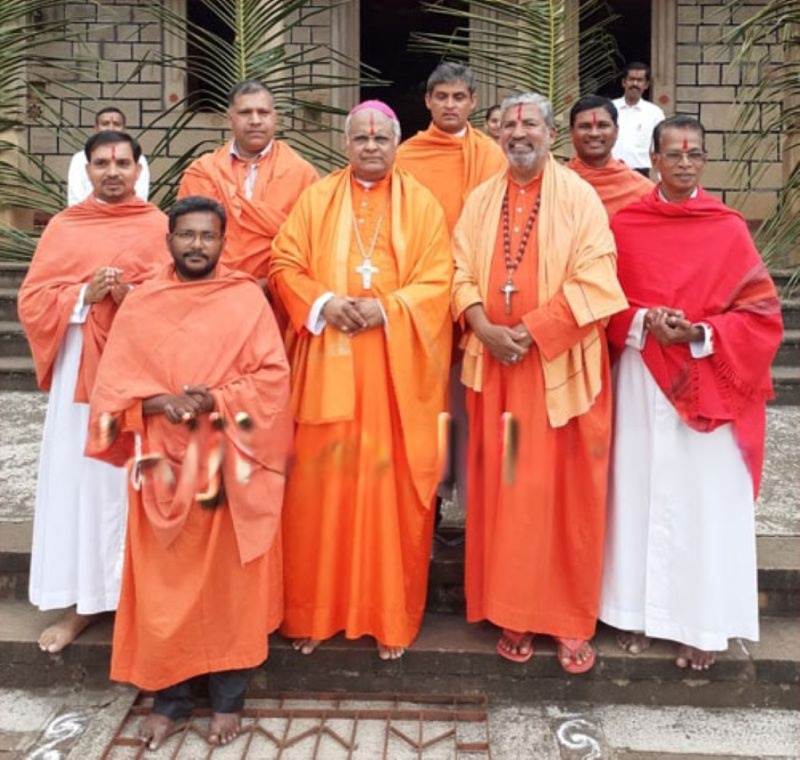
Is it possible that the government does not want to know what is happening on the religious front? … When there is no will to know what is happening regarding conversions, there is probably also no will to stop it. The government, rightfully, maintains that it is secular and not concerned about the religion of its subjects. – Maria Wirth
Abstract
This article examines the aggressive proselytization targeting Hindus in India, exposing the socio-political and cultural ramifications of conversions to Abrahamic religions. It highlights the lack of reliable data on conversions, despite documented cases of fraudulent tactics, including financial incentives, “miracle cures,” and exploitation of vulnerable communities. The author contrasts Hinduism—an inclusive, philosophy-based tradition emphasizing dharma (righteousness) and universal spiritual truth—with the exclusive, dogmatic nature of Christianity and Islam, which claim sole religious legitimacy and threaten non-believers with eternal damnation. The article wonders why the secular Indian government is enabling religious inequalities, such as preferential treatment for “minority” religions and the marginalization of Hindu institutions. It is argued that conversions fracture social harmony, empower divisive forces, and erode India’s spiritual heritage. She calls for educating Hindus about their profound philosophical roots (e.g., Advaita Vedanta), challenging irrational dogmas of Christianity and Islam through rational discourse, and stopping unequal religious policies by the state. Ultimately, Wirth frames the preservation of Hinduism as essential not only for India’s cultural integrity but also for humanity as a whole. The Vedic knowledge that God is within as blissful consciousness (sat-chit-ananda) is lacking in the Abrahamic religions.
Text
Conversion is a big challenge for Hindu society in India. Yet it is hardly a topic of public debate. Moreover, it is impossible to get accurate data of conversions. In fact, even the data regarding the composition of the population religion wise, may not be reliable.
In 1947, India’s population was around 36.1 crores, of whom 30.37 crores (84.1%) were Hindus, 3.54 crore (9.8%) were Muslims, 0.83 crore (2.3%) were Christians and 0.27 crores (0.7%) Buddhists (the figures are based on the census of 1951).
In the 2011 census, the Hindu population had shrunk by 4.3 percent and the Muslim population had grown by 4.4 percent. The overall population had tripled to 121.9 crores. Hindus accounted for 96.62 crore (79.8%), Muslims for 17.22 crore (14.23%), Christians for 2.78 crores (2.3%) and Buddhists for 0.84 crore (0.7%).
The census of 2021 was postponed due to the Covid pandemic and will be held only in 2026/27. It can be assumed that since 2011, the Hindu population has shrunk further, yet the population of Muslims is still cited to be 14 percent and that of Christians still 2 percent. Do we bury our heads ostrich-like in the sand?
According to the website censusofindia.net, in 2025, the overall population is estimated at 141 crores, of whom 114 crores are expected to be Hindus. This would be a slight increase of Hindus to 80 percent, which is unlikely considering the massive conversion attempts, apart from the lower Hindu birthrate. Unfortunately, I could not find official numbers for conversions. ChatGPT says: “I could not find any official government estimate that gives a precise number of Hindus who have converted to Christianity since 2011. In fact, the Government of India has explicitly said that no central record/database of religious conversion is maintained.”
The same is valid for Islam: “There is no reliable official data specifying how many Hindus have converted to Islam in India since 2011.” ChatGPT continued, “Most demographic surveys, including those by Pew Research Center, find that religious switching is very rare overall.” According to Pew research survey of 2021, 0.7 percent of the respondents said that they have changed their religion. This would come to around 6 million people. Yet since there is no central database of religious conversion, the true numbers are anybody’s guess.
Aggressive conversions are happening
Most of us know even from personal observation, that missionary activity is extremely high in India by both Christianity and Islam, especially in certain states like Punjab or Tamil Nadu, and basically everywhere, specifically in tribal areas. They don’t hide it. Christian publications exhort their members to convert Hindus. “India must be evangelised in this generation”, declared Blessings, a Christian youth magazine in its 2008 issue, which a priest from Tamil Nadu had left with me. And a German Catholic magazine, which landed in my mother’s mailbox, had an article with the ominous title, “India – a success story”.
The Joshua Project is clearly implemented. New churches shoot up, Christian schools offer discount for fees for Christians, missionaries ‘visit’ patients in hospitals, etc. Occasionally, news about conversions come out in the media due to complaints by Hindus. Some examples from only one week:
On 30. September 2025, several news outlets reported that over 1000 Hindus from poor and backward castes converted to Christianity in Lucknow’s Mohanlalganj. A village once free of Christianity had now 5 churches and100 plus prayer halls. According to India Today, police unearthed a well-oiled nexus to lure Dalits with the help of ‘miracles cures’.
A few days later, another huge conversion ring with wide connections across states was uncovered in Gujarat’s Nandiad, on which OpInda reported.
Soon after, on 6. October, more concerning news surfaced. An American, James Watson, in India on a business visa, was arrested together with two Indian associates for fraudulent conversions in villages in Maharashtra, targeting especially children. He told them that “Hinduism is based on superstition. But if they convert, they will be happy, prosperous and cured from illness.” In this connection, CNN News 18 reported that between 2018 and 2025 over 320 cases had been discovered of visa misuse for religious conversion. This may be only the tip of the iceberg.
Muslims, too, try hard to get Hindus into their fold
The Chhangur Baba case shows how much money flows into fraudulent, elaborate conversion efforts. He and his associates were arrested in July 2025. He received hundreds of crores from abroad for his conversion racket, where he funded Muslim men to entrap Hindu girls. Love Jihad, for long denied, can’t be denied any longer. Even otherwise, Muslims are taught to coax Hindus into converting by presenting Islam as far more attractive than Hinduism. Zakir Naik said in one of his speeches around 2016, it is easy for Muslims to convert Hindus. They only need to show Hindus a picture of Ganesha, with his elephant head and big belly, and ask them whether this is the God whom they worship.
This situation is concerning and the question, why the government has no database, is only natural. Even in states, which have enacted anti-conversion laws, and where it is obligatory to register a change of religion, no overall numbers are available. What is available, are FIRs filed for unlawful conversion, and individual notifications in government Gazettes about name changes. But how many conversions in toto happened, nobody seems knows.
Religion is not a concern for the government
Is it possible that the government does not want to know what is happening on the religious front? If this is true, then even the 2011 census may not give the correct picture. And from an anecdotical episode, this is indeed possible.
A teacher in Mumbai, who was part of the 2011 census team, told me that during the training for the census, they were instructed to accept whatever information they were given. She surveyed a heavily Muslim populated area and knew that she was not getting honest answers. She went back to her supervisor and told him, that the census won’t be accurate if they are not allowed to check the information, for example how many children a family has. Her instructor was blunt, “You heard the instruction. Accept whatever info is given.” She told me, “If the government manages to conduct an accurate census next time, it will be a shock for Hindus.”
When there is no will to know what is happening regarding conversions, there is probably also no will, to stop it. The government, rightfully, maintains that it is secular and not concerned about the religion of its subjects. It has a point. This is clearly a worldwide attitude. The German government also no longer records the religion of its citizens. It did so till in the 1950s, when I was in primary school and dutifully filled out “RK” for Roman Catholic in all official forms. Yet, today, only the Churches keep a record.
Hinduism and the Abrahamic religions are completely different categories
The situation in India is, however, unique. The Hindu faith of the majority is very different from Islam and Christianity. Often it is not even considered as a religion, because it does not have a rigid belief system, but it is rather a way of life. It has a solid foundation in philosophy and demands to follow dharma—to do the right thing in the given situation according to one’s conscience. It does not exclude anyone from being ‘allowed’ into the Presence of God. In fact, it claims, God is already present in everyone, and explains what is meant by ‘God” (not a kind of biased superman on a golden throne high up in the sky, but all-pervading, pure, blissful consciousness). In short, Hinduism makes a lot of sense.
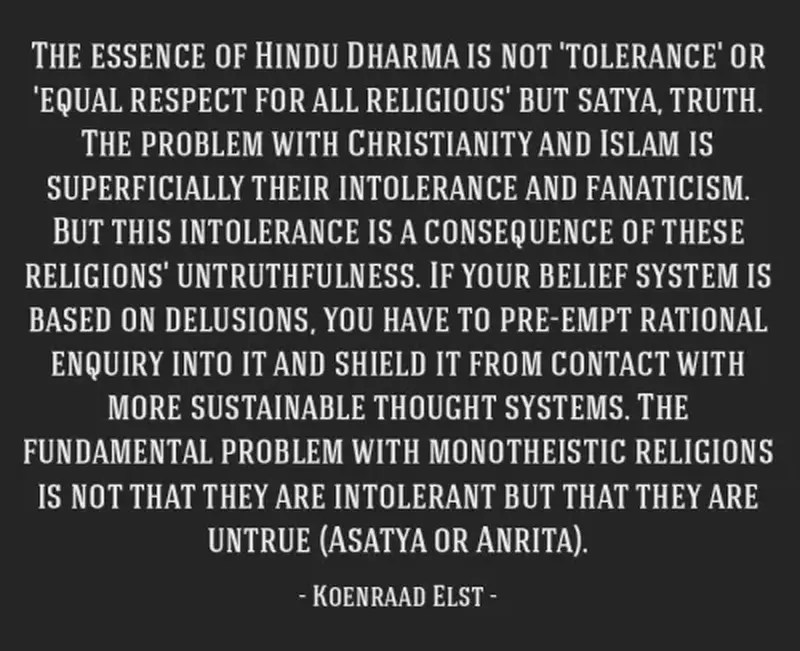
Unlike Islam and Christianity, which were brought to India by invaders, Hinduism does not proselytise. Those two foreign religions demand blind belief in dogmas. A dogma is a claim that cannot be proven to be true, and the most irrational, and very harmful dogmas of both Islam and Christianity are the claims that, 1. Only their religion is true (both didn’t sort out over the centuries, which one exactly is true, because of course they don’t have any proof for their claims) and 2. if you don’t convert to Islam or Christianity, the great God will discard you at Judgement Day and let you burn eternally hell.
Burden of history
Hindus were threatened and brutally coerced to convert first by Muslim and later by Christian invaders over several centuries. Millions of Hindus died for their faith. Many preferred humiliation and financial burden to conversion. When the outsiders left, Hinduism was still strong. However, most of those Hindus, who had converted to Islam and Christianity during foreign occupation, were successfully alienated from their original tradition especially during British rule, who were, and still are, masters in ‘divide and rule’. They made those converts believe that they were better, higher, more worthy than Hindus.
At Independence in 1947, Muslims demanded their own country to be carved out from India, called Pakistan, which in 1971 split into Pakistan and Bangladesh. So, one would expect that Islam is no longer a problem in India, and Hindus have only to deal with those who converted to Christianity but who also, like Muslims, believe that they alone have the true religion, and Hindus will be eternally damned by God if they don’t convert. Yet this is a wrong notion because many Muslims, who agitated for a separate state before Independence on the ground that they can’t live with Hindus, did not go to Pakistan. They stayed back, possibly even with the nefarious agenda to fulfil Allah’s alleged wish to make all Indians follow Islam. The truncated India was generous and allowed it, maybe on the advice of the British who wanted to sow the seeds for division in Independent India.
Many Hindus probably considered the Indian Muslims and Christians as not very different from themselves, and did not realise that their religious doctrine had meanwhile indoctrinated many of them to look down on Hindus, and they had become as unreasonable as their foreign masters used to be. Now the converts, too, believed that the Great God Allah does not like Hindus and will throw them into eternal hellfire, and that Allah/God wants only Muslims/Christians on earth. No reasonable person would believe this, and Indians are generally reasonable, but due to indoctrination from childhood, many of the converts had embraced this irrational belief.
Respectable Gods and religions
Moreover, on the international stage, those religions, which consider the creator of this vast universe as personal, vengeful and biased, are considered respectable even today. People, who are otherwise reasonable, don’t realise that a God, who loves only certain people, must be a tribal God and cannot be the Source of All.
Unfortunately, Hindus did not seem to be aware of those dogmas. Otherwise, why would they allow Christian schools to continue after Independence to teach Hindu children, when ‘good’ Christian teachers naturally look down on their Hindu students because, according to the Church, they follow a dark, demonic cult?
Why would the government allow the catechism to be taught to Christian students, but not allow Vedanta philosophy, which is a rational explanation of what is true, to be taught—not even to Hindu students?
Why would the ‘minority religions’, parts of which are irrational and based entirely on blind belief, get government concessions, and Hindu Dharma, which is based on solid philosophy, would be disadvantaged, for example in the Right to Education Act or regarding their places of worship?
Indian Secularism is upside down
So, even though a secular state is not supposed to be interested in the religion of its subjects, in India, certain reforms would only be fair, as presently the stakes are stacked against Hindus. If a Hindu converts, he gets the advantage of belonging to a politically influential ‘minority’, which is worldwide even a majority. And if he happens to be a criminal, even world media will treat him more leniently than it treats Hindus, and it seems, as if this lenient treatment extends even to the judiciary worldwide.
Agreed, the government has no role to play in religion, but it surely has to level the playing field, especially since the Abrahamic religions and Hindu Dharma are in very different categories: Islam and Christianity are exclusive and divide society between those who are right and saved, and those who are wrong and damned. Even in the interest of developing a ‘rational mindset’, which is the explicit goal of education, the followers of those religions should not be given favours by the government.
In contrast, Hindu Dharma is inclusive and makes sense. It claims that ultimately all will reach back to their divine Source and it exhorts to follow Dharma. It would make sense, in the interest of a stable society, to favour it.
A harmonious society is rather impossible if the divisiveness of the dogmatic religions is not taken out
If you have many crores of Indians who despise Hindus because according to their belief, Hindus are great sinners by worshipping false Gods, a harmonious society is tough to achieve, and enemies of Bharat have a field day to instigate chaos and violence. This is not theory. It’s happening, including with big money from the Deep State, as the investigation into USAID had revealed.
Do Hindus even know what is preached in the innumerable churches and mosques across India? I know that Hindu Gods are called devils or demons by Christian clergy. Yet incredibly, Hindus don’t challenge those harmful dogmas of Christianity and Islam, even though they easily could, as they have the better arguments. Not only this: according to the Human Rights Charter of the United Nations, it is unacceptable to demean a group of people as inferior and damned for eternity. Yet strangely, when a religious doctrine demeans a billion people, moreover people, who are known to be open-minded and dharmic, nobody flags it as wrong.
It shows that the powers-that-be prefer that humans everywhere hold irrational beliefs instead of gaining deep insights into what is true and what can be experienced. It means, Hinduism is an obstacle for those powers. This is an important point and, in all likelihood, responsible for the unfair negative portrayal of Hinduism in world media and the entertainment industry and for funnelling money into conversion attempts. Yet the eradication of Hinduism is definitely not in the interest of humanity as a whole.
Blunders that need to be corrected
It was clearly a blunder that Hindus did not explain their faith to the Indian followers of the Abrahamic religions right after Independence and it needs to be corrected urgently. And an even greater blunder also needs to be corrected: Hindu pundits hardly explained the solid philosophical foundation of their faith even to their own people and especially to the younger generations.
Hindus are strongly focussed on education. Parents make great sacrifices to educate their children well. Yet they did not realise that under the garb of modern education their offspring was not learning anything about their ancient tradition but instead, their children were weaned away from it—due to the immense influence of the Left, which is an arm of the infamous Deep State.
Young Hindus, who went through college education, no longer know the basics of their faith and have not even heard of the Brahman (Advaita Vedanta) that is their own inner essence. Many become atheists, without knowing what being an atheist actually means. In recent years, they become not only atheists, but also ‘woke’ and ‘sexually liberated’, whatever this means. This virus affects mainly the Hindu youth. Of course, not all Hindu youth, but many have no longer an anchor in their faith—a faith for which earlier generations even died. This negative influence makes them vulnerable to go against dharma, not to believe any longer in karma, and it also makes them vulnerable for conversion, if they see material benefits.
It is no virtue not to propagate Hindu Dharma
Hindus sometimes even seem proud that they don’t propagate their faith. It is a false pride and not wise. Christianity and Islam are clever. They explain their good aspects, like strong belief and trust in God or Allah, and strong community support. They also explain why they are closer to the truth. The reason, they say is, that they have one God compared to many Gods in Hinduism. They are right: one source is closer to the truth. The Source must be formless and therefore only One. Unfortunately, most Hindus can’t counter them because, not only do their Muslim and Christian friends not know, but even they themselves don’t know any longer the basic insights of the rishis—the one formless Brahman of the Vedas which is within all of us.
If the Hindu representatives had explained the basics of the Vedas right after Independence in a big way, many of those who had converted to Islam and Christianity might have come back. Anyone who has common sense will come to the conclusion that Hindu Dharma is superior to all three Abrahamic religions, as it is a genuine enquiry and not blind belief in the supremacy of a particular group.
Instead, in the name of ‘harmony’, Hindus downplayed the intellectual superiority of Hindu Dharma and allowed Islam and Christianity to aggressively propagate their religions as “only true” and lure Hindus with a simple formula: there is only one true God and our God is this true God. He is compassionate and loving and has promised that He will look after you, provided you accept him and keep the rules and commandments.
Another positive aspect is stressed: the convert is promised to be part of a strongly bonded brotherhood especially in the case of Islam, but also in the case of Christianity, he will get emotional and financial support from the Church if in distress. Apart from that, since for many Hindus this is not enough reason to forgo their tradition, they lure converts with financial benefits, cheat outright with so-called miracles or frighten simple-minded Hindus with eternal hellfire.
What are the solutions?
Very important is of course that the government does not favour the big and powerful ‘minorities’ of Muslims and Christians. How to achieve this change in a democracy, where everyone is focused mainly on vote banks, needs to be brainstormed.
Apart from the government, Hindu society has a big role to play: First and foremost, the basics of Vedic wisdom need to be made known widely. Schools and universities are a good start and thanks to the New Education Policy, the Indian Knowledge System (IKS) is now indeed taken into educational institutions. There is however a problem: even teachers often don’t know much about the profound philosophy and haven’t done sadhana in their life to discover Atma within. So, they prefer to explain festivals or customs or stories from the Ramayana or Bhagavad Gita.
All this is important, but if the greatest advantage of Hindu Dharma is not clearly explained, students may not be convinced why they should stick to their tradition, especially when they are lured with material benefits and also told that billion humans worldwide see merit in those dogmatic religions. Otherwise, why would there be so many Christians and Muslims in the world?
The most important point and the crucial difference between Hindu Dharma and the Abrahamic religions is that Hindus claim that God is within as Sat-Chit-Ananda (blissful consciousness), and that it can be experienced.
To convey this knowledge effectively, it would need Hindus who have touched their Atma, who know from experience about the oneness of all, because if the truth is conveyed only theoretically, it won’t make an impact. Therefore, sadhana needs to be encouraged and sadhana needs to be the criterion for being able to teach, not academic degrees. Small booklets with sayings of genuine saints like Anandamanyi Ma or Mata Amritanandamayi could be distributed in a big way. They are already available and explain Vedanta philosophy in a simple way. For me personally, meeting Anandamayi Ma had a decisive influence in understanding Vedic wisdom. It was easy to understand because she lived this oneness. Anandamayi Ma once said, “There is no difference between you and me and I don’t see a difference.”
Approach to Indian Christians
The theology of Christianity is a little confusing. On the one hand, it is considered heresy for a Christian to claim that he is one with God, yet on the other hand, the Holy Spirit is supposed to come over him and guide him. And all three—God the Father, Jesus Christ and the Holy Spirit—are seen as God. Nowadays, many Christians in the West no longer accept the dogmas of the Church, but take the sayings of Jesus and bhakti as guideline. Therefore, many even claim that God is within, as Jesus himself said “the Kingdom of heaven is within”.
Hindus should point out to Christians those aspects, where Jesus, in contrast to the Church, is in line with the Indian rishis. For example, he made the Upanishadic statement, “I and my Father are one” (Aham Brahmasmi). Unfortunately, and shrewdly, the Church declared that this claim is valid only for Jesus, but this of course doesn’t make sense.
Another point: When once asked what is the most important commandment, Jesus said, that the most important commandment is to love God above everything else. This teaching is recorded in the Gospels of Matthew, Mark, and Luke. It means, Jesus was foremost advocating bhakti, the most important path also for Hindus, and for anyone who wants to realise the truth. Yet the Church declared as its first commandment: You shall not have other gods before me, and doesn’t mention the bhakti aspect.
Now in all likelihood, the Christians will counter Hindus and claim, “What the Church means, is that we need to worship the true God, and we, the Christians, have the true God and you, Hindus, have false Gods.”
It needs to be understood first by Hindus themselves and then also conveyed to Indian Christians: Hinduism claims that there is absolute truth, and relative truth. Absolute truth is that which is really true, it means it must be always and self-evident. It means, only God (pure, eternal, unchanging consciousness, Brahman) is really true (it can be logically concluded and experienced). And that consciousness is really the only true, invisible, formless God. All else is Maya, a temporary appearance on this truth. This is of course universally valid and independent by what name one calls that one Truth.
An analogy makes it clear: In a movie hall, the flickering, changing pictures of the movie cover the movie screen. Yet the invisible white screen is the only real thing in the movie, all else, including the people, houses, etc. are temporary appearances whose substance is the one screen. The story of the movie is more like virtual reality. This should make sense nowadays. Even Elon Musk believes that this apparent reality is not the real thing. It follows naturally, that discovering the ‘real thing’ (Brahman) is the goal of life.
The Abrahamic religions do not have this absolute Truth level. Even their great (good) God and its opposite, the (evil) Satan, are within Maya, more in tune with the Devas and Asuras of Hinduism.
We should use the sayings of Jesus which are in tune with Vedanta, to make Indian Christians reflect that the dogmas of the Church are unnecessary and even ridiculous, and that their accusation that Hindus worship false Gods does not apply, simply because only one ‘thing’—not a thing of course—is true and everything is contained in that.
Another point: Often, ordinary Christians are critical of their priests and bishops. I know this from Germany, and it may be the case also in India. Especially the higher clergy may be corrupt—morally and financially. If caught, such news should be spread. It helps to wean away common Christians from the Church.
Approach to Indian Muslims
The previous point that often, the clergy is not living an ideal, but rather an immoral life, is valid also for certain Muslim clergy. It should not be hushed up, but spread in news. It helps ordinary Muslims not to be too much under their sway.
It is probably more difficult to have a sensible dialogue with Muslims. Some Britisher made a valid observation: “While the Hindus sharpen their arguments, the Muslims sharpen their swords.” At present, there is the unfortunate situation, that Muslims are confident that Hindus are afraid of their street power. This needs to change and Muslims need to be afraid that they will pay for instigating violence. Law enforcement agencies need to make them pay, or even Hindus who are not afraid to push them back in street violence.
Once I heard a congress spokesperson say on TV, “what does it matter if one worships Krishna or Christ.” True, it doesn’t matter much, Bhakti is a valid path and all true devotion and prayers reach the One. This is valid for Hindus, Christians and Muslims. But it matters what else those religions demand to believe blindly—for example that Hindus are worshipping demons and will go to hell—and which not only creates discord in the society, but also harms those believers individually, as they don’t follow their conscience which tells them to do the right thing in the given circumstances, but instead blindly “believe absurdities which can make them commit atrocities”, as Voltaire had already observed.
So, first, Hindus themselves need to be solidly grounded in their ancient wisdom through knowledge and sadhana, and second, the unreasonable dogmas of Islam and Christianity need to be fearlessly challenged—possibly even by taking the issue to international bodies like the United Nations. – Maria Wirth Blog, 15 March 2026
› Maria Wirth is a German journalist and author resident in Uttarkhand. She is a Neo-Vedantin and the views expressed in this article are personal. This article first appeared in the Journal for Indian Thought and Policy Research, March 2026.

 VOICE OF INDIA